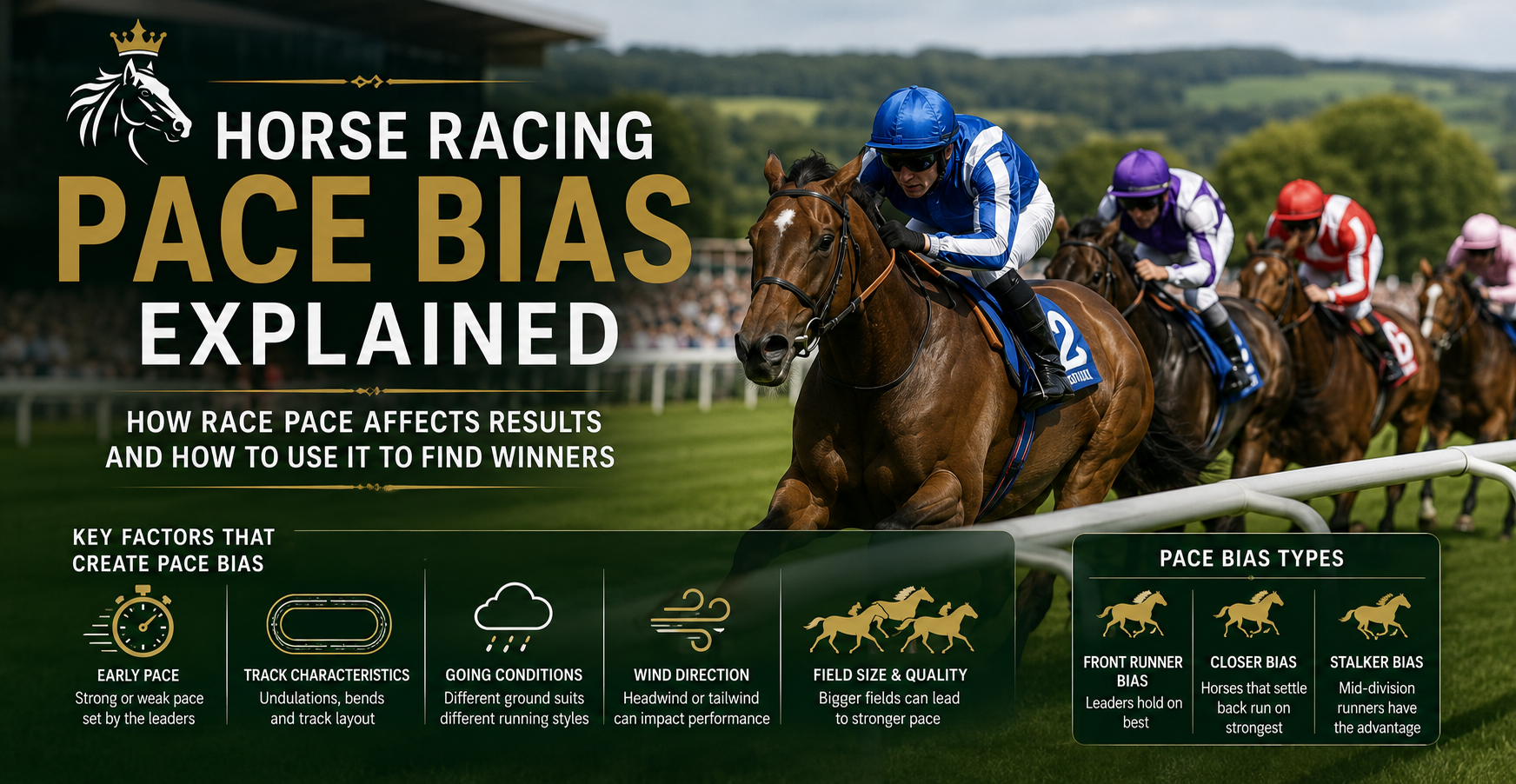
Every horse race develops its own shape long before the runners enter the home straight. Some races are run at a relentless gallop from the start, while others become tactical affairs where the pace only increases in the closing stages. Understanding how these different race scenarios affect individual horses is known as pace bias, and it has become one of the most valuable tools used by professional bettors.
While many punters focus on form, ratings and jockey bookings, experienced race analysts also study how a race is likely to unfold. Knowing which horses prefer to lead, which are happiest tracking the pace and which are usually held up at the rear can provide valuable clues before the stalls even open.
Pace bias should never be viewed in isolation. It works alongside factors such as the draw, the race distance, the course layout and the going to build a much clearer picture of how a contest is likely to develop. When used correctly, pace analysis can help identify horses that are perfectly suited to the expected race shape, while also highlighting favourites that may struggle if the pace does not suit their running style.
This guide explains everything you need to know about pace bias, how it works and how to use it to improve your betting decisions.
What Is Pace Bias?
Pace bias describes the advantage or disadvantage certain running styles have under particular race conditions.
Every horse has a preferred way of racing. Some naturally break quickly from the stalls and attempt to lead from the front. Others settle behind the leaders before making their challenge late, while some are happiest being held up at the back of the field before producing one strong finishing run.
Different racecourses, distances and race conditions reward different tactics.
A slowly run race often benefits horses racing prominently because there is little opportunity for those held up to make up ground. Conversely, a strongly run race can suit horses coming from behind as the early leaders tire in the closing stages.
Understanding which scenario is most likely before the race begins is one of the key skills of successful bettors.
The Four Main Running Styles
Most horses can be grouped into one of four running styles.
Front-Runners
Front-runners attempt to lead immediately after the start and control the pace throughout the race.
These horses often perform best when allowed to dictate their own fractions without pressure from rivals. On certain racecourses, particularly those with tight bends, front-runners can prove extremely difficult to catch.
Advantages include:
- Clear sight of every obstacle.
- Avoiding traffic problems.
- Setting a comfortable rhythm.
- Saving ground around bends.
The main disadvantage is using too much energy early, leaving little for the finish if challenged.
Prominent Racers
Prominent racers sit just behind the leaders before making their move in the closing stages.
This is often regarded as one of the most versatile running styles because it combines tactical flexibility with a relatively trouble-free passage.
Many top-class horses adopt this approach because it allows jockeys to respond to changing race conditions.
Midfield Horses
Midfield runners usually settle in the middle of the pack before gradually improving their position.
These horses require races to develop evenly and often rely on finding clear gaps when making their challenge.
Hold-Up Horses
Hold-up horses are deliberately restrained towards the rear before producing one late run.
When races are run at a strong pace, this tactic can be extremely effective because the early leaders begin to tire.
However, in slowly run contests they often leave themselves with too much ground to make up.
Why Pace Bias Matters
Many races are won not by the best horse, but by the horse enjoying the most suitable race conditions.
Imagine a six-runner race where only one horse likes to lead. That runner may secure an uncontested advantage and dictate the pace exactly as its jockey wishes.
Now imagine another race featuring six habitual front-runners.
Instead of enjoying an easy lead, they may force each other into a speed battle that leaves them vulnerable to horses finishing strongly from behind.
The pace of the race changes everything.
Understanding these likely scenarios before betting provides an edge that many casual punters overlook.
Pace Bias and Draw Bias Work Together
One of the biggest mistakes bettors make is analysing pace and draw separately.
In reality, they are closely connected.
A front-runner drawn low around Chester is often in an ideal position to secure the rail before the first bend.
The same horse drawn widest may have to work much harder early, reducing its chance of lasting home.
Likewise, a hold-up horse drawn wide may suffer very little disadvantage because it is likely to be dropped in towards the rear anyway.
This is why serious race analysis should always combine Horse Racing Draw with pace analysis rather than treating them as separate subjects.
Which Racecourses Favour Front-Runners?
Certain British racecourses consistently reward horses racing prominently.
| Racecourse | Front Runner Advantage | Reason |
|---|---|---|
| Chester | Very Strong | Tight bends make leaders difficult to catch |
| Beverley | Strong | Sharp track rewards early position |
| Catterick | Strong | Short run to bends |
| Pontefract | Moderate | Tactical races often favour leaders |
| Lingfield (AW) | Moderate | First bend arrives quickly |
| Kempton (AW) | Moderate | Inside position valuable around bends |
By contrast, wide galloping tracks such as Newbury often give hold-up horses more opportunity to build momentum.
Which Racecourses Suit Hold-Up Horses?
Some courses naturally allow stronger finishers to come into contention.
| Racecourse | Hold-Up Advantage | Reason |
|---|---|---|
| Newbury | Strong | Long straight |
| Doncaster | Strong | Wide galloping layout |
| York | Moderate | Fair straight course |
| Newcastle | Moderate | Long home straight |
| Haydock | Moderate | Leaders often tire in testing ground |
These trends are not fixed rules but useful guides when analysing races.
How to Read a Pace Map
Modern racecards frequently include pace maps showing where each horse is expected to race during the early stages.
These are based on historical running styles and recent performances.
A pace map helps answer questions such as:
- Who will lead?
- Will there be a contested pace?
- Could the race become tactical?
- Which horses are likely to enjoy the ideal position?
Understanding pace maps is one of the easiest ways to improve your race analysis alongside How to Read a Racecard.
Common Pace Scenarios and What They Mean
One of the biggest advantages of studying pace bias is that it allows you to predict how a race is likely to unfold before the runners even leave the stalls.
While every race is different, most contests fall into one of a handful of common pace scenarios.
One Clear Front-Runner
When only one horse likes to lead, it often enjoys a tactical advantage.
Without pressure from rivals, the jockey can dictate the pace, conserve energy and control the race. This situation frequently produces front-running winners, particularly around sharp tracks where it is difficult for horses to come from behind.
These races deserve close attention because bookmakers do not always fully account for the advantage of an uncontested lead.
Several Front-Runners
If three or four horses all prefer to lead, the race can become much more demanding.
Each jockey wants to secure a prominent position, resulting in a faster early gallop. Horses that expend too much energy during the opening stages often weaken approaching the finish, creating ideal conditions for runners held just behind the pace.
This is why a horse’s preferred running style should always be considered alongside the likely pace scenario rather than in isolation.
Slowly Run Races
Small fields often develop into tactical contests.
Instead of racing at a strong gallop, jockeys may deliberately slow the pace before sprinting for home during the closing furlongs.
These races usually favour horses racing prominently because those held up at the rear simply have too much ground to make up once the pace increases.
Strongly Run Races
Competitive handicaps often produce the opposite effect.
A fast early gallop stretches the field and places greater emphasis on stamina. Horses that settle well before producing one sustained run frequently benefit, while those forcing the pace from the outset may become vulnerable during the closing stages.
Pace Bias by Race Distance
Running style becomes more or less important depending on the distance of the race.
Five Furlongs
Early speed is vital.
With so little time to recover, horses that miss the break or become trapped behind rivals rarely have an opportunity to make up lost ground.
Six and Seven Furlongs
Pace remains extremely important, although jockeys have slightly more time to establish position before the race develops.
Tracks with an early bend continue to reward horses that race prominently.
One Mile
The importance of pace becomes more dependent on the racecourse.
At tighter circuits, securing a good early position remains beneficial. On wider galloping tracks, stronger finishers often enjoy more opportunity to challenge.
Staying Races
Over longer distances, stamina generally becomes more important than outright early speed.
Although pace still influences the race shape, jockeys have much longer to adjust their position before entering the closing stages.
Pace Bias and Different Going Conditions
Ground conditions can dramatically influence how pace develops.
Firm Ground
Fast ground usually allows front-runners to maintain their momentum more easily.
If a leader secures an uncontested advantage, rivals often struggle to reel them in.
Good Ground
On good ground, pace bias tends to reflect the natural characteristics of the racecourse.
Soft and Heavy Ground
Testing conditions place far greater demands on stamina.
Horses forcing the pace too aggressively often tire approaching the finish, creating opportunities for runners that have been ridden patiently.
This is why it is important to combine pace analysis with the latest going reports rather than relying solely on historical trends.
How Professional Punters Use Pace Bias
Professional bettors rarely analyse races by looking only at form figures.
Instead, they build a picture of how the race is likely to unfold before deciding whether the market has underestimated a particular runner.
A typical analysis includes:
- Studying previous running styles.
- Identifying likely front-runners.
- Comparing pace with the draw.
- Assessing the race distance.
- Checking the latest going report.
- Reviewing previous course form.
- Watching recent race replays.
Rather than asking which horse is best, experienced bettors often ask which horse is most likely to enjoy today’s race conditions.
This subtle difference frequently identifies value that casual punters overlook.
Common Pace Bias Mistakes
Understanding pace bias is valuable, but there are several mistakes that regularly catch bettors out.
Assuming Every Front-Runner Will Lead
Some horses are naturally quick from the stalls, while others only lead because there has been little competition in previous races.
Always consider whether today’s field contains several runners with similar early speed.
Ignoring the Draw
Running style and stall position work together.
A front-runner drawn widest around a sharp bend may have to use considerable energy to secure the lead, while the same horse drawn low may enjoy a much easier passage.
This is why Horse Racing Draw and pace analysis should always be used together.
Ignoring Course Characteristics
Every racecourse places different demands on horses.
A front-running style that works perfectly at Chester may be much less effective at Newbury.
Reading our British Racecourse Guides helps build a much clearer understanding of how each venue influences race tactics.
Following Statistics Blindly
Historical pace data is useful, but racing constantly evolves.
Changes to rail positions, going conditions, jockey tactics and field quality all influence how races develop.
Treat statistics as guides rather than fixed rules.
Pace Bias Checklist
Before placing your next bet, ask yourself these questions.
✓ Which horse is most likely to lead?
✓ Is there likely to be a contested pace?
✓ Does today’s racecourse favour front-runners or hold-up horses?
✓ Has the draw helped or hindered the likely pace-setters?
✓ Will today’s going favour early speed or stronger finishers?
✓ Is the betting market fully accounting for the expected race shape?
Working through this checklist takes only a few minutes but often reveals betting opportunities that are easy to miss.
Related Guides
To develop a more complete understanding of horse racing analysis, we recommend reading:
- Horse Racing Betting Odds Explained
- Horse Racing Terms Explained
- Flat Racing vs Jump Racing
- Best Horse Racing Betting Sites
- Every British Racecourse Guide
Understanding pace bias is only one part of successful betting. Combining it with form analysis, draw bias, course characteristics and race tactics will give you a far stronger foundation for making informed betting decisions throughout the Flat racing season.
Pace Bias by Racecourse
Although pace bias exists at every racecourse, its influence varies considerably depending on the track layout, the length of the straight, the position of bends and the typical field sizes. Understanding these differences helps explain why a front-running performance at one venue may be impossible to repeat elsewhere.
Chester
Chester is widely regarded as Britain’s strongest front-running course. The tight left-handed circuit, combined with the extremely short run to the first bend over many distances, makes early position crucial. Horses that secure the lead from a low draw often dictate the race from the front and prove difficult to pass.
Hold-up horses regularly encounter traffic problems around the bends and often leave themselves with too much ground to make up in the short home straight.
For more information about the track, read our Chester Racecourse Guide.
Beverley
Beverley is another course where racing prominently often proves advantageous, particularly over sprint distances. The uphill finish rewards tough horses that can maintain their momentum after securing a good early position.
A horse that breaks quickly and controls the pace is frequently difficult to reel in.
Goodwood
Goodwood presents a different challenge. Its undulating layout and sweeping bends reward well-balanced horses and experienced jockeys. Pace still matters, but so does positioning throughout the race.
Leaders can prove difficult to catch if left alone, although an overly aggressive early gallop often sets the race up for stronger finishers.
See our Goodwood Racecourse Guide for more on how the course rides.
York
York is considered one of Britain’s fairest racecourses. Its wide, galloping nature allows horses from various running styles to win, provided they enjoy the right race conditions.
Rather than favouring one style consistently, York rewards horses that race efficiently and are suited to the pace of the contest.
Newbury
Newbury’s long straight gives hold-up horses every opportunity to challenge late. Unlike tighter tracks, leaders cannot rely on cornering advantages and often face sustained pressure during the final furlong.
This makes Newbury one of the better venues for patiently ridden horses in strongly run races.
Kempton Park
Kempton’s all-weather circuit often rewards horses that secure a prominent early position, particularly over shorter trips where the first bend arrives quickly.
Front-runners can prove difficult to catch if allowed an uncontested lead, although races run at an excessive pace often favour those sitting just behind the leaders.
Lingfield Park
Lingfield combines draw bias with pace bias. Horses that break quickly from an inside stall frequently secure an ideal position entering the first bend, making life difficult for runners caught wide.
Studying both pace and draw together is particularly important here.
Wolverhampton
Wolverhampton’s Tapeta surface generally produces fair racing, although prominent racers often enjoy a tactical advantage over shorter distances.
The relatively short straight means horses need to begin their challenge earlier than they might at more galloping tracks.
Newcastle
Newcastle’s famous straight mile and long home straight allow races to develop naturally.
Unlike Chester or Lingfield, hold-up horses have plenty of time to produce their challenge, making Newcastle one of Britain’s fairest tracks from a pace perspective.
Read our Newcastle Racecourse Guide to learn more.
Pace Bias vs Draw Bias
Many bettors confuse pace bias with draw bias, but they measure two completely different aspects of a race.
| Draw Bias | Pace Bias |
|---|---|
| Based on a horse’s stall position | Based on a horse’s preferred running style |
| Determined before the race starts | Develops once the race begins |
| Influenced mainly by course layout | Influenced by tactics, field size and course layout |
| Particularly important in sprints | Important over almost every distance |
| Cannot be changed | Can change depending on jockey tactics |
The two factors work best when analysed together.
For example, a front-runner drawn low around Chester is often ideally placed to take advantage of both pace and draw bias. Meanwhile, a hold-up horse drawn wide at Newbury may suffer little disadvantage because the long straight gives it time to recover.
How to Read a Pace Map
Modern racecards often include pace maps based on each horse’s previous running style.
A simple pace map may look like this:
| Horse | Likely Running Style |
|---|---|
| Horse A | Front-runner |
| Horse B | Prominent |
| Horse C | Midfield |
| Horse D | Held up |
| Horse E | Front-runner |
This immediately tells you the race could be run at a strong pace, as two horses are likely to contest the lead.
If the map instead showed just one front-runner and several hold-up horses, the likely outcome would be a slower early pace, potentially giving the leader a tactical advantage.
Although pace maps are not always perfect, they provide an excellent starting point when assessing race tactics.
Three Practical Examples
Example One: Uncontested Leader
A six-runner handicap contains just one recognised front-runner.
The horse breaks well, secures an easy lead and settles into a comfortable rhythm. Without pressure from behind, it conserves enough energy to quicken again in the closing stages and wins comfortably.
Example Two: Pace Collapse
An eight-runner sprint features four habitual front-runners.
All four jockeys compete for the lead during the opening furlongs, creating a very fast pace. By the final furlong they begin to tire, allowing a patiently ridden hold-up horse to sweep past them all.
Example Three: Tactical Race
A five-runner Listed race develops into a tactical contest with no horse wanting to force the pace.
The leader controls steady fractions before sprinting clear approaching the final furlong. The horses held up at the rear simply cannot accelerate quickly enough to catch the leader.
These scenarios occur every week throughout the Flat season.
Pace Bias Myths
Front-runners always win
No. They simply perform better under certain conditions. A contested lead can completely remove their advantage.
Hold-up horses always need luck
Not necessarily. At galloping tracks with long straights, they often enjoy plenty of racing room.
Pace only matters in handicaps
Every race has a pace. Pattern races, maidens and novice contests are all influenced by race tactics.
Historical pace statistics guarantee future results
They do not. Going, weather, rail movements and jockey tactics all change from meeting to meeting.
Expert Betting Checklist
Before placing your next bet, ask yourself these questions.
- Is there one obvious front-runner?
- Could several horses contest the lead?
- Which running style normally succeeds at today’s racecourse?
- Does the draw help or hinder the likely pace-setters?
- Will today’s going make it harder for front-runners to last home?
- Does the market appear to have overlooked the likely race shape?
- Have I watched recent races involving today’s runners?
Working through these questions only takes a few minutes but often highlights betting opportunities that are missed by the wider market.
Key Takeaways
- Pace bias explains how different running styles perform under different race conditions.
- Front-runners often thrive on sharp tracks with tight bends, while hold-up horses are better suited to galloping courses with long straights.
- Pace should always be analysed alongside draw bias, the going and course layout.
- Pace maps provide an excellent way of predicting how a race is likely to unfold.
- Understanding race tactics can help identify value before the betting market fully reacts.
Conclusion
Pace bias is one of the most valuable yet overlooked aspects of horse race analysis. While ratings, form and jockey bookings remain important, understanding how a race is likely to develop often provides the missing piece of the puzzle.
The best bettors rarely rely on a single factor. Instead, they combine pace analysis with draw bias, racecourse characteristics, recent form and market movements to build a complete picture before placing a bet.
The more races you watch, the easier it becomes to recognise recurring patterns. Over time, you’ll begin to spot when a lone front-runner has been underestimated, when a pace collapse is likely, or when a patiently ridden horse is perfectly suited to today’s conditions.