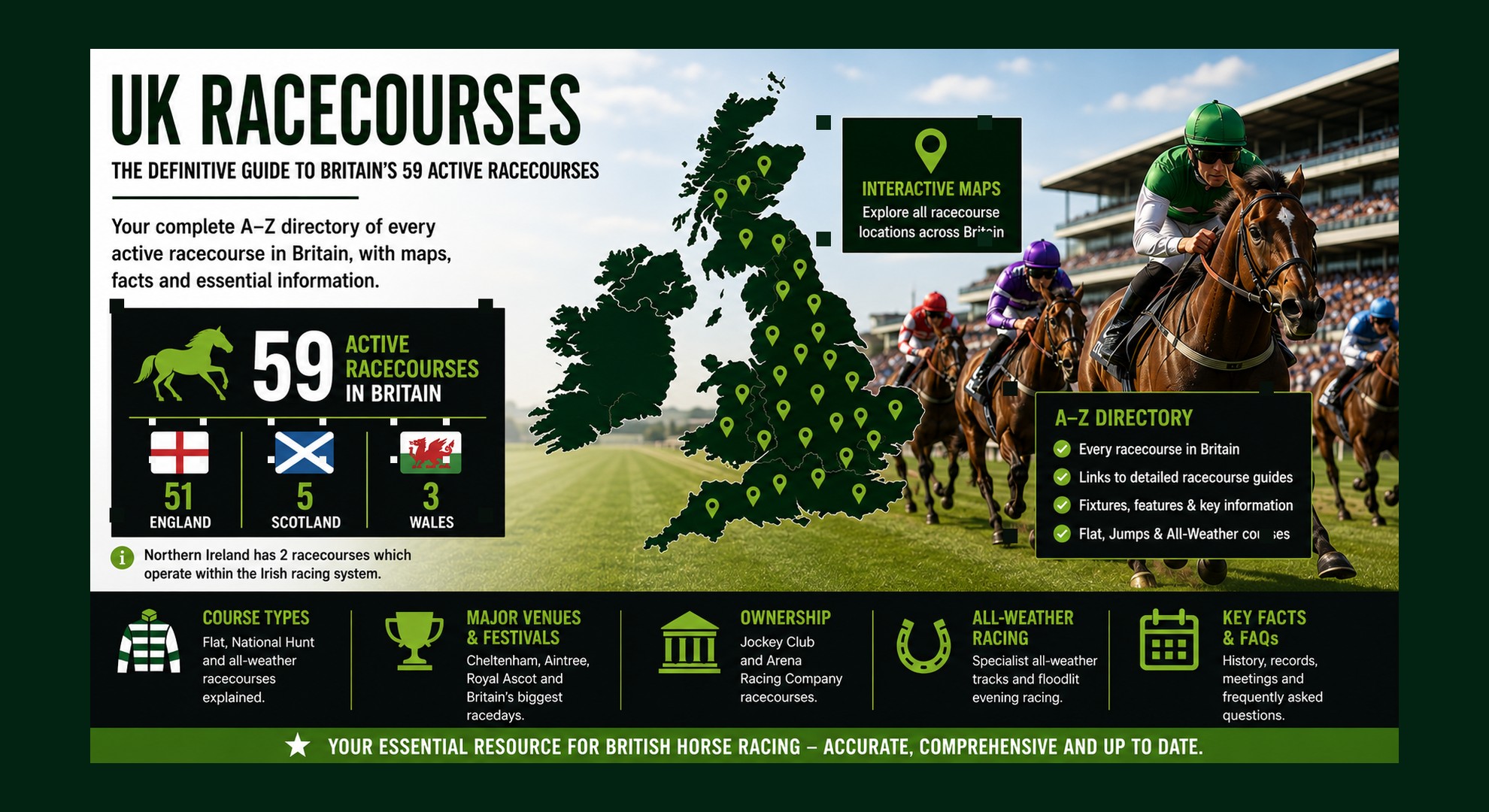
There are 59 active racecourses in Britain, spread across England, Scotland and Wales. British Racecourses has personally visited racecourses across the country to provide first-hand information about the tracks, facilities, major meetings and what makes each venue different.
This page provides our definitive A-Z list of UK racecourses, with direct links to our individual racecourse guides.
Whether you are looking for a specific course, checking how many racecourses there are in Britain or comparing Flat, jumps and all-weather venues, you can use the directory below to find the relevant track.
For help choosing where to go racing rather than searching for a specific venue, visit our broader British racecourses guide. You can also see when each venue races in our UK horse racing fixtures.
Complete A-Z List of UK Racecourses
The 59 active racecourses in Britain are listed alphabetically below:
- Aintree Racecourse is a renowned jumps venue in Merseyside, best known for hosting the Grand National.
- Ascot Racecourse stages both flat and jumps fixtures in Berkshire and is home to Royal Ascot.
- Ayr Racecourse holds major flat and jumps meetings in Scotland, including the Scottish Grand National.
- Bangor-on-Dee Racecourse is a picturesque jumps-only track in North Wales.
- Bath Racecourse operates as a flat-only venue set high above the city of Bath in Somerset.
- Beverley Racecourse offers summer flat racing in the East Riding of Yorkshire.
- Brighton Racecourse provides seaside flat racing on the South Downs in East Sussex.
- Carlisle Racecourse features both jumps and flat action in Cumbria throughout the year.
- Cartmel Racecourse is one of Britain’s most scenic jumps tracks, located in Cumbria.
- Catterick Racecourse stages flat and jumps racing near Richmond in North Yorkshire.
- Chelmsford City Racecourse is a modern all-weather flat track situated in Essex.
- Cheltenham Racecourse is the home of National Hunt racing in Gloucestershire.
- Chepstow Racecourse hosts major flat and jumps fixtures in South Wales, including the Welsh Grand National.
- Chester Racecourse is England’s oldest racecourse and a popular flat venue in Cheshire.
- Doncaster Racecourse runs top-level flat and jumps meetings in South Yorkshire, including the St Leger.
- Epsom Racecourse is a historic flat racing venue in Surrey, famous for The Derby.
- Exeter Racecourse is a leading jumps track set high on Haldon Hill in Devon.
- Fakenham Racecourse is a friendly jumps venue located in rural Norfolk.
- Ffos Las Racecourse offers both flat and jumps meetings near Llanelli in South Wales.
- Fontwell Park Racecourse is a unique figure-of-eight jumps track in West Sussex.
- Goodwood Racecourse delivers high-class flat racing in West Sussex, including the Glorious Goodwood Festival.
- Great Yarmouth Racecourse is a seaside flat racing venue in Norfolk.
- Hamilton Park Racecourse provides flat racing entertainment in South Lanarkshire, Scotland.
- Haydock Park Racecourse stages both flat and jumps events in Merseyside, known for the Betfair Chase.
- Hereford Racecourse is a National Hunt track offering winter jumps fixtures in Herefordshire.
- Hexham Racecourse is Britain’s most northerly jumps course, based in Northumberland.
- Huntingdon Racecourse hosts popular jumps racing near Cambridge in Cambridgeshire.
- Kelso Racecourse is a scenic Scottish Borders jumps venue with a loyal following.
- Kempton Park Racecourse runs flat and jumps meetings in Surrey, including the King George VI Chase.
- Leicester Racecourse stages both flat and jumps fixtures in Oadby, Leicestershire.
- Lingfield Park Racecourse offers flat and jumps racing in Surrey with an all-weather surface.
- Ludlow Racecourse is a traditional jumps track set in the countryside of Shropshire.
- Market Rasen Racecourse specialises in summer jumps racing in Lincolnshire.
- Musselburgh Racecourse provides year-round flat racing near Edinburgh in East Lothian.
- Newbury Racecourse stages high-quality flat and jumps meetings in Berkshire.
- Newcastle Racecourse runs flat and jumps races in Tyne and Wear with an all-weather track.
- Newmarket Racecourse is the headquarters of British flat racing in Suffolk.
- Newton Abbot Racecourse focuses on summer jumps meetings in Devon.
- Nottingham Racecourse is a flat racing venue based at Colwick Park in Nottinghamshire.
- Perth Racecourse is a popular jumps venue in Perthshire, Scotland.
- Plumpton Racecourse offers intimate jumps racing in East Sussex.
- Pontefract Racecourse hosts summer flat meetings in West Yorkshire.
- Redcar Racecourse stages flat racing on the Yorkshire coast in North Yorkshire.
- Ripon Racecourse is known as the Garden Racecourse and offers flat racing in North Yorkshire.
- Salisbury Racecourse provides flat racing with a historic backdrop in Wiltshire.
- Sandown Park Racecourse stages both flat and jumps racing in Esher, Surrey.
- Sedgefield Racecourse is a friendly jumps venue in County Durham.
- Southwell Racecourse runs both flat and jumps fixtures in Nottinghamshire, featuring an all-weather track.
- Stratford Racecourse is a popular summer jumps venue in Warwickshire.
- Taunton Racecourse stages National Hunt racing in Somerset.
- Thirsk Racecourse offers flat racing during the summer months in North Yorkshire.
- Uttoxeter Racecourse hosts jumps fixtures in Staffordshire, including the Midlands Grand National.
- Warwick Racecourse is one of the oldest jumps venues in the country, located in Warwickshire.
- Wetherby Racecourse focuses on National Hunt racing in West Yorkshire.
- Wincanton Racecourse is a well-supported jumps venue in Somerset.
- Windsor Racecourse provides flat racing beside the River Thames in Berkshire.
- Wolverhampton Racecourse offers flat all-weather racing in the West Midlands.
- Worcester Racecourse stages summer jumps meetings in Worcestershire.
- York Racecourse is a premier flat racing venue in Yorkshire, home to the Ebor Festival.
The UK racecourses A-Z list shows all 59 active racecourses in Britain, covering England, Scotland and Wales.
Northern Ireland is part of the United Kingdom geographically, but racing there operates within the Irish racing system.
How Many Racecourses Are There in the UK?
There are 59 active racecourses in Britain.
The total covers racecourses in England, Scotland and Wales that stage racing under the governance of the British Horseracing Authority.
The current geographical split is:
| Country | Active Racecourses |
|---|---|
| England | 51 |
| Scotland | 5 |
| Wales | 3 |
| Total | 59 |
Northern Ireland is part of the United Kingdom geographically, but racing there operates within the Irish racing system. We therefore cover those tracks alongside the Republic of Ireland in our Irish racecourses guide.
Map of UK Racecourses
Our UK racecourses map shows how the 59 active British tracks are distributed across England, Scotland and Wales.
British racing stretches from Perth in Scotland to Newton Abbot in Devon, with racecourses ranging from major metropolitan venues to smaller rural tracks.
Use the map alongside the A-Z directory above to locate a particular course.
If location rather than a specific racecourse is your starting point, our
British racecourses guide provides more help with choosing where to go racing.
Here is a map of UK racecourses:
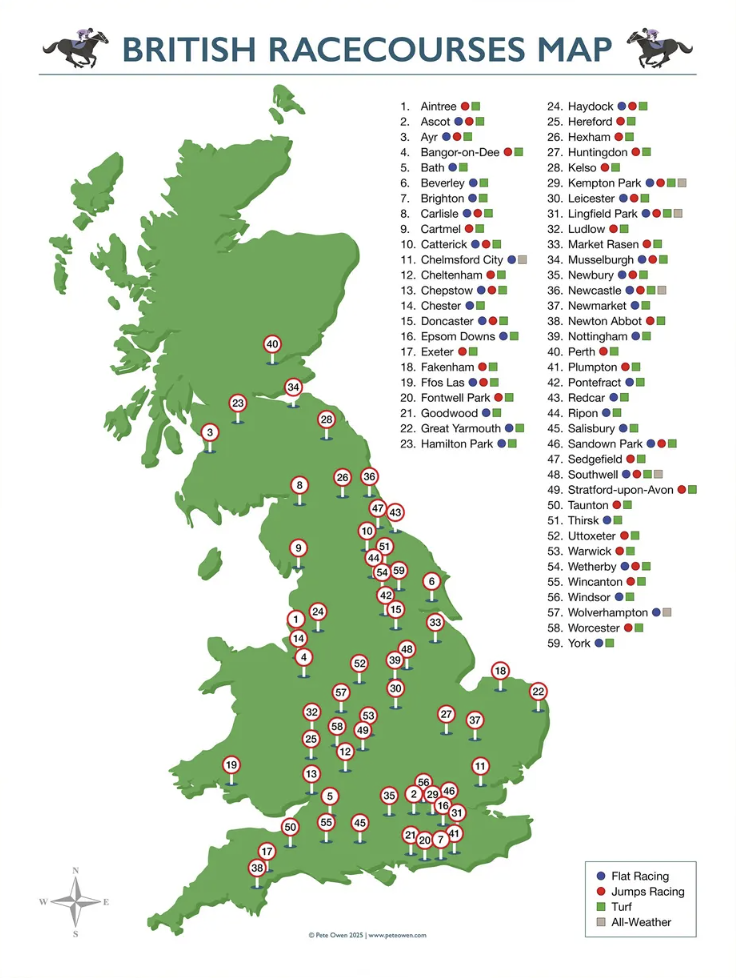
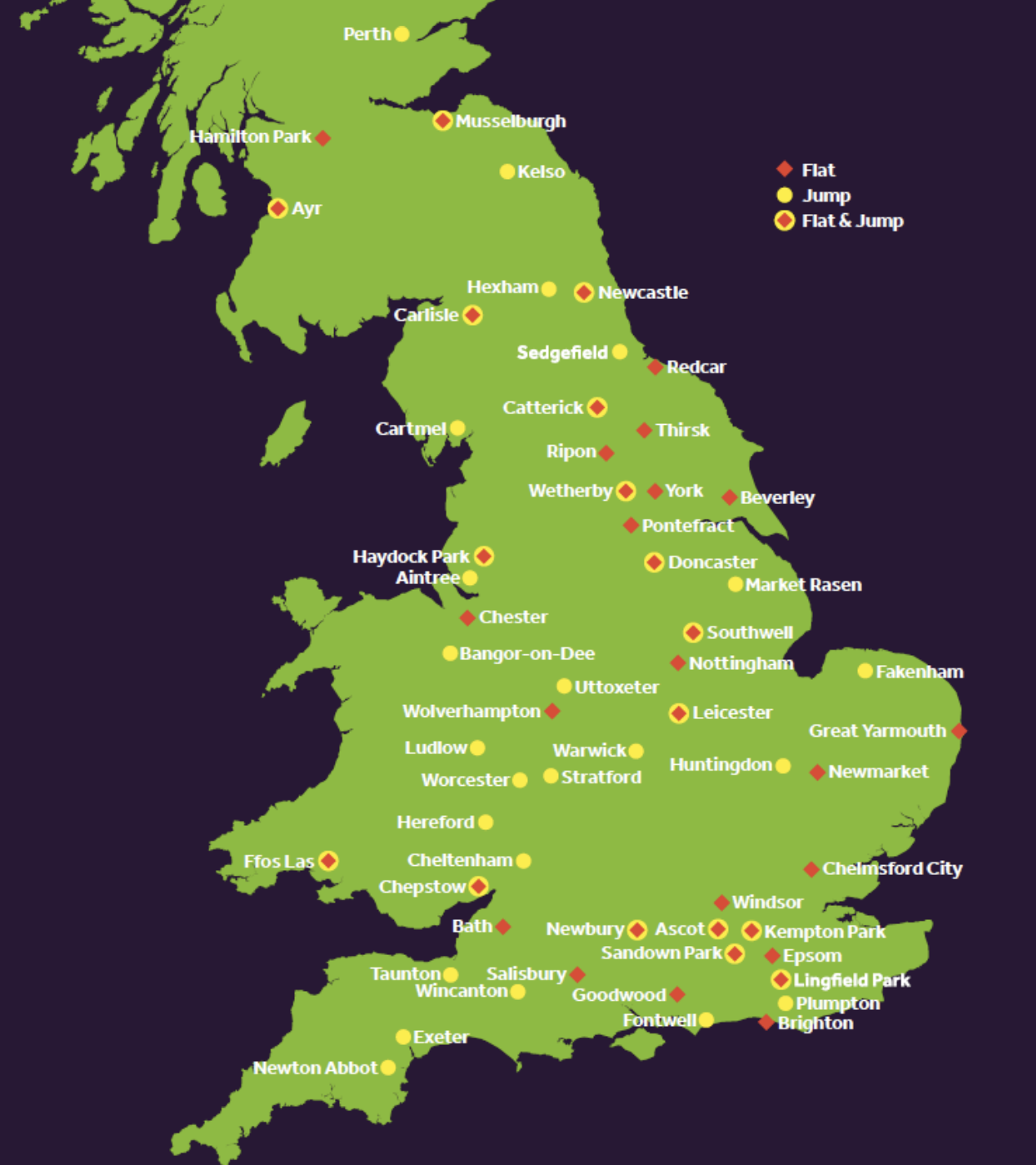
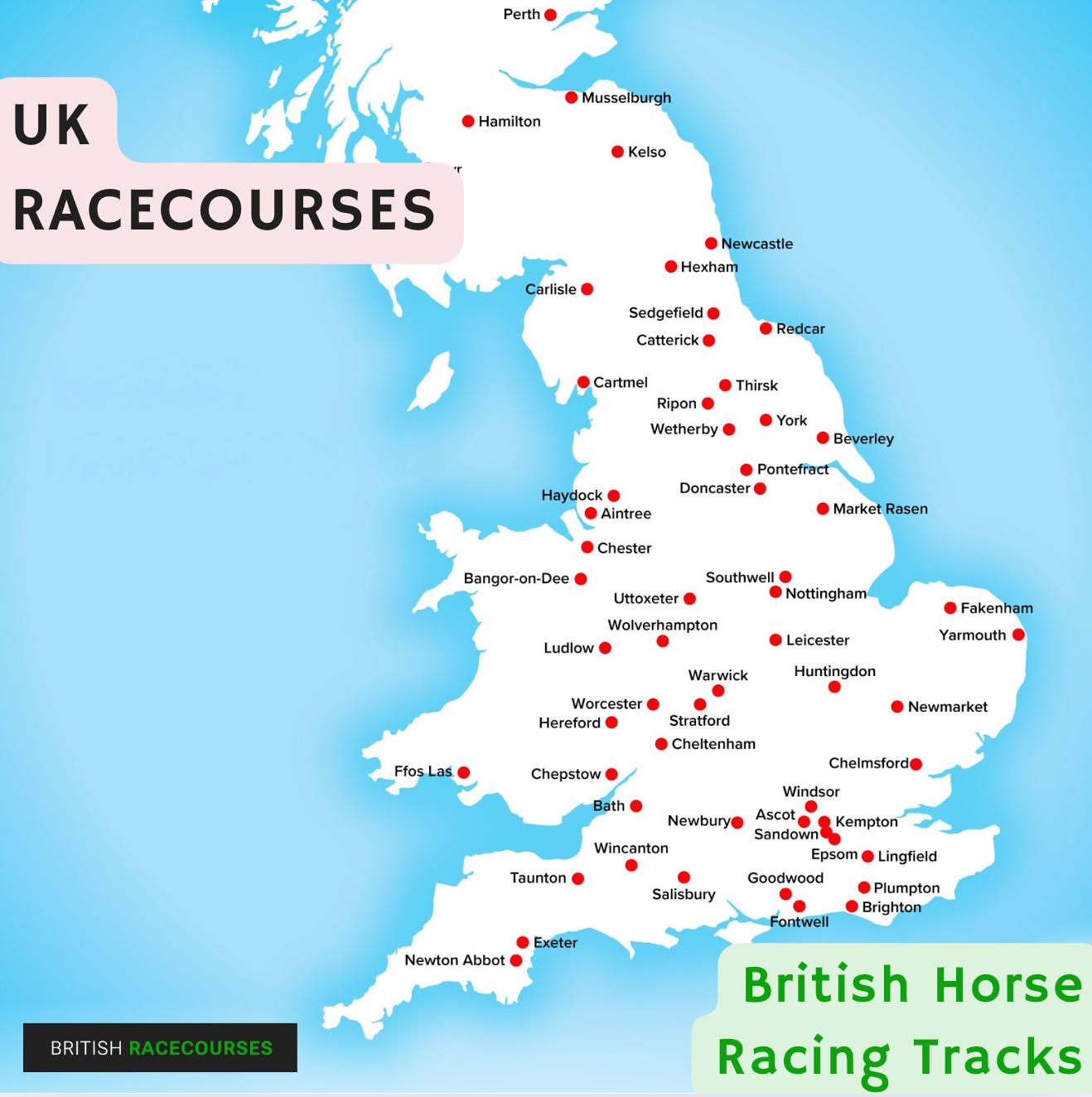
The UK racecourses maps allow you to visualise the location of all horse racing venues throughout the United Kingdom.
UK Racecourses by Country
Racecourses in England
England has 51 active racecourses, accounting for the large majority of Britain’s 59 tracks.
They range from major Flat venues such as Ascot, Newmarket, York, Goodwood and Epsom to leading National Hunt courses including Cheltenham, Aintree and Kempton.
England also contains all-weather tracks, small independent venues and courses staging both Flat and jumps racing.
Our individual course pages provide more detailed information about each venue, including course characteristics, major races, travel information and facilities.
Racecourses in Scotland
Scotland has five active racecourses:
- Ayr
- Hamilton Park
- Kelso
- Musselburgh
- Perth
Ayr and Musselburgh stage both Flat and jumps racing, Hamilton Park concentrates on Flat racing, while Kelso and Perth are National Hunt venues.
Scottish racing includes major events such as the Scottish Grand National at Ayr alongside a varied programme of Flat and jumps fixtures.
Racecourses in Wales
Wales has three active racecourses:
- Bangor-on-Dee
- Chepstow
- Ffos Las
Bangor-on-Dee is a National Hunt venue, while Chepstow and Ffos Las stage both Flat and jumps racing.
Chepstow hosts the Welsh Grand National and remains one of the most significant racing venues in Wales.
What Types of Racecourses Are There in Britain?
British racecourses can broadly be divided according to the racing they stage.
Flat Racecourses
Flat racing takes place without obstacles and ranges from short sprint races to long-distance staying contests.
Major Flat venues include Newmarket, York, Goodwood, Epsom, Chester and Doncaster.
Course configuration varies considerably. Some tracks are relatively flat and galloping, while others have tight turns, gradients, cambers or pronounced draw effects.
These differences are one reason course form can matter when analysing a race. Our guide to course and distance form explains how previous experience at a particular track can be assessed.
National Hunt Racecourses
National Hunt racing incorporates hurdle races, steeplechases and National Hunt Flat races.
Cheltenham, Aintree, Wincanton, Exeter, Warwick and Wetherby are among Britain’s established jumps venues.
National Hunt tracks can differ substantially in their configuration, fences, gradients and finishing straights. A horse suited to one type of course is not automatically suited to another.
Read our National Hunt horse racing guide for more information about British jumps racing.
Dual-Purpose Racecourses
A number of British racecourses stage both Flat and National Hunt racing.
Examples include Ascot, Haydock, Newbury, Musselburgh and Carlisle.
Some dual-purpose venues use substantially different course configurations for the two codes.
All-Weather Racecourses
Britain has six established all-weather racing venues:
- Chelmsford City
- Kempton
- Lingfield
- Newcastle
- Southwell
- Wolverhampton
All-weather racing allows Flat fixtures to take place throughout the year and provides a very different test from turf racing.
Our all-weather racecourses guide explains the tracks, surfaces and characteristics in more detail.
Which UK racecourses host jumps racing?
Britain has specialist National Hunt racecourses as well as dual-purpose venues that stage jumps racing.
A number of British racecourses stage both Flat and National Hunt racing, including Haydock, Newbury, Carlisle, Musselburgh and others.

British Racecourses provides detailed course maps and fence layouts to help punters understand the challenges each venue presents.
The National Hunt jump racecourses in the UK host some of the best jump races, such as the Grand National, the Cheltenham Gold Cup, and the King George VI Chase.
Which racecourses in the UK offer both flat and jumps racing?
Eighteen mixed courses host both codes of racing, such as Newcastle, Lingfield, Kempton, Haydock, and Ffos Las. These dual-purpose venues run year-round and adapt their turf or all-weather surfaces depending on the season.
What Are the Most Famous Racecourses in Britain?
Britain has some of the best-known racecourses in the world.
Aintree
Aintree is internationally recognised as the home of the Grand National.
Its Grand National course contains distinctive fences and provides a very different test from a conventional steeplechase track.
Ascot
Ascot stages both Flat and jumps racing but is best known internationally for Royal Ascot.
The five-day meeting is one of the centrepieces of the British Flat season.
Cheltenham
Cheltenham is closely associated with elite National Hunt racing.
The Cheltenham Festival includes races such as the
Cheltenham Gold Cup, Champion Hurdle and Queen Mother Champion Chase.
Epsom Downs
Epsom is home to the Derby and Oaks.
Its gradients, cambers and famous Tattenham Corner make it one of the most distinctive Flat racecourses in Britain.
Newmarket
Newmarket is widely regarded as the headquarters of British Flat racing.
Racing takes place on the Rowley Mile and July Course, with major races including the 1,000 Guineas, 2,000 Guineas and July Cup.
York
York is one of Britain’s leading Flat racing venues and hosts the Ebor Festival.
Its major races include the International Stakes, Yorkshire Oaks, Nunthorpe Stakes and Ebor Handicap.
Which UK Racecourses Host the Biggest Racing Festivals?
Many of Britain’s biggest racing festivals are closely associated with a particular racecourse.
Major examples include:
- Cheltenham Festival at Cheltenham
- Grand National Festival at Aintree
- Royal Ascot at Ascot
- Derby Festival at Epsom
- Guineas Festival at Newmarket
- Glorious Goodwood at Goodwood
- Ebor Festival at York
- St Leger Festival at Doncaster
These meetings contain many of the most important Flat and National Hunt races of the season.
Our horse racing fixtures section can be used to find upcoming racing across Britain.
Which Are the Oldest Racecourses in Britain?
Horse racing has taken place at many British venues for centuries.
Chester is generally recognised as the oldest racecourse still operating in Britain, with racing at the Roodee dating back to the 16th century.
Newmarket’s association with racing developed during the 17th century and the town subsequently became the centre of British Flat racing.
Doncaster also has a long racing history and stages the St Leger, the oldest of Britain’s five Classic races.
The history of individual venues is covered in greater detail within our racecourse guides.
Which Racecourses Are Owned by The Jockey Club?
The Jockey Club operates 15 British racecourses:
- Aintree
- Carlisle
- Cheltenham
- Epsom Downs
- Exeter
- Haydock Park
- Huntingdon
- Kempton Park
- Market Rasen
- Newmarket
- Nottingham
- Sandown Park
- Warwick
- Wincanton
Newmarket incorporates two separate racing tracks, the Rowley Mile and July Course, within the Jockey Club’s Newmarket operation.
The Jockey Club portfolio contains many of Britain’s most important Flat and National Hunt fixtures, including the Derby, Grand National, Cheltenham Festival and the Guineas.
Arena Racing Company (ARC) owns 16 racecourses, including Doncaster, Lingfield, Newcastle, and Wolverhampton. ARC also runs the all-weather championships, enhancing winter flat racing options across Britain.
What is the difference between a flat racecourse and a jumps racecourse?
Flat racecourses have no obstacles, focusing purely on speed and stamina.
Jumps (National Hunt) courses include hurdles and fences, testing agility and endurance.
Many British venues, such as Haydock and Kempton, are designed to switch between both disciplines throughout the year.
How Many Race Meetings Take Place in Britain?
The British racing calendar contains well over 1,000 fixtures each year, with racing taking place across the Flat, National Hunt and all-weather programmes.
The exact number varies between seasons.
Our 2026 horse racing fixtures page provides more information about the current British racing calendar.
Which UK Racecourses Have All-Weather Tracks?
The six British racecourses with established all-weather Flat tracks are:
- Chelmsford City
- Kempton
- Lingfield
- Newcastle
- Southwell
- Wolverhampton
The surfaces and course layouts are not identical, so all-weather form should not automatically be treated as interchangeable between venues.
Read our all-weather racecourses guide for a detailed comparison.
Which UK Racecourses Stage Evening Racing?
Evening racing forms an important part of the British fixture programme, particularly during the summer and on the all-weather.
Floodlit all-weather venues such as Chelmsford City, Kempton, Newcastle and Wolverhampton regularly stage racing after traditional daytime hours.
Other racecourses also stage evening fixtures during periods when natural daylight permits.
Always check the individual fixture before travelling because race times change throughout the season.
Which UK Racecourse Should I Visit?
The best racecourse to visit depends on the type of racing and experience you want.
A racing fan interested primarily in elite National Hunt racing may prioritise Cheltenham or Aintree, while someone interested in top-class Flat racing could consider Ascot, York, Goodwood or Newmarket.
Smaller tracks can provide a completely different experience, often allowing racegoers to get closer to the action.
Choosing and comparing racecourses is deliberately not the main purpose of this A-Z directory. We cover that subject in much greater detail in our
complete guide to British racecourses.
UK Racecourses FAQs
How many UK racecourses are there?
There are 59 active racecourses in Britain, covering England, Scotland and Wales.
How many racecourses are there in England?
England has 51 active racecourses.
How many racecourses are there in Scotland?
Scotland has five active racecourses: Ayr, Hamilton Park, Kelso, Musselburgh and Perth.
How many racecourses are there in Wales?
Wales has three active racecourses: Bangor-on-Dee, Chepstow and Ffos Las.
Does Northern Ireland have racecourses?
Yes. Northern Ireland has Down Royal and Downpatrick. However, racing in Northern Ireland operates as part of the Irish racing system, so British Racecourses covers these venues within our Irish racecourses section rather than the 59 BHA racecourses in Britain.
What is the oldest racecourse in Britain?
Chester is generally recognised as Britain’s oldest racecourse still in operation, with racing at the Roodee dating to 1539.
What is the newest racecourse in Britain?
Ffos Las is Britain’s newest active racecourse. The Carmarthenshire venue opened in 2009.
Which racecourses stage all-weather racing?
Chelmsford City, Kempton, Lingfield, Newcastle, Southwell and Wolverhampton have established all-weather Flat tracks.
Which racecourse hosts the Grand National?
Aintree Racecourse in Merseyside hosts the Grand National.
Which racecourse hosts the Cheltenham Gold Cup?
Cheltenham Racecourse hosts the Cheltenham Gold Cup during the Cheltenham Festival.
Where is the Derby run?
The Derby is run at Epsom Downs Racecourse in Surrey.
Where is Royal Ascot held?
Royal Ascot takes place at Ascot Racecourse in Berkshire.
Are all British racecourses the same shape?
No. British racecourses differ considerably. Courses can be left-handed or right-handed, flat or undulating, tight or galloping, and some contain straight courses or specialist chutes. These differences can influence how races develop.
Where can I find details about an individual racecourse?
Use the A-Z directory at the top of this page. Each racecourse name links to a dedicated British Racecourses guide covering the track, racing, major meetings and practical information.
Summary
There are 59 active racecourses in Britain, comprising 51 in England, five in Scotland and three in Wales.
This page serves as the British Racecourses’ definitive A-Z directory, allowing you to find a specific racecourse and move directly to its detailed guide.
Britain’s tracks range from major international venues such as Ascot, Cheltenham, Aintree, Newmarket and York to smaller regional courses with their own distinctive layouts and racing programmes. They include Flat, National Hunt, dual-purpose and all-weather venues.
If you already know which course you want, use the A-Z list above. If you are deciding which racecourse to visit, comparing venues or looking for racing near you, continue to our complete British racecourses guide.