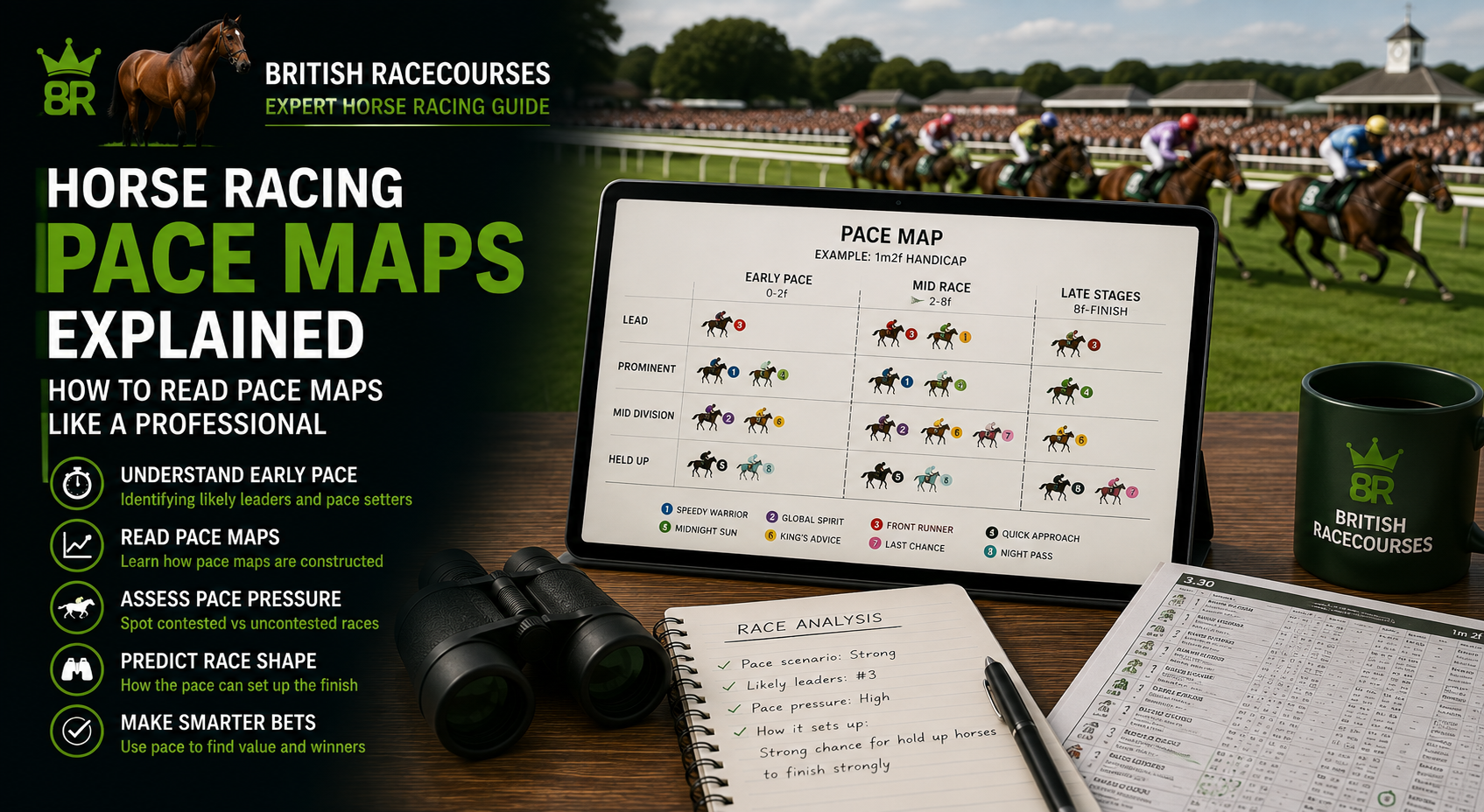
Understanding how a race is likely to unfold before the runners leave the stalls is one of the biggest advantages a bettor can have. While many people focus solely on recent form or the betting market, experienced punters spend just as much time studying race tactics. They want to know which horses will lead, which will be held up and how those different running styles are likely to shape the contest.
This is where pace maps become invaluable.
A pace map is a visual prediction of how each horse is expected to race during the early stages. By analysing previous performances, running styles and the make-up of the field, it becomes possible to build a picture of where every runner is likely to be positioned. That information can reveal tactical advantages which aren’t immediately obvious from a standard racecard.
Pace maps should never be viewed in isolation. Their real strength comes when they are combined with other forms of race analysis, including How to Read Horse Racing Form Like a Pro, Horse Racing Draw, Horse Racing Goings, Top Speed Ratings and How to Analyse a Horse Race Like a Professional. Together, these factors allow you to build a much clearer understanding of how a race is likely to develop.
Many races are effectively won before the field reaches the home straight. A lone front-runner allowed to dictate the pace can prove extremely difficult to catch, while several habitual leaders competing for the same position may set the race up perfectly for a patiently ridden closer. Learning to recognise these scenarios is one of the biggest steps towards analysing races like a professional.
What Is a Horse Racing Pace Map?
A pace map is a prediction of where each horse will be positioned during the opening stages of a race based on its previous running style.
Rather than ranking horses by ability, a pace map focuses on tactics.
Questions it aims to answer include:
- Which horse is most likely to lead?
- Will the early pace be fast or steady?
- Which runners are likely to race prominently?
- Which horses normally sit in midfield?
- Which runners prefer to be held up for one late challenge?
By answering these questions before the race begins, bettors can anticipate how the contest is likely to unfold rather than simply reacting to what happens.
Most pace maps divide runners into four broad categories.
| Running Style | Typical Position |
|---|---|
| Front Runner | Leads or contests the lead immediately after the start |
| Prominent | Races just behind the leaders |
| Midfield | Settles in the middle of the field before making a move |
| Hold-Up Horse | Races near the rear before finishing strongly |
Although these categories appear simple, they provide a huge amount of tactical information when viewed across the entire field.
A race featuring six front-runners will almost certainly develop differently from one containing only a single natural leader.
Why Pace Maps Matter
Horse racing isn’t simply about identifying the fastest horse.
Every runner expends energy throughout the race, and how that energy is used often determines the outcome.
Imagine two races over the same distance.
In the first, several horses battle for the lead through the opening furlongs. The pace becomes relentless, the leaders begin to tire and a horse ridden patiently from the rear sweeps past inside the final furlong.
In the second race, only one horse wants to lead. It secures an uncontested advantage, controls the tempo and still has plenty left approaching the finish.
The horses may possess identical ability in both races, but the tactical scenarios produce completely different results.
This is why pace analysis has become an increasingly important part of professional betting.
It explains how the race is likely to be run rather than simply identifying who has the strongest form.
Expert Insight
Many bettors analyse every horse individually but never consider how those horses interact with one another. Pace maps shift the focus from individual runners to the race as a whole. Often, the tactical shape of the contest has just as much influence on the result as the quality of the runners themselves.
Understanding the Four Main Running Styles
Every horse has a preferred way of racing. While tactics can occasionally change, most runners develop recognisable patterns over time.
Front Runners
Front-runners break quickly from the stalls and aim to lead from the outset.
Their advantages include:
- avoiding traffic problems
- setting their own rhythm
- controlling the pace
- forcing rivals to chase
Some racecourses strongly favour this style. Tight tracks with short home straights often make it difficult for hold-up horses to recover lost ground.
However, leading also comes with risks. If several horses compete for the same position, they may use too much energy before reaching the closing stages.
Prominent Racers
Prominent racers usually settle just behind the leaders.
Many professionals consider this the most adaptable running style because it allows the jockey to respond to changing race conditions without becoming involved in an early battle for the lead.
These horses often receive an economical trip while remaining close enough to challenge entering the straight.
Midfield Horses
Midfield runners tend to settle comfortably through the opening stages before gradually improving their position.
Their success often depends on the pace of the race. A steadily run contest can leave them with too much ground to make up, whereas a strongly run race allows them to move through tiring rivals.
Hold-Up Horses
Hold-up horses are deliberately restrained towards the rear before producing one late challenge.
When the leaders go too quickly, this style can be devastating.
However, hold-up tactics also rely on luck.
Traffic problems, slow early pace or insufficient room in the closing stages can all prevent a horse from delivering its finishing effort.
This explains why some talented hold-up horses appear unlucky more often than front-runners.
Watching race replays alongside your pace analysis is an excellent way to identify these hidden performances. Combining this with our guides to Fast Finishers, Course Distance Winners and How to Read a Racecard can reveal horses ready to improve next time.
How Consistent Are Running Styles?
One of the most common misconceptions is that horses always race in exactly the same position.
In reality, running styles are tendencies rather than fixed rules.
A horse that usually leads may be ridden more patiently from a wide draw. Likewise, a prominent racer may be sent forward if no obvious leader is present.
When analysing pace maps, look for repeated patterns across several recent starts rather than relying on a single race.
Ask yourself:
- Has the horse led in most of its recent races?
- Was a different tactic forced by the draw?
- Has a new jockey adopted a different approach?
- Was the change caused by unusually slow or fast early fractions?
The more races you study, the easier it becomes to separate genuine tactical preferences from one-off situations.
How Are Horse Racing Pace Maps Created?
At first glance, pace maps can appear highly technical, but the process behind them is surprisingly logical. They are created by studying a horse’s previous races and identifying where it tends to position itself during the opening stages. Over time, clear patterns emerge that allow analysts to predict how the next race is likely to unfold.
Professional analysts don’t simply look at the horse’s most recent run. Instead, they examine several races to build a broader picture. A horse that has led in five of its last six starts is highly likely to adopt similar tactics again, whereas one that has shown different running styles may be more difficult to predict.
When creating a pace map, consider the following questions for every runner.
- Does the horse usually lead?
- Has it raced prominently in recent starts?
- Does it finish strongly from the rear?
- Has today’s jockey ridden the horse before?
- Does the draw affect where the horse is likely to race?
- Will today’s race conditions encourage different tactics?
The answers begin to form a tactical blueprint of the race.
It’s also important to remember that pace maps predict intentions rather than guarantee outcomes. A horse expected to lead may miss the break, while another may be forced to race wider than planned. Pace maps improve your understanding of the race before it begins, but they should always be viewed alongside live circumstances.
Building a Simple Pace Map
You don’t need specialist software to create your own pace map.
Start by listing every runner and assigning a likely running style based on its last four or five races.
| Horse | Likely Running Style |
|---|---|
| Horse A | Front Runner |
| Horse B | Prominent |
| Horse C | Hold Up |
| Horse D | Midfield |
| Horse E | Front Runner |
| Horse F | Prominent |
Immediately, a pattern becomes visible.
With two natural front-runners and several prominent racers, there’s likely to be a genuine pace during the early stages. That could suit horses capable of finishing strongly.
Repeating this exercise before every race soon becomes second nature and dramatically improves your understanding of race tactics.
Expert Insight
One of the biggest mistakes bettors make is relying solely on pace figures produced by websites without checking the races themselves. Watching a replay often reveals that a horse led only because there was no other early pace, not because it naturally likes to make the running. Context always matters.
Reading a Pace Map Step by Step
Creating a pace map is only the first stage. The real value comes from interpreting what it tells you.
Rather than asking which horse has the strongest form, ask how the race is likely to develop over the opening furlongs.
Step 1: Identify the Natural Leader
Begin by looking for horses that consistently race in front.
Sometimes there will be only one obvious pace angle. If that’s the case, the horse may enjoy an uncontested lead, allowing the jockey to dictate the tempo.
An easy lead often makes even average horses much harder to pass.
Step 2: Count the Front-Runners
Now count how many runners normally like to race prominently.
If four or five horses regularly attack from the stalls, there’s a strong chance they’ll compete for the same position.
That usually increases the pace and places greater emphasis on stamina during the closing stages.
These races often favour horses ridden patiently.
Step 3: Identify the Closers
Every field usually contains one or two horses that perform best when delivered late.
These runners often appear disappointing in steadily run races because they simply run out of ground.
However, when several front-runners create a strong gallop, those same horses suddenly become much more dangerous.
Understanding this relationship between pace and finishing style is one of the most important aspects of race analysis.
Step 4: Consider the Draw
A pace map should never be analysed without looking at the draw.
Imagine two front-runners.
One is drawn in stall two.
The other is drawn in stall fourteen.
Although both like to lead, the horse drawn low may secure the rail with very little effort, while the wider-drawn runner is forced to use considerably more energy crossing the field.
That extra effort can make the difference between winning and finishing fourth.
This is why pace and draw are so closely linked.
Our guides to Horse Racing Draw, Best Post Position in Horse Racing and How to Analyse a Horse Race Like a Professional explain why these two factors should always be considered together.
Combining Pace Maps with Draw Bias
Many of the best betting opportunities arise when pace and draw point towards the same horse.
Take a five-furlong handicap at Chester.
The course features a short run to the first bend, making low draws particularly valuable.
Now imagine the horse drawn in stall one is also the only natural front-runner.
Suddenly, two important advantages align.
The horse can secure the rail, dictate the pace and force the remainder of the field to race around it.
Conversely, imagine that same front-runner has been drawn widest of all.
It now faces a difficult decision.
Attack early and use valuable energy to cross the field.
Or remain wide and concede ground around the bend.
Both scenarios reduce its chance of winning.
This is why experienced bettors rarely discuss pace or draw separately.
Instead, they assess how the two combine to shape the race.
Different Racecourses, Different Pace Scenarios
Every racecourse places different demands on horses.
For example:
- Chester often rewards low-drawn front-runners because of its tight bends.
- Goodwood regularly produces tactical races where positioning is crucial.
- Beverley can strongly favour runners securing a good early position over sprint distances.
- York is generally fairer, although the pace often develops differently across the width of the track in large-field handicaps.
- Kempton frequently rewards horses travelling smoothly from prominent positions on its all-weather surface.
Understanding how pace behaves at different venues is just as important as understanding the horses themselves.
Our individual racecourse guides explore these characteristics in much greater detail and explain why identical pace maps can produce different outcomes depending on where the race is being run.
How the Going Changes Pace
The going doesn’t just influence which horses perform well. It also changes how races are run.
On firm summer ground, horses can sustain a stronger pace for longer because the surface is quicker and less demanding.
Heavy ground creates the opposite effect.
Front-runners often expend too much energy during the opening stages before becoming vulnerable in the closing furlongs.
That doesn’t mean hold-up horses always benefit on soft ground, but it does increase the importance of stamina and efficient energy use.
Similarly, races over the minimum trip on fast ground often reward horses capable of maintaining relentless early speed.
Long-distance races on testing ground usually become tactical contests where jockeys are reluctant to force the pace too soon.
Before finalising your pace analysis, always ask yourself one additional question.
Will today’s going strengthen or weaken the likely pace scenario?
Combining pace, draw, going and recent form provides a far more complete picture than analysing any one factor in isolation.
By this stage, you should be able to identify the likely leader, predict whether the early gallop will be strong or steady and understand which horses are most likely to benefit. In the next section, we’ll apply these principles to different race types and racecourses before working through a complete real-world pace map example that shows exactly how professional bettors use this information before placing a bet.
Pace Maps in Different Types of Horse Races
Not every race should be analysed in the same way. The importance of pace changes depending on the distance, the race type and even the quality of the horses involved. Understanding these differences helps you avoid one of the biggest mistakes bettors make – applying the same pace principles to every contest.
Sprint Races (5f–6f)
Pace is usually at its most important in sprint races.
With so little time to recover from mistakes, horses that secure a good early position often hold a significant advantage. A slow start or being trapped behind rivals can end a horse’s winning chance before the field has covered half the race.
In large-field sprint handicaps, ask yourself:
- Which horses are likely to attack immediately?
- Is the pace concentrated on one side of the track?
- Does the draw complement the likely pace?
- Will several front-runners force an unsustainably strong gallop?
At tracks such as Chester and Beverley, early positioning can be every bit as important as raw ability. On more galloping courses such as York, the location of the pace across the track may become just as significant.
Expert Insight
Sprint races are often won during the first furlong rather than the last. If you can predict which horses will secure the best tactical positions leaving the stalls, you’re already ahead of many bettors who focus only on the finishing form.
Seven Furlongs to One Mile
These races often produce the most interesting tactical contests.
The opening pace still matters, but jockeys have slightly more time to establish position before committing to their finishing effort.
An uncontested leader can still prove difficult to catch, but races over seven furlongs and one mile often reward horses capable of travelling comfortably behind the pace before striking inside the final two furlongs.
This is why pace maps become especially useful over intermediate distances.
Rather than identifying the fastest horse, you’re identifying the runner most likely to enjoy the ideal trip.
Middle-Distance Races
Between ten furlongs and a mile and a half, stamina becomes increasingly important.
Jockeys are less inclined to force a relentless early gallop because conserving energy for the closing stages is often more beneficial.
Steadily run middle-distance races frequently favour horses racing prominently, while strongly run contests bring patient hold-up performers into the race.
Watching previous races helps identify which horses settle well and which tend to race too freely.
A horse that wastes energy fighting its jockey through the opening mile often finds little under pressure late on.
Staying Races
Long-distance contests over two miles or further become tactical in a different way.
Instead of pure speed, the emphasis shifts towards rhythm, stamina and energy conservation.
Many staying races begin at only a moderate pace before gradually increasing through the final half-mile.
This can disadvantage horses relying on a fast early gallop to bring their stamina into play.
When studying staying races, look for horses that relax well and finish strongly rather than those dependent on an aggressive early pace.
National Hunt Racing
Pace analysis is just as valuable over hurdles and fences, although races often develop differently from those on the Flat.
Jumping introduces another variable.
A horse that jumps fluently can maintain its position with very little effort, while repeated jumping errors force runners to expend extra energy recovering lost ground.
Many successful chasers establish an early rhythm and become difficult to catch once they’ve settled into a consistent jumping pattern.
However, overly aggressive tactics can also prove costly on testing ground, particularly in staying chases where stamina becomes the deciding factor.
If you regularly bet on jumps racing, our guides to National Hunt Racing, Horse Racing Hurdles, Guide to Horse Racing Handicapping and How to Read Horse Racing Form Like a Pro provide additional insight into analysing these contests.
How Pace Maps Vary Between Racecourses
Every British racecourse has its own character. Tight bends, long straights, undulations and draw positions all influence how races unfold, which means the same pace map can produce different results depending on the venue.
Understanding the track is every bit as important as understanding the horses.
Chester Racecourse
Chester is one of Britain’s clearest examples of pace and draw working together.
Its tight left-handed circuit and short run to the first bend reward horses that break quickly and secure an early position against the rail.
A front-runner drawn low often enjoys a considerable tactical advantage.
Conversely, horses drawn wide may have to use valuable energy attempting to cross the field before the bend.
Goodwood Racecourse
Goodwood’s undulating layout creates very different tactical challenges.
Balance and positioning are crucial, particularly around the sweeping bends.
Front-runners can be difficult to catch if allowed to dictate the pace, but races featuring several aggressive runners often collapse late, allowing patiently ridden horses to finish strongly.
York Racecourse
York’s wide, galloping track is generally regarded as one of Britain’s fairest racecourses.
However, pace remains important.
Large-field handicaps often split into groups across the track, making it essential to identify where the strongest early pace is likely to develop.
The fastest horse isn’t always racing on the quickest part of the course.
Kempton Park
Kempton’s all-weather surface frequently rewards horses travelling comfortably in the first half of the race.
Rather than producing frantic early battles for the lead, many contests develop into steadily increasing gallops where tactical positioning becomes increasingly important approaching the home turn.
Lingfield Park
Lingfield’s relatively tight configuration means prominent racers often enjoy an advantage.
Hold-up horses can certainly win, but they usually require a genuinely strong pace and a clear passage through the field.
Newmarket
The Rowley Mile and July Course provide very different tactical examinations.
On the straight courses, identifying where the early pace is concentrated can become more important than the draw itself, particularly in larger fields where runners naturally split into groups.
This is another reason why pace maps should always be interpreted alongside course characteristics rather than in isolation.
Worked Example: Reading a Pace Map
Imagine a twelve-runner handicap over seven furlongs.
The pace map suggests:
- Three habitual front-runners.
- Four prominent racers.
- Three midfield runners.
- Two hold-up horses.
At first glance, the race appears likely to be run at a strong pace.
You then examine the draw.
Two of the front-runners have been drawn high, while the third is drawn low.
Rather than assuming all three will contest the lead immediately, consider what each jockey is likely to do.
The low-drawn horse can secure the rail with relatively little effort.
The high-drawn runners may either push hard to challenge for the lead or accept less favourable positions.
That decision alone could determine how much energy they have left in the closing stages.
Next, examine the likely beneficiaries.
One hold-up horse has consistently produced the fastest closing sectionals over similar trips and has previously won when the early pace has been strong.
The trainer is in excellent recent form, the jockey has a strong record at the course and today’s good-to-soft ground mirrors the conditions of the horse’s last victory.
Finally, compare your analysis with the market.
If the horse is available at a bigger price than you believe its chance warrants, you’ve identified a potential value bet.
Notice that the decision wasn’t based solely on the pace map.
Instead, it combined:
- Pace.
- Draw.
- Going.
- Recent form.
- Trainer form.
- Jockey booking.
- Course suitability.
- Market value.
That’s exactly how professional race analysis should work.
Pace maps don’t replace the rest of your analysis. They strengthen it by helping you understand how the race is likely to be run before deciding which horse offers the best betting opportunity. In the final section, we’ll look at the most common pace map mistakes, provide a professional checklist you can use before every race, answer the most frequently asked questions and summarise the key lessons from this guide.
Common Pace Map Mistakes
Pace maps are one of the most useful tools available to horse racing bettors, but they’re also one of the easiest to misuse. Many punters understand the basic idea of running styles but draw the wrong conclusions because they overlook the wider context. The best pace analysts treat a pace map as one piece of evidence within a complete race assessment rather than a shortcut to finding the winner.
Assuming the Front-Runner Will Always Stay There
One of the biggest misconceptions is believing the horse most likely to lead will automatically win.
While an uncontested lead can be a significant advantage, it doesn’t guarantee success. A front-runner still needs to see out the distance, handle the going and possess the ability to repel late challengers.
Ask yourself:
- Has the horse successfully led over today’s trip before?
- Is today’s opposition stronger than usual?
- Will the pace be sustainable?
- Is another runner likely to challenge for the lead?
Many races are lost because bettors overestimate the importance of securing an early advantage.
Ignoring Changes in Tactics
Running styles are not fixed.
Trainers and jockeys regularly adapt tactics depending on the race conditions.
For example:
- A horse drawn wide may be ridden more patiently.
- A stepping-up horse may be allowed to settle early.
- A first-time visor or blinkers could encourage more positive tactics.
- A change of jockey may completely alter the approach.
This is why it’s important to study several recent races rather than relying solely on the latest performance.
Forgetting About the Going
The same pace map can produce completely different results depending on the ground.
On fast summer ground, leaders often maintain their advantage because the surface allows them to sustain a stronger gallop.
Heavy ground creates a much tougher test.
Early leaders can quickly tire, bringing stamina and patient riding into play.
Always combine your pace analysis with your assessment of today’s going rather than treating them as separate factors.
Ignoring Course Characteristics
Not every racecourse rewards the same tactics.
A pace map that looks ideal at Chester may be much less significant at Newmarket.
Before placing your bet, ask:
- Does this course favour prominent racers?
- Is there a short run to the first bend?
- Does the home straight give hold-up horses enough time to challenge?
- Is there a recognised draw bias that complements today’s pace?
Understanding the track often explains why identical pace scenarios produce different outcomes.
Following Pace Figures Blindly
Modern racecards provide more data than ever before.
That’s useful, but it’s easy to become over-reliant on numbers.
Professional bettors still watch race replays.
Statistics tell you where a horse raced.
Video often explains why.
Watching previous races helps identify:
- Horses that repeatedly met traffic.
- Leaders that were pressured throughout.
- Hold-up horses finishing strongly.
- Jockeys forced to abandon their preferred tactics.
- Horses that travelled much better than the finishing position suggests.
Combining race replays with pace maps provides a much deeper understanding than either tool alone.
Expert Insight
The best bettors don’t ask, “Which horse has the best pace profile?” They ask, “Which horse is most likely to enjoy the best tactical race today?” That small change in thinking often leads to much better betting decisions.
Professional Pace Map Checklist
Before placing a bet, work through the same process every time.
| Question | ✓ |
|---|---|
| Have I identified every likely front-runner? | ☐ |
| Will the early pace be fast or steady? | ☐ |
| Does the draw support the likely pace? | ☐ |
| Does today’s going strengthen or weaken the pace scenario? | ☐ |
| Which horses are likely to get the easiest trip? | ☐ |
| Which horses may be forced to race wide? | ☐ |
| Does the racecourse favour front-runners or closers? | ☐ |
| Do recent race replays support my conclusions? | ☐ |
| Does the market agree with my analysis? | ☐ |
| Does the available price still represent value? | ☐ |
Working through this checklist only takes a few minutes, but it helps remove emotion from your betting and ensures you don’t overlook an important factor.
Frequently Asked Questions
What is a pace map in horse racing?
A pace map predicts where each horse is likely to race during the early stages based on its previous running style. It helps bettors understand how a race is expected to unfold rather than simply identifying the horses with the best recent form.
How accurate are pace maps?
Pace maps are predictions rather than guarantees. They are generally very useful when horses have established running styles, but tactics can change because of the draw, going, jockey instructions or the make-up of the field.
Do professional punters use pace maps?
Yes. Pace analysis has become an important part of professional race assessment because it helps explain how races are likely to develop. Most experienced bettors combine pace maps with form, draw, speed ratings and course characteristics rather than relying on them in isolation.
Which racecourses are most affected by pace?
Tight tracks with short home straights, such as Chester and Lingfield, often place greater importance on early positioning. However, pace remains relevant at every racecourse because it influences how much energy horses use throughout the race.
Are pace maps more important than draw bias?
Neither factor is more important on its own. The strongest analysis comes from combining pace and draw. A low draw is far more valuable if it belongs to a horse capable of making the running, while a wide draw may be less damaging for a hold-up performer.
Should beginners use pace maps?
Absolutely. Pace maps are one of the easiest advanced concepts to learn because they encourage you to think about how a race will develop instead of simply comparing recent finishing positions.
Can pace maps identify value bets?
Yes. Pace maps regularly highlight horses that are likely to enjoy a tactical advantage overlooked by the wider betting market. When combined with strong recent form and suitable race conditions, they can help uncover excellent value betting opportunities.
Final Thoughts
Pace maps are one of the most effective ways to improve your race analysis because they focus on how a race is likely to be run rather than simply who has the strongest form. By understanding running styles, predicting the early pace and assessing how tactics interact with the draw, the going and the racecourse, you gain a much clearer picture of each runner’s chance.
The most successful bettors don’t use pace maps to replace traditional form study. They use them to enhance it. A horse with strong recent form may become a poor betting proposition if today’s pace is against it, while another with less obvious credentials may suddenly become an excellent value bet because the race is set up perfectly for its running style.
As with every aspect of horse racing, experience is invaluable. The more pace maps you create, the more races you watch and the more replays you review, the easier it becomes to recognise recurring tactical patterns. Over time, you’ll begin to spot opportunities that many bettors overlook.
For the best results, use pace maps alongside our guides to How to Analyse a Horse Race Like a Professional, Horse Racing Draw, How to Read Horse Racing Form Like a Pro, Horse Racing Goings, Top Speed Ratings, Course Distance Winners, Fast Finishers, Guide to Horse Racing Handicapping, How to Find Value Bets in Horse Racing and Horse Racing Betting Strategy. Together, these resources will help you build a structured, consistent approach to race analysis and make more informed betting decisions.