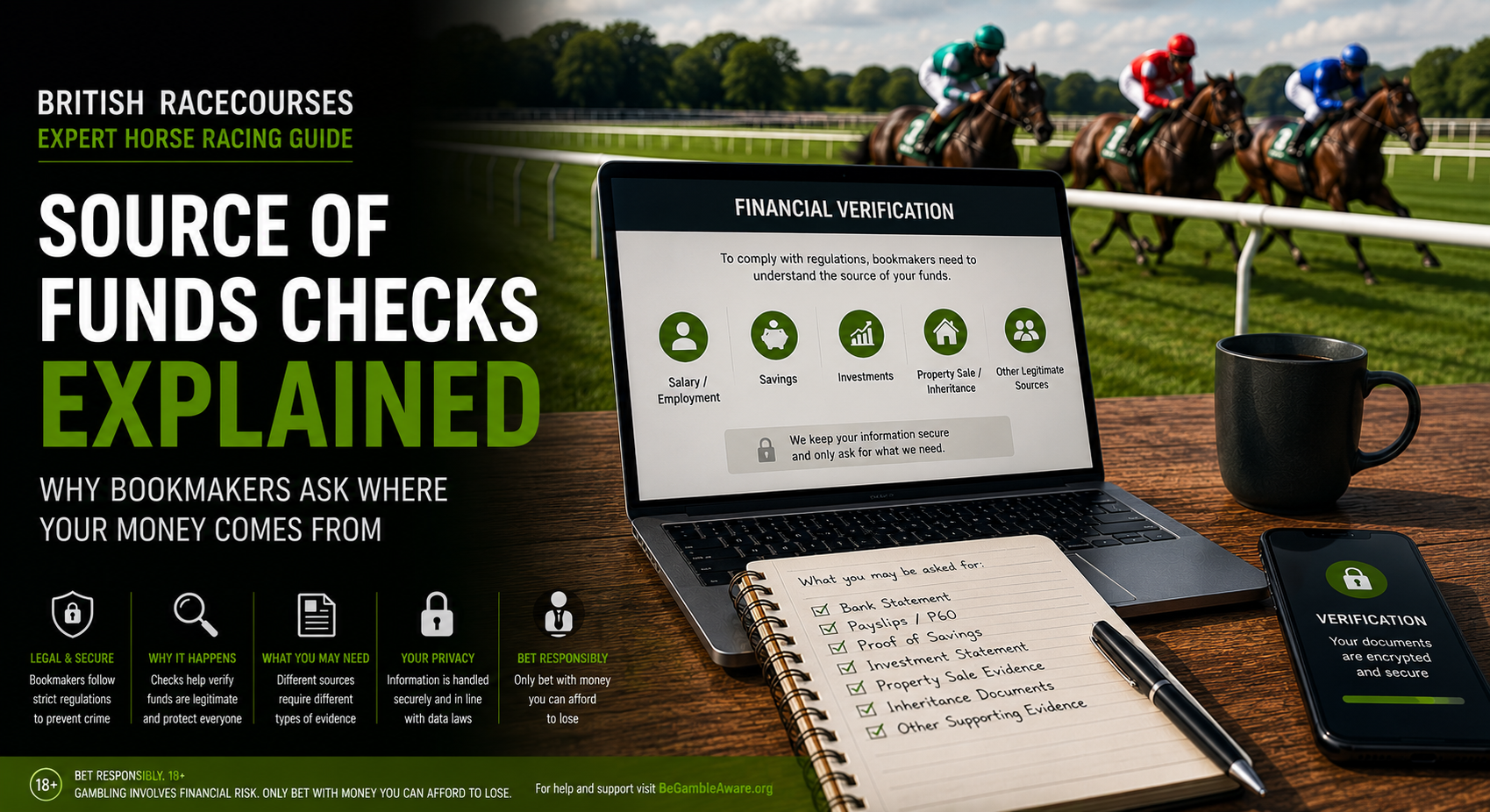
A source of funds check is a process a bookmaker can use to understand where money associated with a customer’s gambling has come from.
Depending on the circumstances, a bookmaker might ask for information or evidence relating to salary, savings, investments, a property sale, inheritance, business income or another legitimate source of money.
This is different from ordinary identity verification.
An identity check broadly asks:
Who are you?
A source of funds check broadly asks:
Where did the relevant money come from?
It is also important not to automatically confuse source of funds with source of wealth or the newer financial-risk assessment processes. These terms can relate to different checks and different information.
If you are dealing with a bookmaker request, the first step should therefore be establishing exactly what type of check is taking place.
If the bookmaker is asking you to prove your identity rather than explain your finances, start with our Betting Account Verification Explained guide.
What Is a Source of Funds Check?
Source of funds refers to the origin of money being used in a particular context.
In betting, a bookmaker may seek information to help understand where relevant funds have originated.
For example, money could potentially come from:
- employment income
- self-employment
- business income
- savings
- investments
- pension income
- sale of a property
- inheritance
- another legitimate source
The appropriate evidence depends on the circumstances.
A payslip might help explain employment income, for example, but would not necessarily explain a large amount received following the sale of a house.
This is why there is no single document that automatically answers every source-of-funds request.
Why Do Bookmakers Carry Out Source of Funds Checks?
Gambling businesses operate within a regulated environment and have responsibilities concerning areas including preventing crime and money laundering.
Bookmakers can therefore seek information about customers and their financial activity in certain circumstances.
The Gambling Commission explains that gambling businesses can use information including bank statements to help establish that funds are legitimate as part of anti-money-laundering checks.
This does not mean every person who opens a betting account will be asked to provide bank statements or prove their income.
The type of checks experienced by customers can vary considerably.
Does Every Bettor Have a Source of Funds Check?
No.
Opening an online betting account does not automatically mean you will be required to send a bookmaker bank statements, payslips or evidence of your savings.
The normal account-opening process includes age and identity checks.
Source-of-funds questions are different.
If you are new to online betting, our How to Sign Up to a Betting Site guide explains the standard registration process.
Is Source of Funds the Same as ID Verification?
No.
This is one of the most important distinctions to understand.
Identity verification
Broadly concerned with establishing who you are.
Evidence could potentially include photographic identification.
Proof of address
Concerned with establishing residential information.
Evidence could potentially include appropriate official or financial documentation.
Source of funds
Concerned with where relevant money originated.
Evidence depends heavily on the source being explained.
These checks can overlap in terms of the documents involved, but their purposes are different.
For more information about identity documents specifically, read Why Do Bookmakers Ask for ID?.
What Is the Difference Between Source of Funds and Source of Wealth?
The terms sound similar but should not automatically be treated as interchangeable.
Source of funds concerns the origin of particular money.
Source of wealth is broader and concerns how someone’s overall wealth has been accumulated.
Consider a simplified example.
A customer has £250,000 in savings and transfers £5,000 into a bank account before making betting deposits.
The source of funds question might concern where that particular £5,000 originated.
A source of wealth question could be broader and concern how the customer accumulated their overall financial position.
The evidence relevant to each question can therefore differ.
Is a Source of Funds Check an Affordability Check?
Do not automatically use these terms interchangeably.
Gambling financial checks have changed considerably, and several different concepts are sometimes described casually as “affordability checks”.
That can create confusion.
Source of funds, source of wealth, financial-risk assessments and customer-interaction processes can have different purposes.
If a bookmaker contacts you, focus on the terminology it actually uses and ask for clarification if the request is unclear.
What Are Financial Risk Assessments?
Financial Risk Assessments are a separate development in British online gambling regulation.
They are designed to provide operators with information relating to financial difficulties for customers meeting the relevant criteria.
Importantly, these should not simply be described as source-of-funds checks.
The Gambling Commission has stated that the vast majority of customers will never require a Financial Risk Assessment and that, for those who do, the process is intended to be frictionless and document-free using information from credit reference agencies.
The Commission has also stated that these assessments do not affect a customer’s credit score.
This is different from a bookmaker directly asking a customer to provide evidence explaining where particular funds originated.
Why Does the Difference Matter?
Because telling readers that every financial check involves handing over bank statements would be inaccurate.
Equally, telling readers that bookmakers can never request financial documents would also be inaccurate.
The correct question is:
What type of check is being conducted?
Once you know that, you can understand what information is relevant.
When Might a Bookmaker Ask About Source of Funds?
There is no simple universal trigger that means every customer will receive exactly the same request at exactly the same point.
Operators assess customers and activity according to their own regulatory responsibilities and processes.
A request could potentially arise during an existing customer relationship rather than when the account is first opened.
If you receive one, avoid trying to guess why.
Read the communication and establish:
- What type of check is being carried out?
- What information does the bookmaker require?
- Which transactions or funds are relevant?
- What evidence will it accept?
- How should that evidence be submitted?
Those questions are more useful than searching for a universal “source of funds limit”.
Is There a Universal Source of Funds Threshold?
You should not assume that there is one simple deposit figure that applies to every bookmaker, customer and circumstance.
Customer circumstances differ.
Betting patterns differ.
Operators’ risk assessments can differ.
Regulatory requirements can also change.
Be particularly cautious about articles claiming that depositing exactly £X will always trigger a source-of-funds check or that staying £1 below a particular amount guarantees you will avoid one.
That is not a sensible way to understand the process.
What Can Bookmakers Ask for as Source of Funds Evidence?
The evidence depends on what you are trying to demonstrate.
Possible examples can include information relating to:
- salary
- self-employment
- business income
- savings
- investments
- pension
- property sale
- inheritance
- other legitimate income
A bookmaker should explain what it needs.
Do not automatically send every financial document you possess.
First establish the purpose of the request.
Can a Bookmaker Ask for Bank Statements?
Yes, bank statements can be relevant to certain financial checks.
The Gambling Commission specifically identifies bank statements as information gambling businesses can obtain to help establish that source of funds is legitimate and as part of anti-money-laundering checks.
However, the fact that a bookmaker asks for a bank statement does not by itself tell you everything about the check.
Ask what information the bookmaker needs the statement to demonstrate.
What Can a Bank Statement Show?
Depending on the circumstances, a bank statement can potentially help show:
- income entering an account
- transfer of savings
- relevant transactions
- movement of money
- origin of particular funds
But context matters.
A £20,000 credit into a bank account does not necessarily explain where the £20,000 originally came from.
Additional information might therefore be needed if the origin of that money is relevant to the check.
Can a Bookmaker Ask for Payslips?
A payslip can potentially be relevant where employment income is being established.
It might show information such as:
- employer
- gross pay
- net pay
- payment period
But a payslip is not necessarily relevant to every source-of-funds request.
If the funds came from selling a property, for example, a payslip may tell the bookmaker very little about the transaction being examined.
Supply information relevant to the actual request.
Can a Bookmaker Ask for a P60?
Potentially.
A P60 can provide evidence relating to employment income over a tax year.
Again, whether it is relevant depends on what the bookmaker needs to establish.
Do not assume that one particular document is mandatory for every customer.
What If You Are Self-Employed?
Self-employed customers may have different evidence available from employees receiving a regular monthly salary.
Depending on the request and circumstances, relevant information could potentially involve:
- tax documentation
- business accounts
- bank statements
- invoices
- other evidence of legitimate income
Ask the bookmaker which evidence it accepts.
What If Your Money Comes From Savings?
Savings are a legitimate potential source of funds.
However, simply stating “savings” may not always explain how the money accumulated.
Depending on the circumstances, relevant evidence might need to show:
- the existence of the savings
- where they were held
- movement of the relevant funds
- potentially how substantial savings accumulated
The exact requirement depends on the check.
What If the Money Came From Investments?
Investment proceeds can potentially be a legitimate source of funds.
Evidence might relate to:
- investment account
- sale of investments
- proceeds received
- transfer into your bank account
Again, establish what the bookmaker actually needs before supplying documents.
What If You Sold a Property?
A property sale can produce a substantial one-off movement of money.
This can look very different from someone’s normal monthly income.
Depending on the circumstances, appropriate evidence could potentially relate to:
- property sale
- completion
- transfer of proceeds
- bank receipt
The important point is demonstrating the legitimate origin of the relevant money rather than trying to make a large transaction look like ordinary salary.
What If You Received an Inheritance?
Inheritance can also result in a customer’s available funds changing substantially without a corresponding change in monthly salary.
If inheritance is the relevant source, the bookmaker may ask for suitable evidence.
Ask which documents it accepts for that circumstance.
What If You Won the Money?
Previous gambling winnings can potentially form part of a person’s available funds.
If this is relevant to a source-of-funds enquiry, evidence might include appropriate account or transaction records.
Do not assume a bookmaker will simply accept a statement such as:
“I won it elsewhere.”
If evidence is required, establish what documentation will satisfy the request.
What If the Money Was a Gift?
Money can sometimes come from another person.
If gifted funds are relevant to a bookmaker’s enquiry, explain the situation accurately.
The bookmaker can then tell you what evidence it requires.
Do not describe borrowed money, business money or somebody else’s betting funds as a “gift” simply because that seems easier to explain.
Accuracy matters.
What If the Money Was a Loan?
Do not misrepresent borrowed money as savings or income.
If the relevant funds came from borrowing, explain that accurately if asked.
Gambling with borrowed money can also create significant financial risk.
If betting requires borrowing to continue, that is a strong reason to stop and reconsider the activity rather than searching for ways to make the funds appear to come from somewhere else.
Can You Refuse a Source of Funds Check?
You can decide whether you want to provide requested information.
However, if a bookmaker legitimately requires information to satisfy its regulatory or legal obligations, refusing to provide it may affect what the operator is able to do with your account.
If you are uncomfortable with a request, ask:
- why the information is required
- what type of check is being carried out
- which information is necessary
- whether alternative evidence is accepted
- how your information will be handled
- what happens if you choose not to provide it
Make your decision once you understand the request.
What Happens If You Don’t Provide Source of Funds Evidence?
The outcome depends on the circumstances.
Possible consequences could include restrictions on account activity or the bookmaker being unable to continue aspects of the customer relationship.
Do not assume that ignoring the request will make it disappear.
If you do not want to provide the requested information, contact the bookmaker and ask what happens next.
Can a Bookmaker Close Your Account?
Bookmakers can close or restrict accounts in accordance with applicable requirements and their terms.
If a source-of-funds issue is involved, ask the bookmaker to explain:
- account status
- outstanding bets
- remaining balance
- withdrawal process
- outstanding information
Keep important correspondence.
Can Source of Funds Affect Withdrawals?
Financial or anti-money-laundering checks can potentially arise around account activity.
However, Gambling Commission rules are important here.
A bookmaker should not wait until withdrawal to request identity information it could reasonably have requested earlier.
That does not prevent an operator seeking information it is required to obtain at that point because of another legal obligation.
This distinction is important.
A legitimate later financial or anti-money-laundering requirement is not automatically the same thing as unnecessarily delaying an ordinary withdrawal for ID that should have been requested earlier.
For more information about withdrawals generally, read our Fast Withdrawal Betting Sites guide.
What Should You Do If a Withdrawal Is Delayed?
First establish the reason.
Ask:
Is there an outstanding verification or financial-information request?
If yes:
What exactly is required?
Then:
Why is it required at this stage?
Keep copies of:
- emails
- chat transcripts
- requested documents
- upload confirmations
- dates
- bookmaker responses
Clear records make it easier to understand what has happened if the issue continues.
Can a Bookmaker Ask for Information After You’ve Already Been Verified?
Yes.
Identity verification and source-of-funds checks are different.
Completing an identity check does not mean that no other legitimate information can ever be requested during the customer relationship.
For example:
Registration: name, address and date of birth verified.
Later request: information about the origin of particular funds.
Those requests address different questions.
Does Using Multiple Bookmakers Avoid Source of Funds Checks?
You should not open accounts with other bookmakers for the purpose of avoiding legitimate checks.
Using multiple bookmaker accounts can have genuine benefits for racing bettors, particularly when comparing:
- odds
- each-way terms
- Best Odds Guaranteed
- extra places
- markets
But multiple accounts should not be used as a strategy for circumventing verification, financial checks, restrictions or account controls.
Each bookmaker has its own relationship with you and can carry out its own required checks.
Can One Bookmaker See Your Other Betting Accounts?
Do not assume that all bookmakers simply share a single customer account system.
Each operator manages its own customer relationship.
However, the wider financial information relevant to a particular check can potentially include transactions involving other gambling companies if those transactions appear within evidence being considered.
Always answer legitimate questions accurately rather than trying to hide betting activity.
Should You Split Deposits to Avoid Checks?
No.
Do not deliberately structure deposits or transactions with the aim of avoiding legitimate bookmaker controls.
If you are worried that the level of your betting might prompt financial questions, the sensible response is not to find a technical way around the checks.
Consider your overall gambling activity and whether the amount you are betting remains appropriate for you.
Should You Open Another Betting Account If One Asks for Documents?
Not as a way to bypass the request.
There are legitimate reasons to maintain accounts with different bookmakers, particularly for horse racing price comparison.
But attempting to move activity elsewhere purely to avoid a legitimate financial check misses the purpose of the process.
Resolve the existing account issue first.
Are Source of Funds Checks Safe?
Financial documents contain highly sensitive information.
Treat them accordingly.
Before providing anything:
- Confirm you are dealing with the genuine bookmaker.
- Check the request within your official account.
- Understand what is being requested.
- Use the bookmaker’s secure submission method.
- Do not send financial documents to unrelated third parties.
Be especially cautious about unexpected emails, messages or telephone calls.
Source of Funds Scams
A criminal could potentially impersonate a bookmaker and claim that a financial check is required.
Never provide:
- online banking passwords
- full security credentials
- one-time authentication codes
- remote access to your computer
- unrestricted access to your bank account
Do not transfer money to a stranger because they claim it is required to “verify” your funds.
If you receive a suspicious request, independently navigate to the bookmaker’s genuine website and contact official customer support.
Can You Redact a Bank Statement?
Do not assume.
The bookmaker may need specific information to remain visible.
If you are uncomfortable providing unrelated information, ask:
Which information must be visible?
and:
Which information, if any, can I redact?
Follow the bookmaker’s response.
Do not alter a document in a way that creates a misleading picture of your finances.
Can You Send Screenshots?
That depends on the bookmaker and the evidence required.
A cropped screenshot may not provide sufficient context for some checks.
If the operator requests:
- PDF statement
- complete statement
- particular date range
- official document
provide the requested format where you decide to proceed.
If you cannot, ask whether an alternative is acceptable.
How Far Back Can a Bookmaker Ask for Bank Statements?
There is no single answer suitable for every situation.
The relevant period depends on what the bookmaker needs to establish.
If the requested period seems unclear, ask why that range is required.
Do not assume that a particular number of months applies universally across all operators and circumstances.
How Long Does a Source of Funds Check Take?
There is no universal processing time.
The length of the process can depend on:
- bookmaker
- complexity
- evidence
- whether information is complete
- whether further questions arise
A straightforward explanation supported by appropriate evidence may be easier to assess than a complicated series of unexplained transactions.
If the bookmaker gives you a timeframe and that period passes, contact it for an update.
What If the Bookmaker Rejects Your Evidence?
Ask why.
Do not immediately send more random documents.
Instead ask:
What part of the source of funds remains unverified?
and:
What evidence would resolve that point?
For example, a bank statement might show money arriving from another account without showing where the money originally came from.
The bookmaker may therefore need information relating to the earlier stage of the transaction.
Understanding the gap makes it easier to provide relevant evidence.
What If You Cannot Prove Where the Money Came From?
Explain the situation accurately.
Do not:
- fabricate evidence
- alter documents
- invent employment
- describe borrowing as savings
- use somebody else’s documents
- create false transactions
Ask the bookmaker what alternative evidence it accepts.
If the required information cannot be established, the bookmaker will need to decide what action it can take regarding the account.
What If You Think the Request Is Excessive?
Ask the bookmaker to explain:
- what information it requires
- why it requires it
- which part is necessary
- what alternatives exist
If you remain dissatisfied, use the bookmaker’s formal complaints process.
Keep written records of the request and your response.
Source of Funds and Payment Methods
Your deposit method can form part of the wider account picture.
Bookmakers have rules governing accepted payment methods and account ownership.
Avoid unnecessary complications by using appropriate payment methods associated with you and following the operator’s requirements.
Our Betting Payment Methods hub explains deposits and withdrawals in greater detail.
Don’t Use Someone Else’s Bank Account to Avoid a Check
Do not attempt to bypass financial checks by moving betting transactions through:
- partner’s account
- parent’s account
- friend’s account
- business account where inappropriate
- another person’s payment method
This can create additional questions about account ownership and the origin of funds.
Use your own legitimate financial information and follow the bookmaker’s rules.
Source of Funds and Horse Racing Bettors
Regular racing bettors can potentially have more complex account activity than somebody who places a few bets each year.
They may use several bookmakers to compare:
- prices
- each-way terms
- Best Odds Guaranteed
- extra places
- promotions
They may also make frequent deposits and withdrawals between operators.
That makes record keeping particularly useful.
Our Multiple Bookmaker Accounts guide explains how to manage several accounts without losing sight of your overall betting position.
Keep Records Across All Your Betting Accounts
If you use several bookmakers, consider maintaining records of:
- deposits
- withdrawals
- stakes
- returns
- bookmaker balances
- overall profit or loss
This has benefits beyond source-of-funds questions.
It gives you a much clearer understanding of your actual betting performance.
A £1,000 balance with one bookmaker does not mean you are £1,000 in profit if you have lost £1,500 elsewhere.
Treat your betting activity as one overall financial picture.
Source of Funds and Responsible Betting
A financial-information request can also be a useful point at which to assess your own betting activity.
Ask yourself:
- How much am I depositing overall?
- How much am I losing overall?
- Am I using money intended for other purposes?
- Am I borrowing to bet?
- Am I chasing losses?
- Am I comfortable with my current level of spending?
Having the money available does not automatically mean betting it is a good financial decision.
Can a Source of Funds Check Tell You How Much You Can Bet?
Do not treat a completed check as permission or encouragement to bet a particular amount.
Your personal betting budget should remain based on what you can comfortably afford to lose.
Passing a bookmaker process does not turn gambling into an investment or remove financial risk.
Does Source of Funds Affect Which Bookmaker You Should Join?
Financial checks are only one part of the bookmaker relationship.
When choosing an operator, racing bettors should also compare:
- licensing
- racing odds
- each-way terms
- Best Odds Guaranteed
- extra places
- payment methods
- withdrawals
- account usability
- mobile experience
- customer service
Our How to Choose a Betting Site guide explains how we assess these factors.
For individual operator comparisons, use our main Best Horse Racing Betting Sites page.
Source of Funds Check: Step-by-Step
If you receive a request, use this process.
Step 1: Check the request is genuine
Log into your bookmaker independently rather than relying solely on an unexpected link.
Step 2: Identify the type of check
Is this:
- identity verification
- proof of address
- source of funds
- source of wealth
- another financial check
Do not assume.
Step 3: Ask what needs to be established
Understanding the question helps you provide relevant evidence.
Step 4: Check the requested documents
Find out exactly what is accepted.
Step 5: Gather genuine evidence
Do not alter or fabricate documents.
Step 6: Submit securely
Use the bookmaker’s official process.
Step 7: Keep records
Retain important communications and submission confirmations.
Step 8: Respond to further questions
If more information is required, establish what remains outstanding.
Step 9: Ask for an update
If the bookmaker’s stated processing period passes, contact support.
Step 10: Use the complaints process if necessary
If you believe the matter has been handled incorrectly and cannot resolve it with customer support, follow the operator’s formal complaints procedure.
Source of Funds Checklist
Before responding:
☐ Confirm the request is genuine
☐ Identify the type of check
☐ Understand what funds are being considered
☐ Ask what evidence is accepted
When preparing evidence:
☐ Use genuine documents
☐ Check the requested date range
☐ Make sure relevant information is readable
☐ Do not alter financial information
☐ Ask before redacting anything
When submitting:
☐ Use the bookmaker’s official channel
☐ Keep confirmation of submission
☐ Never provide passwords or security codes
☐ Never give remote access to your banking
After submitting:
☐ Monitor account messages
☐ Keep bookmaker correspondence
☐ Ask why evidence was rejected
☐ Ask what remains outstanding
☐ Follow the complaints process if the matter cannot be resolved
How Source of Funds Fits Into the Betting Account Journey
The wider British Racecourses betting account cluster now follows a clear path:
Choose a bookmaker
↓
↓
Register
↓
How to Sign Up to a Betting Site
↓
Complete ordinary verification
↓
Betting Account Verification Explained
↓
Provide identification if required
↓
↓
Respond to legitimate financial-information requests if they arise
↓
Source of Funds Checks Explained
↓
Understand deposits and withdrawals
↓
↓
↓
Compare bookmakers
↓
Best Horse Racing Betting Sites
This creates a much stronger account-opening resource than trying to explain registration, ID, financial checks, payments and withdrawals on one page.
Frequently Asked Questions
What is a source of funds check?
A source of funds check concerns the origin of relevant money associated with a customer’s gambling activity.
Why do bookmakers ask for source of funds?
Bookmakers operate within regulatory and legal frameworks that include responsibilities relating to crime and money laundering. Financial information can be requested in relevant circumstances.
Does every bookmaker ask for source of funds?
No. Not every customer will be asked to provide source-of-funds evidence.
Is source of funds the same as ID verification?
No. Identity verification broadly concerns who you are. Source of funds concerns where relevant money came from.
Is source of funds the same as source of wealth?
No. Source of funds concerns particular money, while source of wealth is a broader concept concerning how overall wealth was accumulated.
Is source of funds the same as a Financial Risk Assessment?
No. They are different concepts. Financial Risk Assessments are intended to identify current financial difficulties for customers meeting relevant criteria and are designed to be frictionless and document-free in the vast majority of cases.
Does a Financial Risk Assessment affect my credit score?
The Gambling Commission states that these assessments do not affect a customer’s credit score.
Can bookmakers ask for bank statements?
Yes, bank statements can be relevant to certain financial or anti-money-laundering checks.
Can bookmakers ask for payslips?
Payslips can potentially be relevant where employment income needs to be established.
Can a bookmaker ask for a P60?
Potentially, depending on the circumstances and information required.
What if I am self-employed?
Ask which evidence the bookmaker accepts. Appropriate evidence can differ from that used by a salaried employee.
Can savings be a source of funds?
Yes. Savings can be a legitimate source, although evidence may be required to explain the relevant money depending on the circumstances.
Can inheritance be a source of funds?
Yes. If inheritance is relevant, the bookmaker may ask for appropriate supporting evidence.
Can property-sale proceeds be a source of funds?
Yes. A property sale can be a legitimate source of money and may require evidence appropriate to that transaction.
Can betting winnings be a source of funds?
Previous winnings can form part of available funds, although evidence may be required if they are relevant to an enquiry.
Can I refuse to send bank statements?
You can decide whether to provide requested information. However, if the bookmaker legitimately requires information to meet its obligations, refusing may affect the account relationship.
Can source of funds delay a withdrawal?
Financial or anti-money-laundering checks can potentially affect account processes depending on the circumstances. Ask the bookmaker exactly what information remains outstanding.
Can a bookmaker suddenly ask for financial information after I’ve been verified?
Yes. Identity verification and financial checks can serve different purposes.
Should I open another bookmaker account to avoid a source of funds check?
No. Do not use another operator as a way of circumventing a legitimate check.
Can I split deposits to avoid checks?
You should not deliberately structure transactions to try to avoid legitimate bookmaker controls.
Can I use someone else’s bank account?
Follow the bookmaker’s payment requirements and do not use third-party financial information as a way to circumvent checks.
Can I redact my bank statement?
Ask the bookmaker what information must remain visible and whether any information can legitimately be redacted.
How long does a source of funds check take?
There is no universal timeframe. It depends on the bookmaker, circumstances, evidence and complexity of the enquiry.
What if my evidence is rejected?
Ask what remains outstanding and what evidence would satisfy the requirement rather than repeatedly submitting unrelated documents.
What if I disagree with the bookmaker?
Ask for an explanation and use the bookmaker’s formal complaints process if you cannot resolve the matter through customer support.
Summary
A source of funds check concerns where relevant money came from.
It should not automatically be confused with ordinary betting account verification.
Identity verification broadly establishes who you are.
Source of funds broadly establishes where particular money originated.
Source of wealth is broader again, while Financial Risk Assessments are a separate regulatory process intended to identify financial difficulties among customers meeting relevant criteria.
Bookmakers can request evidence such as bank statements or other financial information in appropriate circumstances.
The evidence required depends on the source being explained.
Employment income, savings, investments, inheritance and property-sale proceeds can all require different forms of supporting information.
If a bookmaker contacts you, do not guess what it wants.
Ask what type of check is being carried out, what information needs to be established and which evidence will satisfy the request.
Never alter documents, fabricate income, use another person’s financial information or structure transactions in an attempt to avoid legitimate checks.
Submit sensitive information only through genuine bookmaker channels and keep records of important correspondence.
For ordinary identity checks, read Betting Account Verification Explained and Why Do Bookmakers Ask for ID?.
For the wider account journey, continue to Betting Payment Methods and Fast Withdrawal Betting Sites.
If you are deciding which bookmaker to use, our Best Horse Racing Betting Sites page is the main British Racecourses comparison.
18+. Gambling involves financial risk. Only bet with money you can afford to lose. Safer-gambling and self-exclusion tools are available if you need them.