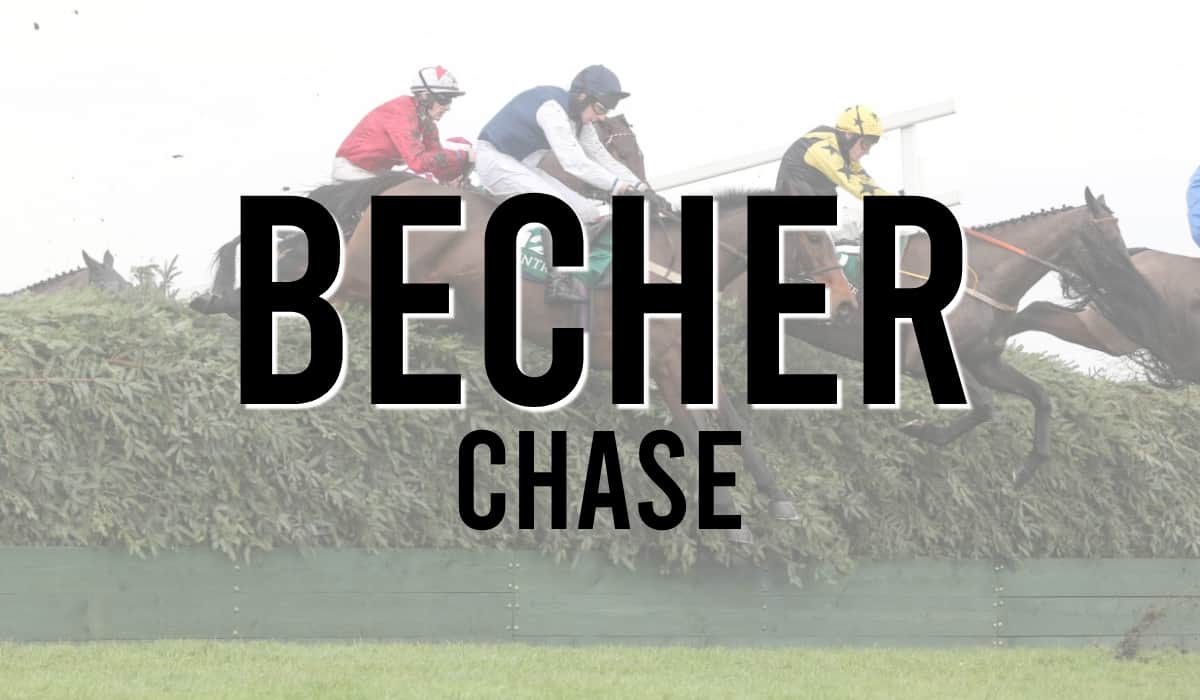
The Becher Chase is a Premier Handicap run over Aintree’s Grand National fences in December.
Run over approximately three miles and two furlongs, the race gives staying chasers the opportunity to tackle 21 of Aintree’s distinctive National-course fences, including Becher’s Brook, the Canal Turn and Valentine’s Brook.
That makes the Becher Chase unusual. Stamina and handicap ratings matter, but horses also need to adapt to obstacles they do not encounter during conventional steeplechases. Previous Aintree experience can therefore provide particularly useful evidence when assessing the race.
The connection with the Grand National is obvious, but the Becher Chase is also an important and valuable staying handicap in its own right. Amberleigh House and Silver Birch won the race before later winning the Grand National, while horses including Vieux Lion Rouge and Walk In The Mill developed outstanding records over the National fences.
Becher Chase Key Facts
| Race detail | Becher Chase |
|---|---|
| Racecourse | Aintree |
| Race type | National Hunt handicap chase |
| Classification | Premier Handicap |
| Distance | 3m 1f 188yds, approximately 3m 2f |
| Fences | 21 |
| Eligibility | Horses aged 6+ |
| Usual month | December |
| Course | Grand National course |
| Surface | Turf |
Older records may describe the Becher Chase as a Grade 3 handicap. Under the current British jumps classification system, the race is a Premier Handicap.
When Is the Becher Chase 2026?
The 2026 Becher Chase takes place at Aintree on Saturday 5 December.
The race is the centrepiece of Becher Chase Day and will again be staged over the Grand National fences. The Grand Sefton Chase also joins the card in 2026, giving racegoers two opportunities to see horses tackle the famous obstacles on the same afternoon.
The Becher is scheduled over approximately three miles and two furlongs.
Final declarations, handicap weights and the going will provide the most useful information for analysing the 2026 renewal, so there is little value in speculating about potential runners months before the race.
History of the Becher Chase
The Becher Chase was first run in 1992, when Kildimo won for trainer Sue Smith.
The race takes its name from Becher’s Brook, one of the most famous fences on Aintree’s Grand National course. The obstacle itself is named after Captain Martin Becher, who was unseated from Conrad during the 1839 Grand National.
From its earliest years, the race attracted experienced staying chasers.
Into The Red became the first dual winner when successful in 1994 and 1996. Earth Summit won in 1998, three years after winning the Scottish Grand National and Welsh Grand National and in the same year that he won the Grand National.
Amberleigh House, Silver Birch, Hello Bud, Vieux Lion Rouge and Walk In The Mill subsequently strengthened the race’s association with horses particularly effective over Aintree’s National fences.
That history is one of the reasons the Becher remains such an interesting race to analyse. Previous course experience can carry more significance here than it does in many conventional handicaps.
Why Are the Grand National Fences Different?
The Becher Chase is run on Aintree’s Grand National course, not the Mildmay course used for many other races at the venue.
The Grand National fences use spruce and have distinctive dimensions, approaches and landing areas. Horses accustomed to ordinary park fences therefore face a different jumping test when they first race over them.
The Becher Chase does not use every obstacle encountered in the Grand National because it is considerably shorter and covers a different section of the course.
It does, however, include many of the best-known fences.
Horses need to cope with Becher’s Brook, Foinavon, the Canal Turn and Valentine’s Brook while maintaining their position in a competitive handicap.
The nature of these fences has changed over time as Aintree has made alterations to improve safety. Historical footage should therefore not be assumed to show exactly the same physical challenge horses face today.
The fundamental requirement remains. Horses need to establish a jumping rhythm and retain their balance over obstacles that differ from conventional chase fences.
Becher’s Brook
Becher’s Brook gives the race its name and remains one of Aintree’s most recognisable obstacles.
It is distinguished by the difference between the take-off and landing sides. The landing area has been modified over time, but horses still need to cope with the change in ground level after clearing the fence.
Balance matters.
A horse can clear the spruce cleanly but lose momentum if it lands awkwardly or takes time to reorganise itself. In a competitive handicap, that can result in lost ground and force the jockey to use additional energy recovering position.
Becher’s is particularly significant because it comes as part of a sequence of demanding National-course obstacles rather than appearing in isolation.
Horses need to regain their rhythm quickly before tackling what follows.
The Canal Turn
The Canal Turn presents a different challenge.
Horses need to negotiate the fence before changing direction sharply after landing. Position on the approach can therefore influence how efficiently they take the turn.
A horse that jumps cleanly but becomes unbalanced around the bend can lose valuable ground.
The obstacle also demonstrates why simply counting jumping errors does not provide the complete picture at Aintree. A horse may technically clear every fence but continually lose position through inefficient jumping, poor approaches or slow recoveries.
That can become increasingly costly over more than three miles.
How Important Is Previous Aintree Experience?
Previous experience over the National fences is one of the most interesting factors in the Becher Chase.
Vieux Lion Rouge and Walk In The Mill demonstrated how valuable familiarity with the course can become. Both won the Becher twice and repeatedly returned to Aintree.
That does not mean every previous National-course runner should automatically be preferred.
The quality of the experience matters.
A horse that completed fluently and travelled comfortably over the fences has provided positive evidence. A runner that struggled with the obstacles or became increasingly hesitant may have demonstrated the opposite.
Even a non-completion needs context. A horse brought down by another runner has not necessarily failed the Aintree test, while repeated jumping mistakes before falling provide much more relevant evidence.
Our guide to reading horse racing form explains why the circumstances behind a result can matter as much as the finishing position itself.
Vieux Lion Rouge
Vieux Lion Rouge won the Becher Chase twice, in 2016 and 2020.
His wider Aintree record made those victories particularly significant. He repeatedly competed over the Grand National fences and developed extensive experience of the course during his career.
His first Becher victory came as a seven-year-old in 2016. Four years later, at the age of eleven, he returned to win the race again.
That gap between victories is a useful reminder not to impose rigid age rules on the Becher.
Vieux Lion Rouge’s advantage was not that he fitted a fashionable historical profile. He had demonstrated an ability to negotiate the National fences efficiently and possessed the stamina required for the race.
Walk In The Mill
Walk In The Mill became the first horse to win consecutive Becher Chases when successful in 2018 and 2019.
He also produced strong form in the Grand National, finishing fourth behind Tiger Roll in 2019.
His performances reinforced the value of genuine National-course form. Walk In The Mill repeatedly showed that he could establish a rhythm over Aintree’s fences rather than merely completing the course once.
He attempted to win the Becher for a third consecutive year in 2020 but was unable to complete the hat-trick.
Vieux Lion Rouge instead won for a second time, leaving four horses tied on two Becher victories: Into The Red, Hello Bud, Walk In The Mill and Vieux Lion Rouge.
Hello Bud
Hello Bud was another outstanding National-course specialist.
He first won the Becher Chase in 2010 before returning to take the race again in 2012 at the age of fourteen.
His second victory is one of the clearest examples of why age should be considered in context.
A fourteen-year-old would normally be viewed cautiously in a major handicap, but Hello Bud brought extensive staying experience and a proven ability to cope with Aintree.
His performance did not establish that older horses possess an advantage in the Becher. It showed that proven ability over the course can sometimes remain valuable even when a horse is well beyond the age normally associated with improvement.
Amberleigh House and Silver Birch
Two Becher Chase winners subsequently returned to Aintree to win the Grand National.
Amberleigh House won the Becher in 2001 before winning the 2004 Grand National for Ginger McCain.
Silver Birch won the Becher in 2004 and later won the 2007 Grand National.
Those performances establish a genuine connection between the races, but the gap between the Becher and subsequent National victories is important.
Neither horse won the Grand National immediately after winning the Becher.
Their careers instead demonstrate that strong form over Aintree’s distinctive fences can remain relevant when assessing future Grand National prospects.
Recent Becher Chase Winners
The Becher has continued to produce varied winners rather than one narrow type of horse.
Snow Leopardess won in 2021, making much of the running and holding off Hill Sixteen in a close finish.
Ashtown Lad won in 2022 for Dan and Harry Skelton.
The 2023 race produced a notable piece of history when Chambard won under Lucy Turner, who became the first female jockey to win the Becher Chase. The Venetia Williams-trained eleven-year-old won by 13 lengths.
There was no Becher Chase in 2024, with the meeting abandoned.
The race returned in 2025 when Twig won for trainer Ben Pauling and conditional jockey Beau Morgan. Twig had already finished tenth in that year’s Grand National, giving him valuable previous experience over the course. He defeated Mr Vango by a short head after a prolonged battle on the run-in.
That recent sequence illustrates the variety of routes into the race. Previous National experience can be useful, but horses can arrive at the Becher with very different ages, weights and profiles.
Why Is Jumping So Important?
Every steeplechase requires competent jumping, but Aintree makes the quality of that jumping particularly visible.
The Becher Chase contains 21 fences.
A horse that approaches the obstacles confidently can preserve momentum and remain in a comfortable racing rhythm. One that continually shortens into its fences, loses balance or requires its jockey to reorganise it after landing expends additional energy.
Those differences become more important as fatigue develops.
Previous jumping form should therefore be assessed qualitatively rather than simply by counting falls or unseated riders.
A horse can complete a race while jumping inefficiently throughout. Another can fall after producing an otherwise accomplished round because of one isolated error.
Understanding that distinction is particularly useful when analysing horses returning to Aintree.
How Much Stamina Does the Becher Chase Require?
The Becher is run over approximately three miles and two furlongs, making proven stamina an important part of the analysis.
It is shorter than the Grand National, so the races should not be treated as equivalent tests.
A horse can possess enough stamina for the Becher without proving that it will stay the National’s longer distance. Conversely, a proven marathon chaser may find a strongly run Becher well within its stamina range.
Ground can change the balance.
Three miles and two furlongs on soft ground demands considerably more energy than the same trip under faster conditions. A strong pace can increase the requirement further.
Look beyond whether a horse has simply won over three miles.
How strongly did it finish? What was the ground? How competitive was the pace? Did its jumping remain efficient as it tired?
Those questions provide much more useful evidence.
How Does the Going Affect the Becher Chase?
December ground at Aintree can make stamina an even greater consideration.
Soft conditions increase the energy horses need to maintain their position and can make jumping more difficult as fatigue develops.
The 2025 Becher, for example, was staged on soft ground and produced a close finish between Twig and Mr Vango after nearly seven minutes of racing.
Better conditions can produce a quicker contest in which tactical position and cruising speed become more influential.
Previous Aintree form should therefore be compared with the likely conditions rather than treated as universally transferable.
A horse that excelled over the National fences on good ground may face a substantially different physical test when returning on soft.
Our horse racing going guide explains how different surfaces can alter the demands of a race.
Pace and Position at Aintree
The Becher Chase can contain a mixture of front-runners, prominent racers and horses normally held up.
That makes the likely early pace worth examining before the race.
A strong gallop can test stamina and jumping from an early stage. Horses racing prominently may be forced to use more energy than expected if several runners compete for the same position.
An uncontested leader can create the opposite situation.
The 2025 race provided an interesting example. Mahons Glory established a substantial advantage before the closing stages, forcing the chasing horses to judge when to close the gap.
Twig eventually took over approaching the final fence and then had to withstand Mr Vango’s challenge after the Elbow.
The result demonstrates why a horse racing pace map can add useful context to Aintree form.
The previous winner’s tactics should never be copied mechanically. The current field determines how the next race is likely to develop.
Does Weight Matter in the Becher Chase?
The Becher is a handicap, so weight needs to be considered alongside ability.
Higher-rated horses carry more because their previous performances have established that they are better horses. A large weight is therefore not automatically a disadvantage.
Mr Vango demonstrated this in 2025 when carrying 12st and missing victory by only a short head.
At the other end of the handicap, a lightly weighted horse can become particularly interesting when its current ability has developed faster than its official rating.
The relationship between ability and weight matters more than either number in isolation.
Ground can influence the calculation as well. Carrying a substantial weight through soft conditions over more than three miles can create a different physical demand from racing on a quicker surface.
Our guide to horse racing handicap ratings explains how official marks determine the weights horses carry in races such as the Becher.
Course-and-Distance Form at Aintree
Course form is particularly interesting when the course is as distinctive as Aintree’s National circuit.
Repeated winners including Vieux Lion Rouge, Walk In The Mill and Hello Bud provide clear evidence that some horses become especially effective over these fences.
That does not justify automatically backing every previous Aintree winner.
The strength of the performance still matters.
A narrow success in a weaker race should not outweigh stronger form elsewhere simply because it occurred at Aintree. Equally, an apparently modest finishing position in a Grand National can represent high-quality course form when viewed against the opposition and circumstances.
Our guide to course-and-distance winners explains how previous track form should be weighed against the rest of a horse’s profile.
Becher Chase and the Grand National
The Becher is frequently described as a Grand National trial because both races use the National course.
There is good reason to examine the connection.
A Becher runner gets competitive experience over many of the same obstacles it may encounter the following spring. That can answer an important question about whether the horse adapts to Aintree.
The Becher cannot answer every Grand National question.
The National is substantially longer, the field can be larger and horses need to negotiate 30 fences. It therefore creates a greater stamina and race-management test.
Amberleigh House and Silver Birch eventually won both races, while Walk In The Mill produced strong performances in each without winning the National.
The most useful approach is to treat the Becher as evidence of Aintree suitability rather than a direct predictor of Grand National success.
When the National approaches, the horse’s subsequent form, handicap position and the published Grand National weights all add important information.
Does a Becher Chase Win Guarantee Grand National Entry?
No.
Winning the Becher does not guarantee that a horse will run in the Grand National.
The National has its own conditions and handicap process. Horses need to satisfy the eligibility requirements and ultimately make the final field.
The Becher can nevertheless strengthen a horse’s profile because it provides direct evidence over the National fences.
Readers following the build-up to Aintree can use our Grand National runners page for the developing field rather than assuming every Becher contender will return in April.
What About Horses That Have Fallen at Aintree?
A previous fall should be investigated rather than treated as an automatic negative.
The circumstances can vary considerably.
A horse may make a serious jumping error of its own, become unsighted behind another runner, be brought down or lose its rider following interference.
Those outcomes do not provide identical evidence.
A horse that repeatedly struggled with the fences before falling has more to prove than one whose race ended through circumstances largely outside its control.
The same distinction applies when studying historical Grand National fallers.
Previous non-completion is relevant, but understanding why it happened is more useful than simply placing a cross beside the horse’s Aintree record.
Trainers with a Strong Becher Chase Record
Nigel Twiston-Davies has an exceptional historical record in the Becher Chase.
His winners include Indian Tonic, Young Hustler, Earth Summit, Hello Bud and Blaklion, with Hello Bud winning twice.
That gives Twiston-Davies six victories in the race.
The record reflects his long-term strength with staying chasers and horses suited to Aintree rather than identifying an automatic system for future renewals.
Other trainers have won the race more than once, including Paul Nicholls, David Pipe, Robert Walford, Philip Hobbs, Dessie Hughes and Sue Smith.
Trainer records are useful when they provide evidence that a stable understands the race and the type of horse required. The ability and current condition of the individual runner remain more important.
Multiple Becher Chase Winners
Four horses have won the Becher Chase twice:
- Into The Red: 1994 and 1996.
- Hello Bud: 2010 and 2012.
- Walk In The Mill: 2018 and 2019.
- Vieux Lion Rouge: 2016 and 2020.
The list is significant because all four returned to reproduce their form over Aintree’s distinctive fences.
Walk In The Mill achieved his victories in consecutive seasons, while Vieux Lion Rouge returned four years after his first success.
That variation again makes rigid age trends difficult to justify.
The stronger conclusion is that proven National-course ability can remain relevant across multiple seasons when a horse retains enough underlying ability to compete from its handicap mark.
What Matters Most in the Becher Chase?
The Becher is better understood through the demands of Aintree than through a checklist based on a small sample of previous winners.
National-course experience can help. Horses that have already jumped the fences fluently have answered a question first-time runners still face.
Jumping efficiency matters. Completing the course is not enough. Look for horses that maintain momentum and balance over the fences.
Stamina matters. The race extends beyond three miles and can become a severe test on soft ground.
Pace matters. A strongly contested lead can change the physical demands of the race, while an uncontested front-runner may be able to conserve energy.
Weight needs context. A high weight reflects ability, while an improving horse lower in the handicap may still be ahead of its official mark.
Current form still matters. Previous Aintree experience cannot compensate indefinitely for declining ability or poor recent performances.
Those factors explain why horses win the Becher more effectively than statistics such as how many of the previous twelve winners were a particular age or starting price.
How to Analyse the Becher Chase
Start with jumping.
Identify which runners have previous experience over the National fences and examine how they actually performed. Do not restrict the assessment to whether they completed.
Next consider stamina and ground together.
Look for evidence that the horse can maintain its effort beyond three miles under conditions similar to those expected at Aintree.
Then assess likely pace.
Identify the habitual front-runners and prominent racers. Decide whether the field contains enough early speed to create a strongly run contest or whether one horse could obtain a relatively comfortable lead.
The handicap can then be considered.
An improving horse may have more ability than its official mark suggests, while an experienced National-course specialist needs to show that it remains competitive from its current rating.
Finally, compare that assessment with the available odds.
A horse with the strongest chance of winning is not automatically the best-value selection if its price already fully reflects those credentials. Our guide to finding value bets in horse racing explains how probability and price work together.
Readers comparing bookmakers for the wider jumps season can also use our horse racing betting sites comparison rather than choosing where to bet solely because a bookmaker sponsors the race.
Becher Chase FAQs
Where is the Becher Chase run?
The Becher Chase is run at Aintree Racecourse in Liverpool.
When is the Becher Chase 2026?
The 2026 Becher Chase takes place on Saturday 5 December.
How far is the Becher Chase?
The race is run over 3 miles, 1 furlong and 188 yards, usually described as approximately 3 miles and 2 furlongs.
How many fences are jumped in the Becher Chase?
Horses jump 21 fences.
Does the Becher Chase use the Grand National fences?
Yes. The Becher Chase takes place on Aintree’s Grand National course and uses many of the famous fences associated with the National.
Is Becher’s Brook jumped in the Becher Chase?
Yes. Becher’s Brook is one of the National-course fences used in the race and gives the Becher Chase its name.
Is the Becher Chase a Grade 3?
No. Historical records may describe the race as Grade 3, but it is now classified as a Premier Handicap.
What age horses can run in the Becher Chase?
The current race is open to horses aged six and older.
Who won the Becher Chase in 2025?
Twig won the 2025 Becher Chase for trainer Ben Pauling, ridden by conditional jockey Beau Morgan.
Who won the Becher Chase in 2024?
There was no winner in 2024 because the meeting was abandoned.
Who won the Becher Chase in 2023?
Chambard won in 2023 for trainer Venetia Williams and jockey Lucy Turner. Turner became the first female jockey to win the race.
Which horses have won the Becher Chase twice?
Into The Red, Hello Bud, Walk In The Mill and Vieux Lion Rouge have each won the race twice.
Has a Becher Chase winner won the Grand National?
Yes. Amberleigh House and Silver Birch both won the Becher before subsequently winning the Grand National. Earth Summit also won both races during his career, although his Grand National victory came earlier in the same year as his Becher success.
Is the Becher Chase a good Grand National trial?
It provides valuable evidence because horses gain competitive experience over the National fences. The Grand National is considerably longer and presents additional demands, so a strong Becher performance should be treated as evidence of Aintree suitability rather than proof that a horse will win the National.
What should I look for when analysing the Becher Chase?
Concentrate on jumping over the National fences, stamina, going, likely pace, current form and the horse’s relationship with its handicap mark. Previous Aintree experience is particularly useful when the horse has demonstrated that it can negotiate the fences fluently.
Becher Chase Summary
The Becher Chase provides one of the most distinctive tests of Britain’s winter jumps season.
Its position on Aintree’s Grand National course means horses need to combine staying ability with the balance, confidence and jumping technique required by the National fences. That helps explain why previous course experience has repeatedly proved valuable.
The history supports that view. Hello Bud, Vieux Lion Rouge and Walk In The Mill all won the race twice, while Amberleigh House and Silver Birch later became Grand National winners. Earth Summit also won both races during an outstanding staying-chase career.
The Becher should not be reduced to a Grand National trial, however. It is a valuable Premier Handicap in its own right, and its shorter distance creates a different test from the National.
The best analysis combines National-course experience with jumping efficiency, stamina, going, pace, current form and handicap position rather than relying on fixed age or starting-price trends.
The 2026 Becher Chase takes place at Aintree on Saturday 5 December.