A tongue strap, also called a tongue tie, is a piece of equipment used to hold a racehorse’s tongue in a controlled position. Trainers may use one when they believe it could help a horse with an upper-airway problem or prevent the horse from moving its tongue over the bit.
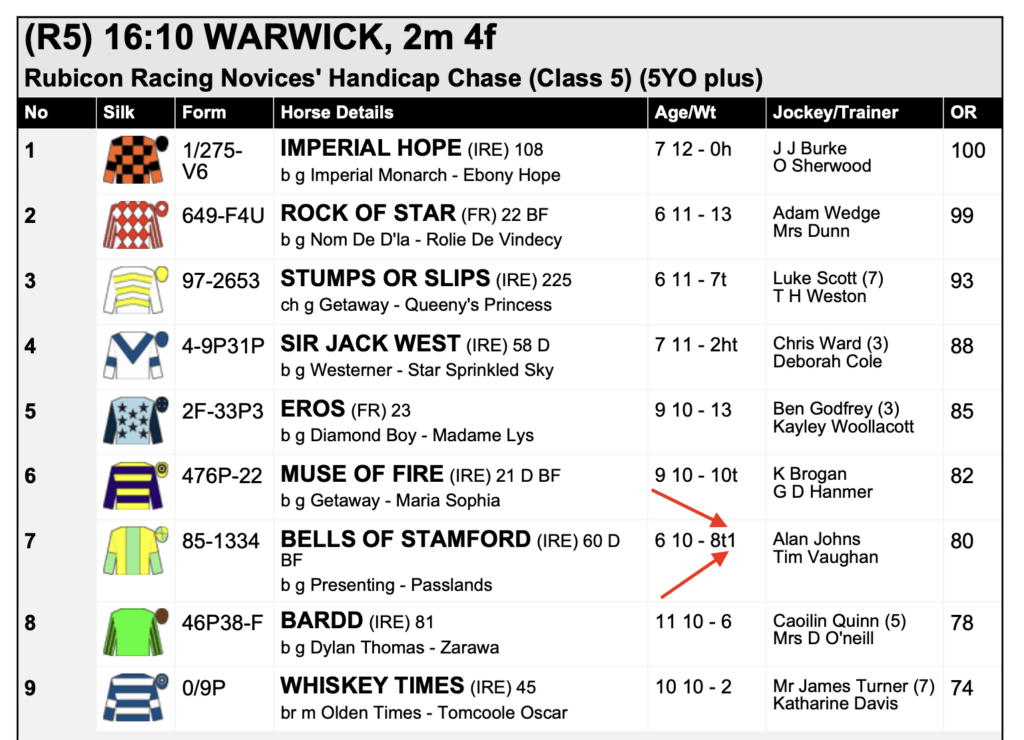
On a racecard, t1 means a horse is wearing a tongue strap for the first time in a race. The letter t indicates a tongue strap, while the number 1 identifies first-time use.
A tongue strap does not guarantee improved breathing or performance. Its effect depends on the individual horse and the reason it has been fitted. When assessing a runner, consider its previous form, any known breathing issues, the trainer’s decision and the demands of the race.
Today’s Horses Wearing Tongue Straps
Tongue straps are declared as part of a horse’s racing equipment. Racecards identify runners wearing them, including horses using a tongue strap for the first time.
Check the latest today’s racecards for declared equipment. A t1 symbol is worth noting when assessing a horse, but it should not be treated as a selection in its own right.
A horse’s recent performances, distance, going, opposition and available odds remain central to its chance. The tongue strap provides another piece of information to consider alongside those factors.
What Is a Tongue Strap in Horse Racing?
A tongue strap is a strip of suitable material used to hold a horse’s tongue in position. It is fitted by someone responsible for the horse and must comply with the rules governing racing equipment.
The equipment is sometimes called a tongue tie. The two terms refer to the same general type of racing equipment.
Unlike blinkers or a visor, a tongue strap does not restrict a horse’s vision. It is associated with the position of the tongue and its possible effect on the upper airway or the horse’s interaction with the bit.
A tongue strap should not be confused with other items covered in our horse racing headgear guide. Racecards distinguish between different types of equipment because they serve different purposes.
Why Do Racehorses Wear Tongue Straps?
Trainers may use a tongue strap when they believe the position or movement of a horse’s tongue could contribute to a problem during exercise.
One reason is concern about upper-airway function. Some horses experience breathing difficulties during strenuous exercise, and a trainer or veterinary surgeon may consider whether a tongue strap is appropriate.
Another reason is a horse moving its tongue over the bit. This can interfere with the normal contact between the jockey’s hands and the horse’s mouth.
Neither issue can be diagnosed from a racecard symbol. A horse wearing a tongue strap does not necessarily have a confirmed breathing disorder, and a first-time declaration does not reveal the trainer’s full reasoning.
A horse that has previously weakened late in a race may have done so because of the pace, distance, ground, opposition or another factor. The fitting of a tongue strap does not establish that its earlier performances were affected by breathing.
Can a Horse Swallow Its Tongue?
No. A horse does not literally swallow its tongue during a race.
The expression is sometimes used when discussing tongue straps, but it gives an inaccurate impression of the problem trainers may be trying to address.
A horse can experience upper-airway difficulties during exercise. One condition that may affect performance is dorsal displacement of the soft palate, in which the soft palate moves from its normal position relative to the epiglottis. This can interfere with airflow.
A tongue strap may be considered as part of managing an individual horse, but it is not a universal treatment for upper-airway disorders. Veterinary assessment is important when a breathing problem is suspected.
What Does t1 Mean on a Racecard?
The symbol t1 means a horse is wearing a tongue strap for the first time in a race.
A horse that has worn a tongue strap in a previous race is generally identified by t rather than t1. Racecard layouts vary, so the symbol may appear beside the horse’s weight or elsewhere in its runner details.
| Racecard symbol | Meaning |
|---|---|
| t | Tongue strap |
| t1 | Tongue strap for the first time |
| b1 | Blinkers for the first time |
| v1 | Visor for the first time |
| p1 | Cheekpieces for the first time |
| h1 | Hood for the first time |
The t1 symbol refers to the horse’s first race wearing a tongue strap. It does not mean the equipment has never been used during training.
For other racecard abbreviations, see our horse racing terms explained page.
Do Tongue Straps Help Horses Breathe?
A tongue strap may be used in an attempt to help an individual horse with a particular upper-airway problem, but its effectiveness is not established for every horse or every breathing condition.
A horse’s airway involves several structures. Holding the tongue in position does not address every possible cause of restricted airflow during exercise.
It is therefore inaccurate to assume that every horse wearing a tongue strap has a breathing problem or that the equipment will automatically increase the amount of air reaching its lungs.
When a horse has a suspected respiratory issue, the relevant veterinary findings matter more than the equipment symbol on its racecard.
Do Tongue Straps Improve Racing Performance?
Some horses may perform better after a tongue strap is fitted. Others may show little change or run below their previous level.
The result of one race cannot establish whether the tongue strap caused a change in performance. A horse may also have encountered more suitable ground, a different distance, a weaker field or a more favourable pace.
The most useful comparison is between performances under similar conditions. Review how the horse travelled during the race, whether it maintained its effort and whether any previously observed problem appeared again.
Our guide to analysing a horse race explains how to assess these factors together rather than relying on a single equipment change.
How to Assess a Horse Wearing a Tongue Strap for the First Time
First-time tongue straps are most useful as a prompt to investigate a horse’s previous performances. The symbol alone provides too little information to support a bet.
Review Its Previous Form
Start with the horse’s recent results and race comments. Look for a repeated pattern rather than one disappointing run.
A horse that travelled well before weakening may have failed to stay the distance or raced too quickly early on. A horse that lost its position before the closing stages may have faced a different problem.
Read the comments alongside the race conditions. Our horse racing form guide provides a starting point for interpreting previous performances.
If a race replay is available, watch how the horse travelled and responded when its jockey asked for an effort. A replay can add context that a brief written comment cannot capture.
Check for Previous Wind Surgery
A tongue strap and wind surgery are different interventions. A tongue strap is equipment fitted for a race, while wind surgery is a veterinary procedure.
A horse may have a history of wind surgery and also wear a tongue strap, but one does not establish why the other has been used.
Assess any declared wind-surgery information separately. Our horses after wind surgery page explains how to approach a runner returning after a procedure.
Do not assume that the combination of wind surgery and a tongue strap guarantees a better performance.
Consider the Distance
Distance is particularly important when assessing a horse that has weakened in previous races.
A runner moving up in trip may face a greater stamina test. A runner dropping in distance may encounter a faster early pace.
If a horse wears a tongue strap for the first time while changing distance, it becomes harder to attribute any improvement to the equipment alone.
Compare its previous performances over similar trips and assess whether the new race conditions suit its established form.
Assess the Likely Pace
A strongly run race can expose stamina limitations and make it difficult for a horse to sustain its effort.
A slowly run race may produce a different result, particularly for a horse that prefers to settle before quickening.
Use the likely running styles of the field to assess how the race may develop. Our pace maps guide explains how to approach that analysis.
A tongue strap does not remove the need to consider pace, race position and the horse’s preferred way of running.
Check the Going and Course
A horse’s suitability for the ground and track can have a substantial effect on its performance.
A runner with strong form on good ground may face a different test on heavy going. A horse that has performed well on a galloping course may not reproduce that effort on a sharper track.
If the tongue strap is fitted at the same time as a favourable change in conditions, keep those factors separate when assessing the result.
Examine the Trainer’s Record
A trainer’s record with first-time tongue straps may provide useful context if it is based on enough runners and relevant race conditions.
A high strike rate from a handful of horses is not a reliable system. Check the number of runners, the period covered and the prices of the winners before drawing conclusions.
Recent stable form can also provide context. Our in-form trainers page helps identify yards whose runners have been performing well, although it cannot predict how an individual horse will respond to a tongue strap.
Tongue Straps and Other Racing Equipment
A tongue strap can appear on a racecard alongside other equipment. Each item should be assessed separately.
Blinkers restrict some of a horse’s side and rear vision. They are generally used when a trainer wants to influence concentration. Our first-time blinkers page explains what b1 means and how to assess the change.
A visor also restricts vision but has openings in its eye cups. Cheekpieces and hoods have different designs and purposes.
A horse wearing a tongue strap and blinkers for the first time has undergone more than one equipment change. If its performance improves, the race alone may not establish which change, if either, made the difference.
Are Tongue Straps Painful or Harmful to Horses?
A tongue strap should not be described as automatically painless or harmless.
Restraining the tongue can cause discomfort, and concerns about pressure, restricted blood flow and tissue injury are relevant to how the equipment is fitted and used. A horse’s response can vary.
The welfare of the individual horse must take priority over any possible performance benefit. Racing authorities regulate equipment, and those responsible for a horse must comply with the applicable rules.
A racecard declaration tells you that a horse is scheduled to wear a tongue strap. It does not provide evidence that the horse is comfortable in it or that the equipment is necessary.
Are Tongue Straps Allowed in British Horse Racing?
Tongue straps are permitted in British racing when their use complies with the applicable rules.
The equipment must be declared, and the rules govern how it may be used. A trainer cannot treat a tongue strap as an undeclared last-minute addition.
Rules and procedures can change, so participants should consult the current British Horseracing Authority requirements rather than relying on an older description of the regulations.
For racegoers and bettors, the practical point is to check the final racecard and any official equipment updates before the race.
Are First-Time Tongue Straps a Profitable Betting System?
Backing every horse wearing a tongue strap for the first time is not a sound betting method on its own.
Trainers fit the equipment for different reasons, and the horses involved have different levels of ability, form and suitability for their races.
A meaningful statistical analysis needs a defined period, a sufficient sample and consistent treatment of prices and returns. It should distinguish between first-time use and horses that have worn a tongue strap previously.
Even a method that produces winners can lose money if the winning prices are too short. Compare the available odds with your assessment of the horse’s chance.
Our bet calculator can help check potential returns, while the betting odds drifting guide explains why a horse’s price may change before the off.
Tongue Straps in Major Races
Tongue straps can be declared in races at different levels. The significance of the equipment depends on the individual runner and the demands of the contest.
In a staying chase such as the Cheltenham Gold Cup, a horse still needs the stamina, jumping ability and class required by the race. A tongue strap cannot compensate for a lack of those qualities.
The Grand National presents its own demands over an extended distance and distinctive fences. Previous experience, jumping and stamina remain essential considerations when assessing a runner wearing new equipment.
For a younger Flat horse in a race such as the Dewhurst Stakes, previous form and the horse’s development are important. A first-time tongue strap is one detail within that wider assessment.
What to Look for After a Horse Runs in a Tongue Strap
The first race provides evidence about how the horse performed while wearing the equipment.
Review the race replay and compare the performance with its previous runs. Consider how the horse travelled, whether it settled, how it responded under pressure and whether it maintained its effort.
A better finishing position is encouraging only when considered alongside the quality of the opposition and the race conditions.
If the horse wears the tongue strap again, its next start may help establish whether the performance was repeatable. If the trainer removes it, do not assume that the equipment failed. The decision may reflect information that is not publicly available.
Tongue Strap FAQs
What is a tongue strap in horse racing?
A tongue strap, also called a tongue tie, is equipment used to hold a horse’s tongue in position. Trainers may use it when they believe it could help with an upper-airway issue or prevent the tongue from moving over the bit.
What does t1 mean on a racecard?
t1 means the horse is wearing a tongue strap for the first time in a race. The letter t identifies the equipment and the number 1 indicates first-time use.
What does t mean on a racecard?
The letter t indicates that a horse is declared to wear a tongue strap. Without the number 1, it does not identify the run as the horse’s first race in the equipment.
Can a racehorse swallow its tongue?
No. Horses do not literally swallow their tongues. The phrase is an inaccurate description sometimes used when discussing breathing problems and tongue straps.
Do tongue straps make horses run faster?
A tongue strap does not increase a horse’s natural speed. It may help an individual horse if it addresses a particular problem, but improvement is not guaranteed.
Does a tongue strap mean a horse has a breathing problem?
Not necessarily. Trainers may use tongue straps for different reasons, and the racecard does not identify a diagnosis.
Are tongue straps the same as blinkers?
No. Blinkers restrict part of a horse’s vision, while a tongue strap holds the tongue in position. The two types of equipment have different purposes.
Should I back a horse wearing a tongue strap for the first time?
The t1 symbol alone is not a reason to back a horse. Assess its form, distance, going, pace, opposition and odds before deciding whether the equipment change is relevant.
Summary
Tongue straps are used to hold a racehorse’s tongue in position. Trainers may fit them when they believe the equipment could help with an individual horse’s upper-airway function or prevent the tongue from moving over the bit.
The t1 symbol identifies a horse wearing a tongue strap for the first time in a race. It does not confirm a breathing disorder or guarantee improved performance.
For bettors, the useful question is whether the horse’s previous form and today’s conditions support its chance. Treat the tongue strap as one part of that assessment and review the horse’s performance before drawing conclusions about its effect.