
Tomorrow’s racecards give racing followers time to study the next day’s races before race day.
Once the runners have been declared, you can begin assessing the field, recent form, jockey and trainer bookings, race conditions, weights, draw and the early betting market. Starting the evening before also gives you more time to watch previous races and investigate runners that require a closer look.
British Racecourses does not currently operate its own live racecard feed. This page explains where to find reliable racecards for tomorrow’s UK and Irish racing and, more importantly, how to use them when preparing for the next day’s action.
If you are looking at races taking place now, head to our racecards for today.
Where to Find Tomorrow’s Horse Racing Racecards
Several established racing websites publish cards for upcoming British and Irish meetings.
| Racecard Provider | Particularly Useful For |
|---|---|
| Racing Post | Detailed form, previous performances and racing analysis |
| Sporting Life | Clear racecards and accessible form information |
| Racing TV | Racecards, form and access to racing video |
| At The Races | Detailed cards, statistics and international coverage |
| Sky Sports Racing | Straightforward race and runner information |
| GG | Form and betting-focused racing information |
| MyRacing | Simple racecards and form information |
| Bookmaker racecards | Combining runners with early betting markets |
The amount of information available can change as race day approaches.
A racecard viewed the previous afternoon should therefore be treated as the beginning of the analysis rather than the final version of the race.
What Racing Is On Tomorrow?
British and Irish racing takes place throughout the year across Flat, All-Weather and National Hunt fixtures.
Tomorrow’s programme could include racing from several courses, with meetings running from the afternoon into the evening.
British Racecourses has individual guides to UK racecourses and Irish racecourses if you want to understand the characteristics of a particular track.
Our racecourse guides are especially useful before analysing a meeting at an unfamiliar venue. Course configuration, gradients, bends, fences, run-ins and draw characteristics can all affect the way races unfold.
For meetings further ahead, use our horse racing fixtures resources rather than relying on a racecard for tomorrow only.
Why Look at Tomorrow’s Racecards?
The main advantage is time.
Trying to analyse an entire afternoon of racing shortly before the first race encourages shortcuts. Looking at the previous day allows you to decide which races deserve closer attention.
You do not need to analyse every race.
A better starting point is to identify contests where you understand the conditions and have enough information to form a view.
Tomorrow’s cards can help you:
- Identify races worth studying
- Check declared runners
- Examine recent form
- Review previous races
- Assess course and distance records
- Consider tomorrow’s going
- Look at weights and ratings
- Assess the draw on Flat races
- Build an initial pace map
- Compare early betting prices
- Prepare a shortlist for raceday
The important word is initial.
Going, non-runners, prices and sometimes riding arrangements can change before the race.
What Is Included on Tomorrow’s Racecards?
The precise layout varies by provider, but most established cards include the same core information.
Racecourse and Off Time
The venue and scheduled race time identify the contest.
Do not treat the course as background information.
A horse returning to a track where it has previously performed well may be facing conditions that suit its running style. Conversely, a horse with strong recent form may be encountering a very different test.
Race Type
Establish exactly what race you are analysing.
A maiden presents a different analytical problem from an exposed older-horse handicap. A novice chase differs considerably from a large-field handicap hurdle.
Understanding the race type helps determine which pieces of form deserve the most weight.
Race Class
Class gives context to previous performances.
Finishing fourth in a strong contest can represent better form than winning a much weaker race.
Look at what the horse faced previously rather than judging form purely from finishing positions.
Distance
Check whether tomorrow’s trip is suitable.
Previous wins over the distance are useful evidence, but they are not the only evidence.
A horse stepping up in trip may have shaped as though the extra distance will suit. Another may repeatedly weaken late despite having previously completed races over the same trip.
Declared Runners
Tomorrow’s racecard provides the horses currently due to compete.
The composition of the field matters because races are shaped by the horses within them.
A field containing several habitual front-runners creates a different tactical problem from one containing no obvious leader.
Jockeys
Check who is booked to ride.
A jockey booking can add context, particularly when a stable has several horses running or a jockey has an established relationship with the horse.
Avoid turning jockey statistics into a standalone selection method. The horse, race and price remain more important.
Trainers
Trainer form is another useful piece of evidence.
A stable operating well can be worth noting, but a high recent strike rate does not make every runner from that yard a good bet.
British Racecourses also tracks racing information around trainers, jockeys and current form as part of our wider analysis coverage.
Weight and Official Rating
Weights and ratings become particularly important in handicaps.
Compare tomorrow’s mark with ratings from previous performances.
A horse dropping to a mark from which it has previously competed strongly may deserve investigation. The age of that form, current condition and suitability of tomorrow’s race still matter.
Recent Form
Form figures provide a quick summary of finishing positions.
They do not explain how those results were achieved.
A horse can run much better than its finishing position after encountering traffic, racing against a pace bias or competing in stronger company.
Use the card to identify the previous races, then investigate the performances that matter.
Draw
The draw applies to Flat racing and can matter considerably at certain course-and-distance combinations.
Do not rely on a general rule such as “low is best” or “high is best”.
Draw effects depend on the particular track, distance, field size, ground and distribution of early pace.
Going
Tomorrow’s expected going deserves attention, particularly when conditions are changing.
The published description the previous evening is not guaranteed to be the description under which racing eventually takes place.
Weather, watering and course management can alter conditions.
Make an initial assessment, then check again on race day.
Odds
Some racecards display early bookmaker prices.
These are useful because they allow you to compare your assessment with the market.
They can also change considerably overnight and on the morning of racing.
A shortening price does not prove that a horse will win, just as a drifting price does not automatically mean it should be opposed.
How to Analyse Tomorrow’s Racing the Night Before
The extra time available is most useful when the analysis follows a sensible order.
1. Look Through the Meetings
Start with the complete programme.
Identify the racecourses, race types and races that interest you.
You may know one course particularly well or have a stronger understanding of handicaps than novice races. Concentrating on races where you have useful knowledge is more productive than forcing an opinion on every contest.
2. Understand the Race Conditions
Before looking for a selection, establish:
- Class
- Distance
- Going
- Race type
- Field size
- Age restrictions
- Handicap conditions where relevant
This establishes what the horses are being asked to do.
3. Examine the Strongest Form
Look for performances that relate closely to tomorrow’s conditions.
Recent form is useful, but relevance matters more than recency alone.
A strong performance over the same course and distance six months ago can sometimes tell you more than an unsuitable run two weeks ago.
4. Check the Strength of Previous Races
Do not assume identical finishing positions represent identical performances.
Consider the horses a runner competed against and what those horses have done subsequently.
Strong form lines can reveal that a seemingly ordinary performance came in a better race than the bare result suggests.
5. Review Important Replays
Race replays can answer questions the racecard cannot.
You may discover that a horse:
- Travelled strongly but lacked room
- Raced on the unfavoured part of the track
- Used too much energy early
- Jumped poorly
- Stayed on after the race was effectively over
- Was better than its final position suggests
Do not search every replay indiscriminately. Focus on runs where the result needs explanation.
6. Build the Likely Pace
Identify the horses that usually lead, race prominently, sit midfield or are held up.
Then consider how those styles interact.
A front-runner with no obvious pace rival can face a very different race from one drawn alongside three other horses that also want the lead.
This is one of the areas where preparing the night before can provide a major analytical advantage: you have time to examine how each runner normally races rather than relying on a quick impression.
7. Add the Draw
For Flat racing, combine the stall positions with the expected pace.
A favourable historical draw can lose some of its advantage if the horse cannot obtain the position it needs.
Pace and draw frequently make more sense together than separately.
8. Create a Shortlist
You should now have a much clearer view of the race.
A shortlist does not need to contain a selection.
Sometimes the correct conclusion is that the race is too difficult, too dependent on uncertain conditions or priced too efficiently to interest you.
Leaving a race alone is a valid outcome of race analysis.
9. Compare the Early Prices
Only after assessing the race should price become central to the decision.
The horse you consider most likely to win is not necessarily the horse offering the best betting value.
Compare the available odds with your assessment of the horse’s chance.
Tomorrow’s Racecards and Early Prices
Looking at tomorrow’s racing often means encountering markets before race day.
Early prices can move as bookmakers take bets and the market develops.
There is no rule that says an early price will be better than the price available tomorrow.
Sometimes a horse shortens. Sometimes it drifts.
The important question is whether the available price represents value based on your assessment at the time you place the bet.
This is also where comparing bookmakers becomes important.
A horse might be available at different odds across several betting sites, while each-way terms can also differ.
British Racecourses compares the
Best Horse Racing Betting Sites specifically from a racing perspective.
Early Prices Are Not the Same as Ante-Post Betting
These terms are sometimes used too loosely.
Betting on tomorrow’s declared racing at an early price is different from placing a traditional ante-post wager weeks or months before a major race.
Ante-post markets can involve different non-runner conditions and additional uncertainty because the final field may not yet be known.
Our
Ante-Post Betting guide explains how those markets work and why checking the bookmaker’s non-runner terms is important.
For tomorrow’s racing, always establish the actual market and conditions under which your bet is being accepted rather than assuming all advance bets are settled in the same way.
Tomorrow’s Going
The going is one of the pieces of information most likely to require another check.
If tomorrow is expected to be dry and warm, atheturf course cmay differfrom the previous day’s description.
Heavy overnight rain can move conditions in the opposite direction.
This matters because going affects more than individual horse preference.
It can alter:
- Race pace
- Stamina demands
- Draw effects
- The part of the track jockeys want to use
- The significance of previous form
Treat the forecast going as part of your preliminary analysis.
Use the confirmed rrace-dayinformation for your final assessment.
Tomorrow’s Non-Runners
A declared horse can still become a non-runner.
This is another reason not to regard the previous evening’s analysis as finished.
A withdrawal can affect the race in several ways.
If the horse was an expected front-runner, the pace map can change.
If it occupied an important stall, the draw setup can change.
A reduced field can alter each-way terms.
Withdrawals can also affect prices and lead to Rule 4 deductions under applicable betting rules.
Always check the final field again.
Tomorrow’s Racecards and Pace Analysis
Tomorrow’s cards provide enough time to do one of the most useful pieces of pre-race work: establish how the race might be run.
Start by categorising each runner’s normal position.
Look for habitual leaders and prominent racers.
Then identify horses that prefer to settle behind the pace.
The aim is not to predict exactly where every horse will sit. Races are too variable for that.
Instead, identify potential pressure points.
Three committed front-runners in the same race could create strong early competition. One obvious leader in a field without another habitual pace horse could have an easier route to its preferred position.
British Racecourses has separate resources explaining pace maps and pace bias for readers who want to develop this part of their analysis further.
Tomorrow’s Racecards and Draw Analysis
Draw analysis is particularly useful when you have enough time to examine the specific course and distance.
Historical draw statistics need context.
A raw percentage can be distorted by:
- Field sizes
- Going
- Small samples
- Changes to rail positions
- Differences in horse ability
- Where the early pace was situated
Look at the evidence, then relate it to tomorrow’s actual runners.
The purpose is to understand how the stalls could influence this particular race rather than finding a historical statistic and applying it mechanically.
Tomorrow’s Racecards and Form Study
The previous evening is an ideal time to move beyond the most recent form figures.
Look at:
- Class of previous races
- Winning distances
- Course form
- Distance form
- Going
- Ratings
- Race comments
- Pace setup
- Subsequent form of opponents
A sequence such as 642 may look less attractive than 112 at first glance.
Once the underlying races are examined, the first horse may have produced the stronger performances.
That distinction is one of the reasons detailed racecards are useful.
Tomorrow’s Racecards and Horse Racing Festivals
Advance preparation becomes particularly valuable during major horse racing festivals.
Meetings such as Cheltenham, Royal Ascot, Glorious Goodwood, York’s Ebor Festival and the Grand National meeting produce large amounts of form, analysis and betting information.
Trying to process everything on the morning of racing is difficult.
The previous day’s cards allow you to concentrate on the races that interest you, review key performances and establish an initial view before the volume of race-day coverage increases.
British Racecourses also maintains dedicated festival and individual-race guides that can add context on course, race history, and trends to the raw racecard.
Best Racecard Providers for Tomorrow’s Racing
The existing providers on British Racecourses remain useful because they serve slightly different needs.
At The Races Tomorrow’s Racecards
At The Races provides detailed cards covering Britain, Ireland and international racing.
The cards include runners, jockeys, form, statistics, breeding information and betting information.
You can view tomorrow’s racecards on At The Races.
Sporting Life Tomorrow’s Racecards
Sporting Life provides accessible cards with runners, jockeys, form and other racing information.
Its clear layout makes it particularly useful when moving between several meetings and races.
You can check Sporting Life racecards.
Racing Post Tomorrow’s Racecards
Racing Post provides one of the deepest racing resources available to British and Irish racing followers.
Its tomorrow page displays meetings, race times, runners and going information, with considerably more form information available within individual cards.
Some deeper Racing Post features require an appropriate subscription.
You can view Racing Post tomorrow’s racecards.
Sky Sports Racing Racecards
Sky Sports Racing provides racecards alongside its broader racing coverage.
The cards are useful for checking the principal runners, race information and form without needing the depth of a specialist form database.
Racing TV Tomorrow’s Racecards
Racing TV combines racecards with its wider coverage of British and Irish racing.
Video is particularly valuable when researching previous performances because the visual evidence can explain a run that is difficult to understand from the finishing position alone.
GG Tomorrow’s Racecards
GG provides detailed racing information with a strong form and betting focus.
It gives racing followers another source for checking tomorrow’s runners and comparing information with other racecard providers.
MyRacing Tomorrow’s Racecards
MyRacing provides cards containing runners, riders, trainers, draw and form information.
Its simpler presentation can suit readers primarily looking for the main information on tomorrow’s races.
Which Tomorrow’s Racecard Provider Should You Use?
There is little reason to restrict yourself to one source.
A racing follower might use one provider for quickly scanning tomorrow’s programme, another for detailed form and another for replays.
The important consideration is the quality and relevance of the information.
For a straightforward race, the basic card may tell you everything you need.
A competitive handicap can justify much deeper investigation.
Betting on Tomorrow’s Racing
Preparing early does not mean you need to bet early.
Separate the analysis from the decision to place a wager.
You might identify a horse you like the previous evening but decide the available price is too short.
You might also want to wait for:
- Updated going
- Non-runners
- Raceday market prices
- Confirmed each-way terms
- Additional places
- Other bookmaker racing offers
There is no benefit in forcing the timing of a bet simply because the analysis has been completed.
Compare Tomorrow’s Horse Racing Odds
Price is part of the bet.
If the same horse is available at different odds with two bookmakers, accepting the shorter price reduces the potential return without changing the horse’s chance of winning.
For regular racing bettors, comparing prices should therefore be part of the normal process.
Terms matter as well.
One bookmaker may have a stronger win price while another offers better each-way terms.
Our Best Horse Racing Betting Sites page compares bookmakers using racing-specific factors rather than judging them only on headline promotions.
Best Odds Guaranteed on Tomorrow’s Racing
Best Odds Guaranteed can be relevant when betting at an early price on qualifying horse races.
Where a bet qualifies under the bookmaker’s current BOG rules, settlement may use a bigger qualifying SP if the horse drifts after you place the bet.
Do not assume every bookmaker, market, customer or bet qualifies.
BOG terms differ and bookmakers can change them.
Check the conditions attached to the account and wager before relying on the concession.
Tomorrow’s Racecards and Each-Way Betting
Each-way terms become particularly important in larger fields.
The number of places and place fraction can materially affect the value of the wager.
Bookmakers can also offer extra places on selected races.
This creates another reason to compare the complete bet rather than the horse’s win price alone.
If you are analysing a large handicap the previous evening, note the likely field size but check the final terms again before betting.
Tomorrow’s Racecards on Betting Apps
Most leading horse racing betting apps provide access to upcoming race markets and racing information.
For racing bettors, useful app features include easy navigation between meetings, racecards, form, prices, betting markets and streaming.
An app designed well for racing can make it easier to return to tomorrow’s shortlist on raceday and check what has changed.
What Should You Recheck Tomorrow Morning?
Work done the night before should make race day easier, not eliminate the need for another check.
Before finalising a selection, revisit:
- Non-runners
- Going
- Weather
- Jockey changes
- Current odds
- Each-way terms
- Market changes
- Significant changes to the expected pace
If an important part of the original analysis has changed, reassess the race.
Do not remain committed to a selection simply because you spent time analysing it the previous evening.
A Simple Tomorrow-to-Raceday Routine
A practical routine separates deeper analysis from final checks.
The Evening Before
Study the race conditions, form, replays, course, distance, pace and draw.
Create a shortlist.
Record the prices available when you form your view.
On Raceday
Check the going and weather.
Look for non-runners and jockey changes.
Rebuild the pace map if an important runner has been withdrawn.
Compare current bookmaker odds and terms.
Then decide whether the original selection still makes sense at the available price.
This approach reduces the amount of work required immediately before racing without relying on information that may have changed overnight.
Tomorrow’s Racing on ITV
ITV broadcasts selected British horse racing rather than every meeting.
Coverage varies according to the racing calendar, with major Saturdays and festivals receiving extensive coverage.
If you are specifically looking for tomorrow’s televised races, check the current ITV Racing schedule.
Do not assume that a particular course or number of races will be shown every Saturday. The schedule changes throughout the season.
Tomorrow’s Racecards vs Today’s Racecards
The two pages serve different stages of the same process.
Tomorrow’s Racecards is for preparation.
Use it to identify races, study form, watch replays, examine pace and create a shortlist.
Today’s Racecards is for the final raceday picture.
Use our Today’s Racecards page when you return to check the latest information and continue your analysis.
This distinction is particularly important while British Racecourses does not operate its own live racecard data feed.
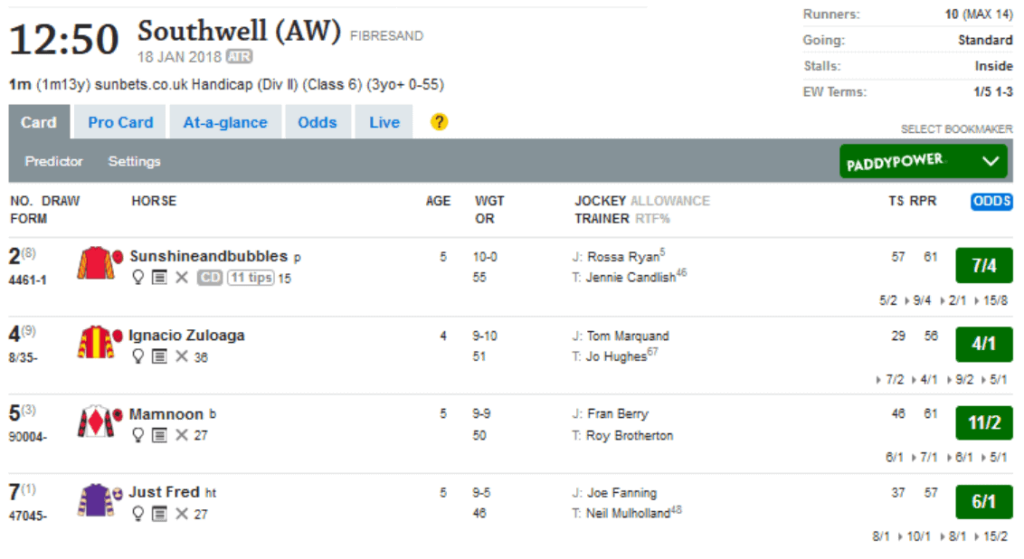
It’s worth pointing out that the runners and riders at horse racing meetings taking place tomorrow are not always featured on the individual racecourse websites the day before, so if you want to bet online before you attend a race meeting, or get some early selections made, reading the top racecards from the providers is the best way.
Tomorrow’s Racecards for Racing on ITV?
The horse racing cards tomorrow on ITV can be found here on the ITV Horse Racing Schedule.
If wanting to watch the ITV horse races you can do so going onto ITV1, which is on Sky Channel 103 and Virgin Media Channel 103.
ITV1 Horse Racing shows six live races every Saturday. These are usually the main meetings, typically at Ascot, Cheltenham, Aintree, Newbury, York, and Sandown. However, they will also cover smaller venues such as Wetherby, Wincanton, Warwick, and Uttoxeter.
Weekend horse racing on ITV television is a hugely popular event.
Tomorrow’s Racecards FAQs
What are tomorrow’s racecards?
Tomorrow’s racecards show the races and declared runners for the following day’s racing. Depending on the provider, they can include jockeys, trainers, form, weights, ratings, draw, going, breeding information, comments and betting odds.
Where can I find tomorrow’s racecards?
Tomorrow’s racecards are available from established racing providers including Racing Post, Sporting Life, Racing TV, At The Races, Sky Sports Racing, GG and MyRacing.
British Racecourses currently helps readers find and use these racecards rather than publishing its own live racecard feed.
When are tomorrow’s racecards available?
Availability depends on the race, declaration schedule and provider. Do not rely on a fixed time such as 5pm for every meeting.
Information can also be updated after the initial card appears.
Are tomorrow’s runners final?
Declared runners can still become non-runners.
Always check the field again on race day.
What should I study the night before racing?
Start with race conditions and then examine relevant form, course and distance records, ratings, going, pace and draw where appropriate.
Use replays when a previous performance needs more investigation.
Should I place my bets the night before?
Not automatically.
An early price can shorten or drift. Conditions and field composition can also change overnight.
Place a bet only when you are satisfied with the price, terms and information available at that point.
Do tomorrow’s racecards show odds?
Many racecard providers display bookmaker prices, although coverage varies.
Prices can change continuously as the market develops.
Can I find tomorrow’s UK racecards?
Yes. Major racing providers publish cards for upcoming UK meetings once the relevant information is available.
British Racecourses also provides individual guides to UK racecourses.
Can I find tomorrow’s Irish racecards?
Yes. Leading racing providers cover Irish meetings alongside British racing.
You can also use the British Racecourses Irish racecourse section for more information about individual tracks.
Are international racecards available?
Yes. Some providers cover extensive international racing alongside Britain and Ireland. The countries and meetings available differ between services.
How do I know if tomorrow’s going will change?
You cannot know with certainty.
Check the published going, weather forecast and any available course updates, then confirm the latest conditions on race day.
Why does the draw matter?
The draw determines a horse’s starting stall in Flat racing.
Its significance depends on the course, distance, field size, going and likely pace.
Should I follow horses that shorten overnight?
Price movement is information, not proof.
A horse shortening in the market does not guarantee that it will perform well, and you should not replace your race analysis with assumptions about why the price has moved.
Can I use tomorrow’s racecards to find value bets?
Racecards provide information that can help you assess a race.
Value depends on the relationship between your assessment of a horse’s chance and the price available. A racecard cannot establish value by itself.
Are tomorrow’s racecards useful if I am going racing?
Yes.
Studying the card beforehand allows you to understand the programme, runners and important races before arriving at the course.
You can then use race-day information and observations to update that initial analysis.
Summary
Tomorrow’s racecards give you time to prepare before the next day’s racing begins.
Use them to identify the races worth studying, understand the conditions, examine relevant form, review important replays and assess pace and draw.
Do not treat the previous evening’s information as final.
Check the going, non-runners, jockey changes, prices and betting terms again on race day.
British Racecourses does not currently publish its own live racecard feed. Our role is to help racing followers find reliable cards, understand the information they contain and use that information as part of a structured approach to race analysis.
Once tomorrow becomes today, move to our Today’s Racecards resources and update the analysis with the latest information.
If you decide to bet, compare both the price and the horse-racing terms available rather than automatically using a single bookmaker.
British Racecourses provides betting information for adults aged 18 and over. Betting involves financial risk, and race analysis cannot guarantee a profit.