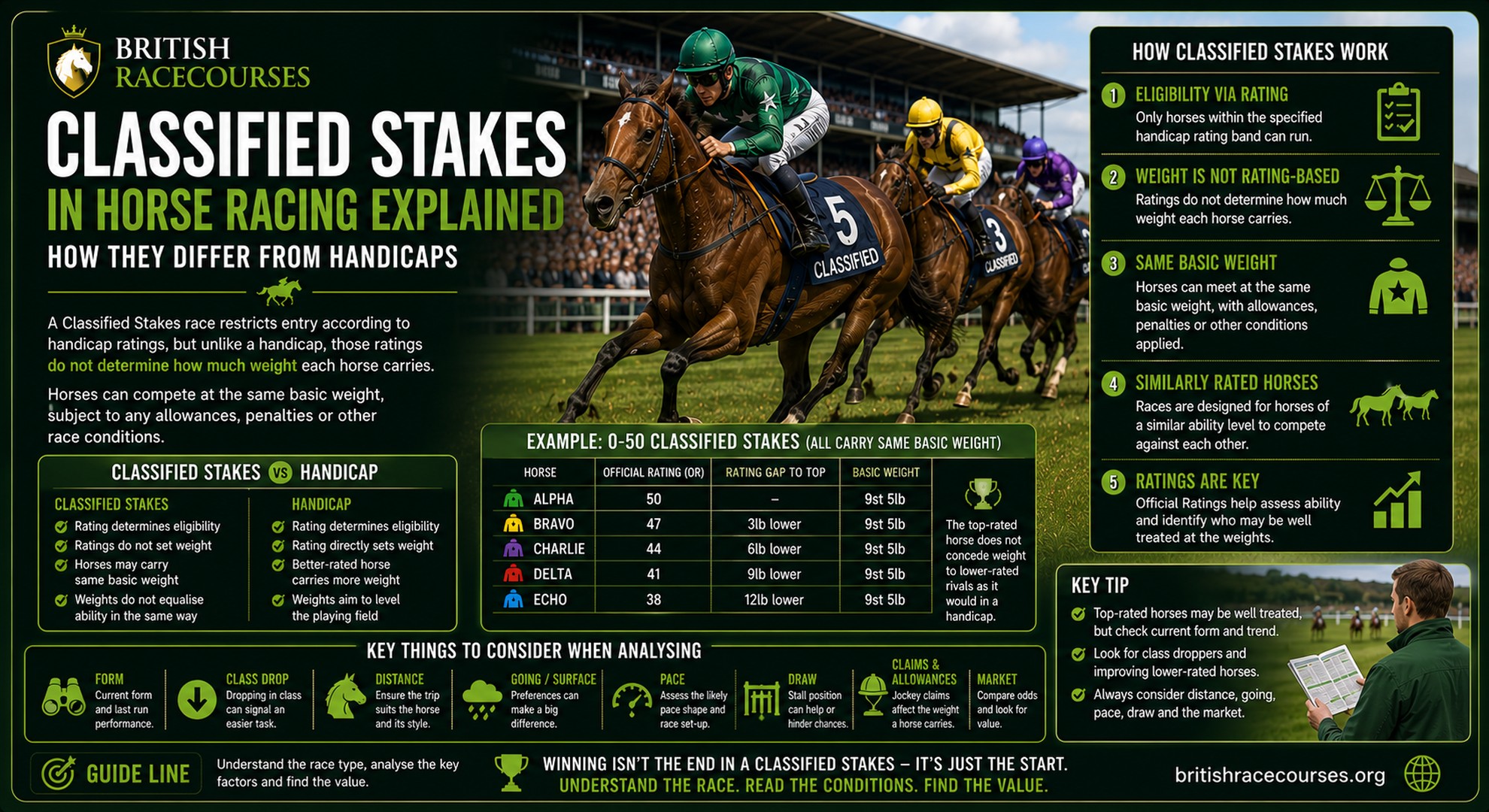
A Classified Stakes race is a race restricted to horses within a specified handicap-rating range, but unlike a handicap, those ratings do not determine how much weight each horse carries.
That difference is easy to miss.
You might see a racecard containing a horse rated 65 competing against one rated 57 and assume the lower-rated horse receives eight pounds from its higher-rated rival.
In a normal handicap, that would broadly be the principle.
In a Classified Stakes race, it is not.
The horses can compete at the same basic weight despite having different Official Ratings.
That creates a distinctive type of race where handicap ratings determine who can enter, rather than being used to equalise the runners through different weights.
For bettors, this makes understanding the ratings particularly important.
What Is a Classified Stakes Race?
A Classified Stakes race restricts entry according to the handicap ratings of the horses.
For example, a race could be restricted to horses rated:
0-50
Only horses meeting the eligibility conditions can normally compete.
However, unlike a conventional handicap, the horse rated 50 does not automatically carry more weight than one rated 45.
They can instead compete at the same basic weight, subject to any allowances, penalties or other conditions applying to that particular race.
The simplest definition is:
A handicap uses ratings to determine weight.
A Classified Stakes race uses ratings primarily to determine eligibility.
That distinction explains almost everything you need to know about the race type.
Why Is It Called a Classified Stakes Race?
The word classified refers to horses being grouped according to their level of ability.
Their Official Ratings effectively classify which horses are eligible for the race.
A 0-50 Classified Stakes, for example, is designed to provide an opportunity for horses within that lower rating band.
This differs from unrestricted races where horses of substantially different abilities could potentially meet.
The word stakes can cause confusion because racing uses it in several different contexts.
A Classified Stakes race should not be confused with a Group or Listed stakes race.
It is its own race category.
Our Type of Horse Races guide explains how Classified Stakes fit into the wider British racing programme.
How Does a Classified Stakes Race Work?
The easiest way to understand the race is to separate eligibility from weight.
Imagine a 0-65 Classified Stakes.
The field contains:
| Horse | Official Rating |
|---|---|
| Horse A | 65 |
| Horse B | 63 |
| Horse C | 60 |
| Horse D | 57 |
| Horse E | 52 |
The Official Ratings determine whether those horses qualify for the race.
Horse A sits at the top of the permitted rating band.
Horse E is rated 13lb lower.
In a standard handicap, that difference would normally be reflected substantially in their respective weights.
The lower-rated horse would receive weight from the higher-rated horse.
In the Classified Stakes race, the runners can instead compete at the same basic weight.
That creates an obvious question for bettors:
Does the higher-rated horse have an advantage?
Potentially, yes.
But the answer is more complicated than simply backing the horse with the highest rating.
Classified Stakes vs Handicap
This is the most important comparison.
In a handicap, the handicapper attempts to give horses of different abilities a more equal chance by varying the weights they carry.
The basic principle is:
Better-rated horse = more weight
Lower-rated horse = less weight
Our Horse Racing Handicap Ratings guide explains how those marks work.
Suppose two horses have ratings of:
Horse A: 70
Horse B: 62
In a conventional handicap, Horse A would normally carry more weight to reflect its eight-pound higher rating.
The aim is to reduce the difference between their abilities.
In a Classified Stakes race, the rating can determine whether they qualify without creating the same corresponding weight difference.
That means the higher-rated horse may meet its lower-rated rival on much more favourable weight terms than it would in a handicap.
Simple Comparison
| Feature | Classified Stakes | Handicap |
|---|---|---|
| Official Rating matters | Yes | Yes |
| Rating determines eligibility | Yes | Yes |
| Rating directly determines weight | No | Yes |
| Runners may carry same basic weight | Yes | Usually not |
| Designed for similarly rated horses | Yes | Yes |
| Weight attempts to equalise ability | Not in the same way | Yes |
That final point is crucial.
A handicap actively uses weight to try to compensate for differences in ability.
A Classified Stakes race does not operate in the same way.
What Does 0-50 Classified Stakes Mean?
A 0-50 Classified Stakes is designed for horses whose handicap ratings satisfy the specified conditions, with 50 representing the upper rating limit.
You may see other rating bands depending on the race programme.
The number gives bettors an immediate indication of the level of horse the race is intended to accommodate.
A 0-50 contest sits towards the lower end of the racing programme.
That does not mean it is necessarily easy to analyse.
Lower-rated horses can be inconsistent.
Small changes in:
- fitness
- distance
- going
- surface
- pace
- draw
- tactics
can produce significant changes in performance.
A horse does not need to improve dramatically to become much more competitive against rivals operating within a narrow rating range.
Why Do Classified Stakes Exist?
Classified Stakes provide opportunities for horses of broadly similar assessed ability to compete without using the conventional handicap-weight structure.
They are particularly useful for horses that need appropriate races within their rating level.
This matters because the British racing population contains horses across a huge range of ability.
Elite horses have Group and Listed opportunities.
Progressive horses can move through novice and handicap company.
Lower-rated horses also require races in which they can compete against suitable opposition.
Classified Stakes help provide those opportunities.
Are Classified Stakes Only for Low-Rated Horses?
No.
You should not define Classified Stakes solely as low-grade races.
The structure can be used at different rating levels.
However, many everyday Classified Stakes that bettors encounter involve horses towards the lower end of the ratings scale.
This is why 0-50 and similar contests are particularly recognisable.
The important feature is not the absolute quality of the horses.
It is that eligibility is linked to rating while the weights are not allocated in the same way as a handicap.
Do All Horses Carry Exactly the Same Weight?
Not necessarily.
Saying Classified Stakes are simply “level-weight races” can be misleading because other race conditions can affect what individual runners actually carry.
Depending on the conditions, differences can arise through factors such as:
- age
- sex allowances
- penalties
- jockey allowances
- specific race conditions.
The important point is that the horses’ different handicap ratings are not being translated directly into different weights as they would be in an ordinary handicap.
Always read the conditions of the individual race.
Never assume the race title tells you everything about the weights.
Why Official Ratings Matter So Much
Official Ratings are particularly interesting in Classified Stakes because they give you a direct measure of the handicapper’s assessment without the usual corresponding weight adjustment.
Consider:
| Horse | OR | Basic Weight |
|---|---|---|
| A | 50 | 9st 9lb |
| B | 49 | 9st 9lb |
| C | 46 | 9st 9lb |
| D | 43 | 9st 9lb |
| E | 40 | 9st 9lb |
Ignoring any other allowances or conditions for this simplified example, Horse A is rated 10lb superior to Horse E but meets it at the same basic weight.
On ratings alone, Horse A looks well treated.
That makes the top-rated horses an obvious starting point.
But it should only be a starting point.
Should You Always Back the Highest-Rated Horse?
No.
This is the biggest analytical trap in Classified Stakes.
A horse may have the highest Official Rating because of performances achieved several runs ago.
Its current ability could be declining.
Suppose a horse’s rating history looks like this:
67 → 63 → 59 → 55 → 51
It now enters a 0-50 Classified Stakes following another ratings adjustment.
On historical form it might look much better than most of the field.
But its rating trajectory tells another story.
The horse has been declining.
Compare that with a rival whose profile is:
42 → 43 → 45 → 47 → 49
The second horse may be improving.
The difference between their current ratings could be tiny while their trajectories are moving in opposite directions.
This is why horse racing form must be analysed alongside the numbers.
Why Top-Rated Horses Can Be Interesting
Although blindly backing the highest-rated runner is a mistake, there is a logical reason to examine horses towards the top of the permitted rating band.
Imagine a 0-65 Classified Stakes containing horses rated:
65, 64, 61, 58, 55 and 51
If the horses compete at the same basic weight, the 65-rated runner is not conceding the 14lb to the 51-rated horse that their ratings difference might imply in handicap terms.
That can give the higher-rated runner favourable theoretical terms.
The question is whether its current ability still justifies that rating.
If it does, the horse becomes interesting.
If the rating is based on form it can no longer reproduce, the apparent advantage may be misleading.
What Does “Best In at the Weights” Mean?
You may hear punters or racing analysts describe a horse as:
“best in at the weights”
This means the conditions appear favourable when comparing the horse’s ability or rating with the weight it must carry.
Classified Stakes can produce obvious examples.
Suppose:
Horse A: OR 65
Horse B: OR 55
Both carry the same basic weight.
Horse A appears better treated on the official figures because it is assessed as 10lb superior without conceding the corresponding 10lb.
But racing is not run on spreadsheets.
Horse A still needs to reproduce the performance level behind its rating.
What Is an Official Rating?
An Official Rating, commonly abbreviated to OR, is the numerical assessment assigned to a horse by the handicapper.
A higher number indicates a higher assessed level of ability.
A horse rated 70 is therefore assessed as superior to one rated 60.
Ratings change as horses produce new performances.
They help determine:
- handicap eligibility
- handicap weights
- entry into rating-restricted races
- the general level at which horses compete.
Our Handicap Ratings Explained page covers the process in detail.
Does a Horse Need a Handicap Rating to Run?
Classified Stakes are rating-related races.
Horses therefore need the required rating and must satisfy the applicable eligibility conditions.
This is important because Classified Stakes are not simply open races where any horse can turn up because connections like the conditions.
The rating forms a central part of determining whether the horse qualifies.
Classified Stakes and the 2026 British Racing Programme
Classified Stakes continue to play a practical role in British racing.
They are particularly relevant to some horses at the bottom of the Flat handicap ratings.
Changes to the British racing programme have increased the importance of alternative opportunities for very low-rated horses that may have limited handicap options.
That can include races such as:
- Classified Stakes
- sellers
- claimers
- eligible maidens
- eligible novice races.
This makes understanding the category worthwhile rather than treating Classified Stakes as an obscure race type.
They are part of the route through which horses can continue competing against suitable opposition.
Are Classified Stakes Flat Races?
Classified Stakes are strongly associated with Flat racing, including everyday turf and all-weather racing.
The broader racing structure also provides rating-related weight-for-age opportunities over Jumps.
For everyday punters, however, the Flat version is likely to be the Classified Stakes format encountered most frequently on racecards.
Always read the individual race conditions rather than assuming every similarly named contest operates identically.
How to Analyse a Classified Stakes Race
Classified Stakes reward a slightly different approach from conventional handicaps.
Ratings matter, but they need context.
1. Start With the Official Ratings
Create a simple ratings hierarchy.
For example:
| Horse | OR |
|---|---|
| Red | 50 |
| Blue | 50 |
| Green | 48 |
| Yellow | 45 |
| Black | 43 |
| White | 39 |
The two horses rated 50 immediately deserve attention.
They sit at the top of the permitted range.
But do not stop there.
Ask how those ratings were earned and whether the horses remain capable of running to them.
2. Compare the Actual Weights
Next, look at what each horse will actually carry.
Do not simply assume every runner has identical terms.
Check:
- basic weight
- age allowances
- sex allowances
- penalties
- jockey claims
- any other relevant race conditions.
The racecard gives you the information needed to establish the actual weight each horse carries.
3. Study Recent Form
Current form is critical.
A horse can be theoretically well treated on ratings while performing poorly.
Look beyond finishing position.
Suppose a horse’s last three results are:
7th, 6th, 5th
That appears weak.
But perhaps those races were:
- stronger handicaps
- over an unsuitable distance
- on unsuitable ground.
Today’s Classified Stakes could represent a substantial drop in difficulty.
Alternatively, the horse may simply be regressing.
You need to establish which explanation is better supported by the evidence.
4. Look for Horses Dropping in Class
Class droppers can be particularly interesting.
A horse moving from stronger handicap company into a weaker Classified Stakes race may find the opposition easier.
Our Horses Dropped in Class Today page can help identify runners changing grade.
But never treat a class drop as an automatic positive.
Ask:
Why is the horse dropping?
A trainer might have found an ideal opportunity.
Or the horse’s recent performances might show it is no longer competitive at the previous level.
5. Look for Improving Lower-Rated Horses
The opposite angle can be equally important.
A lower-rated horse may be improving faster than its current Official Rating reflects.
This is particularly interesting when the horse has:
- few career starts
- recently changed distance
- switched surface
- joined a new trainer
- recently been gelded
- started wearing effective headgear
- produced a career-best performance.
An exposed 50-rated horse is not automatically preferable to an improving horse rated 46.
Ratings describe assessed ability.
They do not freeze horses permanently at that level.
6. Check Distance
The best horse on ratings can still be vulnerable over the wrong trip.
Suppose the highest-rated horse has produced all its best performances over six furlongs.
Today’s race is over a mile.
The rating advantage remains interesting, but stamina becomes a major uncertainty.
Conversely, a horse returning to its optimum distance can improve sharply.
Analyse:
- previous wins
- strongest performances
- finishing effort
- pedigree where relevant
- pace requirements.
Distance suitability should never be sacrificed simply because a horse looks well treated at the weights.
7. Check the Going
Turf conditions can transform a race.
A horse rated 50 may have earned that mark predominantly on good or fast ground.
If today’s race takes place on heavy ground, its rating may be less relevant.
Another horse rated 45 could have repeatedly shown its best form in testing conditions.
That horse might be better suited to the actual race despite having a lower Official Rating.
The same principle applies to different all-weather surfaces.
8. Examine All-Weather Form
Classified Stakes regularly appear within all-weather racing.
Do not assume all synthetic surfaces are identical.
Horses can have different records at:
- Newcastle
- Southwell
- Wolverhampton
- Kempton
- Lingfield
- Chelmsford.
Some prefer Tapeta.
Others perform better on Polytrack.
Course configuration also matters.
A horse’s overall all-weather record can therefore hide important differences.
9. Analyse the Pace
Pace can decide a Classified Stakes just as easily as a major handicap.
Imagine a seven-runner race where six horses normally race towards the rear.
One horse regularly leads.
That runner could obtain an uncontested advantage.
Now imagine four habitual front-runners meeting.
The opposite could happen.
They may compete for the lead and create a pace that favours horses held up behind them.
Our Horse Racing Pace Maps guide explains how to estimate the likely race shape.
Ratings tell you about ability.
Pace tells you how that ability may be deployed.
10. Consider the Draw
Draw bias matters at some Flat courses and distances much more than others.
A horse can be:
- highly rated
- in form
- suited by the distance
- well treated at the weights
and still face a tactical disadvantage from its stall.
The importance of the draw depends on the particular race.
Our Horse Racing Draw guide explains why stall position needs to be considered alongside pace and course configuration.
11. Check Jockey Claims
Where permitted, a jockey allowance can alter the effective weights.
An apprentice’s claim could mean one horse carries less than another despite the underlying race conditions.
That does not automatically make the horse better treated.
You should consider both:
- the weight removed
- the ability and experience of the jockey.
Our Jockey Claims in Horse Racing guide explains apprentice and conditional allowances.
12. Look at Headgear
Lower-level races often contain exposed horses whose trainers are trying different ways to produce improvement.
That can include:
- first-time blinkers
- cheekpieces
- visors
- hoods
- headgear being reapplied.
Check the horse’s previous response to equipment.
Our Horse Racing Headgear guide explains what the main types are designed to do.
First-time headgear can be significant.
It is not automatically positive.
13. Look for Trainer Changes
A horse joining a different trainer deserves attention.
The new yard might:
- change its distance
- alter training
- switch surface
- change tactics
- apply different headgear
- freshen the horse up.
Some horses improve immediately.
Others do not.
Treat the trainer change as a reason to investigate rather than a reason to bet.
14. Consider Recent Sellers and Claimers
Horses can move between different parts of the lower-level racing programme.
A runner in today’s Classified Stakes might recently have contested a seller or claimer.
That does not make it inferior.
Instead, compare the actual level of opposition.
Our guides to Selling Races and Claiming Races explain how those categories operate.
The label attached to a race matters less than the quality of horses that competed in it.
15. Watch the Market
Classified Stakes can contain obvious-looking runners.
A horse sitting at the top of the ratings and dropping from handicap company may attract substantial support.
That can be informative.
But price remains crucial.
Suppose you estimate a horse has a:
40% chance of winning
Its fair decimal odds are:
1 ÷ 0.40 = 2.50
If bookmakers offer 3.00, your assessment suggests potential value.
If the horse is backed into 1.80, the situation changes.
It may still be the most likely winner.
That does not mean it remains a good bet.
Our How to Find Value Bets in Horse Racing guide explains why probability and price need to be considered together.
Worked Example: 0-50 Classified Stakes
Imagine a six-runner Classified Stakes over seven furlongs.
| Horse | OR | Recent Form | Best Distance |
|---|---|---|---|
| Alpha | 50 | 6-5-4 | 7f |
| Bravo | 49 | 2-3-2 | 7f |
| Charlie | 47 | 8-6-7 | 6f |
| Delta | 45 | 3-1-4 | 7f |
| Echo | 42 | 5-5-6 | 1m |
| Foxtrot | 39 | 9-8-7 | 6f |
Alpha
Alpha has the highest rating.
It has also been running in stronger races and is proven over seven furlongs.
That gives it a strong theoretical chance.
Bravo
Bravo is rated only one pound below Alpha but arrives in considerably better form.
It is also proven over the trip.
This makes Bravo an obvious danger.
Delta
Delta is rated five pounds below Alpha but has recently won.
If that performance suggests improvement beyond its current rating, Delta could be more competitive than the raw numbers imply.
Foxtrot
Foxtrot is rated 11 pounds below Alpha and arrives in poor form.
Meeting Alpha at similar basic weights appears difficult.
Unless there is a compelling reason to expect major improvement, Foxtrot has plenty to find.
Now consider the prices:
Alpha: 7/4
Bravo: 5/2
Delta: 6/1
The highest-rated horse is not automatically the bet.
You need to decide whether Alpha’s theoretical ratings advantage justifies 7/4, whether Bravo’s current form makes 5/2 preferable, or whether Delta’s improving profile is underestimated at 6/1.
That is the difference between identifying the most obvious horse and finding a worthwhile price.
Are Classified Stakes Easier to Analyse Than Handicaps?
Not necessarily.
At first glance they can appear easier because you can compare ratings without the conventional handicap-weight adjustment.
But many Classified Stakes contain:
- exposed horses
- inconsistent runners
- declining horses
- horses changing conditions
- runners trying different distances
- horses switching surfaces.
That creates uncertainty.
A Group-class horse might have a relatively stable level of ability.
A low-rated horse can fluctuate considerably from one race to another.
That makes understanding the circumstances behind each performance important.
Why Low-Rated Racing Can Be Difficult
A common misconception is that lower-class racing must be easier to predict because the horses are less talented.
Ability and predictability are different things.
A lower-rated horse may have:
- physical limitations
- inconsistent form
- strong surface preferences
- temperament issues
- declining ability
- tactical dependencies.
Small differences can decide the race.
A favourable pace setup or return to a preferred surface can be enough to transform a horse’s chance.
This is why simply sorting the field by Official Rating is insufficient.
Classified Stakes vs Conditions Race
These race types can appear similar because neither operates like a conventional handicap.
But they are not identical.
In a Classified Stakes race, the handicap rating is central to eligibility.
In a Conditions Race, weights and eligibility are dictated by the specific conditions of that race rather than operating through a standard handicap structure.
Those conditions can account for factors such as:
- age
- sex
- previous wins
- value of previous victories
- weight-for-age allowances.
Our Weight-for-Age in Horse Racing guide explains one of the major mechanisms used to allow horses of different ages to compete.
Classified Stakes vs Selling Race
A seller is defined by what happens to the horses in relation to sale after the race.
The winner is offered for auction.
A Classified Stakes race is defined by rating eligibility and race conditions.
The two concepts therefore serve completely different purposes.
Classified Stakes vs Claiming Race
A claimer allows horses to be claimed under the relevant claiming conditions.
A Classified Stakes race does not make a horse available to buy merely because it participates.
Again, these are fundamentally different race structures.
Classified Stakes vs Nursery
A nursery is a handicap restricted to two-year-olds.
The horses’ handicap ratings therefore influence the weights they carry.
Our Nursery Handicap guide explains these races in detail.
A Classified Stakes race instead uses rating primarily to determine eligibility without applying the normal handicap weight structure.
Common Mistakes When Betting on Classified Stakes
Automatically Backing the Highest-Rated Horse
The highest rating is important, but only if the horse remains capable of running to that level.
Ignoring Current Form
A declining horse can retain a rating that makes it appear stronger than its recent performances suggest.
Treating Every Runner as Carrying Identical Weight
Check the actual conditions, allowances, penalties and jockey claims.
Ignoring Class Drops
A horse moving from stronger handicap company can become much more competitive.
Ignoring Improving Horses
A lower-rated runner may be progressing beyond its current mark.
Looking Only at Ratings
Distance, surface, pace, draw and form still matter.
Assuming Lower-Class Racing Is Easy
Lower-rated horses can be highly inconsistent.
Ignoring Price
The best horse in the race can still be a poor bet at sufficiently short odds.
Classified Stakes Analysis Checklist
Before betting on a Classified Stakes race, check:
- What is the rating ceiling?
- What is each horse’s Official Rating?
- Which runners sit closest to the top of the band?
- What weight will each horse actually carry?
- Are there penalties or allowances?
- Is a jockey claiming weight?
- Which horses are in the best current form?
- Is anyone dropping significantly in class?
- Is a lower-rated horse improving?
- Which horses are suited by the distance?
- Which horses are suited by the going or surface?
- Does course form matter?
- What is the likely pace?
- Does the draw create an advantage or disadvantage?
- Is there a headgear change?
- Has the horse recently changed trainer?
- What level of opposition has each horse been facing?
- Has the betting market moved?
- What probability would you give each leading contender?
- Do the available odds offer value?
This provides a much stronger framework than simply backing the runner with the highest number beside its name.
Frequently Asked Questions
What is a Classified Stakes race in horse racing?
A Classified Stakes race restricts horses according to handicap-rating conditions, but their handicap ratings do not directly determine the weight they carry as they would in a normal handicap.
What does 0-50 Classified Stakes mean?
It indicates a Classified Stakes race with an upper handicap-rating limit of 50, subject to the complete eligibility conditions of the race.
Is a Classified Stakes race a handicap?
No. Although handicap ratings determine eligibility, a Classified Stakes race does not use those ratings to allocate weights in the same way as a conventional handicap.
Do all horses carry the same weight in a Classified Stakes?
They can compete at the same basic weight despite different ratings, but actual weights may still differ because of the specific conditions, allowances, penalties or jockey claims.
Does Official Rating matter in a Classified Stakes?
Yes. It determines eligibility and is extremely useful when comparing the theoretical ability of the runners.
Is the highest-rated horse best in at the weights?
It can be theoretically well treated because it may meet lower-rated horses without conceding the corresponding handicap weight. However, you still need to establish whether it remains capable of running to its rating.
What does OR mean on a racecard?
OR stands for Official Rating. It represents the handicapper’s assessment of a horse’s ability.
Can a horse rated below the top of the band win?
Absolutely. Current form, improvement, distance, going, pace, draw and other factors can outweigh a small ratings disadvantage.
Are Classified Stakes only for low-rated horses?
No. Classified Stakes are defined by their structure rather than simply being races for poor horses, although many everyday examples involve horses at lower rating levels.
Are Classified Stakes run on the all-weather?
Yes. Classified Stakes can feature in all-weather racing as well as turf racing.
Is a Classified Stakes the same as a Conditions Race?
No. They share some characteristics but are distinct race categories. Classified Stakes use handicap ratings to determine eligibility, while Conditions Races operate according to their specified race conditions.
Is a Classified Stakes the same as a seller?
No. A seller involves the winner being offered for auction after racing. A Classified Stakes race is based around rating eligibility.
Is a Classified Stakes the same as a claimer?
No. Horses in claiming races can be claimed under the claiming rules. Running in a Classified Stakes does not itself make a horse available to claim.
Why do trainers run horses in Classified Stakes?
They can provide suitable opportunities for horses to compete against rivals of broadly similar assessed ability without using the normal handicap weight structure.
Are Classified Stakes good races for betting?
They can produce betting opportunities, particularly when the market overvalues the highest-rated horse or underestimates an improving lower-rated runner. No race type guarantees betting value.
Summary
A Classified Stakes race uses a horse’s handicap rating to help determine whether it can enter, but unlike a conventional handicap, that rating does not directly determine how much weight the horse carries.
That creates the fundamental difference:
Handicap: rating determines eligibility and influences weight.
Classified Stakes: rating determines eligibility, but runners can meet on the same basic weight terms.
This makes Official Ratings particularly useful when analysing the race.
A horse sitting at the top of the permitted rating band can appear well treated because it may not have to concede the weight to lower-rated rivals that it would in a handicap.
But that does not mean you should automatically back the highest-rated horse.
The key question is whether the horse remains capable of reproducing the level of performance represented by its rating.
Look for:
- horses near the top of the rating band
- strong current form
- class droppers
- improving lower-rated runners
- favourable weight conditions
- suitable distance
- suitable going or surface
- advantageous pace
- useful draw positions
- jockey allowances
- trainer changes
- headgear changes
- value in the betting market.
Classified Stakes are a useful reminder that Official Ratings do more than determine handicap weights.
Sometimes they determine which horses can compete while the runners meet on much closer weight terms.
Understanding that distinction makes these races considerably easier to read and prevents one of the most common mistakes when looking at a Classified Stakes racecard: treating it as if it were simply another handicap.