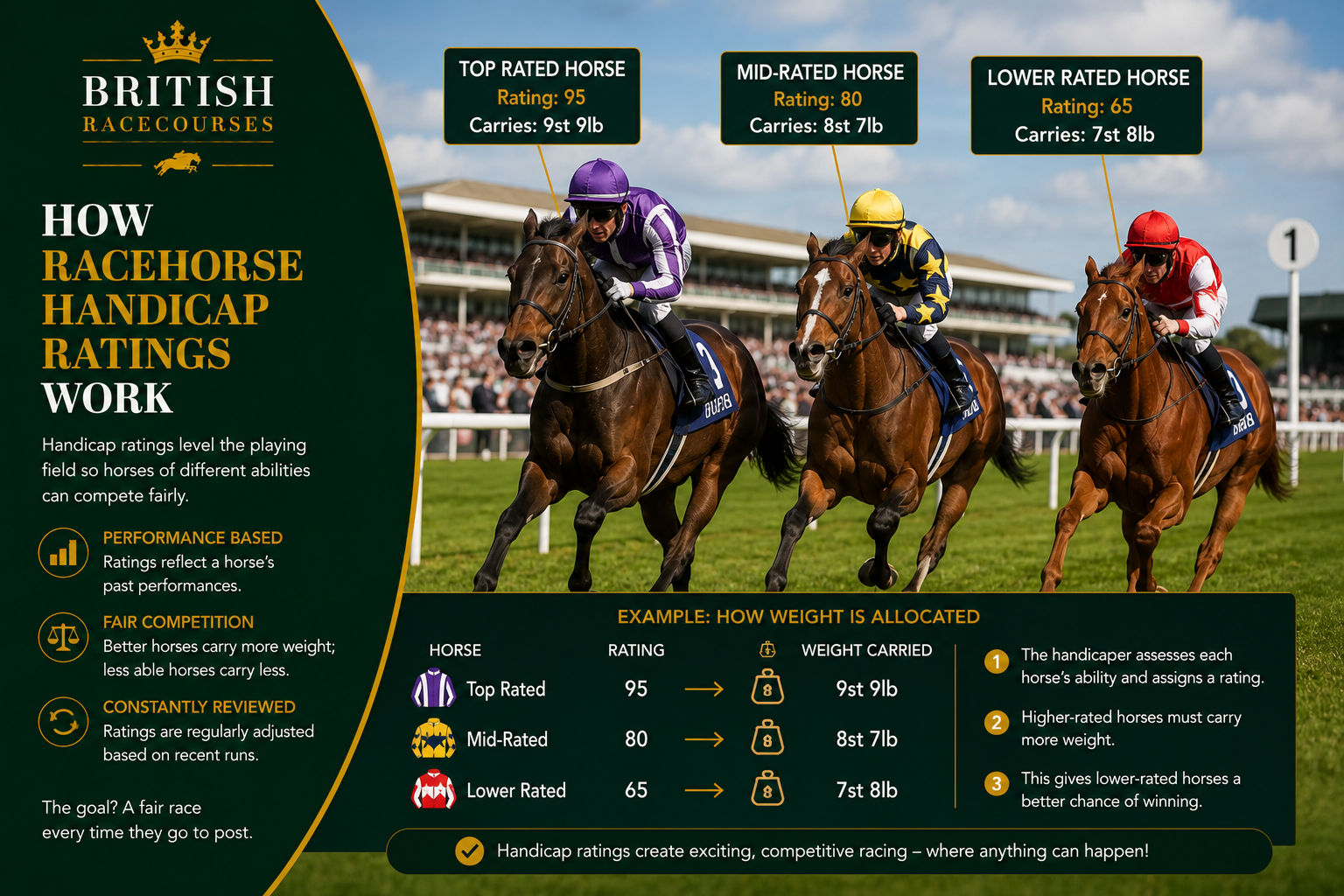
If you’ve ever looked at a racecard and wondered why one horse is carrying more weight than another, the answer usually lies in handicap ratings.
Handicap races make up a significant proportion of horse racing in Britain and Ireland. They are designed to create competitive contests by giving every runner a fair chance of success.
At first glance, the system can seem complicated. Horses carry different weights, ratings rise and fall throughout the season, and commentators often talk about horses being “well handicapped” or “ahead of the handicapper”.
Once you understand the basics, however, handicap ratings become one of the most useful tools for analysing races.
Whether you’re reading a racecard, studying form or simply trying to understand why horses carry different weights, handicap ratings play a central role in modern horse racing.
What Is a Handicap Race?
A handicap race is a race in which horses carry different weights based on their ability.
The aim is simple.
The better the horse, the more weight it must carry.
The lower-rated horse receives a weight advantage.
This system is designed to create closer finishes and more competitive races.
Without handicaps, the highest-rated horses would often dominate weaker rivals.
Handicapping helps level the playing field and creates uncertainty, which is one of the reasons handicap races are so popular with racegoers and punters.
Who Creates Handicap Ratings?
In Britain, handicap ratings are assigned by official handicappers working for the British Horseracing Authority.
Each horse receives an Official Rating, often abbreviated to OR.
This rating reflects the horse’s ability based on its race performances.
For example:
| Horse | Official Rating |
|---|---|
| Horse A | 100 |
| Horse B | 92 |
| Horse C | 78 |
The higher the rating, the better the horse is considered to be.
Ratings are constantly reviewed throughout a horse’s career.
Strong performances can lead to an increase in rating, while disappointing results may cause a horse’s mark to fall.
What Does an Official Rating Mean?
Every point in the handicap system is equivalent to one pound of weight.
For example:
- A horse rated 100 is considered 10lb superior to a horse rated 90.
- A horse rated 85 is considered 5lb superior to a horse rated 80.
The handicapper uses these ratings to determine how much weight each horse should carry.
This is why understanding ratings can be so useful when studying a racecard.
If you’re unfamiliar with racecards, our article on How to Read a Racecard explains where ratings appear and how they fit into race analysis.
How Do Handicap Weights Work?
Let’s imagine a race featuring three horses:
| Horse | Rating | Weight |
|---|---|---|
| Horse A | 100 | 10st |
| Horse B | 95 | 9st 9lb |
| Horse C | 90 | 9st 4lb |
The theory is that the additional weight carried by Horse A offsets its superior ability.
If the handicapper has assessed every horse correctly, all three runners should have an equal chance of winning.
Of course, horse racing is rarely that simple.
Ground conditions, pace, tactics and improvement all play a role.
This is why handicaps remain fascinating races to analyse.
Why Ratings Change
Handicap ratings are not fixed.
They move up and down depending on performance.
Winning Races
When a horse wins convincingly, its rating is likely to increase.
For example:
- Rating before race: 80
- Wins comfortably
- New rating: 86
The higher rating means the horse will carry more weight in future handicaps.
Poor Performances
When a horse consistently performs below expectations, its rating may be reduced.
For example:
- Rating before race: 92
- Several disappointing runs
- New rating: 88
This lower mark means the horse will carry less weight.
Many trainers deliberately wait for a horse’s rating to drop before targeting a suitable handicap.
What Does “Well Handicapped” Mean?
One of the most common phrases you’ll hear in racing is:
“This horse looks well handicapped.”
This means the horse may be better than its current rating suggests.
There are many reasons why this might happen.
For example:
- The horse has improved recently.
- The horse was unlucky in previous races.
- The horse is returning to ideal conditions.
- The handicapper has not yet fully adjusted its rating.
These runners are often considered attractive betting propositions.
British Racecourses tracks horses that may be ahead of their current mark on this page:
How Form and Ratings Work Together
Ratings should never be viewed in isolation.
They become far more useful when combined with recent form.
Imagine two horses:
Horse A
- Rating: 90
- Recent form: 1112
Horse B
- Rating: 90
- Recent form: 90708
Although both horses have identical ratings, Horse A clearly arrives in much better form.
This is why many racing fans combine ratings with form analysis.
For a deeper look at race form, visit:
Why the Going Matters
The handicapper’s rating reflects a horse’s overall ability, but conditions still matter enormously.
A horse rated 100 may perform like a 110-rated horse on soft ground and an 85-rated horse on firm ground.
This is why the going remains one of the most important factors in race analysis.
You can learn more about ground conditions here:
Certain horses are particularly effective when the ground turns soft:
Others perform best on quicker conditions:
What Is a Handicap Debut?
Many horses begin their careers in non-handicap races.
After several runs, they receive an official rating and become eligible for handicaps.
This first appearance in handicap company is often known as a handicap debut.
These runners attract plenty of attention because the handicapper has limited evidence on which to assess them.
Sometimes horses improve dramatically once entering handicaps.
How Trainers Use Handicap Marks
Successful trainers often plan campaigns around handicap ratings.
A horse may be entered in races specifically because its current mark provides an advantage.
Many trainers believe certain horses become particularly competitive when they drop to a favourable rating.
You can learn more about Britain’s leading trainers here:
Monitoring trainer form can also be helpful:
Speed Ratings and Handicap Ratings
Official ratings are not the only ratings available.
Many analysts also use speed ratings.
Speed ratings attempt to measure how quickly a horse has run relative to race conditions and track factors.
Comparing speed ratings with official ratings can sometimes reveal horses that may be capable of outperforming their current mark.
British Racecourses publishes daily speed ratings here:
Why Handicap Races Are Popular
Handicaps are popular because they create uncertainty.
In a typical handicap:
- More runners have realistic winning chances.
- Betting markets are more competitive.
- Results can be harder to predict.
- Analysis becomes more interesting.
Many of Britain’s biggest betting races are handicaps.
Examples include:
- The Cambridgeshire Handicap
- The Ebor Handicap
- The Stewards’ Cup
- The November Handicap
These races often attract large fields and significant public interest.
How Handicap Ratings Help Punters
Handicap ratings can be a useful starting point for race analysis.
Many bettors begin by asking:
- Is this horse well handicapped?
- Is it running from a favourable mark?
- Has its rating fallen recently?
- Does today’s race suit its current rating?
Ratings should never be the only factor considered.
Successful analysis usually combines:
- Ratings
- Form
- Going
- Distance
- Trainer form
- Jockey form
Those new to betting may find these resources helpful:
Common Handicap Racing Terms
Handicap Mark
Another term for a horse’s official rating.
Top Weight
The horse carrying the most weight in a handicap.
Bottom Weight
The horse carrying the least weight.
Raised in the Weights
A horse whose rating has increased following a strong performance.
Dropped in the Weights
A horse whose rating has been reduced following disappointing runs.
Frequently Asked Questions
What is a good handicap rating?
There is no universal answer.
The significance of a rating depends on the quality of racing.
A rating of 60 may be competitive in one race, while a rating of 100 may be required in another.
Why do some horses carry more weight?
Because they are considered better horses according to the handicapper’s assessment.
Can handicap ratings be wrong?
Yes.
Handicappers make assessments based on available evidence.
Some horses improve unexpectedly, while others fail to perform as anticipated.
What does OR mean on a racecard?
OR stands for Official Rating.
It is the rating assigned by the handicapper.
Final Thoughts
Handicap ratings are one of the foundations of modern horse racing.
They help create competitive races, provide structure to race analysis and allow horses of varying abilities to compete against one another on fair terms.
Understanding how ratings work can make racecards far easier to interpret and race analysis much more rewarding.
Combined with form, ground conditions and trainer insight, handicap ratings offer valuable clues about a horse’s chances and remain one of the most important tools available to racing fans.