
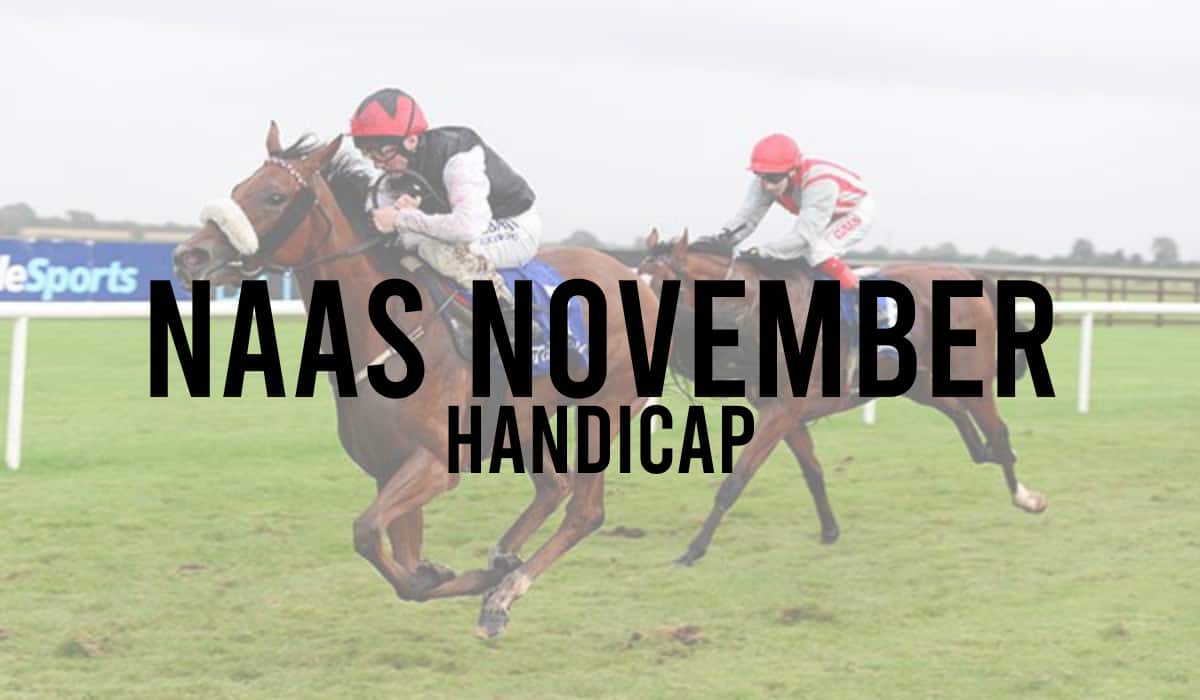
The Naas November Handicap is a Premier Handicap run over one mile and six furlongs at Naas Racecourse in Ireland.
Open to horses aged three and older, the race traditionally forms part of the closing stages of the Irish Flat season. Its position in November means stamina, handicap marks and the ability to handle autumn ground can all play an important part.
The race has attracted established Flat stayers, improving handicappers and dual-purpose horses capable of competing over both Flat and National Hunt distances.
Naas November Handicap Key Facts
| Race detail | Information |
|---|---|
| Racecourse | Naas |
| Race type | Flat handicap |
| Classification | Premier Handicap |
| Distance | 1m6f / 14 furlongs |
| Eligibility | Horses aged three and older |
| Time of year | November |
| Country | Ireland |
The Naas November Handicap should not be confused with the British November Handicap. Although both take place towards the end of the turf season, they are separate races staged in different countries and over different distances.
Our guide to Naas Racecourse covers the venue, its racing programme and other important meetings.
What Is the Naas November Handicap?
The Naas November Handicap is one of Ireland’s Premier Handicaps.
Premier Handicaps occupy an important position in Irish Flat racing and generally offer greater prize money and attract stronger fields than ordinary handicaps.
Our guide to Irish Premier Handicap races explains where these contests fit into the Irish racing programme.
The Naas November Handicap is distinctive because of its position at the end of the turf Flat season and its staying distance.
Fourteen furlongs demands significantly more stamina than a conventional middle-distance handicap, while November ground can make the race more testing again.
Distance
The Naas November Handicap is run over one mile and six furlongs, equivalent to 14 furlongs.
That places the race between the traditional mile-and-a-half middle-distance contests and races over two miles or further.
The distance is important when assessing runners.
A horse proven over 12 furlongs may possess enough stamina for the additional quarter-mile, but that should not simply be assumed. Conversely, a proven two-mile stayer may have sufficient stamina but lack the tactical speed required if the race develops steadily.
The ideal candidate often combines proven staying ability with enough pace to maintain a competitive position.
Naas Racecourse
Naas is a right-handed racecourse in County Kildare that stages both Flat and National Hunt racing.
The November Handicap takes place during the Flat programme and provides a very different examination from the shorter races commonly associated with the venue.
The distance gives horses time to establish their positions, but jockeys still need to judge pace carefully.
Racing too freely through the early stages can leave a horse vulnerable late, particularly when the ground is testing.
A slowly run contest creates a different problem. Proven stayers can find themselves vulnerable to rivals possessing greater tactical speed.
Understanding the likely race shape is therefore important despite the long distance.
What Type of Horse Wins the Naas November Handicap?
The race can suit several types of runner, but successful horses generally need to be well treated by the handicapper and capable of seeing out the distance.
Proven stamina
Stamina is the starting point.
Previous form at 14 furlongs or further provides strong evidence, particularly when achieved under comparable ground conditions.
Horses stepping up from a mile and a half can improve for the longer distance, but their previous races should provide evidence that extra stamina rather than speed is likely to suit.
A competitive handicap mark
Every runner carries a weight determined by its handicap rating.
A horse can possess plenty of ability but still face a difficult task if its current mark leaves little room for improvement.
Progressive horses can be particularly interesting because their official rating may not yet fully reflect their developing ability.
Ability on autumn ground
Ground conditions deserve particular attention in a November Flat handicap.
Rain can turn a 14-furlong race into a considerably greater stamina test.
A horse whose best performances have come on quick summer ground may therefore face a different challenge from one proven in softer conditions.
Our explanation of the going in horse racing covers how changing ground conditions can affect performance.
Ability to settle
Horses that race too freely can waste valuable energy during a staying contest.
A runner capable of relaxing behind the pace gives its jockey more options and has a better chance of preserving energy for the closing stages.
Previous Naas November Handicap Winners
The race has produced a varied collection of winners, including established stayers and horses with significant National Hunt ability.
Its results underline why rigid trends need to be treated cautiously. Different ground conditions, field sizes and race shapes can favour different types of horse from one year to the next.
One of the most notable winners was Yaxeni, who succeeded at a big price and demonstrated how competitive the race can be.
Swamp Fox and Golden Spear are particularly interesting when considering the relationship between the Naas race and major staying handicaps elsewhere.
Naas November Handicap and the Cesarewitch
The Cesarewitch at Newmarket has provided an important form reference for the Naas November Handicap.
Golden Spear finished fifth in the Cesarewitch before winning at Naas, while Swamp Fox finished sixth at Newmarket before taking the November Handicap.
The connection makes sense.
Both races require stamina and attract horses suited to competitive Flat handicaps over longer distances.
However, the races are not identical.
The Cesarewitch Handicap is run over approximately two miles and two furlongs at Newmarket, making it significantly longer than the 14-furlong Naas contest.
A horse running well in the Cesarewitch has demonstrated stamina, but it still needs enough speed to cope effectively with the shorter Naas race.
Irish Cesarewitch Form
The Irish Cesarewitch can also provide useful evidence.
Its extended distance makes it another important test of Flat-racing stamina during the autumn.
Silver Concorde had contested the Irish Cesarewitch before winning the Naas November Handicap.
That horse was particularly interesting because he also possessed high-class National Hunt form, having won the Champion Bumper at Cheltenham.
This crossover between Flat stayers and National Hunt horses is a recurring feature of long-distance handicaps.
Horses with hurdling backgrounds often possess abundant stamina, although they still need enough Flat speed to remain competitive.
Galway Form
Competitive staying handicaps at Galway can also provide useful clues.
Swamp Fox had twice finished runner-up in major handicaps at the Galway Festival before winning at Naas.
Galway provides a different course test, so previous success there should not be treated as a prerequisite.
The value lies in the level of competition.
A horse that has performed strongly in a large, competitive handicap has already demonstrated an ability to cope with traffic, changing pace and pressure from numerous rivals.
Why Dual-Purpose Horses Can Be Interesting
The Naas November Handicap can attract horses that also compete over hurdles.
That is unsurprising given the distance and time of year.
National Hunt horses often possess proven stamina and experience racing on softer ground, two attributes that can become valuable in a November Flat handicap.
However, hurdling ability should not be mistaken for evidence that a horse is well handicapped on the Flat.
Flat ratings and National Hunt ratings measure performance in different disciplines.
The key question remains whether the horse has enough Flat speed and is favourably treated under the race conditions.
Age Profile
The Naas November Handicap is open to horses aged three and older.
That creates an interesting contrast between younger, potentially improving runners and older horses with proven staying form.
Three-year-olds may still be progressing physically and can have more scope to improve their handicap ratings.
Older runners often provide stronger evidence about stamina, ground preferences and ability in competitive handicaps.
Neither profile should automatically be preferred.
The better approach is to determine whether the horse’s current handicap mark accurately represents its ability under the conditions it will face.
Handicap Weights
Weight is central to analysing the Naas November Handicap.
The purpose of handicapping is to give horses of different abilities a more equal chance by requiring higher-rated runners to carry more weight.
That means the best horse in the field is not necessarily the best bet.
An improving runner near the bottom of the weights may be capable of performing beyond its current rating, while an established horse near the top may need to reproduce a career-best performance under a demanding weight.
Recent form should therefore be considered alongside the handicap mark rather than separately.
Ask whether the handicapper has caught up with the horse or whether there may still be improvement available.
Ground Conditions
November ground at Naas can have a major influence on the race.
Soft conditions increase the stamina requirement and can expose horses whose previous staying form was achieved on faster ground.
Testing conditions can also affect race pace.
Jockeys may be reluctant to commit too early because they know an aggressive early gallop could leave their horses vulnerable late.
Conversely, a steadily run race can develop into a test of acceleration rather than pure stamina.
This is why distance alone does not tell the complete story.
The combination of distance, going and pace determines the actual physical demands placed on the runners.
Pace and Race Shape
Staying handicaps are sometimes treated as if pace matters less because the horses have so far to travel.
The opposite can be true.
An uncontested front-runner may be able to conserve energy and control the race before increasing the tempo at a favourable point.
Several horses competing for the lead can create a much stronger stamina test.
Hold-up horses also need the race to develop favourably. A runner delivered late can struggle if the leaders have been allowed to conserve too much energy.
Our guide to horse racing pace maps explains how to identify likely leaders, prominent racers and hold-up horses before a race.
Does the Draw Matter?
Draw should be considered, but its importance needs context over a staying distance.
Longer races generally provide jockeys with more time to find a position than short sprints, reducing the immediate importance of stall position.
That does not make the draw irrelevant.
A horse forced to race wide or use additional energy to obtain its preferred position can still be disadvantaged.
The useful question is not simply whether a stall number has historically produced winners.
Consider how the draw interacts with the horse’s running style and the expected pace.
How to Analyse the Naas November Handicap
Start with stamina.
Identify which horses have already demonstrated that they can perform effectively around 14 furlongs or further.
Then examine the handicap marks.
Look for runners whose recent performances suggest they may still be ahead of their current ratings.
Ground comes next.
Separate horses proven under likely autumn conditions from those whose best form depends on faster going.
Then assess race shape.
Identify the likely leaders and consider whether the field contains enough pace to create a genuine stamina test.
Recent form should be analysed in context. A defeat in a strong staying handicap can be more valuable evidence than a victory in weaker company.
Look particularly at performances in competitive races such as the Cesarewitch, Irish Cesarewitch and major Galway handicaps.
Finally, compare your assessment with the market.
The strongest horse on ratings does not automatically represent the best betting opportunity.
Betting on the Naas November Handicap
Large handicaps can produce attractive prices because numerous runners have plausible winning chances.
That does not mean outsiders should be supported simply because previous long-priced horses have won.
Historical starting prices describe what happened in previous editions. They do not establish that outsiders are systematically undervalued in the next race.
Build an assessment around form, handicap mark, stamina, going and pace first.
Then compare your estimated chance with the available price.
Our guide to finding value bets in horse racing explains why a horse can be the most likely winner without necessarily representing value at its current odds.
Naas November Handicap 2026
The Naas November Handicap is scheduled to return during the closing stages of the 2026 Irish Flat season.
The race remains a Premier Handicap over one mile and six furlongs for horses aged three and older.
Final date, race time, declarations, weights and going should be checked against the official race programme and racecard before the meeting.
Naas November Handicap FAQs
What is the Naas November Handicap?
The Naas November Handicap is a Premier Handicap on the Flat at Naas Racecourse in Ireland.
Where is the Naas November Handicap run?
The race is held at Naas Racecourse in County Kildare.
How far is the Naas November Handicap?
The race is run over one mile and six furlongs, equivalent to 14 furlongs.
Is the Naas November Handicap run over two miles?
No. The Naas November Handicap is run over 14 furlongs, or one mile and six furlongs. References describing the race as a two-mile contest are incorrect.
When is the Naas November Handicap run?
The race is normally staged in November towards the end of the Irish Flat turf season.
What is a Premier Handicap?
A Premier Handicap is one of the higher-value handicap races within the Irish Flat programme. Horses carry different weights according to their handicap ratings.
Who can run in the Naas November Handicap?
The race is open to eligible horses aged three and older.
Is the Naas November Handicap the same as the November Handicap in Britain?
No. The Naas November Handicap is an Irish Premier Handicap over 14 furlongs. Britain’s November Handicap is a separate race.
Is the Cesarewitch a useful guide?
It can be. Golden Spear and Swamp Fox both ran in the Newmarket Cesarewitch before winning at Naas. However, the Cesarewitch is considerably longer, so the races present different tests.
Are National Hunt horses suited to the Naas November Handicap?
Dual-purpose horses can be well suited because the distance and autumn conditions reward stamina. They still need sufficient Flat ability and a competitive handicap mark.
Summary
The Naas November Handicap is an important late-season Irish Premier Handicap over one mile and six furlongs.
Its combination of a staying distance, handicap weights and autumn ground creates a demanding test in which stamina alone is not enough.
Strong candidates generally need proven staying ability, a competitive handicap mark, suitable ground and a race shape that complements their running style.
Form from races such as the Cesarewitch, Irish Cesarewitch and competitive Galway handicaps can provide useful evidence, while dual-purpose horses add another dimension to the contest.
The strongest analysis combines stamina, handicap position, going, pace and price rather than relying on rigid historical trends.












