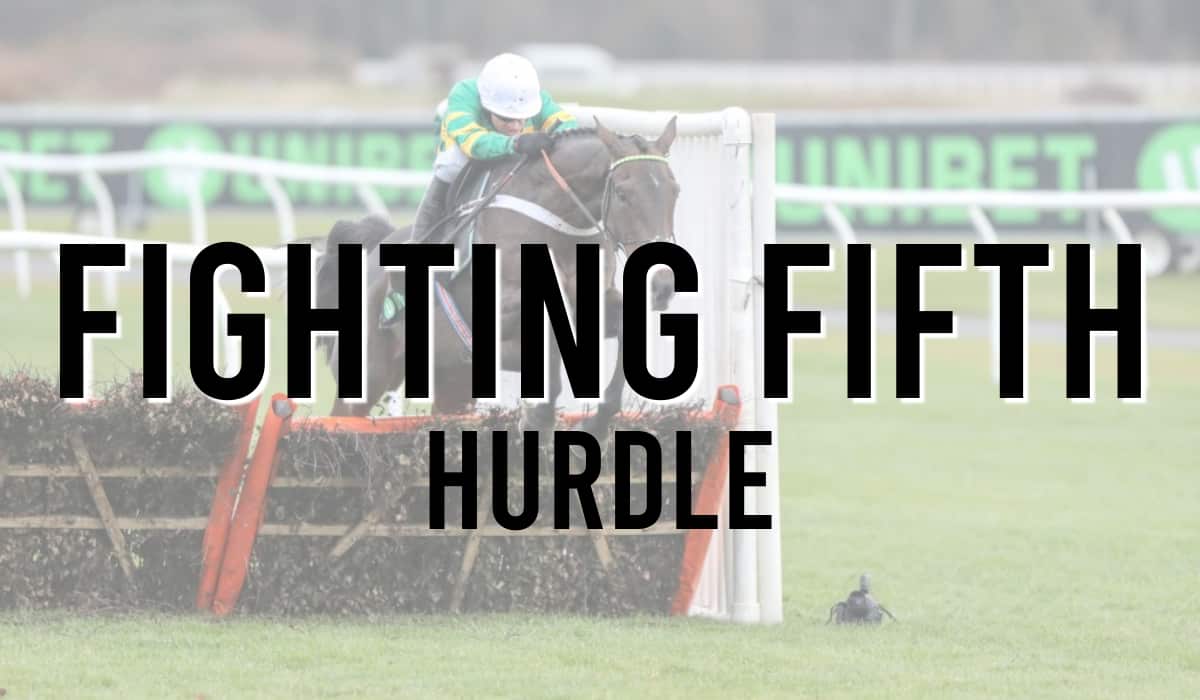
The Fighting Fifth Hurdle is one of the first major tests for Britain’s leading two-mile hurdlers each National Hunt season.
Run at Newcastle Racecourse over an extended two miles, the Grade 1 contest has a roll of honour featuring Champion Hurdle winners and some of the outstanding hurdlers of their generations. Constitution Hill, Buveur d’Air, Epatante, Punjabi, Sea Pigeon and Night Nurse are among the high-class horses to have won the race.
The Fighting Fifth also occupies an important position in the two-mile hurdling calendar. It takes place early enough in the season to shape the championship picture while leaving horses time to progress towards the Christmas Hurdle at Kempton and ultimately the Champion Hurdle at the Cheltenham Festival.
For that reason, the result matters beyond Newcastle. A dominant winner can establish itself as a leading championship hurdler, while an unexpected result can completely change perceptions of the division.
Fighting Fifth Hurdle Key Facts
| Race detail | Fighting Fifth Hurdle |
|---|---|
| Racecourse | Newcastle |
| Race type | National Hunt hurdle |
| Grade | Grade 1 |
| Distance | About 2 miles and half a furlong |
| Hurdles | 9 |
| Eligibility | Horses aged 4+ |
| Usual period | 28 November |
| Established | 1969 |
The Fighting Fifth is staged on Newcastle’s turf jumps course rather than the all-weather Flat track used for much of the venue’s racing.
Newcastle is a galloping course with a long home straight and a gradual climb towards the finish. Those characteristics help make the Fighting Fifth a searching early-season examination of a two-mile hurdler’s speed, jumping and ability to maintain momentum.
When Is the Fighting Fifth Hurdle 2026?
The 2026 Fighting Fifth Hurdle is scheduled to take place at Newcastle on Saturday 28 November 2026.
This date is included as a simple current-season reference rather than the basis of this guide. The Fighting Fifth remains an important annual Grade 1 regardless of the precise date or runners in an individual renewal.
Why Is the Fighting Fifth Important?
The Fighting Fifth gives established two-mile hurdlers and emerging championship contenders an opportunity to meet relatively early in the National Hunt season.
That timing makes it particularly informative.
Some horses arrive having already had a preparation run, while others make their seasonal reappearance at Newcastle. Younger hurdlers may be stepping into open Grade 1 company for the first time, while established stars can be returning after several months away from the racecourse.
The challenge when analysing the race is therefore not simply identifying the horse with the best historical form. Bettors need to decide how much improvement, fitness and current ability each runner is likely to bring to Newcastle.
That makes the Fighting Fifth an excellent example of why reading horse racing form requires context rather than a simple comparison of finishing positions.
Newcastle and the Fighting Fifth
Newcastle Racecourse is unusual because it stages both all-weather Flat racing and National Hunt racing.
The Fighting Fifth takes place on the turf jumps course. Newcastle’s National Hunt track is left-handed and galloping, with a long home straight and a steady climb from the final turn.
That creates a different test from the sharper two-mile hurdle races found elsewhere.
Horses need enough tactical speed to hold their position, but they also need to keep travelling and jumping efficiently when the race begins to develop. A runner that uses too much energy early can become vulnerable in the closing stages, while a horse repeatedly losing momentum at its hurdles may struggle to recover against Grade 1 opposition.
The course can therefore reward a complete two-mile hurdler rather than simply the horse with the quickest turn of foot.
Pace and the Fighting Fifth
Pace is particularly important in a small or medium-sized Grade 1 field.
A large handicap often contains several obvious front-runners, making a strong early gallop easier to anticipate. Championship hurdle races can be different. If only one horse wants to lead, the field may settle into a controlled rhythm before accelerating later in the race.
That scenario can favour a horse with tactical speed and accurate jumping.
A stronger gallop changes the emphasis. Horses need to travel efficiently while conserving enough energy to remain competitive through Newcastle’s long straight, and any runner that races too freely can pay for that effort late.
Before analysing a Fighting Fifth, it is therefore worth constructing a basic horse racing pace map. Look at the normal running style of each horse rather than assuming the race will be strongly run simply because it is a Grade 1.
Jumping Matters at Two Miles
The Fighting Fifth is a speed test as well as a jumping contest, which means even relatively small mistakes can matter.
A horse that meets its hurdles fluently can maintain momentum without using additional energy. A runner that repeatedly gets too close, jumps slowly or lands without rhythm can lose valuable lengths at precisely the stage when the race is becoming faster.
That does not mean a single mistake should automatically eliminate a horse from consideration. The important question is whether poor jumping forms a pattern.
Look back through previous races and consider how efficiently the horse negotiated its hurdles when competing at speed. This can be particularly revealing when a younger horse steps from novice or juvenile company into an open Grade 1.
Does the Going Matter?
The horse racing going can substantially change the character of a two-mile hurdle.
On quicker ground, tactical speed and fluent jumping can become increasingly important because horses are able to maintain a higher cruising speed. Softer conditions place greater emphasis on stamina and efficiency, particularly through Newcastle’s long finishing straight.
Ground preferences still need to be judged alongside the quality of the performance. Winning a weak race on soft ground does not automatically prove that a horse will reproduce the same level against Grade 1 opposition.
The best evidence comes from high-quality performances under similar conditions.
Fighting Fifth and the Champion Hurdle
The Fighting Fifth has a longstanding relationship with the Champion Hurdle.
Several winners have subsequently demonstrated championship-level ability at Cheltenham, and some have won both races during their careers. The list includes horses such as Sea Pigeon, Kribensis, Punjabi, Buveur d’Air, Epatante and Constitution Hill.
This does not make the Fighting Fifth an infallible Champion Hurdle predictor. There is a substantial gap between the races, during which form, fitness and the shape of the division can change.
What Newcastle can provide is an early indication of whether a horse possesses the speed and class required to compete at the top of the two-mile hurdling division.
The quality of the performance matters more than simply recording the victory. A horse winning comfortably after travelling strongly and jumping fluently may produce much stronger championship evidence than one narrowly taking a slowly run tactical contest.
Fighting Fifth and the Christmas Hurdle
The Christmas Hurdle at Kempton provides another major Grade 1 opportunity for two-mile hurdlers later in the season.
Historically, leading horses have competed in both races, although trainers do not need to follow the same route every year. Campaigns depend on fitness, ground, the horse’s experience and the wider championship programme.
The two races also present different tactical tests. Newcastle’s galloping track and long finish differ from Kempton, meaning a horse can be better suited to one course than the other.
Comparing performances across the Fighting Fifth and Christmas Hurdle can therefore reveal more than simply looking at which horse won each race.
History of the Fighting Fifth Hurdle
The Fighting Fifth Hurdle was established in 1969.
Its unusual name comes from the “Fighting Fifth”, the nickname associated with the Royal Northumberland Fusiliers and the historic Fifth Regiment of Foot. The connection gives the race a strong North East identity that distinguishes it from many championship races named after sponsors or racing figures.
The contest developed into one of Britain’s important early-season hurdle races and was eventually promoted to Grade 1 status in 2004.
Its history includes periods when circumstances forced the race away from Newcastle. The 2008 renewal was staged at Wetherby and the 2010 race at Newbury, while the 2023 renewal took place at Sandown after conditions prevented Newcastle from hosting the race.
Despite those temporary moves, Newcastle remains the home of the Fighting Fifth.
Comedy Of Errors and Birds Nest
The 1970s produced two of the race’s greatest specialists.
Comedy Of Errors won three consecutive Fighting Fifth Hurdles in 1972, 1973 and 1974. He was also an outstanding hurdler beyond Newcastle, twice winning the Champion Hurdle during a career that established him among the leading hurdlers of the decade.
Birds Nest subsequently matched the three-win record, taking the Fighting Fifth in 1976, 1977 and 1979.
Their achievements remain significant because no horse has surpassed three Fighting Fifth victories.
The strength of the roll of honour during this period also reflects the quality of British hurdling at the time. Night Nurse and Sea Pigeon are among the other celebrated names associated with the race.
Nicky Henderson’s Fighting Fifth Record
Nicky Henderson has built an exceptional modern record in the Fighting Fifth.
His winners include Landing Light, Punjabi, My Tent Or Yours, Buveur d’Air, Epatante, Constitution Hill and Sir Gino. Epatante’s dead heat with Not So Sleepy in 2021 also forms part of that record.
The variety of those winners is notable. Henderson has won the race with established Champion Hurdle horses, emerging younger runners and horses making important seasonal returns.
Trainer records can provide useful context, particularly when a stable repeatedly targets the same Grade 1, but they should not override the evidence presented by the individual horse. Current form, fitness, ground and opposition remain more important than backing a runner simply because of its trainer’s historical record.
Constitution Hill
Constitution Hill produced one of the outstanding modern Fighting Fifth performances when winning in 2022.
Already unbeaten after a dominant novice-hurdle campaign, he returned at Newcastle and defeated the previous year’s joint winners Epatante and Not So Sleepy by a wide margin.
He subsequently won the Christmas Hurdle before completing the season with victory in the Champion Hurdle at Cheltenham.
That sequence demonstrated the role the Fighting Fifth can play in a championship campaign. Newcastle did not create Constitution Hill’s reputation, but his performance provided strong early-season evidence that his exceptional novice form could be reproduced against established Grade 1 hurdlers.
Sir Gino
Sir Gino won the 2024 Fighting Fifth as a four-year-old for Nicky Henderson and Nico de Boinville.
His victory was particularly interesting because he was still relatively inexperienced compared with several of his opponents. He travelled strongly before asserting in the straight, showing that a younger hurdler could step successfully into open Grade 1 company.
The performance provides a useful analytical lesson for future renewals. Experience matters, but rapidly improving horses should not be judged solely on how many open-company Grade 1 races they have previously contested.
The level of their existing performances and the potential for further improvement can be more important.
Golden Ace Wins in 2025
Golden Ace won the 2025 Fighting Fifth for trainer Jeremy Scott and jockey Lorcan Williams.
The race developed unusually after Constitution Hill fell at the second hurdle and The New Lion also came down later in the contest. Golden Ace remained on her feet and ultimately defeated Anzadam, with Nemean Lion the only other finisher.
The result is a good example of why finishing positions should always be considered alongside the circumstances of a race. Golden Ace was the legitimate winner and added another Grade 1 success to her record, but anyone using the race as subsequent form evidence also needs to understand how the contest unfolded.
That principle applies throughout racing. Our guide to horse racing form lines explains why the circumstances behind a result can be as important as the bare finishing order.
Recent Fighting Fifth Hurdle Winners
| Year | Winner | Trainer | Jockey |
|---|---|---|---|
| 2025 | Golden Ace | Jeremy Scott | Lorcan Williams |
| 2024 | Sir Gino | Nicky Henderson | Nico de Boinville |
| 2023 | Not So Sleepy | Hughie Morrison | Sean Bowen |
| 2022 | Constitution Hill | Nicky Henderson | Nico de Boinville |
| 2021 | Epatante / Not So Sleepy | Nicky Henderson / Hughie Morrison | Aidan Coleman / Jonathan Burke |
| 2020 | Epatante | Nicky Henderson | Aidan Coleman |
| 2019 | Cornerstone Lad | Micky Hammond | Henry Brooke |
| 2018 | Buveur d’Air | Nicky Henderson | Barry Geraghty |
| 2017 | Buveur d’Air | Nicky Henderson | Barry Geraghty |
| 2016 | Irving | Paul Nicholls | Harry Cobden |
| 2015 | Identity Thief | Henry de Bromhead | Bryan Cooper |
| 2014 | Irving | Paul Nicholls | Nick Scholfield |
| 2013 | My Tent Or Yours | Nicky Henderson | Tony McCoy |
| 2012 | Countrywide Flame | John Quinn | Denis O’Regan |
| 2011 | Overturn | Donald McCain | Jason Maguire |
The 2021 renewal resulted in a dead heat between Epatante and Not So Sleepy.
The 2023 race was staged at Sandown rather than Newcastle, an important detail when using that result to assess previous course form.
What Are the Most Useful Fighting Fifth Trends?
The strongest Fighting Fifth trends are those connected to the actual demands of the race rather than arbitrary historical cut-offs.
High-class two-mile form is important because the Fighting Fifth is a Grade 1. Most winners have already demonstrated that they can compete at a high level over hurdles or are improving quickly enough to make that step.
Jumping at speed matters because the race can develop quickly. Efficient hurdlers lose less momentum and can hold a better tactical position.
Fitness needs individual assessment. Some winners arrive after a recent run, while high-class horses can win the Fighting Fifth on their seasonal reappearance. Treating a fixed number of days since a previous race as an automatic rule can therefore be misleading.
The likely pace matters. A slowly run race can reward tactical speed, whereas a stronger gallop increases the emphasis on stamina and efficient energy use.
Ground suitability should be based on evidence. Newcastle conditions can vary significantly from one year to another, so previous performances on similar going deserve more attention than broad assumptions about a horse’s preferences.
Historical trainer, age and starting-price statistics can add context, but none should be treated as an automatic selection system.
How to Analyse the Fighting Fifth Hurdle
Begin with the quality of each horse’s hurdle form.
Grade 1 performances deserve particular attention, but improving horses moving out of novice or juvenile company should not automatically be discounted. Sir Gino’s 2024 victory illustrates how quickly a high-class younger hurdler can establish itself in open company.
Next, assess fitness and preparation. A seasonal debut is not necessarily a negative for a horse with a strong record when fresh, while another runner may need racing before reaching peak condition.
Then consider pace and jumping together. Establish which horse is likely to lead, which runners prefer to race prominently and whether any of the field habitually race keenly. A horse expending unnecessary energy early can be vulnerable late, especially through Newcastle’s long straight.
Ground and course suitability should complete the racing assessment. The objective is to build a picture of how the race is likely to unfold rather than eliminate runners because they fail a historical statistical rule.
Only then should price enter the decision. Our guide to finding value bets in horse racing explains why identifying the horse most likely to win is different from deciding whether its available odds represent value.
Readers comparing bookmakers specifically for racing can use our horse racing betting sites comparison.
Fighting Fifth Hurdle FAQs
What is the Fighting Fifth Hurdle?
The Fighting Fifth Hurdle is a Grade 1 National Hunt hurdle race for horses aged four and older. It is normally staged at Newcastle in late November or early December.
Where is the Fighting Fifth Hurdle run?
The race is run at Newcastle Racecourse on its turf National Hunt track.
How far is the Fighting Fifth Hurdle?
The Fighting Fifth is run over approximately two miles and half a furlong.
How many hurdles are jumped?
Runners negotiate nine hurdles during the Fighting Fifth.
When is the Fighting Fifth Hurdle 2026?
The 2026 Fighting Fifth Hurdle is scheduled for Saturday 28 November at Newcastle.
Who won the Fighting Fifth Hurdle in 2025?
Golden Ace won the 2025 Fighting Fifth for trainer Jeremy Scott and jockey Lorcan Williams.
Who has won the most Fighting Fifth Hurdles?
Comedy Of Errors and Birds Nest share the record with three victories each.
Why is it called the Fighting Fifth Hurdle?
The name refers to the “Fighting Fifth”, a nickname associated with the historic Fifth Regiment of Foot and Royal Northumberland Fusiliers. The title reflects the race’s North East heritage.
Is the Fighting Fifth a Champion Hurdle trial?
The Fighting Fifth is an important early-season Grade 1 for two-mile hurdlers and has been won by numerous horses with Champion Hurdle form. However, the races are several months apart, so Newcastle should be treated as one piece of the championship picture rather than an automatic predictor.
Is the Fighting Fifth part of the Triple Crown of Hurdling?
The Fighting Fifth is traditionally regarded as the opening leg of the British Triple Crown of Hurdling, followed by the Christmas Hurdle at Kempton and the Champion Hurdle at Cheltenham.
Where can I find Fighting Fifth betting tips?
Our Newcastle betting tips cover racing at the course. Closer to the meeting, final declarations, current form, ground and market prices should all be considered before making a selection.
Fighting Fifth Hurdle Summary
The Fighting Fifth has developed from a race first staged in 1969 into one of Britain’s most important early-season hurdle contests.
Its roll of honour explains its status. Comedy Of Errors, Night Nurse, Sea Pigeon, Kribensis, Punjabi, Buveur d’Air, Epatante and Constitution Hill are among the horses that have demonstrated top-level ability at Newcastle, while more recent winners such as Sir Gino and Golden Ace have continued the race’s relevance to the modern two-mile division.
The best way to analyse the Fighting Fifth is not through a rigid collection of historical rules. Focus instead on the quality of each horse’s two-mile form, its jumping, fitness, ground preferences and the likely pace of the race. Newcastle’s galloping jumps track and long finishing straight then provide the final piece of the assessment.
The result can offer an important early indication of the strength of Britain’s two-mile hurdling division, but the championship season still has a long way to run after Newcastle.