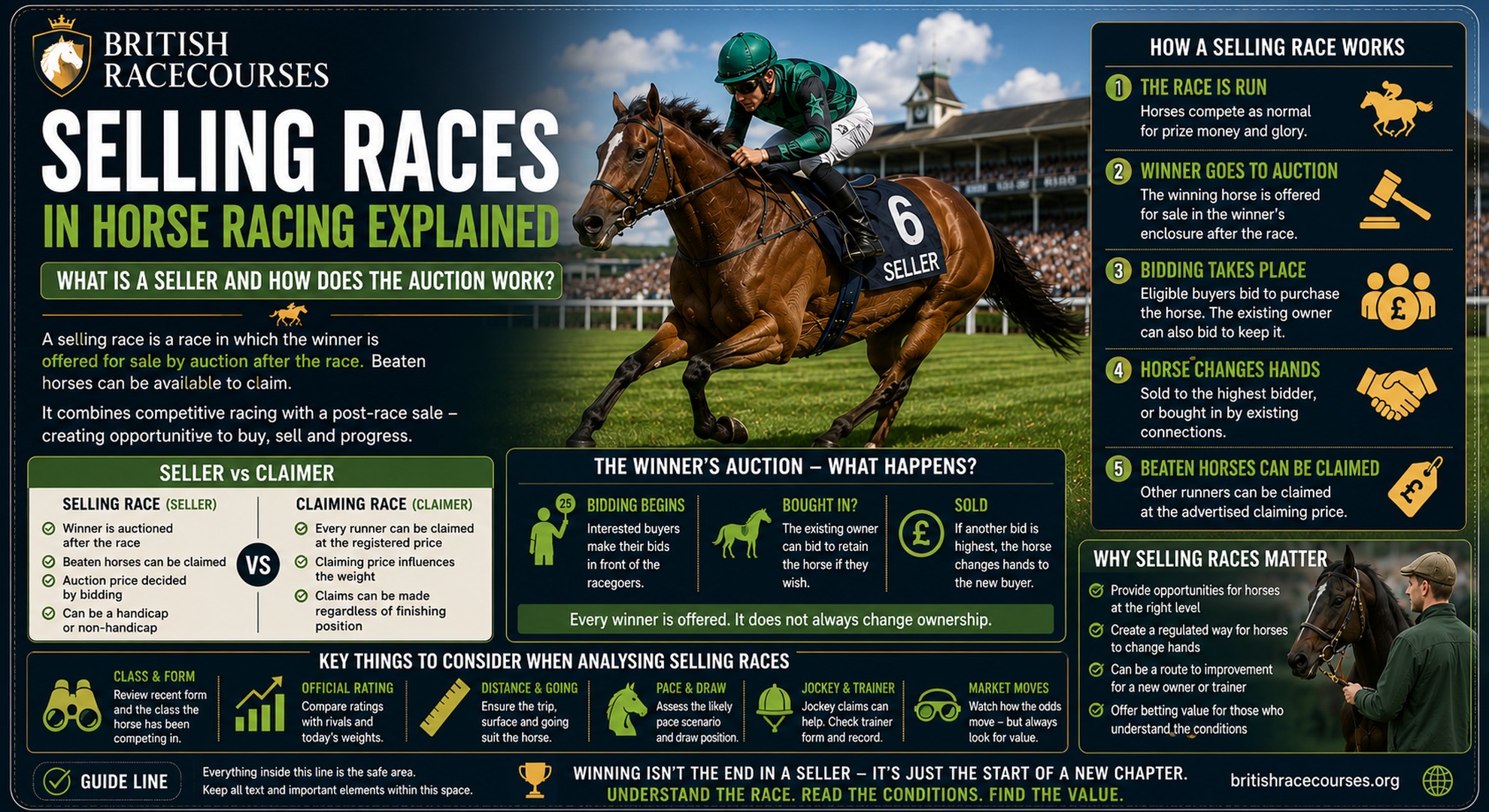
A selling race, usually shortened to a seller, is a horse race in which the winner is offered for sale by auction after the race.
The other horses that competed in the race can also be available to claim under the claiming system.
That makes selling races different from most other types of British horse races.
Winning normally means connections collect the prize and take their horse home. Winning a seller means the horse must first go through the post-race auction process.
The existing owner can bid to retain the horse, while other eligible buyers can also bid.
For bettors, this does not make a seller fundamentally different to analyse from another horse race. Form, class, distance, going, pace, draw, jockey and trainer remain important.
However, understanding why a horse has been entered in selling company, how the weights work and what happens after the race provides valuable context.
What Is a Selling Race in Horse Racing?
A selling race is a race in which the winner is offered for sale by auction after racing.
You will commonly hear these races called sellers.
The British racing programme can include both handicap and non-handicap selling races.
What defines the race is not whether it is a handicap.
It is what happens to the horses afterwards.
The winner goes through a post-race auction.
The beaten horses can be available to claim under the relevant claiming procedures.
This creates an important distinction between a seller and a claiming race.
In a claimer, every runner is available to claim at the registered claiming price.
In a seller, the winner is auctioned.
Why Is It Called a Selling Race?
The name describes the central feature of the race.
The winning horse is offered for sale after it has won.
That sale takes place through an auction rather than simply allowing somebody to claim the winner for a predetermined amount.
This means the eventual selling price can be determined by bidding.
If several people want the horse, competition can push the price higher.
The existing owner can also bid in an attempt to retain the horse.
Selling races therefore combine competitive racing with a genuine post-race sale.
What Does Seller Mean in Horse Racing?
A seller is simply the common racing term for a selling race.
If somebody says:
“That horse is dropping into a seller.”
they mean the horse is moving into selling-race company.
You might also see the term selling plate.
Do not confuse a selling race with an auction race or sales race.
Those are separate types of races with different eligibility and weight conditions.
Our Type of Horse Races page explains the wider range of races staged in Britain.
How Does a Selling Race Work?
The process can be divided into two parts:
- the race
- the sale.
The horses first compete normally.
There is still a winner, prize money and an official result.
What makes a seller different happens afterwards.
Before the Race
The horse is entered into a selling race under the conditions attached to that contest.
Those conditions determine matters including eligibility and weight.
During the Race
The runners compete like horses in any other race.
The fact the winner will subsequently be auctioned does not alter the objective.
Every jockey is trying to obtain the best possible finishing position.
After the Race
The winning horse is offered for auction.
Interested eligible parties can bid.
The horse can then be sold to the successful bidder or bought in by its existing interests.
Meanwhile, beaten horses can be available through the claiming process.
Is the Winner of a Selling Race Always Auctioned?
Yes.
The defining feature of a seller is that the winner is offered for auction after the race.
That applies even if the existing owner wants to keep the horse.
Connections cannot simply win the race and withdraw the horse from the selling process because they have changed their minds.
Entering the horse in a seller means accepting the conditions of the race.
That includes the post-race auction.
Where Is the Winner Auctioned?
The auction takes place at the racecourse after the race.
Traditionally, the winner is offered in or around the winner’s enclosure as part of the post-race procedure.
For racegoers, this can make a seller particularly interesting.
The race itself has finished, but there is still another competitive process to come.
Instead of horses competing on the track, prospective buyers compete through bidding.
Who Can Buy the Winner of a Selling Race?
The sale operates within British racing’s regulated procedures.
It is therefore not simply a case of a racegoer walking into the winner’s enclosure, waving some cash and taking the horse home.
Anyone seeking to acquire racehorses through regulated selling or claiming procedures needs to satisfy the applicable requirements.
The important point for racing fans is that other eligible interests can bid against the existing connections.
The auction is genuine.
Winning a seller therefore creates the possibility that the horse will leave its current owner and trainer immediately after the race.
Can the Existing Owner Keep the Horse?
Yes, but retaining the horse can involve bidding for it at the auction.
This is known as the horse being bought in.
Suppose an owner runs a horse in a seller and it wins.
The owner wants to keep it.
Another interested party also wants the horse.
The bidding might look something like this:
| Bid | Bidder |
|---|---|
| £5,000 | Existing interests |
| £5,500 | New bidder |
| £6,000 | Existing interests |
| £6,500 | New bidder |
| £7,000 | Existing interests |
If the existing interests make the successful final bid, the horse can be bought in and remain with them.
The actual auction procedure and financial arrangements are governed by the Rules and conditions in force.
What Does Bought In Mean in Horse Racing?
Bought in means the horse has been retained through the auction process rather than being sold to a new outside buyer.
This phrase is not exclusive to selling races.
You can also encounter it at bloodstock auctions.
In the context of a seller, it normally means the winning horse has gone through the required auction but has effectively remained with its existing interests following the bidding process.
That distinction matters.
The horse was still genuinely offered at auction.
It was not exempt from the selling-race conditions.
Can Someone Outbid the Existing Owner?
Yes.
That is one of the risks connections accept when entering a horse in a seller.
If another eligible bidder is prepared to pay more and makes the successful bid, the horse can change hands.
This creates the fundamental trade-off.
A seller may provide a suitable racing opportunity, but the existing owner must accept that winning can result in somebody else buying the horse.
What Happens If Nobody Wants to Buy the Winner?
The auction still follows the procedures governing the race.
A horse does not automatically move to a new stable simply because it has won a seller.
If there is no successful outside purchase, the horse can remain with its existing interests following the relevant auction process.
The important distinction is between:
being offered for sale
and
actually changing ownership.
Every seller winner is offered.
Not every seller winner necessarily joins a new owner.
What Happens to the Beaten Horses in a Selling Race?
This is one of the most important parts of selling races.
The winner is auctioned.
The beaten horses can be claimed through the claiming system.
That means a horse does not have to win a seller to change ownership.
A runner finishing second, fourth or last could potentially be claimed.
This is where selling races overlap with the mechanics explained in our Claiming Races in Horse Racing guide.
The crucial difference concerns the winner:
Seller winner → auction
Seller beaten runner → can be claimed
Claimer runner → can be claimed regardless of finishing position
Selling Race vs Claiming Race
Sellers and claimers are closely related, but they should not be treated as interchangeable terms.
| Selling Race | Claiming Race |
|---|---|
| Winner is auctioned after racing | Every runner can be claimed |
| Beaten runners can be claimed | Winner can also be claimed |
| Auction determines what happens to winner | Registered claiming price is central |
| Can be handicap or non-handicap | Run under claiming-race conditions |
| Existing interests can bid for winner | Claims follow claiming procedures |
The easiest way to remember the distinction is:
Win a seller and the horse goes to auction.
Run in a claimer and the horse can be claimed.
Is a Selling Race the Same as a Handicap?
No.
A selling race describes what happens in relation to the horses being available for sale.
A handicap describes how horses are weighted according to assessed ability.
A seller can be:
- a handicap; or
- a non-handicap.
If it is a handicap seller, Official Ratings become particularly relevant when assessing the weights.
The race conditions should always be checked rather than assuming every seller operates identically.
Why Would an Owner Enter a Horse in a Selling Race?
This is one of the most common questions about sellers.
Why risk losing a horse?
There are several reasons.
The Horse Needs an Appropriate Level of Competition
Racehorses vary enormously in ability.
A horse struggling against stronger opposition may have a much better chance in selling company.
Suitable Races Can Be Limited
Finding the right race involves balancing:
- class
- distance
- surface
- going
- rating
- timing
- location.
A seller may provide a suitable opportunity when alternatives are limited.
Connections Are Prepared to Sell
The owner may genuinely be comfortable with the horse moving elsewhere.
Not every racehorse is intended to remain with the same owner throughout its career.
The Horse Could Benefit From Different Connections
Racehorses regularly change trainers and owners.
Some subsequently improve.
Others simply find a different racing programme.
The Race Provides a Winning Opportunity
A horse that is no longer competitive in stronger company might have a realistic chance of winning a seller.
That can be valuable to connections even though the horse must subsequently be offered for auction.
Does Entering a Seller Mean Connections Do Not Want the Horse?
No.
This is an easy mistake to make.
A horse being entered in a seller does not automatically mean:
- something is wrong with it
- the owner dislikes it
- the trainer wants rid of it
- retirement is imminent
- the horse has no future.
The existing interests may be prepared to buy the horse in if it wins.
The seller may simply be the most suitable race available.
Treat the entry as information rather than constructing a story around it without evidence.
Are Selling Races Low-Class Races?
Selling races are generally associated with horses below the highest levels of racing.
You will not see the winner of the Derby being sent straight into an ordinary seller.
But describing sellers as meaningless or poor-quality races misses their purpose.
British racing contains horses at many different levels.
The programme needs opportunities for:
- Group and Grade performers
- Listed horses
- handicappers
- maidens
- novices
- lower-rated horses
- horses whose current level makes selling or claiming company suitable.
A seller can still be competitive.
For bettors, what matters is whether you can accurately assess the runners relative to their opposition and the available odds.
Can Good Horses Run in Sellers?
A horse can possess useful ability and still appear in a seller.
Its current circumstances matter more than a simplistic label.
A horse may:
- have declined from a higher level
- be returning from an absence
- have become difficult to place
- need a particular distance
- prefer a certain surface
- have a handicap rating that makes other races difficult
- simply have a suitable seller available.
Historical ratings should therefore be treated carefully.
A horse that was rated much higher two years ago is not necessarily still capable of that level.
Why Do Horses Drop Into Selling Company?
A move into a seller often represents a drop in class.
That immediately attracts attention from bettors.
Suppose a horse has recently competed in Class 4 and Class 5 handicaps before entering a seller.
Its opposition may now be weaker.
But the important question is:
Why is it dropping?
Possibilities include:
- declining form
- falling handicap rating
- lack of suitable alternatives
- age
- inconsistent performances
- poor recent results
- connections identifying an easier opportunity.
Our Horses Dropped in Class Today page helps identify runners changing grade.
A class drop can be positive.
It is not automatically a reason to bet.
Can a Horse Improve After Being Bought From a Seller?
Yes.
A horse bought from a seller can subsequently improve for new connections.
Changing stable can mean changes to:
- training routine
- feeding
- race planning
- distance
- surface
- headgear
- tactics
- jockey bookings.
Some trainers are particularly skilled at improving horses acquired from other yards.
But improvement should never be assumed.
Plenty of horses continue performing at approximately the same level or regress.
If a horse has recently changed trainer after being bought from a seller, treat that as another factor to investigate.
How Does Weight Work in a Selling Race?
There is no single universal weight structure covering every seller.
A seller can be a handicap or non-handicap, so the race conditions matter.
The first step when analysing one is therefore to read the race conditions and racecard carefully.
Look at:
- weight carried
- Official Rating
- penalties
- allowances
- jockey claims
- race type.
Do not assume that because two horses have similar ratings they must carry identical weights.
Understand the conditions first.
What Is the Advertised Claiming Price in a Seller?
Beaten horses in a seller can be available to claim.
The race therefore includes an advertised claiming-price structure relevant to those horses.
This should not be confused with the sale of the winner.
The winner goes to auction.
Its eventual price can therefore be determined by bidding rather than simply the claiming mechanism applying to beaten horses.
That distinction is fundamental.
Is the Winner’s Auction Price Its True Value?
Not necessarily.
An auction price tells us what somebody was prepared to pay in that particular auction.
That does not establish an objective permanent value for the horse.
The price can be affected by:
- number of bidders
- knowledge of the horse
- recent performance
- age
- soundness considerations
- future racing opportunities
- current handicap mark
- potential resale value.
A horse could subsequently become worth more.
It could also become worth less.
Racehorse values constantly change.
Our Can You Make Money Owning a Racehorse? guide explains some of the wider financial realities of racehorse ownership.
How to Analyse a Selling Race
Sellers should be analysed systematically.
Do not start with the assumption that the favourite must win because it has previously raced at a higher level.
1. Understand the Race Conditions
First determine whether the seller is a handicap or non-handicap.
Then establish:
- class
- distance
- surface
- weights
- penalties
- allowances
- eligibility conditions.
Everything else should be considered within that framework.
2. Examine Recent Form
Recent form matters more than a horse’s reputation.
A runner might once have been rated 85.
If it is now running to a level closer to 60, that historical figure has limited relevance.
Study what the horse has achieved recently.
Look beyond finishing positions.
A sequence such as:
7-6-5
could hide improving performances.
A sequence such as:
2-2-3
could have been achieved in weak races.
Our Horse Racing Form content explains how to interpret previous performances in context.
3. Look at the Class Drop
Class is particularly important in sellers because some runners arrive after competing in stronger races.
Ask:
- What level has the horse been facing?
- How competitive was it?
- Is today’s opposition genuinely weaker?
- Has the market already accounted for the drop?
A horse beaten five lengths in stronger company might be capable of winning a seller.
A horse beaten 30 lengths repeatedly may still struggle.
4. Compare Official Ratings
Official Ratings provide a useful starting point.
If the field contains horses rated:
| Horse | OR |
|---|---|
| A | 76 |
| B | 71 |
| C | 68 |
| D | 62 |
| E | 58 |
Horse A appears to have the strongest assessed ability.
But you still need to consider:
- weights
- recent form
- conditions
- distance
- going
- pace.
Ratings organise the field.
They do not predict the result by themselves.
5. Check Today’s Distance
A class drop is far less valuable when the horse is racing over the wrong trip.
Suppose a horse’s strongest form has come over seven furlongs.
It enters a one-mile-and-two-furlong seller.
The weaker opposition may help, but the additional distance introduces a serious question.
Conversely, a horse returning to its optimum trip while dropping in grade can become much more interesting.
Distance should always be analysed alongside class.
6. Consider Course Form
Some exposed horses develop clear course preferences.
That can be particularly useful in races containing older, established runners.
Look for horses with previous:
- course wins
- distance wins
- course-and-distance wins.
Our Course and Distance Winners page explains the C, D and CD indicators found on racecards.
Do not reject a horse merely because it has never visited the course.
But proven suitability removes one uncertainty.
7. Assess the Going or Surface
Sellers can be staged on turf and all-weather tracks.
Some horses have strong surface preferences.
A horse with poor recent turf form could become much more interesting when returning to an all-weather surface on which it has previously performed well.
Similarly, a proven soft-ground horse might improve when rain arrives.
Look at the conditions behind previous performances rather than treating every run equally.
8. Analyse Pace
Race class does not remove the importance of pace.
Imagine a five-runner seller containing one habitual front-runner.
If the other four horses usually race behind the leaders, the front-runner could control the race.
Alternatively, four horses may all want the lead.
That could produce an unsustainably strong early pace.
Our Horse Racing Pace Maps Explained guide explains how to construct the likely race shape.
9. Consider the Draw
Draw can matter in Flat sellers just as it does in other Flat races.
Its significance depends on:
- course
- distance
- field size
- going
- pace.
Do not mechanically back a stall because historical statistics show a favourable percentage.
Consider where the horse is drawn relative to the likely early speed.
10. Check Jockey Claims
An apprentice jockey may be able to claim weight where the conditions permit.
This can become significant in closely matched races.
But a claim should not simply be treated as free weight.
The jockey still has to ride the horse effectively.
Our Jockey Claims in Horse Racing guide explains how apprentice and conditional allowances work.
11. Look for Headgear Changes
Exposed horses frequently race in headgear.
A seller could contain runners wearing:
- blinkers
- cheekpieces
- visor
- hood.
Check whether the equipment is:
- first-time
- reapplied
- removed
- changed.
Our Horse Racing Headgear guide explains the main equipment types.
First-time blinkers are not automatically a positive.
Look at why connections may be making the change.
12. Consider Trainer Form
Stable form matters.
A horse dropping significantly in class may appear obvious, but a yard going through a prolonged quiet period adds another consideration.
Likewise, a trainer doing particularly well with similar horses deserves attention.
Trainer statistics should support the horse’s case rather than replace it.
13. Watch the Betting Market
Selling races can produce strong market moves.
A horse dropping significantly in class might shorten rapidly.
Another could attract support because it is returning to favourable conditions.
But shortening odds do not prove a horse will win.
Our Best Backed Horses Today page tracks notable movers.
Always ask whether the new price still represents value.
Worked Example: Analysing a Selling Race
Imagine a six-runner one-mile seller.
Horse A
OR: 75
Recent form: 6-5-4
Previous class: Class 4 handicap
Today’s weight: 9st 8lb
Distance: Proven
Horse A has the strongest historical form and drops significantly in class.
Horse B
OR: 70
Recent form: 2-1-3
Previous class: Seller/claimer
Today’s weight: 9st 5lb
Distance: Proven
Horse B lacks Horse A’s historical class but is thriving at this level.
Horse C
OR: 67
Recent form: 8-7-6
Previous class: Class 6 handicap
Today’s weight: 9st
Distance: Questionable
Horse C receives weight but has weak recent form and an uncertain distance profile.
At first glance, Horse A may look obvious because of the class drop.
But suppose the market offers:
Horse A: 6/4
Horse B: 7/2
Now price becomes important.
Horse A might be the most likely winner without necessarily representing the best betting value.
Horse B has current form, proven suitability and a larger price.
The decision should therefore combine:
ability + conditions + probability + odds
rather than simply backing the horse with the highest historical rating.
Should You Automatically Back Horses Dropping Into Sellers?
No.
This is probably the biggest potential mistake when betting on selling races.
A significant class drop looks attractive.
But horses generally drop in class for a reason.
Sometimes the reason is simply finding a suitable winning opportunity.
Sometimes it reflects declining ability.
Consider a horse whose Official Rating has fallen:
82 → 78 → 73 → 68 → 63
The horse may now be entering a seller after previously competing at a much higher level.
Using its old rating of 82 to assess its current ability would be misleading.
Current evidence matters more.
Are Favourites Strong in Selling Races?
There is no reason to assume a favourite should be backed purely because the race is a seller.
The market is trying to estimate the same factors you are:
- class
- form
- ratings
- distance
- conditions
- connections.
Obvious class droppers can become short-priced favourites.
Sometimes that price is justified.
Sometimes the market overreacts to historical form.
Our How to Price a Horse Race guide explains how to create your own estimate before comparing it with bookmaker odds.
Can Selling Races Produce Betting Value?
Yes, but value comes from price rather than race type.
Imagine you assess a horse as having a 30% chance of winning.
Its fair decimal price would be:
1 ÷ 0.30 = 3.33
If bookmakers offer 4.50, your assessment suggests the available odds exceed your fair price.
That does not guarantee a profit.
A horse with a genuine 30% chance still loses 70% of the time.
Our How to Find Value Bets in Horse Racing guide explains this distinction in more detail.
Common Mistakes When Analysing Sellers
Assuming the Highest-Rated Horse Must Win
Ratings are useful, but current form and conditions matter.
Automatically Backing the Class Dropper
A horse can drop in class because its ability has declined.
Ignoring Recent Form
Historical performances from several seasons ago may no longer represent the horse.
Ignoring Distance
Weaker opposition cannot guarantee a horse will stay an unsuitable trip.
Confusing Sellers With Claimers
The winner of a seller is auctioned. In a claimer, runners are available through the claiming system.
Assuming the Owner Wants Rid of the Horse
Connections may intend to bid to retain the winner.
Ignoring Pace
Small fields can become particularly tactical.
Backing a Horse Because the Odds Are Shortening
Market support is information, not certainty.
Selling Race Analysis Checklist
Before betting on a seller, ask:
- Is it a handicap or non-handicap seller?
- What are the race conditions?
- Which horse has the strongest current form?
- Which runners are dropping in class?
- Why might they be dropping?
- What are their current Official Ratings?
- How do the weights compare?
- Is today’s distance suitable?
- Does the going or surface suit?
- Does course form matter?
- What does the pace look like?
- Is the draw important?
- Are any jockeys claiming weight?
- Is there a headgear change?
- How are the trainers performing?
- Has the market moved?
- Does the available price represent value?
This provides a much stronger framework than simply backing the horse with the best historical form.
Selling Races vs Other Race Types
Understanding where sellers sit within the wider programme makes them easier to interpret.
Seller vs Claimer
Seller winner goes to auction. Claimer runners can be claimed.
Seller vs Handicap
A seller concerns the post-race sale mechanism. A handicap concerns the weighting of horses according to ability. A seller can itself be a handicap.
Seller vs Maiden
A maiden is primarily restricted to horses that have not won under the relevant code. A seller is defined by its selling conditions.
Seller vs Novice
Novice races provide opportunities for horses meeting specific experience and winning conditions. Sellers are structured around horses being available for sale.
Seller vs Auction Race
An auction race is not a post-race auction.
Auction races are named because eligibility is linked to the price for which horses were previously sold at specified sales.
This is very different from the winner of a seller being auctioned after the race.
Seller vs Sales Race
Sales races are generally restricted to horses sold through specified bloodstock sales.
Again, that is different from a selling race.
The similar terminology can be confusing, which is why the race conditions should always be checked.
Are Selling Races Still Part of British Horse Racing?
Yes.
Selling races remain a recognised category within the British racing programme and Rules.
They provide opportunities for suitable horses while creating a regulated mechanism through which horses can move between owners and trainers.
They may receive less attention than Group 1 races, major handicaps or famous festival contests, but they still serve a practical purpose within the racing structure.
For people learning the sport, sellers are also a good example of why understanding race type matters.
Two races over the same distance at the same racecourse can operate under very different conditions.
Frequently Asked Questions
What is a selling race in horse racing?
A selling race is a race in which the winner is offered for sale by auction after the race. Beaten runners can also be available to claim.
What is a seller in horse racing?
Seller is the common shortened term for a selling race.
What happens to the winner of a selling race?
The winner is offered for auction at the racecourse after racing.
Does the winner have to be sold?
The winner must go through the auction process, but it does not necessarily move to a new outside owner. Existing interests can bid to retain the horse.
What does bought in mean?
Bought in means the horse has been retained through the auction process rather than sold to an outside buyer.
Can the owner buy their horse back after winning a seller?
Existing interests can participate in the auction process in an attempt to retain the horse.
Can another person outbid the owner?
Yes. Another eligible bidder can make the successful bid and acquire the horse.
What happens to the losing horses in a seller?
Beaten horses can be available to claim under the claiming procedures.
Can the second-placed horse be claimed?
Yes. A beaten runner can potentially be claimed.
What is the difference between a seller and a claimer?
The winner of a seller is auctioned after racing, while every horse in a claiming race is available to claim at its registered claiming price.
Is a selling race a handicap?
It can be. Selling races can be handicaps or non-handicaps.
Are sellers only run on the Flat?
Selling races can form part of both Flat and Jump racing programmes.
Are selling races low class?
They generally operate below racing’s elite level, but race quality varies. The important factor for bettors is the relative ability of the horses competing.
Why would an owner enter a horse in a seller?
The race may provide suitable opposition or a good winning opportunity, and connections may be prepared for the possibility of the horse changing hands.
Does entering a seller mean the owner wants to sell?
Not necessarily. Existing interests may bid to retain the winner.
Can a horse improve after being bought from a seller?
Yes. Some horses improve after changing connections, although improvement is never guaranteed.
What is a selling plate?
Selling plate is another term you may encounter for a selling race.
Is an auction race the same as a selling race?
No. An auction race normally relates to horses purchased within specified sale-price conditions before their racing careers. In a seller, the winner is auctioned after the race.
Summary
A selling race, or seller, is a horse race in which the winner is offered for auction after racing.
The beaten runners can also be available through the claiming system.
That creates the easiest way to distinguish sellers from claimers:
Seller winner = auctioned.
Seller beaten horses = can be claimed.
Claimer = every runner can be claimed under the claiming conditions.
The existing owner can bid during the winner’s auction, which means winning a seller does not automatically result in the horse moving to a different stable.
For bettors, the selling mechanism provides useful context but should not dominate the analysis.
Focus on:
- current form
- class
- Official Rating
- weight
- distance
- course
- going
- surface
- pace
- draw
- jockey
- trainer
- headgear
- market price.
Pay particular attention to horses dropping from stronger company.
They can be well suited to selling company, but a class drop is not automatically positive. Some horses are moving down because their ability has declined.
The best approach is to understand why the horse is running in a seller, assess how well today’s conditions suit it and then compare its estimated winning chance with the available odds.
Selling races may sit a long way below the glamour of Royal Ascot or the Cheltenham Festival, but they remain a distinctive part of British racing.
And unlike most races, the action does not necessarily finish when the horses cross the winning line.
For the winner, the auction comes next.