
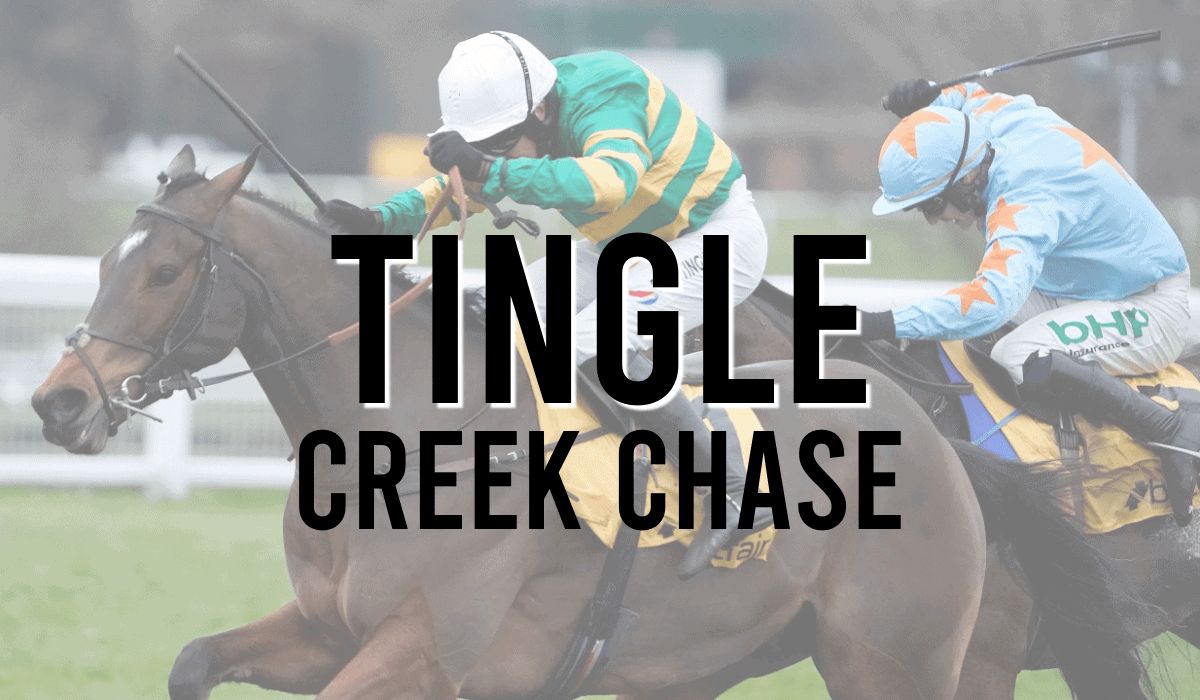
The Tingle Creek Chase is one of Britain’s leading Grade 1 races for two-mile chasers and one of the defining early-season tests in the division.
Run at Sandown Park in December, the race demands speed, accurate jumping and enough stamina to cope with Sandown’s uphill finish. The famous Railway Fences provide a particularly searching examination because three obstacles arrive in quick succession down the back straight, leaving little time for a horse to recover from a mistake.
The roll of honour reflects that challenge. Desert Orchid, Viking Flagship, Moscow Flyer, Kauto Star, Master Minded, Sprinter Sacre, Altior and Jonbon have all won the Tingle Creek, while several winners have also succeeded in the Queen Mother Champion Chase at Cheltenham.
The race is therefore an important part of the two-mile chase season, but its value goes beyond being a Cheltenham trial. Winning a Grade 1 over Sandown’s fences is a major achievement in its own right.
Tingle Creek Chase Key Facts
| Race detail | Tingle Creek Chase |
|---|---|
| Racecourse | Sandown Park |
| Race type | National Hunt steeplechase |
| Grade | Grade 1 |
| Distance | About 1 mile 7½ furlongs |
| Fences | 13 |
| Eligibility | Horses aged 4+ |
| Usual month | December |
| First run | 1979 |
| Named after | Tingle Creek |
The modern race is effectively a two-mile championship test. There is little opportunity for a horse to hide a weakness in its jumping because the pace is usually strong enough to put technique under sustained pressure.
When Is the Tingle Creek Chase 2026?
The 2026 Tingle Creek Chase is scheduled for Saturday 5 December 2026 at Sandown Park.
It forms the centrepiece of the two-day Tingle Creek Festival on Friday 4 and Saturday 5 December. The Saturday card also includes the Grade 1 Henry VIII Novices’ Chase.
Final declarations, going and race conditions will become more relevant close to the meeting. The core of this page therefore concentrates on the enduring characteristics of the Tingle Creek rather than speculative runners or early betting markets.
Why Is the Tingle Creek Chase Important?
The Tingle Creek brings established two-mile chasers together relatively early in the National Hunt season.
That timing makes it useful because leading horses can arrive at Sandown from different routes. Some have already run during the autumn, while others make their seasonal return with bigger targets still several months away.
The result can provide an early indication of the strength of the two-mile division, but the performance itself is usually more informative than the finishing position alone.
A horse that travels comfortably before jumping Sandown’s Railway Fences fluently has demonstrated qualities that can transfer to other Grade 1 races. Conversely, a horse exposed by the speed and accuracy required at Sandown may need different conditions even if its overall chasing form remains strong.
The Tingle Creek is closely connected with the Queen Mother Champion Chase at the Cheltenham Festival, although the two courses present different challenges. Sandown is right-handed and places enormous emphasis on rhythm through its fences, while Cheltenham introduces its own undulations and championship pressure.
Sandown Park and the Tingle Creek
Sandown Park Racecourse is a right-handed course with an uphill finish.
The track rewards horses capable of travelling at speed without sacrificing jumping accuracy. This becomes particularly important in a Grade 1 two-mile chase, where a mistake can cost several lengths against horses operating close to championship pace.
Sandown also asks horses to keep working after the final fence. A runner that has used too much energy chasing the early pace can become vulnerable on the climb towards the winning post.
This combination of speed, jumping and finishing strength explains why the Tingle Creek has repeatedly been won by genuine championship performers.
It is not simply a speed race.
The winner needs enough pace to remain competitive over two miles but also the jumping efficiency and stamina to sustain that speed around Sandown.
What Are the Railway Fences at Sandown?
The Railway Fences are one of the defining features of Sandown’s National Hunt course.
Three fences appear close together down the back straight. Horses approach them while the race is developing at speed and have relatively little time to reorganise between each obstacle.
This creates a different challenge from a sequence of fences separated by longer stretches of galloping.
A fluent jumper can maintain momentum through the sequence and potentially gain ground without being asked for additional effort. A horse that gets too close to one fence, lands awkwardly or loses its rhythm can find the next obstacle arriving before it has fully recovered.
That makes the Railway Fences particularly significant in the Tingle Creek.
At Grade 1 two-mile pace, small inefficiencies become magnified. Losing a length through one fence may be manageable. Losing momentum repeatedly through the Railway Fences can leave a horse several lengths behind rivals that have jumped them cleanly.
The Railway Fences are one reason previous Sandown form deserves attention when analysing the race.
Jumping in the Tingle Creek Chase
Fast, accurate jumping is fundamental to the Tingle Creek.
Some staying chases give a horse time to recover from an early error. A two-mile Grade 1 provides far less margin because the leaders continue travelling quickly between the obstacles.
The best two-mile chasers often appear to gain ground at their fences. They shorten or lengthen efficiently when required, land running and immediately return to their racing rhythm.
When reading horse racing form, it is therefore worth looking beyond the letters and finishing positions beside a horse’s name.
Watch how the horse actually jumped.
Repeated small mistakes can be more concerning for the Tingle Creek than one isolated error. Equally, a horse that jumped fluently when placed under pressure in a previous Grade 1 has demonstrated an attribute particularly relevant to Sandown.
Pace in the Tingle Creek Chase
Two-mile Grade 1 chasers are naturally fast horses, but the composition of the field still determines how the Tingle Creek develops.
A single habitual front-runner may be able to establish a comfortable rhythm. Several horses wanting the same position can create a much stronger early pace and force the field to jump under pressure from an earlier stage.
This matters because Sandown still has to be finished.
A horse that races too aggressively through the opening stages can travel impressively before weakening on the climb to the line. A runner sitting just behind a contested lead may conserve enough energy to become stronger after the final fence.
Building a horse racing pace map is therefore useful even when the Tingle Creek attracts a relatively small field.
Rather than assuming a small field means a tactical race, examine the normal running style of every horse. Four elite chasers can still produce a fierce gallop if several want to lead.
How the Going Affects the Tingle Creek
December weather means Sandown can produce testing conditions, but the Tingle Creek should not automatically be analysed as a soft-ground race.
The going changes the balance between speed and stamina.
On better ground, jumping rhythm and cruising speed can become particularly important. Horses travel faster between fences and mistakes can be harder to recover from because their rivals maintain momentum.
Soft or heavy conditions increase the physical demands. Maintaining Grade 1 pace through testing ground uses more energy, making the ability to finish strongly increasingly important.
Jumping can also deteriorate as horses tire.
The correct approach is to assess the actual conditions for that renewal and compare them with each horse’s previous performances. A historical reputation for handling “winter ground” is less useful than evidence from genuinely comparable going.
History of the Tingle Creek Chase
The Tingle Creek was first run in 1979 and developed into one of the most prestigious two-mile chases in British racing.
The race is named after Tingle Creek, a popular chaser closely associated with Sandown during the 1970s. His bold front-running style and spectacular jumping made him a favourite with racegoers, particularly at the Surrey course.
The race named in his honour has proved an appropriate memorial.
Sandown rewards many of the same qualities that made Tingle Creek himself so popular: speed, attacking jumping and the ability to maintain a strong gallop around a demanding course.
Over subsequent decades, the race attracted many of Britain’s and Ireland’s outstanding two-mile chasers.
The quality of the winners is particularly striking. Desert Orchid won before becoming one of the most famous National Hunt horses of his generation. Viking Flagship and Moscow Flyer became leading two-mile chasers. Master Minded, Sprinter Sacre and Altior produced some of the highest-rated performances of the modern era.
The relatively recent Jonbon era has added another multiple winner to that history.
Kauto Star and the Tingle Creek
Kauto Star is remembered primarily as one of the greatest staying chasers in modern racing, but his Tingle Creek record demonstrates his exceptional versatility.
Trained by Paul Nicholls, Kauto Star won the race in 2005 and 2006.
Those victories came over two miles, yet he later became a dominant force over three miles, winning the Cheltenham Gold Cup twice and the King George VI Chase five times.
That range is extraordinary.
Most elite chasers specialise around a particular distance. Kauto Star possessed enough speed and jumping ability to win a Tingle Creek while also having the stamina to become one of the defining staying chasers of his era.
His two Sandown victories remain an important part of the Tingle Creek’s history because they demonstrate the calibre of horse the race can attract.
Moscow Flyer
Moscow Flyer won consecutive Tingle Creeks in 2003 and 2004.
Trained by Jessica Harrington, he became one of the outstanding two-mile chasers of his generation and also won the Queen Mother Champion Chase twice.
His career illustrates the qualities that connect Sandown with Cheltenham.
Moscow Flyer possessed the speed required for top-class racing over the minimum distance and could produce spectacular jumping when in rhythm. He was also capable of recovering from the intensity of early-season Grade 1 racing and remaining at championship level later in the campaign.
His second Tingle Creek victory came at the age of ten, another reminder that age statistics should never replace analysis of the individual horse.
Master Minded
Master Minded won the Tingle Creek in 2008 and 2010 for Paul Nicholls.
At his peak, he was an exceptional two-mile chaser. His dominant Cheltenham performances established him as one of the highest-class horses in the division, while his Sandown victories confirmed that his speed translated to another demanding Grade 1 course.
Master Minded’s record also reinforces Paul Nicholls’ exceptional association with the Tingle Creek.
Nicholls has repeatedly targeted high-class two-mile chasers at Sandown, with horses including Flagship Uberalles, Kauto Star, Twist Magic, Master Minded, Dodging Bullets, Politologue and Greaneteen contributing to his record in the race.
Sprinter Sacre
Sprinter Sacre won the Tingle Creek in 2012 for Nicky Henderson.
The victory came during the period when Sprinter Sacre was establishing himself as the dominant two-mile chaser in Britain and Ireland.
He went on to win the Queen Mother Champion Chase at Cheltenham in 2013 as part of an unbeaten season.
Sprinter Sacre’s presence on the roll of honour strengthens the Tingle Creek’s standing as a race capable of identifying a genuine championship horse. His combination of cruising speed and jumping was particularly well suited to a race in which maintaining momentum matters so much.
Altior
Altior added his name to the Tingle Creek roll of honour in 2018.
Another outstanding two-mile chaser trained by Nicky Henderson, Altior arrived at Sandown already established at the top level and defeated Un De Sceaux.
Like Sprinter Sacre, Altior possessed the ability to travel strongly at championship pace while remaining efficient over his fences.
His victory continued the strong relationship between the Tingle Creek and the leading two-mile chasers of their respective generations.
Jonbon’s Back-to-Back Tingle Creek Wins
Jonbon won consecutive Tingle Creek Chases in 2023 and 2024 for Nicky Henderson and jockey Nico de Boinville.
His first victory came when he defeated Edwardstone in 2023. He returned twelve months later and successfully defended the race, beating Quilixios on soft ground.
The second victory was particularly significant historically because it made Jonbon the first horse since Kauto Star to win consecutive Tingle Creeks.
Jonbon’s Sandown record also demonstrates why course experience matters. Repeated Grade 1 success at the track provides much stronger evidence of suitability than a general statistic suggesting that previous Sandown winners perform well.
Rather than turning course form into an automatic betting system, the important question is why a horse has repeatedly performed well there.
For Jonbon, fluent jumping, tactical speed and the ability to maintain his rhythm around Sandown provided a logical explanation.
Il Etait Temps Wins the 2025 Tingle Creek
Il Etait Temps won the 2025 Tingle Creek Chase for trainer Willie Mullins and jockey Paul Townend.
The seven-year-old started favourite and defeated Jonbon, who was attempting to win the race for a third consecutive year.
That result brought Jonbon’s winning sequence in the race to an end and added another Irish-trained winner to the Tingle Creek roll of honour.
Il Etait Temps arrived with established Grade 1 credentials, reinforcing one of the enduring characteristics of the race: the Tingle Creek usually requires genuine top-level ability rather than simply promising handicap form.
Recent Tingle Creek Chase Winners
| Year | Winner | Age | Trainer | Jockey |
|---|---|---|---|---|
| 2025 | Il Etait Temps | 7 | Willie Mullins | Paul Townend |
| 2024 | Jonbon | 8 | Nicky Henderson | Nico de Boinville |
| 2023 | Jonbon | 7 | Nicky Henderson | Nico de Boinville |
| 2022 | Edwardstone | 8 | Alan King | Tom Cannon |
| 2021 | Greaneteen | 7 | Paul Nicholls | Bryony Frost |
| 2020 | Politologue | 9 | Paul Nicholls | Harry Skelton |
| 2019 | Defi Du Seuil | 6 | Philip Hobbs | Barry Geraghty |
| 2018 | Altior | 8 | Nicky Henderson | Nico de Boinville |
| 2017 | Politologue | 6 | Paul Nicholls | Harry Cobden |
| 2016 | Un De Sceaux | 8 | Willie Mullins | Ruby Walsh |
| 2015 | Sire De Grugy | 9 | Gary Moore | Jamie Moore |
| 2014 | Dodging Bullets | 6 | Paul Nicholls | Sam Twiston-Davies |
| 2013 | Sire De Grugy | 7 | Gary Moore | Jamie Moore |
The recent record contains several repeat winners, but the important conclusion is not simply that previous winners should be backed when they return.
Multiple winners tend to be exceptional two-mile chasers that retain their ability across several seasons. Course suitability helps, but class remains fundamental.
Multiple Tingle Creek Winners
The Tingle Creek has repeatedly rewarded horses capable of returning to Sandown and reproducing Grade 1 form.
Notable multiple winners include:
- Moscow Flyer: 2003 and 2004.
- Kauto Star: 2005 and 2006.
- Twist Magic: 2007 and 2009.
- Master Minded: 2008 and 2010.
- Sire De Grugy: 2013 and 2015.
- Politologue: 2017 and 2020.
- Jonbon: 2023 and 2024.
Repeat success is meaningful because Sandown presents such a recognisable test. A horse that has already demonstrated that it can maintain speed through the Railway Fences and finish strongly up the hill has answered an important question.
Current ability still matters more than historical achievement. An ageing former winner should not be upgraded purely because its best performances came at Sandown.
Paul Nicholls and the Tingle Creek
Few trainers are more closely associated with the Tingle Creek than Paul Nicholls.
His winners have included several very different types of chaser, from Kauto Star and Master Minded to Politologue and Greaneteen.
That record reflects the strength of the two-mile chasers trained at Ditcheat over several generations, but it also demonstrates an understanding of the type of horse suited to Sandown.
Trainer records should still be used carefully.
The fact that a trainer has an outstanding historical record does not make every future runner a strong selection. The horse must possess the class, current form, jumping and course suitability required for that particular renewal.
Trainer history provides context rather than a shortcut to a bet.
Tingle Creek and the Queen Mother Champion Chase
The Tingle Creek is one of the most informative early-season races for horses with Queen Mother Champion Chase ambitions.
Moscow Flyer, Master Minded, Sprinter Sacre and Altior are among the outstanding chasers to feature prominently in both races during their careers.
The connection is logical.
Both races demand high cruising speed and accurate jumping over approximately two miles. A horse capable of competing successfully in a strongly run Tingle Creek has demonstrated several of the qualities needed at Cheltenham.
The courses themselves are sufficiently different that the Sandown result should not be treated as a direct forecast of what will happen in March.
Cheltenham’s undulations create a different physical test, the championship takes place several months later and the composition of the division can change considerably during the winter.
The best approach is to analyse how a horse performed in the Tingle Creek. Jumping fluently under pressure and finishing strongly can provide more useful Champion Chase evidence than the bare result.
What Are the Most Useful Tingle Creek Trends?
The most useful Tingle Creek trends have a racing explanation behind them.
Grade 1 ability matters. This is an elite level-weights chase, and its roll of honour is dominated by horses capable of competing at the highest level.
Jumping matters enormously. Sandown’s Railway Fences punish horses that lose their rhythm, particularly when the race is being run at two-mile pace.
Previous Sandown form is useful evidence. The race has produced numerous multiple winners, and proven ability over the course can be valuable.
Two-mile speed is essential. A horse may possess considerable chasing ability but still struggle if it lacks the pace to remain competitive against specialist two-milers.
Finishing strength remains important. Sandown’s uphill run to the line means speed alone is insufficient, particularly on testing ground.
Current form matters more than arbitrary age rules. Winners have come from a broad range of age groups, including experienced horses such as Moscow Flyer.
These factors are more useful than taking a fixed sample of previous winners and creating rules simply because a particular statistic happened frequently.
How to Analyse the Tingle Creek Chase
Start with class.
Look for evidence that each runner can perform at or close to Grade 1 level. A horse stepping up from handicaps or novice company needs enough evidence to suggest it can bridge that gap.
Then examine the jumping.
Watch previous races rather than relying only on completion statistics. Does the horse meet its fences confidently when the pace increases? Does it lose momentum through mistakes? Can it adjust when arriving on an imperfect stride?
Sandown magnifies those differences.
Next, assess the likely pace. Identify the natural leaders and prominent racers and decide whether the field is likely to produce an even gallop or a battle for early position.
Then add the going. A horse’s chance can change materially when a speed test on good ground becomes a stamina-heavy contest on soft conditions.
Course form should then be considered in context. A previous Sandown win is particularly useful when it came over fences against strong opposition and under conditions resembling the current race.
Finally, compare your assessment with the available market. Identifying the horse most likely to win does not automatically mean its odds offer value.
Our guide to finding value bets in horse racing explains how to separate those two questions.
Does Starting Price Matter in the Tingle Creek?
The Tingle Creek frequently attracts leading horses from the two-mile division, so short-priced runners are common.
That does not make “back the favourite” a useful standalone strategy.
A favourite can have the strongest chance and still be a poor bet if its odds underestimate the possibility of defeat. An outsider can have a smaller chance of winning and still represent value if the available price is sufficiently large.
This distinction matters particularly in small Grade 1 fields, where one star horse can dominate the market.
Analyse the race first and price second.
If you want to compare racing bookmakers after forming an opinion, our best horse racing betting sites page covers the main options from a horse-racing perspective.
Tingle Creek Chase FAQs
What is the Tingle Creek Chase?
The Tingle Creek Chase is a Grade 1 National Hunt steeplechase for horses aged four and older. It is run at Sandown Park in December and is one of Britain’s principal races for two-mile chasers.
Where is the Tingle Creek Chase run?
The race takes place at Sandown Park in Esher, Surrey.
How far is the Tingle Creek Chase?
The modern race is run over approximately one mile, seven and a half furlongs, generally described as about two miles.
How many fences are jumped in the Tingle Creek?
Horses jump 13 fences.
When is the Tingle Creek Chase 2026?
The 2026 Tingle Creek Chase is scheduled for Saturday 5 December at Sandown Park.
Who won the Tingle Creek Chase in 2025?
Il Etait Temps won the 2025 Tingle Creek for trainer Willie Mullins and jockey Paul Townend, beating the dual defending champion Jonbon.
Who won the Tingle Creek in 2024?
Jonbon won the 2024 Tingle Creek for Nicky Henderson and Nico de Boinville. It was his second consecutive victory in the race.
Why is it called the Tingle Creek Chase?
The race is named after Tingle Creek, a popular chaser renowned for his performances and bold jumping at Sandown during the 1970s.
What are Sandown’s Railway Fences?
The Railway Fences are three fences positioned close together down Sandown’s back straight. Their proximity makes maintaining jumping rhythm particularly important.
Did Kauto Star win the Tingle Creek?
Yes. Kauto Star won the Tingle Creek in 2005 and 2006 before becoming one of the greatest staying chasers of the modern era.
Did Sprinter Sacre win the Tingle Creek?
Yes. Sprinter Sacre won the race in 2012 for Nicky Henderson.
How many times did Jonbon win the Tingle Creek?
Jonbon won twice, in 2023 and 2024.
Is the Tingle Creek a Champion Chase trial?
The Tingle Creek is an important early-season Grade 1 for horses targeting the Queen Mother Champion Chase. Several outstanding horses have succeeded in both races, although Sandown and Cheltenham present different tests.
Does previous Sandown form matter?
It can. The Tingle Creek has a notable history of repeat winners, and previous success provides evidence that a horse handles Sandown’s fences and uphill finish. Current ability, conditions and opposition must still be considered.
Where can I find Tingle Creek betting tips?
Our Sandown Park betting tips cover racing at the course. For the Tingle Creek itself, wait until declarations and the likely going are known before drawing strong conclusions about an individual renewal.
Tingle Creek Chase Summary
The Tingle Creek is one of the defining Grade 1 races of the British jumps season.
Sandown’s two-mile course combines speed with a demanding jumping test, particularly through the Railway Fences. The uphill finish ensures that horses must sustain their effort rather than relying on speed alone.
Its roll of honour demonstrates the quality required. Moscow Flyer, Kauto Star, Master Minded, Sprinter Sacre, Altior and Jonbon are among the outstanding modern chasers to have won the race, while Il Etait Temps added his name to the list in 2025.
The race also provides important evidence for the Queen Mother Champion Chase, although the Sandown result should be interpreted rather than simply carried forward to Cheltenham.
For race analysis, concentrate on Grade 1 ability, jumping efficiency, two-mile speed, likely pace, going and proven Sandown form. Those factors have a clear relationship with the demands of the race and provide a stronger foundation than arbitrary age, favourite or historical-profit systems.
The 2026 Tingle Creek Chase takes place at Sandown Park on Saturday 5 December.












