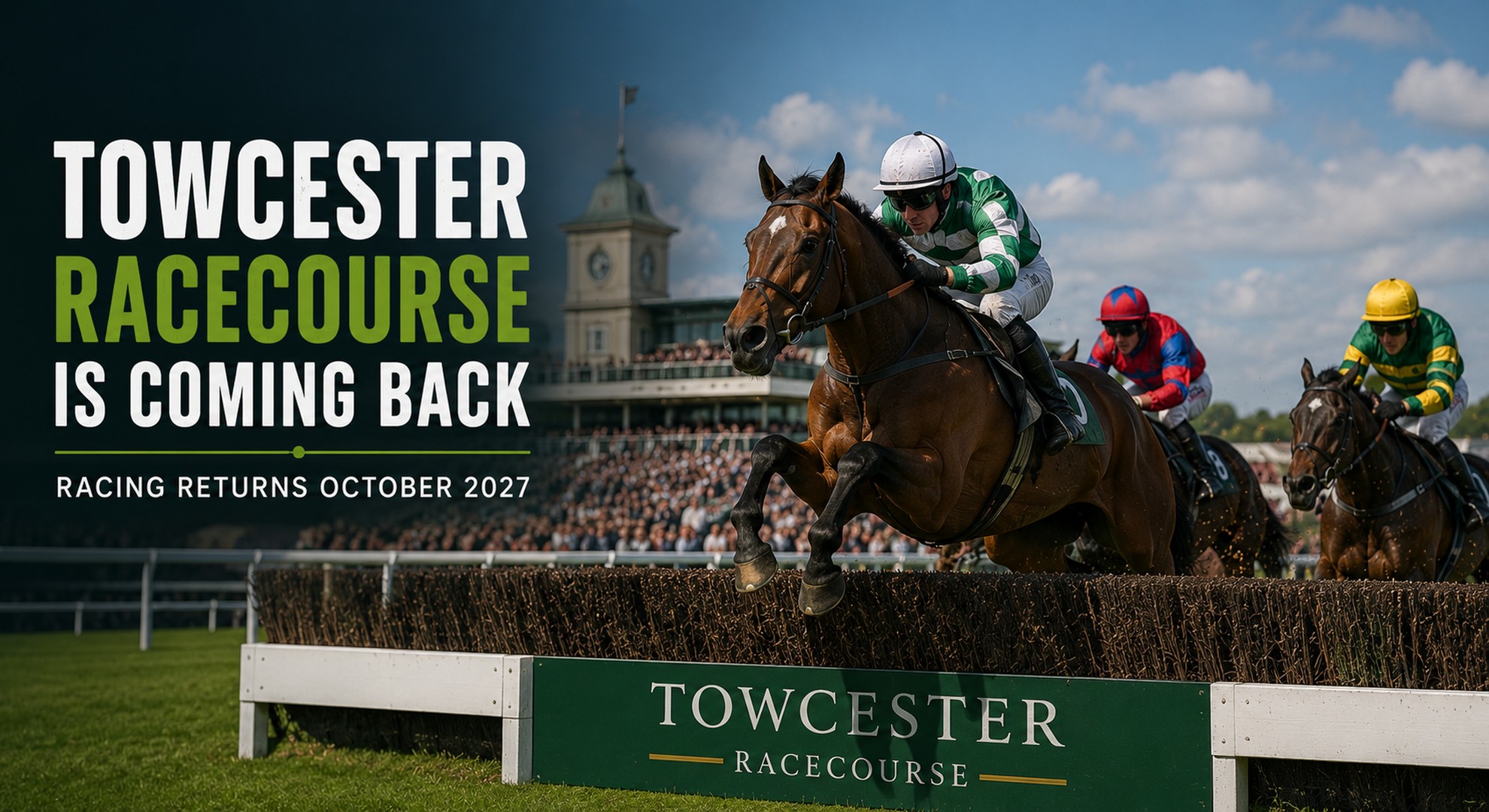
Towcester Racecourse is moving closer to staging horse racing again after six National Hunt fixtures were agreed for the 2027/28 jumps season.
The Northamptonshire racecourse has not staged a horse racing meeting since May 2018, but plans are now taking shape for a return under Rules on Wednesday 20 October 2027.
For British jump racing, this is more than another six dates on the fixture list.
Bringing a historic racecourse back after almost a decade without horse racing is significant at a time when much of the discussion around Britain’s racing infrastructure has focused on financial pressures, falling attendances, fixture congestion and the long-term sustainability of racecourses.
Towcester’s return therefore deserves to be welcomed.
There are still important hurdles to clear. The proposed fixtures remain subject to British Horseracing Authority approval and the racecourse must secure the necessary licence before racing can resume.
But for the first time in years, there is a genuine route back.
And British jump racing will be stronger if Towcester succeeds.
When Will Horse Racing Return to Towcester?
The planned return of racing under Rules is 20 October 2027.
Six National Hunt fixtures have been lined up for the 2027/28 season:
- Wednesday 20 October 2027
- Tuesday 30 November 2027
- Thursday 16 December 2027
- Sunday 16 January 2028
- Friday 4 February 2028
- Tuesday 15 February 2028
All six dates remain subject to BHA approval.
The schedule tells us something about the intended identity of the revived Towcester.
This is not an attempt to transform the racecourse into something it never was.
Towcester is coming back as a National Hunt racecourse.
Its meetings run from October through February, placing the track firmly within the core British jumps season.
That feels right.
Towcester Has Not Staged Horse Racing Since 2018
Towcester last staged a horse racing meeting in May 2018.
The racecourse subsequently entered administration, bringing an end to regular horse racing at a venue with a long history in the sport.
The wider site did not disappear.
Towcester continued as a greyhound racing venue and became an important home for major greyhound events, including the English Greyhound Derby.
Horse racing, however, was gone.
As the years passed, it became increasingly reasonable to wonder whether it would ever return.
That is why the latest announcement matters.
This is no longer simply an ambition to bring horses back to Towcester.
There are now proposed dates, significant investment, redevelopment work and a timetable.
Point-to-Point Racing Could Come First
The return is planned in stages.
Towcester is aiming to stage Point-to-Point racing in spring 2027 before National Hunt racing under Rules resumes later in the year.
That looks like a sensible approach.
Bringing horses, jockeys and racing professionals back to the course before the first Rules fixture provides an opportunity to test the venue following its redevelopment.
It also gives Towcester time to rebuild its identity as an equine venue.
The target is then for the first Rules meeting to take place on 20 October.
For supporters of National Hunt racing, that date will be worth remembering.
More Than £2 Million Is Being Invested
A racecourse cannot simply reopen its gates after nearly a decade and expect everything to work.
Significant redevelopment is required.
More than £2 million is being invested into Towcester as part of the project involving racecourse management company Orchestrate and Betway.
The work includes an overhaul of the racing surface alongside improvements and modernisation of spectator facilities.
That investment is important.
The racecourse returning is one thing.
Returning with a surface, facilities and infrastructure capable of supporting modern British racing is another.
The project has to work for:
- horses;
- jockeys;
- trainers;
- stable staff;
- racegoers;
- officials;
- owners;
- broadcasters;
- commercial partners.
A successful reopening needs to be more than a nostalgic exercise.
Towcester has to become a viable modern racecourse.
Towcester Will Become Betway Towcester Racecourse
One of the most unusual parts of the redevelopment is the commercial agreement behind it.
Betway has become Towcester’s Principal Strategic Partner and exclusive betting partner.
The venue is also set to be officially known as Betway Towcester Racecourse when racing returns.
For British racing, the naming arrangement is noteworthy.
Race sponsorship is nothing new. Neither are racecourse partnerships with bookmakers.
But incorporating the betting brand into the racecourse’s official name represents a different level of commercial involvement.
Some racing traditionalists will inevitably prefer simply calling it Towcester.
Others will see the partnership as a practical example of commercial investment helping to restore a racecourse that otherwise might have remained lost to the sport.
For us, the important point is the outcome.
A British racecourse that stopped staging horse racing is being rebuilt with the intention of racing again.
That is a positive development.
Why Towcester Matters to British Jump Racing
Britain has an extraordinary variety of racecourses.
That variety is one of the strengths of the sport.
Our UK racecourses include huge festival venues, small rural tracks, tight turning courses, galloping courses, Flat specialists, jumps specialists and dual-purpose venues.
They should not all be the same.
Towcester had its own identity.
It was a demanding jumps track where stamina mattered and races could change significantly on the climb towards the finish.
Losing distinctive racecourses makes British racing less varied.
Getting one back does the opposite.
Towcester Was a Proper Jumps Test
One phrase from Sir AP McCoy’s reaction to the news sums up much of Towcester’s appeal.
He described it as a proper jumps track.
That matters.
National Hunt racing is supposed to test more than raw speed.
Different courses test:
- stamina;
- jumping;
- balance;
- tactical speed;
- positioning;
- course handling;
- ability to race uphill and downhill;
- effectiveness on different ground.
Compare Cheltenham with Aintree, or a tight track with one of Britain’s more galloping courses.
They produce different challenges.
That diversity is part of what makes British jump racing compelling.
Towcester adds another distinctive test back into the programme.
AP McCoy’s 4,000th Winner Gives Towcester a Special Place in Racing History
Towcester also owns a permanent place in the career of one of the greatest jump jockeys.
On 7 November 2013, Sir AP McCoy rode his 4,000th career winner at Towcester.
The horse was Mountain Tunes, trained by Jonjo O’Neill.
It was an extraordinary milestone.
McCoy’s career eventually produced more than 4,000 winners and 20 consecutive British jump jockeys’ championships.
There could hardly be a stronger association between a racecourse and one of the defining achievements of modern National Hunt racing.
That connection makes the loss of Towcester particularly noticeable.
It also makes its return more meaningful.
A new generation of racegoers will potentially be able to stand at a course where one of British racing’s most famous records was achieved.
Britain Should Celebrate Racecourses Reopening
Racing discussions naturally concentrate on the biggest meetings.
The Cheltenham Festival, Grand National and major championship races dominate attention.
But British racing does not survive on a handful of festivals.
The everyday racecourse network matters enormously.
Smaller and medium-sized tracks provide opportunities for:
- horses below championship level;
- developing jockeys;
- smaller trainers;
- local owners;
- racing staff;
- regional racegoers;
- new fans.
They also spread racing geographically.
Not everybody can or wants to travel to Cheltenham, Aintree, Ascot or Newmarket every time they want to watch racing.
A strong racing industry needs a strong network of racecourses.
Reopening Towcester adds to that network.
It Is Also Good News for Racegoers
Racecourses need racegoers.
That sounds obvious, but the racecourse experience is sometimes treated as secondary to betting, broadcasting and media rights.
It shouldn’t be.
Going racing remains one of the best ways to turn someone with a passing interest in horses into a long-term racing fan.
Our newcomer’s guide to a day at the races exists for exactly that reason.
Racegoers can:
- see horses in the parade ring;
- watch jockeys and trainers at close quarters;
- experience a race from beside the course;
- understand the speed of a racehorse;
- see jumping from a perspective television cannot reproduce;
- enjoy racing as a social occasion.
Towcester’s location gives another part of the country access to live National Hunt racing.
If the redevelopment produces good spectator facilities alongside a distinctive racing experience, the course has an opportunity to rebuild a loyal audience.
The First Meeting Will Be Fascinating
From a racing-analysis perspective, the first Towcester meetings will be particularly interesting.
We will effectively be watching an established racecourse return with a substantially redeveloped racing surface.
Historical Towcester form will have limited relevance after such a long absence.
That means analysts will need to learn how the new version of the course behaves.
Questions will include:
- How will the surface ride?
- Will old course characteristics remain?
- How testing will the finish be?
- Will prominent racers have an advantage?
- How will different going conditions affect the course?
- Will particular racing lines emerge?
- How will the fences ride?
- Which trainers target the meetings?
- Which horses appear particularly suited to the track?
Our guides to pace bias, track bias and race replay analysis will become particularly relevant once racing resumes.
We should avoid assuming that the Towcester of 2027 will behave exactly like the Towcester of 2018.
The evidence will need to be rebuilt.
Could Towcester Become Important Again?
Six fixtures is a modest beginning.
That is probably a strength rather than a weakness.
There is no need to reopen with an enormous fixture programme.
First, Towcester needs to demonstrate that it can stage safe, competitive and commercially viable National Hunt racing.
If those first meetings succeed, the course can build from there.
The long-term opportunity is interesting.
Towcester has:
- history;
- a recognisable name;
- a distinctive course;
- a central location;
- substantial new investment;
- a major commercial partner;
- an association with AP McCoy;
- an established sporting venue around it.
Those are useful ingredients.
What happens next will depend on execution.
There Are Still Hurdles to Clear
The excitement around Towcester’s return should not obscure the fact that the process is not complete.
The six proposed fixtures require BHA approval.
The racecourse licence must be secured.
Redevelopment work must be completed.
The racing surface must satisfy the required standards.
Operational arrangements must be ready.
There is therefore an important distinction between:
Towcester planning to return
and:
Towcester having successfully staged its first meeting.
The direction is encouraging.
But there is still work to do before horses line up for the first race.
What Towcester’s Return Says About British Racing
The most interesting part of the story goes beyond Northamptonshire.
British racing spends a lot of time discussing decline.
There are legitimate reasons for concern.
Racecourse economics are difficult. Betting revenues are changing. Attendances matter. Ownership costs are substantial. The fixture programme is regularly debated.
But racing should also recognise positive developments.
A racecourse returning after almost ten years is one of them.
There is private investment.
There is redevelopment.
There is commercial backing.
There is an attempt to attract spectators.
And, most importantly, there is a plan to put racehorses back on a British racecourse that many people thought might never stage racing again.
That deserves support.
Could Other Lost Racecourses Ever Return?
Towcester inevitably raises a wider question.
Could other former racecourses come back?
Britain’s racing history is filled with courses that disappeared because of redevelopment, financial problems, war, changing populations and shifting economics.
Most will never return.
Land has been redeveloped and the practical obstacles are enormous.
Towcester is unusual because the sporting venue remained active after horse racing stopped.
That made revival more realistic.
Its return should therefore not be interpreted as evidence that reopening old racecourses is easy.
It isn’t.
Instead, Towcester demonstrates something more useful:
the closure of a racecourse does not always have to be permanent.
Towcester and the Future of National Hunt Racing
National Hunt racing faces its own challenges.
Field sizes, fixture distribution, horse populations, ground conditions and the economics of ownership all influence the health of the sport.
Adding another venue does not solve those problems.
But Towcester can still make a valuable contribution.
Its winter programme could provide additional opportunities for horses and connections while restoring a distinctive course to the jumps calendar.
The important word is valuable.
British racing does not simply need more races.
It needs races and racecourses that add something worthwhile to the programme.
Towcester has the potential to do that.
What Happens Next at Towcester?
The next stages are straightforward to describe even if they are complicated to deliver.
Towcester must continue:
- redeveloping the racing surface;
- modernising spectator facilities;
- working through the BHA licensing process;
- preparing for the return of equine activity;
- working towards Point-to-Point racing in spring 2027;
- securing approval for the six proposed Rules fixtures;
- preparing for 20 October 2027.
There should be further announcements as the redevelopment progresses.
British Racecourses will follow those developments as the return gets closer.
Once racing resumes, Towcester should also return to our wider coverage of British racecourses alongside the country’s established active tracks.
Our View: British Racing Is Better With Towcester
Our view is straightforward.
Towcester returning is good news for British racing.
Not because British racing desperately needs another six fixtures.
Not because a racecourse reopening solves the sport’s wider challenges.
And not simply because of nostalgia.
It is good news because British racing benefits from having distinctive racecourses.
Towcester was distinctive.
It provided a genuine National Hunt test and had a character different from Britain’s major festival venues.
The fact that more than £2 million is being invested in bringing the racing surface and spectator facilities back into use also shows serious intent.
There is an important commercial element through Betway, and racing will have its own opinions about the racecourse naming arrangement.
But the fundamental result is difficult to argue with.
Horses are on course to race at Towcester again.
For a venue that has been absent from the horse racing calendar since May 2018, that is something worth celebrating.
Towcester Racecourse Return FAQs
Is Towcester Racecourse reopening for horse racing?
Towcester is preparing to resume horse racing. Six National Hunt fixtures have been proposed for the 2027/28 season, with the first planned for October 2027. The fixtures and racecourse licence remain subject to BHA approval.
When is the first Towcester horse racing fixture?
The proposed first Rules fixture is Wednesday 20 October 2027.
How many horse racing fixtures will Towcester have?
Six National Hunt fixtures have been lined up for the 2027/28 season.
When did Towcester last stage horse racing?
Towcester last staged a horse racing meeting in May 2018.
Will Towcester have Flat racing?
The announced programme is for National Hunt racing. Towcester is returning as a jumps venue.
Will there be racing at Towcester before October 2027?
The racecourse is aiming to stage Point-to-Point fixtures in spring 2027 as part of a phased return to equine activity.
How much is being invested in Towcester Racecourse?
More than £2 million is being invested in the racing surface and spectator facilities as part of the redevelopment.
Why is it called Betway Towcester Racecourse?
Betway has become the Principal Strategic Partner and exclusive betting partner of the venue. The racecourse is set to be officially renamed Betway Towcester Racecourse as part of the partnership.
Did AP McCoy ride his 4,000th winner at Towcester?
Yes. AP McCoy rode his 4,000th career winner aboard Mountain Tunes at Towcester on 7 November 2013.
Are the Towcester fixtures confirmed?
The six dates have been agreed/proposed as part of the planned return, but they remain subject to BHA approval, and Towcester’s racecourse licence application must also be completed.
Summary
Towcester Racecourse is closer to returning to British horse racing than at any point since its final meeting in May 2018.
Six National Hunt fixtures are planned between October 2027 and February 2028, beginning with a proposed return on 20 October 2027.
More than £2 million is being invested in the racing surface and spectator facilities, while Point-to-Point racing could bring horses back to the venue as early as spring 2027.
There are still important conditions to satisfy.
The fixtures require BHA approval and the racecourse must secure its licence.
But the direction is clear.
Towcester is being rebuilt for horse racing.
For British National Hunt fans, the prospect of a distinctive jumps track returning after almost a decade away is excellent news.
And if everything goes to plan, 20 October 2027 will mark more than the first meeting of a new season.
It will mark the return of a British racecourse.