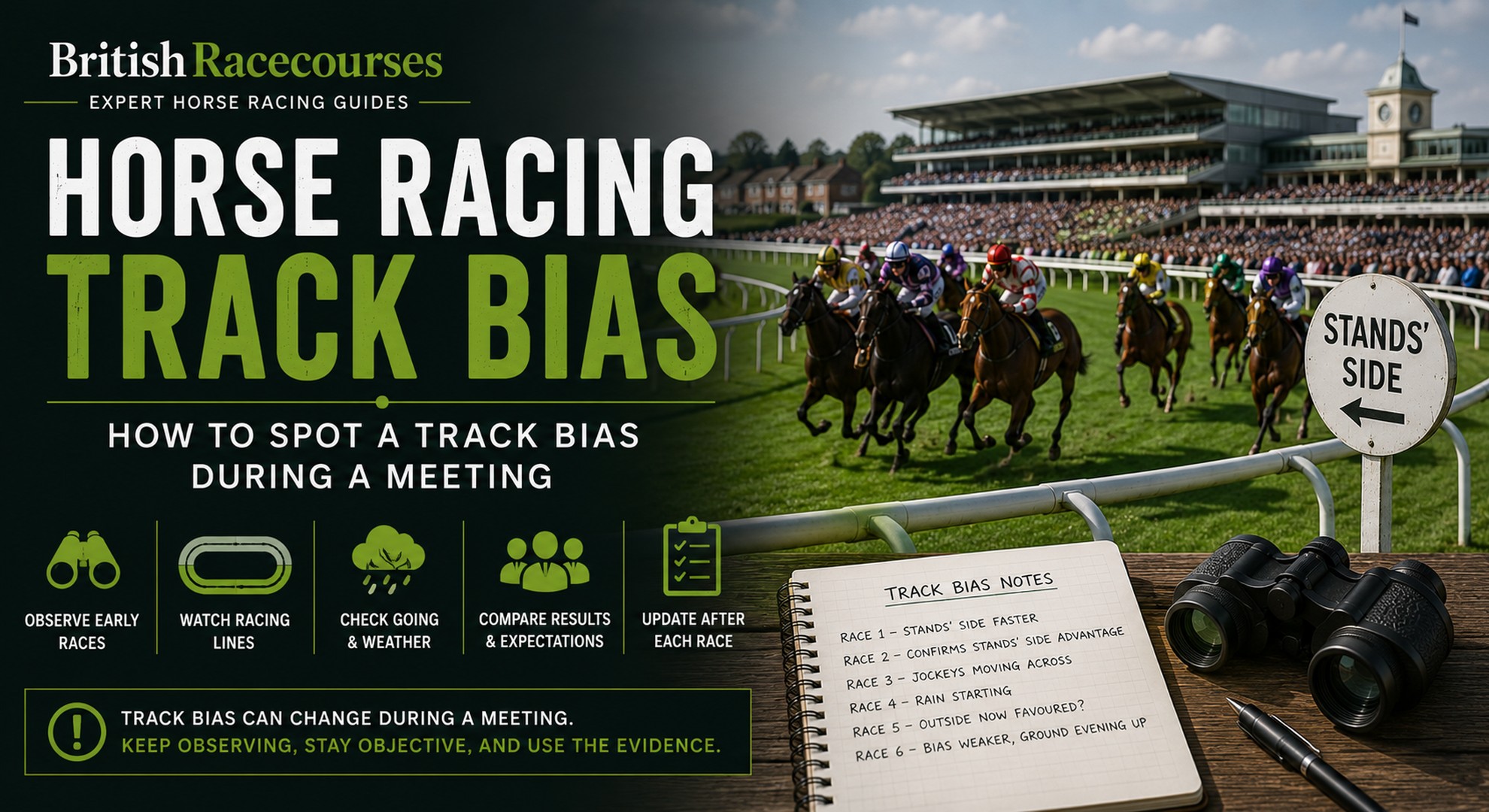
Horse racing track bias occurs when one part of a racecourse or one type of track position gives horses an advantage or disadvantage beyond their underlying ability.
A bias can develop because of ground conditions, drainage, wear, rail movements, weather, track maintenance or the way earlier races affect the racing surface.
It can favour horses racing:
- close to a particular rail;
- on one side of a straight course;
- away from heavily used ground;
- prominently;
- away from the lead;
- on a particular racing line.
Track bias matters because the final result does not always represent a completely level test.
A horse racing on the quickest part of the course may perform better than expected. Another horse could run extremely well while competing on slower or more testing ground.
Recognising the difference can improve both your analysis of the current meeting and your interpretation of the form when those horses race again.
The key is not to declare a bias after one unusual result. Good track-bias analysis requires evidence from several races, an understanding of the course and careful separation of track bias, draw bias and pace bias.
This page explains how to do that.
What Is Track Bias in Horse Racing?
Track bias describes a situation where the racing surface, track position or course conditions favour some runners more than others.
Imagine a straight-course handicap containing 20 horses.
Ten race towards the stands’ side.
Ten race towards the far side.
The stands-side group repeatedly travels more strongly and finishes well ahead of the far-side runners.
There are several possible explanations.
The stands-side group may contain better horses.
It may contain more early pace.
Its runners may have received more efficient rides.
But the ground on that side could also be faster.
If the same pattern appears across several races, evidence of a track bias starts to build.
The important word is evidence.
One result rarely proves that a bias exists.
Track Bias Is Not the Same as Draw Bias
Track bias and draw bias are closely connected, but they are not identical.
A draw bias is an advantage associated with starting from particular stall positions.
A track bias is an advantage associated with where horses actually race or with how the surface is performing.
For example, low-numbered stalls can have a long-term advantage over a particular course and distance because they provide a shorter route around the first bend.
That is primarily a draw bias.
Now imagine heavy rain falls before racing and the ground against the inside rail becomes considerably slower than the ground several horse-widths away from it.
The historical low-draw advantage could disappear or even reverse.
That is why our horse racing draw guide stresses that weather, ground and rail movements can change established draw patterns.
Historical statistics tell you what usually happens.
Track-bias analysis asks what appears to be happening today.
Track Bias Is Not the Same as Pace Bias
Pace bias concerns the relationship between running style and race outcomes.
Some course-and-distance combinations make life easier for horses that race prominently. Others give hold-up horses more opportunity.
Our guide to horse racing pace bias examines these historical tendencies in detail.
A live track bias is different.
Suppose front-runners win the first four races.
That does not automatically prove the surface is favouring leaders.
The early races may simply have lacked genuine competition for the lead.
The leaders may have controlled slow fractions and conserved energy.
The strongest horses may coincidentally have raced prominently.
You therefore need to separate:
course characteristics
from:
race pace
from:
what the surface itself is doing.
This distinction is fundamental to accurate bias analysis.
Why Does Track Bias Develop?
British racecourses are outdoor sporting surfaces rather than perfectly uniform running tracks.
Conditions change.
Several factors can produce temporary advantages.
Rain
Heavy rain can affect different sections of a racecourse differently.
Drainage varies.
Some areas can become waterlogged or more testing before others.
Drying ground
A track drying after rain can also develop uneven conditions.
One section may dry more quickly and provide a firmer, faster racing line.
Wear
Repeated racing can churn up heavily used sections of turf.
This becomes particularly relevant during multi-day festivals and meetings.
Rail movements
Racecourses move running rails for course management and to provide fresh ground.
This changes the racing line and can expose horses to sections of turf that have experienced different levels of wear.
Drainage
The underlying drainage of a course can make one area behave differently after significant rainfall.
Track maintenance
Watering, mowing and other course preparation can influence how the surface rides.
Weather during racing
Conditions do not stop changing when the first race begins.
Rain, sunshine, wind and drying conditions can alter the course throughout the afternoon.
This is why a track bias identified early in a meeting should never automatically be assumed to remain unchanged until the final race.
What Is a Rail Bias?
A rail bias occurs when racing close to a particular rail appears advantageous or disadvantageous.
This could involve:
- the inside rail around a bend;
- the stands’ rail on a straight course;
- the far rail;
- an area several horse-widths away from the rail.
Imagine horses racing against the stands’ rail repeatedly travel better than horses positioned towards the centre.
If the pattern persists across different races and cannot be adequately explained by ability, draw or pace, the rail itself may be providing an advantage.
The reverse can happen.
Jockeys sometimes move away from a rail because they believe the ground there is slower.
Watching where jockeys choose to race can therefore be highly informative.
Inside Track Bias
An inside bias occurs when horses racing close to the inner rail gain an advantage.
On turning tracks this can happen because inside runners cover less ground.
That effect is partly course geometry rather than surface bias.
However, if the inside ground is also riding particularly well, the advantage can become greater.
The distinction matters.
If the inside has always been advantageous because of the course layout, you are observing an established course characteristic.
If it becomes unusually dominant on one particular day, there may be an additional temporary track bias.
Outside Track Bias
An outside bias occurs when horses racing away from the inside perform disproportionately well.
This can happen when:
- inside ground is worn;
- rain has affected one section more heavily;
- jockeys deliberately search for fresher ground;
- rail movements expose a faster strip;
- earlier races have damaged the traditional racing line.
An outside bias can be particularly revealing if horses deliberately sacrifice ground around a bend to race on a better part of the surface.
A jockey choosing a longer route is significant.
It suggests they believe the quality of the ground can compensate for the additional distance travelled.
Stands-Side and Far-Side Bias
Large-field straight races often split into groups.
Some horses race towards the stands’ side.
Others remain towards the far side.
A third group may race through the centre.
These races can provide some of the clearest examples of track bias.
Suppose a 24-runner sprint splits almost evenly.
The first six horses from the stands-side group finish ahead of every horse racing far side.
That is worth investigating.
But before concluding that the stands’ side is faster, ask:
- Where were the best horses drawn?
- Which side contained the favourite?
- Which side contained the strongest early pace?
- Did one group race more efficiently?
- Was one group larger?
- Did the jockeys believe one side was preferable before the race?
Group composition can create an apparent bias that has nothing to do with the surface.
How to Spot Track Bias During a Meeting
The best way to identify a live track bias is to build evidence race by race.
Do not begin the meeting determined to find one.
Start neutral.
Then observe.
Step 1: Know the Course Before Racing Starts
You need a baseline.
Before the first race, understand:
- whether the course is left or right-handed;
- whether races take place on a straight or round course;
- where the bends occur;
- how long the finishing straight is;
- whether there are recognised historical draw tendencies;
- where the stalls are positioned;
- whether rails have moved;
- the official going;
- recent weather.
Our individual British racecourse guides provide detailed information about course layouts around Britain.
Without a baseline, it becomes difficult to distinguish unusual behaviour from normal course characteristics.
Step 2: Check the Going
The official going provides your starting description of the racing surface.
But a single going description cannot explain every square metre of a large racecourse.
A track officially described as soft can contain areas that ride differently.
Our horse racing going guide explains the main going descriptions and how different conditions affect performance.
Track-bias analysis goes one stage further.
Ask:
Is the whole course apparently riding consistently with that description?
Step 3: Watch the First Race Carefully
The first race provides information.
It does not provide a verdict.
Watch:
- where the winner raced;
- where the placed horses raced;
- where the favourite raced;
- which horses travelled comfortably;
- where jockeys moved;
- whether horses changed racing line;
- how the pace developed;
- whether the field split into groups.
Then record what happened.
Avoid statements such as:
“The inside is definitely fastest.”
After one race, a better conclusion is:
“The inside may have been advantageous in race one. Watch the next races for confirmation.”
Step 4: Compare Expectations With Results
This is one of the most important steps.
A 1/2 favourite winning from the inside does not provide strong evidence that the inside is favoured.
The horse was expected to win.
Now imagine a series of horses with modest form dramatically outperform their market expectations while racing on the same strip of ground.
That is more interesting.
Compare:
Expected performance
with:
Actual performance
If horses continually outperform expectations from the same part of the track, evidence of a bias becomes stronger.
Step 5: Watch Where the Jockeys Go
Jockey behaviour can reveal changing perceptions of the course.
Early in a meeting, runners may remain close to the traditional racing line.
Later, jockeys may begin moving towards:
- the stands’ rail;
- the far rail;
- the centre;
- several horse-widths away from the inside.
This is particularly informative when several experienced jockeys independently make the same decision.
They have ridden the surface.
They may have received feedback from riders in earlier races.
A visible migration towards one part of the track deserves attention.
It still does not prove that the area is faster, but it is useful evidence.
Step 6: Look for Repeated Patterns
Track bias becomes more credible when the same pattern survives different types of race.
For example:
Race 1: winner races stands side.
Race 2: first two finishers race stands side.
Race 3: an unfancied stands-side runner performs significantly above expectations.
Race 4: jockeys deliberately move across to the stands’ rail.
Now you have a much stronger case.
The races should ideally contain different horses, trainers, jockeys, classes and pace scenarios.
The more independent the evidence, the more convincing the pattern becomes.
Step 7: Separate Pace From Surface
Imagine the first three winners all lead from start to finish.
You might conclude:
Front-runners are favoured.
Before doing so, examine the pace.
Were the leaders allowed to dictate slowly?
Were there few other front-runners?
Did the chasing horses give them too much room?
Did the winners simply have superior ability?
Use a horse racing pace map to compare the expected race shape with what actually occurred.
A genuine bias should survive reasonable alternative explanations.
Step 8: Compare Similar Races
Comparing completely different contests can mislead.
A two-mile chase tells you relatively little about a five-furlong Flat sprint.
Try to compare races using similar sections of the course.
For Flat racing, consider:
- same straight;
- similar distance;
- comparable field size;
- similar stall configuration.
For jump racing, consider:
- which parts of the course overlap;
- where horses raced around bends;
- whether fresh or worn ground was used;
- how conditions changed.
The closer the comparison, the more useful the evidence.
Step 9: Keep Watching the Weather
A bias is not permanent.
Suppose the stands’ side appears fastest during the first three races.
Heavy rain then arrives.
The surface can change.
The same bias may:
- strengthen;
- weaken;
- disappear;
- reverse.
Do not continue applying an earlier conclusion after the evidence changes.
Step 10: Update Your View After Every Race
Treat track bias as a live hypothesis.
After every race ask:
What evidence supports the bias?
What evidence contradicts it?
Can the result be explained by pace, ability or draw instead?
Have the jockeys changed where they are racing?
This prevents one early observation from controlling your interpretation of the entire meeting.
Track Bias and the Draw
Draw and track bias often interact.
Imagine high-numbered stalls place horses closest to the stands’ rail.
If the stands’ rail is riding faster, high-drawn horses may gain an advantage.
The result will appear statistically as a high-draw bias.
But the underlying cause could be the racing surface.
This distinction becomes important when using historical data.
The high-draw advantage may disappear at the next meeting if the ground changes.
This is why draw bias should always be interpreted alongside current conditions.
Track Bias and Pace
Pace can magnify or disguise a track bias.
Suppose the fastest part of the course is near the inside rail.
A front-runner secures that position and controls the race.
It now has two potential advantages:
- favourable pace position;
- favourable ground.
Another horse may be forced wide onto slower ground while also racing further back.
Its disadvantage is compounded.
This is one reason pace bias and track bias should be analysed together rather than separately.
Track Bias and Race Replays
Race replays are essential for identifying track bias properly.
A result sheet tells you where horses finished.
It does not always tell you where they raced.
When watching a horse racing replay, focus on:
- racing line;
- position relative to the rail;
- group position;
- where the horse made its challenge;
- whether it changed sides;
- where it began to weaken;
- whether the jockey deliberately searched for different ground.
Watching several races from the same meeting consecutively can reveal patterns that are difficult to spot when viewing races individually.
Track Bias and Sectional Times
Sectional times can provide another layer of evidence.
Suppose horses racing towards one side consistently record stronger finishing sectionals.
That may support the visual impression that the ground there is quicker.
But sectionals also help you avoid false conclusions.
A horse that appears to benefit from a track position may simply have conserved more energy because of a slow early pace.
Times add evidence.
They do not remove the need for interpretation.
Track Bias and Horses That Ran Better Than the Result
One of the most valuable uses of track-bias analysis comes after the meeting.
Imagine the evidence strongly suggests that the stands’ side was faster.
A horse races alone on the far side and finishes fifth overall.
On the bare result, it appears to have been comfortably beaten.
But it may have produced one of the strongest individual performances in the race.
That horse could qualify as a horse that ran better than the result.
The reverse also matters.
A winner that enjoyed the best part of the track may deserve less credit than the finishing position suggests.
This process is sometimes described as upgrading and downgrading performances.
How to Upgrade a Horse for Track Bias
Consider upgrading a performance when a horse:
- races on apparently slower ground;
- remains competitive despite being isolated from the favoured group;
- takes a longer route to avoid poor ground;
- finishes strongly from the disadvantaged side;
- performs better than other horses using the same racing line;
- runs close to horses enjoying a clear positional advantage.
An upgrade does not mean the horse will win next time.
It means the performance may have been stronger than the bare result suggests.
How to Downgrade a Horse for Track Bias
A horse may deserve less credit when it:
- races exclusively on the apparently quickest ground;
- receives an uncontested favourable rail position;
- is part of a strongly favoured group;
- beats rivals who raced on significantly worse ground;
- benefits from both track position and pace.
Again, this does not make the horse poor.
It simply changes how you assess the performance.
What Is a False Track Bias?
A false track bias occurs when results appear to show an advantage that is actually explained by something else.
This is one of the biggest dangers in live race analysis.
Suppose three consecutive winners race prominently.
It is tempting to conclude:
The track favours front-runners.
But perhaps all three winners were favourites.
Or perhaps all three races were slowly run.
Or perhaps the best horses happened to race near the pace.
The apparent bias disappears once you account for horse ability and race shape.
Common Causes of False Bias
Small samples
Two races are not enough to establish a strong conclusion.
Strong favourites
Expected winners can create patterns by coincidence.
Pace
Slow races often favour prominent horses regardless of the surface.
Draw
Stall position can determine which horses reach a particular racing line.
Group quality
One side of a split field may simply contain better horses.
Jockey behaviour
Once riders believe a bias exists, they may all move to the same place.
This can create congestion and alter later results.
Different race types
Comparing unrelated races can create meaningless patterns.
The goal is not to identify a bias as quickly as possible.
The goal is to identify one correctly.
The Danger of Confirmation Bias
Once you believe a track bias exists, every subsequent result can appear to confirm it.
Suppose you decide after race two that the inside is fastest.
Race three is won from the inside.
You count that as confirmation.
Race four is won wide.
You dismiss it because the winner was clearly the best horse.
Race five is won inside.
You count that as confirmation again.
You have now created an analysis where evidence supporting your theory counts and contradictory evidence does not.
That is confirmation bias.
Instead, deliberately look for evidence that could prove your hypothesis wrong.
A strong analytical process should survive challenge.
Sample Size Matters
Track-bias analysis has an unavoidable problem.
A race meeting contains a limited number of races.
You may have only six or seven opportunities to observe the surface.
Some races may use different courses or distances.
That leaves a small sample.
You should therefore think in probabilities rather than certainty.
Instead of:
“The stands’ rail is definitely five lengths faster.”
think:
“The evidence from the first four relevant races suggests the stands’ side may be advantageous.”
The second statement is less dramatic.
It is also more defensible.
Track Bias on Turf
Turf racing provides many opportunities for temporary bias because natural ground responds to:
- rain;
- drainage;
- wear;
- watering;
- temperature;
- rail movements;
- previous racing.
Large meetings can be especially interesting because repeated racing places more stress on the course.
Different days of a festival can therefore produce different patterns.
Never assume that a bias identified on day one remains identical on day three.
Track Bias on All-Weather Surfaces
All-weather racing does not eliminate track bias.
Synthetic surfaces are designed to provide more consistent racing, but conditions and maintenance still matter.
Britain’s all-weather racecourses use different surfaces and course configurations.
When assessing an all-weather meeting, consider:
- surface type;
- kickback;
- maintenance;
- weather;
- pace;
- draw;
- track position;
- recent course results.
Course configuration can also create positional advantages independently of the surface itself.
For example, a short run to the first bend can make early position particularly important.
Do not automatically interpret that as evidence that one strip of synthetic surface is faster.
Track Bias in Jump Racing
Traditional stall-based draw bias does not apply to National Hunt racing, but track position can still matter.
Jump racing takes place over larger areas of turf and longer distances, which can create different forms of advantage.
Watch for:
- jockeys avoiding damaged ground;
- runners moving away from the inside;
- fresher ground on wider lines;
- changing racing lines between races;
- sections of the course becoming particularly testing.
Jump racing also introduces another major variable: jumping.
A horse losing ground through poor jumping should not automatically be upgraded because it raced on an apparently unfavourable part of the track.
Separate the different causes of the performance.
Our National Hunt racing guide explains the different demands of jump racing.
Track Bias at Tight Racecourses
Tight racecourses make positional analysis particularly important.
At tracks such as Chester, horses racing close to the inside can naturally cover less ground around the bends.
That is a structural feature of the course.
It should not automatically be labelled a temporary track bias.
The question is whether the advantage today appears stronger or weaker than the normal course effect.
This is why course knowledge must come before live bias analysis.
Track Bias on Galloping Racecourses
Wide, galloping tracks often provide horses with more room and time to find a racing position.
However, that does not make them immune to track bias.
Large straight-course fields can split into separate groups.
Ground differences across the width of the course can then become extremely important.
At courses such as Newmarket and York, understanding where the pace develops and where horses choose to race can be as important as simply looking at stall numbers.
Track Bias at Undulating Courses
Courses with unusual cambers, gradients and bends add another layer.
Epsom is an obvious example of a course where balance, position and track suitability matter.
When analysing unusual racecourses, be careful not to describe a permanent course characteristic as a temporary bias.
A horse struggling with a camber has not necessarily been disadvantaged by a biased surface.
It may simply not have handled the track.
That distinction is important when interpreting the form later.
Can Wind Create an Apparent Bias?
Wind can affect how races develop.
A strong headwind can make it difficult for horses racing without cover.
A tailwind can change the demands placed on leaders.
Crosswinds may influence positioning.
This can create results that look like a track or pace bias.
Before concluding that one racing line is quicker, consider whether wind direction affected the horses differently.
This is another reason weather matters beyond the official going description.
Can a Bias Change During a Meeting?
Yes.
This is one of the most important principles on this page.
Track bias is dynamic.
Imagine:
Race 1: inside appears fastest.
Race 2: inside appears fastest.
Race 3: rain begins.
Race 4: jockeys move away from the inside.
Race 5: outside runners dominate.
The correct conclusion is not that one of the patterns must be wrong.
The surface may have changed.
Continue analysing rather than becoming attached to your first conclusion.
Can Jockeys Remove a Track Bias?
Jockey behaviour can reduce the betting usefulness of an obvious bias.
Suppose the stands’ rail has looked significantly faster.
By race five, every jockey knows it.
The whole field moves towards that rail.
The original advantage may still exist, but no horse now receives it exclusively.
The market may also react.
An informational advantage is most useful before everyone else has incorporated it.
This is another reason track bias should not be treated as an automatic betting system.
Does Track Bias Create Betting Value?
Track bias can change your assessment of a horse’s probability.
It can therefore contribute to identifying value bets in horse racing.
But spotting a bias does not automatically create value.
Suppose everyone watching the meeting recognises that the stands’ side is favoured.
Bookmakers and bettors can adjust prices.
A horse ideally positioned to exploit the bias may shorten significantly.
At that point, the advantage could already be reflected in the odds.
The correct process is:
Identify the potential bias → assess how it changes each horse’s chance → estimate a fair price → compare with the market.
Our guide to pricing a horse race explains the final stage.
Track Bias and Market Movement
A developing bias can influence betting markets later on a card.
If earlier races strongly favour one side, horses positioned to use that side may attract support.
This can contribute to betting odds shortening.
However, market movement is not proof that the bias exists.
Other bettors can be wrong too.
Treat market reaction as another piece of information rather than confirmation.
Recording Track Bias
Keeping notes improves track-bias analysis considerably.
For each race record:
Race: time, distance and class
Going: official description
Winner’s position: rail/centre/wide
Placed horses: where they raced
Pace: slow/average/strong
Draw: relevant stall positions
Market: whether results broadly matched expectations
Jockey behaviour: any deliberate changes of racing line
Bias assessment: none/possible/moderate/strong
Confidence: low/medium/high
After the meeting, review your conclusions again.
The most useful question is:
Did the horses I upgraded or downgraded perform as expected when they raced again?
That turns subjective observation into something you can evaluate.
Building a Track-Bias Database
More advanced racing analysis can record track-bias observations over time.
Useful fields include:
- racecourse;
- date;
- distance;
- going;
- field size;
- rail position;
- draw;
- run style;
- racing line;
- weather;
- pace;
- result;
- notes.
Over a large sample, you can distinguish temporary meeting-specific biases from persistent course tendencies.
This is where analysis can eventually feed into a horse racing betting model.
But be careful.
Subjective bias labels can contaminate a dataset if they are applied inconsistently.
Define your methodology before collecting the data.
Backtesting Track-Bias Ideas
If you believe certain track-bias signals have predictive value, test them.
Do not rely on memorable examples.
Our guide to backtesting horse racing betting systems explains why historical testing needs:
- clear rules;
- adequate sample sizes;
- realistic prices;
- no hindsight;
- consistent methodology.
Track bias is particularly vulnerable to hindsight because a racing line can look obviously advantageous after the winners are known.
Your analysis needs to ask what could reasonably have been identified before the later races took place.
Track Bias and Form Lines
Track bias can completely change how you interpret a previous result.
Suppose Horse A beats Horse B by three lengths.
Later analysis shows Horse A raced on the favoured side while Horse B competed on slower ground.
The three-length margin should not necessarily be taken literally when comparing them in the future.
This is where track bias connects directly with horse racing form lines.
Form lines tell you how horses are connected through previous results.
Track-bias analysis helps you decide how much confidence to place in those results.
Track Bias and Course-and-Distance Form
Previous course-and-distance form is valuable because it proves a horse has handled the track before.
But even the same course and distance can produce a different test from one meeting to another.
A previous C&D win may have come:
- on different going;
- with different rail positions;
- under a different pace scenario;
- when another part of the track was favoured.
C&D form is useful evidence.
It is not proof that today’s conditions are identical.
A Practical Track-Bias Checklist
Before deciding that a bias exists, ask:
Course: What normally happens here?
Going: What is the official ground description?
Weather: Is the surface changing?
Rail: Have rail positions changed?
Draw: Are particular stalls producing the apparent pattern?
Pace: Could race shape explain the results?
Ability: Are the horses outperforming market expectations?
Racing line: Where are winners and placed horses actually racing?
Jockeys: Are riders deliberately moving to one part of the track?
Sample: How many genuinely comparable races have taken place?
Contradictions: Which results do not fit the theory?
Change: Is the pattern strengthening, weakening or reversing?
If you cannot answer these questions, confidence in the bias should remain low.
Five Levels of Track-Bias Confidence
A simple framework can prevent overreaction.
Level 1: No Evidence
Nothing unusual has happened.
Analyse the race normally.
Level 2: Possible
One race suggests a potential advantage.
Record it but do not rely on it.
Level 3: Developing
Two or more comparable races provide similar evidence.
Investigate more closely.
Level 4: Strong
Several independent races support the pattern and alternative explanations are becoming less convincing.
Adjust your assessment accordingly.
Level 5: Obvious and Widely Recognised
The bias is clear enough that jockeys and the betting market have reacted.
At this stage, the bias may be real but much of its betting value may already have disappeared.
This framework deliberately separates existence of a bias from value created by a bias.
They are not the same thing.
Common Track-Bias Mistakes
Declaring a bias after one race
One race is information, not proof.
Confusing draw with track bias
Starting position and racing surface are related but different.
Confusing pace with track bias
Front-runners winning does not automatically mean the track favours leaders.
Ignoring horse ability
Good horses win races.
Do not attribute every result to the surface.
Ignoring the market
A series of favourites winning from one position is less informative than outsiders repeatedly outperforming expectations from it.
Assuming the bias lasts all day
Weather and wear can change the surface.
Ignoring contradictory evidence
A hypothesis must be capable of being wrong.
Treating a permanent course characteristic as temporary bias
A tight bend or short straight is part of the racecourse.
Using hindsight
A bias that looks obvious after seven races may not have been identifiable after two.
Automatically betting the bias
An advantage can be fully reflected in the odds.
Frequently Asked Questions
What is track bias in horse racing?
Track bias occurs when part of a racecourse, a racing line or a type of track position gives horses an advantage or disadvantage beyond their underlying ability. It can be caused by ground, weather, drainage, wear, rail movements and other factors.
Is track bias the same as draw bias?
No. Draw bias relates to starting stall position, while track bias relates more broadly to where horses race and how the surface is performing. The two can interact.
Is track bias the same as pace bias?
No. Pace bias concerns which running styles tend to be favoured. Track bias concerns the racing surface or track position. A result can be influenced by both.
How can I tell if a racecourse has a bias today?
Watch several comparable races and record where horses race, how they perform relative to expectations, how the pace develops and whether jockeys start favouring a particular part of the course.
How many races do I need to identify a track bias?
There is no fixed number. One race provides very weak evidence. Confidence increases when several comparable races independently show the same pattern and alternative explanations such as pace, draw and horse ability become less convincing.
Can track bias change during a meeting?
Yes. Rain, drying conditions, wear and jockey behaviour can change how a course races during the day.
Can all-weather tracks have a bias?
Yes. Synthetic surfaces tend to provide more consistent conditions than turf, but maintenance, weather, course configuration, kickback, pace and track position can still affect results.
Does track bias matter in jump racing?
It can. Jump races do not have conventional stall draw bias, but jockeys can still seek fresher or quicker ground and avoid damaged sections of turf.
What is rail bias?
Rail bias occurs when racing close to or away from a particular rail appears to provide an advantage. It can involve the inside rail, stands’ rail, far rail or another preferred racing line.
What is a false track bias?
A false track bias is an apparent pattern actually caused by another factor, such as strong favourites, race pace, draw, horse ability or the quality of horses within different groups.
Should I back every horse on the favoured part of the track?
No. Track position is only one part of race analysis. Form, class, pace, ratings, going, distance, weight and price remain important.
Can track bias make a losing horse’s performance better than it looks?
Yes. A horse racing on slower ground or away from a favoured group may have performed better than its finishing position suggests.
Can track bias make a winner look better than it really was?
Yes. A horse enjoying significantly better ground than its rivals may deserve less credit than the bare winning margin suggests.
Do jockeys know when there is a track bias?
Jockeys can gain valuable information by riding the surface and speaking to other riders. Changes in where jockeys choose to race can therefore provide useful evidence, although their collective opinion is not infallible.
Does track bias create betting value?
It can change a horse’s estimated chance, but the betting market may also recognise the same information. A track advantage only creates betting value if the available odds remain bigger than your assessment of the horse’s true chance justifies.
Summary
Horse racing track bias occurs when the racing surface or track position gives some horses an advantage over others.
The most important lesson is not to find a bias too quickly.
Start with the course, going, weather, draw and expected pace.
Then watch the meeting develop.
Look for repeated evidence across comparable races.
Pay attention to where jockeys choose to race, whether horses are outperforming expectations and whether one racing line repeatedly produces stronger performances.
At the same time, actively search for alternative explanations.
What looks like track bias could actually be:
- draw bias;
- pace bias;
- superior horses;
- a small sample;
- group composition;
- normal course configuration.
When the evidence becomes strong, track bias can help you understand both the races still to come and the performances already recorded.
A horse competing on the wrong part of the course may deserve an upgrade.
A winner receiving every advantage may deserve a downgrade.
Those adjustments then feed into form-line analysis, race replay analysis, pace analysis, draw analysis and ultimately your assessment of a horse’s true chance.
The objective is not to say:
“There is definitely a bias.”
It is to ask:
“What does the evidence from today’s racing tell me about which parts of the track are helping or hindering horses?”
That is a much stronger foundation for analysing a race.