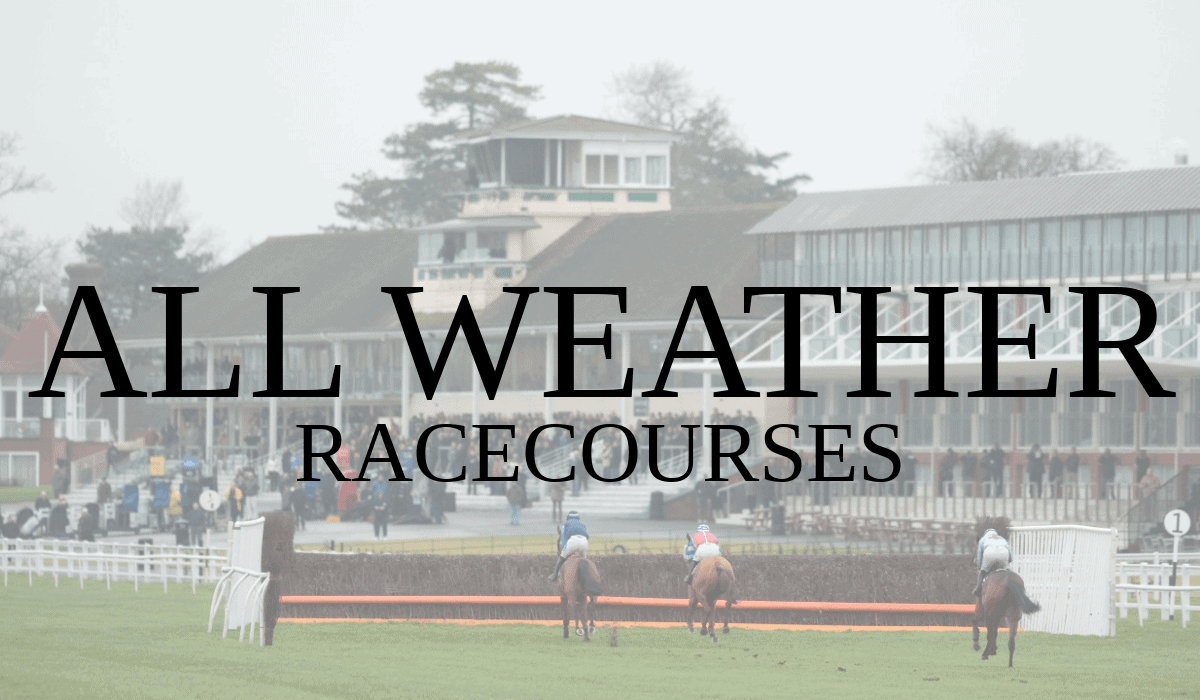
Britain has six all-weather racecourses: Chelmsford City, Kempton Park, Lingfield Park, Newcastle, Southwell and Wolverhampton.
These courses provide Flat racing throughout the year and become particularly important during the autumn and winter when turf racing is more vulnerable to wet weather, frost and other difficult conditions. They should not, however, be treated as six versions of the same type of racecourse.
Britain currently uses two principal all-weather racing surfaces, Polytrack and Tapeta, while the six tracks differ significantly in their configuration, direction, bends and length of finishing straight. Newcastle even has a straight mile, creating a completely different test from a sharp turning course such as Lingfield or Wolverhampton.
These differences matter when assessing form. A horse with an excellent record on the all-weather may still be much better suited to one course than another.
UK All-Weather Racecourses List
The six British all-weather tracks are:
| Racecourse | Surface | General course characteristic |
|---|---|---|
| Chelmsford City | Polytrack | Galloping circuit with a relatively long straight |
| Kempton Park | Polytrack | Right-handed and relatively flat |
| Lingfield Park | Polytrack | Sharp, left-handed and undulating |
| Newcastle | Tapeta | Galloping track with a straight mile |
| Southwell | Tapeta | Broad, galloping circuit |
| Wolverhampton | Tapeta | Sharp, left-handed circuit |
Three British all-weather courses therefore use Polytrack and three use Tapeta.
The distinction is useful, but surface alone should never determine whether a horse will reproduce its form. Track configuration, race distance, draw, pace and the individual horse can be equally important.
What Is an All-Weather Racecourse?
An all-weather racecourse uses a synthetic racing surface rather than turf.
The term “all-weather” does not mean racing can literally take place regardless of conditions. Extreme weather can still cause meetings to be abandoned. Synthetic tracks are, however, considerably less dependent on conventional turf conditions and allow Britain to stage a large programme of Flat racing throughout the winter.
This has changed the structure of British Flat racing.
The traditional turf season remains central to the sport, but Flat horses no longer have to disappear from British racecourses during the winter. Trainers can campaign horses throughout the year, while specialists have emerged whose strongest form is almost entirely on artificial surfaces.
All-weather racing has consequently developed its own form lines, course specialists and tactical characteristics.
Which UK Racecourses Have All-Weather Tracks?
Britain’s six all-weather venues are Chelmsford City, Kempton Park, Lingfield Park, Newcastle, Southwell and Wolverhampton.
Some of these venues also stage racing on other surfaces.
Kempton combines its all-weather Flat course with a turf National Hunt track and is home to the King George VI Chase. Newcastle also stages major jumps racing, including the Fighting Fifth Hurdle. Lingfield has all-weather and turf Flat tracks as well as a jumps course, while Southwell stages National Hunt racing alongside its Tapeta programme.
This makes “all-weather racecourse” a description of a racing surface rather than necessarily the only type of racing staged at that venue.
Polytrack vs Tapeta
Britain’s current all-weather programme is divided evenly between Polytrack and Tapeta.
Polytrack is used at Chelmsford City, Kempton and Lingfield.
Tapeta is used at Newcastle, Southwell and Wolverhampton.
Both are synthetic surfaces designed to provide consistent racing conditions, but that does not mean horses perform identically on them. The material beneath the horses is only one component of the racing test.
A horse moving from Lingfield to Kempton remains on Polytrack but encounters a very different course. Similarly, moving from Wolverhampton to Newcastle keeps the horse on Tapeta while changing from a relatively sharp turning circuit to a much more galloping test that includes straight-course racing.
When analysing all-weather form, it is therefore better to think in terms of surface + course + distance rather than simply “AW form”.
Chelmsford City Racecourse
Chelmsford City Racecourse uses a Polytrack surface and stages a substantial programme of all-weather racing.
The venue originally opened as Great Leighs in 2008 before later reopening as Chelmsford City. Its modern design and floodlights make it particularly suited to evening racing.
Chelmsford is a galloping course compared with sharper all-weather venues, with a relatively long home straight giving horses more time to build a challenge. That does not remove the importance of tactical position. Races can still favour horses able to travel efficiently and establish a useful position before the field reaches the straight.
The Polytrack surface was rewaxed during 2026, illustrating another important feature of all-weather analysis: artificial surfaces still require maintenance and can change over time.
Historical course statistics should therefore never be treated as permanently fixed.
What to look for at Chelmsford
Course experience can be useful, particularly when supported by repeated strong performances rather than a single win.
Pace also deserves attention. A horse allowed an uncontested lead can be difficult to catch, while a field containing several prominent racers can produce a very different race.
Draw should be assessed according to distance, field size and likely pace rather than through a single Chelmsford-wide rule.
Kempton Park Racecourse
Kempton Park uses Polytrack for its Flat racing.
The all-weather circuit is right-handed, making Kempton immediately different from the other British artificial tracks. It is relatively flat and provides a fair galloping test, although tactical position remains important at particular distances.
Kempton also has a separate turf jumps course. The venue is therefore associated both with regular all-weather Flat racing and major National Hunt races such as the King George VI Chase on Boxing Day.
For form students, it is essential to distinguish between a horse’s Kempton all-weather record and performances on the jumps track. They share a venue but tell us about completely different racing tests.
What to look for at Kempton
Previous Polytrack form can provide useful evidence, but Kempton form itself is stronger evidence of course suitability.
Positioning becomes particularly important when the race develops steadily. Horses held too far behind a controlled pace can find themselves trying to make up significant ground against rivals that have conserved energy.
As with every turning all-weather course, the horse racing draw should be considered alongside the distance and location of the first bend.
Lingfield Park Racecourse
Lingfield Park is one of Britain’s most distinctive all-weather tracks.
Its Polytrack circuit is left-handed, relatively sharp and contains more undulation than the other artificial courses. Horses need to handle the turns and changes in gradient while remaining balanced enough to accelerate when the race develops.
This can make previous Lingfield form particularly interesting.
A horse may have an excellent record elsewhere on Polytrack without being ideally suited to Lingfield’s configuration. Conversely, some horses repeatedly produce their best performances around the Surrey course.
The circuit is only around a mile and a quarter in circumference, so tactical position can become important. Horses that travel strongly and possess a useful change of pace can be well suited to the track, particularly when races are not strongly run.
What to look for at Lingfield
Course form deserves more attention at Lingfield than a generic “all-weather winner” marker.
The sharp nature of the course also means pace and draw can interact. A horse drawn away from its preferred position may need to use additional energy before a bend, while another can gain an efficient racing position without being asked for an early effort.
Our guide to course and distance winners explains why previous success under the same conditions can be particularly informative at distinctive tracks.
Newcastle Racecourse
Newcastle Racecourse provides one of the most unusual all-weather tests in Britain.
The Tapeta track opened in 2016 after Newcastle converted its Flat racing surface from turf. Its defining feature is the straight course, which allows races over distances up to a mile to be staged without negotiating a bend.
That makes Newcastle fundamentally different from Wolverhampton and Southwell despite all three using Tapeta.
The course is galloping and places less emphasis on negotiating tight bends. In straight-course races, the draw can interact with where the strongest pace develops and whether one part of the track is performing differently from another.
This is particularly relevant in larger fields. Horses can form separate groups, making it important to assess not only stall position but where the principal pace horses are drawn.
What to look for at Newcastle
Straight-course racing changes the way the draw should be analysed.
A high or low stall does not automatically create an advantage. The position of the early pace can determine which group receives the strongest tow into the race, while any developing track bias can also influence which side performs best.
Newcastle therefore provides an excellent example of why draw, pace and track position should be analysed together.
Southwell Racecourse
Southwell Racecourse has undergone the most significant surface change of any current British all-weather venue.
For many years, Southwell was famous for Fibresand. The deeper surface created a distinctive racing test and produced genuine course specialists, with form at Southwell often treated separately from performances on other artificial tracks.
That era ended in 2021.
The Fibresand was removed and replaced with Tapeta, with racing on the new surface beginning in December 2021. The Tapeta was subsequently refurbished after flooding affected the course in 2023.
This means old Southwell Fibresand form should not be treated as equivalent to modern Southwell form.
A horse that excelled on the old surface was demonstrating suitability for a racing test that no longer exists.
What to look for at Southwell
Modern Southwell analysis should begin with performances since the switch to Tapeta.
The change also provides an important lesson about historical statistics. Long-term draw, pace and course figures can become misleading after a significant alteration to the racing surface.
Rather than combining decades of Southwell data, concentrate on evidence produced under the current configuration and conditions.
This is one reason British Racecourses treats pace bias and draw bias as dynamic pieces of analysis rather than permanent rules.
Wolverhampton Racecourse
Wolverhampton Racecourse uses Tapeta and stages a large programme of all-weather racing.
The course is left-handed and relatively sharp, creating a very different test from Newcastle despite the shared surface. Wolverhampton also became Britain’s first floodlit racecourse, helping establish evening racing as an important part of the modern all-weather programme.
The turning nature of the course places emphasis on balance, pace and position. Horses repeatedly racing wide around bends can cover more ground, while runners able to secure an economical position can conserve energy for the finish.
This makes the relationship between draw and running style particularly important.
A wide draw is not automatically a disadvantage. A horse with enough early speed may still obtain a good position, while a low-drawn horse that starts slowly can lose the theoretical benefit of its stall.
What to look for at Wolverhampton
Start with the likely early pace.
Determine which horses normally race prominently and whether they have enough speed to secure their preferred positions. Then consider the draw in that context.
Previous Wolverhampton form can also be valuable. Repeated good performances show that a horse is comfortable with the turns, surface and tactical demands rather than simply proving that it can race on Tapeta.
Which UK All-Weather Racecourse Is the Most Different?
Newcastle and Lingfield sit at opposite ends of the all-weather spectrum.
Newcastle provides a wide, galloping Tapeta track with straight-course racing over distances up to a mile. Lingfield’s Polytrack circuit is sharper, left-handed and more undulating.
A horse can therefore be ideally suited to one and less effective at the other despite both races appearing simply as “AW” on a racecard.
Southwell presents another useful distinction because modern results should be separated from the old Fibresand era.
These differences are why all-weather racing rewards detailed course analysis.
Does All-Weather Form Transfer Between Tracks?
All-weather form can transfer, but it should never be assumed.
A horse winning on Tapeta at Wolverhampton has demonstrated that it handles Tapeta. It has not automatically demonstrated that it will be equally effective over Newcastle’s straight mile.
Likewise, a Lingfield Polytrack specialist may encounter a completely different tactical test at Kempton despite remaining on the same surface.
When comparing all-weather form, consider:
- Surface.
- Course configuration.
- Distance.
- Direction.
- Turns.
- Draw.
- Likely pace.
- Field size.
- Previous course form.
The closer the previous race resembles today’s conditions, the stronger the comparison becomes.
Is Course Form More Important on the All-Weather?
Course form can be particularly useful on the all-weather because several of Britain’s artificial tracks have distinctive configurations.
Lingfield specialists provide an obvious example. A horse comfortable around its sharp, undulating circuit has answered a question that a first-time visitor has not.
Wolverhampton can similarly reward horses comfortable racing around a sharp turning track, while Newcastle asks different questions through its straight-course races.
This does not mean bettors should automatically back previous course winners. A horse can return out of form, race over the wrong distance or encounter a completely different pace setup.
Course form is evidence, not a betting system.
Draw Bias on All-Weather Tracks
Draw bias exists in all-weather racing, but the effect depends heavily on the particular course and distance.
Turning races can place greater emphasis on the distance between the stalls and first bend. A horse drawn wide may need to cover additional ground or use early speed to secure a better position.
Straight races create different considerations. At Newcastle, for example, there is no bend to make an outside stall inherently wider over the straight course. The important factors can instead become where the pace sits and whether one side of the track is riding differently.
Field size matters as well.
A theoretical draw disadvantage can become relatively insignificant in a six-runner race but much more important when a large field competes for position.
Our complete draw bias guide explains how to combine stall position with course, distance and pace.
Pace Bias in All-Weather Racing
Pace can be one of the most useful elements of all-weather analysis.
Sharp turning courses can make it difficult for hold-up horses when the leaders are allowed to dictate a slow gallop. Those near the front conserve energy before accelerating, leaving horses behind them trying to make up ground against rivals that are also quickening.
A strongly contested lead produces the opposite situation. Front-runners can weaken after using too much energy, allowing horses positioned behind the pace to become involved.
This is why simply recording that “front-runners do well at this course” is rarely enough.
Ask why they have done well and whether today’s race is likely to develop in the same way.
Our pace maps guide explains how to estimate where each horse is likely to race before the start.
All-Weather Track Bias
Synthetic surfaces are designed to provide consistency, but they are not immune from temporary biases.
Maintenance, temperature, moisture, wear and the way the surface is prepared can influence how a track performs. Chelmsford’s Polytrack being rewaxed in 2026 is a good example of why an artificial surface should not be treated as permanently identical.
Bias can also appear to exist when the real cause is pace or horse ability.
If three consecutive front-runners win, the obvious conclusion might be that the surface is favouring leaders. The races may simply have been slowly run, or the strongest horses may have happened to race prominently.
Our horse racing track bias guide explains how to separate genuine surface effects from pace, draw and coincidence.
All-Weather Racing and Racecards
A racecard usually identifies an artificial race through its surface or all-weather designation, but the individual form figures need more detailed interpretation.
Look for previous performances at the same course and on the same surface. Course and distance indicators can be particularly useful when the venue has distinctive characteristics.
Then examine the quality of those performances.
A horse can win a course-and-distance race from a weak race without showing enough ability for today’s contest. Another runner may never have won at the course but could have produced several stronger performances in defeat.
Our guide to reading a racecard explains how the different pieces of form information fit together.
Does Turf Form Transfer to the All-Weather?
Some horses perform equally well on turf and synthetic surfaces. Others develop a clear preference.
There is no reliable rule that a good turf horse will automatically handle the all-weather or that an all-weather specialist cannot transfer its form back to turf.
Pedigree can provide clues when a horse has never raced on the surface, but actual racecourse evidence becomes more valuable once it is available.
Running style can also influence the transition. A horse suited to a galloping turf course may be less comfortable around a sharp artificial circuit, even if it handles the synthetic surface itself.
Separate surface suitability from course suitability.
They are related questions, but they are not the same question.
Why All-Weather Racing Matters During Winter
All-weather racing becomes particularly prominent during the British winter.
The turf Flat season reduces considerably, while National Hunt racing becomes the dominant turf code. Synthetic courses allow Flat horses to continue racing and provide regular afternoon and evening fixtures throughout the colder months.
This creates a substantial body of winter form.
Horses can meet repeatedly at Chelmsford, Kempton, Lingfield, Newcastle, Southwell and Wolverhampton, giving bettors opportunities to build detailed records of course suitability and head-to-head form.
The consistency of the programme is one of its strengths. Rather than treating all-weather racing as a substitute for turf, it is better understood as a distinct part of British Flat racing with its own horses, trainers, races and form patterns.
What Were Fibresand and the Old Southwell Track?
Fibresand was the synthetic surface used at Southwell for more than three decades.
It was deeper and more testing than Britain’s other artificial tracks and generated substantial kickback. The unusual conditions produced strong course specialists because horses that handled Fibresand could gain a meaningful advantage over rivals encountering it for the first time.
Southwell’s final Fibresand era ended when the surface was replaced by Tapeta in 2021.
This matters when researching historical form. Old articles, databases and statistics may still describe Southwell as a Fibresand course, but that information no longer reflects the current racing surface.
The distinction should also be made when assessing horses with older Southwell form. A historical Fibresand performance and a modern Tapeta performance occurred under materially different conditions.
Is Dundalk a UK All-Weather Racecourse?
No.
Dundalk is an all-weather racecourse in the Republic of Ireland and therefore should not be included among the six UK all-weather tracks.
It remains important to British and Irish racing followers and uses a synthetic surface, but it belongs within our coverage of Irish racecourses rather than the British list.
This gives Britain six current all-weather racecourses, not seven.
How to Analyse an All-Weather Horse Race
Begin with the horse’s ability rather than the surface. Establish whether its recent form is strong enough for the class of today’s race before looking for course-specific advantages.
Then examine its artificial-surface record in more detail. Separate Polytrack from Tapeta and, where relevant, distinguish old Southwell Fibresand form from modern Southwell Tapeta performances.
Course configuration comes next. A previous all-weather success becomes more relevant when it occurred on a track with similar characteristics, but the strongest evidence usually comes from the exact course and distance.
Now assess draw and pace together. Identify the likely leaders and consider whether each horse can obtain its preferred racing position from its stall. On a turning course, this may determine how much ground a horse covers before settling. At Newcastle, the relationship between stall position and the location of the strongest pace becomes more important in straight races.
Finally, consider the current track evidence. If earlier races on the card suggest a developing bias, test that theory against pace and horse ability before using it to influence later selections.
This approach is more reliable than simply backing a horse because it has an “AW” win beside its name.
Betting on All-Weather Horse Racing
The basic principles of betting on all-weather racing are the same as for turf racing.
The objective remains to assess a horse’s chance accurately and compare that assessment with the available odds. The difference is in the information used to reach that assessment.
Course specialists, pace, draw and surface experience can become particularly useful because Britain has only six artificial tracks and horses frequently return to the same venues.
That creates detailed form histories for regular all-weather runners.
Before placing a bet, compare the horse’s recent form, class, course record, distance record, surface preference, draw and likely race position. Our guide to analysing a horse race professionally explains how to combine these factors rather than relying on one statistic.
Readers who want to compare bookmakers from a racing perspective can use our best horse racing betting sites page.
UK All-Weather Racecourses FAQs
How many all-weather racecourses are there in Britain?
There are six: Chelmsford City, Kempton Park, Lingfield Park, Newcastle, Southwell and Wolverhampton.
Which UK racecourses use Polytrack?
Chelmsford City, Kempton Park and Lingfield Park use Polytrack.
Which UK racecourses use Tapeta?
Newcastle, Southwell and Wolverhampton use Tapeta.
Does Southwell still use Fibresand?
No. Southwell’s Fibresand surface was replaced with Tapeta in 2021. Racing on the new Tapeta track began in December of that year.
Which is the newest UK all-weather track?
Newcastle became Britain’s newest all-weather track when its Tapeta Flat course opened in 2016.
Which all-weather racecourse has a straight mile?
Newcastle has a straight mile on its Tapeta course, making it substantially different from Britain’s turning all-weather circuits.
Is Kempton an all-weather racecourse?
Yes. Kempton stages Flat racing on a right-handed Polytrack course. It also has a separate turf National Hunt track.
Is Lingfield all-weather?
Lingfield has a Polytrack all-weather course as well as separate turf Flat and National Hunt courses.
Is Wolverhampton all-weather?
Yes. Wolverhampton stages Flat racing on a Tapeta surface and is one of Britain’s busiest all-weather venues.
Is Chelmsford City all-weather?
Yes. Chelmsford City uses a Polytrack surface and stages all-weather Flat racing throughout the year.
Is Dundalk a UK all-weather racecourse?
No. Dundalk is in the Republic of Ireland. It is an important Irish all-weather venue but is not one of Britain’s six all-weather tracks.
Is all-weather racing always run on the same surface?
No. British all-weather racing currently uses Polytrack and Tapeta. The courses also differ considerably in shape and configuration.
Is all-weather form transferable between Polytrack and Tapeta?
It can be, but previous success on one synthetic surface does not guarantee the same performance on another. Course configuration, distance, pace and the individual horse remain important.
Does draw matter in all-weather racing?
Yes, but its importance varies according to the course, distance, field size and location of the first bend. At Newcastle, straight-course races create different draw considerations from turning tracks such as Lingfield and Wolverhampton.
Is all-weather racing only held during winter?
No. All-weather racing takes place throughout the year, although it becomes particularly prominent during autumn and winter when the turf Flat programme is reduced.
UK All-Weather Racecourses Summary
Britain’s six all-weather racecourses provide much more variety than the term “all-weather” suggests.
Chelmsford City, Kempton and Lingfield use Polytrack, while Newcastle, Southwell and Wolverhampton race on Tapeta. Within those two groups, the tracks still present substantially different tests.
Lingfield and Wolverhampton are relatively sharp turning courses. Newcastle offers a galloping Tapeta track and straight-mile racing. Kempton is Britain’s right-handed all-weather circuit, while Southwell’s move from Fibresand to Tapeta means its modern form needs to be separated from historical results on the old surface.
Those differences make course-specific analysis particularly valuable.
Rather than treating an all-weather win as universally transferable, assess the surface, course configuration, distance, draw, pace and previous course form together. A horse that repeatedly performs well under the same conditions has provided much stronger evidence than one with a generic “AW winner” label.
All-weather racing is now an established part of British Flat racing, particularly through the winter, and understanding the differences between Britain’s six tracks provides a stronger foundation for analysing it.
Related All-Weather Racing Articles
Here are all the articles related to all-weather racing:
-

Horse Racing Classes Explained
-
Novice Races in Horse Racing Explained: How Novice Flat, Hurdle and Chase Races Work
-
Maiden Races in Horse Racing Explained: What Is a Maiden Horse?
-
Conditions Races in Horse Racing Explained
-
Classified Stakes in Horse Racing Explained
-
Selling Races Racing Explained
-
Claiming Races in Horse Racing Explained
-
What Is a Nursery Handicap in Horse Racing
-
Grade 3 Jump Races
-
Grade 2 Jump Races: British National Hunt Grade 2 Races Explained
-
Grade 1 Jump Races
-
National Hunt Racing: Complete Guide to British Jump Racing
-
Irish Listed Horse Races
-
Irish Group 3 Horse Races
-
Irish Group 2 Horse Races
-
Irish Group 1 Horse Races
-
Irish Premier Handicap Horse Races
-
Listed Horse Races
-
Heritage Handicaps: Britain’s Biggest Flat Handicap Races
-
Group 3 Horse Races
-
Group 2 Horse Races
-
Group 1 Horse Races
-
Types of Horse Races: Flat, Jumps, Groups, Grades & Handicaps Explained