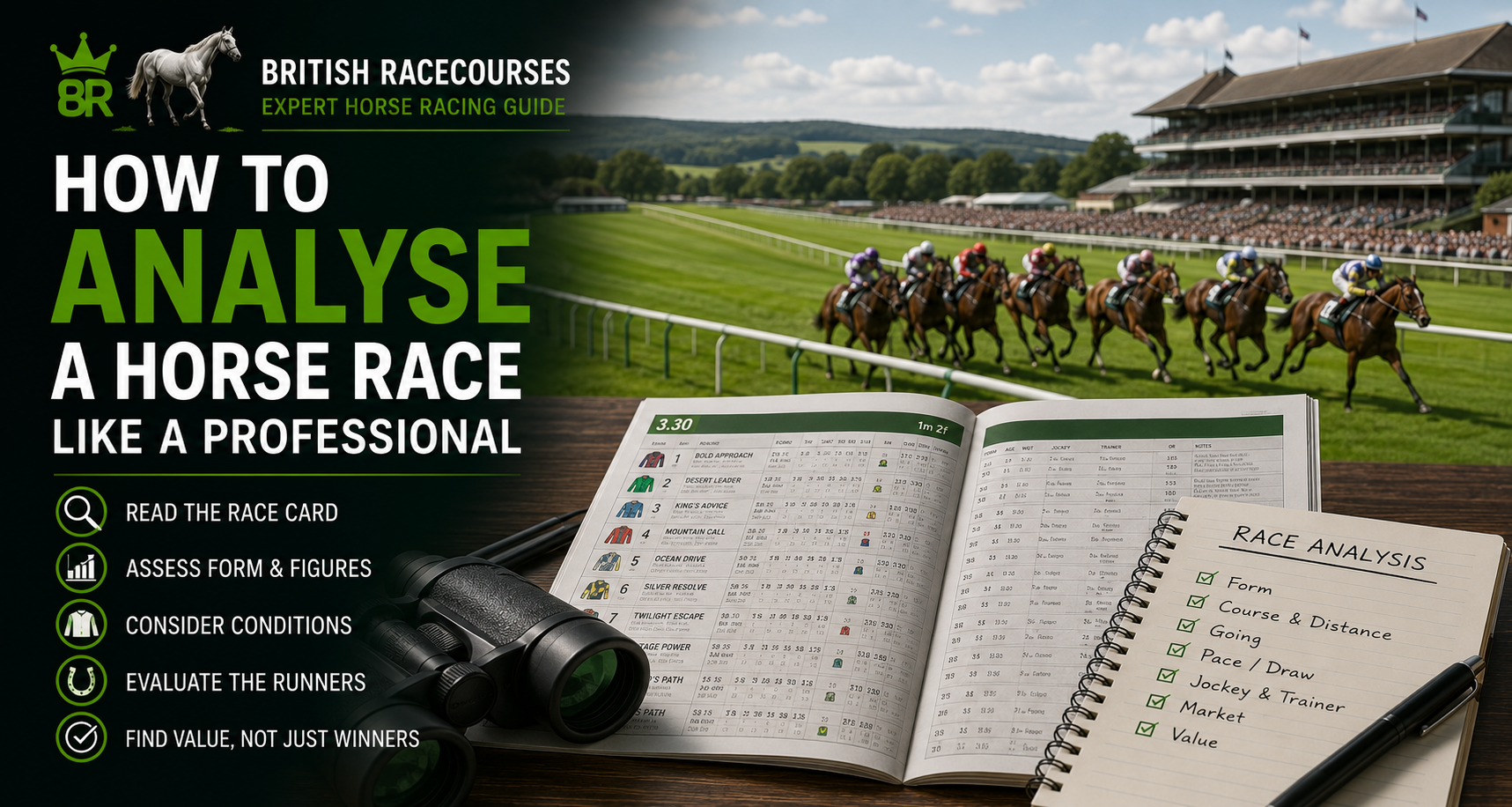
Picking winners consistently isn’t about luck. Professional punters follow a structured process that helps them identify horses with the best chance of winning while also recognising when the betting market has made a mistake.
Many beginners make the same error. They look at the favourite, glance at the last finishing position and place a bet. Successful race analysis goes much deeper. Every race contains dozens of clues, from the going and draw to pace, trainer form and previous course performance. The key is knowing which factors matter most and when to ignore information that has little impact.
The good news is that analysing a horse race is a skill that anyone can learn. You do not need expensive software or years of experience. By following the same process before every race, you’ll make more informed decisions and avoid many of the common mistakes that cost bettors money.
This guide explains how professionals assess a race from start to finish. We’ll look at the importance of race conditions, form, pace, draw, speed ratings, jockeys, trainers and betting value, while showing how each factor fits into the bigger picture.
Why Professional Race Analysis Matters
Every horse enters a race with strengths and weaknesses. Some perform best over six furlongs, while others need a mile or further. Some thrive on fast ground, whereas others only show their best form when conditions become soft.
The challenge is identifying which horses are running under their ideal conditions today.
Professional bettors rarely rely on one statistic. Instead, they build a complete picture by combining multiple pieces of information before deciding whether a horse represents value.
Think of race analysis as solving a puzzle. Each factor provides another piece.
| Factor | Why It Matters |
|---|---|
| Race conditions | Determines whether today’s race suits the horse |
| Recent form | Shows current performance level |
| Going | Some horses improve dramatically on certain ground |
| Draw | Can offer a tactical advantage on some tracks |
| Pace | Determines how the race is likely to unfold |
| Speed ratings | Helps compare performances objectively |
| Trainer form | Indicates whether the stable is in good health |
| Jockey form | Confidence and tactics influence results |
| Betting market | Can reveal confidence, but isn’t always correct |
Only when these factors are considered together can you make an informed judgement.
Step 1: Understand the Race Conditions
Before analysing individual horses, understand the race itself.
Many bettors skip this step, yet it immediately removes horses that are unlikely to be suited by today’s conditions.
Ask yourself:
- Is it a handicap?
- Is it a maiden?
- Is it a novice race?
- Is it Listed or Group class?
- Is it Flat or National Hunt?
- What distance is being run?
- What age restrictions apply?
These questions provide valuable context.
For example, an improving three-year-old stepping into open company may have plenty of ability but could still lack the experience needed to compete against older horses.
Similarly, a horse that has been winning handicaps may struggle when moving into Pattern company against proven Group performers.
Understanding race class is essential before looking at anything else.
Is the Horse Running in the Right Class?
One of the simplest questions professionals ask is whether today’s race is easier or harder than the horse’s previous assignments.
For example:
- Dropping from Class 2 into Class 4 often represents a significant ease in competition.
- Moving from a Listed race into Group company usually means facing much stronger opposition.
- Horses returning to handicaps after competing in Pattern races can become well treated.
A horse’s finishing position alone rarely tells the whole story.
Finishing sixth in a strong Group race may represent a much better performance than winning a weak handicap.
Always consider the quality of the opposition.
Does Today’s Distance Suit?
Distance is another critical factor.
Many horses have an optimum trip where they consistently produce their best performances.
Some sprinters possess enough early speed to dominate over five furlongs but struggle to see out six.
Others finish strongly over seven furlongs and improve again when stepping up to a mile.
Rather than looking only at today’s race, study the horse’s previous runs over similar distances.
Questions to ask include:
- Has the horse won over today’s trip?
- Does it usually finish strongly?
- Has it been weakening late?
- Is it trying a new distance for the first time?
Patterns soon emerge.
Step 2: Analyse Recent Form
Once you’ve established that today’s race suits the horse, the next step is analysing recent performances.
Most racecards display a string of numbers representing finishing positions.
While these provide a useful starting point, they never tell the full story.
For example:
22113
Appears impressive.
However, those victories may have come in weaker races against inferior opposition.
Meanwhile:
55642
Looks ordinary.
Yet the horse may have been running consistently in stronger company and now finds itself in an easier contest.
This is why professionals rarely judge form purely by finishing positions.
Look Beyond the Numbers
Instead, ask:
- Who did the horse race against?
- How far was it beaten?
- Was it finishing strongly?
- Did it encounter trouble in running?
- Was the pace suitable?
- Did the ground suit?
- Was today’s jockey riding previously?
Watching race replays often reveals far more than the form figures.
A horse finishing fifth after repeatedly meeting traffic may have performed much better than one finishing second with a clear run.
Look for Improving Horses
Younger horses often improve rapidly.
Three-year-olds in particular can develop significantly during the season as they gain experience and physical strength.
Improving profiles often include:
- consecutive personal bests
- stronger finishing efforts
- successful step-ups in class
- increasing speed ratings
Conversely, older exposed handicappers generally perform close to their established level.
Knowing whether a horse is still improving is one of the biggest advantages a bettor can have.
Consider the Strength of the Form
Always ask whether previous races have worked out well.
Did subsequent winners emerge?
Have horses from the race won again?
Has the form been franked?
A maiden that produces several future winners is usually much stronger than one where no horse wins again.
Professionals constantly compare races rather than looking at horses in isolation.
Build a Habit of Watching Replays
One habit shared by many successful punters is watching race replays.
Statistics explain what happened.
Video explains why it happened.
Watching replays allows you to identify:
- unlucky losers
- horses finishing strongly
- poor rides
- pace disadvantages
- difficult draws
- horses needing further
- horses needing softer ground
These observations often provide an edge before the betting market catches up.
How to Analyse a Horse Race Like a Professional
Step 3: Assess the Going
Once you’ve established that a horse is running under suitable race conditions and arrives in good form, the next step is to assess the going. This is one of the most influential factors in horse racing and one that many bettors underestimate.
The going describes the condition of the racing surface. Even the most talented horse can produce a below-par performance if the ground doesn’t suit its running style or action. Likewise, an outsider may improve dramatically when encountering its preferred conditions.
Before analysing any race, check the official going report and compare it with each horse’s previous performances. You’ll often find that a horse’s best efforts have come under very similar conditions.
Common descriptions include:
| Going | Characteristics |
|---|---|
| Firm | Fast surface that favours speed and efficient movers |
| Good to Firm | Quick ground with consistent footing |
| Good | The fairest surface for most horses |
| Good to Soft | Slightly slower and more testing |
| Soft | Demanding conditions requiring stamina |
| Heavy | Extremely testing, often producing slow finishing times |
While these descriptions appear straightforward, every racecourse drains differently. Good ground at Newmarket may ride very differently from good ground at Haydock, particularly after periods of mixed weather. Understanding how individual tracks behave can provide another edge.
Some horses repeatedly produce their best performances on quick ground, while others need plenty of cut to show their true ability. Instead of assuming a horse will handle today’s conditions, study its record on similar surfaces. One poor run on heavy ground may simply indicate the horse dislikes testing conditions rather than being out of form.
It’s also worth looking beyond the finishing position. A horse beaten only three lengths on unsuitable ground may improve significantly when returning to its preferred surface.
For a more detailed explanation of ground conditions, see our guides to Horse Racing Goings, Fast Ground Horses and Soft Ground Horses, which explore how different surfaces affect performance and betting strategies.
Don’t Ignore Weather Changes
Ground conditions can change quickly throughout the day.
Heavy overnight rain may transform a good surface into soft ground before the first race. Likewise, strong sunshine and drying winds can make the ground significantly quicker by the afternoon.
Professional bettors continually monitor weather forecasts and clerk of the course updates rather than relying on information published the previous evening.
Late changes to the going often create value opportunities because many casual bettors continue to base their selections on outdated conditions.
Step 4: Consider Draw Bias
Draw bias is one of the most misunderstood aspects of race analysis. Some bettors believe it always matters, while others ignore it completely. The truth lies somewhere in between.
The starting stall assigned to a horse can have a significant impact, but only under the right circumstances. Whether the draw is an advantage depends on the racecourse, distance, field size and prevailing ground conditions.
On straight tracks over longer distances, the draw may have very little influence. However, in large-field sprint handicaps or races with an early bend, a favourable stall position can make a substantial difference.
Take Chester as an example. The sharp left-handed circuit and short run to the first bend mean low-numbered stalls often enjoy a tactical advantage over sprint distances. Horses drawn wide frequently have to use extra energy early to secure a position or risk racing around rivals.
At Goodwood, the draw can vary depending on the distance and rail position, while at York it is often the pace of the race rather than the draw itself that determines where the advantage lies.
This highlights an important point. Never analyse the draw in isolation.
Instead, ask:
- Does today’s course have a recognised draw bias?
- Is there an early bend?
- How many runners are competing?
- Which side contains the early pace?
- Will today’s going strengthen or weaken the bias?
Many bettors simply look for a low draw at Chester or a high draw elsewhere without considering how the race is likely to develop. Professionals combine draw analysis with pace to understand where the best track position is likely to emerge.
Our detailed guides to Horse Racing Draw and Best Post Position in Horse Racing explain how draw bias varies across Britain’s racecourses and when it can be safely ignored.
Step 5: Analyse the Pace
If there is one area where many professional punters gain an advantage, it is pace analysis.
Pace determines how a race is likely to unfold. Understanding which horses are likely to lead, press the pace or be held up towards the rear allows you to predict whether the race will favour front-runners or strong finishers.
Every horse has a preferred running style.
Some like to attack from the stalls and dominate from the front. Others settle towards the rear before producing one late challenge inside the final furlong.
Neither style is automatically better. Success depends on the pace scenario created by the field.
Imagine a race containing five habitual front-runners. All are likely to compete for the lead during the opening stages, increasing the overall pace and using valuable energy. As they begin to tire, a patiently ridden closer may benefit from the strong gallop and finish over the top of them.
Now imagine the opposite scenario.
Only one horse likes to lead, and none of the others is naturally aggressive. That horse may secure an uncontested lead, dictate a comfortable pace and conserve enough energy to prove difficult to catch.
Understanding these likely race scenarios is often more valuable than simply comparing recent finishing positions.
Rather than asking which horse is fastest, professionals ask how today’s race will be run.
Useful questions include:
- Which horse is likely to lead?
- Will the early pace be strong or steady?
- Which runners require cover?
- Does the draw support each horse’s preferred tactics?
- Which horses are likely to benefit if the leaders go too quickly?
Combining pace analysis with draw bias provides one of the strongest foundations for race analysis. Two horses with identical ability may have very different winning chances depending on how the race develops.
If you’d like to explore this subject further, our guides on Horse Racing Pace Bias, Fast Finishers, Winning Distances in Horse Racing and Course Distance Winners explain how pace influences results across different race types and distances.
Step 6: Use Speed Ratings to Compare Performances
One of the biggest challenges in horse racing is comparing performances from different meetings, distances and race classes. A horse may win comfortably at Carlisle, while another finishes second in a stronger contest at Newmarket. Looking only at finishing positions makes it difficult to judge which performance was actually better.
This is where speed ratings become invaluable.
Speed ratings attempt to measure how good a performance was by considering factors such as the race time, distance, going and standard times. Rather than simply telling you who won, they help identify which horses produced the strongest overall performance.
Professional punters rarely rely on one set of ratings alone, but they often use them as an important part of their race analysis. A horse recording consistently high figures is generally more reliable than one producing one exceptional run followed by several below-par efforts.
When analysing speed ratings, look for consistency rather than one standout performance. A horse that regularly runs close to its career-best figure is often more dependable than one capable of brilliance but equally capable of disappointing.
It is also important to consider how those ratings were achieved. A career-best figure recorded on heavy ground may not be repeated on fast summer ground, while a horse stepping up in class may struggle to reproduce the same level of performance against stronger opposition.
Speed ratings should support your analysis rather than replace it. They are most effective when combined with recent form, pace, draw and the going.
For a deeper understanding of how ratings are calculated, read our guides to Top Speed Ratings, Racing Post Ratings (RPR) and How to Read Horse Racing Form Like a Pro.
Don’t Chase One Big Number
One common mistake is assuming the horse with the highest speed rating will automatically win.
Imagine one runner produced a rating of 102 twelve months ago but has failed to reach 90 in its last five starts. Another has recorded ratings of 94, 95, 96 and 97 over recent weeks.
Although the first horse has the superior career best, the second is arriving at the race in much stronger current form.
Professional bettors place far greater emphasis on what a horse is capable of today rather than what it achieved last season.
Step 7: Assess Trainer Form
Even the best horses are affected by the wellbeing of the stable they represent.
A trainer enjoying a productive spell often sees many of their runners outperform market expectations. Horses look fitter, confidence within the yard is high, and race planning tends to be working well.
Conversely, some stables go through quiet periods where even well-fancied runners fail to perform.
Checking recent trainer statistics has become a routine part of professional race analysis.
Questions worth asking include:
- Has the trainer had several recent winners?
- What is the trainer’s strike rate over the past two weeks?
- Does the trainer perform particularly well at this racecourse?
- Does the trainer target this meeting each year?
- Is the stable renowned for improving horses after a break?
Some trainers consistently excel with certain types of horses or under particular conditions.
For example, some yards are renowned for developing juvenile talent, while others specialise in improving handicappers or targeting staying chases during the winter months.
It’s also worth considering trainer and jockey combinations. Partnerships that regularly ride together often outperform expectations because they understand each other’s strengths and tactics.
Our guides to In Form Trainers, Charlie Appleby, Willie Mullins, Dan Skelton, Andrew Balding and Gordon Elliott explain how leading trainers prepare their runners throughout the season.
Beware of Small Samples
A trainer may have two winners from four runners, producing an impressive 50% strike rate. However, another trainer with six winners from thirty runners may actually be operating at a much more sustainable level.
Always consider the number of runners behind any statistic.
Small samples can produce misleading conclusions.
Step 8: Evaluate the Jockey
A talented jockey cannot turn an average horse into a champion, but they can make the difference between winning and losing in a closely contested finish.
Good jockeys make hundreds of small decisions during a race.
They judge the early pace, position their mount to avoid trouble, conserve energy and decide exactly when to launch their challenge. One poor tactical decision can easily cost several lengths.
When assessing today’s jockey, consider more than reputation.
Ask yourself:
- Is the jockey currently riding with confidence?
- Have they partnered this horse before?
- Do they have an excellent record at today’s racecourse?
- Are they particularly effective over today’s distance?
- Have they formed a successful partnership with the trainer?
Some jockeys excel on front-runners, while others are renowned for their patience and timing on hold-up horses. Matching the jockey’s strengths with the horse’s preferred running style often provides another useful clue.
Experienced riders also understand the unique demands of individual racecourses. Tracks such as Chester, Goodwood and Epsom require different tactical approaches from more conventional circuits like Newbury or Doncaster.
Our features on In Form Jockeys, William Buick, Hollie Doyle, Sean Bowen, Harry Cobden and Frankie Dettori explore how Britain’s leading riders consistently influence results.
Step 9: Look for Course Specialists
Some horses simply love certain racecourses.
This isn’t coincidence.
Every track presents different challenges. Some feature sharp bends and short straights, while others demand stamina with long uphill finishes or wide sweeping turns.
A horse perfectly suited to one venue may struggle to reproduce that form elsewhere.
For example, Chester rewards horses that race prominently and handle tight turns, while Newmarket’s Rowley Mile places a greater emphasis on balance and stamina during the demanding climb to the finish.
Goodwood’s undulating layout catches many horses out, whereas the flat, galloping nature of York allows long-striding horses to build momentum.
Before dismissing an older horse because its recent form appears modest, check whether it returns to a course where it has previously performed well.
Course specialists regularly outperform market expectations because many bettors focus solely on recent finishing positions.
Look for horses that have:
- Multiple wins at today’s racecourse.
- Consistently run well over today’s course and distance.
- Produced their highest speed ratings at the venue.
- Recorded strong performances under similar conditions.
Our racecourse guides covering venues including Chester, York, Goodwood, Kempton, Lingfield, Ayr and Haydock explain the characteristics of each track and the types of horses that tend to succeed there.
By this stage of your analysis, you should have built a detailed picture of each runner. You will know whether today’s race conditions suit the horse, whether recent form is reliable, how the going, draw and pace are likely to influence the contest, and whether trainer, jockey and course statistics strengthen or weaken its chance.
The final stage is bringing all of those pieces together to decide whether the available odds represent genuine betting value rather than simply identifying the horse that appears most likely to win. That distinction is what separates professional betting from simply trying to pick winners.
Step 10: Watch the Betting Market
The betting market provides valuable information, but it should never be the only reason to back a horse. Prices move for many reasons. Some reflect genuine confidence from connections, while others are simply driven by public money or bookmakers adjusting their books.
Professional bettors use the market to support their analysis rather than dictate it.
A horse that shortens significantly in the betting may have attracted support because of positive reports from the stable, favourable weather changes or strong recent work at home. Equally, a horse drifting in price is not necessarily a poor bet. Drifts often occur because money has arrived for another runner rather than because confidence has disappeared.
The key is understanding why the market is moving.
Ask yourself:
- Has the going changed?
- Has a leading jockey been booked?
- Has a key rival been withdrawn?
- Does the market support your own analysis?
If your research identifies a horse at 8/1 and the market agrees by shortening it to 5/1, that’s often reassuring. However, if you’re backing horses simply because they’re being supported, you’re reacting rather than analysing.
Our guides to Betting Odds, Betting Odds Shortening, Betting Odds Drifting and Horse Racing Betting Exchanges explain how to interpret market movements and when they should influence your betting decisions.
Step 11: Learn to Find Value
This is where many recreational bettors differ from professionals.
Most people ask one simple question:
“Which horse is most likely to win?”
Professional bettors ask a different question:
“Which horse offers the best value at the current odds?”
These are not always the same thing.
Imagine Horse A has a 50% chance of winning.
Fair odds would be Evens (1/1).
If bookmakers offer 4/6, the horse may still win but represents poor value because the price underestimates the risk.
Now consider Horse B.
You believe it has a 20% chance of winning.
Fair odds would be 4/1.
If bookmakers offer 8/1, the horse may lose more often than it wins, but over hundreds of bets it could prove highly profitable because the odds consistently exceed its true chance.
This concept is known as value betting and forms the foundation of long-term success.
Professional punters accept that good value bets lose regularly. Their objective isn’t to find the winner of every race but to consistently back horses whose odds are bigger than their true probability.
That approach requires discipline. It also means avoiding emotional decisions after short-term losing runs.
Value Betting Checklist
Before placing a bet, ask yourself:
| Question | Yes/No |
|---|---|
| Does today’s race suit the horse? | ☐ |
| Is the horse in good recent form? | ☐ |
| Will today’s going suit? | ☐ |
| Does the draw help rather than hinder? | ☐ |
| Does the pace scenario suit its running style? | ☐ |
| Is the trainer currently in form? | ☐ |
| Is the jockey a positive booking? | ☐ |
| Has the horse run well at this course before? | ☐ |
| Are the available odds bigger than your assessment? | ☐ |
The more boxes you tick, the stronger the overall case becomes.
Worked Example: Analysing a Race
Imagine a 12-runner, seven-furlong handicap at York.
Rather than immediately looking for the favourite, start with the race conditions.
The horse you’re considering has already won over seven furlongs and has performed well at York previously. That’s an encouraging start.
Next, examine recent form. It finished fourth on its latest outing, but a replay shows it was repeatedly denied a clear run before finishing strongly. The bare result doesn’t reflect the quality of the performance.
Today’s ground is good to firm, matching the conditions for two of its previous victories.
Looking at the draw, stall four appears favourable based on previous races over the same course and distance. The likely pace map suggests several front-runners drawn higher, increasing the chance of a strong gallop that should suit a horse that finishes well.
The trainer has sent out four winners in the past fortnight, while the jockey has an excellent strike rate at York.
Finally, you compare your assessment with the market. You believe the horse should be around 9/2, but bookmakers are offering 7/1.
At that point you have found something far more important than simply a likely winner.
You’ve identified a value opportunity.
Common Race Analysis Mistakes
Even experienced bettors occasionally fall into bad habits. Recognising these mistakes can improve your results immediately.
Backing Horses on Reputation
Well-known horses often attract support regardless of current form. Always judge today’s race on today’s evidence rather than achievements from previous seasons.
Ignoring Race Conditions
A talented horse running over the wrong trip or on unsuitable ground is often worth opposing.
Overreacting to One Performance
Every horse has good and bad days. Look for long-term patterns instead of making decisions based on one run.
Following the Favourite Blindly
Favourites win more races than any other market position, but they don’t always represent value. Short-priced horses can still be poor bets if the odds underestimate the risks.
Ignoring Pace
Many races are won or lost before the runners reach the home straight. Understanding how the race is likely to unfold provides a significant advantage.
Focusing Only on Statistics
Statistics tell part of the story, but watching race replays often reveals information that numbers cannot capture.
Professional Race Analysis Checklist
Before placing any bet, work through the same process every time.
- Is the horse running in the right class?
- Does today’s distance suit?
- Will the going help or hinder?
- Has the horse shown good recent form?
- Is the draw favourable?
- Does the likely pace suit its running style?
- Do the speed ratings support its chance?
- Is the trainer currently in form?
- Is the jockey a positive booking?
- Has the horse performed well at this course before?
- Are the available odds bigger than your assessment?
- Would you still back the horse if you ignored the betting market?
Following a consistent routine helps remove emotion from your decision-making and ensures you don’t overlook important details.
Frequently Asked Questions
What is the most important factor when analysing a horse race?
There isn’t one single factor. The best analysis combines race conditions, form, going, pace, draw, trainer form, jockey bookings and value. Looking at these factors together produces far better decisions than relying on one statistic.
Should I always back the favourite?
No. Favourites win more often than other runners, but many start at odds that offer little value. Professional bettors are interested in finding overpriced horses rather than simply backing the most likely winner.
How important is draw bias?
Draw bias is very important at some racecourses and over certain distances but has little effect in others. Always consider the course, distance, field size and likely pace before deciding whether the draw is significant.
Do professional punters watch race replays?
Yes. Watching replays often reveals trouble in running, tactical mistakes or horses finishing strongly. These details are impossible to identify from finishing positions alone.
Are speed ratings reliable?
Speed ratings are an excellent tool when used alongside other forms of analysis. They should support your conclusions rather than replace them.
How long should race analysis take?
Experienced bettors can assess a race in around 10 to 20 minutes, although major handicaps and festival races often require much more detailed preparation.
Can beginners learn to analyse horse races?
Absolutely. The key is developing a consistent process and practising it regularly. Experience helps you recognise patterns more quickly, but every successful bettor started as a beginner.
Final Thoughts
Successful race analysis isn’t about discovering a secret system or finding one statistic that predicts every winner. It’s about building a complete picture using all the available information and making disciplined decisions based on evidence rather than instinct.
Every race presents a unique puzzle. Some will be decided by the pace, while others will hinge on the going, the draw or a horse returning to its ideal distance. The more experience you gain, the easier it becomes to identify which factors deserve the greatest attention.
Perhaps the biggest lesson is that finding winners and finding value are not the same thing. Professional bettors understand that they will back losing horses if the odds represent long-term value, because profitability comes from consistently taking better prices than the true chance of winning.
By following the structured approach outlined in this guide and exploring related topics such as Horse Racing Draw, how to Read Horse Racing Form Like a Pro, Top Speed Ratings, Guide to Horse Racing Handicapping and Horse Racing Betting Strategy, you’ll develop a far more rounded understanding of how races are won and, more importantly, how successful bettors identify opportunities that others overlook. Over time, that knowledge will help you make more confident, informed and consistent betting decisions.