Betting odds drift when the price of a horse gets bigger. A horse available at 3/1 in the morning might move to 4/1 and then 5/1 before the race. The horse is described as a drifter because a winning bet at the later price would return more money for the same stake.
A drift shows that the betting market has changed its assessment of a horse. It does not prove that the horse is less fit, will run badly or has a lower actual chance of winning.
Prices can lengthen because another runner attracts support, the going changes, a jockey is replaced or bookmakers adjust their positions. Sometimes a horse drifts without any obvious change to its racing prospects.
Understanding the difference between a market move and a horse’s actual chance is central to reading horse racing betting odds.
What Does Drifting Odds Mean?
Drifting odds are betting prices that increase. The terms drifting, lengthening and weakening in the market all describe a move towards a bigger price.
For example, a horse might move from 5/2 to 4/1. At 5/2, a £10 winning bet produces £25 profit. At 4/1, the same stake produces £40 profit.
The market’s implied probability has also changed. A price of 5/2 represents an implied probability of approximately 28.6%, while 4/1 represents 20%, before accounting for the bookmaker’s margin.
That does not mean the horse’s actual chance has fallen by 8.6 percentage points. It means the available prices now imply a lower chance than they did earlier.
You may also hear a horse described as “drifting like a barge” or “friendless in the betting ring”. These are informal descriptions of a noticeable drift, not explanations of why it happened. Our horse racing betting terms glossary explains other expressions used by bookmakers, commentators and punters.
What Causes Horse Racing Odds to Drift?
There is no single cause of drifting odds. Bookmakers respond to betting activity, information, competing prices and their exposure to different outcomes. Exchange markets also move as backers and layers change the prices they are prepared to accept.
Another Horse Attracts Support
A horse can drift even when nothing has changed about its own prospects.
Suppose a race has two prominent contenders. One starts at 3/1 and the other at 4/1. Strong support for the second horse may push its price down to 5/2. Bookmakers might then lengthen the first horse to 4/1 to rebalance the market.
The first horse has drifted, but the move may be driven primarily by support for its rival.
This is why it helps to examine the whole race rather than one runner’s price. Our best-backed horses today page covers market movers and the distinction between shortening horses and drifters.
Changes in Going or Weather
Ground conditions can change the way a race is assessed.
A horse with strong form on good ground may drift after sustained rain changes the going to soft. The move could reflect uncertainty about whether the horse will reproduce its best performance under the new conditions.
The reverse can also happen. A proven soft-ground performer may attract support when rain arrives, causing other runners to drift.
The important question is whether the change genuinely affects the horse being assessed. A horse’s previous performances, action and pedigree may provide useful evidence, but a market move alone cannot establish its ground preference.
Our pages on soft-ground horses and fast-ground horses provide further context for assessing different conditions.
New Information About a Runner
A jockey change, a revised race plan or other new information can alter market expectations. A horse may also drift if a rival is confirmed to run or if the final field looks stronger than the earlier entries suggested.
Not every rumour deserves attention. Check official race information and reliable reporting before treating an apparent explanation as fact.
The five-day declarations stage can help you follow how a race develops, but final declarations and subsequent non-runners may still change the market.
Early Markets Have Less Money Available
Prices in an early betting market can move sharply when relatively little money has been matched or wagered.
A horse might drift from 6/1 to 8/1 following a modest amount of activity, then shorten again as more bookmakers and bettors become active closer to the race.
A large percentage move in a thin market does not necessarily carry the same significance as a sustained move across several bookmakers and an active exchange market.
Bookmakers Adjust Their Prices
Bookmakers do not all hold the same prices or liabilities. One firm might offer 7/1 while another offers 8/1 because their customers have backed different runners or their traders assess the race differently.
A price can also move because a bookmaker follows a wider market change rather than because its own customers have placed a large number of bets.
Compare several firms before deciding that a horse is drifting across the market. The horse racing betting sites comparison is a starting point for comparing bookmaker features, while the price itself should be checked at the time you place a bet.
Examples of Drifting Odds
The following examples show how a horse’s price can lengthen. The figures are illustrative rather than results from particular races.
| Earlier odds | Later odds | Market movement |
|---|---|---|
| 4/7 | 11/10 | An odds-on favourite drifts to odds-against |
| 7/2 | 5/1 | A prominent contender becomes a bigger price |
| 13/2 | 8/1 | A runner drifts moderately |
| 9/1 | 16/1 | A horse experiences a substantial drift |
| 50/1 | 66/1 | An outsider becomes a longer-priced outsider |
The move from 7/2 to 5/1 is a clear drift, but its importance depends on the race, the timing and the reason for the change.
A horse moving from 50/1 to 66/1 has also drifted, although both prices already imply a relatively small chance of winning. The numerical change alone does not tell you whether the horse has become a better or worse bet.
How Do You Know if a Horse Is Drifting?
The simplest way to identify a drifter is to compare its current price with an earlier price.
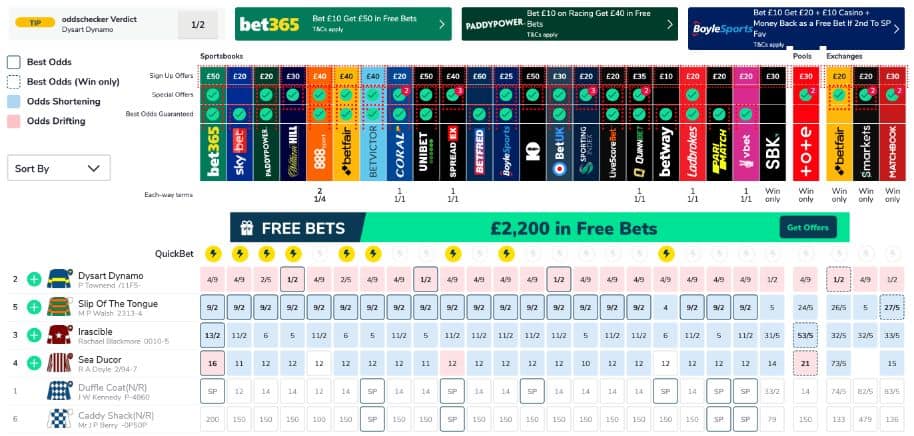
Odds-comparison websites display prices from several bookmakers. Some also use colours to highlight recent changes. On the comparison screenshot in this article, pink squares indicate prices that have lengthened, while blue squares indicate prices that have shortened.
Retain the existing odds-comparison screenshot here. Its colours illustrate how a market-movement display can distinguish drifters from horses attracting support.
Colours and display conventions vary between websites, so check the site’s key rather than assuming that every comparison service uses the same system.
A useful market check involves looking at the opening price, the current best available price, the prices offered by other bookmakers and the movement close to the off. A drift that appears at only one bookmaker may simply reflect that firm’s pricing. A sustained move across the market is more informative.
The racecard provides the context that a price chart cannot. Check the horse’s recent performances, weight, draw, jockey, distance and conditions using the racecards alongside the market.
Does a Drifting Horse Have Less Chance of Winning?
A drifting price represents a lower implied probability. It does not establish that the horse’s actual chance has decreased.
A market move may reflect information that genuinely changes a runner’s prospects. For example, unexpected rain could be a meaningful concern for a horse whose strongest form is on fast ground.
Other drifts may be caused by support for a rival, early-market volatility or a bookmaker changing its prices. In those cases, the horse’s underlying chance may be largely unchanged.
The distinction matters because a bigger price can be attractive if your assessment of the horse remains sound. Equally, a bigger price is not automatically value if new information has materially weakened its chance.
Assess the runner’s form independently and then compare your estimate with the available odds. The horse racing statistics and top speed ratings pages cover information that can support a broader assessment.
Are Drifting Odds Good or Bad for Bettors?
A drift can be favourable for someone who has not yet placed a bet because a winning selection would return more at the later price. It can be unfavourable for someone who took the earlier price, unless their bet qualifies for a concession such as Best Odds Guaranteed.
Neither outcome makes a drifter automatically worth backing.
Consider a horse you assessed as having a 25% chance of winning. That corresponds to fair decimal odds of 4.00, or 3/1. If its price drifts from 5/2 to 4/1 and your assessment remains unchanged, the later price offers a more attractive return relative to your estimate.
If the horse drifts because you discover a material weakness in its form or suitability for the race, your probability estimate should change too. The bigger price may no longer be attractive.
Avoid treating the market’s direction as a substitute for assessing the race. The favourite-longshot bias is another reason to consider probability and price together rather than relying on a horse’s position in the betting.
Should You Back a Horse That Is Drifting?
A drifting horse deserves another look, not an automatic bet or an automatic rejection.
First, establish whether the price has moved across the market. Then look for a credible reason. Check the latest going, declarations, non-runners and any material changes since you first assessed the race.
If your view of the horse remains unchanged, compare the new price with the odds you believe are fair. If your view has changed, update that assessment before deciding whether the price is attractive.
A horse drifting from 3/1 to 6/1 may look tempting because its potential return has doubled. That does not help if its chance of winning has fallen enough to make 6/1 a poor price.
The same principle applies to horses moving in the opposite direction. Shortening odds can indicate support, but backing a horse after a major move may mean accepting a price that no longer offers value.
Should You Lay a Drifting Horse?
Some bettors lay drifting horses because they interpret the move as a sign of weakening market confidence. Laying means betting against a selection, usually through a betting exchange.
The risk is that a bigger lay price increases the liability for the same lay stake. A horse drifting from decimal odds of 4.00 to 6.00 may look less fancied, but laying it at 6.00 exposes the layer to a larger potential loss if it wins.
A drift is not a complete laying strategy. You still need to assess the horse’s chance and decide whether the available lay price is favourable after accounting for liability and any exchange commission.
Our lay betting explanation covers the mechanics and risks in more detail.
What Happens if Your Horse Drifts After You Have Backed It?
If you take fixed odds, your bet normally remains settled at the accepted price, subject to the bookmaker’s rules and any applicable deductions.
Suppose you place a £10 win bet at 4/1. The horse then drifts to 8/1 and wins. Your bet at 4/1 produces £40 profit plus your £10 stake, unless a qualifying concession changes the settlement.
The later market price does not automatically replace your accepted odds.
There is an important exception when an eligible bet qualifies for Best Odds Guaranteed.
Drifting Odds and Best Odds Guaranteed
Best Odds Guaranteed, often shortened to BOG, is a bookmaker concession that can pay a qualifying winning bet at the higher of the eligible early price taken and the official Starting Price.
For example, you back a horse at 4/1 under qualifying BOG terms. Its official SP is 6/1 and it wins. The bet is settled at 6/1 rather than 4/1, subject to the bookmaker’s conditions.
If the horse shortens to an SP of 2/1, the original 4/1 price would normally apply under the same concession.
A drift in the live market is not the same as a higher official SP. Your horse might touch 8/1 before the race but return an SP of 7/2. In that case, a qualifying BOG bet placed at 4/1 would ordinarily retain the 4/1 price.
Eligibility can depend on the market, bet type, time of placement and bookmaker terms. Check the conditions rather than assuming that every bet qualifies. Our bet365 Best Odds Guaranteed page explains the concession for that bookmaker.
If a runner is withdrawn, Rule 4 deductions may also affect a fixed-odds return. Read our Rule 4 deductions explanation before assuming that the original quoted return will remain unchanged.
How Much More Do You Win When Odds Drift?
The effect of a drift on your potential return depends on the price you actually take.
For a £10 win stake, these illustrative returns show the difference between earlier and later odds:
| Odds taken | Profit if the horse wins | Total return |
|---|---|---|
| 3/1 | £30 | £40 |
| 4/1 | £40 | £50 |
| 5/1 | £50 | £60 |
| 8/1 | £80 | £90 |
A move from 3/1 to 5/1 increases the potential profit on a £10 winning bet from £30 to £50. It does not increase the chance of winning or guarantee that the later price represents value.
Use the bet calculator to check potential returns for different stakes and odds.
Drifting Odds FAQs
What is a drifter in horse racing?
A drifter is a horse whose betting odds become bigger. A horse moving from 4/1 to 6/1 is drifting because a winning bet at the later price offers a higher return for the same stake.
Does drifting mean a horse will lose?
No. A drift shows that the market price has lengthened. It does not prove that the horse will lose, is unfit or is unsuited to the race. Some drifters win, just as some heavily backed favourites lose.
What is the opposite of drifting odds?
The opposite is shortening odds. A horse that moves from 6/1 to 4/1 has shortened in the market. A horse attracting a substantial amount of support may also be described as a steamer.
Can a favourite drift and still be favourite?
Yes. A favourite might drift from 6/4 to 2/1 and remain the shortest-priced runner if every other horse is available at bigger odds. A horse can also drift enough to lose favouritism to another runner.
Are long odds the same as drifting odds?
No. Long odds describe a relatively big price, while drifting describes a change from a shorter price to a bigger one. A horse can remain at 33/1 throughout the day without drifting. A favourite can drift from 4/7 to 4/5 while remaining at relatively short odds.
Is a drifting horse a good each-way bet?
Not necessarily. A bigger price can increase the potential return, but an each-way bet also depends on the horse’s chance of placing, the place fraction and the number of places offered. Check the race terms and the horse’s prospects rather than using the drift alone as a reason to bet. Our each-way tips page covers the wider considerations.
Does Best Odds Guaranteed apply whenever a horse drifts?
No. The bet must qualify under the bookmaker’s terms, and the concession normally compares the eligible price taken with the official SP. A temporary drift before the off does not guarantee settlement at the biggest price displayed during the day.
Summary
Betting odds drifting means a horse’s price is lengthening. A drift can reflect new information, support for another runner, changing conditions or normal market adjustments.
The useful question is not simply whether a horse has drifted. It is whether the reason for the move changes your assessment of its chance and whether the new price offers value. Compare prices, check the race conditions and calculate the potential return before placing a bet.
Betting Odds Guide
Check out all the betting odds used for football betting and for horse racing events in the UK.
-

Convert Fractional Odds to Decimal Odds
-
Betting Odds Drifting Explained
-
Betting Odds Shortening: What Shortening Odds Mean in Horse Racing
-
4-11 Betting Odds
-
1-3 Betting Odds
-
1-2 Betting Odds
-
1-5 Betting Odds
-
2-5 Betting Odds
-
4-5 Betting Odds
-
6-5 Betting Odds
-
7/5 Betting Odds
-
8-5 Betting Odds
-
9-5 Betting Odds
-
11-5 Betting Odds
-
12-5 Betting Odds
-
13-5 Betting Odds
-
16-5 Betting Odds
-
10-3 Betting Odds
-
4-7 Betting Odds
-
8-13 Betting Odds
-
8-15 Betting Odds
-
4-9 Betting Odds
-
5-6 Betting Odds
-
4-6 Betting Odds
-
8-11 Betting Odds
-
1-1 Betting Odds
-
11-10 Betting Odds
-
100-1 Betting Odds
-
66-1 Betting Odds
-
33-1 Betting Odds
-
25-1 Betting Odds
-
16-1 Betting Odds
-
14-1 Betting Odds
-
12-1 Betting Odds
-
10-1 Betting Odds
-
9-1 Betting Odds
-
8-1 Betting Odds
-
7-1 Betting Odds
-
6-1 Betting Odds
-
5-1 Betting Odds
-
4-1 Betting Odds
-
3-1 Betting Odds
-
2-1 Betting Odds
-
15-2 Betting Odds
-
13-2 Betting Odds
-
11-2 Betting Odds
-
9-2 Betting Odds
-
7-2 Betting Odds
-
5-2 Betting Odds
-
11-8 Betting Odds
-
13-8 Betting Odds
-
11-4 Betting Odds
-
9-4 Betting Odds
-
7-4 Betting Odds
-
6-4 Betting Odds
-
5-4 Betting Odds
-
50-1 Betting Odds
-
20-1 Betting Odds
-
10-11 Betting Odds
-
15-8 Betting Odds
-
Betting Odds Explained: How Horse Racing Odds Work
-
Starting Price Betting Explained: What Does SP Mean in Horse Racing?
-
Each Way Bet


Check out our in-depth guide to understanding sport betting odds.