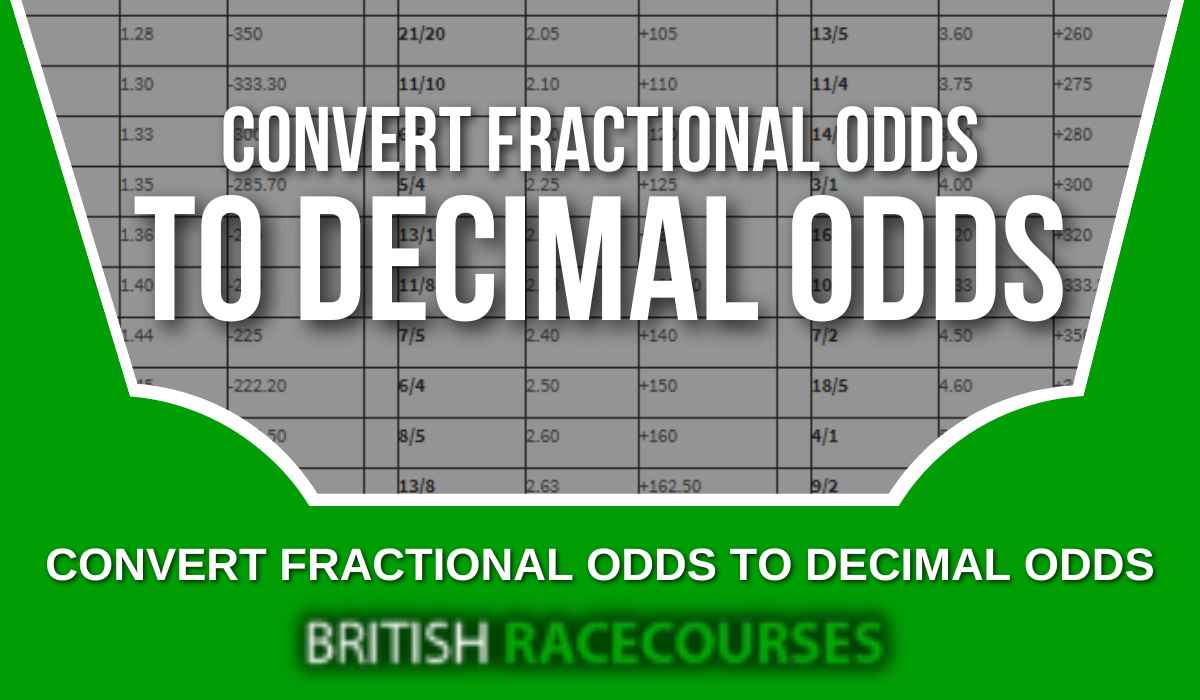
Converting fractional odds to decimal odds is straightforward: divide the first number by the second number, then add 1.
For example, 5/2 fractional odds convert to 3.50 decimal:
5 ÷ 2 = 2.5
2.5 + 1 = 3.50
Both prices represent exactly the same bet. Only the way the odds are displayed has changed.
British and Irish horse racing bettors commonly encounter fractional prices, while decimal odds are particularly useful for calculating total returns and converting prices into implied probability.
Our main betting odds guide explains how betting prices work. Use the conversion table below when you simply need to change fractional odds into their decimal equivalent.
Fractional to Decimal Odds Conversion Table
The table below converts common fractional betting odds into decimal odds.
| Fractional Odds | Decimal Odds |
|---|---|
| 1/10 | 1.10 |
| 1/9 | 1.11 |
| 1/8 | 1.13 |
| 1/7 | 1.14 |
| 1/6 | 1.17 |
| 1/5 | 1.20 |
| 2/9 | 1.22 |
| 1/4 | 1.25 |
| 2/7 | 1.29 |
| 3/10 | 1.30 |
| 1/3 | 1.33 |
| 4/11 | 1.36 |
| 2/5 | 1.40 |
| 4/9 | 1.44 |
| 1/2 | 1.50 |
| 8/15 | 1.53 |
| 4/7 | 1.57 |
| 8/13 | 1.62 |
| 4/6 | 1.67 |
| 8/11 | 1.73 |
| 4/5 | 1.80 |
| 5/6 | 1.83 |
| 10/11 | 1.91 |
| 1/1 or Evens | 2.00 |
| 11/10 | 2.10 |
| 6/5 | 2.20 |
| 5/4 | 2.25 |
| 11/8 | 2.375 |
| 6/4 | 2.50 |
| 13/8 | 2.625 |
| 7/4 | 2.75 |
| 9/5 | 2.80 |
| 15/8 | 2.875 |
| 2/1 | 3.00 |
| 11/5 | 3.20 |
| 9/4 | 3.25 |
| 12/5 | 3.40 |
| 5/2 | 3.50 |
| 13/5 | 3.60 |
| 11/4 | 3.75 |
| 3/1 | 4.00 |
| 10/3 | 4.33 |
| 7/2 | 4.50 |
| 4/1 | 5.00 |
| 9/2 | 5.50 |
| 5/1 | 6.00 |
| 11/2 | 6.50 |
| 6/1 | 7.00 |
| 13/2 | 7.50 |
| 7/1 | 8.00 |
| 15/2 | 8.50 |
| 8/1 | 9.00 |
| 17/2 | 9.50 |
| 9/1 | 10.00 |
| 10/1 | 11.00 |
| 11/1 | 12.00 |
| 12/1 | 13.00 |
| 14/1 | 15.00 |
| 15/1 | 16.00 |
| 16/1 | 17.00 |
| 18/1 | 19.00 |
| 20/1 | 21.00 |
| 25/1 | 26.00 |
| 33/1 | 34.00 |
| 40/1 | 41.00 |
| 50/1 | 51.00 |
| 66/1 | 67.00 |
| 100/1 | 101.00 |
How Do You Convert Fractional Odds to Decimal Odds?
Use this formula:
Decimal odds = (Numerator ÷ Denominator) + 1
The numerator is the first number in the fraction. The denominator is the second.
For 9/4:
9 ÷ 4 = 2.25
Then add 1:
2.25 + 1 = 3.25
Therefore:
9/4 fractional = 3.25 decimal
The extra 1 represents the original stake included in the decimal return.
That is the main difference to remember. Fractional odds primarily express the potential profit relative to the stake, while decimal odds express the total return, including the stake.
Why Do You Add 1 When Converting Fractional Odds?
You add 1 because decimal odds include the original stake in the displayed return.
Take 4/1 odds.
A £1 winning bet at 4/1 produces:
£4 profit + £1 returned stake = £5 total return
The decimal price is therefore:
5.00
The same applies at 10/1:
£10 profit + £1 stake = £11 total return
So 10/1 fractional odds convert to 11.00 decimal odds.
5/2 Fractional Odds in Decimal
5/2 odds convert to 3.50 decimal.
The calculation is:
5 ÷ 2 = 2.5
Then:
2.5 + 1 = 3.50
A £10 winning bet therefore returns:
£10 × 3.50 = £35
That consists of £25 profit and the £10 stake.
Using the fractional calculation gives exactly the same result:
£10 × 5 ÷ 2 = £25 profit
Add the £10 stake and the total return is £35.
7/2 Fractional Odds in Decimal
7/2 odds convert to 4.50 decimal.
Calculate:
7 ÷ 2 = 3.5
Then add 1:
3.5 + 1 = 4.50
A £20 bet at 7/2 therefore has a potential total return of:
£20 × 4.50 = £90
The profit is £70, with the £20 stake making up the remainder of the £90 return.
13/8 Fractional Odds in Decimal
13/8 odds convert to 2.625 decimal.
Calculate:
13 ÷ 8 = 1.625
Then:
1.625 + 1 = 2.625
Some bookmakers or betting interfaces may display the decimal price to two decimal places, giving 2.63.
A £10 stake at the exact decimal equivalent of 2.625 produces a £26.25 total return if successful.
1/1 Fractional Odds in Decimal
1/1 odds are also known as evens or even money.
They convert to:
1 ÷ 1 + 1 = 2.00
A £10 winning bet at 1/1 therefore returns £20 in total:
£10 profit + £10 stake
Decimal odds of 2.00 are particularly easy to recognise because the total return is exactly twice the stake.
2/1 Fractional Odds in Decimal
2/1 odds convert to 3.00 decimal.
The calculation is:
2 ÷ 1 + 1 = 3.00
A £10 winning bet at 2/1 returns:
£10 × 3.00 = £30
That is £20 profit plus the returned £10 stake.
3/1 Fractional Odds in Decimal
3/1 odds convert to 4.00 decimal.
Calculate:
3 ÷ 1 + 1 = 4.00
A £10 winning bet produces a £40 total return.
This price also provides a useful example of probability. Decimal odds of 4.00 have a raw implied probability of:
1 ÷ 4.00 × 100 = 25%
That means 3/1 represents a raw implied probability of 25%, not one in three.
How Do Decimal Odds Calculate Your Return?
Decimal odds make return calculations particularly simple.
Use:
Stake × Decimal Odds = Total Return
For example, a £25 stake at decimal odds of 6.00 gives:
£25 × 6.00 = £150
The £150 consists of:
£125 profit + £25 stake
Decimal odds therefore allow you to see the total potential return directly.
At 5/1, the decimal equivalent is 6.00. Every £1 staked therefore returns £6 if the bet wins.
Fractional Odds Versus Decimal Odds
Fractional and decimal odds are two ways of displaying the same betting price.
For example:
5/2 = 3.50
7/2 = 4.50
4/1 = 5.00
10/1 = 11.00
Changing from one format to the other does not change the selection’s price, potential profit or underlying bet.
The main difference is what the displayed number communicates.
Fractional odds show potential profit relative to the stake.
Decimal odds show the complete potential return for each unit staked.
A bettor may find one format easier to read, but neither format is inherently better value.
Are Decimal Odds Better Than Fractional Odds?
Decimal odds are often easier for calculations.
If a horse is priced at 7.50 and you stake £12, multiply:
£12 × 7.50 = £90
That immediately gives the total potential return.
Fractional odds remain familiar to many British and Irish racing bettors and can make the relationship between stake and profit easy to see.
For example, 6/1 immediately shows that the potential profit is six units for every one unit staked.
The format does not affect whether the bet represents value.
How Do You Convert Decimal Odds Back to Fractional?
To reverse the calculation:
Decimal odds – 1 = fractional value
For example:
4.50 – 1 = 3.50
3.50 can be written as the fraction:
7/2
Therefore:
4.50 decimal = 7/2 fractional
Another example is 11.00:
11.00 – 1 = 10
So:
11.00 decimal = 10/1 fractional
Some decimal numbers need to be converted into less obvious fractions, which is where the table above becomes useful.
Fractional and Decimal Odds Do Not Change the Value of a Bet
A common misconception is that switching odds formats can produce a better return.
It cannot.
Suppose one bookmaker displays:
5/1
and another interface displays:
6.00
Those are the same price.
A £10 winning bet returns £60 in either format.
What matters is a genuine difference in price.
If one bookmaker offers 5/1 and another offers 11/2, the second price is bigger. Converting both to decimal makes that easy to see:
5/1 = 6.00
11/2 = 6.50
The 6.50 price gives a larger return for exactly the same winning outcome.
Fractional Odds, Decimal Odds and Implied Probability
Converting odds into decimal format also makes implied probability easy to calculate.
Use:
Raw implied probability = 1 ÷ Decimal Odds × 100
For example, 4/1 odds convert to decimal odds of 5.00.
Therefore:
1 ÷ 5.00 × 100 = 20%
The raw implied probability is 20%.
At 20/1, the decimal price is 21.00:
1 ÷ 21.00 × 100 = 4.76%
These percentages are mathematical conversions of the quoted prices. They should not automatically be treated as the selection’s true probability.
Why Implied Probabilities Can Add Up to More Than 100%
If you convert every runner’s bookmaker odds into raw implied probabilities and add them together, the total will commonly exceed 100%.
That happens because bookmaker markets contain a margin.
For example, imagine two theoretical outcomes both priced at decimal odds of 1.90.
Each has a raw implied probability of:
1 ÷ 1.90 × 100 = 52.63%
Together:
52.63% + 52.63% = 105.26%
The amount above 100% illustrates the margin in that simplified market.
Our bookmaker overround guide explains how this works in horse racing markets and why raw implied probability should not be confused with a runner’s independently assessed true chance.
Converting Long Odds to Decimal Odds
Long fractional prices become particularly simple in decimal format because you add 1 when the denominator is 1.
20/1 odds become:
21.00
33/1 odds become:
34.00
50/1 odds become:
51.00
66/1 odds become:
67.00
100/1 odds become:
101.00
The same rule applies at any whole-number fractional price.
For example, 8/1 becomes 9.00 and 12/1 becomes 13.00.
What Does 100/1 Convert to in Decimal Odds?
100/1 converts to 101.00 decimal.
The calculation is:
100 ÷ 1 + 1 = 101.00
A £10 winning stake at 101.00 would produce a total return of:
£10 × 101 = £1,010
That consists of £1,000 profit plus the returned £10 stake.
The raw implied probability of 101.00 decimal odds is approximately 0.99%.
Again, that is the mathematical probability represented by the quoted price rather than proof of the selection’s true chance.
How to Compare Bookmaker Prices Using Decimal Odds
Decimal conversion makes comparing prices easier when different platforms or sources use different formats.
Suppose a horse is:
9/2 with Bookmaker A
and:
5.75 decimal with Bookmaker B
Convert 9/2:
9 ÷ 2 + 1 = 5.50
You can now compare:
Bookmaker A: 5.50
Bookmaker B: 5.75
Bookmaker B is offering the bigger price.
If you have already decided to place the bet, taking the bigger available price increases the potential return without changing the horse’s chance of winning.
British Racecourses compares bookmakers from a racing perspective on our best horse racing betting sites page.
How Odds Conversion Helps With Value Betting
Converting odds does not tell you whether a bet represents value.
It does make the calculations easier.
Suppose you believe a horse has a 25% chance of winning.
Its theoretical fair decimal price is:
1 ÷ 0.25 = 4.00
That is equivalent to 3/1 fractional odds.
If a bookmaker offers 5.00, equivalent to 4/1, your assessment suggests the available price is bigger than your fair price.
If the bookmaker offers 3.00, equivalent to 2/1, it is shorter than your assessment.
The accuracy of your original 25% estimate remains the difficult part. Converting the odds simply allows you to compare your assessment with the market on the same basis.
Fractional and Decimal Odds When Prices Move
A horse’s price can shorten or drift regardless of the format used to display it.
A move from:
10/1 to 5/1
is exactly the same as:
11.00 to 6.00
The horse has shortened.
Our betting odds shortening guide explains why prices contract and why a shortening horse is not automatically a good bet.
The reverse move:
5/1 to 10/1
or:
6.00 to 11.00
is a drift.
Our betting odds drifting guide covers how to interpret lengthening prices.
Converting the format does not change the direction or size of the underlying market move.
How to Calculate Multiple Bets With Decimal Odds
Decimal odds are particularly convenient when calculating accumulators.
Suppose a three-selection accumulator contains:
2.00
3.00
4.00
Multiply the prices:
2.00 × 3.00 × 4.00 = 24.00
A £10 winning accumulator would therefore return:
£10 × 24.00 = £240
Every selection must win for a standard accumulator to be successful.
Calculations become more complicated with each-way bets, Rule 4 deductions, dead heats and combination bets. The British Racecourses bet calculator can calculate these rather than requiring you to work them out manually.
Fractional to Decimal Odds FAQs
What is the formula for converting fractional odds to decimal?
Divide the numerator by the denominator and add 1.
For example:
5/2 = 5 ÷ 2 + 1 = 3.50
What is 1/1 in decimal odds?
1/1, or evens, converts to 2.00 decimal.
What is 2/1 in decimal odds?
2/1 converts to 3.00 decimal.
What is 5/2 in decimal odds?
5/2 converts to 3.50 decimal.
What is 3/1 in decimal odds?
3/1 converts to 4.00 decimal.
What is 7/2 in decimal odds?
7/2 converts to 4.50 decimal.
What is 4/1 in decimal odds?
4/1 converts to 5.00 decimal.
What is 10/1 in decimal odds?
10/1 converts to 11.00 decimal.
What is 20/1 in decimal odds?
20/1 converts to 21.00 decimal.
What is 50/1 in decimal odds?
50/1 converts to 51.00 decimal.
What is 100/1 in decimal odds?
100/1 converts to 101.00 decimal.
Why are decimal odds one higher than whole-number fractional odds?
Decimal odds include the returned stake. A £1 winner at 4/1 produces £4 profit plus the £1 stake, giving a £5 total return. The decimal equivalent is therefore 5.00.
Do fractional and decimal odds pay different amounts?
No. Equivalent fractional and decimal prices produce the same return. For example, 4/1 and 5.00 represent the same betting price.
Are decimal odds easier for calculating returns?
They can be. Multiply the decimal odds by your stake to calculate the potential total return.
Summary
To convert fractional odds to decimal odds, divide the first number by the second and add 1.
The formula is:
Decimal odds = (Numerator ÷ Denominator) + 1
That means:
1/1 = 2.00
5/2 = 3.50
7/2 = 4.50
4/1 = 5.00
10/1 = 11.00
20/1 = 21.00
Fractional and decimal odds represent the same price. Fractional odds primarily show potential profit relative to your stake, while decimal odds show the total return including the stake.
Decimal prices also make it easy to calculate implied probability and compare prices across different markets.
Use the conversion table whenever you need a quick answer, then use the individual British Racecourses odds pages for detailed payout, probability and price explanations.
Odds Used in the Betting Market
Here is a list of guides for specific betting odds used by UK sportsbook bookmakers:
-

Convert Fractional Odds to Decimal Odds
-
Betting Odds Drifting Explained
-
Betting Odds Shortening: What Shortening Odds Mean in Horse Racing
-
4-11 Betting Odds
-
1-3 Betting Odds
-
1-2 Betting Odds
-
1-5 Betting Odds
-
2-5 Betting Odds
-
4-5 Betting Odds
-
6-5 Betting Odds
-
7/5 Betting Odds
-
8-5 Betting Odds
-
9-5 Betting Odds
-
11-5 Betting Odds
-
12-5 Betting Odds
-
13-5 Betting Odds
-
16-5 Betting Odds
-
10-3 Betting Odds
-
4-7 Betting Odds
-
8-13 Betting Odds
-
8-15 Betting Odds
-
4-9 Betting Odds
-
5-6 Betting Odds
-
4-6 Betting Odds
-
8-11 Betting Odds
-
1-1 Betting Odds
-
11-10 Betting Odds
-
100-1 Betting Odds
-
66-1 Betting Odds
-
33-1 Betting Odds
-
25-1 Betting Odds
-
16-1 Betting Odds
-
14-1 Betting Odds
-
12-1 Betting Odds
-
10-1 Betting Odds
-
9-1 Betting Odds
-
8-1 Betting Odds
-
7-1 Betting Odds
-
6-1 Betting Odds
-
5-1 Betting Odds
-
4-1 Betting Odds
-
3-1 Betting Odds
-
2-1 Betting Odds
-
15-2 Betting Odds
-
13-2 Betting Odds
-
11-2 Betting Odds
-
9-2 Betting Odds
-
7-2 Betting Odds
-
5-2 Betting Odds
-
11-8 Betting Odds
-
13-8 Betting Odds
-
11-4 Betting Odds
-
9-4 Betting Odds
-
7-4 Betting Odds
-
6-4 Betting Odds
-
5-4 Betting Odds
-
50-1 Betting Odds
-
20-1 Betting Odds
-
10-11 Betting Odds
-
15-8 Betting Odds
-
Betting Odds Explained: How Horse Racing Odds Work
-
Starting Price Betting Explained: What Does SP Mean in Horse Racing?
-
Each Way Bet