Betting odds tell you two important things: the price available for a bet and the return you will receive if that bet wins.
Odds can also be converted into an implied probability. A horse priced at evens has a raw implied probability of 50%, while a horse at 4/1 has a raw implied probability of 20%.
That does not mean the bookmaker has established the horse’s true chance of winning. Betting markets contain a bookmaker margin; prices change as markets develop, and different bookmakers can offer different odds on the same horse.
Understanding that distinction is central to horse racing betting.
What Are Betting Odds?
Betting odds are the price offered on an outcome.
In horse racing, bookmakers price every runner in a race. Shorter odds indicate that the market considers a horse more likely to win than a horse at a bigger price.
For example, compare:
2/1
and
10/1
The 2/1 runner has a shorter price and a higher market-implied probability. The 10/1 runner has a bigger potential return but a lower market-implied probability.
The odds also determine how much you receive if your selection wins.
At 2/1, a £10 winning stake produces £20 profit plus the £10 stake returned.
At 10/1, the same £10 winning stake produces £100 profit plus the £10 stake returned.
This does not mean the 2/1 horse will win or the 10/1 horse will lose. Odds are prices, not results.
How Do Betting Odds Work?
Fractional odds show the potential profit relative to your stake.
If a horse is 4/1, the first number represents the potential profit and the second represents the stake.
A £1 winning bet returns:
£4 profit + £1 stake = £5 total return
A £10 winning bet returns:
£40 profit + £10 stake = £50 total return
Our dedicated 4/1 betting odds page gives more examples for that price.
The same principle applies to other fractional odds, although fractions such as 5/2 require a little more calculation.
Fractional Odds Explained
Fractional odds remain familiar to British and Irish horse racing bettors.
Common prices include:
1/1, 13/8, 5/2, 7/2, 4/1, 10/1 and 20/1.
The number on the left tells you the potential profit relative to the number on the right.
At 5/2, you receive £5 profit for every £2 staked.
A £10 bet is five times £2, so the potential profit is:
5 × £5 = £25
Your total return is:
£25 profit + £10 stake = £35
Our 5/2 odds explanation covers the price, probability and returns in more detail.
What Does Evens Mean?
Evens means the potential profit is equal to the stake.
It can be written as:
Evens
Even money
1/1
A £20 bet at evens produces £20 profit if successful, with the £20 stake also returned.
The total return is therefore £40.
Evens or 1/1 odds have a raw implied probability of 50%.
That does not mean an even-money horse is guaranteed to win one race in every two. It means 50% is the probability represented by that individual price before considering the wider market and bookmaker margin.
What Are Odds-On Prices?
Odds-on prices have a potential profit smaller than the stake.
Examples include:
4/5
4/6
1/2
At 1/2, a £10 winning bet produces £5 profit plus the £10 stake.
Odds-on horses have a raw implied probability above 50%.
Being odds-on does not make a horse a certainty or automatically make it a good bet. The question is whether the price is bigger or smaller than the horse’s actual chance justifies.
A horse with a genuine 75% chance would have fair decimal odds of approximately 1.33. If a bookmaker offered 1.50, that would be a different proposition from offering 1.20.
The horse’s chance has not changed between those examples. The price has.
What Are Odds-Against Prices?
Odds-against prices produce potential profit greater than the stake.
Examples include 5/2, 4/1, 10/1 and 20/1.
At 20/1, a £10 winning stake produces £200 profit and a £210 total return.
The bigger potential payout reflects the lower implied probability represented by the price.
Again, bigger odds do not automatically mean better value.
A 20/1 horse can be too short if its genuine chance is considerably smaller than the price implies. An odds-on horse can offer value if its true probability is greater than the bookmaker’s implied probability.
Betting Odds and Implied Probability
Implied probability converts betting odds into a percentage.
For decimal odds, the basic calculation is:
Implied probability = 1 ÷ decimal odds × 100
At decimal odds of 4.00:
1 ÷ 4.00 × 100 = 25%
Fractional odds of 3/1 are decimal odds of 4.00, so the raw implied probability is 25%.
This corrects a common misunderstanding. 3/1 does not represent a one-in-three chance.
For fractional odds, you can calculate raw implied probability using:
Denominator ÷ (numerator + denominator) × 100
For 3/1:
1 ÷ (3 + 1) × 100 = 25%
For 7/2:
2 ÷ (7 + 2) × 100 = 22.22%
The British Racecourses 7/2 odds guide shows how that price converts into probability and returns.
Betting Odds Conversion Table
The following table shows some common horse racing prices.
| Fractional Odds | Decimal Odds | Raw Implied Probability | £10 Total Return |
|---|---|---|---|
| 1/2 | 1.50 | 66.67% | £15.00 |
| 4/5 | 1.80 | 55.56% | £18.00 |
| 1/1 | 2.00 | 50.00% | £20.00 |
| 13/8 | 2.625 | 38.10% | £26.25 |
| 2/1 | 3.00 | 33.33% | £30.00 |
| 5/2 | 3.50 | 28.57% | £35.00 |
| 3/1 | 4.00 | 25.00% | £40.00 |
| 7/2 | 4.50 | 22.22% | £45.00 |
| 4/1 | 5.00 | 20.00% | £50.00 |
| 5/1 | 6.00 | 16.67% | £60.00 |
| 10/1 | 11.00 | 9.09% | £110.00 |
| 20/1 | 21.00 | 4.76% | £210.00 |
| 33/1 | 34.00 | 2.94% | £340.00 |
| 50/1 | 51.00 | 1.96% | £510.00 |
| 66/1 | 67.00 | 1.49% | £670.00 |
| 100/1 | 101.00 | 0.99% | £1,010.00 |
These percentages are mathematical conversions of individual prices. They should not be presented as independently established estimates of each selection’s true chance.
What Are Decimal Odds?
Decimal odds express the total return for every £1 staked.
A decimal price of:
2.00
means a £1 winning bet returns £2 in total.
A decimal price of:
3.50
means a £1 winning bet returns £3.50.
A decimal price of:
11.00
means a £1 winning bet returns £11.
Unlike fractional odds, the decimal figure already incorporates the returned stake when calculating the total return.
The calculation is:
Stake × decimal odds = total return
If you stake £20 at decimal odds of 3.50:
£20 × 3.50 = £70
The £70 consists of the £20 stake and £50 profit.
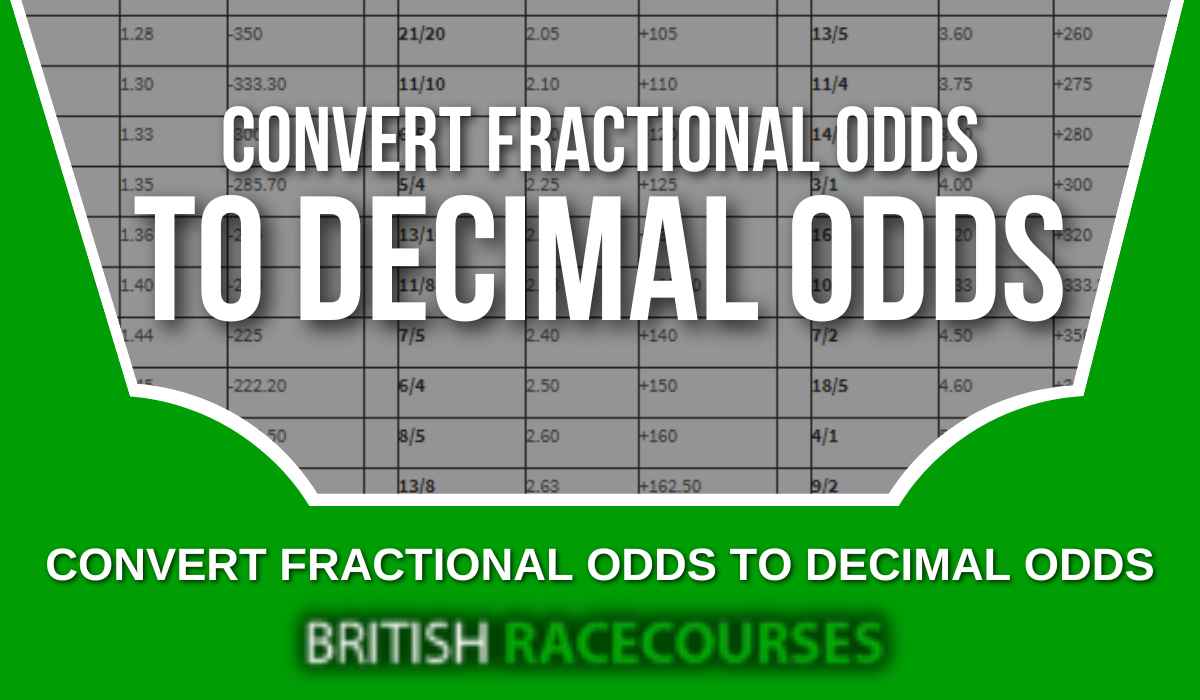
Our fractional to decimal odds converter provides a fuller conversion table.
Fractional Odds Versus Decimal Odds
Fractional and decimal odds can represent exactly the same price.
For example:
5/2 fractional = 3.50 decimal
7/2 fractional = 4.50 decimal
4/1 fractional = 5.00 decimal
10/1 fractional = 11.00 decimal
Changing the format does not change the value of the bet.
Fractional odds make the profit-to-stake relationship easy to see once you understand the fraction. Decimal odds make total returns and probability calculations straightforward.
The best format is the one you can interpret accurately and quickly.
What Are American Odds?
American odds, also called moneyline odds, use positive and negative numbers.
Positive American odds show the profit from a $100 stake. Negative odds show how much must be staked to make $100 profit.
They are far less common in British horse racing than fractional or decimal odds.
A UK racing bettor does not need to use American odds to assess a race. Understanding fractional and decimal prices covers the formats most commonly encountered when comparing British racing markets.
Why Are Betting Odds Not the Same as True Probability?
Bookmaker prices contain a margin.
Imagine a race with four horses. If their quoted implied probabilities were:
30%
30%
25%
25%
the total would be:
110%
A race can only have one winner, so the genuine probabilities of mutually exclusive win outcomes must total 100%.
The additional percentage in the bookmaker market is known as the overround.
Our bookmaker overround guide explains how this margin affects the prices offered to bettors.
This is why it is more accurate to describe the percentage calculated from a bookmaker price as a raw implied probability, rather than automatically calling it the horse’s true chance.
What Is a Fair Price?
A fair price is the odds corresponding to your estimate of an outcome’s genuine probability without a bookmaker margin.
Suppose you assess a horse as having a:
25% chance of winning
The fair decimal price is:
1 ÷ 0.25 = 4.00
That is equivalent to:
3/1
If a bookmaker offers 4/1, the available price is bigger than your assessed fair price.
If the bookmaker offers 2/1, it is shorter.
That does not prove your probability estimate is correct. It gives you a framework for deciding whether a price represents value rather than simply deciding whether you think a horse will win.
What Is Value in Horse Racing Odds?
Value exists when the available odds are greater than the chance you believe an outcome has.
Consider a horse you assess as having a 25% chance.
Your fair price is 3/1.
If you can bet at 5/1, your assessment says the bookmaker is offering a bigger price than the horse’s chance warrants.
The bet can still lose.
Value betting is not about predicting every individual result correctly. It is about repeatedly trying to obtain prices greater than your estimate of the underlying probability.
This also explains why a short-priced horse can represent value while a longshot can be poor value.
What Does Shortening Odds Mean?
Odds shorten when a price becomes smaller.
A horse moving from:
10/1 to 7/1 to 4/1
is shortening.
The raw implied probability represented by its market price is increasing, while the potential return for a new bettor is decreasing.
A shortening price does not prove that the horse itself has become more likely to win. The market may have reacted to betting activity, a non-runner, conditions or other information.
Our betting odds shortening guide explains how to assess these movements without automatically treating a steamer as a betting selection.
What Does Drifting Odds Mean?
Odds drift when the price becomes bigger.
A horse moving from:
5/2 to 7/2 to 5/1
is drifting.
The potential return is increasing, while the market-implied probability is falling.
That does not prove the horse is less fit, that its connections are negative or that it will lose.
Another horse may simply be attracting support, or the market may have reassessed the relative chances of several runners.
Read our betting odds drifting explanation for the other side of market movement.
What Is Starting Price in Horse Racing?
Starting Price, normally shortened to SP, is the industry Starting Price returned for a horse when the race begins.
A bettor can choose an early fixed price where available or take SP, depending on the bet and bookmaker.
For example, a horse might be available at 6/1 earlier in the day and return an SP of 4/1.
Another could be backed at 5/1 before drifting to an SP of 8/1.
The difference matters because the price used determines the return.
Our Starting Price betting guide explains SP, early prices and how the two differ.
How Does Best Odds Guaranteed Affect the Price?
Best Odds Guaranteed, usually called BOG, can apply to qualifying horse racing bets with bookmakers offering the concession.
A simplified example is a horse backed at 5/1 that subsequently returns a bigger SP of 7/1. Under qualifying BOG terms, a winning bet may be settled at the bigger SP.
If the horse instead shortens to 3/1, the bettor normally retains the qualifying 5/1 early price.
Terms, eligible races and qualifying times vary, so the bookmaker’s current rules need to be checked.
Our Best Odds Guaranteed betting guide covers the concession in more detail.
Why Comparing Horse Racing Odds Matters
Different bookmakers can offer different prices on the same horse.
Imagine four bookmakers price one runner at:
Bookmaker A: 4/1
Bookmaker B: 9/2
Bookmaker C: 5/1
Bookmaker D: 11/2
The horse has exactly the same chance of winning regardless of where you place the bet.
The potential return does not.
A £20 win bet at 4/1 returns £100 including the stake.
A £20 win bet at 11/2 returns £130 including the stake.
That £30 difference comes entirely from obtaining the better price.
Our comparison of horse racing betting sites assesses bookmakers from a racing perspective. Readers who primarily place bets on a phone can use the separate horse racing betting apps comparison.
Why Long Odds Are Not Automatically Good Odds
A large potential payout can make an outsider look attractive.
Suppose a horse is priced at 50/1.
Its raw implied probability is approximately 1.96%.
If you believe its true chance is only 0.5%, 50/1 is actually too short according to your assessment.
Now consider a horse at evens.
If you believe that horse has a 60% genuine chance, an even-money price could represent value despite producing a much smaller potential profit.
This distinction is central to understanding odds.
Big price does not automatically mean good value. Short price does not automatically mean poor value.
How Do 33/1, 66/1 and 100/1 Odds Work?
Large prices use exactly the same fractional calculation.
At 33/1, a £1 winning bet produces £33 profit plus the £1 stake.
At 66/1, a £1 winner produces £66 profit plus the stake.
At 100/1, a £1 winner produces £100 profit plus the stake.
Their raw implied probabilities are approximately 2.94%, 1.49% and 0.99% respectively.
These percentages describe the quoted prices. They do not establish the true probability of the horses winning.
How to Calculate Your Betting Returns
For fractional odds, calculate the profit from the fraction and then add the original stake.
At 7/2 with a £20 stake:
£20 ÷ 2 × 7 = £70 profit
Add the £20 stake:
£90 total return
For decimal odds, multiply the stake directly by the decimal price.
7/2 is 4.50 decimal, so:
£20 × 4.50 = £90 total return
For more complicated bets, including accumulators and multiple bets, use the British Racecourses bet calculator.
Betting Odds and Each-Way Bets
An each-way bet consists of two bets: one on the horse to win and one on it to place under the bookmaker’s stated terms.
That means a £10 each-way bet normally costs £20.
The place part is settled at a fraction of the win odds, such as a quarter or a fifth, depending on the race and bookmaker terms.
This makes the original win price important.
A place return calculated from 20/1 is different from one calculated from 10/1.
Field size, race type, number of places and bookmaker enhancements can all affect the place terms. Check those terms rather than choosing an each-way bet solely because a horse has a large headline price.
Betting Odds and Favourites
The favourite is the horse with the shortest price in the market.
If one runner is 2/1 and every other horse is 4/1 or bigger, the 2/1 horse is the favourite.
Two horses sharing the shortest price are joint-favourites.
Being favourite means the betting market currently prices that runner as having the highest individual chance. It does not guarantee that the horse will win, nor does it establish that its price represents value.
The distinction between most likely winner and best bet at the available odds is fundamental.
Why Horse Racing Prices Change
Horse racing is a live betting market.
Prices can move because money is entering the market, information has changed, a horse has been withdrawn or bookmakers are adjusting prices in response to activity elsewhere.
A runner at 10/1 in the morning could be 4/1 by the afternoon.
Another horse could move from 4/1 to 10/1.
Neither move tells you the race result in advance.
It tells you that the market’s pricing has changed.
This is why bettors should record both the price they considered fair and the price they actually obtained.
Common Betting Odds Mistakes
One common mistake is confusing profit with total return. A £10 bet at 4/1 produces £40 profit and £50 total return, not £40 returned in total.
Another is reading 3/1 as a one-in-three chance. The raw implied probability of 3/1 is 25%, or one in four.
Bettors can also mistake the probability implied by a bookmaker’s price for an independently established true probability. The bookmaker margin means the prices across a market will generally imply more than 100% when added together.
Another mistake is assuming the biggest potential payout offers the best value. Value depends on price relative to probability, not the size of the headline return.
Finally, do not ignore differences between bookmakers. Repeatedly accepting shorter odds than are readily available elsewhere reduces returns without improving your chance of winning.
Betting Odds FAQs
What are betting odds?
Betting odds are prices attached to possible outcomes. They determine the potential return from a successful bet and can be converted into raw implied probabilities.
What does 3/1 mean?
Odds of 3/1 mean a successful £1 bet produces £3 profit plus the £1 stake. The total return is £4. The raw implied probability is 25%.
What does 5/2 mean?
At 5/2, every £2 staked can produce £5 profit if the bet wins. A £10 winning bet therefore produces £25 profit and a £35 total return.
What does 1/1 mean?
Odds of 1/1 are known as evens. A successful bet produces profit equal to the stake. The raw implied probability is 50%.
Are shorter odds more likely to win?
A shorter price represents a higher market-implied probability than a bigger price. It does not guarantee the result or establish the horse’s true probability.
Are bigger odds better?
Only if the bigger price is attractive relative to the selection’s chance. A 50/1 horse can still be poor value if its genuine chance is substantially lower than the odds imply.
How do I convert fractional odds to decimal?
Divide the numerator by the denominator and add 1. For example, 7/2 becomes 3.5 + 1 = 4.50.
How do I calculate implied probability?
For decimal odds, divide 1 by the decimal price and multiply by 100. Decimal odds of 5.00 therefore represent a raw implied probability of 20%.
Why do bookmakers offer different odds?
Bookmakers operate their own markets, liabilities and pricing. This can leave different prices available for the same horse at the same time.
What does it mean when odds shorten?
Shortening means a price becomes smaller, such as a horse moving from 10/1 to 5/1. It shows that the market has repriced the selection but does not guarantee it will win.
What does it mean when odds drift?
Drifting means the price becomes bigger. A horse moving from 3/1 to 5/1 is drifting.
What is SP in horse racing?
SP means Starting Price. It is the industry Starting Price returned when the race starts and can be used to settle bets placed at SP.
Do betting odds include the bookmaker’s margin?
Bookmaker markets normally contain a margin. This is why adding the raw implied probabilities of every runner can produce a total above 100%.
Summary
Betting odds are prices. They determine how much a winning bet returns and provide a way to calculate the probability implied by the market.
Fractional odds such as 5/2, 4/1 and 10/1 express potential profit relative to the stake. Decimal odds such as 3.50, 5.00 and 11.00 express the total return for every unit staked.
The most important distinction is between price and true probability.
A 4/1 price represents a raw implied probability of 20%, but it does not prove that the selection has exactly a 20% chance. Bookmaker margin and market pricing need to be considered.
Understand the odds, calculate the implied probability, assess the horse independently and compare the available prices.
Finding the winner matters. The price you take matters too.
Odds Used in the Betting Market
Here is a list of guides for specific betting odds used by UK sportsbook bookmakers:
-

Convert Fractional Odds to Decimal Odds
-
Betting Odds Drifting Explained
-
Betting Odds Shortening: What Shortening Odds Mean in Horse Racing
-
4-11 Betting Odds
-
1-3 Betting Odds
-
1-2 Betting Odds
-
1-5 Betting Odds
-
2-5 Betting Odds
-
4-5 Betting Odds
-
6-5 Betting Odds
-
7/5 Betting Odds
-
8-5 Betting Odds
-
9-5 Betting Odds
-
11-5 Betting Odds
-
12-5 Betting Odds
-
13-5 Betting Odds
-
16-5 Betting Odds
-
10-3 Betting Odds
-
4-7 Betting Odds
-
8-13 Betting Odds
-
8-15 Betting Odds
-
4-9 Betting Odds
-
5-6 Betting Odds
-
4-6 Betting Odds
-
8-11 Betting Odds
-
1-1 Betting Odds
-
11-10 Betting Odds
-
100-1 Betting Odds
-
66-1 Betting Odds
-
33-1 Betting Odds
-
25-1 Betting Odds
-
16-1 Betting Odds
-
14-1 Betting Odds
-
12-1 Betting Odds
-
10-1 Betting Odds
-
9-1 Betting Odds
-
8-1 Betting Odds
-
7-1 Betting Odds
-
6-1 Betting Odds
-
5-1 Betting Odds
-
4-1 Betting Odds
-
3-1 Betting Odds
-
2-1 Betting Odds
-
15-2 Betting Odds
-
13-2 Betting Odds
-
11-2 Betting Odds
-
9-2 Betting Odds
-
7-2 Betting Odds
-
5-2 Betting Odds
-
11-8 Betting Odds
-
13-8 Betting Odds
-
11-4 Betting Odds
-
9-4 Betting Odds
-
7-4 Betting Odds
-
6-4 Betting Odds
-
5-4 Betting Odds
-
50-1 Betting Odds
-
20-1 Betting Odds
-
10-11 Betting Odds
-
15-8 Betting Odds
-
Betting Odds Explained: How Horse Racing Odds Work
-
Starting Price Betting Explained: What Does SP Mean in Horse Racing?
-
Each Way Bet