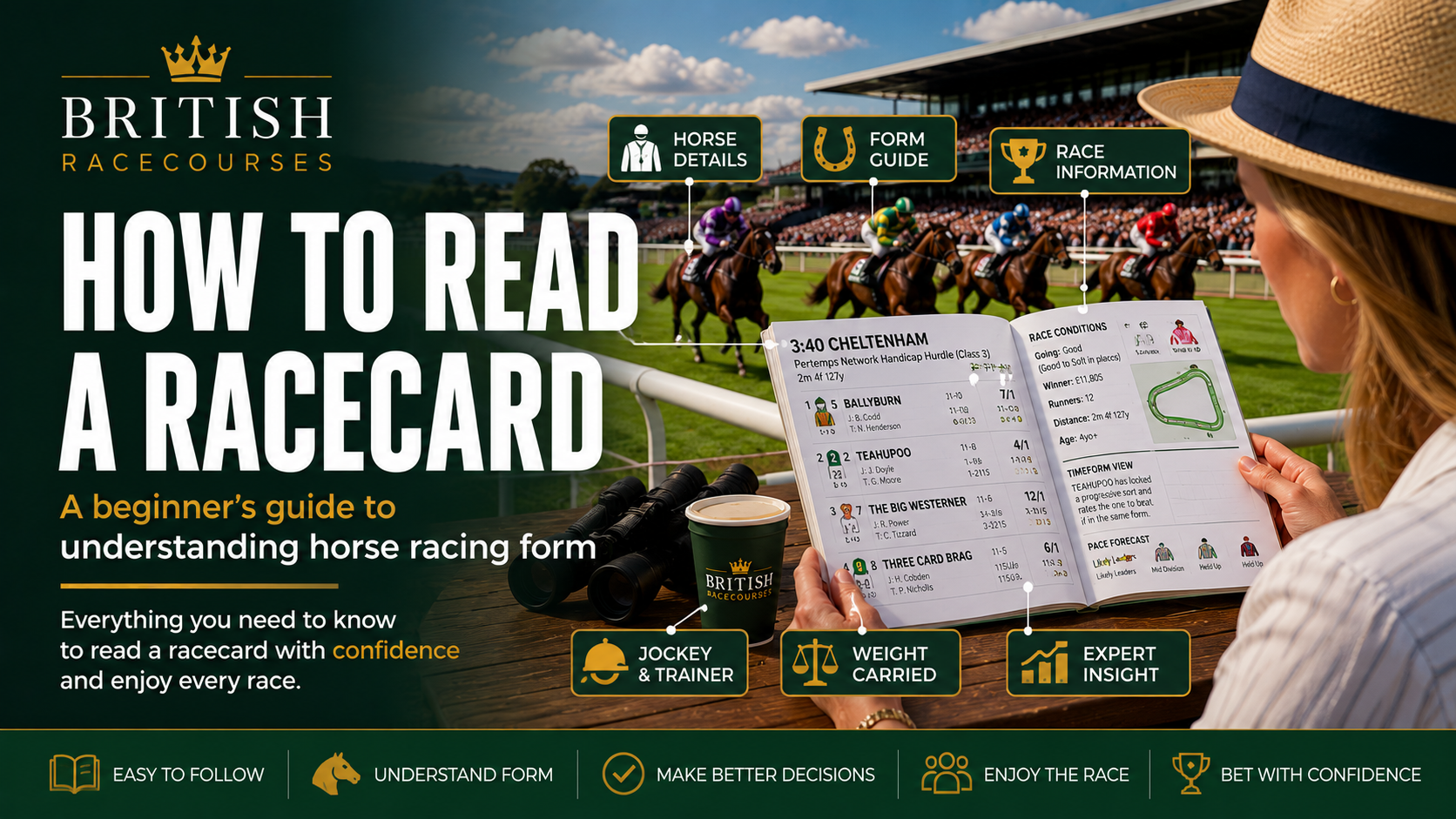
If you’ve ever looked at a racecard before a race meeting, you’ll know that they can appear overwhelming at first glance.
Numbers, abbreviations, ratings, weights and statistics all compete for your attention, leaving many newcomers wondering where to begin.
The good news is that racecards are far simpler than they first appear. Once you understand the key sections, you’ll quickly gain a better understanding of each horse’s chances and enjoy a much richer experience, whether you’re watching from home or attending a race meeting in person.
We’ll explain how to read a racecard, what the various figures mean, and how to use the information to better understand the sport.
What Is a Racecard?
A racecard is essentially the programme for a horse race. It contains important information about the race itself, as well as details on every horse taking part.
Racecards can be found online, in newspapers, through bookmakers, and in printed form at racecourses throughout Britain.
They typically include:
- Horse names
- Jockeys
- Trainers
- Recent form
- Official ratings
- Weights carried
- Race conditions
- Course and distance records
While experienced racing fans may analyse every detail, beginners only need to focus on a handful of key areas to start understanding what they’re looking at.
Understanding the Race Conditions
Before you look at the individual horses, it’s important to understand the race itself.
The conditions of the race often determine which horses are most likely to perform well.
Flat Racing or National Hunt Racing?
The first thing to identify is whether you’re looking at a Flat race or a National Hunt race.
Flat racing takes place without obstacles and focuses on speed, acceleration and tactical positioning.
National Hunt racing, often known as jump racing, includes hurdles and fences that horses must negotiate during the race.
If you’re unfamiliar with the differences between the two disciplines, our guide to National Hunt Racing provides an excellent introduction:
Race Distance
Race distances in Britain are measured in miles and furlongs.
Examples include:
- 5f (five furlongs)
- 7f (seven furlongs)
- 1m (one mile)
- 1m4f (one mile and four furlongs)
- 2m4f (two miles and four furlongs)
Different horses excel over different distances.
Some possess exceptional speed over shorter trips, while others thrive over longer distances where stamina becomes increasingly important.
When assessing a horse’s chances, always check whether it has previously performed well over today’s distance.
The Going
One of the most important pieces of information on any racecard is the going.
The going refers to the condition of the racing surface and can have a major impact on performance.
Common descriptions include:
- Firm
- Good to Firm
- Good
- Good to Soft
- Soft
- Heavy
Some horses prefer fast ground, while others perform significantly better on softer conditions.
For a full explanation of how ground conditions influence racing, see our guide to Horse Racing Goings:
Understanding Form Figures
One of the first things you’ll notice beside each horse’s name is a sequence of numbers.
These are known as form figures.
For example:
42131
These numbers represent the horse’s finishing positions in its recent races.
Reading from left to right:
- 4 = Fourth
- 2 = Second
- 1 = First
- 3 = Third
- 1 = First
This horse has clearly been running consistently well.
Learning how to interpret form figures is one of the most valuable skills in racing.
You can find a much more detailed breakdown in our guide to Horse Racing Form:
What Does 0 Mean?
Many newcomers assume a zero means a horse finished last.
This isn’t quite correct.
A zero simply indicates the horse finished outside the first nine positions.
For example:
23010
This horse has shown both strong and weaker performances recently.
Letters and Symbols
Racecards also contain letters which indicate unusual race outcomes.
Common examples include:
- P = Pulled Up
- F = Fell
- U = Unseated Rider
- R = Refused
- BD = Brought Down
These are particularly common in jump racing.
Official Ratings Explained
Most racecards display an Official Rating (OR).
This is a numerical assessment of a horse’s ability issued by the British Horseracing Authority.
Examples include:
- OR 65
- OR 82
- OR 104
- OR 130
Generally speaking, higher-rated horses are considered better performers.
However, ratings are particularly important in handicap races.
Understanding Handicap Races
Handicaps are designed to give every horse a realistic chance of winning.
To achieve this, higher-rated horses carry more weight than lower-rated rivals.
For example:
| Horse | Rating | Weight |
|---|---|---|
| Horse A | 95 | 9st 10lb |
| Horse B | 85 | 9st 0lb |
The theory is that the extra weight carried by Horse A balances its superior ability.
Many race meetings feature handicaps because they often produce competitive and exciting racing.
For a deeper look at ratings and weights, read our Guide to Horse Racing Handicapping:
Jockeys and Trainers
The people behind the horse are often just as important as the horse itself.
Trainers
Trainers are responsible for preparing horses for races and ensuring they are fit, healthy and ready to perform.
Some trainers specialise in Flat racing, while others focus on National Hunt racing.
You can learn more about leading trainers in our Horse Racing Trainers guide:
Jockeys
Jockeys play a crucial role in race outcomes.
Their ability to judge pace, positioning and timing can make a significant difference.
Some jockeys have particularly strong records at specific racecourses or on certain horses.
Our Horse Racing Jockeys guide introduces many of the sport’s biggest names:
Course and Distance Winners
Racecards often include the abbreviations:
- C = Course Winner
- D = Distance Winner
- CD = Course and Distance Winner
These indicators can be useful because racecourses vary enormously in layout.
A horse that has already won over the same course and distance has proven it can handle the unique demands of that particular track.
Why Racecourses Matter
Every racecourse has its own characteristics.
Some feature uphill finishes.
Others have sharp bends.
Some place a premium on stamina, while others favour speed.
Understanding these differences helps explain why certain horses perform well at particular venues.
If you’re interested in learning more about Britain’s racecourses, browse our complete Racecourses Directory:
You may also enjoy:
- https://www.britishracecourses.org/top-ten-racecourses/
- https://www.britishracecourses.org/most-scenic-and-most-historic-racecourses-in-the-uk/
- https://www.britishracecourses.org/uk-racecourses/
Five Quick Checks Before Choosing a Horse
If you’re new to racing, focus on these five areas:
1. Recent Form
Has the horse been running consistently well?
2. Distance
Has it performed over today’s trip before?
3. Going
Does the horse appear suited to the current ground conditions?
4. Trainer and Jockey
Are they in good recent form?
Pages such as In Form Trainers and In Form Jockeys can provide useful context:
5. Course Record
Has the horse previously won at this venue?
Racecards and Betting
While racecards are useful for understanding a race, they can also help inform betting decisions.
Many punters use racecards to identify:
- Horses in good form
- Favourable ground conditions
- Strong trainer-jockey combinations
- Well-handicapped runners
If you’re completely new to betting, our guides below provide useful starting points:
Frequently Asked Questions
Are racecards free?
Many online racecards are available free of charge, although some detailed racecards require a subscription.
What is the most important part of a racecard?
For beginners, recent form figures, race distance and going conditions are usually the most useful areas to focus on.
What does CD mean on a racecard?
CD stands for Course and Distance and indicates the horse has previously won over the same course and distance as today’s race.
Do favourites always win?
No. While favourites win more often than other runners, horse racing remains highly competitive and unpredictable.
Final Thoughts
Learning how to read a racecard is one of the best ways to improve your understanding and enjoyment of horse racing.
By focusing on recent form, ratings, race conditions and course suitability, you’ll quickly develop a much clearer picture of how a race is likely to unfold.
Whether you’re planning your first visit to the races, studying tomorrow’s runners, or simply looking to understand the sport better, a racecard provides the perfect starting point.
The more racecards you read, the more familiar the information becomes – and before long you’ll find yourself spotting patterns, recognising opportunities and enjoying horse racing on a whole new level.