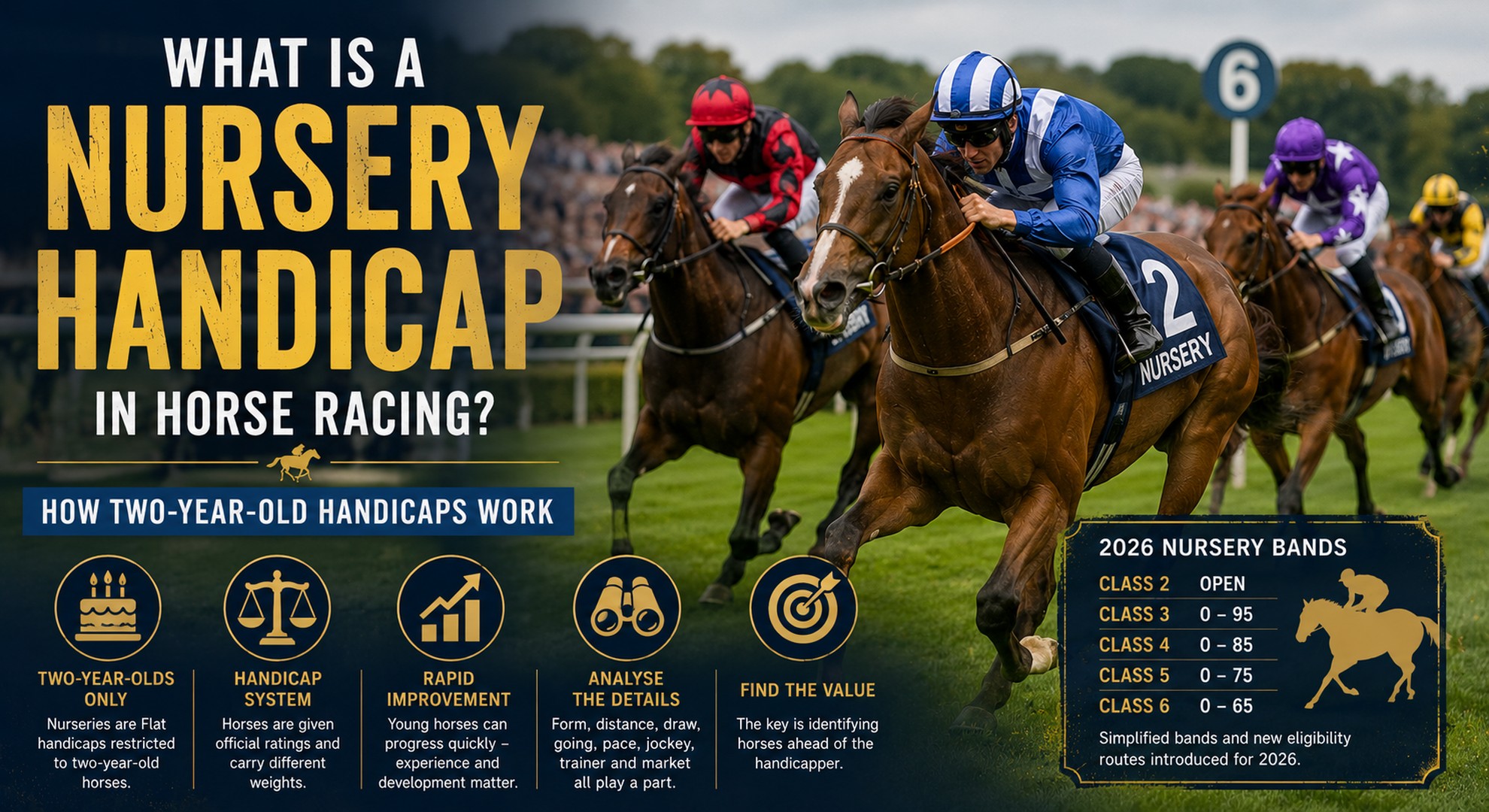
A nursery handicap is a Flat handicap race restricted to two-year-old horses.
The name can sound unusual if you are new to horse racing, but the principle is straightforward. Nurseries use the same basic handicapping system as other handicap races, with horses carrying different weights according to their assessed ability.
The major difference is age.
Every runner is a two-year-old.
That makes nursery handicaps particularly interesting because the horses are still developing, many have raced only a handful of times and their true level of ability may not yet be obvious.
A horse can therefore start its nursery career from a handicap mark that quickly proves too low or too high.
That uncertainty is one of the defining features of nursery racing.
For bettors and racing fans, understanding nursery handicaps means looking beyond the weight a horse carries. Previous form, improvement, distance, pedigree, draw, pace, trainer record and the circumstances of earlier races can all help determine whether a two-year-old has been accurately assessed.
What Is a Nursery Handicap?
A nursery is a handicap Flat race restricted to two-year-old horses.
It is essentially the juvenile equivalent of a standard Flat handicap.
The official handicapper assesses each qualifying horse and gives it an Official Rating, usually shown as OR on a racecard.
Those ratings determine the relative weights the horses carry.
For example:
| Horse | Official Rating | Relative Weight |
|---|---|---|
| Horse A | 80 | Highest |
| Horse B | 75 | 5lb less |
| Horse C | 70 | 10lb less |
| Horse D | 65 | 15lb less |
In simple terms, the handicapper considers Horse A 15lb superior to Horse D.
Horse A therefore carries 15lb more weight, subject to the specific conditions and weight limits of the race.
The theory is that the difference in weight compensates for the difference in ability and gives the horses more equal chances.
Our How Racehorse Handicap Ratings Work guide explains the wider British handicapping system.
Why Is It Called a Nursery?
The term “nursery” refers to the age of the horses.
Nursery handicaps are exclusively for two-year-olds, which are also commonly described as juveniles.
These horses are at the beginning of their racing careers.
Some may have raced several times.
Others may have made only two or three starts.
Many will still be developing physically and learning how to race.
The nursery system gives these young horses an opportunity to compete against horses of the same age under handicap conditions rather than continuing exclusively in maiden, novice or higher-level conditions races.
How Old Are Horses in Nursery Handicaps?
Every horse in a nursery is officially two years old.
British racehorses share an official birthday of 1 January, regardless of the exact date on which they were born.
A horse born in March and another born in May of the same year are therefore officially the same racing age.
The difference in their actual maturity can still matter.
A few weeks or months can represent a meaningful amount of physical development for a young horse.
That is one reason analysing two-year-old races can differ from analysing established older horses.
Our Yearling Horse page explains the stage immediately before horses become two-year-olds.
When Do Nursery Handicaps Start?
Nursery handicaps form part of the second half of the British two-year-old Flat programme.
They cannot simply begin at the start of the Flat season because handicappers first need evidence from racecourse performances.
Two-year-olds initially tend to compete in races such as maidens and novices.
Those performances provide evidence about their ability.
Once sufficient evidence exists and the horse meets the relevant eligibility requirements, the handicapper can allot an Official Rating.
The horse can then potentially compete in a nursery.
This creates an important distinction between early-season juvenile racing and the later programme.
Early in the season, much of the emphasis is on discovering ability.
By the time nurseries become established, handicapping becomes another major part of the two-year-old programme.
How Does a Two-Year-Old Qualify for a Nursery Handicap?
Nursery eligibility is particularly important because the rules changed for the 2026 season.
The traditional assumption that every two-year-old simply needs three runs before receiving a nursery mark is no longer a complete description of the system.
Under the 2026 British programme, certain horses can become eligible for Class 4, Class 5 or Class 6 nurseries after only two runs.
A British-trained two-year-old that has raced twice can qualify for one of those nursery categories when:
- it finishes in the first four on both starts; or
- it wins its second race after being unplaced on debut and the handicapper is prepared to allot a rating of 80 or lower.
Other established qualification routes remain relevant, including horses that have accumulated sufficient qualifying runs.
The important point for racing fans is that some nursery runners can now arrive in handicap company with very limited racing experience.
That makes analysing their opening marks particularly interesting.
What Changed to Nursery Handicaps in 2026?
British racing changed the two-year-old programme for 2026 partly in response to declining numbers of two-year-olds in training and relatively small fields in some nursery handicaps.
One of the biggest changes was a simplification of the nursery rating bands.
The 2026 structure is:
| Nursery Class | Rating Band |
|---|---|
| Class 2 | Open |
| Class 3 | 0-95 |
| Class 4 | 0-85 |
| Class 5 | 0-75 |
| Class 6 | 0-65 |
The programme therefore contains fewer different nursery rating bands than previously.
Eligibility was also changed so certain two-year-olds can enter lower and middle-level nurseries earlier in their careers.
For anyone analysing nurseries, this matters.
Older articles explaining qualification rules may no longer give the complete current position.
What Is a Nursery Handicap Rating?
A nursery handicap rating is the Official Rating allocated to a two-year-old by the handicapper.
The handicapper uses the horse’s previous performances to estimate its level of ability.
Imagine a juvenile has run three times:
- 5th on debut over 6f
- 3rd on its second start over 7f
- 2nd on its third start over 7f
The handicapper assesses those performances alongside the quality of opposition, margins, subsequent form and other relevant evidence.
The horse might then receive an opening mark of 72.
That does not mean 72 represents the horse’s permanent ability.
It represents the handicapper’s assessment based on the evidence available at that point.
For young, lightly raced horses, that distinction is important.
Why Can Opening Nursery Marks Be Difficult to Assess?
The handicapper faces a problem when rating inexperienced two-year-olds.
There is less evidence.
An older handicapper might have raced 20 or 30 times.
Its record could tell us:
- its best distance
- preferred going
- ideal course type
- typical running style
- established level of ability
- how it responds to different race scenarios.
A two-year-old making its nursery debut may have raced only a few times.
Its evidence could be limited to several runs in maiden or novice company.
The horse may also be improving rapidly.
That creates uncertainty.
The handicapper has to produce a rating.
The bettor has to decide whether that rating is accurate.
What Is a Nursery Debut?
A nursery debut is a horse’s first start in a nursery handicap.
This can be an important point in a two-year-old’s season.
Before entering handicap company, the horse will normally have competed under different race conditions.
Once it receives its first handicap rating, the question changes.
Instead of simply asking how good the horse is, we can ask:
How good is the horse compared with the mark it has been given?
Suppose a horse receives an opening rating of 68.
If its true current ability is closer to 75, it could be well handicapped.
If its true ability is only around 62, its opening mark could make winning difficult.
Finding those discrepancies is one of the attractions of nursery analysis.
Why Do Nursery Horses Improve So Quickly?
Two-year-olds are developing racehorses.
Physical growth is part of the equation, but experience matters too.
A horse can learn considerably from its first few races.
It may improve its:
- starting-stall behaviour
- early positioning
- ability to settle
- response to the jockey
- balance
- ability to race among other horses
- finishing effort.
Distance can also transform a juvenile.
A horse showing limited speed over five furlongs may improve significantly when stepped up to seven furlongs.
Another may look promising over six furlongs before struggling when asked to race over a mile.
That makes improvement particularly difficult to quantify.
Are Nursery Handicaps Hard to Predict?
Nurseries can be challenging because the runners have less established form than older handicappers.
That does not make them random.
It means different information may carry greater importance.
A typical older handicap might contain horses whose abilities and preferences are well established.
A nursery can contain several horses whose true ability remains uncertain.
Some may be improving.
Some may have been allocated generous opening marks.
Some may be stepping up to a more suitable distance.
Others may be encountering very different conditions from their previous races.
The key is recognising uncertainty rather than pretending it does not exist.
How to Analyse a Nursery Handicap
A strong nursery analysis should combine the handicap mark with the circumstances surrounding each horse.
There is no single nursery statistic that identifies winners consistently.
Instead, build a picture.
1. Start With the Official Rating
Check each horse’s OR.
This establishes the handicapper’s current view of the field.
Then ask whether you agree.
Do not automatically assume the highest-rated horse is the best bet.
The weight structure is designed to compensate for its superior rating.
Likewise, do not automatically assume the lowest-rated runner has an advantage because it carries less weight.
The relevant question is whether each horse’s rating accurately reflects its current ability.
2. Examine the Runs That Created the Rating
Opening nursery marks do not appear from nowhere.
Look at the performances on which the handicapper has based the rating.
Ask:
- How strong were the races?
- What did the horse finish behind?
- Has that form been strengthened subsequently?
- Was the horse beaten a long way?
- Did it encounter trouble?
- Was the distance suitable?
- Did the pace work against it?
- Was it inexperienced?
This is where reading form properly becomes valuable.
A finishing position alone can hide a lot.
A horse finishing sixth after being trapped behind runners might have performed considerably better than the bare result suggests.
Another horse finishing third after enjoying a perfect run might have achieved less than the position implies.
Our Horse Racing Form content explains how to look beyond basic finishing figures.
3. Look for Improvement
Improvement is central to nursery handicaps.
Ask whether the horse is likely to be better now than when the handicapper assessed its earlier performances.
Possible clues include:
- improving finishing positions
- stronger closing sectionals
- a more suitable distance
- better racecourse experience
- improved starting behaviour
- stronger form from previous races
- a physical type likely to develop with racing.
Do not assume every lightly raced juvenile will improve.
Some horses show their ability early.
The aim is to identify evidence of potential improvement rather than relying on the vague idea that a horse “could be anything”.
4. Pay Close Attention to Distance
Distance changes can be especially important with two-year-olds.
Juvenile careers often begin over relatively short distances.
As the season progresses, more races become available over six furlongs, seven furlongs, a mile and beyond.
A horse bred to appreciate seven furlongs may struggle to show its full ability in an early five-furlong race.
Once stepped up in trip, it can look like a different horse.
The reverse also applies.
A fast juvenile can weaken badly when moved beyond its optimum distance.
When assessing a nursery runner, ask:
Is today’s distance more suitable than the distances over which its handicap mark was earned?
That question can uncover significant improvement.
5. Consider Pedigree
Pedigree can provide clues when racecourse evidence is limited.
For an established six-year-old, pedigree often matters less than years of actual racing evidence.
For a two-year-old with only a few starts, it can be more informative.
Look at whether the sire and dam suggest:
- speed
- stamina
- preference for certain surfaces
- likely improvement over longer distances
- potential development with age.
Pedigree should not override what the horse has shown on the track.
It can, however, help answer questions for which there is not yet enough direct evidence.
6. Study the Going
Young horses can react differently when encountering new ground conditions.
A juvenile whose previous races came on quick ground may be racing on soft going for the first time.
Another might be switching from soft ground to a much faster surface.
The horse’s previous performances, action and pedigree can provide clues.
Our Horse Racing Going guide explains the main British going descriptions and why ground conditions affect performance.
Do not assume a horse will handle a surface simply because it is well handicapped.
A favourable rating is useful only if the horse can perform effectively under the race conditions.
7. Assess the Draw
Draw bias can matter significantly in Flat racing.
Its importance depends on:
- racecourse
- distance
- field size
- going
- rail position
- pace.
Some nursery handicaps are run over sprint distances where early position can be crucial.
A horse drawn away from the strongest pace may face a disadvantage.
At courses where particular stalls have historically performed well over certain distances, the draw deserves additional attention.
The important point is not to treat draw statistics mechanically.
A stall number only becomes meaningful when placed within the context of the race.
8. Build a Pace Picture
Young horses can be particularly sensitive to race shape.
Some want to lead.
Others race prominently.
Some need cover to settle.
Others are inexperienced and may race too freely.
Before a nursery, try to identify the likely pace.
If several runners habitually lead, the race could become competitive early.
That might help horses capable of settling behind the pace.
If there is only one obvious front-runner, that horse might obtain an uncontested lead.
Our Horse Racing Pace Maps Explained guide covers how to construct this type of race picture.
9. Consider Jockey Claims
A claiming jockey can reduce the weight carried by a nursery runner when the race conditions permit a claim.
That can be useful, but the allowance should never be considered in isolation.
A 5lb claim does not automatically make a horse 5lb better.
The jockey still needs to:
- get the horse settled
- judge the pace
- secure a position
- react to developments
- deliver the horse effectively.
This can matter even more with inexperienced two-year-olds.
Our Jockey Claims in Horse Racing guide explains apprentice allowances and how to assess their value.
10. Examine Trainer Patterns
Some trainers have strong records with juveniles.
Others are particularly effective when moving horses into handicap company.
Useful questions include:
- Does the trainer often improve two-year-olds through the season?
- Is the stable in form?
- Does the trainer have a strong record with nursery debutants?
- Is there a clear change in distance?
- Has equipment been changed?
- Is the horse being placed into a noticeably different race?
Trainer statistics can provide context.
They should not replace analysis of the individual horse.
A strong trainer record does not make every runner from the yard well handicapped.
11. Look at the Strength of Previous Form
Not all maidens and novice races are equal.
One horse may have finished fifth in a race containing future Group performers.
Another may have finished second in a weak contest.
The second horse has the better finishing position.
The first may have produced the stronger performance.
Look at what the horses around a nursery runner have done subsequently.
If several have won or performed well from higher ratings, the original race may have been stronger than it appeared at the time.
This is particularly useful when assessing an opening handicap mark.
12. Watch for Horses Running Over a More Suitable Trip
One of the most interesting nursery profiles is a horse whose early runs came over distances shorter than its likely optimum.
For example:
Run 1: 6f maiden, stayed on late
Run 2: 6f novice, outpaced before finishing strongly
Run 3: 7f novice, improved noticeably
Nursery debut: 1 mile
The horse’s opening mark partly reflects performances at shorter distances.
If a mile brings significant improvement, that mark may underestimate its current ability.
This does not mean every horse stepping up in distance is well handicapped.
Look for evidence that the extra distance is likely to help.
13. Do Not Ignore Horses Dropping in Distance
The opposite angle can also work.
A juvenile may have failed to stay over seven furlongs or a mile.
Dropping back to six furlongs could allow it to race more effectively.
Look at how the horse travelled before weakening.
If it showed speed but failed to finish, the shorter trip could suit.
Distance analysis should therefore consider the individual horse rather than following a simple “step up in trip equals improvement” rule.
14. Check Whether Headgear Is Being Used
Young horses sometimes race in equipment intended to improve concentration or help them settle.
Examples include:
- blinkers
- cheekpieces
- hoods
- visors.
First-time equipment can attract betting attention.
It should not automatically be treated as a positive.
Ask why the equipment is being introduced.
Was the horse distracted?
Did it race too freely?
Did it fail to concentrate?
Our Horse Racing Headgear page explains the main types of equipment and the reasons trainers use them.
15. Read the Racecard Carefully
Nurseries can contain plenty of information that is easy to overlook.
Check:
- age
- weight
- OR
- draw
- jockey
- jockey claim
- headgear
- recent form
- distance
- course form
- days since last run.
Our How to Read Racecards guide explains the information displayed on British racecards.
The more unfamiliar the horses are, the more useful a systematic racecard review becomes.
Are Low-Weighted Horses Better Bets in Nurseries?
Not automatically.
A low weight can look attractive, particularly when attached to an improving juvenile.
But the horse carries less weight because the handicapper considers it inferior to the higher-rated runners.
The important question is whether that assessment remains accurate.
A low-weighted horse can be interesting when there is evidence that it has improved beyond its rating.
Without that evidence, the low weight alone means little.
Are Top Weights Disadvantaged in Nursery Handicaps?
Again, not automatically.
Top weight usually belongs to one of the highest-rated horses in the race.
That horse has more weight to carry because it has demonstrated greater ability.
If its rating is accurate, the weight should theoretically balance that ability.
A top weight can still be well handicapped if it has improved since earning its rating.
The correct approach is to assess ability relative to weight rather than rejecting a horse solely because it heads the handicap.
Can a Nursery Horse Be Ahead of the Handicapper?
Yes.
This is one of the most interesting aspects of nursery racing.
A horse is ahead of the handicapper when its current ability is better than its Official Rating suggests.
Two-year-olds can be particularly capable of doing this because they are developing quickly.
Imagine a horse earns an opening rating of 67 after three relatively ordinary performances.
It then:
- gains racing experience
- steps up to its ideal distance
- settles better
- develops physically
- encounters more suitable ground.
Its true performance level might now be closer to 75.
Until the handicapper catches up, the horse could be favourably treated.
British Racecourses also tracks the broader concept on our Ahead of the Handicapper page.
What Happens After a Two-Year-Old Wins a Nursery?
The handicapper reviews the performance.
A strong victory will normally result in a higher Official Rating.
Suppose a horse wins from 70.
Its next mark might rise to 76.
The exact increase depends on the performance and the handicapper’s assessment.
The horse must then compete from the revised mark in future handicaps.
This creates an ongoing contest between improvement and reassessment.
If the horse continues improving faster than its rating rises, it may win again.
Eventually the handicapper may catch up.
What Is a Penalty in a Nursery Handicap?
Sometimes a horse wins after the weights for its next race have already been determined.
Depending on the conditions of the race, it may have to carry a penalty.
A penalty is additional weight.
For example:
- original allocated weight: 9st
- subsequent qualifying win
- penalty: 6lb
- new race weight: 9st 6lb.
The exact penalty depends on the race conditions.
Always check the racecard rather than assuming the same penalty applies in every nursery.
Can a Horse Win Several Nurseries?
Yes.
Progressive juveniles can win multiple nursery handicaps.
After each win, however, life normally becomes more difficult.
The horse may:
- receive a higher rating
- carry more weight
- move into a stronger class
- face better opposition.
Multiple nursery wins can therefore indicate that a horse is improving faster than its rating is being adjusted.
What Is the Difference Between a Nursery and a Maiden?
A nursery is a handicap for two-year-olds.
A maiden is a race primarily for horses that have not previously won.
The key differences are:
| Nursery | Maiden |
|---|---|
| Two-year-olds only | Can be restricted by age and conditions |
| Handicap | Normally not a conventional handicap |
| Different weights based on ratings | Weights determined by race conditions |
| Runners have handicap marks | Handicap rating not central to race structure |
| Designed to balance ability | Designed around non-winners |
A horse may run in maiden company before moving into a nursery.
What Is the Difference Between a Nursery and a Novice Race?
A novice race and a nursery serve different purposes.
Novice races allow inexperienced horses to develop outside conventional handicap competition under specific eligibility conditions.
Nurseries use handicap ratings to determine weights.
A horse’s performances in novice races can therefore contribute to the evidence used when assigning its opening nursery mark.
This transition from novice company into a nursery is often worth analysing carefully.
What Is the Difference Between a Nursery and a Normal Handicap?
The main difference is age.
A nursery is exclusively for two-year-olds.
Other Flat handicaps can be restricted to older age groups or open to several ages depending on the race conditions.
The handicapping principle remains similar.
Better-rated horses generally carry more weight.
Lower-rated horses generally carry less.
What makes nurseries distinctive is the relative inexperience and rapid development of the runners.
Are Nursery Handicaps Only Run on the Flat?
Yes.
A nursery handicap is a Flat racing term.
Two-year-olds do not compete in British Jump racing.
For an introduction to the difference between the two codes, see our National Hunt Jump Horse Racing coverage.
Do Course and Distance Records Matter in Nurseries?
They can, although two-year-olds have had fewer opportunities to establish extensive course records.
A previous win over the same course and distance can provide useful evidence that the horse handles:
- the track configuration
- distance
- surface
- local characteristics.
But lack of course experience should not automatically count against an inexperienced juvenile.
Many nursery runners will be visiting a racecourse for the first time.
Our Course and Distance Winners page explains what the C, D and CD indicators mean and why they can matter.
How Important Is the Market in Nursery Handicaps?
The betting market can be informative, particularly when dealing with lightly raced horses.
A horse making its handicap debut may shorten considerably in price.
That can happen because bettors believe:
- its opening mark is lenient
- the new distance will suit
- previous form is stronger than it appears
- the trainer has a strong record in similar situations.
But market movement is not proof that the horse will win.
A shortening price also changes the value available.
A horse that looked attractive at 8/1 may be much less appealing at 3/1.
This is why identifying the likely winner and identifying a good bet are not always the same thing.
Our How to Find Value Bets in Horse Racing guide explains this distinction.
Common Nursery Handicap Betting Mistakes
Nursery handicaps encourage several recurring mistakes.
Assuming Low Weight Means Well Handicapped
Low weight reflects a lower rating.
You still need evidence that the rating underestimates the horse.
Ignoring Improvement
Two-year-olds can progress quickly.
A rating based on performances several weeks earlier may not represent current ability.
Looking Only at Finishing Positions
A fifth in a strong novice can be better form than a second in a weak maiden.
Analyse the race, not just the number.
Ignoring Distance Changes
A juvenile can improve significantly when moved to a trip that suits its breeding and running style.
Treating Trainer Statistics as Certainty
A trainer with a strong nursery record still saddles losers.
Statistics provide context rather than guarantees.
Assuming Market Support Means Inside Information
Prices move for many reasons.
A backed horse is not automatically a stable gamble or certain winner.
Overestimating Jockey Claims
Weight allowances matter, but inexperienced horses can require skilled handling.
Consider the jockey and horse together.
A Simple Nursery Handicap Analysis Checklist
Before assessing a nursery, ask:
- What is the horse’s Official Rating?
- Which performances produced that rating?
- Is the horse improving?
- Is today’s distance more suitable?
- What does the pedigree suggest?
- Does the going suit?
- Does the draw matter at this course and distance?
- What is the likely pace?
- Is a jockey claiming weight?
- Is the trainer significant?
- Has previous form been strengthened?
- Is the horse making its nursery debut?
- Has headgear changed?
- Has the market moved significantly?
- Does the available price represent value?
This process will not identify every winner.
It will, however, produce a much better assessment than simply choosing the lowest-weighted horse or the favourite.
Frequently Asked Questions
What does nursery mean in horse racing?
A nursery is a Flat handicap race restricted to two-year-old horses.
Why are two-year-old handicaps called nurseries?
The term reflects the young age of the runners. Every horse competing in a nursery is a two-year-old juvenile.
Are nursery handicaps only for two-year-olds?
Yes. A British nursery handicap is restricted to two-year-old horses.
Are nurseries Flat races?
Yes. Nursery handicaps are part of Flat racing.
When do nursery handicaps start in Britain?
Nurseries appear after the early part of the two-year-old season once horses have accumulated sufficient racing evidence and become eligible for handicap ratings. They cannot be programmed before 1 July.
How does a horse qualify for a nursery in 2026?
There are several routes. Importantly, the 2026 rules allow certain British-trained two-year-olds to qualify for Class 4, 5 or 6 nurseries after two runs. This can include horses finishing in the first four on both starts, or a horse winning on its second start after being unplaced on debut when the handicapper can allot a rating of 80 or lower.
What are the 2026 nursery handicap classes?
The 2026 programme uses Class 6 0-65, Class 5 0-75, Class 4 0-85, Class 3 0-95 and Class 2 Open nurseries.
What is a nursery debut?
A nursery debut is a two-year-old’s first appearance in a nursery handicap.
Are nursery handicaps difficult to predict?
They can be challenging because the horses are inexperienced and developing quickly. This can also create opportunities when a horse has improved beyond its current handicap rating.
Does the highest-rated horse carry the most weight?
Generally the highest-rated runner carries the greatest weight, subject to the specific conditions and weight structure of the race.
Is the bottom weight the best bet?
No. A low weight reflects a lower Official Rating. The important question is whether the horse is better than its rating suggests.
Can a nursery winner be raised in the handicap?
Yes. The handicapper can increase a horse’s Official Rating after a strong performance or victory.
Can a jockey claim weight in a nursery?
A qualified apprentice jockey may be able to claim an allowance when the conditions of the race permit it.
Can nursery horses wear blinkers or other headgear?
Yes. Two-year-olds can race in permitted headgear such as blinkers, cheekpieces, visors or hoods when declared appropriately.
Does draw bias matter in nursery handicaps?
It can. Draw importance depends on the racecourse, distance, field size, pace and conditions.
Should I back nursery handicap debutants?
A nursery debut is not automatically a positive or negative. Analyse whether the horse’s opening rating accurately reflects its ability and whether today’s conditions could produce improvement.
Summary
A nursery handicap is a Flat handicap restricted to two-year-old horses.
The basic principle is the same as other handicaps. Horses receive Official Ratings and carry different weights according to the handicapper’s assessment of their ability.
What makes nurseries different is the age and inexperience of the runners.
Two-year-olds can develop rapidly.
They can improve for experience, distance, ground, race shape and physical maturity. Their handicap ratings are often based on a much smaller body of evidence than those of established older horses.
The 2026 British programme has also changed. Nursery rating bands have been consolidated into Class 6 0-65, Class 5 0-75, Class 4 0-85, Class 3 0-95 and Class 2 Open races, while certain juveniles can now qualify for Class 4, 5 and 6 nurseries after only two starts.
That makes understanding the current rules important.
For race analysis, the best approach is to look beyond weight alone.
Assess the opening mark, previous form, improvement, distance, pedigree, going, draw, pace, jockey, trainer and price.
The central question is the same one that matters throughout handicap racing:
Has the handicapper accurately assessed the horse’s current ability?
With rapidly developing two-year-olds, the answer can change quickly.