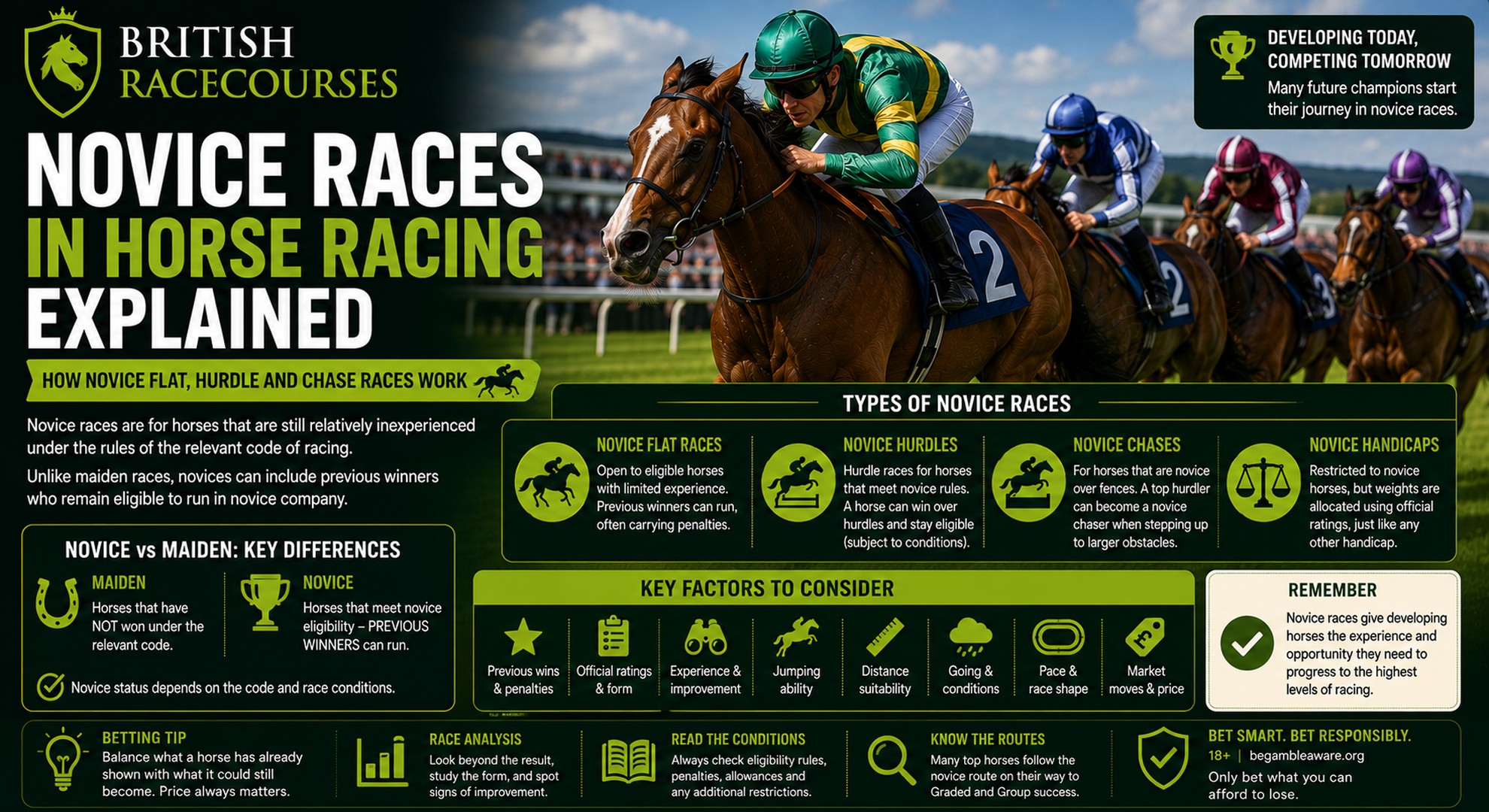
Novice races are horse races designed for horses that remain relatively inexperienced under the rules governing a particular type of racing.
They are an important part of British racing because they allow developing horses to progress without immediately having to compete exclusively against seasoned performers.
Novice races take place on the Flat and over jumps, but the meaning of “novice” is not identical across every code.
A Flat novice race can include eligible horses that have already won races.
A novice hurdler can win over hurdles and remain eligible for novice company during the relevant period.
The same principle applies to novice chasers.
This is one of the biggest differences between novice and maiden racing.
A maiden is defined primarily by not having won under the relevant code. A novice can already be a winner.
Understanding that distinction makes novice races much easier to interpret.
What Is a Novice Race in Horse Racing?
A novice race is a contest restricted according to novice eligibility rules.
The exact rules depend on whether the race is:
- on the Flat
- over hurdles
- over fences.
The word “novice” can therefore be misleading if it is interpreted simply as meaning a horse that has never won.
Some novices are already winners.
Some are highly talented horses progressing towards championship races.
Others remain inexperienced and are still learning their job.
The important question is not simply:
Has this horse won before?
It is:
Does this horse still qualify as a novice under the conditions of this race?
What Is a Novice Horse?
A novice is a horse that remains eligible to compete in novice company under the rules governing its particular racing discipline.
Novice status is particularly important in National Hunt racing.
A horse can be:
- a novice hurdler
- a novice chaser.
These are separate categories.
A horse with extensive hurdle experience can become a novice chaser when it begins racing over fences.
Likewise, an experienced Flat horse can begin a jumping career as a novice hurdler.
This means “novice” describes experience within a particular discipline rather than necessarily describing the horse’s entire racing career.
Can a Novice Horse Have Already Won?
Yes.
This is one of the most important points to understand.
A horse does not necessarily stop being a novice immediately after winning its first race.
That distinguishes novice races from conventional maiden races.
A novice hurdler can win a hurdle and continue competing in eligible novice hurdles, often carrying a penalty in subsequent races.
A novice chaser can similarly win over fences and continue in novice chase company while it remains eligible.
Flat novice races also allow eligible previous winners according to the specific Flat novice rules and individual race conditions.
So:
maiden does not mean novice
and:
novice does not mean non-winner.
Novice Races vs Maiden Races
The distinction between a maiden race and a novice race is fundamental.
A maiden race is centred on horses that have not won under the relevant racing code.
Novice races can include previous winners.
Consider three horses:
| Horse | Previous Record | Maiden? | Could Be Novice? |
|---|---|---|---|
| Horse A | 0 wins | Yes | Yes |
| Horse B | 1 qualifying win | No | Potentially |
| Horse C | Multiple established wins | No | Depends on code and conditions |
Horse B demonstrates the important difference.
After winning a maiden, it is no longer a maiden under that code.
But it may remain eligible for novice races.
That gives trainers a progression route for developing horses.
Why Do Novice Races Exist?
Novice races help horses develop.
A horse does not become an experienced professional simply because it has won once.
It may still need to learn:
- how to settle
- how to race efficiently
- how to handle different tracks
- how to cope with larger fields
- how to jump at racing speed
- how to respond under pressure.
This is especially important over jumps.
A novice chaser may have raced dozens of times over hurdles while still having very little experience jumping fences competitively.
Novice races allow horses at a similar developmental stage to compete against each other.
Novice Flat Races
Flat novice races form part of Britain’s developmental racing programme.
They provide opportunities for maidens and eligible previous winners.
The Flat definition is more specific than simply saying that the horse is inexperienced.
Eligibility can depend on factors including:
- number of previous wins
- class of those victories
- number of completed runs
- age
- timing within the season
- individual race conditions.
This makes reading the actual race conditions essential.
Can Winners Run in Flat Novice Races?
Yes.
Eligible winners can compete in Flat novice races.
This is one of their main differences from conventional maiden races.
A promising horse might:
- make its debut in a maiden or novice
- win
- remain eligible for another novice
- carry a penalty
- progress into handicap, Listed or Pattern company.
The novice system therefore gives trainers options when developing promising horses.
How Many Races Can a Flat Novice Have Won?
The general Flat novice definition allows horses within specified winning restrictions rather than requiring every runner to be a maiden.
However, eligibility is not determined purely by counting victories.
The class of previous wins and the horse’s number of completed starts can also matter.
For two-year-olds, the rules were changed from the 2025 Flat turf season.
From 1 July, a two-year-old that has won and completed three or more runs is no longer treated as a novice under the revised definition.
The practical lesson for racegoers and bettors is simple:
Do not try to determine Flat novice eligibility from the horse’s number of wins alone.
Read the race conditions.
Restricted Novice Races
Some Flat novice races have additional restrictions.
These can relate to the horse’s sales history or other qualification criteria.
Restricted races form part of the developmental programme and can be divided into different bands.
These races aim to provide suitable opportunities for horses that meet specified conditions rather than simply allowing every novice horse to compete.
A racecard may therefore describe a contest as a:
Restricted Novice Stakes
rather than simply a:
Novice Stakes.
The word “restricted” matters.
Open Novice Races
Open novice races have broader eligibility than restricted novice races, although normal novice rules and the individual conditions still apply.
This can result in stronger competition.
A well-bred newcomer could meet:
- a maiden with promising form
- a previous novice winner carrying a penalty
- a lightly raced horse from a leading stable
- a runner already displaying Listed-race potential.
The difference in experience can be considerable.
What Is a Novice Stakes?
Novice Stakes is a common title for a Flat novice race.
These races can include:
- unraced horses
- maidens
- eligible previous winners.
The exact conditions determine:
- who can enter
- basic weights
- penalties
- allowances
- additional restrictions.
Never assume that every Novice Stakes operates under identical terms.
Penalties in Flat Novice Races
Previous winners can be required to carry additional weight.
This is known as a penalty.
Suppose the standard weight is:
9st 4lb
and a previous winner carries a:
7lb penalty.
That horse would carry:
9st 11lb.
The penalty compensates to some extent for the horse’s previous success.
But it does not automatically make the horse badly treated.
A talented previous winner may still have considerably more ability than its rivals.
Is a Novice Winner With a Penalty a Bad Bet?
Not necessarily.
The penalty must be compared with the horse’s ability.
Imagine:
Horse A: previous winner, carries 9st 11lb
Horse B: maiden, carries 9st 4lb
Horse A concedes 7lb.
But suppose Horse A has already produced form suggesting it is 12lb superior.
The penalty may not be enough to eliminate its underlying advantage.
This is similar to analysing penalties in Conditions races.
The important question is:
How much ability is the horse conceding relative to how much additional weight it carries?
What Is a Novice Hurdle?
A novice hurdle is a hurdle race for horses that meet novice hurdle eligibility.
These races are a major part of National Hunt racing.
Some runners may be completely inexperienced over hurdles.
Others may already have:
- several hurdle starts
- a hurdle victory
- strong Flat form
- National Hunt Flat experience
- point-to-point experience.
That makes novice hurdles far more varied than the word “novice” might suggest.
Can a Novice Hurdler Have Won a Hurdle?
Yes.
A horse can win over hurdles and continue racing in eligible novice hurdle company during the period in which it retains novice status.
After winning, it may have to carry penalties in certain novice races.
This allows talented young hurdlers to progress through the novice programme before moving into open company.
What Is a Novice Chaser?
A novice chaser is a horse that remains a novice over fences according to the relevant rules.
This does not mean it is an inexperienced racehorse.
A novice chaser could previously have:
- raced on the Flat
- won National Hunt Flat races
- won several hurdles
- competed at a high level over hurdles.
What makes it a novice is its status over fences.
This distinction is crucial.
A Grade 1-winning hurdler moving to fences can be a novice chaser despite already being a highly accomplished racehorse.
Why Do Hurdlers Become Novice Chasers?
Many National Hunt horses develop through a progression such as:
National Hunt Flat → Hurdles → Fences
Not every horse follows that exact route, but it is common.
Hurdles introduce horses to jumping at racing speed.
Fences are larger and generally place greater demands on jumping technique.
A talented hurdler may therefore spend a season in novice chase company while learning to race over fences.
Some then develop into leading open chasers.
Novice Hurdler vs Novice Chaser
The difference relates to the type of obstacle.
A novice hurdler is developing or competing within the novice hurdle division.
A novice chaser is doing the same over steeplechase fences.
Fences are generally larger and more demanding than hurdles.
The transition from hurdles to fences can change a horse’s performance dramatically.
Some horses improve.
Others struggle.
A horse’s hurdle rating therefore provides useful information but does not guarantee that it will reach the same level over fences.
Jumping Technique Matters
Jumping is a major analytical factor in novice races.
An inexperienced jumper can lose significant ground through:
- jumping too high
- getting too close to an obstacle
- standing too far off
- drifting across a fence
- losing momentum on landing
- making an outright mistake.
A horse can have the strongest engine in the race and still lose because it jumps inefficiently.
This is especially important in novice chases.
What Is a Beginners’ Chase?
A Beginners’ Chase is another race type encountered in jump racing.
It should not simply be treated as another name for every novice chase.
The eligibility conditions are different and should be checked for the particular contest.
Broadly, Beginners’ Chases provide opportunities for horses that have not previously won over fences under the relevant conditions.
That makes them more closely connected to non-winner status than the wider novice chase category.
A novice chaser can already have won over fences.
A horse in a Beginners’ Chase generally faces more restrictive previous-winning conditions.
Novice Races vs Beginners’ Chases
The distinction can be simplified as follows:
Novice chase: based on novice eligibility.
Beginners’ Chase: based more specifically on the conditions restricting previous chase winners.
This matters when analysing fields.
A novice chase may contain proven chase winners carrying penalties.
A Beginners’ Chase can provide a different type of contest where runners are trying to establish themselves over fences.
Always check the exact conditions rather than relying on the race title alone.
Novice Races vs Handicaps
A normal novice race and a handicap work differently.
In a horse racing handicap, Official Ratings are used to allocate different weights with the aim of making horses of differing abilities more competitive.
In a weight-for-age novice race, the weights are determined through the race conditions, including relevant penalties and allowances.
This can create situations where one horse appears significantly better treated on established ratings.
What Is a Novice Handicap?
A novice handicap combines novice eligibility with handicap weighting.
The race is restricted to eligible novice horses, but the weights are determined through handicap ratings.
This creates a different challenge from a conventional weight-for-age novice race.
You need to assess:
- Official Rating
- current ability
- improvement
- jumping
- experience
- suitability
- whether the handicap mark is fair.
An improving novice can be particularly interesting if its current ability has moved ahead of its published rating.
Our guide to how racehorse handicap ratings work explains the rating system in more detail.
Why Novice Handicaps Can Be Difficult
Novices can improve quickly.
Handicap ratings are based on evidence from previous performances.
But developing horses do not remain static.
Suppose a novice is rated:
120
after three hurdle runs.
The handicapper is saying its demonstrated level is around that mark.
But the horse could already have improved to the equivalent of:
128
by its next start.
That creates the possibility that its handicap mark understates its current ability.
The same problem occurs with improving Flat horses.
Graded Novice Races
Novice racing is not restricted to ordinary developmental contests.
Some of Britain’s highest-quality jump races are Grade 1 and Grade 2 novice events.
These races bring together the best developing hurdlers and chasers.
The term “novice” therefore does not mean:
low quality.
A Grade 1 novice can be one of the most talented horses in training.
The novice label simply reflects its status within that particular discipline.
Grade 1 Novice Hurdles
The best novice hurdlers can progress into major Grade 1 races.
These contests test whether promising horses can reproduce their ability against the strongest members of their generation or novice division.
British racing has a range of major Grade 1 jump races involving novice hurdlers and novice chasers.
These races can produce future Champion Hurdle, Champion Chase, Stayers’ Hurdle and Gold Cup contenders.
Grade 1 Novice Chases
Top novice chasers can progress into Grade 1 company during their first major season over fences.
At this level, jumping becomes even more important.
The horses are talented, but many remain relatively inexperienced over fences.
One mistake can decide the race.
A horse that jumps accurately and efficiently can therefore outperform a rival with a slightly higher hurdle rating but less natural chasing ability.
Minimum Ratings for Major Novice Hurdles
British racing continues to refine the developmental programme.
For 2026, horses must have achieved the required minimum level to be eligible for Grade 1 Novices’ and Juvenile Hurdles.
A horse must be allocated a minimum rating of 110, either through a published handicap mark or by being assessed by the BHA handicapper as having performed to that level in at least one hurdle start.
The purpose is to ensure that horses competing in the highest-level novice hurdle races have demonstrated an appropriate level of ability and gained relevant experience.
Why Novice Races Matter to British Racing
Novice and maiden races are central to developing future racehorses.
They give trainers a structured route through which horses can:
- gain experience
- learn their discipline
- progress in class
- establish ratings
- prepare for handicaps
- develop towards Listed, Group or Graded races.
The BHA continues to treat novice and maiden races as an important part of the developmental programme.
For 2026, additional prize money has been directed towards developmental racing on both the Flat and over jumps.
That reflects the role these races play in producing future high-class horses.
How to Read a Novice Racecard
Start with the race title.
Look for words such as:
- Novice Stakes
- Restricted Novice Stakes
- Novices’ Hurdle
- Novices’ Chase
- Novice Handicap.
Then read the full race conditions.
Our guide to how to read racecards explains the wider information available.
For novice races, pay particular attention to:
- previous wins
- penalties
- allowances
- Official Ratings
- number of starts
- age
- previous racing code
- distance
- going
- equipment
- days since last run.
You need to understand both the horse’s ability and its level of experience.
Separate Experience From Ability
One of the most useful novice-racing principles is:
experience and ability are not the same thing.
Horse A might have:
- six hurdle starts
- two hurdle wins
- OR 130.
Horse B might have:
- one hurdle start
- one win
- no established rating.
Horse A has more evidence and experience.
Horse B may have more potential.
The difficulty is estimating how much improvement remains hidden.
Previous Flat Form
Flat form can be highly relevant when analysing novice hurdlers.
A horse rated 95 on the Flat clearly possesses significant basic speed and ability.
But hurdling introduces new requirements.
It must:
- jump efficiently
- settle over a longer distance
- cope with softer ground
- maintain rhythm
- handle obstacles under pressure.
A high Flat rating therefore increases interest but does not automatically translate into high-class hurdle form.
National Hunt Flat Form
National Hunt Flat races, commonly called bumpers, provide another route into novice hurdling.
These races contain no obstacles but are designed around horses bred or developed for National Hunt racing.
A strong bumper performer may have:
- stamina
- physical size
- National Hunt pedigree
- experience of racing over longer distances.
The unanswered question is jumping.
A talented bumper horse still needs to demonstrate that it can hurdle effectively.
Point-to-Point Form
Point-to-point racing can be particularly relevant when assessing novice chasers and hurdlers.
A horse with point-to-point experience may already have jumped fences in competitive conditions before appearing under Rules.
This can give it valuable experience.
However, the quality of point-to-point form varies.
Consider:
- strength of opposition
- race conditions
- jumping
- finishing effort
- subsequent form.
Do not simply assume that point-to-point experience guarantees superior jumping.
Previous Hurdle Form for Novice Chasers
Hurdle ratings provide an important starting point when horses move over fences.
Suppose:
Horse A: hurdle OR 150
Horse B: hurdle OR 135
Horse A has demonstrated considerably more ability over hurdles.
But chasing can alter the relationship.
Horse B might:
- jump fences more naturally
- improve for the larger obstacles
- be physically better suited to chasing.
Horse A might:
- lose ground at fences
- lack confidence
- make repeated mistakes.
The best hurdler is not automatically the best chaser.
Look for a Chaser’s Build
Physical characteristics can matter.
Some horses appear particularly suited to fences because they are:
- larger
- athletic
- balanced
- scopey jumpers.
Others are extremely efficient hurdlers but less convincing over fences.
Racecourse evidence remains more important than appearance alone, but the transition to chasing should never be assessed purely from hurdle ratings.
Why Horses Improve Over Fences
Some horses improve considerably when switched from hurdles to fences.
Possible reasons include:
- fences encourage a better jumping rhythm
- the horse respects larger obstacles
- slower tactical tempos suit
- physical build is better suited to chasing
- stamina becomes more important.
This is why novice chase seasons can transform a horse’s reputation.
An ordinary hurdler can become a very good chaser.
Why Good Hurdlers Sometimes Fail Over Fences
The reverse also happens.
A top hurdler may struggle because it:
- jumps too low
- lacks confidence
- loses momentum
- makes mistakes
- does not enjoy larger obstacles.
Ability alone is not enough.
The horse must perform the new discipline effectively.
Experience in Novice Races
Experience deserves particular attention.
Suppose two horses appear similar on ratings.
Horse A has:
five chase starts
Horse B has:
one chase start
Horse A may have an advantage through greater familiarity with:
- jumping at speed
- racing in a field
- adjusting stride
- recovering from mistakes.
But Horse B may improve more quickly because it is less exposed.
This balance between:
experience
and:
potential
is central to novice analysis.
Look for Improvement
Novice horses are often developing rapidly.
Consider this sequence:
| Start | Result |
|---|---|
| Hurdle debut | 6th |
| Second hurdle | 3rd |
| Third hurdle | 1st |
The improvement is obvious.
Now compare a horse with:
| Start | Result |
|---|---|
| 1 | 2nd |
| 2 | 2nd |
| 3 | 3rd |
| 4 | 4th |
| 5 | 3rd |
The second horse has more consistent finishing positions but may have less improvement remaining.
Do not confuse established consistency with future potential.
Look Beyond the Finishing Position
A novice may run much better than its finishing position suggests.
A horse could:
- make a serious jumping error
- lose position
- race too freely
- encounter traffic
- be caught behind a slowing rival
- finish strongly.
That context matters.
Our guide to identifying a horse that ran better than the result explains how to look beyond the bare form figures.
Jumping Errors
Jumping errors deserve careful analysis.
Not every mistake has the same meaning.
A horse that makes one isolated error but otherwise jumps fluently may deserve another chance.
A horse that repeatedly:
- gets too close
- jumps right
- jumps left
- loses ground
- lands awkwardly
has a more significant problem.
Watch for patterns rather than simply recording that the horse “made a mistake”.
Horses That Jump Left or Right
Some jump horses consistently move in one direction over obstacles.
That can make course configuration important.
A horse that repeatedly jumps left may be better suited to a left-handed track.
A horse that jumps right may prefer racing in the opposite direction.
British Racecourses’ individual racecourse guides explain track layouts and characteristics across Britain.
Course suitability can therefore become more important in novice chases than a simple ratings comparison suggests.
Distance Matters
Novices are still revealing their optimum distances.
A horse that performs strongly over two miles may later improve when moved to:
2m4f
or:
3m.
Another may travel strongly before failing to stay.
Look at:
- pedigree
- previous finishing effort
- racing style
- trainer placement
- strength late in races.
A novice’s current race distance should not automatically be assumed to be its ideal trip.
Going Matters
Ground conditions affect novice races significantly.
An inexperienced jumper encountering heavy ground faces a different test from one racing on good ground.
Testing conditions can place greater emphasis on:
- stamina
- jumping rhythm
- balance
- efficiency.
A horse with strong form on good ground may not reproduce the same performance on heavy going.
Conversely, a stamina-focused horse may improve when conditions become more demanding.
Pace in Novice Races
Race shape matters on the Flat and over jumps.
A novice hurdle with no obvious front-runner could become tactical.
A novice chase containing several aggressive horses could produce a strong pace that places jumping under greater pressure.
Our guide to horse racing pace maps explains how to assess likely race shape.
Over jumps, also consider how pace affects jumping.
A horse may jump fluently at a controlled tempo but make mistakes when pressured.
Small-Field Novice Races
High-quality novice races sometimes attract small fields.
Small fields are not automatically easy to analyse.
They can produce tactical races.
A horse may:
- receive an uncontested lead
- be forced to lead unexpectedly
- race without cover
- encounter a sprint finish.
This can favour a horse whose running style suits the scenario rather than simply the one with the highest rating.
Official Ratings
Official Ratings remain extremely useful when comparing novice horses.
Our guide to horse racing handicap ratings explains how these marks work.
Suppose:
| Horse | OR |
|---|---|
| Alpha | 145 |
| Bravo | 137 |
| Charlie | 132 |
Alpha has demonstrated the strongest established level.
But novice racing requires an additional question:
Which horse is most likely to improve?
Charlie may be rated 132 after only two starts.
Alpha may have raced ten times.
The ratings tell you what has already been demonstrated.
They do not tell you exactly what will happen next.
Ratings vs Potential
Potential is one of the most heavily discussed concepts in novice racing.
A horse winning easily on its first two starts might receive a rating of 135.
Another horse might already be rated 145 after six races.
Which is better?
The published evidence says the 145-rated horse.
But the 135-rated horse may still have substantial improvement available.
This uncertainty is why novice races can be particularly interesting.
Trainer Placement
Trainer behaviour can provide useful context.
A horse progressing from:
maiden hurdle → ordinary novice hurdle → Grade 2 novice
is being asked increasingly difficult questions.
A rapid jump in class can indicate that connections believe the horse has significant ability.
But trainer confidence is not proof.
Assess whether the horse’s actual performance supports the placement.
Novice Races as Stepping Stones
Many novice races are designed as progression opportunities.
A talented horse might follow a route such as:
Maiden Hurdle → Novice Hurdle → Graded Novice Hurdle → Grade 1 Novice Hurdle
or:
Beginners’ Chase → Novice Chase → Graded Novice Chase → Grade 1 Novice Chase
These routes help connections develop horses gradually.
The best novices can then progress into open championship company in later seasons.
How to Analyse a Novice Race
A structured approach helps separate the important information.
Step 1: Identify the Race Type
Is it:
- Flat novice
- restricted Flat novice
- novice hurdle
- novice chase
- novice handicap?
The analytical approach changes depending on the answer.
Step 2: Read the Conditions
Identify:
- eligibility
- penalties
- allowances
- age restrictions
- sex restrictions
- previous-win restrictions.
Step 3: Assess Established Ability
Compare:
- Official Ratings
- Racing Post-style performance figures where you use them
- quality of previous races
- finishing margins.
Step 4: Assess Experience
How many starts has each horse had in this discipline?
Step 5: Assess Improvement
Which horses are still progressing?
Which look exposed?
Step 6: Assess Suitability
Consider:
- distance
- going
- course
- pace
- draw on the Flat.
Step 7: Assess Jumping
For hurdle and chase races, analyse:
- accuracy
- speed
- confidence
- repeated tendencies.
Step 8: Assess the Price
Finally, decide whether the available odds compensate for the uncertainty.
Our broader guide to analysing a horse race covers the full process.
Betting on Novice Races
Novice races can contain more uncertainty than races involving established horses.
That does not make them automatically good or bad betting races.
The key is recognising how much you actually know.
A six-runner novice chase containing horses with four or five previous chase starts provides more evidence than a 12-runner Flat novice containing seven newcomers.
Your confidence should reflect that difference.
Short-Priced Novice Favourites
Promising novices can start at very short odds.
This often happens when one runner has:
- much stronger ratings
- an impressive previous victory
- high-profile connections
- strong market support.
But the most likely winner is not automatically a good bet.
If you believe a horse has a:
70% chance of winning
its theoretical fair decimal price is approximately:
1.43
If bookmakers offer:
1.20
you may consider it too short.
If they offer:
1.70
the same assessment creates a different value proposition.
Penalty Carriers
Previous winners carrying penalties deserve careful attention in Flat novice races.
Do not automatically oppose them because of the additional weight.
Ask:
Is the penalty larger or smaller than the horse’s apparent ability advantage?
A progressive winner may comfortably overcome a penalty if its rivals have shown considerably less ability.
The market often recognises this, which means price remains critical.
Betting on Novice Chases
Novice chases introduce a specific source of uncertainty:
fences.
When assessing a novice chaser, consider:
- previous chase experience
- jumping accuracy
- hurdle ability
- point-to-point experience
- physical suitability
- distance
- ground
- pace.
A horse making its chase debut may have the highest hurdle rating but still face a major question over jumping.
Betting on Novice Hurdles
For novice hurdles, consider:
- previous hurdle form
- Flat or bumper ability
- jumping
- improvement
- penalties
- stamina
- race strength.
Horses switching from the Flat can sometimes be overbet because of a high Flat rating.
They still need to demonstrate that their ability transfers to hurdles.
Market Moves
Novice markets can move significantly, particularly when lightly raced horses are involved.
A strong move can indicate changing market expectations.
But it should not be interpreted as certainty.
Our best backed horses today coverage tracks the broader market-movers concept, while our guides to betting odds shortening and betting odds drifting explain why prices move.
Always ask whether the new price still represents value.
Finding Value in Novice Races
Potential value can arise when the market:
- underestimates improvement
- overreacts to one jumping mistake
- overrates a previous win
- underestimates a penalty
- overvalues famous connections
- fails to account for race shape
- misjudges the effect of distance or ground.
The objective is not to find a clever angle for its own sake.
It is to estimate the horse’s winning chance more accurately than the available price implies.
Our guide to finding value bets explains this principle in detail.
Compare Prices
If you decide a novice represents a bet, compare the available odds.
A horse available at:
5/1
with one bookmaker and:
6/1
with another has exactly the same chance of winning regardless of where the bet is placed.
The higher price provides the greater potential return.
British Racecourses compares operators in our horse racing betting sites section.
Our bet365 Horse Racing page covers bet365’s racing service where you want to compare its horse racing markets and features.
Common Novice Race Mistakes
Assuming Novice Means Maiden
Novices can already be winners.
Assuming Novice Means Low Quality
Some novice races are Grade 1 contests featuring future champions.
Ignoring Penalties
Previous victories can affect the weight carried.
Automatically Opposing Penalty Carriers
A talented horse may still be well treated despite additional weight.
Assuming the Best Hurdler Will Be the Best Chaser
Jumping fences is a different test.
Ignoring Experience
A horse’s number of starts within the relevant discipline matters.
Ignoring Improvement
Novices can progress rapidly.
Looking Only at Ratings
Ratings describe demonstrated ability, not necessarily future potential.
Ignoring Jumping Technique
Small jumping errors can become decisive over hurdles and fences.
Ignoring Race Conditions
Novice eligibility and weights can be more complicated than the race title suggests.
Treating Market Support as Proof
Supported horses can still be poor value.
Novice Race Analysis Checklist
Before analysing a novice race, ask:
Race Type
- Flat novice?
- Restricted novice?
- Novice hurdle?
- Novice chase?
- Novice handicap?
Eligibility
- Why does each horse qualify?
- Has it won before?
- Does it carry a penalty?
- Does it receive an allowance?
Ability
- What are the Official Ratings?
- How strong is the previous form?
- Which horse has faced the strongest opposition?
Experience
- How many starts has each horse had?
- How experienced is it in this discipline?
Improvement
- Which horses are progressing?
- Which are exposed?
- Is a rating likely to underestimate current ability?
Jumping
- Is the horse accurate?
- Does it lose ground?
- Does it jump left or right?
- Is it moving from hurdles to fences?
Suitability
- Does the distance suit?
- Does the going suit?
- Does the course suit?
- What is the likely pace?
- Does the draw matter on the Flat?
Market
- What chance do you give the horse?
- What chance does the available price imply?
- Has the horse shortened or drifted?
- Is a better price available elsewhere?
This provides a more complete assessment than simply backing the runner with the highest rating.
Frequently Asked Questions
What is a novice race in horse racing?
A novice race is a race restricted to horses that meet the relevant novice eligibility rules. Novice races take place on the Flat and over jumps.
Is a novice horse the same as a maiden?
No. A maiden has not won under the relevant code, while an eligible novice may already have won.
Can a novice horse have won a race?
Yes. Previous winners can remain eligible for novice races depending on the racing code and individual race conditions.
What is a novice hurdle?
A novice hurdle is a hurdle race for horses meeting novice hurdle eligibility. Previous hurdle winners can remain eligible for novice company during the relevant period.
What is a novice chase?
A novice chase is a steeplechase for eligible novice chasers. A horse can be highly experienced over hurdles while still being a novice over fences.
Can a novice chaser have won over hurdles?
Yes. Hurdle victories do not prevent a horse from becoming a novice chaser.
Can a novice hurdler have won on the Flat?
Yes. A horse can have significant Flat experience and still begin its jumping career as a novice hurdler.
Can a novice win more than once?
Yes. Novice status does not necessarily disappear after the horse’s first victory.
Do novice winners carry penalties?
Previous winners can carry penalties in many novice races according to the specific race conditions.
What is a Novice Stakes?
A Novice Stakes is a Flat novice race for horses that meet the relevant eligibility conditions. It can contain maidens and eligible previous winners.
What is a Restricted Novice Stakes?
It is a novice race with additional eligibility restrictions, often associated with the structure of the developmental Flat programme.
What is a novice handicap?
A novice handicap is restricted to eligible novice horses, but the weights are determined through handicap ratings.
What is the difference between a novice chase and a Beginners’ Chase?
A novice chase uses novice eligibility, while a Beginners’ Chase has more specific restrictions relating to previous wins over fences. Always check the individual conditions.
Are novice races low quality?
No. Novice races range from ordinary developmental contests to Grade 1 races containing some of the best young hurdlers and chasers in Britain.
Why are novice races important?
They allow developing horses to gain experience and progress through the racing programme before moving into more established open company.
Are novice races difficult to bet on?
They can be because horses are developing and their true ability may not yet be established. Jumping experience adds further uncertainty in novice hurdles and chases.
Should I back the highest-rated novice?
Not automatically. Ratings are useful, but improvement, experience, jumping, distance, going, pace and price also matter.
Why do horses improve when they go chasing?
Some horses are physically and technically better suited to larger fences than hurdles. The different race tempo and emphasis on stamina can also suit them.
Can a good hurdler be a poor chaser?
Yes. A horse can have significant hurdle ability but fail to reproduce it over fences because its jumping technique or confidence is unsuitable.
What should I look for in a novice race?
Focus on established ability, experience, improvement, penalties, jumping, distance, going, course, pace and price.
Summary
Novice races are an essential part of the British racing programme.
The most important point is:
A novice is not necessarily a maiden.
Novice horses can already be winners.
On the Flat, novice eligibility depends on the relevant rules and individual race conditions.
Over jumps, novice status is linked to the horse’s experience and winning history within hurdles or steeplechases.
That means an experienced Flat horse can become a novice hurdler.
A top-class hurdler can become a novice chaser.
And a novice can win before continuing to compete in novice company.
This structure gives developing horses a pathway through the sport.
Typical progressions can include:
Maiden → Novice → Handicap or higher-class company
or:
Bumper → Novice Hurdle → Graded Hurdle → Novice Chase → Open Chase
When analysing novice races, concentrate on:
- race conditions
- previous wins
- penalties
- Official Ratings
- experience
- improvement
- jumping
- distance
- going
- course
- pace
- market price.
The challenge is balancing what a horse has already demonstrated against what it may still become.
For readers learning the structure of British racing, start with our Horse Racing Types page before exploring Maiden Races, Conditions Races, Nursery Handicaps and our wider National Hunt racing guide.
If you bet on novice races, remember that developing horses create additional uncertainty. Ratings, trainer records, jumping form and market moves can all be useful, but none guarantees the result. Only bet what you can afford to lose.