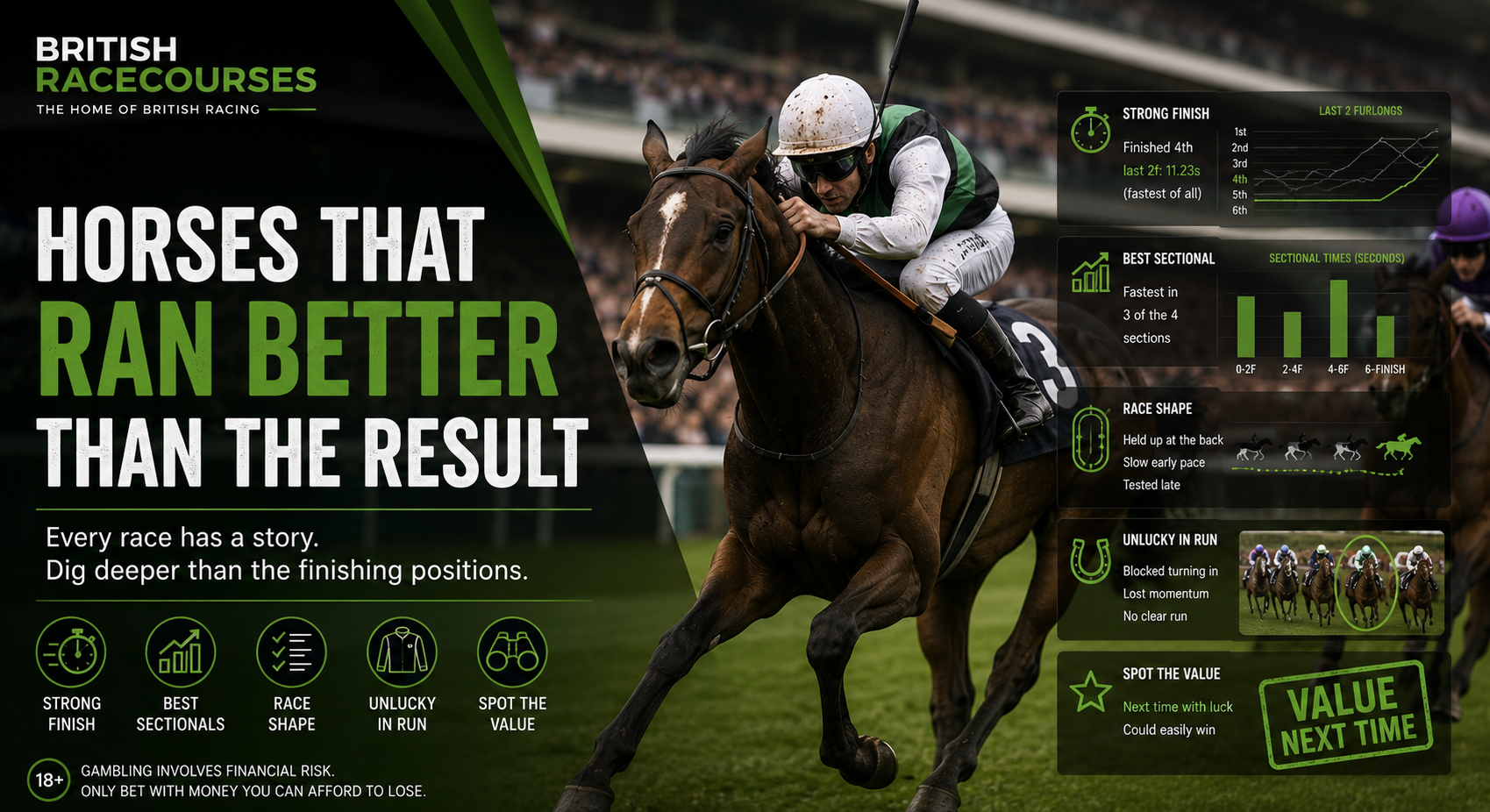
A horse’s finishing position tells you where it finished.
It does not always tell you how well it ran.
A horse finishing sixth may have produced a much better performance than a horse finishing second.
That sounds contradictory until you consider how a race actually unfolds.
One horse might:
- enjoy the perfect pace
- save ground throughout
- find clear running room
- race on the best part of the track
- encounter no interference
Another might:
- be trapped wide
- race against the pace
- get blocked at a crucial moment
- lose momentum
- switch around horses
- finish strongly when the race is effectively over
The result might show:
2nd versus 6th.
The underlying performances can tell a very different story.
Learning to identify these horses is one of the most useful skills in form analysis because today’s apparently disappointing run can become tomorrow’s hidden form.
The challenge is separating horses that were genuinely unlucky from horses for which punters are simply making excuses.
What Does “Ran Better Than the Result” Mean?
A horse has run better than the result when its finishing position understates the quality of its actual performance.
Imagine a horse finishes:
7th of 12.
On paper, that looks ordinary.
Now watch the race.
The horse:
was held up last
travelled strongly
became trapped behind weakening horses
had to switch wide
and:
finished fastest over the final two furlongs.
The seventh-place finish remains a fact.
But it does not completely describe the performance.
That horse may deserve to be upgraded when assessing its next race.
Why Finishing Positions Can Be Misleading
Horse racing is not a time trial.
Horses do not run independently around an empty racecourse.
They race against other horses.
That creates:
- tactical positioning
- traffic
- pace pressure
- interference
- changing ground
- racing lines
- jockey decisions
Two horses covering the same distance can therefore experience very different races.
This is why serious form analysis needs to go beyond the numbers printed beside a horse’s name.
Our How to Read Horse Racing Form Like a Pro guide explains how to interpret form in its wider context.
The Difference Between Result and Performance
Consider two horses.
Horse A
Finished:
2nd
It:
- broke well
- sat behind the leader
- travelled comfortably
- found a clear gap
- challenged at the ideal moment
Horse B
Finished:
5th
It:
- broke slowly
- raced three wide
- was caught behind a weakening rival
- switched outside
- finished strongly
Which horse ran better?
You cannot answer from finishing position alone.
Horse A might still have produced the superior performance.
But Horse B may have achieved considerably more than its fifth place suggests.
That is the distinction we are trying to uncover.
Start With the Race Replay
The race replay is one of the most valuable tools available to a form analyst.
Racecards tell you:
what happened.
Video can help explain:
how it happened.
When reviewing a previous run, watch the horse from the start rather than concentrating only on the final furlong.
Look at:
- the break
- early position
- pace
- racing line
- traffic
- jockey actions
- when the horse was asked to accelerate
- whether momentum was interrupted
- finishing effort
One dramatic moment should not dominate your analysis.
Assess the entire trip.
Watch the Race More Than Once
A useful replay process is:
First viewing
Watch the race normally.
Understand the overall shape.
Second viewing
Watch only your horse.
Ignore the winner.
Track your horse from start to finish.
Third viewing
Look at the horses around it.
Ask:
- Was it travelling better than nearby runners?
- Did another horse cause the problem?
- Did the jockey have alternatives?
- Was the horse already weakening before trouble occurred?
Fourth viewing
Compare the final stages.
Look at how your horse finished relative to rivals.
This reduces the temptation to notice only the incident that supports your existing opinion.
Trouble in Running
Traffic is one of the most obvious reasons a horse can run better than its finishing position.
Imagine a horse travelling strongly two furlongs from home.
The jockey begins looking for a gap.
None appears.
The horse is checked.
A gap eventually opens.
The horse accelerates again but the leaders have gone.
The form book might simply show:
6th.
The replay can reveal much more.
Not Every Blocked Horse Is Unlucky
This is important.
A horse may become blocked because it lacks the speed to take an earlier gap.
Another might have been weakening before encountering traffic.
Another might find trouble because its hold-up style repeatedly leaves it dependent on gaps appearing.
Do not automatically upgrade every horse described as:
not clear run.
Ask whether the incident genuinely cost:
- momentum
- distance
- position
- finishing opportunity
Loss of Momentum
Interference becomes particularly important when a horse has already accelerated.
A horse moving at racing speed cannot instantly:
slow down → change direction → accelerate again
without using energy.
A horse that regains momentum and still finishes strongly may deserve more credit than its finishing position indicates.
Racing Wide
Distance matters.
A horse racing around the outside of rivals on bends covers additional ground.
This can be particularly significant on tighter racecourses.
Imagine:
Horse A saves ground against the rail.
Horse B races three horses wide around two bends.
Both finish close together.
Horse B may have produced the stronger underlying performance.
But context remains essential.
Wide Is Not Always Bad
The outside may sometimes be advantageous because:
- the inside ground is slower
- traffic is avoided
- the pace develops outside
- the horse races more comfortably with space
Do not use:
raced wide
as an automatic upgrade.
Determine whether it actually created a disadvantage.
Poor Starts
A slow start can completely alter a race.
This is particularly important over shorter distances.
Suppose a horse normally races prominently.
Today it breaks slowly.
Instead of sitting:
second or third
it finds itself:
last.
The horse is now running a completely different race from the one that suits it.
If it still finishes close, the performance may deserve upgrading.
Calculate What the Horse Had to Overcome
Ask:
How much ground did it lose?
How quickly did it recover position?
Did recovering position use too much energy?
Was the race already tactically lost?
A slightly slow start over two miles may matter less than a severe break disadvantage over five furlongs.
Pace Disadvantage
Pace is one of the biggest reasons finishing positions can mislead.
Our Horse Racing Pace Maps guide explains how to predict likely race shape before a race.
The same principles can be applied retrospectively.
Ask:
Who benefited from the way the race was run?
Held Up in a Slowly Run Race
Suppose a race is run slowly early.
The leaders conserve energy.
The field turns for home.
The leaders accelerate.
A horse held up at the rear now has to:
make up several lengths
while:
running faster than horses that have conserved energy.
That can be extremely difficult.
If the hold-up horse finishes strongly into fifth, the finishing position may underestimate the performance.
Leading in an Unsustainably Fast Race
The opposite can happen.
Suppose several horses fight for the lead.
The opening sections are extremely fast.
The leaders use too much energy.
Closers arrive late.
A front runner finishes:
sixth.
That might look disappointing.
But if every other horse involved in the early pace finishes:
10th, 11th and 12th
the sixth-place finisher may have performed exceptionally well relative to the pace pressure.
This is where Horse Racing Pace Bias becomes useful.
Compare the Horse With Others That Raced Similarly
This is one of the best ways to judge hidden performance.
Suppose four horses race prominently.
They finish:
6th
10th
11th
12th
The sixth-place horse may deserve an upgrade.
Likewise, if almost every hold-up horse finishes strongly, your apparently unlucky closer may simply have benefited from a collapsing pace.
Always compare like with like.
Sectional Times
Sectional times can provide evidence that the eye alone cannot quantify.
Our Horse Racing Sectional Times Explained guide covers this area in depth.
Imagine a horse finishes sixth.
Nothing spectacular.
But its closing sectional is substantially faster than the horses around it.
That can support the argument that the horse had:
more ability left than the finishing position suggests.
Sectionals Need Context
Fast finishing sectionals do not automatically mean:
unlucky horse.
If the early pace was extremely slow, many horses may finish quickly.
Instead ask:
- How fast was the overall race?
- How fast did the horse finish relative to rivals?
- Where was it positioned?
- Did it lose momentum?
- Was the finishing effort sustainable?
Numbers and video work best together.
The Sectional Upgrade Horse
A sectional upgrade horse is broadly a runner whose timed performance suggests it ran better than the headline result or overall time indicates.
Examples include:
- fast-finishing hold-up horses
- runners disadvantaged by a slow pace
- horses forced to accelerate more than once
- runners making sustained wide moves
- front runners surviving aggressive early fractions
These horses can become interesting next time.
But only at the right price.
The Wrong Part of the Track
Racecourses do not always ride evenly.
Ground can be:
- faster near one rail
- slower on the inside
- churned up in certain areas
- affected by previous races
- influenced by drainage or weather
Suppose most winners race towards the stands’ side.
One horse remains isolated on the opposite side yet still finishes close.
That performance may deserve additional credit.
Track Bias Can Change During the Day
Do not assume a bias exists because:
the first race was won near the rail.
Look across the meeting.
Ask:
- Where are winners coming from?
- Where are horses travelling best?
- Where is the pace?
- Are jockeys deliberately changing racing lines?
- Has the weather changed?
Bias analysis requires evidence.
Draw Disadvantage
The Horse Racing Draw can create another hidden disadvantage.
A horse might be:
drawn wide on a tight bend
and forced to either:
race wide
or:
drop further back than ideal.
The bare result does not show that tactical compromise.
Draw and Pace Work Together
A supposedly poor draw may become manageable if the horse can secure a good position.
A supposedly good draw may become useless if the horse misses the break.
Do not analyse stall number in isolation.
Unsuitable Going
A horse can run respectably despite racing on ground that does not suit it.
Suppose a horse has produced its best performances on:
good to firm.
Today it races on:
soft.
It finishes fifth.
That may actually represent a respectable performance.
If it returns to faster ground next time, its chance could improve.
But be careful not to manufacture excuses.
Our guide to Horse Racing Going explains how ground conditions affect racing.
Wrong Distance
Distance can hide ability.
A horse may be racing over:
six furlongs
when its running style increasingly suggests it needs:
seven furlongs.
It gets outpaced before finishing strongly.
The result:
7th.
Next time:
seven furlongs.
Now the previous performance becomes much more interesting.
Horses That Need Further
Common signs include:
- repeatedly staying on late
- struggling when the race quickens
- strongest work after the leaders have gone
- difficulty holding position at shorter trips
None proves the horse needs further.
Pedigree, previous performances and race shape should support the conclusion.
Horses That Need Shorter
The reverse also occurs.
A horse may:
- travel strongly
- move into contention easily
- fail to finish
- repeatedly weaken late
Dropping in distance can allow it to use its speed more effectively.
Again, distinguish:
lack of stamina
from:
lack of fitness or ability.
Stronger Opposition
Finishing sixth in a strong race can represent better form than winning a weak race.
This is why class matters.
Suppose Horse A:
wins a weak Class 5 race.
Horse B:
finishes fifth in a competitive Class 3.
They meet next time in a Class 4.
The headline form figures favour Horse A.
The strength of opposition might favour Horse B.
Follow What Happened Next
Subsequent form can reveal the strength of a previous race.
Ask:
- Did the winner win again?
- Did placed horses improve?
- Did beaten horses win next time?
- Were ratings subsequently increased?
When several horses emerge from one race and perform strongly, the original contest may have been better than it looked.
This is often described as:
the form being franked.
Handicap Marks
Hidden performances become particularly interesting in handicaps.
A horse may run better than its finishing position while avoiding a major rise in its Official Rating.
That can leave it competitively treated next time.
Our How Racehorse Handicap Ratings Work guide explains how marks affect the weight horses carry.
Ahead of the Handicapper
A horse is described as ahead of the handicapper when its current mark appears lower than its actual ability.
Hidden form can contribute to this situation.
For example:
Current mark: 78
The horse finishes fifth.
Its rating remains around:
78.
But deeper analysis suggests it produced a performance closer to an:
82-rated horse.
If correct, it may be better treated than the official number suggests.
That does not guarantee it will win next time.
But it changes the analysis.
The Jockey’s Ride
Jockey decisions influence how races develop.
A horse may:
- challenge too early
- become trapped behind rivals
- be positioned too far back
- race wide
- make an aggressive move
This does not necessarily mean the jockey made a poor decision.
Race riding happens at speed.
Sometimes options disappear instantly.
The important question for form analysis is:
Did the trip allow the horse to show its full ability?
Forced to Challenge Too Early
Suppose a horse moves from the rear around the outside three furlongs from home.
It passes several rivals.
It reaches the leaders.
Then weakens into fourth.
Someone reading only the result might think:
didn’t find much.
But the replay may show the horse made the strongest mid-race move and simply used too much energy too early.
That can be a much better performance than fourth place suggests.
Forced to Challenge Too Late
Another horse may travel strongly but remain trapped until the final furlong.
Once clear, it finishes rapidly.
Again:
the horse lost.
But the underlying performance may contain valuable information.
Weight and Performance
Weight matters particularly in handicaps.
Suppose a horse carries:
9st 12lb
and finishes close behind a rival carrying:
8st 10lb.
The raw finishing positions do not reflect the weight difference.
You should consider the complete handicap context rather than simply saying:
Horse A beat Horse B.
Horses Returning From a Break
A horse returning after a long absence may improve for the run.
Signs of a promising comeback can include:
- travelling well for a long way
- weakening only late
- showing speed before fitness tells
- performing competitively against race-fit rivals
But do not automatically assume every returning horse:
needed the run.
Use trainer patterns, market expectations and previous evidence where available.
Equipment Changes
Headgear can alter performance.
Examples include:
- blinkers
- cheekpieces
- visor
- hood
A horse may respond positively or negatively.
If equipment clearly changes how a horse travels or settles, that information can influence your assessment next time.
Horses That Race Too Keenly
A horse that refuses to settle can waste significant energy.
It may:
- pull against the jockey
- race with its head high
- move too quickly early
- weaken late
The finishing position may understate its ability if excessive early energy use caused the late fade.
But repeated keenness can also be a genuine weakness.
Do not keep forgiving the same behaviour indefinitely.
Horses That Were Never Put Into the Race
This is a difficult area requiring caution.
A horse might appear to:
- remain at the rear
- receive limited pressure
- finish with energy remaining
Do not immediately conclude something suspicious occurred.
There may be legitimate explanations involving:
- race position
- traffic
- inexperience
- pace
- horse welfare
- tactical circumstances
Focus on observable performance rather than speculation.
Inexperienced Horses
Young and lightly raced horses can produce misleading results because they are still learning.
A novice may:
- start slowly
- race green
- wander under pressure
- struggle to negotiate bends
- hesitate between horses
- finish strongly once understanding the task
These performances can be especially interesting because improvement may come quickly.
Look for Improvement Hidden Inside Defeat
Not every upgrade horse needs to be unlucky.
Suppose a lightly raced horse finishes fourth.
Its previous runs were:
10th
8th
7th
Now it finishes:
4th
against stronger opposition while recording better sectionals.
That may represent substantial improvement despite another defeat.
Compare Performance With Market Expectation
Odds provide useful context.
Suppose a horse starts:
50/1
and finishes fourth in a strong race.
That may significantly exceed market expectations.
Another horse starts:
4/5
and finishes third.
The third-place finish looks better numerically.
Relative to expectation, it may be disappointing.
Do not use price as a substitute for analysis, but it can help frame the performance.
Was the Horse Actually Unlucky?
Before upgrading a horse, ask:
Did something genuinely cost it?
Not:
Could I invent a reason for the defeat?
Would a better trip materially change the expected result?
A minor bump ten furlongs from home probably did not cost every beaten horse the race.
Did the horse finish with something left?
Look for evidence.
Does the sectional data support the visual impression?
Ideally, yes.
Was the disadvantage unique?
If every runner suffered the same pace disadvantage, it may not deserve a special upgrade.
The Excuse Horse
Punters frequently become attached to horses that:
look unlucky every time.
Be careful.
A horse that repeatedly gets blocked may:
- need holding up
- lack tactical speed
- require gaps
- be difficult to position
What looks like repeated bad luck may actually be part of the horse’s racing profile.
If the same problem occurs repeatedly, incorporate it into the horse’s probability rather than continually forgiving it.
One Bad Run Can Be Forgiven
Form analysis should not assume every poor run represents a permanent decline.
A horse can underperform because of:
- unsuitable ground
- wrong trip
- pace
- draw
- traffic
- race strength
- tactical position
The question is whether there is a credible explanation.
Several Bad Runs Need More Evidence
Suppose a horse has finished:
9th
10th
8th
11th
You can potentially explain each run.
But at some point, repeated underperformance becomes evidence itself.
Do not allow hidden-form analysis to become:
excuse-making.
Create a Hidden Form Note
When you identify an interesting run, record it.
For example:
Horse: Example Runner
Result: 6th of 12
Upgrade reasons:
- slow start
- held up off slow pace
- blocked 2f out
- switched wide
- fastest closing sectional
Ideal next conditions:
- stronger pace
- 7f rather than 6f
- good ground
Bet only if:
- price remains attractive
This is far more useful than writing:
unlucky last time.
Be Specific About What Needs to Change
A horse should not be upgraded in isolation.
Ask what would make it more interesting next time.
Perhaps it needs:
stronger pace
different distance
better draw
softer ground
faster ground
lower class
more positive ride
That creates a testable hypothesis.
The Next Race Is What Matters
Suppose a horse was unlucky over:
5f at Chester.
Next time it runs:
1m2f at Newmarket.
The previous hidden performance may have limited relevance because the conditions have changed dramatically.
Always connect previous performance to today’s race.
Hidden Form and Value
Finding a horse that ran better than the result is not enough.
The market may have noticed too.
Suppose you identify a horse that finished sixth after severe traffic.
You expect:
10/1.
The horse opens:
4/1.
There may be no value left.
This is where How to Find Value Bets in Horse Racing becomes important.
The objective is not:
find unlucky horses.
It is:
find performances the market may not have fully priced.
Obvious Unlucky Horses Can Be Overbet
Television commentators notice blocked runs.
Race readers notice them.
Bookmakers notice them.
Other punters notice them.
A spectacularly unlucky loser can become extremely popular next time.
The market may overcorrect.
Sometimes the better opportunity is a less obvious horse whose disadvantage requires deeper analysis.
Hidden Form and Market Efficiency
Our Horse Racing Market Efficiency guide explains how information becomes incorporated into prices.
The more obvious the hidden performance, the more likely the market is to notice it.
Your potential advantage is therefore strongest when you:
interpret the performance better than the market
rather than merely:
spot something everyone else saw.
Price the Horse Again
Once you identify an upgrade horse, do not automatically bet it next time.
Reanalyse the new race.
Consider:
- opposition
- pace
- draw
- going
- distance
- weight
- class
- racecourse
- current form
Then create your own assessment.
Our How to Price a Horse Race guide provides a structured process.
A Worked Example
Imagine:
Hidden Star
runs in a 12-runner seven-furlong handicap.
Result:
6th
Beaten:
3 lengths.
That sounds ordinary.
Now analyse the race.
Start
Hidden Star breaks slowly and loses approximately two lengths.
Early race
The pace is moderate.
Hidden Star settles last.
Turn
The leaders remain comfortable.
Two furlongs out
Hidden Star begins travelling strongly but becomes trapped behind two weakening runners.
Final furlong
The jockey switches outside.
Hidden Star accelerates strongly.
Finish
Sixth, beaten three lengths.
Sectionals
Hidden Star records one of the strongest closing sections in the field.
The basic result says:
6th.
Your analysis says:
The horse was disadvantaged by position and traffic in a race where making ground from the rear was difficult.
Now suppose next time:
- pace looks stronger
- distance remains 7f
- going remains suitable
- draw is acceptable
- horse is available at 10/1
That is interesting.
But if the market offers:
5/2
the hidden performance may already be fully recognised.
A Second Worked Example: The False Upgrade
Now consider:
Unlucky Lad
Result:
5th
Replay:
Blocked briefly one furlong out.
Punters describe it as:
unlucky.
Watch again.
Before the gap closed:
- jockey was already pushing
- horse was struggling to quicken
- winner was moving substantially better
- once clear, Unlucky Lad made little progress
The traffic looked dramatic.
But it probably did not cost the horse the race.
This is why replay analysis must remain objective.
Hidden Form Checklist
When reviewing a previous race, ask:
☐ Did the horse start cleanly?
☐ Was it able to obtain its preferred position?
☐ Was the pace suitable?
☐ Did it race wide?
☐ Was it trapped behind other horses?
☐ Did it lose momentum?
☐ Did it have to switch?
☐ Was it forced to challenge earlier than ideal?
☐ Did it finish strongly?
☐ What do the sectional times show?
☐ Was it on the favourable part of the track?
☐ Did the draw create a tactical disadvantage?
☐ Was the going suitable?
☐ Was the distance suitable?
☐ How strong was the opposition?
☐ How much weight did it carry?
☐ Has the form subsequently been franked?
☐ Was the horse inexperienced?
☐ Does it repeatedly encounter the same problem?
☐ What needs to change next time?
☐ Has the market already noticed?
A Simple Upgrade Scale
You can create your own notation.
For example:
No upgrade
Performance matched the result.
Small upgrade
Minor disadvantage that probably cost a little ground.
Medium upgrade
Clear tactical, pace or traffic disadvantage.
Strong upgrade
Multiple significant disadvantages with strong evidence that the horse performed considerably better than the result.
Do not pretend these grades are scientifically precise.
Their purpose is to make your analysis consistent.
Combine Replay Analysis With Data
The strongest hidden-form analysis combines:
video
with:
data.
Video might show:
horse finished strongly.
Sectionals can test that observation.
Video might show:
horse raced wide.
Racecourse geometry and tracking data may help establish the significance.
Video might show:
hold-up horse could not get involved.
Pace analysis can reveal whether the leaders enjoyed a tactical advantage.
Different evidence should support the same conclusion.
Common Hidden Form Mistakes
Upgrading Every Unlucky Horse
Some horses simply were not good enough.
Watching Only the Final Furlong
Problems can begin much earlier.
Ignoring Pace
A strong finish can be misleading without understanding early fractions.
Ignoring the Other Horses
Compare runners that experienced similar positions.
Treating Wide Trips as Automatically Bad
Sometimes the outside is advantageous.
Making Excuses for Favourite Horses
Emotional attachment damages analysis.
Ignoring Repeated Problems
A horse that repeatedly creates its own trouble deserves less forgiveness.
Forgetting the Price
A correct analysis can still produce a poor bet at short odds.
Assuming the Next Race Will Be Different
Identify exactly why conditions should improve.
How This Fits Into Race Analysis
Hidden form sits between:
reading the form book
and:
pricing the next race.
A strong process becomes:
Read the racecard
↓
↓
Watch previous races
↓
Identify hidden performances
↓
Analyse race shape
↓
↓
Check draw and track position
↓
↓
Use timing evidence
↓
↓
Assess the complete race
↓
How to Analyse a Horse Race Like a Professional
↓
Create your probability
↓
↓
Compare with the available odds
↓
That keeps hidden form where it belongs:
as part of a complete analytical process rather than a standalone betting system.
Frequently Asked Questions
What does it mean when a horse ran better than the result?
It means the horse’s finishing position may understate the quality of its actual performance because of factors such as pace, traffic, draw, racing position or unsuitable conditions.
Can a horse finish sixth and run better than the runner-up?
Yes. The sixth-placed horse may have overcome substantially greater disadvantages.
What is hidden form in horse racing?
Hidden form describes performance information that is not immediately obvious from headline finishing positions.
How do I find hidden form?
Watch race replays and combine them with pace, sectional, draw, class and race-condition analysis.
Are unlucky losers good bets next time?
Not automatically. The market may already have recognised the unlucky run.
What is trouble in running?
Trouble in running generally refers to circumstances that prevent a horse from obtaining a clear or efficient passage during a race.
Should I back every horse that was blocked?
No. Determine whether the horse genuinely lost momentum or opportunity.
Why is racing wide a disadvantage?
Racing wide around bends can force a horse to cover additional ground, although the effect varies according to course and conditions.
Is racing wide always bad?
No. Outside ground can sometimes be faster or provide clearer running room.
How does pace create hidden form?
A horse racing against the dominant pace scenario may perform better than its final position suggests.
Why are hold-up horses disadvantaged by slow races?
Leaders conserve energy and can accelerate before the hold-up horse has recovered its positional deficit.
Can front runners be hidden-form horses?
Yes. A front runner that survives an unusually fast pace better than other prominent racers may have produced a strong performance.
What are sectional times?
Sectional times measure portions of a race and can reveal how quickly horses travelled at different stages.
What is a sectional upgrade horse?
It is a horse whose sectional performance suggests it ran better than its overall result or time initially indicates.
Why should I watch race replays?
Replays reveal tactical and positional details that finishing figures cannot show.
Can the draw make a horse look worse than it is?
Yes. Certain draws can force horses into inefficient tactical positions.
Does going matter when analysing hidden form?
Yes. A horse performing respectably on unsuitable ground may improve significantly when returning to preferred conditions.
How can distance hide a horse’s ability?
A horse may be outpaced over an inadequate trip or fail to stay over excessive distance.
Does race class matter?
Yes. A modest finishing position against strong opposition can represent better form than winning a much weaker race.
What does franked form mean?
Form is described as franked when horses from a previous race subsequently perform well, strengthening the perceived quality of that race.
What does ahead of the handicapper mean?
It generally describes a horse whose ability appears greater than its current Official Rating suggests.
Should I forgive one poor run?
Potentially, if there is a credible explanation. Repeated poor runs require increasingly strong evidence.
Why do some horses repeatedly look unlucky?
Their racing style may make them dependent on pace, positioning or gaps appearing. Repeated trouble can become part of the horse’s risk profile.
Can hidden form help find value bets?
Yes, if your interpretation identifies information that has not been fully reflected in the available odds.
What if everyone noticed the unlucky run?
The horse may become overbet next time, removing any potential value.
Should I record horses that catch my eye?
Yes. Record the exact reason for the upgrade and the conditions you want to see next time.
What should I write in a hidden-form note?
Record the race, finishing position, specific disadvantage, supporting evidence, ideal future conditions and the price at which you might become interested.
Summary
A horse’s finishing position tells you:
where it finished.
It does not always tell you:
how well it ran.
The difference can be significant.
A horse can perform better than the result because it:
encountered traffic
raced wide
lost ground at the start
raced against the pace
competed on the wrong part of the track
had an unsuitable draw
ran on unsuitable ground
raced over the wrong distance
or:
faced stronger opposition than the result suggests.
Race replays are therefore essential.
Watch the entire race.
Study:
position
pace
racing line
traffic
momentum
and:
finishing effort.
Then support your visual analysis with:
sectional times
pace maps
draw analysis
ratings
and:
subsequent form.
Most importantly, do not turn hidden-form analysis into excuse-making.
The objective is not to find a reason why every beaten horse should have won.
It is to identify occasions where the recorded result genuinely understates the performance.
Then ask one final question:
Has the betting market noticed too?
Because spotting a horse that ran better than the result is useful.
Spotting one whose next price still underestimates that performance is considerably more valuable.
18+. Gambling involves financial risk. Only bet with money you can afford to lose.