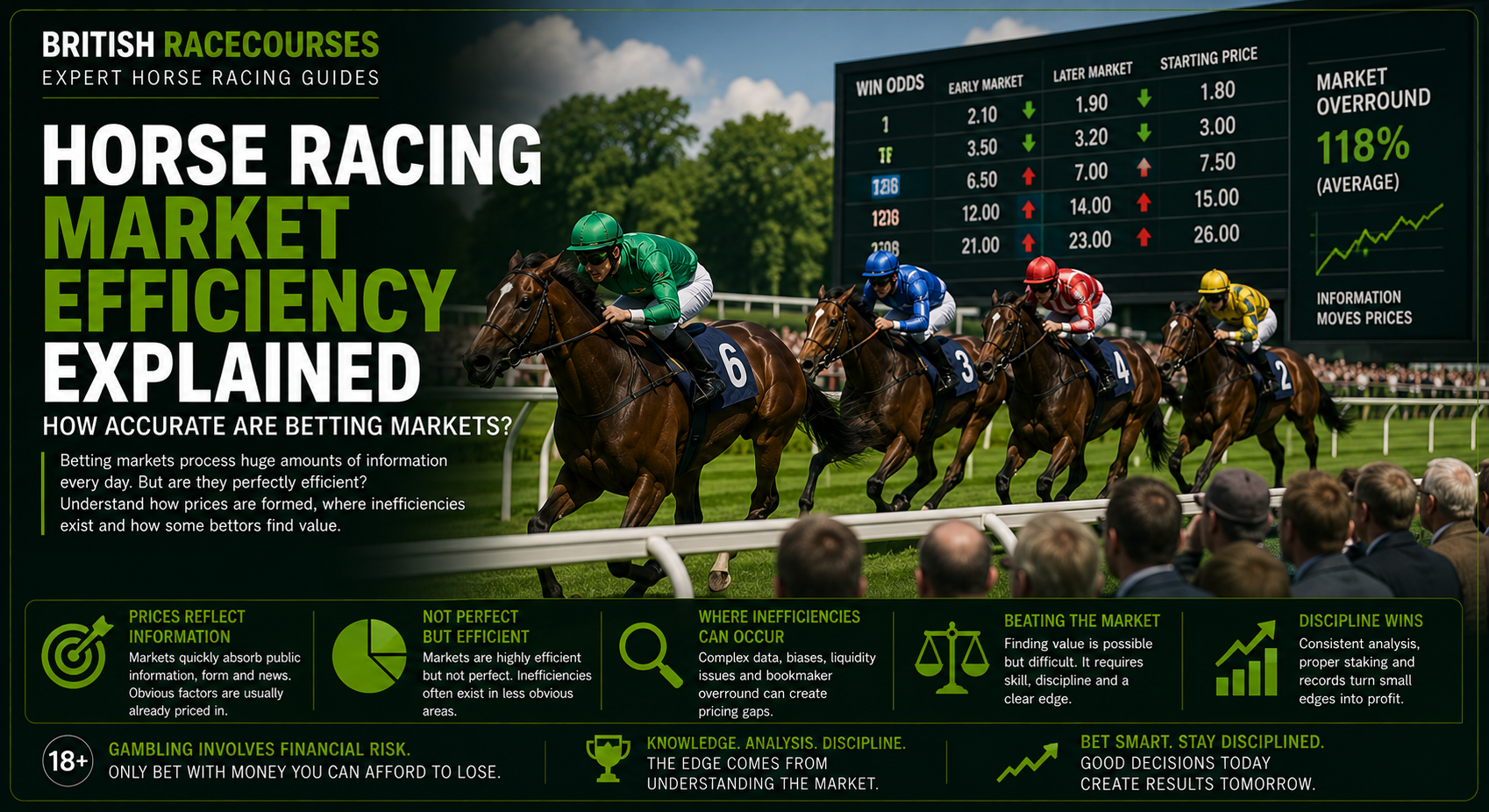
Horse racing betting markets process enormous amounts of information.
Before a race starts, prices can reflect:
- recent form
- trainer form
- jockey bookings
- going
- draw
- pace
- sectional times
- racecourse characteristics
- non-runners
- weather
- market activity
- bookmaker opinions
- professional betting activity
- thousands of individual betting decisions
The result is a market price for every horse.
But how accurate are those prices?
Are horse racing betting markets so efficient that finding value is almost impossible?
Or do bookmakers and bettors still make mistakes?
The answer sits somewhere between the two.
Horse racing markets can be highly efficient, particularly as a race approaches and more information becomes incorporated into prices.
But:
efficient does not mean perfect.
Markets can still:
- overreact
- underreact
- misinterpret information
- price uncertainty incorrectly
- underestimate less obvious factors
- behave differently across favourites and outsiders
Understanding market efficiency helps explain why finding genuine value is difficult, why simple betting systems often stop working, and why the price you take matters as much as the horse you select.
What Is Market Efficiency?
A market is considered efficient when prices accurately reflect the information available to participants.
In horse racing, imagine all relevant information suggests a horse has:
25% chance of winning.
The theoretical fair odds would be:
4.00
or:
3/1.
If the market consistently prices similar horses around that level, it is doing a good job of converting information into probabilities.
If the horse is available at:
8.00
despite genuinely having a 25% chance, the market may have significantly underpriced its chance.
That would represent an inefficiency.
Efficient Does Not Mean Certain
This distinction is crucial.
Suppose the market correctly estimates a horse has:
20% chance of winning.
That means it should still lose approximately:
80%
of the time.
If it loses today, that does not mean the market was wrong.
Market efficiency concerns:
probability
rather than:
certainty.
Betting Markets Are Prediction Markets
Every horse racing price contains information.
Suppose:
Horse A:
2/1
Horse B:
4/1
Horse C:
8/1
Horse D:
20/1
The market is effectively saying:
Horse A is substantially more likely to win than Horse D.
Prices therefore act as collective predictions.
Our Betting Odds Explained page shows how to convert those prices into implied probabilities.
Bookmaker Prices Include Margin
Bookmaker odds are not pure probability forecasts.
They generally contain a margin.
If every horse’s implied probability is added together, the total will normally exceed:
100%.
That excess is known as the:
overround.
Before treating bookmaker prices as probability estimates, it can therefore be useful to remove the margin.
Our Bookmaker Overround Explained page explains the calculation.
Why Horse Racing Markets Can Be Efficient
Horse racing attracts a large amount of analysis.
Before a major race, participants may study:
- form
- speed
- ratings
- pace
- draw
- trainer statistics
- jockey statistics
- sectional data
- ground conditions
- previous course form
- betting movements
Bookmakers also use sophisticated pricing processes.
Betting exchanges add another layer because customers trade prices against one another.
Information is therefore constantly competing to influence the price.
Thousands of Opinions Become One Price
Imagine:
Bettor A thinks Horse X should be:
5/1.
Bettor B thinks:
4/1.
A bookmaker opens:
6/1.
Money arrives.
The bookmaker shortens:
11/2
then:
5/1
then:
9/2.
Other bookmakers react.
Exchange prices move.
More bettors enter.
By race time, enormous amounts of information may have been compressed into one market price.
That is one reason late betting markets can be difficult to beat consistently.
Information Moves Prices
Suppose a horse opens:
10/1.
New information appears.
Perhaps:
- the ground has changed favourably
- a rival becomes a non-runner
- the horse receives significant support
- another runner drifts
- updated analysis changes market opinion
The price moves to:
6/1.
The market has incorporated new information.
This is one of the central mechanisms behind market efficiency.
Obvious Information Is Often Already Priced In
This is one of the most important lessons for bettors.
Suppose everyone knows:
a leading jockey has been booked.
That does not automatically make the horse value.
The jockey booking may already be reflected in the odds.
Likewise:
The horse loves soft ground.
Useful information.
But if every bookmaker and thousands of bettors know it, the market price may already account for the advantage.
The question is not:
Is this positive?
The better question is:
Has the market priced this positive factor correctly?
Good Horse Does Not Equal Good Bet
Imagine the best horse in a race has:
40% chance of winning.
Fair odds:
2.50.
The bookmaker offers:
1.80.
The horse may still be:
the most likely winner.
But according to your assessment, it is a poor price.
This is why How to Find Value Bets in Horse Racing focuses on price rather than simply predicting winners.
Bad Horse Does Not Automatically Equal Bad Bet
Now consider a horse with only:
5% chance of winning.
Fair odds:
20.00
or:
19/1.
A bookmaker offers:
40/1.
The horse remains unlikely to win.
But the price could potentially be attractive relative to its genuine chance.
Market efficiency is ultimately about whether probabilities are being priced correctly.
Are Horse Racing Betting Markets Perfectly Efficient?
No market is perfectly efficient.
Participants do not possess identical information.
Information can be:
- incomplete
- uncertain
- misunderstood
- delayed
- incorrectly weighted
Different bettors also interpret the same evidence differently.
That creates opportunities for disagreement.
Uncertainty Creates Pricing Difficulty
Horse racing contains enormous uncertainty.
You do not know exactly:
- how quickly the race will be run
- where every jockey will position their horse
- whether traffic problems will occur
- whether the favourite will reproduce its previous performance
- whether the going description perfectly reflects conditions
- how horses will respond to tactical changes
Prices must incorporate all that uncertainty.
That is difficult.
Markets Can Overreact
Imagine a horse performs badly in its latest race.
The market may place heavy emphasis on that visible failure.
But perhaps the horse:
- raced against an unsuitable pace
- was trapped wide
- encountered traffic
- ran on the wrong part of the track
- competed over an unsuitable distance
If the poor finishing position receives too much attention, the horse might become overpriced next time.
That would represent a possible inefficiency.
Markets Can Underreact
The opposite can happen.
Suppose a horse finishes:
seventh.
The finishing position looks ordinary.
But Horse Racing Sectional Times reveal an unusually strong closing performance.
If the market focuses heavily on finishing position and insufficiently on how the race developed, the horse’s next price might not fully reflect the underlying performance.
Pace Can Create Inefficiencies
Pace is difficult to predict.
Suppose a race contains one obvious front runner.
If that horse secures an uncontested lead, its chance may improve.
But the market may:
fully price that advantage
partly price it
or:
overprice it.
A Horse Racing Pace Map helps identify the likely race shape.
The betting question remains:
How much should that tactical advantage alter the horse’s probability?
Draw Bias Can Be Mispriced
The same applies to draw.
A low stall may be advantageous under certain:
- courses
- distances
- field sizes
- going conditions
- pace setups
But simply backing every low-drawn horse is unlikely to produce a lasting edge if the advantage is widely known.
Our Horse Racing Draw page explains why draw analysis needs context.
Well-Known Biases Become Priced In
Suppose a particular course develops a strong reputation for favouring:
low draws over five furlongs.
Bettors respond.
Bookmakers respond.
Low-drawn horses shorten.
Eventually, the advantage may remain physically real while disappearing as a betting opportunity.
This illustrates a fundamental principle:
A predictive factor is not automatically a profitable factor.
Price determines whether the information still offers value.
Market Efficiency and Starting Prices
Starting Prices are particularly interesting because they represent the market close to race time.
By then, the market has usually processed far more information than it had:
the previous evening
or:
early that morning.
That can make SP a useful benchmark.
Why the Closing Market Matters
Imagine you back:
Horse A at 12/1.
It starts:
7/1.
You have secured a substantially stronger price than the later market.
Now imagine you repeatedly take:
5/1
about horses that start:
10/1.
That deserves attention.
Over large samples, the relationship between your prices and the closing market can tell you something about your decision-making.
This is the basis of Closing Line Value in Horse Racing.
Does SP Represent the True Probability?
No.
SP is still a market price.
The favourite can be overpriced.
An outsider can be underpriced.
The market can make mistakes.
But a mature market can provide a useful benchmark because it incorporates a large amount of available information.
Closing Prices Can Be More Informative Than Individual Results
Suppose you place:
100 bets.
You lose:
8%.
That looks disappointing.
But your selections consistently shorten substantially before the race.
The financial result may partly reflect normal Betting Variance.
Now imagine:
+10% profit
but your selections consistently drift.
Your immediate financial result is better.
But the underlying price evidence may deserve investigation.
Neither measure should be used alone.
Market Efficiency and Betting Exchanges
Betting exchanges provide another view of market opinion.
Rather than one bookmaker setting every price, exchange participants:
back
and:
lay
against each other.
As liquidity increases, the market can become an important source of pricing information.
See our UK Betting Exchange Sites guide for more information.
Exchange Prices Are Not Perfect Either
Do not assume:
exchange price = true probability.
Exchange markets can be affected by:
- low liquidity
- wide spreads
- commission
- sudden orders
- temporary imbalances
But liquid exchange markets can provide useful evidence about collective market expectations.
Back and Lay Spread
Suppose the best available prices are:
Back:
5.00
Lay:
5.20
The gap represents the market spread.
As liquidity increases closer to the race, that gap may narrow.
A tighter spread generally indicates stronger agreement about the current market price.
Favourite-Longshot Bias and Market Efficiency
If every part of a betting market were perfectly efficient, prices across the entire odds spectrum would behave similarly after adjusting for probability.
Real-world betting behaviour can be more complicated.
Research and historical market behaviour have long prompted discussion around:
favourite-longshot bias.
Our Favourite-Longshot Bias in Horse Racing page explores this in detail.
Why Outsiders Can Behave Differently
Bettors may be attracted to large potential payouts.
A:
50/1 winner
is memorable.
A:
4/6 winner
is not.
If demand for outsiders becomes disproportionately strong, their prices can behave differently from favourites.
This does not mean:
never back outsiders.
It means price behaviour can vary across the market.
Market Efficiency Does Not Mean Every Price Is Equally Efficient
Some parts of a market may be better priced than others.
For example:
- favourites may attract more analysis
- obscure runners may receive less attention
- large-field races contain more pricing complexity
- early markets may have less liquidity
- specialist races may have fewer informed participants
These differences can potentially create varying levels of efficiency.
Early Markets vs Late Markets
Horse racing prices can be available:
the previous day
the morning of racing
hours before the race
minutes before the off.
The amount of information and liquidity can differ dramatically.
Early Markets
Early prices may contain more uncertainty.
Bookmakers may have less information about:
- final conditions
- market opinion
- non-runners
- race-day weather
- betting activity
That can potentially create larger pricing errors.
But early markets can also:
- contain wider margins
- have lower limits
- move quickly
- offer less liquidity
Opportunity and uncertainty both increase.
Late Markets
As the race approaches:
- more money enters
- information becomes clearer
- bookmakers react
- exchanges become more liquid
- prices converge
The market may become more efficient.
That means obvious pricing errors can become harder to find.
Why Price Timing Matters
Suppose your analysis identifies a horse as:
fair odds 5/1.
Early price:
10/1
Morning:
8/1
One hour before:
6/1
SP:
9/2.
The betting opportunity was strongest early.
By SP:
the value may have disappeared.
Your analysis did not necessarily become wrong.
The market simply moved towards your assessment.
How Information Gets Into the Market
Consider a simplified process.
Stage 1: Opening Prices
Bookmakers publish initial odds.
Stage 2: Early Bettors React
Some prices attract money.
Others do not.
Stage 3: Bookmakers Adjust
Prices shorten or drift.
Stage 4: Wider Market Responds
Other bookmakers and exchange participants react.
Stage 5: New Information Arrives
Going, weather, non-runners and other factors become clearer.
Stage 6: Liquidity Increases
More participants enter.
Stage 7: Closing Market
Prices converge towards the market’s final assessment.
This continuous updating process is why betting markets can become increasingly difficult to beat.
What Causes Horse Racing Prices to Move?
Prices move because the balance of available information, money and opinion changes.
Possible causes include:
- significant betting activity
- bookmaker risk management
- exchange trading
- non-runners
- weather
- going
- jockey changes
- market corrections
- competing bookmaker prices
A shortening horse does not automatically mean:
somebody knows it will win.
And a drifting horse does not automatically mean:
it cannot win.
Market Movement Is Information, Not Proof
Suppose a horse moves:
8/1 → 4/1.
That is significant market information.
But it can still lose.
At 4/1, the market is still implying the horse is much more likely to:
lose
than:
win.
Treat price movement as evidence rather than certainty.
Can Professional Bettors Beat Efficient Markets?
If markets were perfectly efficient at all times, consistently beating them after costs would be extremely difficult.
Professional bettors therefore need some reason to believe their probability estimates are better than the available prices.
Potential sources of advantage could include:
- better data
- better interpretation
- faster analysis
- specialist knowledge
- superior models
- identifying underweighted factors
- better price execution
But none automatically creates an edge.
The advantage has to survive:
the price.
Information Alone Is Not an Edge
Suppose you discover:
Horse A has an excellent record on soft ground.
Useful.
But the market already knows.
Horse A shortens from:
8/1
to:
7/2.
The information might be completely correct.
But the betting opportunity may have disappeared.
An edge exists only when your assessment differs favourably from the available price.
Market Efficiency and Value Betting
This is where market efficiency connects directly with value.
Suppose the market’s margin-free probability for a horse is:
20%.
Your assessment:
25%.
Market fair odds:
5.00
Your fair odds:
4.00.
If a bookmaker offers:
5.50
you may believe there is value.
But your 25% probability is not fact.
You need evidence that your probability estimates are better than the market’s.
Disagreement Is Not Automatically Edge
This is one of the most important principles in advanced betting.
Your model says:
30%.
Market says:
20%.
Difference:
10 percentage points.
You might think:
Huge edge.
But perhaps:
your model is wrong.
Treat differences as:
estimated edges
until they have been properly validated.
Testing Whether You Can Beat the Market
This is why record keeping and model validation matter.
You cannot determine whether you have an edge from:
one race
or:
one profitable month.
You need repeated evidence.
Our How to Test a Horse Racing Betting Model page explains how to examine:
- out-of-sample performance
- ROI
- CLV
- calibration
- drawdown
- different odds bands
- different race types
Record Every Bet
Use a Horse Racing Betting Record to capture:
- odds taken
- closing odds
- fair odds
- probability
- stake
- result
- profit/loss
Then determine whether your supposed edge survives across large samples.
Market Efficiency and Expected Value
Expected Value in Horse Racing Betting provides a framework for turning probability disagreement into a theoretical return.
Suppose:
Your probability:
25%
Available decimal odds:
5.00
Expected return:
0.25 × £5 = £1.25
Estimated EV:
+25%.
But that number is only as reliable as your:
25% probability estimate.
If the genuine probability is:
18%
the calculation changes completely.
Probability Accuracy Is Everything
A sophisticated spreadsheet cannot rescue poor probability estimates.
You can calculate:
EV
Kelly stakes
fair odds
to several decimal places.
But if the original probability is wrong, the precision is meaningless.
That is why How to Price a Horse Race should focus on probability first.
Market Efficiency and Betting Models
A Horse Racing Betting Model attempts to estimate probabilities systematically.
The market provides a benchmark.
You can compare:
Model probability
against:
Margin-free market probability.
Suppose:
| Horse | Model | Market |
|---|---|---|
| A | 32% | 34% |
| B | 25% | 20% |
| C | 18% | 19% |
| D | 15% | 16% |
| E | 10% | 11% |
Your biggest positive disagreement is:
Horse B.
But you should then ask:
Why?
Perhaps the model has identified something useful.
Perhaps it is systematically overestimating horses with Horse B’s characteristics.
Testing determines which explanation is more likely.
Why Simple Systems Often Stop Working
Suppose someone discovers:
Front runners drawn low at Course X have historically produced +20% ROI.
Other bettors notice.
Articles are written.
Data becomes widely available.
Bookmakers adjust.
Prices shorten.
The physical advantage may continue.
The:
betting edge
can disappear.
This is how markets can become more efficient over time.
Public Knowledge Gets Priced
The easier information is to discover, the more likely it is to be incorporated into prices.
That does not make public data useless.
It means you need to ask:
Am I interpreting it better?
rather than:
Am I the only person who knows it?
Where Might Market Inefficiencies Occur?
There is no guaranteed list.
If there were, those opportunities would quickly attract attention.
But inefficiencies may be more plausible where there is:
- complexity
- uncertainty
- lower liquidity
- unusual race conditions
- misunderstood information
- behavioural bias
- difficult interactions between variables
Complex Interactions
Perhaps:
draw alone
is correctly priced.
And:
pace alone
is correctly priced.
But:
draw + pace + going
interact in a way the market underestimates.
This is where deeper race analysis can become useful.
Hidden Performance
A finishing position can hide:
- difficult trip
- pace disadvantage
- poor track position
- strong late sectionals
If your analysis extracts information that is not obvious from the result, you may assess the next race differently from the wider market.
Less Liquid Markets
Lower liquidity can mean prices are influenced by fewer participants.
That may increase the potential for mispricing.
But it can also create:
- larger spreads
- smaller available stakes
- greater price volatility
Lower efficiency does not automatically mean easier profit.
Why Efficient Markets Are Good for Bettors
Market efficiency might sound like bad news.
It also provides something extremely useful:
a benchmark.
If the market is reasonably accurate, you can use it to test your own opinions.
Suppose your model continually says horses are:
30%
when the market says:
15%.
If the market consistently proves better calibrated, you have learned something valuable.
The Market Can Teach You
Instead of treating bookmakers and exchanges purely as opponents, treat prices as:
information.
Ask:
Why is this horse shorter than I expected?
Why is this horse drifting?
What might the market understand that my analysis missed?
You do not need to blindly follow the market.
But ignoring it entirely discards valuable information.
Common Market Efficiency Mistakes
Assuming the Favourite Must Be Value
Favourite means:
most likely winner according to the market.
It does not mean:
good price.
Assuming Outsiders Are Always Value
A large price does not automatically mean the horse is overpriced.
Assuming All Information Creates an Edge
Known information may already be reflected in the odds.
Assuming Market Moves Guarantee Results
A heavily backed horse can still lose.
Assuming SP Is Perfect
SP is a market estimate, not certainty.
Assuming Your Model Is Smarter Than the Market
It may be.
Test it.
Ignoring Overround
Raw bookmaker probabilities contain margin.
Ignoring Price Timing
A value bet at:
10/1
might no longer be value at:
5/1.
Confusing Prediction With Profit
Picking winners is not enough.
The odds matter.
Ignoring Sample Size
Short-term profit does not prove market-beating ability.
A Better Market-Efficiency Mindset
Instead of asking:
Who will win?
Ask:
What probability does the market imply?
Then:
What probability do I estimate?
Then:
Why are they different?
Then:
Is my method historically reliable when these disagreements occur?
Then:
Is the available price large enough to justify the uncertainty?
This produces a much more disciplined process.
Horse Racing Market Efficiency Checklist
Before betting:
☐ What probability does the current market imply?
☐ What is the bookmaker overround?
☐ What is the margin-free market probability?
☐ What probability do I estimate?
☐ Why does my estimate differ?
☐ Is my information genuinely useful or already obvious?
☐ Has the market already moved?
☐ What price is actually available?
☐ What price would remove the value?
☐ Have I compared bookmakers?
☐ What does the exchange market suggest?
☐ Am I consistently beating later prices?
☐ Have I tested this type of disagreement historically?
☐ Is my sample large enough to trust?
How Market Efficiency Fits Into the British Racecourses Analysis Cluster
The analytical process now becomes:
Analyse the race
↓
How to Analyse a Horse Race Like a Professional
↓
Understand pace, draw and hidden performance
↓
↓
↓
↓
Understand market prices
↓
↓
Understand market efficiency
↓
Horse Racing Market Efficiency Explained
↓
Create your own prices
↓
↓
Identify value
↓
↓
Measure expected return
↓
↓
Measure price performance
↓
↓
Build and test your process
↓
↓
How to Test a Horse Racing Betting Model
↓
Record the evidence
↓
Market efficiency provides the context for the entire process.
It explains why finding value is difficult and why evidence is required before claiming an edge.
Frequently Asked Questions
What does market efficiency mean in horse racing?
Market efficiency describes how effectively betting prices incorporate available information about each horse’s chance.
Are horse racing betting markets efficient?
They can be highly efficient, particularly mature markets close to race time, but they are not necessarily perfect.
Are bookmaker odds accurate?
Bookmaker odds provide useful probability information but also contain a margin and can still be wrong.
What is an efficient betting market?
An efficient market is one where prices reflect available information sufficiently well that obvious, repeatable profit opportunities are difficult to find.
Does an efficient market mean the favourite always wins?
No. Prices represent probabilities rather than certainties.
Can the market be wrong?
Yes. Markets can overreact, underreact or misprice uncertainty.
Why do horse racing odds change?
Prices can change because of betting activity, new information, non-runners, weather, exchange movements and bookmaker adjustments.
Are early horse racing markets less efficient?
They can contain greater uncertainty and lower liquidity, potentially allowing larger pricing differences. They can also contain wider margins and less available money.
Are markets more efficient near the off?
They can become more efficient as additional information and liquidity enter the market.
Is Starting Price the true probability?
No. SP remains a market estimate rather than objective truth.
Why is SP useful?
It provides a later-market benchmark against which earlier prices can be compared.
What is closing line value?
CLV compares the price you obtained with a later or closing market price.
Does positive CLV prove I have an edge?
No. But consistently obtaining stronger prices than the closing market can provide useful evidence about your price selection.
Are betting exchanges more efficient than bookmakers?
Not automatically. Liquid exchange markets can provide useful price discovery, but liquidity, spreads and commission must be considered.
What is a betting market inefficiency?
An inefficiency occurs when a market price does not accurately reflect the information relevant to an outcome’s probability.
Where do inefficiencies come from?
Possible causes include uncertainty, behavioural bias, incomplete information, complex interactions and lower liquidity.
Does knowing more about horse racing guarantee an edge?
No. Your knowledge must produce probability estimates that are better than the available prices.
Is a good horse always a good bet?
No. A strong horse can still be available at unattractive odds.
Can a bad horse be a good bet?
A horse with a low chance can potentially represent value if its odds sufficiently underestimate that chance.
Why are obvious systems difficult to profit from?
Widely known patterns can become incorporated into prices, removing the betting value even when the underlying racing pattern remains valid.
Is draw bias already priced into odds?
Sometimes substantially. The important question is whether the market has priced the specific draw effect correctly under today’s conditions.
Is pace already priced into odds?
It can be, but race shape contains uncertainty and different participants may assess its importance differently.
Can sectional times uncover inefficiencies?
They can provide additional performance information, but the market may also use sectional data. Their value depends on whether your interpretation improves your probability estimates.
What is favourite-longshot bias?
It describes observed differences in how favourites and outsiders can be priced across betting markets.
Can a betting model beat an efficient market?
Potentially, but it needs to estimate probabilities sufficiently well to overcome pricing errors, bookmaker margins and other costs.
How do I know if I am beating the market?
Track your bets, prices, CLV, calibration and long-term results across meaningful samples.
Does profit prove I beat the market?
Not by itself. Short-term profit can result from variance.
Why should I remove bookmaker overround?
Removing the margin gives you a cleaner estimate of the probabilities implied by the market.
Is market efficiency bad for bettors?
Not entirely. Efficient markets provide useful benchmarks against which you can test your own opinions and models.
Summary
Horse racing betting markets process enormous amounts of information.
Prices can reflect:
form
pace
draw
going
trainer and jockey information
sectional data
weather
non-runners
market activity
and countless individual opinions.
As information and money enter the market, prices change.
That makes mature horse racing markets difficult to beat consistently.
But:
efficient does not mean perfect.
Markets can still:
overreact
underreact
misinterpret complex information
or:
price uncertainty incorrectly.
The key distinction is between:
useful racing information
and:
useful betting information.
Knowing that a horse:
has a favourable draw
does not automatically create value.
Knowing that:
the pace should suit
does not automatically create value.
Knowing that:
the horse loves soft ground
does not automatically create value.
The market may already know all of those things.
The question is:
Has the information been priced correctly?
That changes the betting process from:
Find the winner
to:
Estimate probability → Compare with market probability → Investigate disagreement → Compare prices → Measure results.
Use Bookmaker Overround Explained to understand the margin inside bookmaker prices.
Use How to Price a Horse Race to create your own probabilities.
Use How to Find Value Bets to compare your assessment with available odds.
Use Closing Line Value to monitor how your prices compare with the later market.
Use How to Test a Horse Racing Betting Model to determine whether your apparent edge survives proper testing.
And keep a Horse Racing Betting Record so your conclusions are based on evidence rather than memory.
The market should not be treated as:
always right.
Nor should it be treated as:
easy to beat.
A stronger approach is to treat the market as a highly informed benchmark.
Then ask whether you have a clear, testable reason to disagree with it.
That is the real challenge of finding value in horse racing.
18+. Gambling involves financial risk. Only bet with money you can afford to lose.