Welcome to our official guide to Haydock Racecourse.
We explore this great dual-purpose racecourse in detail, examining its history, a track guide, local hotel recommendations, fixtures, travel information, and betting guides.
Haydock Park is a left-handed, dual-purpose racecourse staging high-quality Flat racing during the warmer months and National Hunt racing through the winter.
The Flat course is broad and galloping, with a long home straight and a slight rise towards the finish. Sprint races up to six furlongs use the straight course, while longer races take place around the main circuit. Haydock can suit horses able to maintain a sustained gallop, although the demands change considerably with the ground.
Conditions are particularly important here. Good ground can produce a very different test from the soft and heavy surfaces frequently associated with Haydock’s winter programme. When the ground becomes testing, stamina moves much further up the list of requirements.
The jumps course is also left-handed and galloping, with ten fences on a circuit. Haydock’s chase fences have traditionally had a reputation for providing a proper jumping test, so rhythm and accuracy matter as much as raw stamina.
That combination makes Haydock an interesting course for form analysis. Previous course form can be useful, but always check the distance, going and type of race before assuming one Haydock performance will translate directly to another.
If you are looking for the latest betting tips for Haydock, check out our complete guide to Haydock Racecourse tips.
Find out more about Haydock Racecourse today.
Overview of Haydock Park Racecourse
Haydock Racecourse is a dual-purpose horse racing course used for both flat and National Hunt racing, situated in Merseyside between Liverpool and Manchester. The course surroundings are misleading – you’d be excused for thinking you were in the deep countryside, with tree-lined roads and vast fields on all sides!
Owned and operated by The Jockey Club, Haydock Racecourse is not just one of the North’s leading horseracing venues, but also one of the largest and busiest conferencing facilities in the North West of England.
It hosts over 30 race meets a year, as well as non-racing events almost every day of the year. The town of Haydock is synonymous with horse racing, though it is also home to several golf courses.
The track at Haydock Racecourse is a flat left-handed oval of one mile five furlongs, with a slight rise toward the end. A straight chute of up to six furlongs is added for longer race distances. The emphasis is very much on stamina, and the going is often hard. The steeplechase course sees ten fences with five hurdles run inside the chase course. It’s the premier year-round course for the North of England, with major races including the Betfair Chase, won famously by Kauto Star, and the Haydock Park Sprint Cup in summer.
As such, a major events venue, the on-site facilities are vast and varied. Haydock Racecourse boasts four grandstands, thirty-three private viewing suites, restaurants, bars, street food options and conferencing and business facilities. Various enclosures cater to all (and all budgets!), and Haydock, like other racecourses in the North, is well-renowned for its Ladies’ Day, with fashionable racegoers frequently attending in haute couture. If the weather is good, picnics are very popular – so if you’re considering visiting, pack up your picnic hamper and enjoy some al-fresco dining while you’re there!
What are the Haydock Park Racecourse fixtures for 2026?
The Haydock racing fixtures for 2026 are :
| Date | Racecourse | Weekday |
|---|---|---|
| 17/1/2026 | Haydock Park | Saturday |
| 14/2/2026 | Haydock Park | Saturday |
| 5/3/2026 | Haydock Park | Thursday |
| 4/4/2026 | Haydock Park | Saturday |
| 25/4/2026 | Haydock Park | Saturday |
| 9/5/2026 | Haydock Park | Saturday |
| 21/5/2026 | Haydock Park | Thursday |
| 22/5/2026 | Haydock Park | Friday |
| 23/5/2026 | Haydock Park | Saturday |
| 29/5/2026 | Haydock Park | Friday |
| 30/5/2026 | Haydock Park | Saturday |
| 20/6/2026 | Haydock Park | Saturday |
| 2/7/2026 | Haydock Park | Thursday |
| 3/7/2026 | Haydock Park | Friday |
| 4/7/2026 | Haydock Park | Saturday |
| 17/7/2026 | Haydock Park | Friday |
| 18/7/2026 | Haydock Park | Saturday |
| 7/8/2026 | Haydock Park | Friday |
| 8/8/2026 | Haydock Park | Saturday |
| 3/9/2026 | Haydock Park | Thursday |
| 4/9/2026 | Haydock Park | Friday |
| 5/9/2026 | Haydock Park | Saturday |
| 25/9/2026 | Haydock Park | Friday |
| 26/9/2026 | Haydock Park | Saturday |
| 16/10/2026 | Haydock Park | Friday |
| 21/11/2026 | Haydock Park | Saturday |
| 2/12/2026 | Haydock Park | Wednesday |
| 19/12/2026 | Haydock Park | Saturday |
| 30/12/2026 | Haydock Park | Wednesday |
Haydock Park Racing Tips
| Meeting | Time | Name | Add To Bet Slip |
|---|---|---|---|
| — | –:– | — | |
| No Race Fixtures found today |
Haydock Park Racecourse History
Horseracing events are documented as having been held as far back as 1752 in Newton-le-Willows, some two miles away from the current course. Racing continued there until 1898 (with just a few brief breaks) and was sponsored by members of the local Newton Hunt.
In 1898, the course moved to its current home, Haydock.
The inaugural event was a two-day National Hunt meeting in February the following year, and by May, race meets were held under Jockey Club results. Haydock Racecourse got its first big break in 1908, when Sydney Sandon became the course’s Secretary. Under his leadership, Haydock Racecourse underwent significant redevelopment and marketing efforts, securing its future as one of the most popular and prestigious courses in the country.
In 1947, Sheila’s Cottage won a three-and-a-half-mile chase at Haydock and went on to Grand National success the following year! In 1963, the Lancashire Oaks was transferred here, and in 1966, the Vernon’s Sprint Cup was also introduced.
The most recent grandstand opened in 1990, and its timeless design has meant only minor refurbishments and redecoration have been needed since. The course is owned and operated by The Jockey Club.
Major Races at Haydock Park
Haydock’s strength is the quality of its racing across both codes. Few British courses stage a Group 1 Flat race and a Grade 1 chase during the same year.
Betfair Chase
The Betfair Chase is Haydock’s leading National Hunt race and one of the first major Grade 1 tests for established staying chasers each season.
Run in November, the race has been won by some outstanding horses including Kauto Star, Cue Card, Bristol De Mai and A Plus Tard.
Kauto Star’s four victories helped establish the Betfair Chase as an important part of the staying-chase programme. The race can also provide valuable evidence ahead of the King George VI Chase at Kempton and Cheltenham Gold Cup later in the season.
Haydock Sprint Cup
The Haydock Sprint Cup is the highlight of the course’s Flat season.
Run over the straight six furlongs in September, the Group 1 brings leading three-year-old and older sprinters together towards the end of the British Flat season.
Be Friendly, Dayjur, Invincible Spirit, Dream Ahead and Harry Angel are among its notable winners.
Ground and pace deserve particular attention because September conditions at Haydock can vary considerably. A strongly run six furlongs on soft ground provides a very different test from a speed-focused race on a quicker surface.
Lancashire Oaks
The Lancashire Oaks is a Group 2 contest for fillies and mares run over approximately one mile and four furlongs in July.
Its position in the summer programme attracts middle-distance fillies and mares with established Pattern-race form alongside improving runners moving into stronger company.
Haydock’s galloping layout provides a fair test of middle-distance ability, although the ground can again influence how much emphasis falls on speed or stamina.
Grand National Trial
Haydock’s Grand National Trial is a long-distance handicap chase staged in February.
The race has strong historical links with Aintree. Red Rum won at Haydock in 1975, while Grand National winner Party Politics and Cheltenham Gold Cup winners Cool Ground and Master Oats also feature on its roll of honour.
Despite its name, the race should not be treated as a simple predictor of the Grand National. A gruelling Haydock contest on testing winter ground can be very different from the challenge horses face over Aintree’s National fences in April.
The most useful evidence comes from assessing the horse’s jumping, stamina, handicap mark and how much effort the Haydock race required.
Haydock Racecourse Tickets
Haydock Park racecourse tickets are always in high demand for all of their meetings. You’ll find great offers, deals, and early bird tickets to all of their events throughout the year. We always recommend booking in advance so you can enjoy the day out and plan.
As racing at Haydock is so popular, events sell out, so it is best to book early to avoid disappointment.
If you are looking for the best deals on Haydock Park Racecourse Tickets, follow the official link here.
Haydock Park Racecourse Map
Below is a map of Haydock Racecourse:
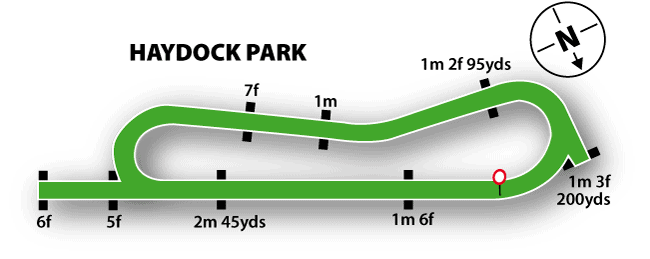
Flat course – Haydock is a left-handed flat track. It is oval-shaped and measures just over twelve furlongs in circumference. It has a home straight of 4 furlongs, which is on a slight incline. Although essentially a galloping track with a long straight a good position turning in is often important with runners frequently slipping the fields. Sprints take place on the straight six-furlong course, and the Haydock Park draw bias suits high numbers.
Haydock Jumps Course
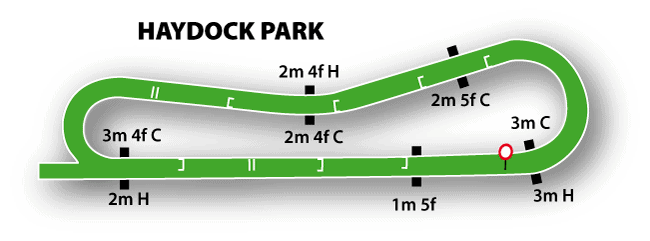
Haydock’s jumps course is left-handed, flat and galloping, but winter conditions can turn it into a demanding stamina test.
The chase course contains ten fences per circuit and its obstacles have a reputation for being stiff. Horses that jump economically can maintain their momentum, while repeated errors become increasingly costly when the ground is soft or heavy.
The long run-in is another important feature. A horse travelling strongly turning for home still needs to sustain its effort, particularly after a strongly run staying chase.
This is one reason the Betfair Chase provides such a valuable early-season examination of leading staying chasers. A performance on deep Haydock ground can expose weaknesses in fitness, stamina or jumping that might be less obvious under easier conditions.
It is also important not to treat Haydock form as directly interchangeable with Kempton or Cheltenham. The King George VI Chase can place greater emphasis on tactical speed around Kempton, while the Cheltenham Gold Cup adds an undulating course and uphill finish.
When assessing Haydock form, consider how much the ground contributed to the performance. A horse finishing strongly in heavy conditions has answered a different question from one producing its best form on a quicker surface.
Draw and Pace Bias at Haydock
Haydock’s draw bias is most relevant on the straight sprint course, but it should not be treated as a fixed rule.
High numbers can have an advantage in sprint races when the ground is soft, particularly when runners move towards the stands’ side in search of quicker or less-used ground. That does not mean a high stall should automatically be upgraded in every Haydock sprint.
The position of the early pace is just as important.
If several prominent racers are drawn together, they can provide each other with a strong lead. An isolated horse on the supposedly favoured side may receive less assistance than a runner drawn among the main pace group.
Ground can also change across the width of the course during a meeting. Watching earlier straight-course races can therefore provide more useful information than relying entirely on historical draw percentages.
For races around the bend, tactical position and pace become increasingly important alongside stall number.
Our horse racing draw guide explains how to combine stall position with pace, field size and course configuration rather than treating the draw as a standalone betting system.
What is the Draw Bias at Haydock 5 Furlongs?
The statistics suggest that there is a significant advantage for horses drawn high over the 5-furlong course at Haydock. Being able to race down the stands’ side seems to be a favourable position.
However, the bias is not as strong as at some other courses and can be affected by different factors such as the pace of the race and the ground conditions.
It’s essential to note that there’s some variability in results from year to year, and the sample sizes of races may not be large enough to draw definitive conclusions.
It’s always advisable to also consider other factors, such as recent form and trainer/jockey combination, when making betting decisions.
What is the Draw Bias at Haydock 6 Furlongs?
The straight 6 furlongs at Haydock is known to be a course where the stand side part of the straight is the quickest. Hence, it is not surprising that horses drawn high near the stands side have a significant advantage over the others.
It’s said that horses which have been drawn low have to move towards the stands side to get an advantage. This can cost them extra ground and often proves to be detrimental to their chances.
The statistics back up the belief that high-drawn runners have an advantage at Haydock over 6 furlongs.
The data suggests that the bias is significant, and horses with a high draw are more likely to win the race.
What is the Draw Bias at Haydock 7 Furlongs?
The number of 7-furlong handicaps at Haydock is limited, but there is a clear pattern indicating a preference for low-drawn runners.
This may not come as a surprise, as the races over 7 furlongs at Haydock are run around a tight bend, where horses drawn low on the inside tend to have an advantage.
In general, the stats suggest that Haydock has a significant draw bias towards high-drawn runners over the 5 and 6 furlong distances, where the stand side rail appears to be the quickest part of the course.
What is the Draw Bias at Haydock 1 Mile?
The stats for Haydock 1 mile indicate a significant advantage to being drawn high, with over a quarter of the races being won by the horse drawn widest of all.
This is a complete contrast to the 7-furlong analysis, where low-drawn horses seem to be favoured.
It’s a peculiar pattern and quite unusual for a racecourse to exhibit such distinct biases over similar distances.
Haydock Racecourse Address
Many people query, ‘Where is Haydock Racecourse?’
The official address of Haydock Park Racecourse is:
Haydock Racecourse
Newton-le-Willows
WA12 0HQ
How To Get To Haydock Racecourse
The ways to get to Haydock Park Racecourse are:
- By car – Haydock Racecourse is located just one mile off the M6 in an area of parkland between Haydock, Ashton-in-Makerfield, Newton-le-Willows and Golborne. Signs for ‘Haydock Park and Conference Centre’ are displayed on all routes in from Liverpool and Manchester. All parking is free of charge. Sat nav systems are (unusually!) effective when using the course postcode, as above, or typing in Newton-le-Willows, Merseyside.
- By train – the nearest train station is Newton-le-Willows, and there’s usually plenty of taxis outside. Free shuttle buses run from the station on racedays, or you can take a direct bus from Liverpool city centre.
Hotels Near Haydock Racecourse
Most racegoers attending Haydock Racecourse will stay in nearby Manchester or Liverpool, but there are some accommodation options slightly closer to the action. Closest to the course is the Mercure Haydock, a Georgian hotel with very reasonable rates and free WiFi! Budget options nearby include the Premier Inn and Travelodge, along the main roads. For something smaller and with more of a countryside feel, check out the Kirkfield, the Pied Bull Hotel or the Bay Horse.
Other Events at Haydock
As a multi-purpose event venue, there’s always something on at Haydock Racecourse.
Upcoming gigs include the Pussycat Dolls, and charity days are planned for various causes. Haydock has a reputation for announcing big-name artists booked to perform – previous acts include Kylie Minogue and Nile Rodgers!
Popular Questions
✅ What is the dress code for Haydock races?
Gentlemen are asked to wear a buttoned collared shirt and smart trousers. Jeans are allowed as long as they’re not faded or ripped. Fancy dress, sportswear, trainers are not permitted.
✅ Can you take your own food and drink to Haydock races?
On certain days picnics are permitted but only food and soft drinks are allowed into the racecourse (no alcohol) and they must be consumed within the Be Friendly Enclosure.
✅ Can you take alcohol into Haydock races?
No alcohol can be brought onto the premises. If so it will be confiscated on arrival by a member of the security.
✅ Can children go to Haydock races?
Yes! Children of all ages are welcome at Haydock with all under 17s given free entrance.
Haydock Park Racecourse Summary
Haydock is a brilliant and lively course set in beautiful parkland – it is the home course of The British Racecourses team!
With a packed schedule, top-class racing, and fun crowds, there’s something for racing fans and those just looking for a night out. Owned by the Jockey Club, major races include the Betfair Chase (won by the legend Kauto Star) and the Haydock Sprint.
Sandwiched between Manchester and Liverpool, there are plenty of options and places to stay, and you can combine your visit with staying in those great cities.
Excellent customer service to boot – a top pick!
A British Racecourse Guide top pick and one of our Top 10 Racecourses in the country.