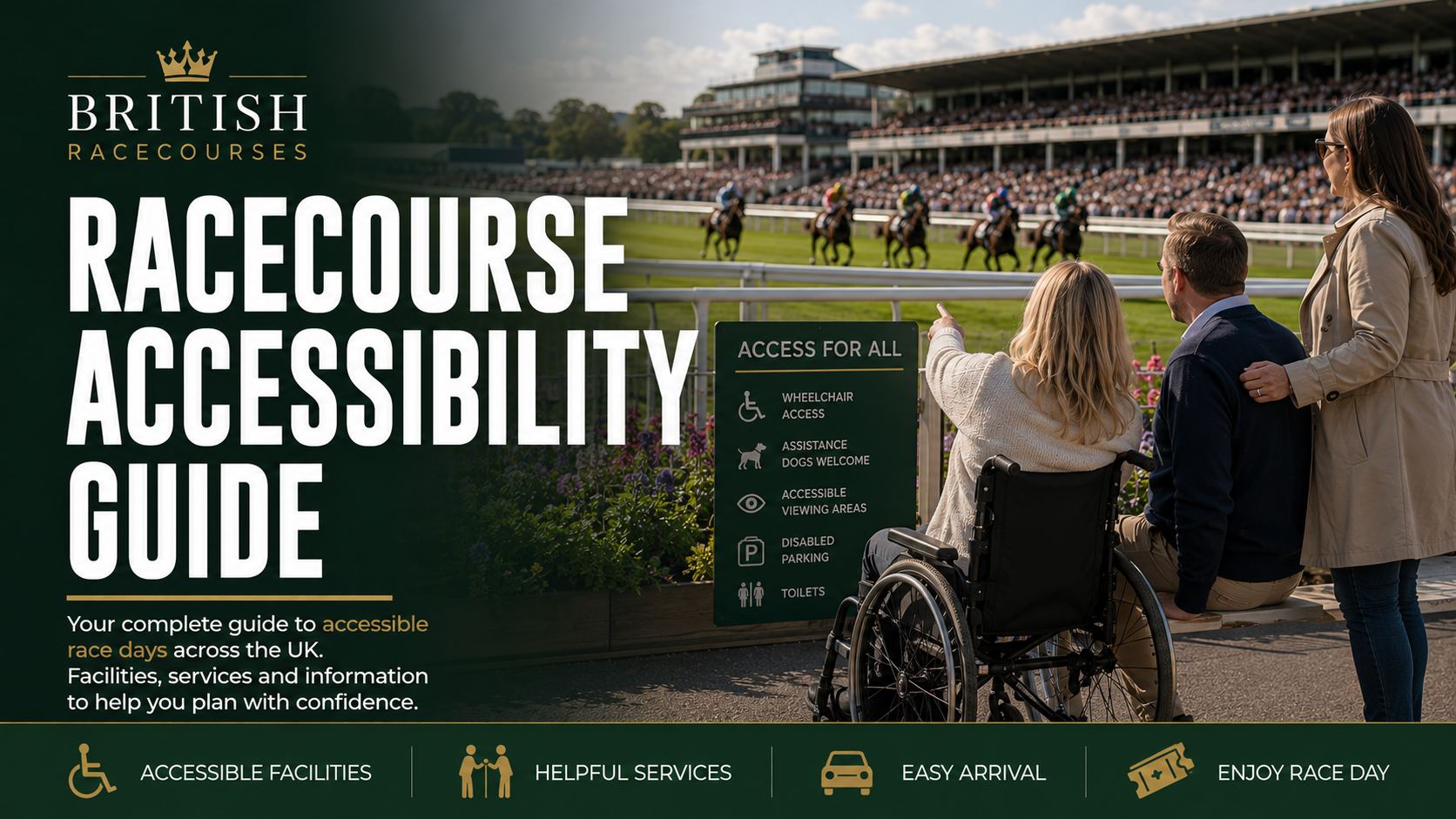
Racecourse accessibility guides give racegoers clear directions when planning a visit.
British Racecourses provides this guide to support visitors who need structured information about access routes, mobility assistance, ticketing arrangements, facilities, and safety standards across UK racecourses.
Racecourse accessibility is now a core part of raceday planning because visitors expect precision, transparency, and reliable support.
Racecourse teams across the UK work to ensure that each venue supports wheelchair users, people with limited mobility, people with sensory impairments, guide dog users, and visitors who need personal assistance.
British Racecourses offers centralised venue guides, maps, and raceday information to help users prepare for their trip with confidence.
Accessible Parking and Arrival
Accessible parking provides visitors with direct access to the racecourse gates.
Many UK racecourses provide marked bays near main entrances, and some allow pre-booked spaces during major festivals.
British Racecourses links to venue pages with complete instructions for major courses, including York racecourse, Newmarket and Goodwood.
Racecourse drop-off zones support both taxis and private cars, with transparent surfaces, gradients, ramps, and trained stewards to guide visitors to accessible gates.
Entrance Gates and Ticketing
Entrance gates now provide step-free access, with wide lanes that accommodate wheelchairs and mobility aids.
Many venues offer express entry for visitors with accessibility needs and have low counter ticket windows.
Companion ticket policies are available in British Racecourses’ course guides for easy reference.
Digital ticketing reduces queueing and simplifies scanning.
Accessible Paths, Surfaces, and Signage
Racecourse paths range from tarmac to paving stones, depending on the venue’s age and layout. British Racecourses highlights the surface types at each course in its course guides so visitors can plan routes that suit their needs.
High-contrast signs, tactile panels, clear toilet symbols, lift indicators, and QR-coded maps support visitors with sensory needs.
Grandstand Access and Viewing Platforms
Grandstand access forms a core part of racecourse accessibility. UK racecourses provide step-free access via ramps and lifts.
Viewing platforms give wheelchair users clear sightlines across the track. Hospitality suites include accessible balconies and step-free private boxes.
Lift access is managed by trained staff to ensure smooth traffic flow during peak times.
Parade Ring and Winner’s Enclosure Access
Parade ring access helps visitors enjoy pre-race viewing. Many venues provide step-free paths and low-barrier viewing points. Dedicated platforms sit near the ring with clear sightlines for wheelchair users.
British Racecourses publishes parade ring details for venues such as https://www.britishracecourses.org/epsom-downs/ and https://www.britishracecourses.org/doncaster/.
Food Outlets, Betting Points, and Hospitality Facilities
Accessible food outlets provide low counters, clear menus, and wide queues. Staff assist visitors with ordering or reaching the counters. Betting points offer low counters, ramps, and quiet service areas, while digital betting options reduce movement through busy areas. British Racecourses also supports visitors with betting guides and raceday tips.
Toilets, Changing Facilities, and Quiet Spaces
Accessible toilets sit near major venues, grandstands, and food courts. Changing Places facilities provide hoists, adjustable benches, wide doors, and areas for personal assistants.
British Racecourses lists Changing Places locations on course pages.
Quiet rooms offer a break from noise and crowds for visitors.
Assistance Dogs and Sensory Support
Racecourses welcome guide dogs and assistance dogs. Water points and rest areas sit near entrances and stand zones. Staff receive training to manage safe movement around horses and crowds. Sensory support includes printed maps, ear defenders, and quiet entry points.
Staff Training and On-Course Support
Racecourse stewards and customer service teams receive structured training in accessibility.
Training includes guiding wheelchair users, supporting sensory needs, communicating with deaf or hard-of-hearing visitors, and maintaining safe walkways. Briefings before each raceday ensure that every team member understands specific requirements and temporary changes across the venue.
Planning a Visit to British Racecourses
British Racecourses provides direct links to venue pages, raceday guides, and ticketing information.
Visitors can assess layouts, viewing options, parking zones, train links, and facilities.
This support removes uncertainty and allows visitors to plan exact routes and timings.
Guides for major venues include Aintree, Cheltenham and Ascot, and many more.
FAQs
What accessibility features do UK racecourses provide?
UK racecourses provide step-free entrances, lifts, accessible toilets, Changing Places facilities, viewing platforms, accessible betting points, clear signage, and support for guide dogs.
Do racecourses offer accessible parking?
Yes. Many racecourses offer accessible parking near entrances, with pre-booking available for major events.
Can personal assistants enter with companion tickets?
Yes. Many venues operate companion ticket policies. British Racecourses lists these arrangements on course pages.
Do racecourses support visitors with sensory needs?
Yes. Many courses provide quiet spaces, ear defenders, printed guides, and trained staff to support sensory requirements.
Are the food and betting areas accessible?
Yes. Many venues provide low counters, wide queues, accessible tills, and digital betting options.
Do racecourses allow assistance dogs?
Yes. Racecourses allow guide and assistance dogs to move freely across the site and provide rest areas with water stations.
Summary of Racecourse Accessbility
This Racecourse Accessibility Guide provides racegoers with clear, practical information about access across UK racecourses. British Racecourses provides venue-specific guidance covering parking, entrances, paths, signage, viewing platforms, toilets, hospitality areas, sensory spaces, and staff support.
This structure helps visitors plan efficient routes and move independently throughout each raceday.