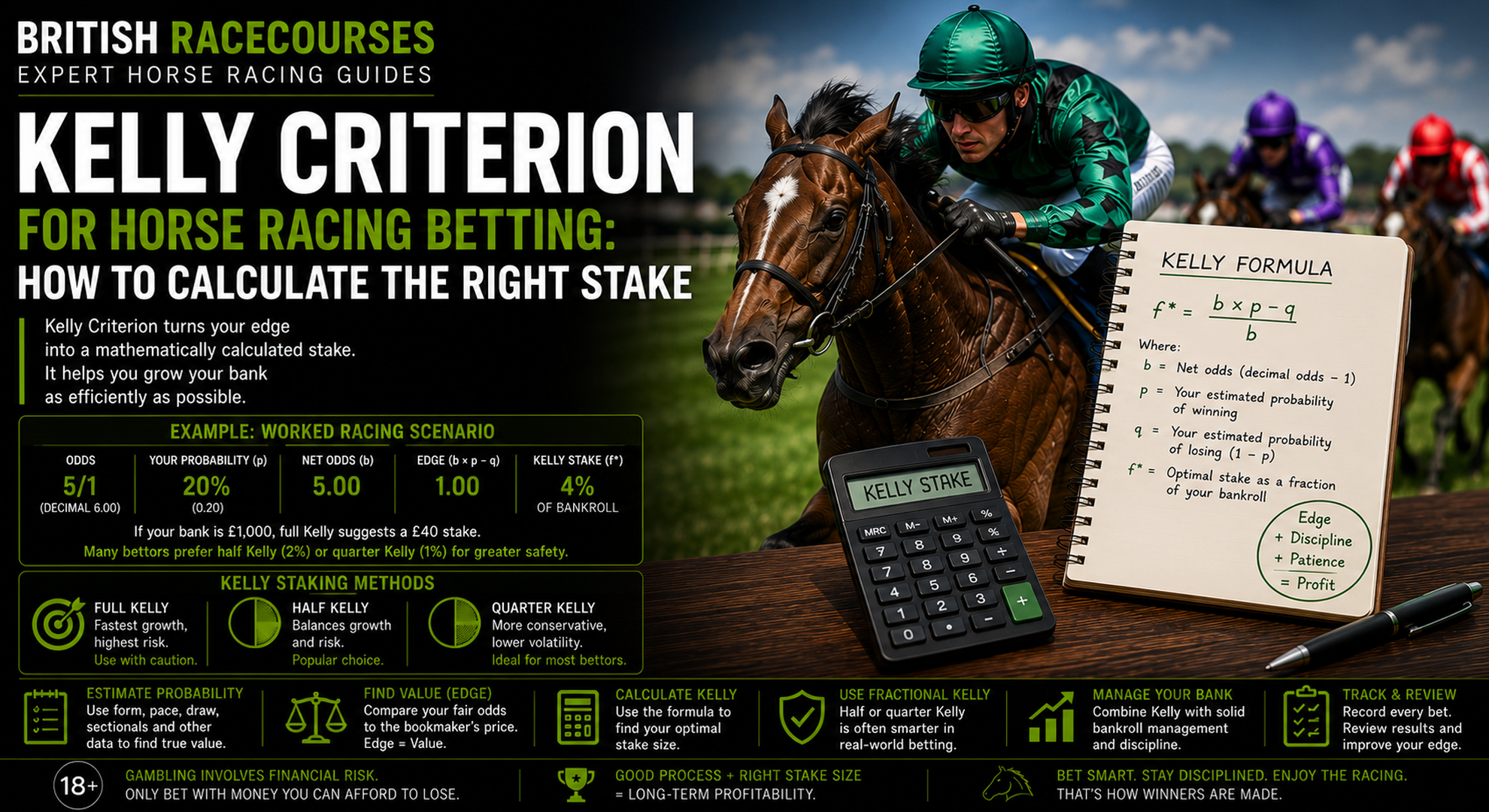
The Kelly Criterion is a mathematical staking method designed to answer one of the most difficult questions in horse racing betting:
How much should you stake when you believe you have found value?
Finding a horse you think is overpriced by the market is only the first step.
You also need to decide how much of your betting bank to risk.
Stake too little and you may fail to make full use of a genuine edge.
Stake too much and normal betting variance can produce severe drawdowns.
The Kelly Criterion provides a mathematical framework for balancing those two considerations.
It uses:
your estimated probability of winning
and:
the odds available
to calculate a suggested percentage of your betting bank to stake.
The concept is powerful.
But there is an important problem when applying it to horse racing.
Your probability estimate might be wrong.
That is why many bettors interested in Kelly staking consider fractional versions such as half Kelly or quarter Kelly rather than automatically risking the full amount produced by the formula.
This guide explains the Kelly Criterion in plain English, shows worked horse racing examples and examines where Kelly staking can go wrong.
What Is the Kelly Criterion?
The Kelly Criterion is a mathematical formula for determining how much of your available capital to risk when you believe you have an advantage.
In betting terms, it considers:
- the odds
- your estimated probability of winning
- your estimated probability of losing
and produces a suggested stake as a percentage of your betting bank.
The underlying objective is not:
maximise the profit from the next bet.
It is concerned with the long-term growth of capital across repeated opportunities.
That distinction is important.
Kelly is therefore fundamentally different from simply saying:
I really fancy this horse, so I’ll have £100 on it.
The Kelly Criterion Formula
A common version of the Kelly formula is:
f = (bp – q) ÷ b*
Where:
f* = fraction of the betting bank to stake
b = decimal odds minus 1
p = your estimated probability of winning
q = your estimated probability of losing
Because:
q = 1 – p
you only need your estimated winning probability and the available odds to perform the calculation.
A Simple Horse Racing Kelly Example
Suppose a horse is available at:
5/1
Decimal odds:
6.00
You believe it has:
20% chance of winning.
Therefore:
p = 0.20
Probability of losing:
q = 0.80
Net odds:
b = 5
Now apply Kelly:
(5 × 0.20 – 0.80) ÷ 5
Which gives:
(1 – 0.80) ÷ 5
=
0.20 ÷ 5
=
0.04
Full Kelly therefore suggests staking:
4% of the betting bank.
If your bank is:
£1,000
the suggested full Kelly stake would be:
£40
Why Did Kelly Suggest a Bet?
Because your probability estimate says the horse represents value.
A 20% winning probability corresponds to fair decimal odds of:
5.00
or:
4/1
But the available odds are:
6.00
or:
5/1
Your assessment therefore says the bookmaker is offering a bigger price than the horse’s true probability warrants.
That difference creates the estimated edge.
Before using Kelly, it is therefore essential to understand How to Price a Horse Race.
Without a meaningful probability estimate, the Kelly calculation has little practical value.
Kelly Criterion Starts With Probability
This is the most important point on this page.
Kelly does not tell you:
which horse will win.
It does not analyse:
- form
- pace
- draw
- going
- sectional times
- trainer form
- jockey bookings
You have to do that work first.
Our How to Analyse a Horse Race Like a Professional guide covers the wider analytical process.
Kelly begins after you have formed a probability estimate.
From Race Analysis to Kelly Stake
A disciplined process might look like this:
Step 1: Analyse the race
Study the runners and race conditions.
Step 2: Estimate probabilities
Assign each horse a realistic chance of winning.
Step 3: Convert probability into fair odds
A 25% probability corresponds to fair decimal odds of:
4.00
or:
3/1
Step 4: Compare your price with the market
If the bookmaker offers:
5/1
you may have identified value.
Step 5: Calculate expected value
Determine whether the difference is meaningful.
Step 6: Calculate Kelly
Use the estimated edge to determine a theoretical stake.
Step 7: Apply your bankroll rules
Decide whether full Kelly, fractional Kelly or another staking method is appropriate.
This connects Kelly directly with our guides to Expected Value in Horse Racing Betting and Horse Racing Bankroll Management.
Kelly Example: A 3/1 Horse
Suppose:
Available odds:
3/1
Decimal odds:
4.00
Your estimated winning probability:
30%
Therefore:
p = 0.30
q = 0.70
b = 3
Kelly:
(3 × 0.30 – 0.70) ÷ 3
=
(0.90 – 0.70) ÷ 3
=
0.20 ÷ 3
=
0.0667
Full Kelly suggests approximately:
6.67% of the bank.
On a:
£1,000 bank
that would mean:
£66.70
That is a sizeable stake.
This immediately demonstrates why Kelly can feel aggressive.
Kelly Example: A Small Edge
Suppose a horse is available at:
4/1
Decimal odds:
5.00
You estimate:
21% probability of winning.
Fair probability implied by 4/1 is:
20%.
So your estimated edge is relatively small.
Using:
b = 4
p = 0.21
q = 0.79
Kelly:
(4 × 0.21 – 0.79) ÷ 4
=
(0.84 – 0.79) ÷ 4
=
0.05 ÷ 4
=
0.0125
Full Kelly suggests:
1.25% of the bank.
On £1,000:
£12.50
Compare that with the previous example.
Kelly automatically responds to the estimated size of the edge.
Kelly Example: No Edge
Suppose:
Horse odds:
4/1
Your estimated probability:
20%
The market price and your fair probability match.
Kelly:
(4 × 0.20 – 0.80) ÷ 4
=
0
Suggested stake:
£0
Under the Kelly framework, there is no reason to bet.
This is a critical principle.
Having an opinion about which horse will win is not enough.
There needs to be value in the price.
Kelly Example: Negative Edge
Suppose a horse is:
4/1
but you believe its true chance is only:
15%.
Then:
p = 0.15
q = 0.85
b = 4
Kelly:
(4 × 0.15 – 0.85) ÷ 4
=
(0.60 – 0.85) ÷ 4
=
-0.0625
Kelly produces a negative figure.
That does not mean:
stake -6.25%.
For a normal back bet, it means:
do not bet.
According to your own assessment, the price does not justify a wager.
Kelly Forces You to Think About Price
This is one of the most useful aspects of Kelly.
It stops the question being:
Will this horse win?
and turns it into:
How often will this horse win relative to the price being offered?
That is exactly the principle behind How to Find Value Bets in Horse Racing.
A horse can be the most likely winner and still be a poor bet.
A less likely winner can represent better value at the right odds.
What Is Full Kelly?
Full Kelly means staking the entire percentage recommended by the formula.
If Kelly calculates:
8%
you stake:
8% of your bank.
£1,000 bank:
£80
If Kelly calculates:
2%
you stake:
£20
The stake changes according to your estimated edge.
Why Full Kelly Can Be Aggressive
Full Kelly assumes your inputs are sufficiently reliable.
Horse racing probabilities rarely come with that certainty.
Suppose you estimate:
30%
but the horse’s true probability is closer to:
24%.
Your calculated stake could be substantially too large.
This is called estimation error.
And estimation error is one of the biggest practical weaknesses of applying full Kelly to horse racing.
Your Probability Is an Estimate
You do not actually know that Horse A has:
27.4%
chance of winning.
You have estimated it.
That estimate may use:
- form
- ratings
- pace
- draw
- going
- sectionals
- trainer data
- market information
But racing contains uncertainty.
A horse can also:
- miss the break
- be hampered
- race too keenly
- encounter traffic
- jump poorly
- dislike the ground
- underperform
Your model can be good without being perfect.
Why Small Probability Errors Matter
Consider a horse available at:
5/1
Your Estimate
Winning probability:
25%
Using Kelly:
10% stake
approximately.
Now suppose the horse’s genuine probability was actually:
20%
At 5/1, Kelly would suggest:
4%.
That difference is enormous.
Your probability error has caused the staking recommendation to jump from:
4%
to:
10%.
This is why blindly using full Kelly can create substantial risk.
What Is Fractional Kelly?
Fractional Kelly means staking only part of the full Kelly recommendation.
Common examples are:
Half Kelly
and:
Quarter Kelly.
If full Kelly says:
8%
then:
Half Kelly:
4%
Quarter Kelly:
2%
The objective is to sacrifice some theoretical growth in exchange for lower volatility and greater protection against probability errors.
Full Kelly vs Half Kelly vs Quarter Kelly
Suppose:
Bank:
£1,000
Full Kelly recommendation:
8%
Then:
| Method | Stake % | Stake |
|---|---|---|
| Full Kelly | 8% | £80 |
| Half Kelly | 4% | £40 |
| Quarter Kelly | 2% | £20 |
The horse and odds are identical.
Only the level of risk changes.
Why Fractional Kelly Can Make Sense in Horse Racing
Horse racing contains significant uncertainty.
Even sophisticated bettors cannot know a horse’s exact probability.
Fractional Kelly provides a buffer against:
being wrong.
If you overestimate your edge, the smaller stake reduces the financial damage.
This can be particularly important with:
- lightly raced horses
- unusual race conditions
- large handicaps
- uncertain going
- unpredictable pace scenarios
- high-priced outsiders
Kelly and Betting Variance
Kelly staking cannot remove variance.
A horse with:
20% chance of winning
still loses approximately:
80% of the time
according to your estimate.
Even if the bet offers outstanding value.
This is why Kelly should be understood alongside Betting Variance in Horse Racing.
A mathematically justified stake can still lose.
Several mathematically justified stakes can lose consecutively.
Kelly Does Not Prevent Losing Runs
Imagine your strategy identifies ten genuine value bets.
Every one loses.
That does not automatically prove:
Kelly failed.
Kelly determined stake size based on your probability estimates.
It did not guarantee the outcomes.
The key questions remain:
Were your probabilities accurate?
Were the prices genuinely favourable?
Was the sample large enough?
Kelly and Drawdown
Full Kelly can produce uncomfortable drawdowns.
Suppose several selections produce suggested stakes of:
5%
7%
4%
6%
and they all lose.
The bank can decline rapidly.
Fractional Kelly reduces the size of those swings.
That can make it easier to continue following the strategy during normal losing periods.
The Psychological Advantage of Smaller Kelly Stakes
Mathematical optimisation is not useful if you cannot follow the strategy.
Imagine full Kelly recommends:
£120
but losing £120 on one horse would make you:
- panic
- chase the loss
- abandon your strategy
- reduce your next good bet
- increase your next bad bet
Then the theoretical calculation is not producing a practical betting system.
A smaller fractional Kelly stake may be more manageable.
Kelly and Bankroll Management
Kelly assumes stakes are calculated as a fraction of available capital.
This means your betting bank matters.
Suppose:
Bank:
£1,000
Kelly recommendation:
4%
Stake:
£40
After losing:
New bank:
£960
If the same 4% opportunity appeared again:
New stake:
£38.40
The stake automatically falls as the bank declines.
That helps control risk.
Our Horse Racing Bankroll Management guide explains why your betting capital should be clearly defined and separated from essential spending.
Kelly Stakes Grow With the Bank
The reverse also happens.
Suppose your bank grows:
£1,000 → £1,500
A 4% Kelly stake becomes:
£60
rather than:
£40.
The monetary stake therefore rises and falls with your capital.
This is a form of compounding.
Never Calculate Kelly From Money You Cannot Afford to Lose
Your Kelly bank should be your actual:
betting bank.
Not:
- savings
- rent money
- mortgage money
- emergency funds
- borrowed money
- available credit
Kelly is a staking formula.
It does not make gambling risk-free.
Kelly vs Flat Staking
Flat staking uses the same stake on each qualifying bet.
For example:
£10 every selection.
Kelly staking varies the stake according to the estimated edge.
Flat Staking
Horse A:
£10
Horse B:
£10
Horse C:
£10
Kelly Staking
Horse A:
£8
Horse B:
£24
Horse C:
£0
Kelly is therefore more responsive to your assessment of value.
But that advantage depends entirely on the quality of your probability estimates.
When Flat Staking May Be Better
Flat staking can be preferable when:
- you are still testing your strategy
- your probability estimates are crude
- you struggle to quantify edge accurately
- you want simple record keeping
- you want to reduce subjective staking decisions
A complicated formula does not improve bad inputs.
For many bettors, simple and consistent staking can be more useful than false mathematical precision.
Kelly vs Points-Based Staking
A Points-Based Betting System expresses stakes in units.
For example:
0.5 points
1 point
2 points
Kelly instead produces a calculated percentage.
You can combine the two ideas.
For example:
Kelly recommendation:
2%
If:
1 point = 1% of bank
then:
Kelly stake:
2 points
Kelly and Expected Value
Expected value asks:
Is this bet theoretically profitable according to my probability estimate?
Kelly asks:
If it is, how much should I risk?
That distinction is important.
You should understand Expected Value in Horse Racing Betting before attempting Kelly staking.
Kelly cannot rescue a negative-EV bet.
Bigger Edge, Bigger Kelly Stake
Suppose two horses are both:
5/1
Horse A
Your probability:
18%
Horse B
Your probability:
25%
Horse B has the larger estimated edge.
Kelly therefore recommends a larger stake.
This is mathematically logical.
But remember:
larger estimated edge does not necessarily mean larger genuine edge.
You could simply be more wrong.
Beware of False Confidence
A dangerous bettor says:
I’m certain this horse should be 2/1, not 5/1.
Kelly sees an enormous edge and responds with a large stake.
But confidence is not evidence.
Ask:
- How did I estimate the probability?
- Is my model historically calibrated?
- Have I considered pace?
- Have I considered draw?
- Have I considered going?
- Have I compared my price with the market?
- Does my assessment consistently beat later prices?
Without evidence, Kelly can magnify overconfidence.
Kelly and Closing Line Value
Closing Line Value in Horse Racing can provide useful feedback.
Suppose you repeatedly:
back 8/1
and the horses start:
5/1.
That does not prove your probability estimates are perfect.
But consistently beating the later market can provide evidence that your pricing process may be identifying information or value earlier than the market.
If you continually take:
5/1
and the selections start:
10/1
you should investigate your assumptions.
Kelly and Market Efficiency
Kelly staking becomes dangerous when bettors assume:
my price must be correct and the market must be wrong.
Horse racing markets contain large amounts of information.
The market should therefore be treated as an important benchmark.
Your probability estimate needs a reason to differ.
That reason might involve:
- pace
- draw
- sectional performance
- ground preference
- improving form
- a misleading previous run
But:
I fancy it
is not enough.
Use Pace to Improve Probability Estimates
A Horse Racing Pace Map can help determine how a race may unfold.
Suppose a horse appears likely to secure an uncontested lead.
That could increase its chance relative to a basic form rating.
But the adjustment should still be realistic.
Do not turn:
possible tactical advantage
into:
certainty.
Kelly will magnify any exaggeration in your probability estimate.
Use Draw Data Carefully
The same applies to Horse Racing Draw.
A favourable stall can improve a horse’s prospects.
But draw bias varies according to:
- course
- distance
- field size
- pace
- going
- rail position
A historical draw advantage should influence your probability assessment rather than automatically determine it.
Sectionals and Kelly
Horse Racing Sectional Times can reveal performances that finishing positions hide.
Imagine a horse finished sixth after being badly positioned in a slowly run race but recorded an exceptional closing sectional.
You may rate the run more highly than the market.
That can produce a different fair price.
Kelly only becomes relevant after you quantify that difference.
Kelly and Outsiders
Kelly can produce interesting results with outsiders.
Suppose:
Odds:
20/1
Decimal:
21.00
Your probability:
6%
Fair odds at 6% are roughly:
15.67/1
So you believe 20/1 represents value.
Using:
b = 20
p = 0.06
q = 0.94
Kelly:
(20 × 0.06 – 0.94) ÷ 20
=
(1.20 – 0.94) ÷ 20
=
0.26 ÷ 20
=
1.3%
Despite the large odds, Kelly suggests a relatively modest stake.
Why Outsider Kelly Bets Still Need Caution
A 6% chance means approximately:
94% chance of losing.
Even if your edge is genuine.
That means long losing sequences are entirely plausible.
This is another reason to understand variance before using Kelly.
Large odds do not mean:
stake more because the payout is bigger.
The winning probability matters just as much.
Kelly and Short-Priced Horses
Suppose:
Odds:
Evens
Decimal:
2.00
Your probability:
55%
Then:
b = 1
p = 0.55
q = 0.45
Kelly:
(1 × 0.55 – 0.45) ÷ 1
=
10%
Full Kelly suggests:
10% of the bank.
That is a substantial position.
And the horse still has an estimated:
45% chance of losing.
This demonstrates again why fractional Kelly can be attractive.
Kelly Does Not Mean “Big Bet on a Certainty”
There are no certainties in horse racing.
Kelly is not a confidence system.
It is a relationship between:
probability
price
and:
bankroll.
A short-priced favourite can produce a large Kelly stake if your probability estimate substantially exceeds the market’s implied probability.
But the bet can still lose.
What Is Half Kelly?
Half Kelly means taking:
50%
of the full Kelly recommendation.
Full Kelly:
6%
Half Kelly:
3%
£1,000 bank:
Full Kelly = £60
Half Kelly = £30
This reduces volatility and provides some protection against inaccurate probability estimates.
What Is Quarter Kelly?
Quarter Kelly means using:
25%
of the full Kelly recommendation.
Full Kelly:
8%
Quarter Kelly:
2%
£1,000 bank:
Full Kelly = £80
Quarter Kelly = £20
This is considerably more conservative.
Full vs Half vs Quarter Kelly Example
Suppose your bank is:
£2,000
and full Kelly calculates:
6%.
| Method | Bank Percentage | Stake |
|---|---|---|
| Full Kelly | 6% | £120 |
| Half Kelly | 3% | £60 |
| Quarter Kelly | 1.5% | £30 |
All three methods use the same:
- horse
- price
- probability estimate
- theoretical edge
The difference is simply how aggressively you expose the bank.
Why Not Use One-Eighth Kelly?
You can.
Fractional Kelly does not have to be:
half
or:
quarter.
You could theoretically use:
one-third Kelly
one-fifth Kelly
one-eighth Kelly
The fraction is a risk-management choice.
However, avoid endlessly adjusting the fraction according to emotion.
Choose a system and apply it consistently enough to evaluate it.
Kelly and Multiple Simultaneous Bets
Basic Kelly examples often assume individual opportunities.
Horse racing can create a more complicated situation.
Suppose you have:
six value bets
running within an hour.
Individually, Kelly suggests:
4%
3%
5%
2%
6%
4%
That creates substantial combined exposure.
You should consider:
- total bank exposure
- correlation
- whether probability estimates share the same assumptions
- whether the bets overlap
Do not blindly treat each calculation in isolation.
Correlated Racing Bets
Imagine you back:
Horse A to win the Cheltenham Gold Cup
and also include Horse A in:
a festival multiple.
Those positions are related.
If Horse A loses, both suffer.
Similarly, several bets might depend on the same:
- ground assumptions
- trainer form
- pace analysis
- festival conditions
Your overall exposure can therefore be greater than it initially appears.
Kelly and Each-Way Bets
Applying Kelly to each-way betting is more complicated because an each-way wager contains two bets:
win
and:
place.
You need to consider:
- win probability
- place probability
- win odds
- place fraction
- number of places
- dead-heat possibilities
- bookmaker terms
Simply applying the standard win-bet Kelly formula to the total each-way stake can be misleading.
Kelly and Betting Exchanges
Kelly can theoretically be applied to exchange betting.
But remember to account for:
commission
when determining the effective return.
A quoted exchange price is not necessarily the same as the net price after commission.
Our UK Betting Exchange Sites guide explains how exchanges differ from traditional bookmakers.
Better Prices Can Change the Kelly Stake
Suppose your probability estimate remains unchanged.
Bookmaker A offers:
4/1
Bookmaker B offers:
5/1
The stronger price:
- increases expected value
- increases the Kelly recommendation
This is another reason comparing prices matters.
Our Best Horse Racing Betting Sites guide can help you compare racing bookmakers.
Never Increase Kelly Because You Lost Yesterday
Kelly is calculated from:
current bank
current price
current probability estimate.
Yesterday’s result is irrelevant to today’s edge.
Do not say:
Kelly says 3%, but I’m down £200, so I’ll use 6%.
That is no longer Kelly.
That is chasing losses.
Never Increase Kelly Because You Are Winning
Winning runs create the opposite temptation.
A bettor starts with:
quarter Kelly
wins repeatedly and decides:
I’m clearly good at this, so I’ll switch to double Kelly.
Short-term success does not prove that probability estimates are accurate.
Betting Variance in Horse Racing works in both directions.
Winning runs can be as misleading as losing runs.
Do Not Round Probabilities to Create Bets
Suppose your analysis produces:
19.2%
but you need:
21%
for the price to look attractive.
Do not simply decide:
I’ll call it 22%.
That destroys the purpose of the calculation.
Kelly is only as useful as the honesty of its inputs.
False Precision Is Dangerous
A spreadsheet might tell you:
Horse A = 23.74%
That looks scientific.
But your underlying assessment may not justify two decimal places.
Your probability is still an estimate.
Writing:
23.74%
instead of:
24%
does not make it more accurate.
Calibrate Your Probability Estimates
One of the best ways to improve a probability-based approach is to examine calibration.
Suppose you have 500 historical selections that you rated:
around 20%
How often did they actually win?
If the answer is approximately:
20%
that is encouraging.
If they won:
10%
your probabilities may be systematically too optimistic.
If they won:
30%
you may be systematically underestimating them.
Calibration matters enormously when using Kelly.
Group Bets by Estimated Probability
A useful record might look like:
| Estimated Probability | Number of Bets | Actual Strike Rate |
|---|---|---|
| 10–14.9% | ||
| 15–19.9% | ||
| 20–24.9% | ||
| 25–29.9% | ||
| 30–39.9% | ||
| 40%+ |
Over a meaningful sample, compare:
predicted
with:
actual.
This can reveal whether your model tends to overestimate or underestimate certain horses.
Track Price Taken Too
For every Kelly bet, record:
- horse
- race
- your probability
- your fair odds
- available odds
- Kelly percentage
- Kelly fraction used
- actual stake
- closing odds
- result
- profit/loss
This gives you far more useful information than simply recording:
winner
or:
loser.
A Practical Kelly Record
| Horse | Your Probability | Odds Taken | Full Kelly | Fraction Used | Actual Stake |
|---|---|---|---|---|---|
| A | 25% | 5/1 | 10% | ¼ | 2.5% |
| B | 21% | 4/1 | 1.25% | ¼ | 0.31% |
| C | 15% | 4/1 | Negative | None | £0 |
This immediately shows how Kelly can act as both:
a staking method
and:
a filter.
Consider a Maximum Stake Cap
Even fractional Kelly can occasionally generate a large recommendation.
Some bettors therefore impose a maximum.
For example:
Quarter Kelly with a maximum stake of 2% of bank.
If quarter Kelly calculates:
1.4%
stake:
1.4%.
If it calculates:
3.5%
stake:
2%.
A cap can provide additional protection against extreme probability errors.
Consider a Minimum Edge
You can also decide not to bet tiny theoretical edges.
Why?
Because:
- your probability estimate contains error
- prices can move
- commission may apply
- small edges can disappear easily
A calculated edge of:
0.2%
may not be meaningful if your probability estimates are only approximate.
Kelly Does Not Know How Good Your Model Is
This is perhaps the biggest limitation.
The formula treats the probability you enter as an input.
It does not ask:
Where did 27% come from?
It could come from:
- a sophisticated model
- years of race analysis
- a random guess
Kelly treats the number the same way.
The quality control has to come from you.
Common Kelly Criterion Mistakes
Using Bookmaker Probability as Your Own Probability
If you simply convert the bookmaker’s price into probability and feed that into Kelly, you have not identified an edge.
You need an independent estimate.
Overestimating Your Edge
Small probability errors can dramatically increase the recommended stake.
Using Full Kelly Automatically
Full Kelly may be far more volatile than expected.
Ignoring Variance
Good Kelly bets still lose.
Chasing Losses
Increasing the calculated stake because previous bets lost defeats the system.
Ignoring the Bank
Kelly is based on current betting capital.
Mixing Banks
Do not calculate percentages from different arbitrary balances.
Ignoring Correlation
Several related bets can create concentrated exposure.
Ignoring Price Movement
The Kelly percentage changes when the odds change.
Assuming Mathematical Means Safe
A formula does not remove gambling risk.
A Practical Kelly Process for Horse Racing
Before every potential Kelly bet:
1. Analyse the Race
Use form, pace, draw, going and relevant performance data.
2. Produce Your Fair Price
Estimate the horse’s genuine winning probability.
3. Compare the Market
Look across bookmakers for the strongest available odds.
4. Check for Value
If the available price is shorter than your fair price, do not back it simply because you fancy the horse.
5. Calculate Full Kelly
Use the formula.
6. Apply Your Chosen Fraction
For example:
Half Kelly
or:
Quarter Kelly.
7. Apply Any Maximum Stake Cap
Do not exceed your predetermined risk limit.
8. Record the Bet
Record your price before the race.
9. Record the Closing Price
This helps assess your process later.
10. Review Across a Large Sample
Do not redesign the system after five bets.
Kelly Criterion Checklist
Before using Kelly, ask:
☐ Do I have a defined betting bank?
☐ Can I afford to lose that bank?
☐ Have I independently estimated the horse’s probability?
☐ How did I arrive at that probability?
☐ What are my fair odds?
☐ What odds are available?
☐ Is there genuinely positive expected value?
☐ What does full Kelly recommend?
☐ Am I using full or fractional Kelly?
☐ Have I defined a maximum stake?
☐ Do I have other correlated positions?
☐ Am I increasing the stake because of previous results?
☐ Will I record the closing price?
☐ Is my probability model calibrated?
If you cannot answer those questions, simplifying your staking method may be more sensible.
When Kelly Criterion Is Most Useful
Kelly becomes most useful when you have:
- a defined betting bank
- repeatable race analysis
- independent probability estimates
- a history of recorded bets
- evidence about the accuracy of your prices
- disciplined staking
- enough opportunities for long-term evaluation
It is less useful when probabilities are essentially guesses.
When Kelly Criterion Is Probably Unnecessary
You probably do not need Kelly if you:
- bet occasionally for entertainment
- do not create your own prices
- do not maintain a betting bank
- choose horses primarily because you fancy them
- do not record results
A simple affordable fixed stake may be easier to understand.
Do not introduce mathematical complexity for its own sake.
How Kelly Fits Into the British Racecourses Analysis Process
The analysis cluster now has a clear progression.
Analyse the race
↓
How to Analyse a Horse Race Like a Professional
↓
Understand race shape
↓
Horse Racing Pace Maps Explained
↓
Identify hidden performance
↓
Horse Racing Sectional Times Explained
↓
Create probabilities and fair odds
↓
↓
Identify value
↓
How to Find Value Bets in Horse Racing
↓
Calculate expected value
↓
Expected Value in Horse Racing Betting
↓
Evaluate your price against the market
↓
Closing Line Value in Horse Racing
↓
Understand why good bets still lose
↓
Betting Variance in Horse Racing
↓
Protect your capital
↓
Horse Racing Bankroll Management
↓
Calculate stake size
↓
Kelly Criterion for Horse Racing Betting
That gives each article a specific purpose rather than creating multiple pages answering essentially the same question.
Frequently Asked Questions
What is the Kelly Criterion in horse racing betting?
The Kelly Criterion is a mathematical staking formula that uses your estimated probability of winning and the available odds to calculate a suggested percentage of your betting bank to risk.
What is the Kelly formula?
A common version is:
f = (bp – q) ÷ b*
where b represents net decimal odds, p your estimated winning probability and q your estimated losing probability.
What does Kelly percentage mean?
It represents the calculated fraction of your betting bank to stake.
Does Kelly tell me which horse to back?
No. You need to analyse the race and estimate probabilities independently before using Kelly.
Does Kelly guarantee profit?
No. Individual bets and sequences of bets can lose, and your probability estimates may be inaccurate.
What is full Kelly?
Full Kelly means staking the entire percentage recommended by the formula.
What is half Kelly?
Half Kelly means staking 50% of the full Kelly recommendation.
What is quarter Kelly?
Quarter Kelly means staking 25% of the full Kelly recommendation.
Why use fractional Kelly?
Fractional Kelly reduces volatility and limits the effect of errors in your probability estimates.
Is full Kelly risky?
It can produce substantial stakes and significant drawdowns, particularly when your probability estimates are inaccurate.
Can Kelly produce a zero stake?
Yes. If your estimated probability matches the available price and there is no calculated edge, Kelly can recommend no bet.
What happens if Kelly produces a negative number?
For a normal back bet, a negative Kelly figure indicates that the wager does not offer positive value according to your probability estimate.
Can I use Kelly on outsiders?
Yes, but low-probability selections can still create long losing runs even when the price represents value.
Can I use Kelly on favourites?
Yes. The same relationship between probability and odds applies.
Is Kelly better than flat staking?
Not universally. Kelly can make better use of varying estimated edges, but it relies heavily on accurate probability estimates. Flat staking is simpler and can be more robust when those estimates are uncertain.
Can I combine Kelly with points?
Yes. You can convert the Kelly percentage into betting points based on your bank.
Should I use a maximum Kelly stake?
A predetermined stake cap can reduce exposure when the formula produces unusually large recommendations.
Does Kelly account for losing streaks?
The formula incorporates probability and bankroll growth mathematically, but it does not prevent losing streaks or uncomfortable drawdowns.
Should beginners use Kelly?
Bettors who cannot confidently create independent probabilities may find simple fixed or percentage staking easier to understand.
Why is probability estimation so important?
The Kelly stake is calculated directly from the probability you enter. An inaccurate probability can therefore create an inappropriate stake.
What is the biggest danger of Kelly betting?
Overestimating your edge and consequently staking too much.
Can I use Kelly with each-way bets?
The calculation becomes more complicated because win and place portions have different probabilities and returns.
Can Kelly be used with betting exchanges?
It can be adapted, but effective odds should account for exchange commission.
Should I change my Kelly fraction after a losing run?
Not simply because you have lost. Any change should come from a deliberate review of your risk tolerance, model or staking strategy rather than an emotional reaction.
Should I increase Kelly after a winning run?
Not simply because recent results were good. Positive variance can make a strategy appear stronger than it really is.
How do I know whether my probabilities are accurate?
Record them and compare predicted probabilities with actual results across sufficiently large samples. Also monitor the prices you take relative to the later market.
Does a bigger edge always mean a bigger stake?
Under Kelly, yes, assuming the probability estimate and odds are correct. In practice, uncertainty around the estimate may justify fractional Kelly or a maximum stake cap.
Summary
The Kelly Criterion provides a mathematical answer to the question:
How much should I stake when I believe I have an edge?
It combines:
your estimated probability
with:
the available odds
to calculate a suggested proportion of your betting bank.
That makes it considerably more sophisticated than simply increasing stakes because you strongly fancy a horse.
But Kelly has an important weakness.
It trusts the probability you give it.
If you say a horse has:
30% chance
when its genuine probability is:
20%
Kelly cannot identify your mistake.
It simply calculates the stake using the incorrect number.
That is why Kelly should never be viewed in isolation.
First, learn How to Analyse a Horse Race Like a Professional.
Then learn How to Price a Horse Race.
Use Expected Value in Horse Racing Betting to determine whether your price suggests an edge.
Use Closing Line Value in Horse Racing as one source of feedback on your pricing process.
Understand Betting Variance in Horse Racing so losing runs do not surprise you.
And establish proper Horse Racing Bankroll Management before calculating percentage stakes.
Only then does Kelly become genuinely useful.
For horse racing, the most important practical lesson may not be:
always use full Kelly.
It is:
the stronger your evidence of an edge, the more defensible a larger stake becomes, but uncertainty in your probability estimate should always be respected.
Full Kelly offers a mathematical benchmark.
Fractional Kelly provides a more conservative way of applying the same principle when real-world probabilities are uncertain.
Whichever approach you use, the stake should come from:
probability + price + bankroll
rather than:
confidence + emotion + previous results.
18+. Gambling involves financial risk. Only bet with money you can afford to lose.