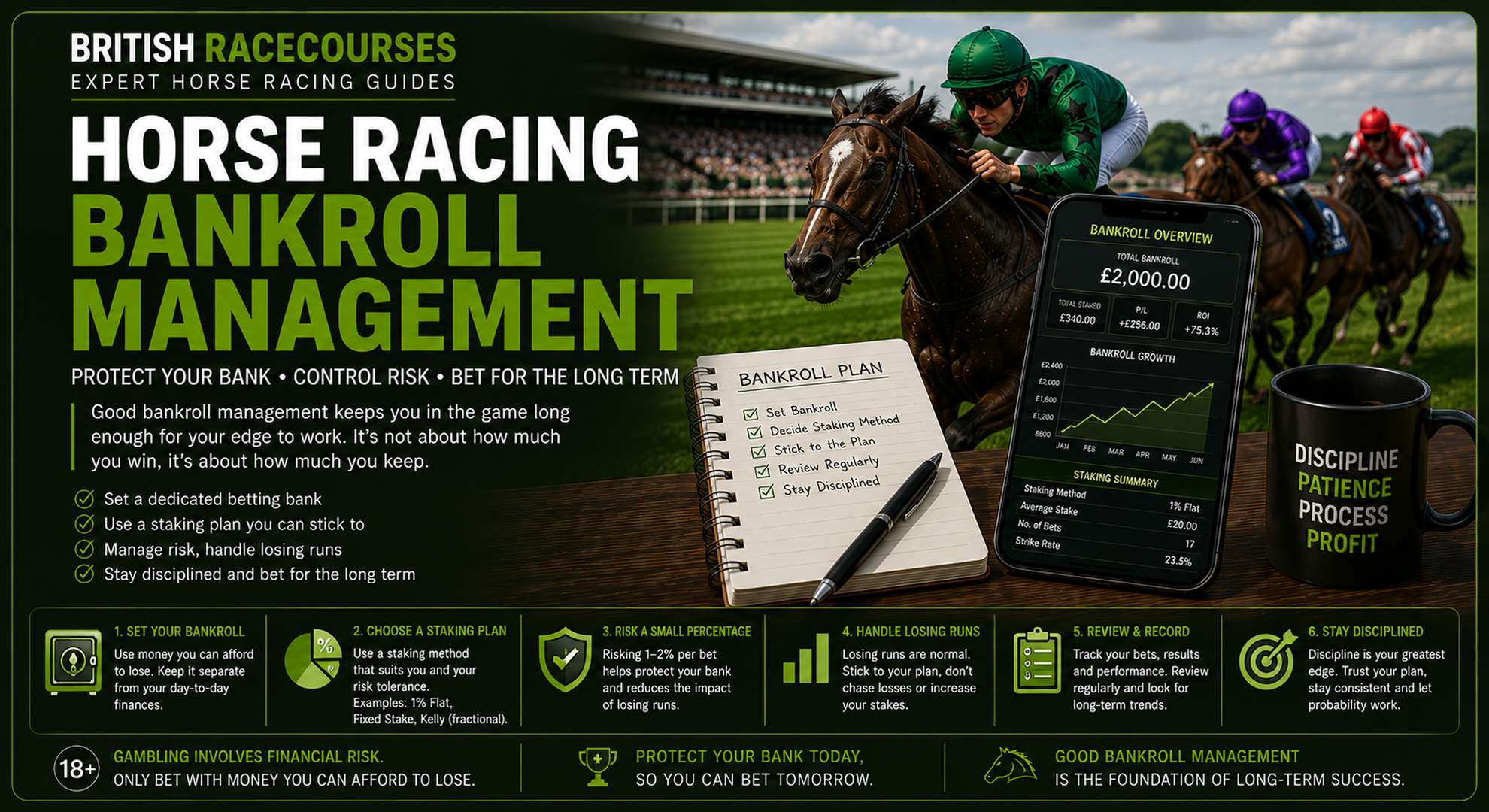
Horse racing bankroll management is the process of deciding how much money you are prepared to allocate to betting and how much of that bank you risk on each selection.
It sounds simple.
In practice, it is one of the most important parts of a disciplined betting strategy.
You can identify value.
You can beat the closing market.
You can make sound race assessments.
But if you stake too aggressively, a perfectly normal losing run can still wipe out your betting bank.
That is why bankroll management sits directly after Betting Variance in Horse Racing in the British Racecourses analysis process.
Variance explains why good bets can lose for extended periods.
Bankroll management determines whether your betting capital can survive those periods.
The objective is not to eliminate losses.
That is impossible.
The objective is to make sure normal betting volatility does not force you into:
- chasing losses
- dramatically increasing stakes
- depositing more money
- abandoning your strategy
- risking money you cannot afford to lose
This guide explains how to set a horse racing betting bank, choose sensible staking units, understand drawdown, compare flat staking with percentage staking and decide when your stake size needs to change.
What Is a Betting Bank?
A betting bank is a separate amount of money allocated specifically for betting.
It should not include money required for:
- mortgage or rent
- household bills
- food
- debt repayments
- savings commitments
- emergencies
- family expenses
Think of the betting bank as the maximum amount of capital you have consciously decided to expose to gambling risk.
If you decide:
My horse racing betting bank is £1,000
then your starting bank is:
£1,000
Not:
£1,000 plus whatever else is available in my current account.
That distinction matters.
Why Use a Separate Betting Bank?
A separate bank gives you a clearer picture of your betting performance.
Suppose you deposit:
£100
then another:
£200
then another:
£150
after losing periods.
Your bookmaker balance might eventually recover to:
£300
and make it feel as though you are doing reasonably well.
But your total deposits were:
£450
You are actually down:
£150
A defined betting bank makes this much easier to see.
Your Betting Bank Is Not Your Bookmaker Balance
These terms should not be confused.
Imagine you have:
Bookmaker A: £150
Bookmaker B: £250
Bookmaker C: £100
Bank account allocated for betting: £500
Your complete betting bank is:
£1,000
The money is simply distributed across several locations.
This is particularly relevant if you use Multiple Bookmaker Accounts to compare prices.
You should always understand the combined position.
How Big Should Your Horse Racing Betting Bank Be?
There is no correct amount for everybody.
One person may use:
£100
Another:
£500
Another:
£5,000
The amount itself is less important than whether it is affordable to lose.
Do not choose your bank based on:
How much money do I want to make?
Start with:
How much money can I allocate without affecting anything important if the entire amount is lost?
That is a much safer foundation.
Treat the Whole Bank as At Risk
A common mistake is thinking:
I will never lose the whole bank because my betting is good.
That assumption can lead to excessive stakes.
Horse racing remains uncertain.
Even a strategy with genuine positive expected value can experience severe drawdowns.
Your bank should therefore be money you can afford to lose completely.
What Is a Betting Unit?
A betting unit is a standard measurement used to size stakes.
Instead of saying:
I bet £10
you might say:
I bet 1 point
If your bank is:
£1,000
and one point is:
1% of your bank
then:
1 point = £10
This makes your staking system easier to compare over time.
Why Use Points?
Points separate staking strategy from the absolute size of your bank.
For example:
Bettor A
Bank: £500
1 point: £5
Bettor B
Bank: £2,000
1 point: £20
Both bettors are risking:
1%
on a one-point bet.
That makes results easier to analyse.
British Racecourses already has a dedicated Points-Based Betting System guide that explains the wider concept.
What Percentage of Your Bank Should You Bet?
There is no universal percentage.
Common staking approaches might involve risking:
- 0.5%
- 1%
- 2%
- sometimes more
per selection.
The correct level depends on:
- average odds
- strike rate
- expected edge
- variance
- number of bets
- personal risk tolerance
- whether bets overlap
Higher stakes create faster bank growth when things go well.
They also produce deeper drawdowns when things go badly.
Example: 1% Staking
Bank:
£1,000
Stake:
1%
Each one-point bet is:
£10
After ten consecutive losing bets:
Loss:
£100
Remaining bank:
£900
That is a:
10% drawdown
if you continue using the original fixed £10 stake.
Example: 5% Staking
Now use the same:
£1,000 bank
but stake:
£50 per bet
Ten consecutive losses cost:
£500
Half the betting bank is gone.
And a ten-bet losing run is not remotely impossible for many racing strategies.
This is why apparently modest changes in staking percentage can dramatically change risk.
Odds Should Influence Bankroll Risk
A bettor specialising in:
Evens to 2/1
faces a different variance profile from someone regularly backing:
10/1 to 25/1
outsiders.
Higher-priced horses generally produce:
- lower strike rates
- longer losing runs
- greater volatility
That means a staking level suitable for short-priced selections may be far too aggressive for an outsider strategy.
Read Horse Racing Favourite-Longshot Bias Explained for more about how price ranges affect betting behaviour.
Bankroll Management and Variance
Suppose your strategy has a:
15% strike rate
That means approximately:
85% of bets lose
in broad terms.
Long losing sequences are therefore part of the strategy’s natural profile.
If your staking plan cannot survive:
15 or 20 consecutive losers
then your bank may be too small or your stakes too large.
Our Betting Variance in Horse Racing guide explains why these sequences can occur even when the underlying strategy is sound.
Flat Staking
Flat staking means betting the same amount on each qualifying selection.
For example:
Bank:
£1,000
Stake:
£10
Every bet:
£10
regardless of:
- price
- confidence
- previous result
This is one of the simplest staking systems.
Advantages of Flat Staking
Flat staking is:
- easy to understand
- easy to record
- resistant to emotional staking changes
- useful for evaluating a strategy
- less vulnerable to overconfidence
It is particularly useful when testing whether your selections themselves have an edge.
Disadvantages of Flat Staking
Flat stakes do not account for:
- changing bank size
- different levels of perceived edge
- differing probability
- odds
A £10 stake may eventually become very small relative to a growing bank.
Or too large relative to a shrinking one.
Fixed Percentage Staking
Percentage staking means risking a fixed percentage of your current bank.
For example:
1% of current bank
Starting bank:
£1,000
Stake:
£10
If the bank rises to:
£1,200
new stake:
£12
If the bank falls to:
£800
new stake:
£8
The stake changes automatically with the bank.
Advantages of Percentage Staking
This approach:
- reduces stakes during losing periods
- increases stakes as the bank grows
- limits the chance of complete ruin under ordinary percentage staking
- keeps risk broadly proportional to available capital
It can be a useful way of controlling drawdowns.
Disadvantages of Percentage Staking
Percentage staking can make individual stake amounts less convenient.
It can also cause:
stake creep
after strong winning periods.
A bettor whose bank grows quickly may suddenly find themselves placing stakes much larger than they are emotionally comfortable with.
You should still maintain personal maximums.
Fixed Stakes vs Percentage Stakes
Consider:
Bank starts at £1,000
Fixed £10 Stake
Bank falls to £500.
You still stake:
£10
That is now:
2% of the bank
rather than the original 1%.
Your risk is increasing as the bank falls.
1% Percentage Stake
Bank falls to £500.
Stake falls to:
£5
Your risk remains:
1%.
This illustrates one of the main advantages of percentage-based staking.
What Is a Drawdown?
A drawdown is the decline from a previous peak in your betting bank.
Suppose:
Peak bank:
£2,000
Current bank:
£1,600
Drawdown:
£400
Percentage drawdown:
20%
Drawdown tells you how severe your losing period has been.
Why Drawdown Matters
Profit alone can hide risk.
Consider two strategies.
Strategy A
Annual profit:
£1,000
Maximum drawdown:
£250
Strategy B
Annual profit:
£1,000
Maximum drawdown:
£2,500
They produced the same eventual profit.
But Strategy B required much greater financial and emotional tolerance.
That makes drawdown an important performance metric.
Recovery From Drawdown Gets Harder
Percentage losses and gains are not symmetrical.
| Bank Loss | Gain Needed to Recover |
|---|---|
| 10% | 11.1% |
| 20% | 25% |
| 25% | 33.3% |
| 50% | 100% |
| 75% | 300% |
This is why avoiding catastrophic losses matters.
If you lose:
50%
of your bank, you need to double the remaining capital just to return to where you started.
Do Not Chase a Drawdown
Suppose your bank drops from:
£1,000
to:
£800
The temptation is:
I need to win £200 back quickly.
That can lead to larger stakes.
But the market does not know you are £200 down.
The next race should be assessed exactly as it would have been if your bank was at an all-time high.
Your drawdown is not a reason to place a larger bet.
Do Not Double Stakes After a Loss
Martingale-style thinking can be particularly dangerous.
Imagine:
Bet 1: £10
Loss
Bet 2: £20
Loss
Bet 3: £40
Loss
Bet 4: £80
Loss
Bet 5: £160
Loss
Bet 6 requires:
£320
You are risking huge amounts simply because previous unrelated bets lost.
Long losing runs can and do occur.
There is no guarantee the next selection wins.
The Market Does Not Owe You a Winner
After ten losers, your next horse is not:
due.
If you calculate that it has:
20% chance of winning
its probability remains roughly:
20%.
Your previous bets do not improve today’s horse.
This is one of the most important psychological parts of bankroll management.
What Is Risk of Ruin?
Risk of ruin is the probability that your staking and results reduce your bank to a level where you can no longer continue the strategy.
It depends on factors including:
- edge
- strike rate
- odds
- variance
- bank size
- stake size
The higher the percentage of your bank risked per bet, the greater the danger.
Can a Winning Bettor Go Broke?
Yes.
A bettor can theoretically have a positive long-term edge and still lose their bank if they stake too aggressively.
Imagine a strategy with genuine:
+5% expected value
but the bettor risks:
25% of the bank per selection.
A few normal losses can destroy the capital before the long-term advantage has time to emerge.
Having an edge and surviving long enough to realise it are different problems.
Expected Value Does Not Tell You Stake Size
Our Expected Value in Horse Racing Betting guide helps determine whether a price may theoretically be worth taking.
It does not automatically answer:
How much should I bet?
You also need to consider:
- uncertainty in your probability estimate
- variance
- bank size
- odds
- correlation with other bets
- personal loss tolerance
This is where staking strategy begins.
Confidence Is Not the Same as Edge
A bettor might say:
I’m very confident, so I’ll stake five times as much.
But subjective confidence can be misleading.
Perhaps you believe:
Horse A has a 60% chance at Evens.
Horse B has a 20% chance at 8/1.
Horse A is more likely to win.
But Horse B could have the larger mathematical edge.
Stake sizing should not simply be based on:
How strongly do I fancy this horse?
Probability and price both matter.
Should You Use Variable Stakes?
Variable staking means changing stake according to the perceived strength of the opportunity.
For example:
0.5 point
1 point
2 points
This can make sense if the differences are based on a genuine assessment of edge.
But it can become dangerous when:
2 points = I really fancy it
and:
4 points = I need to recover yesterday’s losses.
The staking rules need to be defined in advance.
Simple Point-Based Staking
A straightforward approach might be:
0.5 Point
Smaller edge or greater uncertainty.
1 Point
Normal qualifying bet.
1.5 Points
Stronger verified edge.
2 Points
Rare highest-conviction opportunity.
This is only an example.
The important principle is limiting the range.
If one normal bet is £10 and another suddenly becomes £150 because you “really like it”, you no longer have a controlled staking structure.
What Is Kelly Criterion?
Kelly Criterion is a mathematical method for determining stake size based on:
- odds
- estimated probability
- perceived edge
It aims to maximise long-term growth under the assumptions used.
However, full Kelly can produce aggressive stakes when probability estimates are uncertain.
That is why many bettors who use the concept prefer:
- half Kelly
- quarter Kelly
- smaller fractional Kelly
I would cover Kelly separately rather than overload this page.
It remains one of the possible next standalone pages in this cluster.
Why Probability Error Matters for Staking
Suppose you believe a horse has:
40% chance
when its actual chance is:
30%.
Your staking formula may conclude that you have a strong edge.
But the input is wrong.
The more aggressively you stake according to inaccurate probabilities, the more damaging the error becomes.
This is why conservative staking can provide protection against model error.
Create Your Own Fair Price First
A disciplined staking system should begin with:
What price do I think this horse should be?
Our How to Price a Horse Race guide explains how to create a betting tissue.
Only after estimating fair odds should you compare the market and decide whether the bet qualifies.
Stake sizing comes after selection and price analysis.
Do Not Increase Stake Because the Price Is Bigger
Imagine two horses.
Horse A
Odds:
2/1
Horse B
Odds:
20/1
You should not automatically stake more on Horse B because the payout is larger.
In fact, if both represent similar percentage edges, the lower winning probability of the outsider means Horse B may create greater volatility.
Big price does not mean big stake.
Do Not Increase Stake Because the Price Is Shorter
The reverse is also true.
A short-priced horse is not automatically:
safe.
Odds of:
1/2
still represent meaningful losing probability.
The horse can lose.
Staking should reflect your assessed edge and bankroll rules, not the comforting appearance of short odds.
Bankroll Management and Favourite-Longshot Bias
The psychological attraction of bigger payouts can encourage bettors to stake inconsistently.
Someone might bet:
£10 at 2/1
but suddenly:
£25 at 33/1
because the potential return looks exciting.
That is backwards from a risk-management perspective.
Our Horse Racing Favourite-Longshot Bias Explained guide explains why big payouts can distort decision-making.
Bankroll Management and Closing Line Value
Closing Line Value can help you evaluate the quality of your entry prices.
But positive CLV does not justify reckless stakes.
Suppose you repeatedly secure:
8/1
about horses that eventually start:
5/1.
That is encouraging.
You can still experience a long series of losers.
Stake size must remain compatible with that possibility.
Compare Bookmakers Before Increasing Stakes
One of the easiest ways to improve returns does not involve risking more money at all.
Take a better price.
Suppose you want £20 on the same horse.
Prices:
Bookmaker A: 4/1
Bookmaker B: 9/2
Bookmaker C: 5/1
Potential profit:
4/1 = £80
9/2 = £90
5/1 = £100
You have increased potential winning profit by:
£20
without increasing the £20 stake.
That is a far more attractive way to improve the economics of a bet than simply staking more.
Use How to Compare Horse Racing Bookmakers as part of the process.
Multiple Bookmaker Accounts and Your Bank
If you maintain several accounts, record every balance.
For example:
| Location | Balance |
|---|---|
| Bookmaker A | £250 |
| Bookmaker B | £150 |
| Bookmaker C | £300 |
| E-wallet/bank allocated to betting | £300 |
| Total Bank | £1,000 |
Do not view each account as a separate bankroll unless you have deliberately designed the system that way.
Your exposure is the combined amount.
Do Not Keep Depositing to Restore the Bank
Suppose your defined bank is:
£1,000
You lose:
£400
Remaining:
£600
If you immediately deposit another £400 from ordinary income and say:
My bank is back to £1,000
you have hidden the loss.
Your betting operation has consumed:
£400 of additional capital.
Any new deposit needs to be recorded properly.
Replenishing a Betting Bank
There may be circumstances where you consciously decide to add new money to a betting bank.
If you do, record it separately as:
capital added
not:
profit.
For example:
Starting bank: £1,000
Trading/betting loss: -£300
New capital added: +£500
Current bank: £1,200
Your betting profit is still:
-£300
not:
+£200.
Withdrawing Profits
If your bank grows, you may want to withdraw part of the increase.
For example:
Starting bank:
£1,000
Current bank:
£1,500
You withdraw:
£300
Remaining betting bank:
£1,200
Lifetime betting profit remains:
£500
You have simply moved some of it out of betting accounts.
This is why accurate records matter.
When Should You Increase Unit Size?
Avoid adjusting units after every winning day.
Suppose:
Starting bank:
£1,000
1% unit:
£10
After one good Saturday the bank reaches:
£1,120
Immediately increasing your point size may create unnecessary volatility.
Some bettors prefer reviewing stakes:
- monthly
- after a defined number of bets
- after a substantial percentage change in bank
The exact rule matters less than avoiding emotional daily changes.
When Should You Reduce Unit Size?
Reducing stake size during a meaningful drawdown can protect the bank.
Percentage staking does this automatically.
If using fixed points, you can define a review rule such as:
Recalculate the point value after the bank changes by 20%.
Again, the precise threshold is a personal system choice.
What matters is defining it before the drawdown happens.
Bankroll Segmentation
Some bettors divide the bank into strategy categories.
For example:
Total bank:
£2,000
Main win betting:
£1,200
Each-way:
£400
Ante-post:
£200
Experimental strategies:
£200
This can prevent one high-variance strategy consuming the entire betting bank.
However, overcomplicated segmentation can make record keeping harder.
Keep the structure useful.
Separate Experimental Betting
If you are testing a new method, consider tracking it separately.
Suppose your established pace strategy has years of evidence.
You then start experimenting with sectional-based outsider bets.
Do not mix the records immediately.
Track:
- stakes
- ROI
- strike rate
- CLV
- drawdown
separately.
Our Horse Racing Sectional Times Explained guide can generate interesting analytical ideas, but a new angle still needs evidence before you increase financial exposure.
Bankroll Management for Each-Way Betting
Remember that:
£10 each-way
means a total stake of:
£20
£10 win
plus:
£10 place
If your normal risk per bet is:
£10
then placing:
£10 each-way
has doubled your financial exposure.
Always record total stake, not just the quoted each-way component.
Bankroll Management for Multiples
Multiples can create different risk profiles.
A:
£10 accumulator
risks £10.
But regularly adding multiples on top of your normal singles increases total daily exposure.
For example:
Singles: £60 total
Each-way bets: £40 total
Accumulators: £20 total
Actual day’s stake:
£120
Not:
£60
Record everything.
Bankroll Management for Ante-Post Bets
Ante-post bets can lock capital up for extended periods.
If you have:
£500
tied up in festival bets several months ahead, that money remains part of your exposure.
Do not ignore it when calculating your betting bank.
Also remember that ante-post non-runner rules can differ from ordinary race-day bets.
Daily Exposure Matters
Even sensible individual stakes can become aggressive if you place too many bets simultaneously.
Suppose:
Bank:
£1,000
Stake:
1% per bet
That sounds conservative.
But you place:
20 bets in one afternoon.
Total initial exposure:
£200
or:
20% of the bank.
The number of concurrent bets matters.
Correlated Bets
Some bets are not independent.
Suppose you bet:
- Horse A to win the Gold Cup
- Horse A in a festival multiple
- trainer to be top trainer
- related ante-post market
Several positions can depend on the same event.
Your apparent number of separate bets may therefore understate the real concentration of risk.
Bankroll management should consider related outcomes.
Set a Maximum Daily Exposure
Some bettors find it useful to set limits on the total proportion of bank exposed in one day.
For example:
Maximum 5%
or:
Maximum 10%
The appropriate figure depends on the betting style.
The principle is to stop a busy race day from quietly turning normal one-unit betting into an enormous combined position.
Festivals Can Encourage Overbetting
Major meetings such as the Cheltenham Festival, Royal Ascot and Grand National can encourage much higher betting frequency.
There are:
- more markets
- more offers
- more media coverage
- more races of interest
Your bank does not automatically become larger because the meeting is more exciting.
A festival staking plan can help prevent excessive exposure.
Don’t Bet More Because It Is a Big Race
A £10 edge is a £10 edge whether the race is:
the Cheltenham Gold Cup
or:
a weekday handicap.
Race prestige does not increase your probability advantage.
Stake based on your system, not the fame of the event.
Do Not Risk More to Make a Race Interesting
Another common mistake is increasing stakes because:
I want something decent running on it.
Your bet size should come from:
- bank
- edge
- staking rules
not from how entertaining the race feels.
If the normal stake does not make the race exciting enough, that is not a mathematical reason to increase it.
The Difference Between Bankroll and Budget
A betting bank and a gambling budget can overlap but are not exactly the same concept.
Budget focuses on affordability.
Bankroll focuses on managing allocated betting capital.
Affordability comes first.
There is no bankroll strategy that makes unaffordable gambling sensible.
Bankroll Management Cannot Create an Edge
This point is essential.
Suppose every bet you place has negative expected value.
No staking system can magically transform those selections into positive expected value.
Bankroll management can:
- control risk
- reduce chance of ruin
- standardise stakes
- make records clearer
It cannot make poor prices profitable.
Selection and price quality still come first.
A Staking System Is Not a Betting Strategy
Consider two separate questions.
Betting Strategy
Which horses do I back and at what price?
Staking Strategy
How much do I risk when a qualifying opportunity appears?
Do not confuse them.
A sophisticated staking method applied to bad selections remains a bad betting strategy.
Never Borrow to Fund a Betting Bank
A betting bank should come from disposable money you can afford to lose.
Do not build it using:
- loans
- overdrafts
- credit
- money needed elsewhere
The entire concept of bankroll management depends on using genuinely discretionary capital.
Never Chase the Starting Bank
Suppose:
Starting bank:
£1,000
Current bank:
£650
You may become obsessed with:
getting back to £1,000.
The number has no significance to the next race.
Your job is to assess the next opportunity using the current bank and your staking rules.
The market does not know your starting balance.
Review the Process, Not Just the Balance
If your bank falls, investigate:
- expected value
- prices taken
- closing line value
- strike rate
- average odds
- variance
- staking
- selection quality
Do not automatically conclude:
I need bigger stakes.
The opposite may be true.
Betting Bank Record
A useful record might include:
| Date | Starting Bank | Stakes | Returns | Profit/Loss | Ending Bank | Drawdown |
|---|---|---|---|---|---|---|
| Day 1 | £1,000 | £50 | £80 | +£30 | £1,030 | 0% |
| Day 2 | £1,030 | £40 | £0 | -£40 | £990 | 3.9% |
| Day 3 | £990 | £60 | £50 | -£10 | £980 | 4.9% |
This allows you to track more than individual selections.
Record Stakes in Both Pounds and Points
For example:
Horse A
Stake:
1 point / £10
Horse B
Stake:
0.5 points / £5
If your point value later changes to £15, historical results remain comparable in points.
This is particularly useful when evaluating long-term performance.
Calculate Profit in Points
Suppose:
Bet 1: +4 points
Bet 2: -1 point
Bet 3: -1 point
Bet 4: +2 points
Net:
+4 points
That figure remains comparable even if your monetary point value changes over time.
Track Maximum Drawdown
Your maximum drawdown can tell you whether your staking system is realistic.
Suppose historical results show:
maximum drawdown: 35 points
If your entire bank contains only:
40 points
you have very little room for a slightly worse future run.
A larger number of units provides greater protection.
How Many Points Should a Bank Contain?
There is no universal answer.
A bank might contain:
50 points
100 points
200 points
or more.
More points mean:
smaller stake per unit
and generally lower risk of severe percentage drawdown.
For example:
£1,000 divided into 50 points:
£20 per point
£1,000 divided into 100 points:
£10 per point
£1,000 divided into 200 points:
£5 per point
The appropriate choice depends on your strategy’s volatility.
Why 100 Points Is Easy to Understand
A 100-point bank creates a simple relationship:
1 point = 1%
That makes calculations straightforward.
Bank:
£500
Point:
£5
Bank:
£2,000
Point:
£20
This does not mean 1% is automatically the ideal stake.
It is simply an easy reference system.
High-Variance Strategies May Need More Units
If your strategy focuses on:
- high-priced outsiders
- large handicaps
- low strike rates
you may prefer a smaller fraction of the bank per standard bet.
That might mean:
200 units
rather than:
50 units.
Again, the objective is survival through realistic losing runs.
Low-Variance Does Not Mean Low Risk
A strategy backing short-priced favourites can still lose.
Several unexpected defeats can occur close together.
Also, if you stake far more because:
these horses are safe
you can create enormous monetary volatility despite the higher strike rate.
Risk is created by both:
probability
and:
stake size.
Recalculate Stakes Gradually
If your bank grows substantially, consider increasing monetary unit size according to a predetermined rule.
For example:
Starting bank:
£1,000
1 point:
£10
Review threshold:
£1,200
Once the bank reaches £1,200 and stays there under your rules:
New point:
£12
Likewise, a fall could trigger a reduction.
Avoid adjusting after every result.
Withdrawals Do Not Reduce Historical Profit
Suppose your bank grows:
£1,000 → £1,600
You withdraw:
£400
Remaining betting bank:
£1,200
You have not lost £400.
You have realised part of the profit.
Your records should show:
Betting profit: +£600
Profit withdrawn: £400
Bank retained: £1,200
Use a Separate Account or Spreadsheet
You do not necessarily need a separate bank account, although some bettors find one useful.
At minimum, maintain a spreadsheet or record that clearly distinguishes:
- starting capital
- new deposits
- withdrawals
- stakes
- returns
- bookmaker balances
- profit/loss
This stops betting transactions becoming mixed with everyday spending.
Bankroll Management Checklist
Before starting:
☐ Have I set a fixed betting bank?
☐ Can I afford to lose the entire amount?
☐ Is it separate from essential spending?
☐ How many units does my bank contain?
☐ What is one standard point?
For each bet:
☐ What percentage of my bank am I risking?
☐ Is the stake determined by my rules?
☐ Am I increasing it because of emotion?
☐ Have I considered the odds and variance?
☐ Is the price genuinely attractive?
Daily:
☐ What is my total exposure?
☐ Are several bets correlated?
☐ Have I exceeded my planned limits?
During drawdowns:
☐ Have I reduced stakes where required?
☐ Am I chasing losses?
☐ Has the underlying strategy changed?
☐ What does my CLV show?
☐ Is the drawdown plausible given my odds profile?
When the bank grows:
☐ Am I increasing stakes too quickly?
☐ Should I withdraw some profit?
☐ Does the new stake remain comfortable and affordable?
Example: Conservative Bankroll Plan
Starting bank:
£1,000
Number of units:
100
1 unit:
£10
Normal bet:
0.5 to 1 unit
Maximum standard single bet:
1 unit
Maximum total daily exposure:
5 units
Stake review:
after each 20% bank movement
This is only an example.
It illustrates how rules can be decided before emotion becomes involved.
Example: Higher-Variance Outsider Plan
Starting bank:
£1,000
Number of units:
200
1 unit:
£5
Normal bet:
1 unit
Maximum bet:
1.5 units
Daily exposure:
6 units
The lower percentage per bet reflects the higher expected volatility.
Again, the figures are illustrative rather than universal recommendations.
Example: Why Overstaking Destroys Banks
Bank:
£1,000
Stake:
10% = £100
Eight consecutive losses:
£800 lost
Remaining bank under fixed £100 staking:
£200
Your strategy now needs an extraordinary recovery.
Had the stake been:
1% = £10
the same eight losses cost only:
£80
Remaining:
£920
The selections were identical.
Only the money management changed.
Bankroll Management and Value Betting
The purpose of bankroll management is to support good betting decisions.
First identify potential value using How to Find Value Bets in Horse Racing.
Then assess the size and reliability of the edge.
Then apply your predetermined staking rules.
Do not decide:
I want to bet £50
and afterwards search for a horse to justify the stake.
The selection comes first.
The stake comes last.
How Bankroll Management Fits Into the British Racecourses Analysis Cluster
The process now becomes:
Analyse the race
↓
How to Analyse a Horse Race Like a Professional
↓
Understand form, draw and pace
↓
Horse Racing Pace Maps Explained
↓
Identify hidden performance
↓
Horse Racing Sectional Times Explained
↓
Create your prices
↓
↓
Calculate the theoretical edge
↓
Expected Value in Horse Racing Betting
↓
Compare the market
↓
Closing Line Value in Horse Racing
↓
Understand fluctuations
↓
Betting Variance in Horse Racing
↓
Protect the capital
↓
Horse Racing Bankroll Management
↓
Optimise stake size
↓
Kelly Criterion for Horse Racing Betting
I would still reassess whether Kelly deserves its own page before we automatically write it, but it is the natural next technical subject.
Frequently Asked Questions
What is a horse racing betting bank?
A betting bank is a defined amount of money allocated specifically to betting and separate from essential household finances.
How much should my horse racing betting bank be?
There is no universal amount. It should be money you can afford to lose completely without affecting essential spending.
What is bankroll management?
Bankroll management is the process of controlling how betting capital is allocated and how much is risked on each wager.
What is a betting point?
A point is a standard unit used to represent a proportion of your betting bank.
How much should one point be?
It depends on the size of your bank and staking system. In a 100-point bank, one point equals 1%.
Is 1% per bet a good stake?
It is a commonly understandable reference point, but there is no universally correct stake percentage. Your odds profile, variance and edge all matter.
Should I bet the same amount on every horse?
Flat staking is one valid approach, particularly for simplicity and strategy evaluation. Other approaches adjust stakes according to the current bank or perceived edge.
What is flat staking?
Flat staking means using the same monetary stake on each qualifying bet.
What is percentage staking?
Percentage staking means risking a fixed percentage of the current betting bank on each bet.
Which is better, flat or percentage staking?
Neither is universally superior. Flat staking is simple, while percentage staking automatically adjusts risk as the bank rises or falls.
What is a drawdown?
A drawdown is the fall in your betting bank from a previous peak.
What is maximum drawdown?
It is the largest peak-to-trough decline experienced during the period being analysed.
Why is drawdown important?
It shows how much capital a strategy may lose during difficult periods even if it eventually becomes profitable.
What is risk of ruin?
Risk of ruin is the chance that your staking and results reduce your bank to a point where the betting strategy can no longer continue.
Can a profitable bettor lose their bank?
Yes. Excessive stake sizes can destroy a bank before a long-term edge has time to emerge.
Should I increase my stake after losing?
Not simply because you lost. Previous losses do not improve the probability of the next selection.
Should I double my stake after every loss?
No. Progressive loss-chasing systems can create rapidly increasing exposure during normal losing streaks.
When should I increase my point size?
Consider using a predetermined review rule based on significant bank growth rather than adjusting stakes after individual wins.
When should I reduce stakes?
Stake reductions can be appropriate when the bank declines, particularly under percentage-based systems or predetermined review thresholds.
Should I replenish my bank after losses?
Any additional money should be treated as new capital and recorded separately. Do not disguise losses by repeatedly topping the bank back up.
Should I withdraw profits?
That is a personal decision. Withdrawing profit can reduce the amount of capital exposed to future betting.
Does withdrawing money reduce my betting profit?
No. A withdrawal transfers money out of the betting bank. It does not change the profit already generated.
Should I keep money with multiple bookmakers?
You may need balances at several operators for price comparison, but track the combined total as part of your overall bank.
Does each-way betting use twice the stake?
A quoted £10 each-way bet normally means £10 on the win part and £10 on the place part, for £20 total stake.
Should my stake depend on the odds?
Odds and probability affect the risk profile, so they should form part of a considered staking approach. Do not simply stake more because the potential payout is larger.
What is Kelly Criterion?
Kelly Criterion is a mathematical staking method based on the relationship between your estimated probability and the available odds.
Should beginners use Kelly Criterion?
A simple flat or percentage staking system is often easier to understand. Kelly is highly sensitive to probability estimates and can produce aggressive stakes if those estimates are inaccurate.
Does bankroll management make betting profitable?
No. It controls financial risk but cannot turn negative-value selections into positive-value bets.
Is bankroll management the same as a betting strategy?
No. A betting strategy determines which bets to place. Bankroll management determines how much capital to risk.
How many points should my betting bank contain?
There is no single correct number. Higher-variance strategies generally require more conservative unit sizing.
Do outsider bettors need larger banks?
They may need more units or smaller percentage stakes because lower strike rates can produce longer losing runs.
Should I set a maximum daily exposure?
It can be useful, particularly on busy racing days or festivals where many bets might otherwise accumulate.
Can several small bets still create high risk?
Yes. Twenty 1% bets represent much greater combined exposure than one 1% bet.
Summary
Horse racing bankroll management is about keeping your financial risk compatible with the uncertainty of betting.
A good racing opinion is not enough.
A good price is not enough.
Even a genuine positive expected-value strategy can experience:
- losing streaks
- drawdowns
- periods of negative returns
- results substantially below expectation
Your betting bank needs to survive those periods.
Start by defining an amount you can genuinely afford to lose.
Keep it separate from money required for everyday life.
Then divide that bank into sensible units.
A simple approach might use:
100 points
where:
1 point = 1% of the bank.
Higher-variance strategies may require substantially smaller units.
Track:
- total bank
- bookmaker balances
- stakes
- returns
- withdrawals
- new capital
- drawdowns
- profit in pounds
- profit in points
Most importantly, avoid increasing stakes because you are losing.
The market does not know that your bank is in drawdown.
The next horse is not more likely to win because the previous ten lost.
Equally, do not allow a winning run to convince you that normal staking rules no longer apply.
Use Betting Variance in Horse Racing to understand why results fluctuate.
Use Expected Value in Horse Racing Betting to judge whether the potential reward justifies the risk.
Use How to Price a Horse Race to build fair odds.
And use How to Compare Horse Racing Bookmakers to improve the price you receive before considering a larger stake.
The objective of bankroll management is not to guarantee that you win.
It is to stop ordinary betting variance from turning into extraordinary financial damage.
18+. Gambling involves financial risk. Only bet with money you can afford to lose.