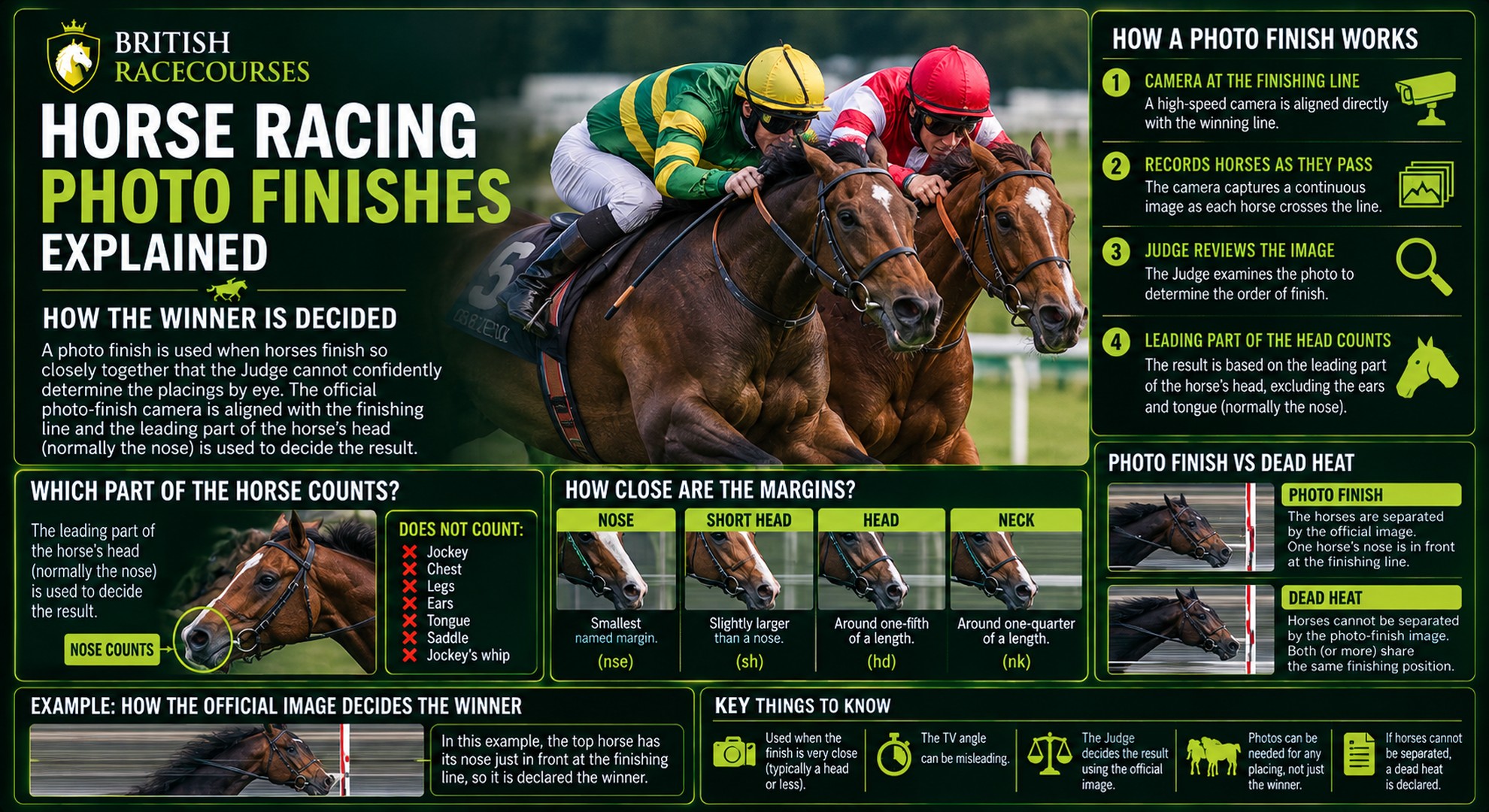
A photo finish in British horse racing is used when horses finish too closely for the Judge to determine the placings reliably by eye. The official photo-finish camera is aligned directly with the finishing line, and the leading part of each horse’s head, normally the nose, is used to decide which horse crossed first.
A horse can win by a tiny margin that is difficult or impossible to identify accurately from the normal television pictures.
That is why the official photo finish matters.
The angle seen by racegoers or television viewers is not the angle used to determine the result.
What Is a Photo Finish in Horse Racing?
A photo finish occurs when two or more horses cross the finishing line so closely together that photographic evidence is used to establish their finishing positions.
The British Horseracing Authority’s judging procedure uses dedicated photo-finish equipment positioned in direct alignment with the winning line.
The result is determined by the leading part of the horse’s head, excluding the ears and tongue.
In practice, this normally means the point of the nose.
A horse’s legs, chest, neck, ears or jockey do not determine which horse has won.
The nose is what matters.
How Does a Horse Racing Photo Finish Work?
The official photo-finish system is different from an ordinary photograph taken from the grandstand.
The camera is precisely aligned with the finishing line.
As horses pass that line, the equipment records the order and timing in which they cross it.
This produces the distinctive photo-finish image used by the Judge.
The important point is that the image represents what happened at the finishing line.
It is not simply a conventional photograph showing the horses approaching the post.
That distinction explains why photo-finish images can initially look unusual to people unfamiliar with them.
New British Photo-Finish Cameras for 2026
British racing upgraded its photo-finish technology in 2026.
Ultra-high-resolution cameras were rolled out across every British racecourse in March 2026.
The new equipment captures images at around 6,000 frames per second, giving judges clearer evidence when horses finish extremely close together.
This is particularly useful when the difference between two horses is measured in millimetres rather than an easily visible winning margin.
The technology has improved.
The basic principle has not changed.
The Judge still needs to determine which horse reached the official finishing line first.
Why Does a Photo-Finish Picture Look Strange?
Photo-finish pictures can make horses appear stretched, compressed or distorted.
That happens because the system is designed to record horses as they pass a fixed line rather than take a conventional snapshot of the entire track at one instant.
Think of it as recording the finishing line continuously.
Each horse is captured as it reaches that precise point.
The resulting image allows the Judge to compare when the leading part of each horse’s head crossed the line.
Its purpose is accuracy rather than producing a natural-looking racing photograph.
Which Part of the Horse Counts in a Photo Finish?
The leading part of the horse’s head determines the finishing position.
The ears and tongue are excluded.
That normally makes the relevant point the end of the horse’s nose.
The following do not determine the winner:
- The Jockey
- The Horse’s Chest
- The Horse’s Legs
- The Horse’s Ears
- The Saddle
- The Jockey’s Whip
This can create a deceptive finish.
One horse might appear to have more of its body in front while another has its nose fractionally ahead at the exact finishing line.
The second horse gets the verdict.
Is It the Horse’s Nose That Has to Cross the Line?
Yes, in practical terms.
The BHA’s procedure directs the photo-finish operator to position the relevant time line on the leading part of each horse’s head, excluding the ears and tongue.
That is normally the point of the nose.
This is why racing commentators often say a horse has “got its nose in front at the right time”.
It can be literally true.
When Is a Photo Finish Called?
The Judge watches the horses cross the line and records the finishing order.
When the distance between relevant placed horses appears particularly close, photographic evidence is used to confirm the result.
The BHA describes a head or less as the type of close margin where the Judge will call for photo-finish evidence.
A photo can be needed for the winner.
It can also be needed to separate horses finishing farther down the field.
That matters for more than the official winning result.
It can determine:
- Place Betting
- Each-Way Settlement
- Forecasts
- Exact Finishing Positions
- Prize-Money Placings
- Full Race Results
A clear winner does not mean there cannot be a photo for second, third or another position.
Who Decides the Winner of a Photo Finish?
The Judge determines the finishing order.
The Photo Finish Operator assists with the specialist equipment and image.
The Judge and operator work closely together, but their roles are not identical.
The photo-finish equipment supplies the evidence.
The Judge uses that evidence to determine the result.
This is different from the role of the racecourse Stewards, who deal with other matters concerning the conduct and outcome of the race.
Judge Versus Stewards
The Judge determines the order in which the horses finished.
The Stewards have a different role.
This distinction becomes important when a close finish is followed by an enquiry.
Imagine Horse A beats Horse B by a nose.
The Judge can determine from the photo that Horse A crossed the finishing line first.
That establishes the finishing order at the line.
If there is subsequently a question about interference during the race, that is a separate matter.
The finishing order and whether the placings subsequently stand should not be confused.
Is the TV Camera Used for a Photo Finish?
No.
The normal television camera is not the official photo-finish camera.
This is one of the main reasons viewers sometimes think the wrong horse has been called.
The television camera is positioned to provide a useful view of the race.
The official photo-finish camera has a different purpose.
It is aligned directly with the winning line.
A camera positioned before or after that line creates an angle.
That angle can make the horse closer to the camera appear to be in front even when another horse’s nose reached the actual line first.
For very close finishes, trust the official photo rather than trying to judge the result from the broadcast angle.
Why Can the TV Angle Be Misleading?
Perspective changes what you see.
Imagine two horses finishing together on opposite sides of a wide racecourse.
If the television camera is positioned slightly beyond the winning line, the horse on the near side can appear farther ahead than it really is.
If the camera is positioned before the line, the visual effect can work differently.
The effect becomes more pronounced when the horses are widely separated across the width of the track.
This explains many apparently surprising photo-finish results.
The official camera removes that perspective problem because it is aligned with the finishing line itself.
Where Is the Actual Finishing Line?
The physical winning post helps riders, officials and spectators identify the finish, but the official line is a precise line across the racecourse.
The photo-finish installation and winning line have to be correctly aligned.
This precision matters because racing can produce extraordinarily small winning margins.
The difference between first and second can be a tiny fraction of the length of a horse.
A rough visual estimate of where the post stands would not be sufficient.
What Is the Mirror in a Horse Racing Photo Finish?
British racecourse photo-finish installations can use a mirror positioned on the opposite side of the track.
The mirror helps provide a clear view where horses overlap from the camera’s perspective.
This becomes important when several horses reach the line together.
Without the additional view, one horse can obscure another.
Racecourse winning posts and photo-finish installations are therefore positioned and aligned according to technical requirements rather than simply placed where they look best to spectators.
What Happens Immediately After a Close Finish?
When the horses cross the line, you will often hear the racecourse commentator or broadcaster avoid declaring a winner.
The sequence is broadly:
- The Horses Cross The Finishing Line
- The Judge Identifies The Finish As Close
- The Photo-Finish Evidence Is Reviewed
- The Horses Are Separated Using The Official Image
- The Judge Determines The Finishing Order
- The Result Is Announced
For an extremely close finish, the wait can feel much longer than it actually is.
Accuracy matters more than making an immediate call.
How Long Does a Photo Finish Take?
There is no fixed time for every photo finish.
A relatively straightforward image can be resolved quickly.
A very tight finish involving several overlapping horses can require closer examination.
The photo-finish image is also not available to the Judge until the last horse has crossed the line and been recorded by the equipment.
That is one reason the official announcement does not necessarily follow immediately after the first horses reach the post.
What Does “Photo” Mean on a Racecourse?
When the result is too close to call immediately, racegoers can hear an announcement that there is a photo.
This means the official finishing order is being checked using the photo-finish evidence.
It does not mean the race has been rerun or that something has necessarily gone wrong.
It simply means the Judge requires the photographic evidence before declaring the relevant placings.
What Does “Photo, Photo” Mean?
A race can require more than one close placing to be resolved.
For example, three horses could finish almost together.
There might be a photo for:
First and second
and another close call involving:
Second and third
The Judge must establish the complete relevant order.
This becomes particularly important in large-field handicaps where each-way bets can depend on finishing fourth, fifth or even farther down the field under enhanced place terms.
What Is a Nose in Horse Racing?
A nose is the smallest named winning distance used in British racing results.
It is commonly abbreviated:
nse
A nose finish means the winner has beaten the runner-up by the narrowest standard named margin.
Our winning distances in horse racing guide explains the full sequence of margins and how official distances are recorded.
Nose, Short Head, Head and Neck Explained
Close horse-racing finishes use several standard descriptions.
| Winning Margin | Abbreviation | Meaning |
|---|---|---|
| Dead Heat | dh | Horses cannot be separated |
| Nose | nse | Smallest named winning margin |
| Short Head | sh | Slightly larger than a nose |
| Head | hd | Approximately one-fifth of a length |
| Neck | nk | Approximately one-quarter of a length |
These margins appear in race results and form records.
They provide more information than simply knowing that a horse won.
A sequence of narrow victories can tell a different story from repeated wide-margin wins.
Is a Nose Smaller Than a Short Head?
Yes.
The order of the closest standard margins is:
Nose
then
Short Head
then
Head
then
Neck
After that, margins are increasingly expressed as fractions or whole lengths.
A horse winning by a nose has therefore won by a smaller official margin than a horse winning by a short head.
What Is a Dead Heat?
A dead heat occurs when horses cannot be separated for the relevant finishing position.
If two horses dead heat for first place, both are regarded as winners.
The race is not run again to decide which horse should take first place.
Dead heats are rare because modern photo-finish technology can separate extremely close finishes.
But if the official evidence cannot separate the horses, a dead heat remains a legitimate result.
Can Three Horses Dead Heat?
Yes.
A dead heat is not limited to two horses.
If three horses cannot be separated for the same position, a three-way dead heat can be declared.
This is much less common than a conventional two-horse dead heat.
The betting settlement becomes correspondingly more complicated because the relevant returns have to account for the shared finishing position.
What Happens to Bets in a Dead Heat?
Dead-heat rules adjust betting returns when two or more selections share a finishing position relevant to the bet.
A simple example is a win bet on a horse involved in a two-way dead heat for first.
Rather than settling the bet exactly as though the horse had been the sole winner, the bookmaker applies its dead-heat settlement rules.
In a two-way dead heat, the winning stake is effectively divided by two for settlement purposes.
If three horses share first place, the relevant stake is divided by three.
The exact calculation becomes more important with each-way bets and other markets.
Always check the bookmaker’s rules for the market you have used.
Example of a Two-Way Dead Heat Bet
Suppose you back a horse:
£10 win at 4/1
It finishes in a two-way dead heat for first.
For dead-heat settlement, the £10 stake is divided by two.
That leaves:
£5 winning at 4/1
and
£5 losing
The winning £5 produces:
£25 return
That consists of £20 winnings plus the £5 winning portion of the stake.
The other £5 portion is lost.
The total return is therefore:
£25
rather than the £50 return you would receive if the horse had been the sole winner.
Dead Heats and Each-Way Bets
Dead heats can also affect the place component of an each-way bet.
The calculation depends on:
- The Finishing Position
- The Number Of Horses Dead Heating
- The Number Of Places Paid
- The Each-Way Fraction
- The Bookmaker’s Settlement Rules
This can become particularly important around the final paid position.
Suppose a bookmaker pays four places and two horses dead heat for fourth.
The available place position is being shared.
Dead-heat settlement rules therefore apply to the relevant place component.
Extra Places and Photo Finishes
Enhanced each-way terms make photo finishes farther down the field increasingly relevant to bettors.
Suppose standard terms pay four places but your bookmaker offers six.
A photo for fifth and sixth can now directly affect your return.
This is one reason the Judge needs to establish more than the identity of the winner.
Our extra-place bookmakers guide explains how enhanced place terms work.
Does a Photo Finish Affect Best Odds Guaranteed?
The photo finish itself does not change how Best Odds Guaranteed works.
BOG concerns the odds used to settle an eligible bet.
The photo finish establishes the horse’s finishing position.
If your horse is declared the winner, the bet is then settled under the applicable bookmaker terms.
If it finishes second by a nose, it has still lost the win component regardless of how small the margin was.
There is no special allowance for nearly winning.
Can a Horse Lose by a Millimetre?
A horse can lose by an extremely small amount.
The official result will normally express the closest winning margin as a nose rather than publish a measurement such as three millimetres.
Modern photo-finish technology allows judges to examine very small separations.
For betting and form purposes, however, the important information is the official finishing order and recorded winning distance.
Does the Winning Post Decide the Winner?
The winning post identifies the finish for racing purposes, but you should not judge a very close result by looking at the visible post from an angled camera.
The official finishing line and photo-finish installation are precisely aligned.
This is why freeze-framing the television coverage against the visible winning post can produce the wrong answer.
The broadcast picture was not designed to replace the official photo-finish system.
Can the Jockey’s Position Make a Difference?
Yes, but indirectly.
The jockey’s body does not count towards the finishing position.
Their riding can affect when the horse’s head reaches forward during its stride.
Jockeys try to time their final effort so the horse is travelling as strongly as possible through the line.
You will sometimes hear this described as getting a horse’s head down “on the bob”.
That relates to the horse’s stride pattern and the movement of its head.
The official question remains simple:
Which horse’s relevant part of the head reached the finishing line first?
What Does “Won on the Nod” Mean?
“Won on the nod” is a racing expression used for an extremely close finish where the movement of the horses’ heads appears to influence which nose is in front at the line.
Horses’ heads move during their stride.
In a very close contest, one horse can appear ahead a fraction before the line before the other has its nose in front at precisely the decisive moment.
The expression is descriptive rather than a separate official winning margin.
The result will still be recorded as a nose, short head or other recognised margin.
Can You Tell Who Won Before the Photo?
Sometimes an experienced racegoer, commentator or jockey will have a strong impression.
They can still be wrong.
The wider the horses are apart across the track, the harder it can be to judge accurately from an ordinary viewing position.
A jockey on one horse also has a very different angle from a Judge looking at the finish.
When an official photo has been called, the sensible approach is to wait for the result.
Do Jockeys Know If They Have Won a Photo Finish?
Not necessarily.
A jockey can feel confident and still have finished second.
Another can think they were beaten and subsequently be announced as the winner.
At racing speed, a difference of a nose can be extremely difficult to assess from horseback.
The official photo provides evidence that the jockey does not have.
Famous Photo Finishes in British Horse Racing
British racing has produced numerous memorable finishes decided by tiny margins.
One particularly famous modern example came in the 2012 Grand National.
Neptune Collonges defeated Sunnyhillboy by a nose at Aintree.
After more than four miles of the Grand National, the result came down to the smallest standard named winning margin.
Neptune Collonges also became the first grey to win the Grand National since Nicolaus Silver in 1961.
It is an excellent example of why racing requires accurate photo-finish technology even in long-distance races.
A contest lasting several minutes can still be decided by a few centimetres at the line.
Why Photo Finishes Matter When Reading Form
A narrow defeat and a wide defeat should not automatically be treated equally.
Suppose a horse’s recent form includes:
2nd, beaten a nose
That tells you it came extremely close to winning.
But the margin still needs context.
Ask:
- Was The Race Strong?
- Did The Horse Have A Favourable Pace?
- Was It Well Treated At The Weights?
- Did It Get A Clear Run?
- Was It Gaining Or Losing Ground At The Finish?
- What Has Happened To Its Handicap Rating Since?
Our guide to reading horse racing form explains how individual results should be assessed as part of the horse’s wider record.
Does Losing a Photo Finish Mean a Horse Was Unlucky?
Not automatically.
A horse beaten a nose has come very close.
That does not prove bad luck caused the defeat.
It may simply have been marginally inferior on the day.
Before describing the horse as unlucky, consider how the race unfolded.
A horse might have:
- Encountered Traffic
- Raced Against A Pace Bias
- Been Poorly Positioned
- Made Its Challenge Too Early
- Had An Ideal Trip And Still Been Beaten
- Been Favoured By The Draw
Our horse racing pace bias and draw bias guides help put close results into context.
Photo Finishes and Handicap Ratings
A horse winning by a nose has won the race, but handicappers do not simply treat every winner identically.
The performance is assessed in context.
Likewise, a horse beaten a nose has not necessarily produced a materially worse performance than the winner.
This is important when analysing subsequent races.
The official placing is binary:
Winner
or
Runner-up
The underlying performance difference can be tiny.
Our guide to horse racing handicap ratings explains how ratings are used to compare performances and allocate weights.
Photo Finishes and Sectional Times
A photo finish tells you what happened at the finishing line.
It does not tell you how the horses got there.
Two horses can cross almost simultaneously after running completely different races.
One might lead throughout.
Another might come from the rear after recording a much faster closing sectional.
That distinction can matter when assessing which horse produced the more interesting performance for the future.
Our sectional times guide explains how the internal fractions of a race add more context than the final result alone.
Photo Finishes and Pace
Pace can produce extremely close finishes.
A slowly run race can leave several horses with enough energy to sprint late, compressing the field near the line.
A strongly run race can produce a different finish, with tired leaders being caught by horses ridden more patiently.
A photo therefore tells you the order.
A pace map can help explain why the finish became so close.
How Are Finishing Distances Calculated?
Not every finishing distance is established by visually measuring the physical gap between horses.
The photo-finish system records elapsed time between finishers.
A Lengths Per Second scale is then used to convert those time differences into official distances.
The scale varies according to factors including whether the race is on the Flat or over Jumps, the racing surface and the official going.
That is why one second cannot simply be treated as the same number of lengths in every race.
A tired staying chaser on heavy ground is moving at a very different speed from a Flat horse finishing quickly on fast ground.
For a fuller explanation, see our winning distances page.
Why Photo Finishes Matter to Bettors
A photo finish can decide much more than who receives the winner’s prize.
For bettors it can determine:
- Win Bets
- Each-Way Bets
- Place Bets
- Forecasts
- Tricasts
- Multiples
- Placepots
- Extra-Place Bets
One nose can therefore decide the outcome of several different markets.
It can also decide whether the next leg of an accumulator remains alive.
The size of the financial difference does not alter the judging process.
The official finishing order is what determines settlement.
When Are Bets Settled After a Photo Finish?
Bookmakers normally wait for the relevant result before settling affected markets.
The result then feeds through to betting systems.
You might occasionally see an account appear to update while the raceday process is still continuing.
Do not treat an early balance movement as more authoritative than the official result.
Bookmakers also have rules governing subsequent amendments, objections, disqualifications and settlement.
Those rules matter if the result changes after the horses have crossed the line.
Photo Finish Versus Stewards’ Enquiry
These are different processes.
A photo finish answers:
Which horse crossed the line first?
A Stewards’ enquiry can examine incidents connected with the race.
A race can therefore have both.
For example:
Horse A crosses the line a nose ahead of Horse B.
The photo confirms Horse A finished first.
There is then an enquiry into interference involving the two horses.
The photo has still correctly established which horse reached the line first.
The enquiry considers a different issue.
Photo Finish Versus Objection
An objection is also separate from the photo-finish process.
The photo establishes the finishing order at the line.
An objection concerns whether there is a reason for the result or placings to be reconsidered under the applicable racing rules.
For somebody following racing for the first time, the easiest distinction is:
Photo = who crossed first
Enquiry or objection = whether another racing issue needs consideration
Are Photo-Finish Results Always Final?
The Judge’s result is the official raceday determination of the finishing order, but racing rules contain procedures covering circumstances where a result may subsequently require correction or alteration.
This is unusual.
For normal racegoers and bettors, the important point is not to confuse the initial unofficial impression from television pictures with the result declared through the official judging process.
Wait for the official result.
How to Read a Photo-Finish Result
Suppose a result shows:
1st Horse A
2nd Horse B, nse
3rd Horse C, 1½L
This means Horse A beat Horse B by a nose.
Horse C then finished one and a half lengths behind Horse B.
The margins are read sequentially between one finisher and the next rather than necessarily as the distance every horse finished behind the winner.
That distinction is important when reading race results.
Our racecard guide explains the other abbreviations and information you will encounter when studying a race.
Photo-Finish Abbreviations
The abbreviations most closely associated with tight finishes include:
| Abbreviation | Meaning |
|---|---|
| dh | Dead Heat |
| nse | Nose |
| sh | Short Head |
| hd | Head |
| nk | Neck |
Learning these makes race results considerably easier to read.
They also help when looking back through a horse’s form.
A row of finishing positions alone does not tell you whether those races were won or lost narrowly.
Photo Finishes on Flat and Jump Racing
Photo finishes occur in both Flat and Jump racing.
The judging principle remains the same.
The main difference lies in the nature of the races producing the finish.
A five-furlong Flat sprint can bring a large group of horses to the line at high speed.
A staying chase can finish with two tired horses battling after several miles.
Both can end with a nose between them.
The official photo is designed to establish the order accurately regardless of how the race developed.
For the wider differences between the two codes, see Flat racing versus Jump racing.
Horse Racing Photo Finish FAQs
What is a photo finish in horse racing?
A photo finish is used when horses finish too closely for the relevant placings to be determined reliably by eye. The official photo-finish equipment records the horses crossing the finishing line so the Judge can determine the order.
Which part of the horse has to cross the line first?
The leading part of the horse’s head is used, excluding the ears and tongue. In practice, this is normally the point of the nose.
Does the jockey count in a photo finish?
No. The jockey’s body, hands, head or whip do not determine the finishing position.
Do the horse’s legs count?
No. A horse can have its front legs farther forward while another horse’s nose reaches the finishing line first.
Is a nose the smallest winning distance?
Yes. A nose is the smallest standard named winning margin in British horse racing. A dead heat is declared when horses cannot be separated.
What is smaller, a nose or a short head?
A nose is smaller. The progression is nose, short head, head and then neck.
Who decides a horse racing photo finish?
The Judge determines the finishing order using evidence from the official photo-finish system with assistance from the Photo Finish Operator.
Is the television camera used to decide a photo finish?
No. The official photo-finish camera is aligned directly with the winning line. Normal television cameras provide different viewing angles and can be misleading in extremely close finishes.
Why does a photo-finish image look distorted?
The system records horses as they cross a fixed finishing line rather than taking a conventional photograph of the whole scene at one moment. This produces the distinctive appearance.
How fast are British racing’s photo-finish cameras?
New ultra-high-resolution cameras introduced across British racecourses in 2026 capture images at around 6,000 frames per second.
What happens if the photo cannot separate two horses?
A dead heat can be declared.
Can three horses dead heat?
Yes. More than two horses can share a finishing position if they cannot be separated.
What happens to a bet in a dead heat?
Dead-heat settlement rules apply. In a simple two-way dead heat for first, the relevant winning stake is divided between the two tied outcomes for settlement.
How long does a horse racing photo finish take?
There is no fixed period. Straightforward photos can be resolved quickly, while exceptionally close or complicated finishes can require more examination.
Why does the Judge wait until all the horses have finished?
The BHA states that the photo-finish image is not available to the Judge until the last horse has crossed the line and been recorded by the equipment.
Can there be a photo for second place?
Yes. Photo finishes can determine any relevant placing, not just first.
Can there be a photo when the winner is clear?
Yes. The winner can be obvious while second and third, or other placings, require a photo.
Does a photo finish affect each-way betting?
Yes. A close finish can determine whether a horse has finished inside or outside the qualifying each-way places.
Is a photo finish the same as a Stewards’ enquiry?
No. A photo finish determines the finishing order at the line. A Stewards’ enquiry examines other issues relating to the race.
Why can a horse look like it won on TV but lose the photo?
Television cameras are viewed from an angle and are not necessarily aligned directly with the finishing line. Perspective can therefore make one horse appear ahead when the official photo shows otherwise.
Summary
A horse racing photo finish determines the finishing order when horses cross the line too closely for the placings to be established reliably by eye.
The official camera is aligned directly with the finishing line.
The leading part of each horse’s head is used, excluding the ears and tongue, which normally means the point of the nose determines the result.
British racing upgraded its photo-finish equipment in 2026, introducing ultra-high-resolution cameras across every British racecourse capable of recording at around 6,000 frames per second.
Normal television pictures should not be used to overrule the official image. Their viewing angle can make extremely close finishes deceptive.
If horses cannot be separated using the official evidence, a dead heat can be declared.
For interpreting the margin after the result is announced, read our winning distances in horse racing guide. You can then use our racecard guide and horse racing form resources to understand how that result fits into a horse’s wider racing record.