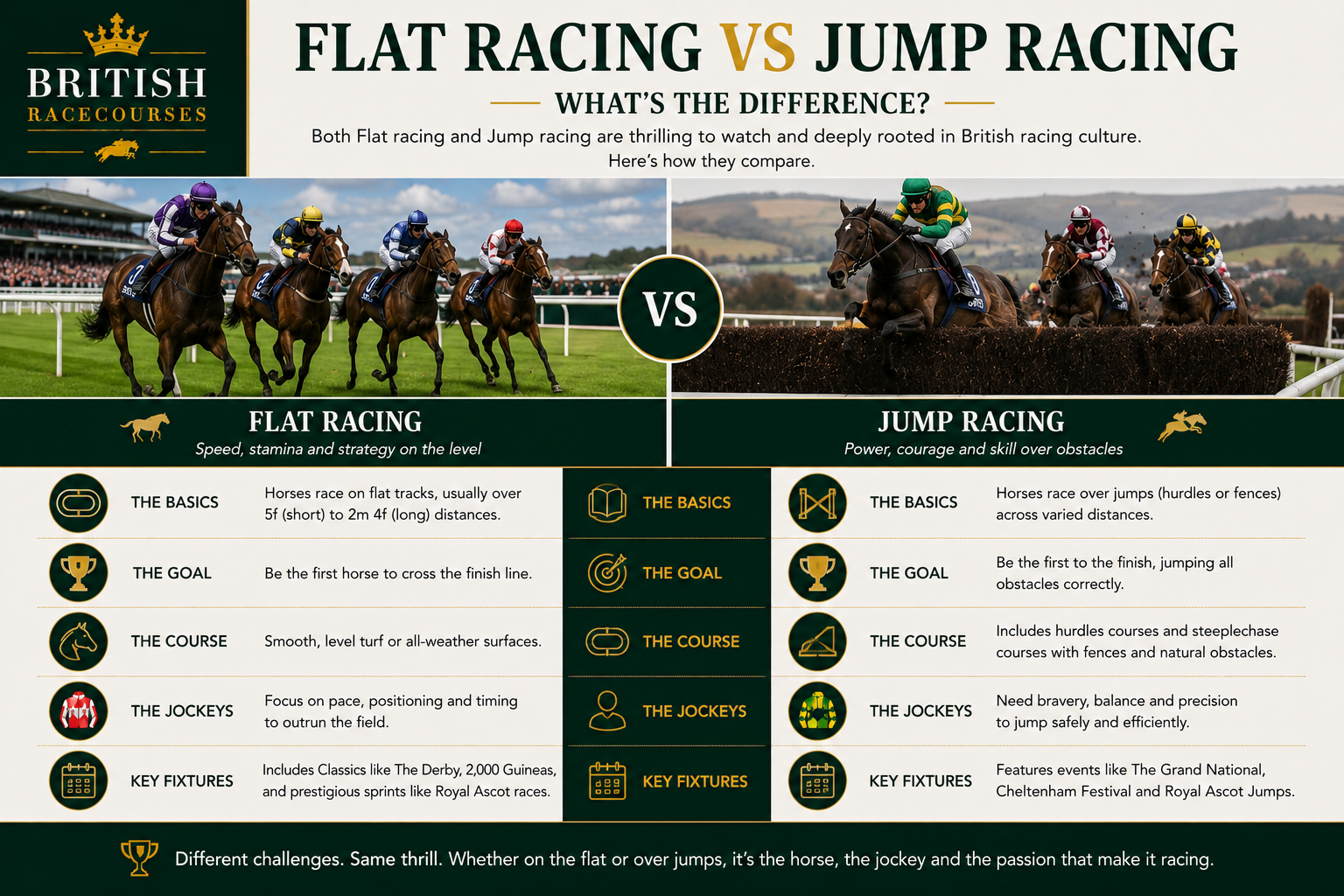
One of the first things newcomers notice about horse racing is that there are actually two distinct versions of the sport.
While both involve horses racing around a track, Flat racing and National Hunt racing offer very different challenges for horses, jockeys and trainers.
Some racegoers prefer the speed and glamour of Flat racing. Others enjoy the stamina, jumping ability and unpredictability of National Hunt racing.
Understanding the differences between the two disciplines will help you make sense of racecards, fixtures and racing calendars throughout the year.
The Two Main Codes of Horse Racing
British racing is divided into:
- Flat Racing
- National Hunt Racing
Both are governed by the British Horseracing Authority and take place at racecourses throughout the country, but the style of racing differs significantly.
If you’re still learning how racing works, it’s worth reading our article on How to Read a Racecard alongside this one.
What Is Flat Racing?
Flat racing is exactly what the name suggests.
Horses compete on a level track without any obstacles.
The emphasis is placed on:
- Speed
- Tactical positioning
- Acceleration
- Balance
- Race riding tactics
Flat racing produces some of the sport’s most famous horses and attracts huge crowds throughout the summer months.
Typical Flat Race Distances
Flat races can vary considerably in distance.
Common examples include:
| Distance | Type |
|---|---|
| 5f | Sprint |
| 6f | Sprint |
| 1m | Mile |
| 1m4f | Middle Distance |
| 2m+ | Staying Race |
The shortest races often last a little more than a minute.
Long-distance staying contests can take over four minutes to complete.
Famous Flat Racing Festivals
Some of Britain’s most prestigious racing events take place on the Flat.
These include:
These meetings attract some of the best horses from Britain, Ireland and around the world.
What Is National Hunt Racing?
National Hunt racing is commonly referred to as jump racing.
Unlike Flat racing, horses must negotiate obstacles during the race.
Success requires much more than speed alone.
Horses must demonstrate:
- Jumping ability
- Stamina
- Courage
- Balance
- Endurance
National Hunt racing is particularly popular during the autumn and winter months.
Many fans appreciate the additional excitement created by hurdles and fences.
Those wanting a more detailed overview can visit:
Hurdles and Fences
National Hunt racing is divided into two primary categories.
Hurdle Races
Hurdles are smaller obstacles designed to introduce horses to jumping.
Many future steeplechasers begin their careers over hurdles.
You can learn more about hurdle racing here:
Steeplechases
Steeplechases feature larger fences that place greater demands on a horse’s jumping ability.
Some of the most famous races in the world are steeplechases, including the Grand National.
National Hunt Flat Races
Despite the name, these races take place under National Hunt rules but contain no obstacles.
They are often known as “bumpers”.
Their purpose is to educate young jump horses before they begin hurdling careers.
Famous National Hunt Festivals
National Hunt racing has some of the most passionate supporters in the sport.
Major meetings include:
- Cheltenham Festival Content Hub
- Aintree Festival
- Grand National
- Punchestown Festival
- Welsh Grand National
These meetings often produce some of the highest television audiences in horse racing.
Which Horses Compete In Each Code?
Flat Horses
Flat horses are typically:
- Younger
- Faster
- More speed-focused
Many begin racing as two-year-olds.
The best Flat horses often retire relatively young to begin breeding careers.
National Hunt Horses
Jump horses are generally:
- Older
- More mature
- Stamina-focused
Many continue racing until they are ten years old or older.
This often allows racegoers to build stronger connections with horses over several seasons.
Racecourse Differences
Certain racecourses specialise in Flat racing, while others focus primarily on National Hunt racing.
Famous Flat Racecourses
Some of Britain’s best-known Flat venues include:
Famous National Hunt Racecourses
Popular jumping venues include:
The complete racecourse directory can be found here:
How Jockeys Differ
Many jockeys specialise in one discipline.
Flat jockeys are generally lighter and focus on pace, positioning and tactical judgement.
National Hunt jockeys often ride longer races and must manage obstacles throughout the contest.
Britain has produced many famous riders in both codes.
Browse our Horse Racing Jockeys section to learn more about stars such as:
- Hollie Doyle
- Oisin Murphy
- Brian Hughes
- Harry Cobden
- Rachael Blackmore
How Trainers Differ
Some trainers focus almost exclusively on Flat racing.
Others specialise in jump racing.
Many of the most successful trainers have built reputations within a particular code.
Learn more about leading yards and trainers here:
Which Is More Popular?
Both forms of racing enjoy huge support.
Flat racing tends to attract larger crowds during the summer season, particularly at major festivals such as Royal Ascot and Glorious Goodwood.
National Hunt racing often generates greater passion among dedicated racing fans because of the unique challenges presented by jumping.
The Grand National remains one of the most-watched sporting events in Britain each year.
Which Is Better For Beginners?
Neither code is objectively better.
Many newcomers find Flat racing easier to understand because there are no obstacles and races are generally shorter.
Others immediately enjoy the drama and excitement of jump racing.
The best approach is to experience both.
Attending meetings from each discipline provides an excellent introduction to the variety that British horse racing offers.
If you’re planning your first race day, you may also enjoy:
- https://www.britishracecourses.org/top-ten-racecourses/
- https://www.britishracecourses.org/most-scenic-and-most-historic-racecourses-in-the-uk/
- https://www.britishracecourses.org/what-to-wear-at-the-races/
Frequently Asked Questions
Is the Grand National Flat racing?
No.
The Grand National is a steeplechase run under National Hunt rules.
Are jump races longer than Flat races?
Generally yes.
National Hunt races often cover greater distances and take longer to complete.
Which horses earn the most prize money?
Many of the highest-earning horses compete on the Flat, particularly in major international races.
Can a horse compete in both Flat and National Hunt racing?
Yes.
Some horses switch between codes during their careers, although most specialise in one discipline.
Final Thoughts
Flat racing and National Hunt racing are two sides of the same sport.
One showcases speed, precision and athleticism.
The other highlights stamina, jumping ability and resilience.
Together, they create the rich racing calendar that attracts millions of racegoers each year.
Whether you’re watching Royal Ascot in June, attending the Cheltenham Festival in March or enjoying a local race meeting at your nearest course, understanding the differences between the two disciplines will help you appreciate the sport on a much deeper level.