
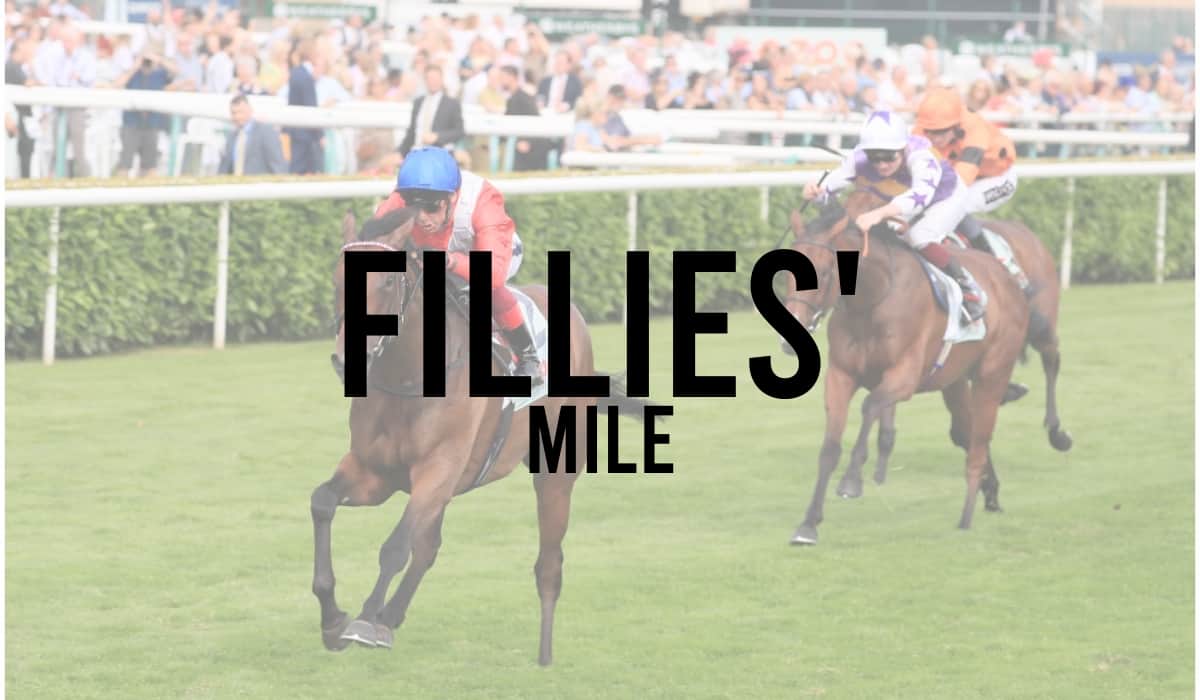
The Fillies’ Mile 2026 takes place at Newmarket on Friday 9 October and is one of the most important Group 1 races of the season for two-year-old fillies.
Run over one mile on the Rowley Mile, the race provides a major test of the leading juvenile fillies before the winter. The result also influences the ante-post markets for the following season’s 1,000 Guineas and Oaks.
The 2026 Fillies’ Mile is currently scheduled for 2.57pm, subject to any later racecard changes, and has a guaranteed prize fund of £500,000.
Musical Times is the leading name in the build-up after winning the May Hill Stakes at Doncaster, while several other high-class juvenile fillies remain in contention.
Fillies’ Mile 2026 Key Information
Date: Friday 9 October 2026
Racecourse: Newmarket, Rowley Mile
Scheduled time: 2.57pm, subject to change
Distance: 1 mile
Race type: Group 1 Flat race
Age: Two-year-old fillies
Weight: 9st 2lb
Guaranteed prize fund: £500,000
Festival: Dubai Future Champions Festival
The Fillies’ Mile is the Group 1 highlight of the opening day of the Dubai Future Champions Festival.
Saturday’s card is headed by the Dewhurst Stakes and also features the Cesarewitch Handicap.
Our Newmarket Racecourse guide explains the Rowley Mile and how it differs from Newmarket’s July Course.
Fillies’ Mile 2026 Runners
The final field for the Fillies’ Mile has not yet been declared.
A sizeable group of fillies remain eligible at this stage, but that should not be confused with the eventual number of runners.
Confirmation and supplementation take place on Saturday 3 October, after which the likely field will become considerably clearer.
Among the important names in the build-up are:
Musical Times
Sun Goddess
Green Empress
Maire Rua
Spirited Gesture
Alpha
Dancing Destiny
Several other fillies remain entered, and plans can change before declarations.
We will update this section once the final runners and jockey bookings are confirmed.
Until then, treat every ante-post runner as a potential participant rather than a confirmed starter.
Who Is Favourite for the Fillies’ Mile 2026?
Musical Times heads the current Fillies’ Mile betting.
The Charlie Appleby-trained filly strengthened her position in the market when winning the Group 2 May Hill Stakes at Doncaster in September.
That race matters because the May Hill has a long history of producing fillies capable of performing well in the Fillies’ Mile.
Musical Times still needs to make the step from Group 2 company into a Group 1.
That is the central question rather than simply whether she deserves to be favourite.
A market leader can be the horse with the strongest chance of winning without necessarily being available at an attractive betting price.
Our betting odds guide explains the relationship between odds, probability and potential return.
Fillies’ Mile 2026 Odds
The Fillies’ Mile market will continue to change before Friday 9 October.
Ante-post prices reflect both a horse’s perceived chance of winning and uncertainty over participation.
That creates an important distinction.
A filly available at a bigger price several days before declarations may look attractive, but ordinary ante-post rules can mean losing the stake if she does not subsequently run.
Waiting until the final field is known reduces that uncertainty, although the price can shorten in the meantime.
Check whether the market is:
Standard ante-post
or:
Non-Runner No Bet
before placing a wager.
Do not assume the terms are identical between bookmakers.
Price comparison also matters. If the same filly is available at a bigger price with another bookmaker, the horse’s chance has not changed. Your potential return has.
Our comparison of the best horse racing betting sites looks specifically at bookmakers from a racing perspective, including prices, Best Odds Guaranteed, each-way terms, streaming and other racing features.
Readers particularly interested in bet365 can also use our bet365 horse racing guide for its racing-specific features.
Musical Times and the May Hill Form
Musical Times brings one of the clearest pieces of British form into the Fillies’ Mile.
She won the May Hill Stakes at Doncaster on 10 September, beating Scommessa Sicura and Speckles.
That Group 2 is run over a mile for two-year-old fillies, making it a particularly relevant trial.
There is no change of distance between the May Hill and the Fillies’ Mile.
There is, however, a change of racecourse and an increase in class.
That makes the correct question:
Was the May Hill performance strong enough to win a Group 1?
rather than:
Did she win her trial?
Charlie Appleby indicated after Doncaster that the Fillies’ Mile had been the intended target.
That gives Musical Times a more straightforward preparation than a filly whose connections are still choosing between autumn targets.
Our separate May Hill Stakes guide covers the race and its historical relationship with the Fillies’ Mile.
How Important Is the May Hill Stakes?
The May Hill is one of the most relevant British trials for the Fillies’ Mile.
Both races are restricted to two-year-old fillies and run over a mile.
Previous fillies to win both races include:
White Moonstone
Lyric Of Light
Certify
Laurens
Inspiral
That history is useful, but it should not become an automatic betting system.
Every renewal is different.
The strength of the opposition, winning performance, pace and subsequent improvement matter more than simply identifying the May Hill winner.
Musical Times deserves close attention because of what she achieved at Doncaster.
She does not deserve to be backed at any price merely because previous May Hill winners have completed the double.
The Moyglare Stud Stakes Form
The Moyglare Stud Stakes at the Curragh provides another important route into the Fillies’ Mile.
Unlike the May Hill, the Moyglare is already a Group 1.
A filly arriving from the Curragh has therefore already competed at the highest level.
The race is run over seven furlongs, so another question enters the analysis:
Will the extra furlong at Newmarket suit?
A strong-finishing seven-furlong filly can improve for the step to a mile.
A filly relying heavily on speed can find the final furlong of the Rowley Mile more demanding.
Minding won both races in 2015 before developing into one of the outstanding fillies of her generation.
The precedent demonstrates that the route works. It does not mean every Moyglare runner should automatically be upgraded.
What Should You Look for When Betting on the Fillies’ Mile?
Two-year-old fillies can improve rapidly during the second half of the season.
That makes the Fillies’ Mile different from analysing a handicap containing older horses with extensive form records.
Six areas deserve particular attention.
Group-Race Form
The Fillies’ Mile is a Group 1.
Previous performances in Listed and Group races therefore provide important evidence about whether a filly is ready for the level.
Do not simply count wins.
A narrow defeat against strong Group 1 opposition can represent better form than a comfortable victory in a weaker race.
Look at who the filly raced against and what those horses subsequently achieved.
Ability Over a Mile
The Fillies’ Mile is the first major one-mile Group 1 test of the autumn for many of these fillies.
Proven mile form is useful.
It is not compulsory.
A filly stepping up from seven furlongs can improve for the extra distance if her previous races and pedigree suggest she will stay.
Conversely, a very fast seven-furlong filly can be vulnerable when asked to maintain her effort through Newmarket’s rising finish.
Improvement
Juveniles do not develop at the same rate.
A filly with five races behind her may have established a higher level of form but have less obvious improvement available.
A lightly raced filly may have achieved less while possessing greater potential to progress.
Do not confuse lack of experience with lack of ability.
The challenge is deciding how much improvement is reasonable to expect.
Going
Newmarket in October can produce very different conditions from summer juvenile races.
Ground that becomes softer than expected can change the demands of the race.
A previous win on similar going is useful evidence, but do not reduce the assessment to a simple going statistic.
Look at how efficiently the filly travelled and finished under comparable conditions.
Pace
A strongly run mile tests stamina differently from a tactical race.
If several runners want to race prominently, the early fractions can make the final climb more demanding.
If there is little obvious pace, acceleration and track position can become more important.
Our horse racing pace bias guide explains why running style should be assessed alongside the likely shape of the race.
Strength of Form
Juvenile form needs context.
Look at the horses beaten and what they have achieved since.
If several runners from a previous race subsequently win or perform well in Pattern company, that can strengthen the original form.
Our horse racing form guide explains how to assess the quality behind finishing positions.
Why the Rowley Mile Matters
The Fillies’ Mile takes place over Newmarket’s straight mile on the Rowley Mile course.
The course rises towards the finish.
That can expose a juvenile that races too freely early or fails to see out the mile strongly.
Newmarket experience is useful but should not be treated as compulsory.
Instead, look for characteristics suited to the test:
Ability to settle
Efficient travelling speed
Mile stamina
Balance
Ability to finish strongly
A filly that uses too much energy during the opening stages can become vulnerable late.
This is particularly relevant with inexperienced two-year-olds.
Does the Draw Matter in the Fillies’ Mile?
The Fillies’ Mile is run on a straight course.
Stall position should therefore not be analysed in the same way as a race where runners quickly approach a bend.
The more useful question is often:
Where will the pace develop?
If the principal front-runners are concentrated on one side, horses drawn around them can receive a different race from those isolated elsewhere.
Track conditions can also vary across a straight course.
Use the races earlier on the card as current evidence rather than assuming a historical high or low draw pattern must repeat.
The draw should be considered alongside pace and race position, not in isolation.
Fillies’ Mile Betting Trends
Historical trends provide context about the type of filly that has succeeded.
They should not be used as rigid elimination rules.
Strong Recent Form Matters
Fillies arriving in good form naturally feature prominently in the race.
That does not mean the winner must have won last time out.
The level of the performance matters more than the finishing position.
A filly beaten narrowly in Group 1 company can bring stronger form than an unbeaten runner stepping directly from a novice.
Group-Race Experience Is Valuable
The Fillies’ Mile asks inexperienced horses to compete at the highest level.
Previous Pattern-race experience gives evidence that a filly can handle stronger opposition and a more competitive race.
It should still be weighed against potential improvement.
The May Hill Is Important
The May Hill has repeatedly produced Fillies’ Mile winners.
Its relevance is easy to understand.
It is a Group 2 for two-year-old fillies over the same one-mile distance and takes place only weeks before Newmarket.
But the historical connection should support analysis rather than replace it.
Market Leaders Deserve Respect, Not Automatic Support
The Fillies’ Mile has regularly been won by strongly fancied horses.
That is unsurprising.
Leading juvenile fillies tend to have already revealed high-level ability by October.
But the shortest price does not automatically represent the best bet.
The question remains whether the market price accurately reflects the filly’s chance.
Price Matters More Than Favourite Status
Suppose you assess a filly as having a 40% chance of winning.
That corresponds to theoretical fair decimal odds of:
2.50
or fractional odds of:
6/4
If bookmakers offer:
2/1
the available price is bigger than your assessment of fair odds.
If they offer:
Evens
the same filly becomes a very different betting proposition.
Her ability has not changed.
Her price has.
That distinction is central to sensible race betting.
Our guide to finding value bets in horse racing explains how price and estimated probability work together.
How to Price the Fillies’ Mile
One way to avoid being led by the market is to assess the race before looking closely at the available odds.
Start by ranking the runners on:
Form
Class
Distance suitability
Going
Pace
Improvement
Course suitability
Then estimate each filly’s chance of winning.
Convert that probability into a fair price.
Only then compare your prices with the bookmaker market.
This does not guarantee a profit.
It does force you to separate:
The horse you think will win
from:
The horse whose odds you think are too big
Our guide to how to price a horse race explains the process in more detail.
Comparing Bookmakers for the Fillies’ Mile
Comparing prices is particularly important when betting on a major Group 1.
Suppose the same filly is available at:
4/1 with one bookmaker
and:
5/1 with another
A £20 winning bet at 4/1 returns:
£100
At 5/1, it returns:
£120
That is a £20 difference in potential return from exactly the same horse and stake.
The same principle applies at shorter prices.
Do not choose a bookmaker purely because it has a prominent Fillies’ Mile promotion.
Check the actual price.
Readers who want to compare their options can use our Best Horse Racing Betting Sites page.
It compares bookmakers specifically for racing rather than treating horse racing as one market among dozens of sports.
For readers placing bets predominantly on a phone, our separate Best Horse Racing Betting Apps comparison focuses on mobile usability and racing features.
Best Odds Guaranteed on the Fillies’ Mile
Best Odds Guaranteed can become important once the race moves into qualifying day-of-race markets.
Where a qualifying fixed-odds horse racing wager receives BOG, the bet can be settled at the bigger qualifying price when the Starting Price is greater than the price originally taken.
Terms vary.
Do not assume every bookmaker:
Offers BOG on identical races
Starts BOG at the same time
Applies it to every bet type
Uses identical eligibility rules
Check the terms attached to the actual bet.
Our Best Odds Guaranteed guide explains the concession in more detail.
Should You Bet Ante-Post on the Fillies’ Mile?
Ante-post betting creates a trade-off between price and certainty.
An early price can be larger.
But you may be betting before the final runners, jockeys and ground conditions are known.
Under standard ante-post rules, a horse that does not run can result in a losing stake.
That means participation needs to form part of the price assessment.
Before betting ante-post, ask:
Is this definitely the intended target?
Does the filly hold alternative entries?
Could the ground affect participation?
Has the trainer publicly indicated a plan?
What happens to my stake if she does not run?
Is Non-Runner No Bet available instead?
Musical Times is a useful example because her trainer has publicly identified the Fillies’ Mile as the intended target.
That reduces one source of uncertainty.
It does not remove the need to decide whether the available odds represent value.
Each-Way Betting on the Fillies’ Mile
The final declarations will determine how attractive the each-way market looks.
Each-way betting depends on:
Number of runners
Number of places
Place fraction
Win price
A £10 each-way wager costs:
£20
because it contains a £10 win bet and a £10 place bet.
Do not look only at the number of places.
A bookmaker offering an extra place but a significantly shorter win price can still provide a less attractive overall proposition.
Our each-way value guide explains how to compare the place terms with the underlying odds.
We will reassess the each-way market when the final Fillies’ Mile field is known.
Should You Back Musical Times?
Musical Times currently has an obvious case.
She has won the May Hill Stakes over a mile, represents Charlie Appleby and has the Fillies’ Mile as her stated target.
Those are relevant positives.
They do not answer the betting question on their own.
Before backing her, assess:
How strong was the May Hill?
What did she beat?
How does that form compare with the leading Irish and other British form?
Is she still improving?
Will the Rowley Mile suit?
What opposition actually turns up?
What price is available?
The final question is crucial.
A horse can have the best form in the race and still be too short to back.
We will update our assessment once the final field and prices are known.
Fillies’ Mile Versus the Dewhurst Stakes
The two Group 1 juvenile races headline the Future Champions Festival.
The Fillies’ Mile is restricted to:
Two-year-old fillies
and is run over:
One mile
The Dewhurst is open to:
Two-year-old colts and fillies
and is run over:
Seven furlongs
Both races provide important evidence for the following season’s Classics.
The Fillies’ Mile has the more direct relationship with the 1,000 Guineas because both races are run over a mile on Newmarket’s Rowley Mile.
The Dewhurst is a furlong shorter.
That makes the two races complementary rather than interchangeable when assessing the next generation.
Fillies’ Mile and the 1,000 Guineas
The Fillies’ Mile is one of the most important juvenile races for the following year’s 1,000 Guineas.
Both are run over the Rowley Mile.
That gives a Fillies’ Mile runner experience of the same course and distance used for the Classic the following spring.
The races are still separated by several months of physical development.
A dominant two-year-old does not automatically become the best three-year-old.
Previous Fillies’ Mile winners to go on to major Classic success include Oh So Sharp, Bosra Sham and Minding.
Minding won the Fillies’ Mile in 2015 before winning the 1,000 Guineas and Oaks in 2016.
The race can therefore provide valuable Classic evidence without functioning as a guaranteed predictor.
Fillies’ Mile and the Oaks
A mile at two and a mile and a half at three are very different tests.
The Fillies’ Mile can nevertheless identify horses with the class and developing stamina to become Oaks contenders.
Reams Of Verse won the Fillies’ Mile before winning the Oaks the following season.
Minding also completed that progression.
Pedigree becomes particularly relevant when assessing whether a Fillies’ Mile horse can eventually stay a mile and a half.
A powerful finish over Newmarket’s mile is useful evidence.
It is not proof that a filly will stay another four furlongs at Epsom.
Famous Fillies’ Mile Winners
The race has produced an outstanding list of winners.
Oh So Sharp won in 1984 before completing the fillies’ Triple Crown the following year.
Bosra Sham won in 1995 and subsequently took the 1,000 Guineas.
Reams Of Verse won in 1996 before winning the Oaks.
Soviet Song won in 2002 and became a multiple Group 1 winner.
Chriselliam won in 2013 before taking the Breeders’ Cup Juvenile Fillies Turf.
Minding won in 2015 and subsequently won both the 1,000 Guineas and Oaks.
Laurens won in 2017 and developed into a multiple Group 1 winner.
Inspiral won in 2021 and went on to an outstanding career at the highest level.
The strength of that roll of honour explains why the Fillies’ Mile is important beyond the result itself.
Fillies’ Mile Leading Trainers
Sir Henry Cecil remains one of the defining trainers in the history of the race.
His six winners included:
Diminuendo
Shamshir
Yashmak
Bosra Sham
Reams Of Verse
Passage Of Time
Aidan O’Brien has also enjoyed repeated success in the race, including with Minding and Rhododendron.
John Gosden and the Gosden operation have been strongly associated with the race through fillies including Rainbow View and Inspiral.
Modern trainer records deserve attention, but they should not become standalone betting systems.
The horse still needs the form, conditions and price to justify support.
Fillies’ Mile Leading Jockeys
Frankie Dettori holds an exceptional historical record in the Fillies’ Mile.
His victories included Shamshir, Glorosia, Teggiano, Crystal Music, White Moonstone, Lyric Of Light and Inspiral.
That record reflects both his ability and the quality of horses he rode.
For the 2026 race, confirmed jockey bookings will matter once declarations are made.
A booking can provide useful information about stable priorities where a jockey has several possible mounts.
It should still be considered as part of the wider form assessment rather than used as a reason to back a horse on its own.
Recent Fillies’ Mile Winners
The recent roll of honour provides useful context for the standard required.
2025: Precise
2024: Desert Flower
2023: Ylang Ylang
2022: Commissioning
2021: Inspiral
2020: Pretty Gorgeous
2019: Quadrilateral
2018: Iridessa
2017: Laurens
2016: Rhododendron
These winners came from different trainers and different routes into the race.
That is another reason to avoid relying on one rigid trend.
Look for Group 1 ability rather than trying to force every winner into an identical profile.
How We Will Analyse the Final 2026 Field
Once the final runners are known, the British Racecourses assessment will start with the horses rather than the bookmaker market.
We will compare the strongest form from the May Hill, Moyglare and other major juvenile races.
Then we will assess:
One-mile suitability
Rowley Mile suitability
Going
Pace
Strength of opposition
Improvement
Trainer plans
Jockey bookings
Only after establishing our view of the field will we compare that assessment with the available prices.
This approach avoids starting with the favourite and then searching for reasons to justify the market.
Our professional horse race analysis guide explains the wider process.
Newmarket Betting Tips for Fillies’ Mile Day
The Fillies’ Mile is the feature race on a strong Friday card at Newmarket.
The supporting races include the Cornwallis Stakes, Oh So Sharp Stakes, Challenge Stakes and Old Rowley Cup.
That creates several different betting problems across sprint, juvenile and handicap races.
Our Newmarket betting tips page is the appropriate place for race-day selections and analysis across the complete card.
This page remains focused specifically on the Fillies’ Mile.
That separation allows us to update the tips page around final declarations, going and market information without turning an evergreen race guide into a list of short-lived selections.
How to Watch the Fillies’ Mile 2026
The Fillies’ Mile is scheduled for 2.57pm on Friday 9 October and is listed for ITV coverage.
Racing TV also covers Newmarket.
Check the final television schedule and racecard before the meeting because race times can change.
Some bookmakers provide live horse racing streaming to eligible customers, usually subject to account and qualifying-bet conditions.
Readers comparing racing-specific bookmaker features can use our horse racing betting sites comparison rather than choosing an account solely because of one race.
Fillies’ Mile 2026 FAQs
When is the Fillies’ Mile 2026?
The Fillies’ Mile takes place at Newmarket on Friday 9 October 2026.
What time is the Fillies’ Mile 2026?
The race is currently scheduled for 2.57pm. Check the final racecard because race times can change.
Where is the Fillies’ Mile run?
The Fillies’ Mile is run on Newmarket’s Rowley Mile course.
How far is the Fillies’ Mile?
The race is run over one mile.
Is the Fillies’ Mile a Group 1 race?
Yes. It is a Group 1 Flat race for two-year-old fillies.
How much is the Fillies’ Mile worth in 2026?
The 2026 race has a guaranteed prize fund of £500,000.
Who is favourite for the Fillies’ Mile 2026?
Musical Times currently heads the ante-post market following her victory in the May Hill Stakes at Doncaster.
Prices can change before the race.
Who are the leading Fillies’ Mile contenders?
Musical Times is prominent in the current market, with fillies including Sun Goddess and Green Empress also among the notable names in the build-up.
The final field has not yet been declared.
When are the Fillies’ Mile declarations?
Confirmation and supplementation take place on 3 October, with the final racecard becoming clearer closer to Friday 9 October.
Who won the Fillies’ Mile in 2025?
Precise won the 2025 Fillies’ Mile.
Who won the Fillies’ Mile in 2024?
Desert Flower won the 2024 Fillies’ Mile.
What is the best Fillies’ Mile trial?
The May Hill Stakes at Doncaster has been an important British trial because it is also run over a mile for two-year-old fillies.
The Moyglare Stud Stakes provides important Group 1 form from Ireland.
No trial should be used as an automatic betting system.
Has a May Hill winner won the Fillies’ Mile?
Yes. White Moonstone, Lyric Of Light, Certify, Laurens and Inspiral are among the fillies to win both races.
Is the Fillies’ Mile a 1,000 Guineas trial?
Yes. It is one of the most important juvenile races when assessing potential 1,000 Guineas horses.
Both races take place over a mile on Newmarket’s Rowley Mile.
Is the Fillies’ Mile an Oaks trial?
It can provide useful evidence for the following year’s Oaks, although the Oaks is run over a mile and a half.
Reams Of Verse and Minding are among the Fillies’ Mile winners to subsequently win the Oaks.
Can I bet on the Fillies’ Mile before declarations?
Yes. Ante-post markets are available.
Check the terms because under standard ante-post rules the stake can be lost if the selection does not run.
Is Best Odds Guaranteed available on the Fillies’ Mile?
BOG can be available on qualifying race-day bets depending on the bookmaker’s current terms.
Do not assume an ante-post wager qualifies.
Can I bet each-way on the Fillies’ Mile?
Yes.
The attractiveness of an each-way bet depends on the final number of runners, win price, place fraction and number of places offered.
Where can I compare bookmakers for the Fillies’ Mile?
Use the British Racecourses Best Horse Racing Betting Sites comparison to compare operators from a racing perspective.
Check the available price as well as BOG, each-way terms and other conditions.
Responsible Betting
The Fillies’ Mile is a major Group 1 and attracts extensive betting coverage.
That does not mean you need to bet on the race.
Two-year-old fillies can improve quickly and the final field, going and market can change during the build-up.
Ante-post bets also introduce the risk that a selection does not run.
Set a stake before betting and do not increase it simply because the potential return looks attractive.
Assess the horse first and the price second.
Summary
The Fillies’ Mile 2026 takes place at Newmarket at 2.57pm on Friday 9 October, subject to any later race-time changes.
The Group 1 is run over one mile on the Rowley Mile for two-year-old fillies and has a guaranteed prize fund of £500,000.
Musical Times currently heads the market after winning the May Hill Stakes, with her trainer Charlie Appleby having identified the Fillies’ Mile as her target.
The final field is not yet known.
Once declarations are confirmed, the most important factors will be the strength of each filly’s form, mile suitability, going, pace, Rowley Mile suitability and potential for further improvement.
The May Hill and Moyglare provide important form lines, but neither should be used as an automatic betting system.
Analyse the fillies first and compare the available prices afterwards.
For race-day selections, use our Newmarket betting tips. To compare bookmakers, racing features and prices before placing a wager, use the British Racecourses Best Horse Racing Betting Sites comparison.












