
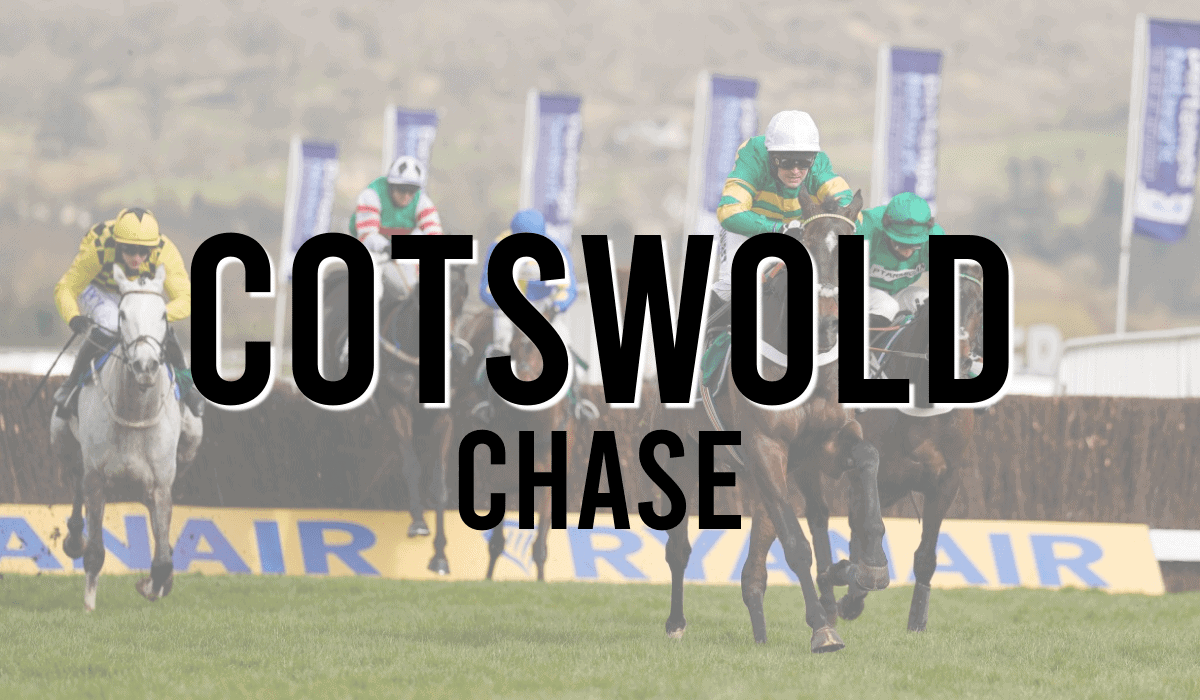
The Cotswold Chase is a Grade 2 steeplechase run at Cheltenham during Festival Trials Day in January.
Staged on the New Course over approximately three miles and one and a half furlongs, it is one of Britain’s established trials for the Cheltenham Gold Cup.
The race has an outstanding roll of honour. Little Owl, Master Oats, See More Business and Looks Like Trouble won the Cotswold Chase and the Cheltenham Gold Cup during their careers, while other winners include One Man, Neptune Collonges, Many Clouds, Frodon, Santini, Native River, L’Homme Presse and Spillane’s Tower.
Its position less than two months before the Cheltenham Festival gives leading staying chasers a chance to compete over the same course that stages the Gold Cup.
Cotswold Chase Race Overview
The Cotswold Chase is open to horses aged five and older.
It is run on Cheltenham’s New Course over three miles, one furlong and 56 yards, usually described as approximately three miles and one and a half furlongs.
Twenty-one fences are jumped.
| Race Fact | Detail |
|---|---|
| Race | Cotswold Chase |
| Racecourse | Cheltenham |
| Course | New Course |
| Classification | Grade 2 |
| Race type | Steeplechase |
| Eligibility | Five-year-olds and older |
| Distance | 3m1f56yds, approximately 3m1½f |
| Fences | 21 |
| Time of year | January |
| Meeting | Festival Trials Day |
| First running | 1980 |
| 2025 winner | L’Homme Presse |
| 2026 winner | Spillane’s Tower |
The Cotswold Chase is registered under its established name but can carry a sponsor title.
Cotswold Chase 2027
The 2027 Cotswold Chase is scheduled for Saturday 30 January 2027 as part of Festival Trials Day at Cheltenham.
Cheltenham’s current programme lists the Grade 2 Cotswold Chase over approximately three miles and one and a half furlongs.
Festival Trials Day is the final Cheltenham fixture before the Festival in March.
The meeting therefore provides an important opportunity to assess leading Festival contenders before the season’s biggest four days of jumps racing.
Final race times and conditions should always be checked closer to the meeting.
Cotswold Chase Course and Distance
The Cotswold Chase is staged on the New Course at Cheltenham Racecourse.
The race is run over three miles, one furlong and 56 yards with 21 fences.
Cheltenham is left-handed and undulating, with the famous uphill finish placing an additional demand on stamina.
That matters over an extended three miles.
A horse can travel strongly for much of the race but still weaken significantly after the final fence if it has used too much energy earlier in the contest.
Jumping also comes under pressure.
The Cotswold attracts experienced staying chasers, but repeated mistakes can be costly when competing against Grade 2 opposition around Cheltenham.
The combination of stamina, jumping and course position makes the race a useful test for horses being considered for the Gold Cup.
History of the Cotswold Chase
The Cotswold Chase was first run in 1980.
Raffi Nelson won the inaugural running for Nicky Henderson and Steve Smith-Eccles.
The quality of the race’s early winners quickly established its reputation.
Little Owl won in 1981 before winning the Cheltenham Gold Cup later that year.
The following decades produced several more top-class staying chasers.
Master Oats, See More Business and Looks Like Trouble all appear on the roll of honour, while One Man won the race during a career that included two King George VI Chases.
The race has also had several sponsorship identities.
Its registered identity as the Cotswold Chase provides the most useful way to follow its history because commercial titles can change between seasons.
Famous Cotswold Chase Winners
Little Owl
Little Owl won the Cotswold Chase in 1981.
Trained by Peter Easterby and ridden by amateur jockey Jim Wilson, he subsequently won the Cheltenham Gold Cup later that season.
Little Owl’s success established an immediate link between the relatively new Cotswold Chase and Cheltenham’s championship staying chase.
Master Oats
Master Oats won the race in 1995 for Kim Bailey and Norman Williamson.
He went on to win the Cheltenham Gold Cup that March, defeating Dubacilla by 15 lengths.
Master Oats was particularly effective on testing ground and provides a good historical example of why conditions need to be considered when assessing Cotswold form.
One Man
One Man won the Cotswold Chase in 1997.
The popular grey was a dual winner of the King George VI Chase and one of the leading chasers of his generation.
The Cheltenham Gold Cup ultimately proved beyond him, but he later demonstrated his versatility by dropping substantially in distance and winning the Queen Mother Champion Chase in 1998.
See More Business
See More Business became the first dual winner of the Cotswold Chase.
He won in 1998 and again in 2001 for Paul Nicholls.
Between those victories he won the 1999 Cheltenham Gold Cup.
His other major successes included two King George VI Chases and the Aintree Bowl.
Looks Like Trouble
Looks Like Trouble won the Cotswold Chase in 2000.
He returned to Cheltenham in March and won the Gold Cup for Noel Chance and Richard Johnson.
His victory reinforced the Cotswold’s position as a genuine championship trial.
Neptune Collonges
Neptune Collonges won the race in 2011 for Paul Nicholls.
He later became best known for winning the 2012 Grand National in a dramatic finish at Aintree.
His career demonstrates that Cotswold winners do not have to be viewed solely through the Gold Cup.
The extended distance and stamina test can also provide useful evidence for other major staying chases.
Many Clouds
Many Clouds won the Cotswold Chase twice, in 2015 and 2017.
His first victory came during the same season in which he won the Grand National for Oliver Sherwood and Leighton Aspell.
Many Clouds returned two years later and produced one of the most memorable performances in the history of the Cotswold Chase.
He defeated Thistlecrack after a sustained battle up the Cheltenham hill.
Tragically, Many Clouds collapsed and died after crossing the line.
His 2017 victory remains an important part of his racing legacy.
Frodon
Frodon won the Cotswold Chase in 2019 for Paul Nicholls and Bryony Frost.
Rather than running in the Gold Cup, he subsequently contested the Ryanair Chase at the Cheltenham Festival and won.
That route is a reminder that the Cotswold can reveal more than stamina.
Connections still need to determine the optimum championship target for the individual horse.
Frodon later demonstrated his staying ability by winning the King George VI Chase at Kempton.
Santini
Santini won the Cotswold Chase in 2020 for Nicky Henderson and Nico de Boinville.
He returned to Cheltenham for the Gold Cup and finished second to Al Boum Photo.
Santini was beaten only a neck, making him one of the strongest recent examples of the Cotswold providing relevant Gold Cup form.
Native River
Native River won the 2021 renewal at the age of 11.
He had already established himself as an outstanding staying chaser, with his biggest success coming in the 2018 Cheltenham Gold Cup.
Native River was particularly effective when stamina and jumping came under sustained pressure.
His Cotswold victory demonstrated that established older chasers can remain competitive in the race.
L’Homme Presse
L’Homme Presse won the 2025 Cotswold Chase for Venetia Williams and Charlie Deutsch.
He defeated Stage Star on soft ground, reinforcing his strong record at Cheltenham.
L’Homme Presse had previously won the Brown Advisory Novices’ Chase at the Festival and had long established himself among Britain’s leading staying chasers.
Spillane’s Tower
Spillane’s Tower won the 2026 Cotswold Chase for trainer Jimmy Mangan and jockey Jack Kennedy.
The Irish-trained chaser defeated the previous year’s winner L’Homme Presse, with Grey Dawning finishing third.
His victory provided another example of the increasing strength of Irish participation in major British staying chases.
Recent Cotswold Chase Winners
| Year | Winner | Trainer | Jockey |
|---|---|---|---|
| 2026 | Spillane’s Tower | Jimmy Mangan | Jack Kennedy |
| 2025 | L’Homme Presse | Venetia Williams | Charlie Deutsch |
| 2024 | Capodanno | Willie Mullins | Paul Townend |
| 2023 | Ahoy Senor | Lucinda Russell | Derek Fox |
| 2022 | Chantry House | Nicky Henderson | Nico de Boinville |
| 2021 | Native River | Colin Tizzard | Richard Johnson |
| 2020 | Santini | Nicky Henderson | Nico de Boinville |
| 2019 | Frodon | Paul Nicholls | Bryony Frost |
| 2018 | Definitly Red | Brian Ellison | Danny Cook |
| 2017 | Many Clouds | Oliver Sherwood | Leighton Aspell |
| 2016 | Smad Place | Alan King | Richard Johnson |
| 2015 | Many Clouds | Oliver Sherwood | Leighton Aspell |
| 2014 | The Giant Bolster | David Bridgwater | Tom Scudamore |
| 2013 | Cape Tribulation | Malcolm Jefferson | Denis O’Regan |
The recent winners illustrate the range of horses capable of succeeding.
Some were established Grade 1 chasers, while others used the race to establish themselves among the leading staying horses of the season.
Is the Cotswold Chase a Cheltenham Gold Cup Trial?
Yes. The Cotswold Chase is one of Britain’s established Cheltenham Gold Cup trials.
Its value comes from more than its position in the calendar.
The race is staged on Cheltenham’s New Course, giving Gold Cup candidates experience of the same course they will encounter at the Festival.
Little Owl, Master Oats and Looks Like Trouble won both races in the same season.
See More Business also won both races during his career.
More recent Cotswold winners have found it harder to complete the same-season double.
That does not mean the race has stopped being relevant.
Santini finished a close second in the 2020 Gold Cup after winning the Cotswold, while other winners have gone on to compete successfully in different championship races.
The strongest approach is to analyse the performance rather than assuming that victory automatically creates a leading Gold Cup contender.
Why Is the Cotswold Chase Useful for Gold Cup Analysis?
The Cotswold asks several questions that are relevant to the Gold Cup.
Cheltenham Form
Course experience is particularly useful at Cheltenham.
Its undulations, downhill sections and uphill finish create a different test from flatter racecourses.
A horse that travels and jumps efficiently around Cheltenham provides evidence that the course itself is unlikely to be a major concern in March.
Stamina
The Cotswold is run over approximately three miles and one and a half furlongs.
The Gold Cup is longer.
A horse that is already struggling for stamina late in the Cotswold may face an even greater challenge at the Festival.
Conversely, a runner finishing particularly strongly can provide evidence that the longer Gold Cup distance will suit.
Jumping
Gold Cup contenders need to jump accurately while maintaining their position in a high-quality field.
The Cotswold provides a useful opportunity to assess jumping around Cheltenham before the Festival.
One mistake is not necessarily significant.
Repeated errors, jumping to one side or consistently losing ground at fences deserve more attention.
Ground
Conditions in late January can differ substantially from those encountered at the Festival.
A Cotswold performance therefore needs to be assessed alongside the going.
A horse producing an outstanding performance on soft ground does not automatically reproduce the same level on a quicker surface.
Our horse racing going guide explains how changing ground conditions can affect performance.
Cotswold Chase and the Grand National
The Cotswold also has an interesting relationship with the Grand National.
Neptune Collonges and Many Clouds both won the race before subsequently winning at Aintree.
Many Clouds won the Cotswold and Grand National in the same season in 2015.
The Cotswold is not a conventional Grand National trial because Cheltenham and Aintree provide very different tests.
However, a strong performance can demonstrate several qualities required by a National horse:
- Stamina.
- Jumping.
- Ability to compete against high-class opposition.
- Experience in strongly run staying chases.
Handicap marks and the unique demands of Aintree then need to be considered separately.
Cotswold Chase Betting
The Cotswold often attracts a relatively small field of established chasers.
That does not necessarily make it straightforward from a betting perspective.
Several runners can arrive with different objectives.
One horse may be at peak fitness with the Cotswold itself as an important target.
Another may be using the race primarily as preparation for the Gold Cup.
An older chaser may be attempting to demonstrate that it retains enough ability to compete at Grade 2 level.
A younger runner may still be improving.
Those different profiles make context important.
Start by assessing:
- Recent form.
- Cheltenham record.
- Stamina.
- Jumping.
- Going.
- Likely pace.
- Fitness.
- Weight conditions.
- Longer-term target.
- Available odds.
Our guide to analysing a horse race covers the wider process of assessing form and race conditions.
Should You Follow Cotswold Chase Betting Trends?
Historic trends can provide useful context, but old statistics should not be treated as permanent rules.
Previous versions of this page focused heavily on the number of favourites to win during a fixed period, the ages of winners and minimum official ratings.
Those figures become stale quickly.
The quality and composition of the field also changes from season to season.
Age provides a good example.
The Cotswold has been won by horses at very different stages of their careers.
Native River won as an 11-year-old, while younger horses have also succeeded.
The important question is not whether a runner fits an arbitrary historic age bracket.
It is whether its current ability, fitness, jumping and stamina give it a strong chance in that particular renewal.
Cotswold Chase and the King George VI Chase
The King George VI Chase is another important race when assessing Britain’s staying chase division.
The two races provide different tests.
Kempton places greater emphasis on speed and fluent jumping around a sharper circuit.
Cheltenham’s Cotswold Chase places more emphasis on stamina and the ability to negotiate an undulating track.
A horse moving from the King George to the Cotswold can therefore produce a substantially different performance without its underlying ability having changed.
That is why racecourse characteristics need to form part of any form analysis.
Leading Cotswold Chase Trainers
Paul Nicholls has an outstanding record in the Cotswold Chase.
His victories include See More Business twice, Taranis, Neptune Collonges and Frodon.
Nicky Henderson has also enjoyed repeated success.
He trained the inaugural winner Raffi Nelson and later won with Santini and Chantry House among others.
Trainer records can help identify races that particular yards have historically targeted.
They should still be treated as secondary evidence.
The ability and suitability of the horse remain more important than the trainer’s historical totals.
Leading Cotswold Chase Jockeys
The race’s winning jockeys include many of the leading National Hunt riders of their generations.
Steve Smith-Eccles, Tony McCoy and Richard Johnson have all enjoyed multiple victories.
More recent winners have been ridden by jockeys including Nico de Boinville, Bryony Frost, Leighton Aspell, Paul Townend, Charlie Deutsch and Jack Kennedy.
Jockey records provide useful historical context but should not be treated as a standalone betting angle.
Cotswold Chase 2025
L’Homme Presse won the 2025 Cotswold Chase for Venetia Williams and Charlie Deutsch.
The ten-year-old started as the 4/5 favourite and defeated Stage Star by three-quarters of a length on soft ground.
Gentlemansgame finished a distant third.
The race was run over three miles, one furlong and 56 yards with 21 fences.
L’Homme Presse’s victory added another major Cheltenham success to a career that already included the Brown Advisory Novices’ Chase.
Cotswold Chase 2026
Spillane’s Tower won the 2026 Cotswold Chase for Jimmy Mangan and Jack Kennedy.
The eight-year-old defeated L’Homme Presse by three-quarters of a length, preventing the defending champion from winning consecutive renewals.
Grey Dawning finished third.
Spillane’s Tower arrived with Grade 1 form and his victory confirmed that he remained a major force among staying chasers.
The result also demonstrated why recent form needs context.
A horse can return to its best when switching back to more suitable race conditions.
How to Analyse the Cotswold Chase
The strongest Cotswold analysis starts with the individual horses rather than historical trends.
Assess the Form
Compare the quality of each runner’s recent opposition.
A defeat in a Grade 1 can represent stronger form than an easy victory in a weaker race.
Check the Distance
Establish whether each horse has demonstrated sufficient stamina.
The extended three-mile trip and Cheltenham finish can expose horses that are more effective at shorter distances.
Study the Jumping
Watch previous races where possible.
Repeated jumping errors can become particularly expensive around Cheltenham.
Consider the Course
Previous Cheltenham form provides useful evidence.
Do not automatically reject a horse without course experience, but give appropriate credit to runners that have already demonstrated they handle the track.
Assess the Going
Compare the forecast conditions with each horse’s strongest previous performances.
Avoid reducing this to a simple win/loss record.
The quality of opposition and circumstances of each run matter.
Examine the Pace
Consider which horses are likely to race prominently and whether several runners could compete for the lead.
Our pace maps guide explains how anticipated race position can help when analysing a field.
Cotswold Chase FAQs
When is the Cotswold Chase?
The Cotswold Chase is staged during Cheltenham’s Festival Trials Day in January.
When is the 2027 Cotswold Chase?
The 2027 Cotswold Chase is scheduled for Saturday 30 January at Cheltenham.
Where is the Cotswold Chase run?
The race is staged on the New Course at Cheltenham Racecourse.
How far is the Cotswold Chase?
The race is run over three miles, one furlong and 56 yards, approximately three miles and one and a half furlongs.
How many fences are jumped?
The Cotswold Chase has 21 fences.
Is the Cotswold Chase a Grade 2?
Yes. The Cotswold Chase is a Grade 2 National Hunt steeplechase.
Which horses can run in the Cotswold Chase?
The race is open to horses aged five and older, subject to the conditions applying to the individual renewal.
When was the first Cotswold Chase?
The inaugural Cotswold Chase was run in 1980 and won by Raffi Nelson.
Who won the Cotswold Chase in 2026?
Spillane’s Tower won the 2026 race for trainer Jimmy Mangan and jockey Jack Kennedy.
Who won the Cotswold Chase in 2025?
L’Homme Presse won the 2025 Cotswold Chase for Venetia Williams and Charlie Deutsch.
Is the Cotswold Chase a Gold Cup trial?
Yes. It is one of Britain’s established Cheltenham Gold Cup trials and is particularly useful because it takes place on Cheltenham’s New Course.
Which horses have won the Cotswold Chase and Cheltenham Gold Cup in the same season?
Little Owl, Master Oats and Looks Like Trouble are among the horses to complete the Cotswold Chase and Cheltenham Gold Cup double in the same season.
Has a Cotswold Chase winner won the Grand National?
Yes. Neptune Collonges and Many Clouds both won the Cotswold Chase during careers that included Grand National victories. Many Clouds won both races in 2015.
Who has won the Cotswold Chase more than once?
See More Business and Many Clouds are among the multiple winners of the race.
Is previous Cheltenham form important?
Previous Cheltenham form is useful because the course has distinctive demands. However, it should be considered alongside current form, stamina, jumping, going and the strength of opposition.
Cotswold Chase Summary
The Cotswold Chase is one of Britain’s leading Grade 2 staying chases and an established trial for the Cheltenham Gold Cup.
Run over approximately three miles and one and a half furlongs on Cheltenham’s New Course, it provides an important examination of stamina, jumping and course suitability before the Festival.
Its roll of honour includes Little Owl, Master Oats, One Man, See More Business, Looks Like Trouble, Neptune Collonges, Many Clouds, Frodon, Santini and Native River.
More recently, L’Homme Presse won in 2025 before Spillane’s Tower took the 2026 renewal.
Historic trends can provide context, but the strongest way to assess the Cotswold is to concentrate on current form, Cheltenham suitability, jumping, stamina, ground, pace and price.
The next Cotswold Chase is scheduled for Festival Trials Day at Cheltenham on Saturday 30 January 2027.












