
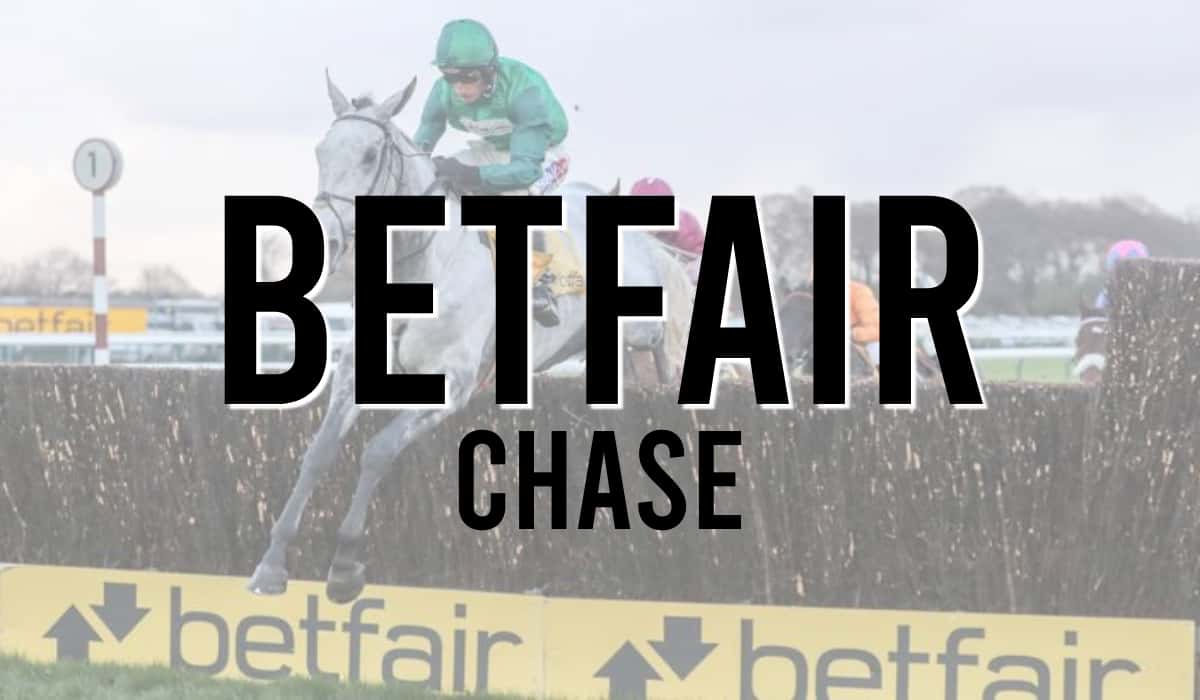
The Betfair Chase is one of Britain’s leading Grade 1 races for staying chasers and provides an important early-season test for horses targeting the major three-mile prizes.
Run at Haydock Racecourse in November, the race has quickly developed an outstanding roll of honour despite being considerably younger than many of Britain’s championship chases. Kauto Star, Imperial Commander, Cue Card, Bristol De Mai and A Plus Tard are among the winners that have also produced top-level performances elsewhere.
Haydock’s three-mile test can become particularly demanding when autumn rain produces soft or heavy ground, but conditions vary considerably between renewals. The strongest analysis therefore considers the actual going, pace, jumping and fitness rather than assuming every Betfair Chase will become an extreme stamina contest.
The race also occupies an important position in the staying-chase season. Leading horses can progress from Haydock towards the King George VI Chase at Kempton before attention turns towards the Cheltenham Gold Cup in March.
Betfair Chase Key Facts
| Race detail | Betfair Chase |
|---|---|
| Racecourse | Haydock Park |
| Race type | National Hunt steeplechase |
| Grade | Grade 1 |
| Distance | About 3 miles 1½ furlongs |
| Fences | 19 |
| Eligibility | Horses aged 5+ |
| Usual month | November |
| Established | 2005 |
| Registered name | Lancashire Chase |
The Betfair Chase has held Grade 1 status since its introduction and is one of the first major opportunities of the British jumps season for established staying chasers to meet at level weights.
When Is the Betfair Chase 2026?
The 2026 Betfair Chase is scheduled for Saturday 21 November 2026 at Haydock Park.
The final field, going, and race conditions become much more important close to race day, so this guide focuses on the enduring characteristics of the race rather than trying to predict one particular renewal months in advance.
Why Is the Betfair Chase Important?
The Betfair Chase gives racing followers an early indication of the strength of the staying-chase division.
Many leading three-mile chasers spend the summer away from the racecourse before returning during the autumn. Haydock can therefore be the first opportunity to discover whether an established Grade 1 horse has retained its ability or whether an improving rival is ready to challenge the existing hierarchy.
Fitness adds another layer to the analysis. Some horses arrive after a preparatory run, while others can produce a high-level performance on their seasonal reappearance. Trainer comments and historical fresh form can provide useful context, but the individual horse should be assessed rather than applying a rigid rule about previous runs.
The result can influence the wider staying-chase picture without settling it. Haydock in November and Cheltenham in March present different tests several months apart, so a horse can excel in one without necessarily reproducing the same level in the other.
Haydock and the Betfair Chase
Haydock is a left-handed, relatively flat course that can still produce an extremely demanding examination of a staying chaser.
The track itself lacks the pronounced undulations associated with Cheltenham, but its long straights and exposed nature can place sustained pressure on horses. Conditions are often influential during the winter months, particularly when rain turns the ground soft or heavy.
That combination has helped create Haydock specialists.
Some horses appear particularly comfortable maintaining their rhythm around the course, while others struggle when the surface becomes testing. Bristol De Mai is the clearest modern example, building an exceptional Haydock record that included three Betfair Chase victories.
Course form therefore deserves attention, but it should be understood rather than used mechanically. A horse that has never raced at Haydock is not automatically disadvantaged, while previous success on good ground may provide limited evidence if a subsequent renewal is staged in very different conditions.
How the Going Changes the Betfair Chase
The horse racing going can completely alter the demands of the Betfair Chase.
On better ground, horses can maintain a higher cruising speed and tactical position becomes increasingly important. A runner with enough speed to travel close to the leaders can place pressure on rivals before stamina becomes the decisive factor.
Soft or heavy ground creates a different race. Horses expend more energy maintaining momentum and the extended three-mile distance becomes increasingly demanding. Jumping errors can also become more expensive because tired horses find it harder to regain lost ground.
This is why broad statements about a horse being a “stayer” are not enough. The relevant question is whether it can sustain its performance over this distance under the actual conditions.
Previous performances on comparable ground provide the strongest evidence, particularly when they came against high-quality opposition.
Pace in the Betfair Chase
The Betfair Chase often attracts relatively small fields compared with major handicaps, which can make the likely pace particularly important.
A field containing an obvious front-runner can develop very differently from one in which several jockeys are happy to wait. If the early fractions are controlled, horses with tactical speed may retain enough energy to accelerate later in the race.
Several prominent racers can create a much stronger stamina test. Horses that race too freely or repeatedly challenge for the lead may use valuable energy before reaching the decisive stages.
A horse racing pace map can therefore add useful context even in a small Grade 1 field. Identify each runner’s normal position and consider which horse is most likely to control the race.
The pace should then be assessed alongside the going. A strong gallop on testing ground can produce a very different finishing effort from the same early pace on a quicker surface.
Jumping at Haydock
Accurate jumping is fundamental to the Betfair Chase.
The 19 fences give horses repeated opportunities either to maintain their rhythm or surrender momentum. Small errors can accumulate throughout the race, while a serious mistake against Grade 1 opposition can quickly leave a horse out of position.
Fluent jumpers can also use their technique tactically. A horse repeatedly gaining small amounts of ground at its fences can hold a prominent position without its jockey needing to expend additional energy between obstacles.
When reading horse racing form, look beyond whether a horse completed its previous races. Consider how efficiently it jumped when the pace increased and whether errors became more frequent as it tired.
That information becomes particularly useful when assessing horses returning from a break or stepping into stronger company.
History of the Betfair Chase
The Betfair Chase is relatively young by Grade 1 standards.
It was first run in 2005, when Kingscliff won the inaugural contest for trainer Robert Alner and jockey Robert Walford. The race was established as a Grade 1 from the beginning and quickly attracted many of Britain’s leading staying chasers.
Its position in November helped give the staying-chase division an important championship-level target before Christmas. The race subsequently became closely associated with some of the outstanding chasers of the modern era.
Kauto Star did more than any other horse to establish its reputation, but the roll of honour also includes Cheltenham Gold Cup winners Imperial Commander and A Plus Tard alongside high-class chasers such as Cue Card, Silviniaco Conti and Bristol De Mai.
Kauto Star and the Betfair Chase
Kauto Star is the most successful horse in Betfair Chase history.
Trained by Paul Nicholls, he won the race four times in 2006, 2007, 2009 and 2011.
His record is particularly notable because the victories formed part of one of the greatest staying-chase careers in modern racing. Kauto Star also won the King George VI Chase five times and became the first horse to regain the Cheltenham Gold Cup after losing it.
Haydock played an important role in several of those campaigns.
His 2006 Betfair Chase victory came during the season in which he also won the King George and Cheltenham Gold Cup. Five years later, he returned to Haydock as an 11-year-old and defeated the previous season’s Gold Cup winner Long Run.
That 2011 victory demonstrated why age statistics need to be handled carefully. An older horse with proven Grade 1 ability can remain extremely competitive when its form and physical condition remain strong.
Kauto Star’s four victories remain the Betfair Chase record.
Cue Card
Cue Card became another horse closely associated with the Betfair Chase during the following decade.
He won the race in 2013, 2015 and 2016, giving him three victories at Haydock.
The 2015 success formed part of an exceptional campaign. Cue Card went on to win the King George VI Chase at Kempton and arrived at Cheltenham with the opportunity to secure a major bonus by adding the Gold Cup.
He fell three fences from home at Cheltenham while still travelling strongly, leaving one of the great unanswered questions of his career.
His record nevertheless demonstrates the relationship between Haydock and Kempton. A horse with the combination of stamina, jumping and tactical speed required for the Betfair Chase can also possess many of the qualities needed for the King George, even though the courses themselves are very different.
Bristol De Mai
Few horses have been as strongly associated with Haydock as Bristol De Mai.
Trained by Nigel Twiston-Davies, the grey won the Betfair Chase in 2017, 2018 and 2020.
His first victory was particularly emphatic, establishing his reputation as a horse exceptionally well suited to testing conditions at Haydock. He subsequently demonstrated that the initial performance was not an isolated result by returning repeatedly to produce high-class form at the course.
Bristol De Mai provides a useful lesson for analysing the Betfair Chase. Course form can sometimes be dismissed as coincidence, but repeated high-level performances under similar circumstances become increasingly meaningful.
The challenge is distinguishing genuine course suitability from a simple historical statistic.
Imperial Commander
Imperial Commander won the Betfair Chase in 2010, months after winning the Cheltenham Gold Cup.
His career demonstrates that the relationship between the two races can work in both directions. Rather than using Haydock purely as a trial for Cheltenham, an established Gold Cup horse can return the following season and use the Betfair Chase as an important Grade 1 target in its own right.
Imperial Commander’s victory also adds to the quality of the race’s roll of honour. Despite its comparatively short history, the Betfair Chase has repeatedly attracted horses already proven at championship level.
A Plus Tard
A Plus Tard won the 2021 Betfair Chase for trainer Henry de Bromhead and jockey Rachael Blackmore.
The performance proved particularly significant when viewed in the context of the entire season. A Plus Tard went on to win the Cheltenham Gold Cup the following March, having finished second in the championship race a year earlier.
His campaign provides one of the clearest modern examples of the Betfair Chase acting as an early-season indicator of Gold Cup ability.
It should not be turned into a rigid rule. Haydock and Cheltenham are different courses and the races are separated by several months, but producing a high-class staying performance at Haydock remains valuable evidence when assessing a horse’s championship credentials.
Royale Pagaille
Royale Pagaille won consecutive Betfair Chases in 2023 and 2024 for trainer Venetia Williams and jockey Charlie Deutsch.
His victories continued the tradition of horses producing repeated high-level performances at Haydock and also demonstrated the value of proven ability under winter conditions.
By winning at the age of nine and returning successfully as a ten-year-old, Royale Pagaille provides another warning against simplistic age trends. Established staying chasers can remain competitive in the Betfair Chase when their current form, jumping and suitability for the conditions remain intact.
Grey Dawning Wins in 2025
Grey Dawning won the 2025 Betfair Chase for trainer Dan Skelton and jockey Harry Skelton.
The eight-year-old started favourite and defeated the dual defending champion Royale Pagaille, with Stellar Story third.
Grey Dawning’s victory added another high-class staying chaser to the roll of honour and ended Royale Pagaille’s attempt to become only the fourth horse to win the race at least three times.
As with every renewal, the result should be assessed alongside the circumstances in which it was achieved. Ground, pace, jumping and the fitness of horses making early-season appearances all affect how useful the race becomes as evidence for later targets.
Recent Betfair Chase Winners
| Year | Winner | Trainer | Jockey |
|---|---|---|---|
| 2025 | Grey Dawning | Dan Skelton | Harry Skelton |
| 2024 | Royale Pagaille | Venetia Williams | Charlie Deutsch |
| 2023 | Royale Pagaille | Venetia Williams | Charlie Deutsch |
| 2022 | Protektorat | Dan Skelton | Harry Skelton |
| 2021 | A Plus Tard | Henry de Bromhead | Rachael Blackmore |
| 2020 | Bristol De Mai | Nigel Twiston-Davies | Daryl Jacob |
| 2019 | Lostintranslation | Colin Tizzard | Robbie Power |
| 2018 | Bristol De Mai | Nigel Twiston-Davies | Daryl Jacob |
| 2017 | Bristol De Mai | Nigel Twiston-Davies | Daryl Jacob |
| 2016 | Cue Card | Colin Tizzard | Paddy Brennan |
| 2015 | Cue Card | Colin Tizzard | Paddy Brennan |
| 2014 | Silviniaco Conti | Paul Nicholls | Noel Fehily |
| 2013 | Cue Card | Colin Tizzard | Joe Tizzard |
| 2012 | Silviniaco Conti | Paul Nicholls | Ruby Walsh |
| 2011 | Kauto Star | Paul Nicholls | Ruby Walsh |
The recent winners illustrate one of the strongest characteristics of the Betfair Chase: repeat success is relatively common.
Kauto Star won four times, Cue Card and Bristol De Mai three times each, while Silviniaco Conti and Royale Pagaille both won twice. Proven Haydock form therefore deserves serious consideration, particularly when it is supported by current form rather than used as an isolated historical statistic.
Betfair Chase and the King George VI Chase
The King George VI Chase at Kempton is one of the obvious subsequent targets for horses competing at Haydock.
Kauto Star and Cue Card provide outstanding examples of horses capable of succeeding in both races, but the tests are not identical.
Haydock is a galloping track where testing November ground can place considerable emphasis on stamina. Kempton is sharper and can reward tactical speed and fluent jumping around its tighter circuit.
A strong Betfair Chase performance therefore needs to be interpreted according to how it was achieved. A horse that wins primarily because it relishes extremely testing ground may face a different challenge at Kempton, while a horse demonstrating speed and jumping efficiency at Haydock may possess attributes particularly well suited to Boxing Day.
Betfair Chase and the Cheltenham Gold Cup
The Cheltenham Gold Cup is the ultimate championship target for many horses appearing in the Betfair Chase.
Kauto Star, Imperial Commander and A Plus Tard all won both races during their careers, while numerous other Betfair Chase runners have subsequently competed in the Gold Cup.
Haydock provides useful evidence about stamina, jumping and Grade 1 ability, but the result should never be treated as a direct Gold Cup prediction.
Cheltenham is more undulating, the Gold Cup is run over a longer distance and the championship takes place much later in the season. Horses can improve, regress or encounter completely different conditions between November and March.
The useful information comes from the performance itself. Assess how the horse travelled, jumped and finished rather than simply recording whether it won or lost.
What Are the Most Useful Betfair Chase Trends?
The strongest Betfair Chase trends are those connected to the actual demands of the race.
Grade 1 ability matters. The roll of honour contains numerous championship-level horses, and established top-class form is particularly valuable in a level-weights contest.
Haydock form can be significant. Multiple winners are unusually prominent in the race’s history, suggesting that proven suitability for the track and typical winter conditions deserves attention.
Three-mile stamina is important. The extended distance can become particularly demanding when the ground is soft or heavy.
Jumping efficiency matters. Nineteen fences place sustained pressure on technique, and repeated mistakes can prevent a horse maintaining a competitive position.
Fitness needs individual assessment. Some top-class chasers can perform close to their best on their seasonal return, while others improve significantly for a previous run.
Ground suitability should be based on evidence. Haydock’s reputation for testing conditions should not lead bettors to assume the ground will always be soft. Assess the actual surface and the horse’s record under comparable conditions.
Age, starting price and the number of previous runs can provide supporting information, but none should become an automatic selection rule.
How to Analyse the Betfair Chase
Start with the quality of each horse’s staying-chase form.
The Betfair Chase is a Grade 1 at level weights, so proven performances against elite opposition deserve considerable respect. Improving horses can still progress into that category, but they need enough evidence to justify the step.
Next, assess fitness. Look at previous seasonal debuts and consider whether the horse normally produces its best form fresh or improves after racing. Trainer patterns can add context, although they should never override the individual horse’s record.
Then combine ground, pace and jumping. A horse that stays three miles on good ground may face a very different test on soft or heavy going, particularly if several runners create a strong early gallop. Similarly, an excellent stayer can still struggle if jumping errors repeatedly interrupt its rhythm.
Course suitability completes the racing assessment. Repeated strong performances at Haydock are worth noting because the Betfair Chase has produced several genuine course specialists.
Only after assessing those factors should price determine whether the horse represents a worthwhile bet. Our guide to finding value in horse racing explains why identifying the most likely winner and identifying a value bet are different decisions.
Readers comparing bookmakers specifically for racing can use our best horse racing betting sites comparison.
Betfair Chase FAQs
What is the Betfair Chase?
The Betfair Chase is a Grade 1 National Hunt steeplechase staged at Haydock Park. It is one of Britain’s principal early-season races for staying chasers.
Where is the Betfair Chase run?
The race is run at Haydock Park in Merseyside.
How far is the Betfair Chase?
The race is run over approximately three miles and one and a half furlongs.
How many fences are jumped in the Betfair Chase?
The modern race involves 19 fences.
When is the Betfair Chase 2026?
The 2026 Betfair Chase is scheduled for Saturday 21 November at Haydock Park.
Who won the Betfair Chase in 2025?
Grey Dawning won the 2025 Betfair Chase for trainer Dan Skelton and jockey Harry Skelton.
Which horse has won the most Betfair Chases?
Kauto Star holds the record with four victories in 2006, 2007, 2009 and 2011.
How many times did Cue Card win the Betfair Chase?
Cue Card won three times, in 2013, 2015 and 2016.
How many times did Bristol De Mai win the Betfair Chase?
Bristol De Mai won three renewals, in 2017, 2018 and 2020.
Has a Betfair Chase winner gone on to win the Cheltenham Gold Cup?
Yes. Kauto Star won both races during his career, while A Plus Tard won the 2021 Betfair Chase before winning the 2022 Cheltenham Gold Cup. Imperial Commander won the 2010 Betfair Chase after winning the Gold Cup earlier that year.
Is the Betfair Chase a King George trial?
The race is an important early-season Grade 1 for staying chasers and can form part of the route towards the King George VI Chase. However, Haydock and Kempton present different tests, so the performance should be assessed in context rather than treating the result as an automatic King George predictor.
Why do some horses perform particularly well at Haydock?
Track configuration, ground, jumping rhythm and race pace can all contribute. Horses such as Bristol De Mai and Royale Pagaille produced repeated high-level performances at Haydock, providing strong evidence that some staying chasers are particularly well suited to the course and typical winter conditions.
Where can I find Betfair Chase betting tips?
Our Haydock betting tips cover racing at the course. Final declarations, current form, going and market prices should be assessed close to the race rather than relying on early speculative selections.
Betfair Chase Summary
The Betfair Chase has established itself as one of Britain’s most important staying chases despite only being introduced in 2005.
Kauto Star’s record four victories played a major role in establishing its reputation, while Cue Card, Bristol De Mai, Imperial Commander, A Plus Tard and Royale Pagaille have added considerable depth to the roll of honour.
Haydock’s extended three-mile test rewards stamina and accurate jumping, with the going capable of substantially changing the character of an individual renewal. The race’s history of multiple winners also makes proven course suitability more relevant than in many Grade 1 contests.
The strongest analysis therefore combines class, current form, fitness, pace, jumping, ground and Haydock suitability rather than relying on a fixed age, favourite or starting-price trend.
The Betfair Chase can provide an important early indication of the strength of the staying-chase division, but the King George and Cheltenham Gold Cup remain different challenges. Understanding how a horse performed at Haydock is ultimately more useful than the finishing position alone.












