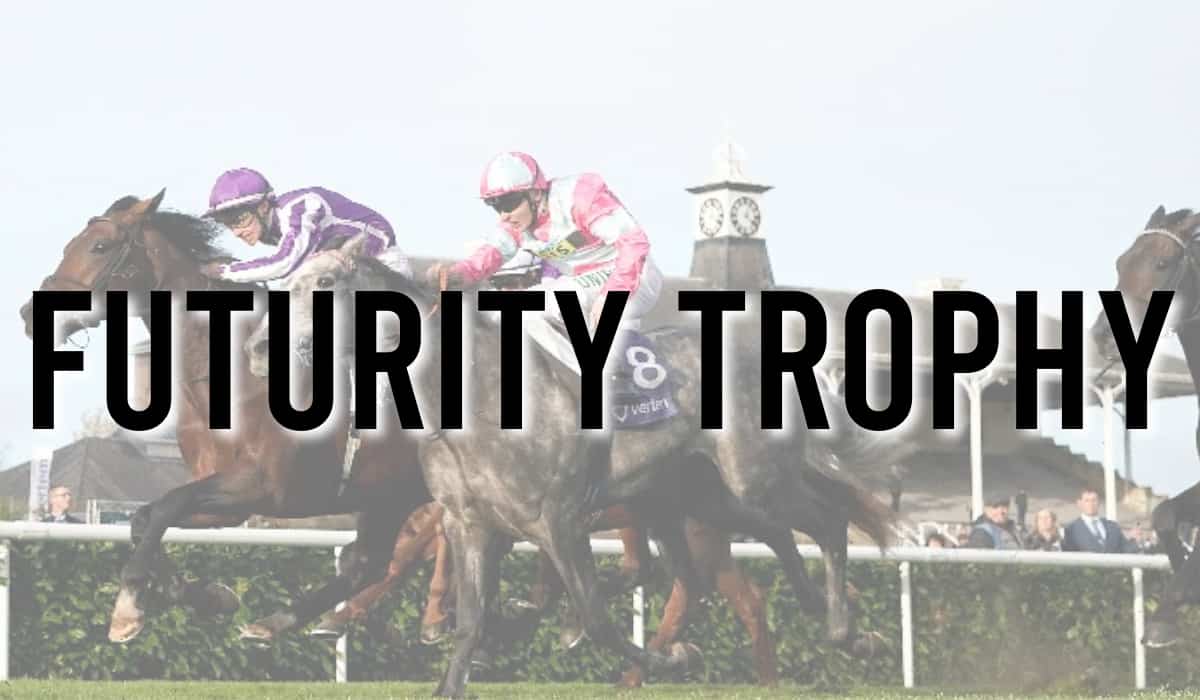
The Futurity Trophy is a Group 1 Flat race for two-year-old colts and fillies run over one mile at Doncaster Racecourse. Staged in late October, it is traditionally the final Group 1 of the British Flat season and has developed an outstanding record for identifying horses capable of succeeding in the following year’s Classics.
Its position in the calendar makes the Futurity Trophy particularly revealing. The leading juveniles have already had most of their two-year-old campaigns, often progressing through maiden, novice, Listed and Group races before reaching Doncaster. They must then cope with a straight mile at a time of year when soft or heavy ground can turn the race into a much stronger examination of stamina than an ordinary juvenile mile.
The race’s influence extends well beyond the result itself. Reference Point, High Chaparral, Motivator, Authorized, Camelot and Auguste Rodin all won the Futurity Trophy before winning the Derby the following season, while Magna Grecia and Kameko are among the winners who subsequently captured the 2,000 Guineas.
That record explains why the Futurity Trophy is one of Britain’s most important races for assessing the next generation.
Futurity Trophy Key Facts
- Racecourse: Doncaster
- Distance: 1 mile
- Race type: Group 1 Flat race
- Age: Two-year-olds
- Eligible horses: Colts and fillies
- Geldings: Not eligible
- Course: Straight mile
- Usual month: October
- First running: 1961
- Original name: Timeform Gold Cup
- Former names: Observer Gold Cup, Futurity Stakes and Racing Post Trophy
- Current name: Futurity Trophy
- Significance: Final Group 1 of the British Flat season
The race has been staged at Doncaster for most of its history and has been run on the straight mile since 2001. Its position late in the season means it provides a very different examination from many of the faster juvenile races staged during the summer.
When Is the Futurity Trophy?
The Futurity Trophy is normally staged at Doncaster in late October, towards the end of the British turf Flat season.
The exact date, race time, prize money and sponsorship can change from year to year, so these should always be checked against the current fixture information rather than treated as permanent features of the race.
The 2026 Futurity Trophy is scheduled for Saturday 24 October as the feature race of Doncaster’s two-day Futurity Trophy Weekend.
Our UK horse racing fixtures section carries the wider British racing calendar.
Why Is the Futurity Trophy Important?
Few juvenile races have established a stronger relationship with future Classic success. The Futurity Trophy takes place late enough in the season for the leading two-year-olds to have developed substantially, but early enough in their careers that considerable improvement may still lie ahead.
The mile distance is also significant. Juveniles capable of winning a Group 1 over a mile in October often possess the combination of class, stamina and physical development required to compete over longer distances as three-year-olds. Others prove better suited to remaining at a mile and can develop into leading 2,000 Guineas contenders.
This gives the race relevance across several Classic distances. A Futurity Trophy winner does not need to become a Derby horse, and winning at Doncaster certainly does not guarantee Classic success, but the race provides valuable evidence about which juveniles are developing the attributes required for top-level three-year-old racing.
The quality of the winners supports that reputation. High Chaparral, Camelot and Auguste Rodin went on to become outstanding middle-distance horses, while other winners have developed into leading milers.
The Futurity Trophy and the Derby
Six Futurity Trophy winners have subsequently won the Derby at Epsom:
- Reference Point
- High Chaparral
- Motivator
- Authorized
- Camelot
- Auguste Rodin
This is one of the strongest historical connections between a British two-year-old race and the following season’s Derby.
The relationship makes racing sense. Doncaster’s mile asks a juvenile to settle, travel and sustain its effort, while an autumn race on softer ground can place considerably more emphasis on stamina than a fast-ground mile earlier in the season. Horses that finish strongly under those circumstances can have the physical and racing profile to improve when stepping up in distance at three.
The Derby is still a very different examination. Epsom extends to a mile and a half and adds gradients, cambers, bends and the demands of Tattenham Corner. Futurity Trophy form should therefore be viewed as evidence of potential rather than a direct Derby trial.
Auguste Rodin provides the most recent example. He won at Doncaster in 2022 before taking the Derby and Irish Derby in 2023, reinforcing the race’s reputation as a place where future middle-distance champions can emerge.
Read our Epsom Derby guide for more on Britain’s premier Classic.
The Futurity Trophy and the 2,000 Guineas
The Futurity Trophy is equally capable of identifying future top-class milers. Magna Grecia won at Doncaster in 2018 before taking the 2,000 Guineas at Newmarket the following spring, while Kameko completed the same sequence after winning the Futurity Trophy in 2019.
That versatility is one of the most interesting aspects of the race. At the end of a horse’s two-year-old season, it is not always obvious whether its long-term future lies at a mile, ten furlongs or a mile and a half. Physical development over the winter can alter the picture considerably.
Running style can provide clues. A horse showing a sharp change of pace and travelling strongly through a mile may develop into a specialist miler, while one that takes time to reach top speed and continues powerfully through the line can look more likely to appreciate longer distances.
Pedigree adds further evidence, but neither pedigree nor one juvenile performance should be treated as definitive. The strongest assessment combines what the horse has demonstrated on the racecourse with how it is bred and how much physical development appears likely.
Doncaster’s Straight Mile
The Futurity Trophy is run over Doncaster’s straight mile. This removes the bends and positional complications associated with a turning course, but it does not make the race tactically simple.
Doncaster is a wide, galloping track and large fields can spread across the course. The strongest pace may develop on one side, particularly if jockeys have formed different opinions about where the best ground lies. A horse can therefore be disadvantaged by racing away from the main pace even when its draw would not ordinarily be considered unfavourable.
The long straight also gives horses time to build momentum. Juveniles that race efficiently and respond progressively to pressure can be well suited by the course, while inexperienced horses may find themselves exposed when a Group 1 begins to develop several furlongs from home.
Our Doncaster Racecourse guide covers the course, its configuration and its major races in more detail.
Why Ground Matters So Much
The Futurity Trophy’s late-October position means ground conditions deserve particular attention. Doncaster can produce soft or heavy going at this stage of the season, although conditions vary considerably between renewals.
Testing ground changes the nature of a juvenile mile. Horses must expend more energy maintaining their speed, making stamina increasingly important and potentially reducing the advantage held by juveniles whose strongest asset is acceleration on a quick surface.
The 2025 renewal demonstrated the point particularly clearly when Hawk Mountain won on heavy ground. Hotazhell had also won on soft going twelve months earlier. Those results do not mean future winners must be soft-ground specialists, but they demonstrate why summer form on fast ground cannot simply be transferred to Doncaster without considering the conditions.
Juveniles can be particularly difficult to assess because many have limited evidence on genuinely testing ground. Pedigree can provide useful clues when a horse has never encountered similar conditions, but its own racing evidence should carry more weight whenever it is available.
Our horse racing going guide explains how ground conditions affect pace, stamina and performance.
Pace Can Change the Race Completely
A straight mile allows considerable tactical variation. Some Futurity Trophy fields contain an obvious front-runner capable of establishing a genuine gallop, while others lack pace and develop into a much sharper test during the closing stages.
That distinction matters when assessing the runners. A horse that has looked particularly strong at the end of seven furlongs may appreciate a strongly run mile, whereas another with greater natural acceleration could become more dangerous if the field reaches halfway without racing hard.
Juvenile inexperience adds another dimension. A two-year-old can race too freely, become unbalanced under pressure or fail to settle when surrounded by rivals. Those behaviours consume energy and can become particularly costly over a mile on testing ground.
The strongest analysis therefore considers where the pace is likely to come from and which horses are most likely to obtain the racing conditions that suit them. Our horse racing pace maps guide explains how to approach that assessment.
Draw Analysis at Doncaster
The Futurity Trophy is run on a straight course, so the draw should not be analysed in the same way as a race beginning close to a bend. A low or high stall is not automatically advantageous.
What matters is how the draw interacts with pace and ground. If most of the likely leaders are drawn together, horses near that group can gain a tactical advantage by receiving a stronger lead into the race. When the field splits, a horse in a smaller group may find itself racing without enough cover or away from the strongest tempo.
Late-season ground can make this relationship even more important. Jockeys may move towards whichever part of the course they believe is riding quickest, and the preferred racing line can change during a meeting as earlier races provide more evidence.
This is why our horse racing draw guide treats stall position as one part of a wider assessment rather than a standalone betting system.
Juvenile Form Requires Different Analysis
Two-year-old form develops quickly. A juvenile that looked ordinary in June can improve considerably by October, while an early-season star may find that physically later-maturing rivals have caught up.
That makes the Futurity Trophy different from analysing an established older-horse Group 1. There is less racing evidence available and greater uncertainty about the level each horse is capable of reaching.
The strength of previous opposition becomes particularly important. Winning a maiden impressively does not automatically prove Group 1 ability, while finishing second or third in a strong Group race can represent considerably better form than winning a weaker contest.
Look beyond finishing positions. Consider how the race was run, whether the horse travelled comfortably, how much pressure it faced, what happened to the horses around it and whether its performance improved as the distance increased.
Our guide to reading horse racing form explains how to put individual results into a wider racing context.
The Dewhurst Is an Important Comparison
The Dewhurst Stakes at Newmarket and Futurity Trophy are Britain’s two major late-season Group 1 races for juvenile colts, but they ask different questions.
The Dewhurst Stakes is run over seven furlongs on Newmarket’s Rowley Mile. The Futurity Trophy extends to a full mile at Doncaster, giving horses an additional furlong and potentially placing greater emphasis on stamina.
The races therefore attract overlapping but not identical types of horse. A juvenile with abundant speed may look ideally suited to the Dewhurst, while a horse expected to develop into a middle-distance three-year-old can find the Doncaster mile a more natural target.
Both races are important when assessing the following year’s Classics. Rather than treating one as inherently stronger, compare the quality of each field, the manner of the performances and how the leading horses are likely to develop over the winter.
The Royal Lodge Can Produce Futurity Trophy Horses
The Royal Lodge Stakes at Newmarket provides another relevant autumn form line because it is also run over a mile for two-year-olds.
Horses emerging from the Royal Lodge Stakes have already demonstrated their ability over the Futurity Trophy distance, although Newmarket and Doncaster present different racing tests. The timing also allows several weeks between the races, giving connections the opportunity to target Doncaster after a strong Royal Lodge performance.
As with every trial, the finishing position should not be considered in isolation. A horse that encountered traffic, raced against an unfavourable pace or finished strongly can sometimes bring better form into Doncaster than the bare result suggests.
The same principle applies to juvenile races in Ireland and France. The Futurity Trophy attracts leading horses from Britain and Ireland in particular, so the strongest form line does not necessarily originate from a British trial.
Aidan O’Brien’s Futurity Trophy Record
Aidan O’Brien has an exceptional record in the Futurity Trophy and became the race’s most successful trainer through a sequence of victories with horses including Saratoga Springs, High Chaparral, Brian Boru, St Nicholas Abbey, Camelot, Kingsbarns, Saxon Warrior, Magna Grecia, Luxembourg and Auguste Rodin.
His record grew further when Hawk Mountain won in 2025. O’Brien’s repeated success is particularly significant because several of his Doncaster winners subsequently developed into Classic and Group 1 performers at three.
The useful lesson is not simply to back a horse because O’Brien trains it. Ballydoyle regularly possesses a deep group of high-class juveniles, and identifying which horse is most suited to Doncaster still requires analysis of form, distance, ground and likely progression.
When the stable has several possible runners, jockey bookings and final declarations can provide additional information, but they should be interpreted alongside the evidence supplied by the horses themselves.
Lester Piggott and Pat Eddery Share the Jockey Record
Lester Piggott and Pat Eddery both rode five Futurity Trophy winners, placing two of British racing’s most celebrated jockeys at the head of the race’s historical riding records.
Piggott’s winners included Ribocco, Noble Decree, Apalachee, Dunbeath and Lanfranco. Eddery’s victories included Sporting Yankee, Dactylographer, Beldale Flutter, Reference Point and Armiger.
The record reflects the quality of horses attracted to the race across different generations. Reference Point is particularly significant because he returned as a three-year-old to win the Derby, demonstrating the relationship between top-class juvenile form at Doncaster and subsequent Classic success.
Historical jockey records add useful context to the race, but modern analysis should focus on the horse first. Even an elite jockey cannot compensate for a juvenile being unsuited by the distance, ground or pace.
Futurity Trophy History
The race was founded in 1961 by Phil Bull, the creator of Timeform, and was initially known as the Timeform Gold Cup. Miralgo won the inaugural running.
The Observer took over sponsorship in 1965 and the race became the Observer Gold Cup. When the modern European Pattern system was introduced in 1971, the contest was classified at Group 1 level, reflecting the high standard it had already established.
William Hill began sponsoring the race in 1976, when it became the Futurity Stakes. Another major identity change arrived in 1989 when the Racing Post took over sponsorship, and the Racing Post Trophy name became synonymous with the race for almost three decades.
Vertem sponsored the contest from 2018, producing the Vertem Futurity Trophy name familiar from several recent renewals. William Hill subsequently returned as sponsor in 2024.
Sponsorship can change, but the identity of the race is much more stable: a Group 1 mile for leading two-year-olds at Doncaster, staged near the end of the British Flat season.
Why Was the 2019 Futurity Trophy Run at Newcastle?
The 2019 Futurity Trophy occupies a unique place in British racing history. Waterlogging forced Doncaster’s meeting to be abandoned, so the race was transferred to Newcastle and staged on its Tapeta surface.
Kameko won the relocated race before returning as a three-year-old to win the 2,000 Guineas at Newmarket. His subsequent success helped ensure that an unusual renewal still produced a winner worthy of the race’s reputation.
The transfer was historically significant because the Futurity Trophy became the first British Group 1 race staged on an artificial surface.
It remains an exceptional edition rather than a change to the normal race conditions. The Futurity Trophy is a Doncaster turf race and returned to its traditional venue.
Notable Futurity Trophy Winners
The roll of honour contains horses whose achievements extended far beyond their juvenile campaigns.
Reference Point
Reference Point won the race in 1986 before developing into one of the leading three-year-olds of 1987. His subsequent Derby victory established an important connection between Doncaster and Epsom.
High Chaparral
High Chaparral won in 2001 and took both the Derby and Irish Derby the following season. He later became a major international performer, winning the Breeders’ Cup Turf twice.
Motivator
Motivator won at Doncaster in 2004 before taking the Derby in 2005. His juvenile victory had already marked him out as a colt with the stamina and class to develop over middle distances.
Authorized
Authorized followed the same route, winning the Futurity Trophy in 2006 before capturing the Derby the following year.
Camelot
Camelot won at Doncaster in 2011 and developed into one of Aidan O’Brien’s most accomplished Classic colts. He won both the 2,000 Guineas and Derby in 2012 before finishing second in the St Leger when attempting to complete the Triple Crown.
Saxon Warrior
Saxon Warrior won the Futurity Trophy in 2017 before taking the 2,000 Guineas the following spring. His career demonstrates that Doncaster winners do not need to develop into specialist middle-distance horses.
Magna Grecia
Magna Grecia won in 2018 and returned to take the 2,000 Guineas in 2019, strengthening the race’s relationship with the first colts’ Classic as well as the Derby.
Kameko
Kameko won the unusual Newcastle edition in 2019 before breaking the 2,000 Guineas race record at Newmarket the following spring.
Luxembourg
Luxembourg won at Doncaster in 2021 and later became a multiple Group 1 winner, including success in the Irish Champion Stakes.
Auguste Rodin
Auguste Rodin won the 2022 Futurity Trophy before becoming a Derby, Irish Derby and Breeders’ Cup Turf winner. His subsequent achievements provided the latest major demonstration of the quality that can emerge from this race.
Recent Futurity Trophy Winners
- 2025: Hawk Mountain, trained by Aidan O’Brien
- 2024: Hotazhell, trained by Jessica Harrington
- 2023: Ancient Wisdom, trained by Charlie Appleby
- 2022: Auguste Rodin, trained by Aidan O’Brien
- 2021: Luxembourg, trained by Aidan O’Brien
- 2020: Mac Swiney, trained by Jim Bolger
- 2019: Kameko, trained by Andrew Balding
- 2018: Magna Grecia, trained by Aidan O’Brien
- 2017: Saxon Warrior, trained by Aidan O’Brien
- 2016: Rivet, trained by William Haggas
- 2015: Marcel, trained by Peter Chapple-Hyam
- 2014: Elm Park, trained by Andrew Balding
- 2013: Kingston Hill, trained by Roger Varian
The list shows why the race deserves to be judged on more than its immediate result. Several winners became major Group 1 horses at three and beyond, while others reached their peak as juveniles. The challenge after each renewal is deciding which category the latest winner is likely to join.
Hawk Mountain Won the 2025 Futurity Trophy
Hawk Mountain won the 2025 Futurity Trophy for Aidan O’Brien and jockey Ronan Whelan, defeating stablemates Action and Benvenuto Cellini on heavy ground at Doncaster.
The conditions made the mile a genuine stamina test. Hawk Mountain raced prominently and had to sustain his effort when challenged, eventually holding Action by half a length.
Rather than treating that result as a permanent template for future renewals, its main value on this page is historical. The race showed again how dramatically late-October ground can affect the demands of the Futurity Trophy and extended O’Brien’s outstanding record in the contest.
Future assessments of Hawk Mountain should be based on what he subsequently achieves rather than assuming a juvenile Group 1 automatically guarantees Classic success.
Hotazhell Won in 2024
Hotazhell won the 2024 Futurity Trophy for trainer Jessica Harrington and jockey Shane Foley, defeating Delacroix after a prolonged duel on soft ground.
The race again placed significant emphasis on stamina and determination. Hotazhell raced prominently before challenging two furlongs from home, and the leading pair fought through the closing stages before he prevailed narrowly.
His victory also broke a sequence in which Aidan O’Brien had supplied several of the race’s most prominent recent winners. It served as a reminder that trainer records can provide context without determining the outcome of an individual renewal.
For evergreen analysis, the 2024 race is most useful as another example of how testing autumn ground can change the nature of Doncaster’s mile.
Should You Follow Futurity Trophy Favourites?
The old version of this page placed considerable emphasis on the historical record of favourites. That statistic is less useful than it initially appears.
Strong favourites have won the race because the Futurity Trophy often attracts juveniles that have already established themselves in high-level company. When a horse such as Camelot arrives with exceptional form and wins at a short price, the market may simply have assessed its ability correctly.
That does not mean favourite status itself creates an advantage. Every renewal contains different horses, ground conditions and tactical circumstances, while two-year-olds can improve at very different rates.
The better question is whether the market has accurately assessed the individual horse. Form, progression, distance, ground, pace and price all matter more than the finishing positions of unrelated favourites from previous decades.
What Makes a Futurity Trophy Winner?
There is no single profile that identifies the winner every year, but the race repeatedly rewards several qualities that make sense given its conditions.
A strong candidate normally needs enough class to compete at Group level, but raw ability is only the starting point. The horse must be comfortable racing over a mile, settle well enough to conserve energy and cope with whatever ground Doncaster produces in late October.
Progression matters because these are two-year-olds rather than established older horses. A juvenile improving rapidly through the autumn can take a major step forward between races, making its most recent performance particularly important.
Experience needs balance. A horse must be professional enough to handle a Group 1, but a lightly raced juvenile should not be dismissed simply because it has had fewer starts. Some of the best future Classic horses arrive at Doncaster while still developing.
How to Analyse the Futurity Trophy
Start with the horse rather than historical betting statistics.
Examine the quality of its previous opposition, how it travelled through its races and whether it has shown evidence that a mile suits. Then consider the likely ground at Doncaster and whether its existing form or pedigree suggests it can handle the conditions.
The likely pace should be considered next. A strong gallop can expose stamina limitations, particularly on soft ground, while a tactical race can place greater emphasis on acceleration.
Finally, assess how much improvement may still be available. Juvenile racing requires an element of projection because the horses are developing physically and mentally from one start to the next.
Useful factors include:
- Strength of previous form
- Experience over seven furlongs or a mile
- Evidence of stamina
- Ground suitability
- Racing style
- Likely pace
- Ability to settle
- Physical progression
- Pedigree
- Quality of previous opposition
- Performance under pressure
Our professional horse race analysis guide explains how to combine those factors without allowing one statistic to dominate the assessment.
Futurity Trophy Betting
The Futurity Trophy betting market can change considerably during the build-up because leading juveniles often hold several autumn options. Final declarations therefore matter more than speculative lists of possible runners published weeks in advance.
Once the field is confirmed, assess the horses before looking too closely at the prices. That reduces the risk of allowing market reputation to dictate your opinion of the race.
A well-fancied runner can still represent value if its chance is greater than the available odds imply, while an outsider is not automatically attractive simply because the price is large. The objective is to compare your assessment of each horse’s chance with the probability represented by the market.
Our guide to finding value bets in horse racing covers that distinction in more detail. Readers comparing bookmakers for racing can also use our Best Horse Racing Betting Sites page.
Doncaster Tips for Futurity Trophy Day
Race-day analysis should begin with the latest ground, final declarations and evidence from earlier races at Doncaster. Late October weather can change conditions quickly, so assessments made several days before the meeting may need revisiting.
Earlier straight-course races can provide useful evidence about where the best ground lies and whether horses racing on one side appear to hold an advantage. That information should still be considered alongside pace because the strongest group of horses can make one part of the track appear faster than it really is.
Our Doncaster betting tips page carries selections and race-day analysis when Doncaster is racing.
Futurity Trophy FAQs
What is the Futurity Trophy?
The Futurity Trophy is a Group 1 Flat race for two-year-old colts and fillies run over one mile at Doncaster. Geldings are excluded.
Where is the Futurity Trophy run?
The race is normally staged at Doncaster Racecourse on its straight mile.
When is the Futurity Trophy?
The Futurity Trophy usually takes place in late October and is traditionally the final Group 1 race of the British Flat season.
How far is the Futurity Trophy?
The race is run over one mile, or approximately 1,609 metres.
Is the Futurity Trophy a Group 1?
Yes. The Futurity Trophy has held Group 1 status since the European Pattern system was introduced in 1971.
Can fillies run in the Futurity Trophy?
Yes. The race is open to two-year-old colts and fillies, although geldings are excluded.
What was the Futurity Trophy previously called?
The race began as the Timeform Gold Cup and has also been known as the Observer Gold Cup, Futurity Stakes, Racing Post Trophy and, under previous sponsorship, the Vertem Futurity Trophy.
Why is the Futurity Trophy important for the Derby?
Six Futurity Trophy winners have subsequently won the Derby: Reference Point, High Chaparral, Motivator, Authorized, Camelot and Auguste Rodin.
Have Futurity Trophy winners won the 2,000 Guineas?
Yes. Winners including Magna Grecia and Kameko returned the following season to win the 2,000 Guineas at Newmarket.
Who has trained the most Futurity Trophy winners?
Aidan O’Brien holds the training record and has won the race with numerous high-class juveniles, including High Chaparral, Camelot, Saxon Warrior, Magna Grecia, Luxembourg, Auguste Rodin and Hawk Mountain.
Which jockeys have won the Futurity Trophy most often?
Lester Piggott and Pat Eddery share the leading jockey record with five victories each.
Why was the 2019 Futurity Trophy run at Newcastle?
Waterlogging caused Doncaster’s meeting to be abandoned, so the race was transferred to Newcastle and run on Tapeta. Kameko won that exceptional renewal before winning the following year’s 2,000 Guineas.
Who won the Futurity Trophy in 2025?
Hawk Mountain won the 2025 Futurity Trophy for Aidan O’Brien and Ronan Whelan, defeating Action on heavy ground.
Who won the Futurity Trophy in 2024?
Hotazhell won the 2024 renewal for Jessica Harrington and Shane Foley, narrowly defeating Delacroix on soft ground.
Does the Futurity Trophy winner usually win the Derby?
No. The race has an excellent record of producing future Classic horses, but most winners do not go on to win the Derby. Futurity Trophy form should be treated as evidence of future potential rather than a guarantee of Classic success.
Responsible Betting
Juvenile Group 1 races contain considerable uncertainty because two-year-olds are still developing and often have relatively limited racing records. Ground, pace and progression can change the result even when one horse appears to hold the strongest form.
Assess the race before betting, set your stake in advance and only gamble with money you can afford to lose.
Futurity Trophy Summary
The Futurity Trophy is one of the most important two-year-old races in British racing. Run over Doncaster’s straight mile in late October, the Group 1 provides a demanding final examination for leading juveniles before they enter their three-year-old seasons.
Its reputation rests on what its winners have subsequently achieved. Reference Point, High Chaparral, Motivator, Authorized, Camelot and Auguste Rodin all progressed from Doncaster to Derby success, while Magna Grecia and Kameko became 2,000 Guineas winners.
The race can vary considerably from year to year because autumn ground and pace alter the demands of the straight mile. That makes current conditions, relevant form and the development of the individual juvenile more useful than rigid statistics based on previous favourites or winning ages.
Above all, the Futurity Trophy is a race about the future. Winning a juvenile Group 1 is important in its own right, but the enduring fascination comes from discovering whether the latest Doncaster winner will develop into the next Classic horse when racing resumes the following spring.