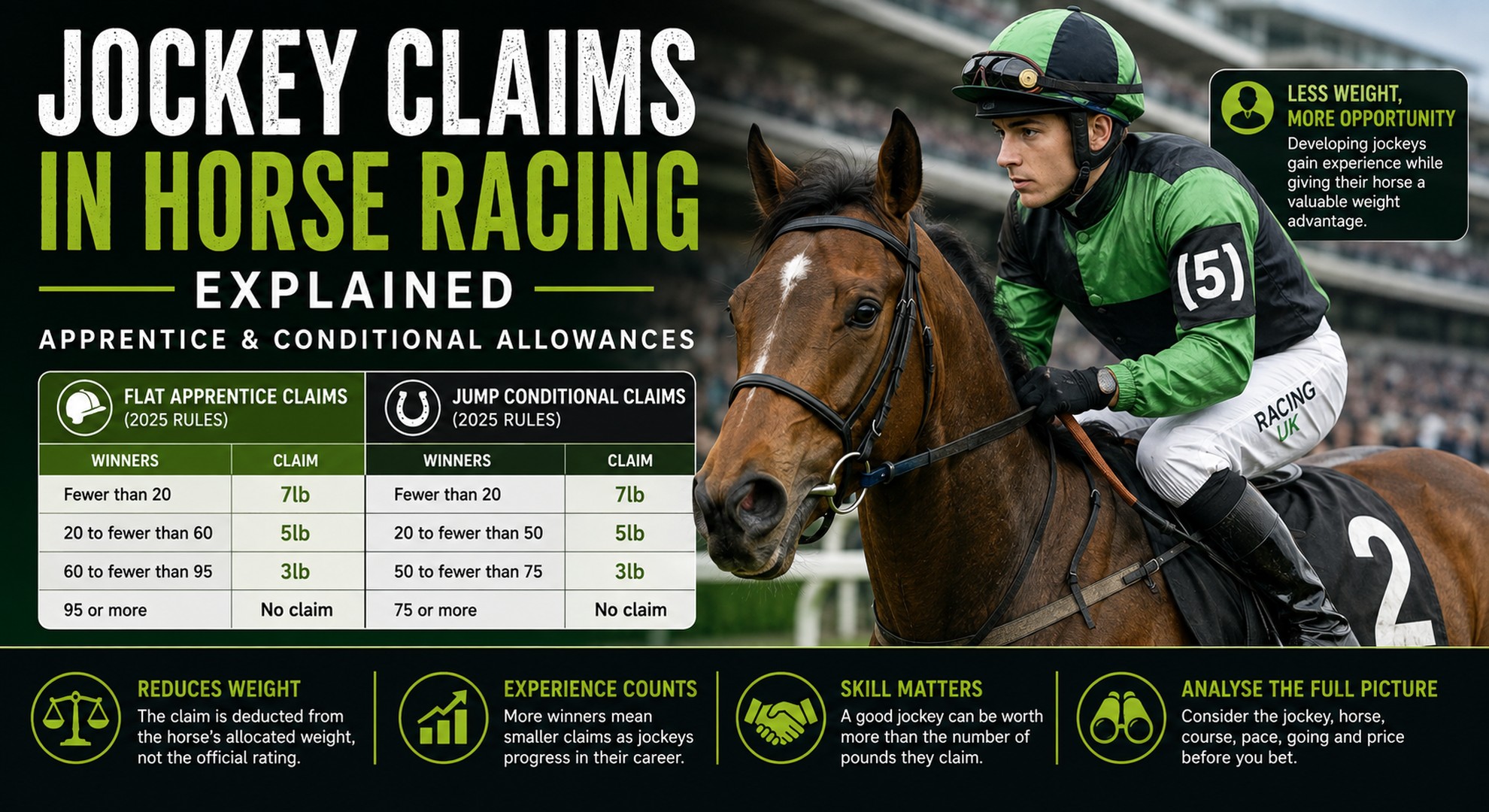
Jockey claims allow less experienced riders to reduce the weight carried by their horse when competing against fully professional jockeys.
A claiming jockey may receive an allowance of 7lb, 5lb or 3lb depending on their experience and number of winners. In some qualifying Jump races, a conditional jockey can claim as much as 10lb when riding for their employing trainer.
The purpose is straightforward. Young jockeys need race-riding experience to develop, but trainers might otherwise favour established professionals. The claim compensates for the rider’s relative lack of experience by reducing the weight their horse carries.
This creates one of the most interesting calculations on a British horse racing racecard.
A talented 5lb claimer who already rides close to professional standard can potentially offer considerably more value than an inexperienced rider entitled to exactly the same allowance.
Understanding jockey claims therefore involves more than spotting (7), (5) or (3) next to a jockey’s name.
What Is a Jockey Claim in Horse Racing?
A jockey claim is a weight allowance available to qualifying inexperienced jockeys.
The allowance reduces the weight the horse actually carries.
Suppose a horse is allocated:
9st 7lb
The trainer books a jockey entitled to claim 5lb.
The horse effectively carries:
9st 2lb
That 5lb reduction is the jockey’s claim.
The horse’s underlying handicap rating has not changed. The jockey’s allowance changes the weight carried in that race.
British racing uses claims to compensate for a jockey’s relative inexperience while allowing developing riders to gain valuable opportunities against established professionals.
Why Do Claiming Jockeys Get a Weight Allowance?
Race riding requires considerable experience.
A professional jockey needs to judge:
- pace
- position
- balance
- when to challenge
- when to conserve energy
- racing room
- jumping rhythm
- track position
- tactical changes during the race
A young jockey cannot develop these skills without race-riding opportunities.
The claiming system encourages trainers and owners to use developing jockeys by giving their horses a weight advantage.
A trainer therefore has a trade-off.
They could use an experienced professional with no claim.
Or they could use a less experienced jockey and receive a reduction in the horse’s weight.
The key question for bettors is whether the jockey’s ability compensates for their lack of experience.
What Do (7), (5) and (3) Mean Next to a Jockey’s Name?
The numbers normally represent the jockey’s weight allowance in pounds.
For example:
J. Smith (7)
means the jockey can claim 7lb.
J. Smith (5)
means a 5lb claim.
J. Smith (3)
means a 3lb claim.
These figures are usually displayed alongside the jockey on a racecard.
Our How to Read Racecards page explains the other information you will encounter, including weights, official ratings, draw, headgear and recent form.
Current Apprentice Jockey Claims on the Flat
Flat apprentice claims are based on the number of races the jockey has won.
Under the current British structure:
| Flat Apprentice Winners | Standard Claim |
|---|---|
| Fewer than 20 winners | 7lb |
| 20 to fewer than 60 winners | 5lb |
| 60 to fewer than 95 winners | 3lb |
| 95 winners or more | No claim |
The 5lb threshold changed in March 2025.
Previously, a Flat apprentice’s allowance reduced from 5lb to 3lb after 50 winners. The threshold increased to 60 winners to give developing jockeys longer to gain experience while retaining the 5lb allowance.
Once an apprentice reaches 95 winners, they have ridden out their claim.
Current Conditional Jockey Claims Over Jumps
Developing professional Jump jockeys are known as conditional jockeys.
The current standard structure is:
| Jump Conditional Winners | Standard Claim |
|---|---|
| Fewer than 20 winners | 7lb |
| 20 to fewer than 50 winners | 5lb |
| 50 to fewer than 75 winners | 3lb |
| 75 winners or more | No claim |
The 5lb threshold for conditionals also changed in 2025.
Previously, the 5lb allowance reduced after 40 winners. The threshold increased to 50.
Certain conditionals can receive an additional allowance when riding for their employing trainer in qualifying races, which can result in a 10lb claim.
Exact eligibility depends on the race and current Rules of Racing.
Apprentice Jockey Versus Conditional Jockey
The distinction depends primarily on the racing code.
Apprentice jockeys ride on the Flat.
Conditional jockeys ride over Jumps.
Both systems perform a similar role.
They allow developing professional jockeys to claim weight while gaining experience.
However, the winner thresholds are different.
A Flat apprentice rides out their standard claim after reaching 95 winners.
A Jump conditional rides out their standard claim after reaching 75 winners.
This reflects the different structures and demands of Flat and National Hunt racing.
You can learn more about the second code in our National Hunt Horse Racing guide.
What Is a 7lb Claimer?
A 7lb claimer is a jockey entitled to reduce the weight carried by their horse by seven pounds.
This is normally the largest standard claim.
A 7lb claimer is at an earlier stage of their professional career than a 5lb or 3lb claimer.
That does not mean every 7lb claimer has the same ability.
This distinction is crucial.
One jockey may still be learning the basics of race positioning and pace.
Another could be an exceptional young rider progressing rapidly towards professional standard.
Both may technically claim the same 7lb.
The second jockey can potentially be far more valuable to a horse.
What Is a 5lb Claimer?
A 5lb claimer has progressed beyond the initial 7lb stage but can still remove five pounds from the horse’s allocated weight.
These jockeys have already ridden a meaningful number of winners.
That makes the 5lb category particularly interesting for analysis.
A successful 5lb claimer has demonstrated an ability to win races but still receives a substantial weight allowance.
The strongest riders can therefore become highly sought after by trainers.
What Is a 3lb Claimer?
A 3lb claimer is approaching the end of the claiming stage of their career.
They have accumulated considerably more winning experience than a 7lb claimer.
The weight advantage is smaller, but the jockey may now ride much closer to the standard of an established professional.
This creates an interesting trade-off.
Would you rather have:
a less experienced jockey taking 7lb off
or:
a much more accomplished jockey taking 3lb off?
There is no universal answer.
It depends on the individual riders, horse and race.
What Does “Riding Out a Claim” Mean?
A jockey has ridden out their claim when they reach the winner threshold at which they are no longer entitled to the standard weight allowance.
For a Flat apprentice, that point comes at 95 winners.
For a Jump conditional, it comes at 75 winners.
You may hear commentators say:
“She is close to riding out her claim.”
That means the jockey is approaching the number of winners required to lose the final 3lb allowance.
Successful claiming jockeys often attract increased attention as this point approaches.
The reason is that they have accumulated considerable experience while still being able to take weight off a horse.
Why Can a Good Claimer Be Valuable?
The claiming system assumes that inexperience has a cost.
The weight allowance compensates for it.
But jockey development is not perfectly linear.
Some riders improve much faster than others.
Imagine two jockeys.
Jockey A
- experienced professional
- no claim
- high riding ability
Jockey B
- 5lb claimer
- rapidly improving
- already riding close to professional standard
If their actual riding abilities are closer than the official 5lb allowance implies, Jockey B may offer valuable weight relief.
This is what racing analysts mean when they describe a jockey as:
“good value for their claim.”
The jockey’s perceived loss through inexperience is smaller than the weight benefit their horse receives.
Does a 7lb Claim Make a Horse 7lb Better?
Not automatically.
This is one of the biggest mistakes when analysing claiming jockeys.
A 7lb allowance removes seven pounds of physical weight from the horse.
It does not automatically improve the horse’s effective performance by seven pounds.
You must account for the jockey.
An inexperienced rider could lose ground through:
- poor positioning
- setting the wrong pace
- challenging too early
- challenging too late
- becoming boxed in
- losing balance
- inefficient use of the whip
- poor jumping decisions
- failing to react quickly
An outstanding claimer may make few of these mistakes.
That is why the value of a claim depends on who is claiming it.
Jockey Claims and Handicap Races
Claims are particularly important in handicaps.
Handicap weights are primarily designed to reflect differences in ability between horses.
If one horse is rated higher than another, it generally carries more weight.
Our Horse Racing Handicap Ratings guide explains how these ratings work.
A claiming jockey can then reduce the physical weight carried.
For example:
Horse A is allocated 9st 10lb.
A 5lb claimer rides.
The effective weight becomes 9st 5lb.
This does not change the horse’s official handicap mark.
It changes the weight carried because of the rider’s allowance.
Worked Jockey Claim Example
Consider a handicap runner allocated:
10st 0lb
Its jockey claims:
7lb
The horse therefore carries:
9st 7lb
Now consider a rival allocated:
9st 9lb
with a professional jockey who has no claim.
Before the claim, the first horse was set to carry 5lb more than its rival.
After the claim, it physically carries 2lb less.
That can materially change how you assess the weights.
But it still does not prove the first horse is better treated.
You must also compare:
- ability
- official ratings
- jockey ability
- form
- course
- distance
- going
- pace
Jockey Claims Versus Weight-for-Age
A jockey claim and a weight-for-age allowance are different.
A jockey claim compensates for rider inexperience.
Weight-for-age compensates younger horses for differences in physical maturity when competing against older horses.
A horse could potentially be affected by both concepts depending on the race conditions.
Our Weight-for-Age in Horse Racing guide explains the WFA system in detail.
The important point is that not every reduction in weight has the same cause.
Jockey Claims Versus Penalties
A penalty adds weight.
A jockey claim removes weight.
Suppose a horse receives a 6lb penalty after winning.
The trainer then books a 5lb claimer.
It is tempting to think:
6lb penalty minus 5lb claim = only 1lb worse off.
That describes the physical weight relationship, but it does not tell the entire story.
The horse earned the penalty because of its previous performance.
The jockey receives the claim because of their experience level.
Those are separate factors and should be analysed separately before considering their combined effect.
Can a Jockey Claim Cancel Out a Penalty?
A claim can offset some or all of the additional physical weight caused by a penalty where the race conditions permit the allowance.
That does not mean the penalty disappears from the horse’s record or handicap position.
Always distinguish between:
why the horse has been allocated its weight
and:
the weight it physically carries after allowances.
This distinction helps prevent misleading comparisons between runners.
Do Jockey Claims Apply in Every Race?
No.
A jockey cannot automatically use their claim in every race they ride.
Eligibility depends on the race conditions and the Rules of Racing.
Certain races restrict or exclude claims.
Others may be specifically confined to particular categories of rider.
Always check the conditions rather than assuming a jockey displaying a claim elsewhere will necessarily receive the same allowance in every race.
What Is a Conditional Jockeys’ Race?
Some Jump races are restricted to conditional jockeys.
These races provide developing riders with opportunities against jockeys at broadly comparable stages of their careers.
Because the race itself is restricted to conditionals, allowance rules can differ from races where conditionals compete against fully professional jockeys.
Again, the individual race conditions matter.
What Is an Apprentice Race?
Apprentice races are Flat races restricted to qualifying apprentice jockeys.
They provide race-riding experience and competitive opportunities for developing riders.
Because every jockey in the race belongs to a qualifying category, the allowance structure can differ from a standard race against full professionals.
Do not assume the usual claim shown beside a jockey’s name applies identically in an apprentice-only race.
Are Apprentice Jockeys Professional Jockeys?
Apprentices are developing professional Flat jockeys.
They are not the same as amateur riders.
Likewise, conditional jockeys are developing professional Jump jockeys.
The claiming structure forms part of their progression towards becoming full professional jockeys without an allowance.
Claiming Jockey Versus Amateur Jockey
A claiming jockey and an amateur jockey are not the same thing.
An apprentice or conditional is following the professional jockey pathway.
An amateur rider competes under a different permit and set of rules.
Amateur riders can have their own weight allowances in qualifying races, but these should not be confused with the standard apprentice and conditional structures.
Why Do Trainers Use Claiming Jockeys?
Weight is an obvious reason, but it is not the only one.
Trainers may use claimers because:
- the allowance suits a particular horse
- the jockey rides the horse regularly at home
- the jockey knows the horse well
- the horse is straightforward to ride
- the race suits an inexperienced rider
- the trainer believes the jockey is improving rapidly
- an established stable relationship exists
- the trainer wants to develop a young rider
Some trainer-jockey relationships become particularly productive.
This is worth considering alongside wider trainer and jockey statistics.
Why Jockey Experience Matters More on Some Horses
Not every horse is equally easy to ride.
Some horses:
- race keenly
- need cover
- require precise timing
- hang under pressure
- start slowly
- need encouragement
- have complicated jumping techniques
- dislike racing between horses
- need to be delivered late
A 7lb claim can look attractive on paper.
But putting an inexperienced rider on a difficult horse can cost more than the seven pounds saves.
Conversely, a straightforward front-runner could make life easier for a developing jockey.
Analyse the horse-jockey combination, not merely the allowance.
Jockey Claims and Course Experience
Racecourse characteristics can increase the importance of jockey experience.
Tracks differ considerably.
A jockey may need to handle:
- tight bends
- long straights
- undulations
- downhill sections
- stiff finishes
- unusual starting positions
- short run-ins
- different fence layouts
A claiming jockey with previous experience at the venue may therefore appeal more than a rider visiting it for the first time.
Course familiarity can matter for horses too.
Our Course and Distance Winners page identifies horses that have already won at today’s track or over today’s distance.
Combining horse course form with jockey course experience can provide a more complete picture.
Jockey Claims at Different Racecourses
The value of experience can be especially noticeable at distinctive tracks.
At Chester Racecourse, positioning and the tight configuration can make tactical decisions important.
At Epsom Downs, horses and riders encounter a unique combination of gradients, turns and camber.
Jump tracks present different challenges.
A conditional jockey riding around Cheltenham or Aintree needs to make decisions involving pace, jumping and positioning while competing against experienced professionals.
A claim should therefore never be assessed without considering the course.
Jockey Claims and Pace
Race pace can expose inexperienced riders.
A jockey needs to judge whether the field is travelling:
- too quickly
- too slowly
- evenly
- tactically
Getting this wrong can compromise a horse’s chance.
Suppose a 7lb claimer races ten lengths behind a slowly run race.
The physical weight advantage may be irrelevant if the horse is left with an impossible positional task.
Likewise, an apprentice who sends a horse too hard from the start can use up valuable energy before the finish.
Our Horse Racing Pace Maps guide explains how likely race position can be assessed before a race.
Claims on Front-Runners
Front-running horses can sometimes simplify tactical decisions.
If a horse naturally races prominently, the jockey may not need to negotiate as much traffic.
But front-running still requires good pace judgement.
Going too quickly can destroy a horse’s chance.
Going too slowly can give rivals an easy opportunity to challenge.
Do not assume a front-runner automatically makes a claim more valuable.
Claims on Hold-Up Horses
Hold-up horses can place greater tactical demands on jockeys.
The rider may need to:
- find cover
- avoid becoming trapped
- judge the leaders’ pace
- identify racing room
- time the challenge
A highly talented apprentice may execute this well.
An inexperienced jockey can make costly errors.
This is another reason to analyse riding style rather than treating every pound claimed as equal.
Jockey Claims and Course-and-Distance Form
A horse with proven course-and-distance form may reduce some uncertainty for a claiming jockey.
The horse has already demonstrated that it can handle:
- the track
- the distance
- the turns
- the surface or going requirements
That does not make a C&D winner an automatic bet.
It does mean one important suitability question has already been answered.
The abbreviations C, D and CD are explained on our Course and Distance Winners page.
Jockey Claims and the Going
Ground conditions can alter the demands on both horse and rider.
Soft and heavy ground may require careful energy management.
Fast ground can place greater emphasis on speed and positioning.
A jockey who knows the horse well may understand when to conserve energy and when to commit.
Check the likely conditions using our Horse Racing Going guide before assessing the wider race.
Should You Back Horses Ridden by Claimers?
Not simply because they have a claimer aboard.
The presence of a 7lb, 5lb or 3lb allowance is one piece of information.
Ask instead:
- How good is the jockey?
- How experienced are they?
- Are they improving?
- Is the horse straightforward?
- Has the jockey ridden the horse before?
- Does the jockey have experience at the course?
- Does the horse’s running style suit the rider?
- How important could the weight reduction be?
- Does the race require complicated tactical decisions?
- Is the betting price attractive?
This approach fits into the wider process explained in How to Analyse a Horse Race Like a Professional.
What Does “Value for Their Claim” Mean?
A jockey is considered good value for their claim when their riding ability appears better than the allowance implies.
Imagine a 5lb claimer who is already nearly as effective as an established professional.
If the difference in riding ability is effectively only 1lb or 2lb, but the horse receives 5lb physically, the jockey could theoretically provide an advantage.
This is not an exact calculation.
Jockey ability cannot be reduced perfectly to pounds.
But the concept explains why talented apprentices and conditionals can become highly sought after before they ride out their claims.
Can the Market Already Price in a Good Claimer?
Yes.
This is important for bettors.
A talented apprentice does not remain a secret simply because they still have a claim.
Trainers, bookmakers, analysts and bettors can all identify successful young riders.
A horse ridden by a fashionable 5lb claimer may therefore attract additional support.
The question is not merely:
“Is this jockey good value for 5lb?”
The better question is:
“Does the horse’s price already reflect the advantage?”
That is the same principle behind finding value bets in horse racing.
How to Analyse a Claiming Jockey
Look Beyond the Claim
Never rank jockeys purely by 7lb, 5lb and 3lb.
Check Recent Results
Is the jockey riding winners and placing regularly?
Consider Strike Rate
Strike rate provides useful context but needs to be interpreted alongside the quality of rides.
Our Horse Racing Strike Rate guide explains how to use strike rates properly.
Look at Trainer Relationships
Does the jockey ride regularly for the trainer?
Check Previous Rides on the Horse
Experience with the individual horse can be valuable.
Examine Course Record
Some tracks demand greater familiarity than others.
Analyse Race Type
A large-field handicap may require different skills from a small-field novice race.
Consider Running Style
A difficult hold-up horse may test an inexperienced rider more than a straightforward prominent racer.
Compare the Price
Even the best claiming jockey is only relevant to betting decisions if the horse’s odds represent value.
Common Mistakes When Assessing Jockey Claims
Treating Every 7lb Claimer Equally
They are not equal.
Ability varies substantially between jockeys.
Assuming More Weight Off Is Always Better
A top 3lb claimer may be preferable to an inexperienced 7lb claimer.
Ignoring the Horse
Some horses are considerably harder to ride than others.
Ignoring Race Conditions
Claims do not necessarily apply identically in every race.
Using Old Claim Thresholds
The British claiming structure changed in 2025.
Older articles may still state that Flat apprentices lose their 5lb claim at 50 winners and conditionals at 40 winners.
Those thresholds are outdated.
Ignoring Course Experience
Distinctive tracks can magnify tactical errors.
Ignoring Pace
A poor tactical decision can outweigh the physical benefit of carrying less weight.
Assuming the Claim Is Free Value
Bookmakers and other bettors know the jockey’s allowance.
It is visible information and can already be reflected in the odds.
Current British Jockey Claim Thresholds at a Glance
Flat Apprentices
7lb: until 20 winners
5lb: from 20 until 60 winners
3lb: from 60 until 95 winners
No standard claim: after 95 winners
Jump Conditionals
7lb: until 20 winners
5lb: from 20 until 50 winners
3lb: from 50 until 75 winners
No standard claim: after 75 winners
Qualifying conditional jockeys riding for their employing trainer can receive additional weight relief in certain races, potentially taking the allowance to 10lb.
Always check the individual race conditions and current British Horseracing Authority Rules when the precise allowance matters.
Frequently Asked Questions
What is a jockey claim in horse racing?
A jockey claim is a weight allowance available to qualifying developing jockeys. It reduces the weight carried by the horse to compensate for the rider’s relative lack of experience.
What does (7) mean next to a jockey’s name?
It normally means the jockey is entitled to claim 7lb from the horse’s allocated weight in a race where the allowance applies.
What does (5) mean next to a jockey?
It indicates a 5lb jockey allowance.
What does (3) mean next to a jockey?
It indicates that the jockey can claim 3lb. A 3lb claimer is generally further through the claiming stage of their career.
What is a 7lb claimer?
A 7lb claimer is a qualifying jockey entitled to reduce their horse’s weight by seven pounds.
What is a 5lb claimer?
A 5lb claimer receives a five-pound allowance when the relevant race conditions permit it.
What is a 3lb claimer?
A 3lb claimer receives a three-pound allowance and is normally approaching the point at which they will ride out their claim.
How many winners can a Flat apprentice ride before losing their 7lb claim?
The standard Flat apprentice claim reduces from 7lb to 5lb after 20 winners.
How many winners before a Flat apprentice loses their 5lb claim?
Under the structure introduced in March 2025, the allowance reduces from 5lb to 3lb after 60 winners.
How many winners before a Flat apprentice loses their claim completely?
The standard claim disappears after 95 winners.
How many winners before a conditional jockey loses their 5lb claim?
Under the structure introduced in 2025, the standard Jump conditional allowance reduces from 5lb to 3lb after 50 winners.
When does a conditional jockey lose their claim completely?
The standard claim disappears after 75 winners.
Can a conditional jockey claim 10lb?
Yes, in qualifying circumstances a conditional with fewer than five winners can receive an additional allowance when riding for their employing trainer, producing a total 10lb allowance. The individual race conditions determine whether it applies.
What is the difference between an apprentice and conditional jockey?
Apprentices are developing professional jockeys on the Flat. Conditionals perform the equivalent role in Jump racing.
What does riding out your claim mean?
A jockey has ridden out their claim when they have ridden enough winners to lose their final weight allowance.
Does a jockey claim change the horse’s handicap rating?
No. The claim reduces the weight carried. It does not directly change the horse’s official handicap rating.
Does a 7lb claim make a horse 7lb better?
No. The horse carries seven pounds less, but the jockey is receiving that allowance because of relative inexperience. The value of the claim depends partly on the jockey’s actual ability.
Are 3lb claimers better than 7lb claimers?
Not necessarily, although a 3lb claimer has normally accumulated more winning experience. Individual ability varies considerably.
Can a jockey claim cancel out a penalty?
A qualifying claim can offset some of the physical weight added by a penalty, but the penalty and jockey allowance arise for different reasons and should be analysed separately.
Do jockey claims apply in every horse race?
No. Eligibility depends on the race conditions and applicable Rules of Racing.
Are amateur jockeys the same as claiming jockeys?
No. Apprentices and conditionals follow the professional jockey pathway. Amateur riders compete under a different system.
Is it good when a horse has a claiming jockey?
It can be, particularly when the jockey is considered good value for their allowance. However, a claim alone is never enough reason to back a horse.
Summary
Jockey claims reduce the weight carried by horses ridden by qualifying developing jockeys.
On the Flat, these riders are known as apprentice jockeys.
Over Jumps, they are known as conditional jockeys.
The current standard Flat structure is:
- 7lb until 20 winners
- 5lb until 60 winners
- 3lb until 95 winners
The current standard Jump structure is:
- 7lb until 20 winners
- 5lb until 50 winners
- 3lb until 75 winners
Certain qualifying conditional jockeys can claim additional weight when riding for their employing trainer.
The most important betting lesson is that the numerical claim and the value of the claim are not the same thing.
A 7lb claimer is not automatically more valuable than a 5lb or 3lb claimer.
The best claiming jockeys can become particularly effective when their riding ability develops faster than their allowance reduces. These are the riders commonly described as good value for their claim.
Analyse the jockey alongside the horse, racecourse, pace, going, race conditions and betting price.
A claim tells you how much weight comes off.
It does not tell you how well the jockey will ride the horse.
18+. Gamble responsibly. Betting involves financial risk.