The going in horse racing describes the condition of the racing surface. On turf, it tells you how firm or soft the ground is. On an all-weather track, a separate set of descriptions indicates how quickly or slowly the synthetic surface is riding.
Going matters because the same horse can produce very different performances as conditions change. Ground affects how easily a horse travels, how much stamina a race demands, how jockeys ride the track and, at some racecourses, which part of the track proves quickest.
For anyone analysing a race, the useful question is not simply “what is today’s going?”
It is:
How is today’s going likely to affect this particular horse, over this distance, at this racecourse and in this race?
That distinction turns a basic going description into useful racing analysis.
British Horse Racing Going Descriptions
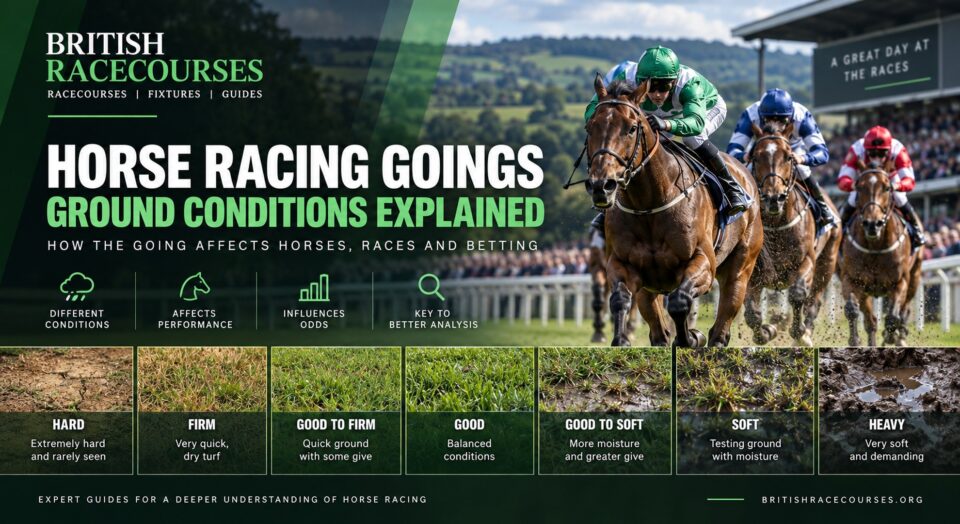
The official turf going descriptions used in British racing are:
| Going | General description |
|---|---|
| Hard | Extremely hard surface and rarely encountered in racing |
| Firm | Very quick, dry turf |
| Good to Firm | Quick ground with some give |
| Good | Neither particularly firm nor soft |
| Good to Soft | More moisture and greater give |
| Soft | Testing ground with substantial moisture |
| Heavy | The softest and most testing turf conditions |
The official report can contain more detail when conditions vary around the track.
For example:
Good to Soft, Soft in Places
That tells you parts of the course are riding more testing than the overall description.
This matters at racecourses with separate straights, bends, chutes or courses because conditions need not be identical everywhere.
Hard Going
Hard remains an official British going description, but it is rarely seen at a racecourse actually staging racing.
Modern course management and horse welfare considerations mean racecourses seek to avoid excessively hard racing surfaces.
Hard should therefore not be treated as simply another normal summer going description. If exceptionally dry conditions develop, watering and course management become important factors in preparing the track.
Firm Going
Firm is very quick turf with relatively little give underfoot.
Dry summer weather can produce firm conditions, although racecourse watering means outright firm ground is less common than good to firm.
Firm going can suit horses that move efficiently on a quick surface, but previous form needs context.
A horse having won on firm ground once does not automatically make it a firm-ground specialist.
Look at how often it has encountered similar conditions, the level of those races, the distances involved, how well it travelled and whether its performance figures improved.
One result is evidence. A repeated pattern is much stronger evidence.
Good to Firm Going
Good to firm is common during the British Flat season when conditions are relatively dry.
The surface remains quick but retains more give than firm ground.
Many Flat horses handle good to firm well, particularly those accustomed to summer racing.
Race times can become informative here. A horse repeatedly producing strong performances and good times on quick ground has more convincing evidence of a preference than one whose record contains a single good-to-firm victory.
Our guide to horse racing speed ratings explains how time-based performance measures can add further context.
Good Going
Good sits around the middle of the British turf scale.
It contains more moisture than good to firm without becoming genuinely soft or testing.
Good ground often suits a broad range of horses, but individual preferences still matter. A confirmed soft-ground performer may want considerably more rain, while a horse with its strongest performances on fast summer turf could be better suited by good to firm.
There is no single going description that is best for every horse.
Good to Soft Going
Good to soft contains more moisture and gives more under the hoof than good ground.
Races can begin to place a greater emphasis on stamina as conditions soften, particularly over longer distances.
The effect depends heavily on the racecourse.
Good to soft over a flat, sharp mile is not the same test as good to soft over a stiff two miles, and neither is equivalent to a long-distance chase on an undulating course.
Going and distance should rarely be analysed independently.
Soft Going
Soft ground contains substantial moisture and usually creates a more demanding racing surface.
Horses generally travel more slowly through soft ground than through good or good-to-firm conditions, and maintaining speed requires greater effort.
This can expose weaknesses in stamina.
It can also change the value of previous form.
Suppose a horse’s recent record reads:
2nd, 1st, 3rd
That appears strong.
If all three performances came on good to firm and today’s race is on soft, those finishing positions do not tell the whole story.
The next step is to inspect its previous soft-ground form.
Some horses repeatedly improve when the ground becomes testing. Others fail to reproduce their best performances.
Read our dedicated guide to soft-ground horses for more on identifying horses suited by slower turf.
Heavy Going
Heavy is the most testing normal turf description in British racing.
The ground contains substantial moisture and horses expend more energy maintaining their momentum.
Heavy ground can transform the demands of a race.
A horse proven over two miles on good ground is not automatically guaranteed to stay the same two miles effectively on heavy.
The combination of distance, ground and course matters.
A stiff finish adds another stamina demand. A strong early pace can make the test harder again.
This is particularly important in National Hunt racing, where horses may be racing over long distances while also jumping hurdles or fences.
Heavy-ground form is valuable evidence when conditions become extreme, but even that form should be interpreted in context.
What Does Yielding Mean in Irish Horse Racing?
Irish racing uses yielding within its going terminology.
For British readers, yielding broadly occupies the territory associated with good to soft, but it is better to read the actual Irish going description than automatically translate every use of yielding into a British term.
You will also encounter combinations such as:
Good to Yielding
and:
Yielding to Soft
This is especially relevant when comparing form between our Irish racecourses and British racecourses.
A horse arriving from Ireland may therefore have useful ground form described using terminology that differs from its British racecard appearances.
What Does “In Places” Mean?
A racecourse does not always have uniform ground across every yard of turf.
You might therefore see:
Good, Good to Firm in Places
or:
Soft, Heavy in Places
The second description identifies significant areas that differ from the predominant going.
This can matter because horses may race across different sections of ground during the same contest.
Straight-course races can also develop differently if one side is riding quicker than another.
When conditions have been affected by uneven rainfall, drainage or previous racing, jockeys may seek what they believe is the best strip of ground.
This can influence positioning and should be considered alongside our analysis of horse racing pace maps and pace bias.
What Is the GoingStick?
The GoingStick provides a numerical measurement to accompany the Clerk of the Course’s official description of British turf conditions.
It measures two characteristics associated with a horse’s hoof interacting with the ground: penetration and shear.
The scale runs from 1 to 15. Lower readings indicate softer and slower conditions, while higher readings indicate firmer and faster conditions.
The GoingStick should not be treated as a universal conversion chart where one number always equals one particular going description.
Racecourses differ. Soils differ. Different sections of the same course can differ.
The most useful approach is often to compare readings at the same racecourse over time, alongside the official going description and the evidence provided by the racing itself.
Who Decides the Going?
The Clerk of the Course is responsible for reporting the official going.
This is not simply a matter of checking how much rain has fallen.
Ground conditions reflect a combination of rainfall, irrigation, drainage, soil, temperature, wind, drying conditions and previous use of the racing surface.
Going reports are updated as a meeting approaches and can change again on raceday.
For bettors, the practical lesson is simple:
Check the latest going rather than relying on the description you saw several days earlier.
Can the Going Change on Raceday?
Yes.
A morning going report is a snapshot of conditions at that time.
Persistent rain can soften a course during racing. Strong sunshine and drying winds can move conditions in the other direction.
This is particularly important during meetings containing several races across a long afternoon.
The official description can be updated when conditions change materially.
Racegoers and bettors should therefore pay attention to later updates rather than assuming conditions for the opening race will remain unchanged throughout the card.
How Rain Changes the Going
Rainfall is the most obvious cause of softer ground, but the amount of rain alone does not tell you exactly how a racecourse will ride.
Ten millimetres of rain can have a different effect depending on how dry the course was beforehand, when the rain fell, soil composition, drainage, temperature and existing moisture.
This is why weather forecasts should inform going analysis rather than replace the official report.
A forecast of rain is not the same thing as confirmed soft ground.
How Watering Affects the Going
Racecourses can irrigate turf during dry periods.
Watering helps manage racing conditions and prevent the surface becoming excessively quick.
This information can matter when analysing a meeting because natural rainfall and irrigation can affect different tracks in different ways.
The official raceday report remains more useful than trying to infer the going solely from the weather forecast.
Does the Going Affect Every Horse Differently?
Yes, but ground preference is often oversimplified.
Physical characteristics and a horse’s action can provide clues, but actual racing evidence is stronger.
Start with what the horse has already done.
Look at:
Wins: Has it won on today’s going?
Placed efforts: Has it run well without winning?
Performance level: Were those races strong enough to make the form relevant today?
Repeated evidence: Does the pattern occur across several races?
Distance: Was the horse racing over today’s trip?
Course: Did the track place similar demands on it?
Our guide to reading horse racing form explains how to put those pieces together.
How to Identify a Horse’s Ground Preference
Do not simply count wins.
Imagine two horses.
Horse A
Soft-ground record:
1 win from 2 runs
Horse B
Soft-ground record:
2 wins and 5 places from 10 runs
Horse A has the better win percentage.
Horse B has considerably more evidence.
You need to inspect the races themselves.
Perhaps Horse A’s victory came in a weak novice event and it was well beaten on its only other soft-ground appearance.
Perhaps Horse B repeatedly produced its highest ratings on soft despite often competing in stronger races.
The raw win percentage cannot tell you that.
Why Recent Form Can Be Misleading When the Going Changes
A horse can arrive apparently out of form just as conditions turn back in its favour.
Suppose its last three races were:
8th on Good to Firm
6th on Good
7th on Good to Firm
Today’s going is Soft.
Those finishing positions look poor.
Now suppose the horse’s previous soft-ground runs include:
1st
2nd
1st
That does not prove it will win today.
It tells you the recent form figures need more investigation.
This is one reason a finishing-position sequence should never be analysed without considering the conditions behind it.
Going and Race Distance
Ground can alter the effective stamina demands of a race.
A horse that stays a mile and a half comfortably on fast summer ground may find the same distance much harder on heavy turf.
The distance has not changed.
The energy required to cover it has.
This becomes especially important in staying races and long-distance National Hunt events.
Before deciding a horse “stays the trip”, check what ground it encountered when demonstrating that stamina.
Going in Flat Racing
Going can have a particularly visible effect on Flat racing because speed, acceleration and positioning play such important roles.
Quick ground can produce fast race times.
Softer conditions can reduce the importance of raw speed and increase the stamina required to maintain a gallop.
In sprint races, ground can also interact with the draw and pace.
A low draw is not automatically favourable or unfavourable. Its value depends partly on where the quickest ground and strongest pace are located.
Serious draw analysis therefore considers the racecourse, distance, field size, pace and going together.
Going in National Hunt Racing
Ground is equally important over hurdles and fences, but the longer distances common in National Hunt racing can magnify its effect on stamina.
Heavy ground over three miles is a very different physical test from three miles on good.
Jumping also matters.
A tiring horse still has obstacles to negotiate, and a strong early pace on testing ground can expose jumping weaknesses later in the race.
When assessing a jumper, check its previous performances under similar combinations of going, distance, course type and pace, rather than using a ground statistic in isolation.
Going and Pace
Going can change how a pace scenario develops.
On testing ground, an aggressive early gallop can prove expensive because horses have to work harder to maintain speed.
A front-runner that controls a modest pace may conserve enough energy to remain difficult to catch.
Several leaders competing hard for position can create the opposite scenario.
This is why our pace maps should be read alongside the ground conditions rather than independently.
Ask:
Who wants to lead?
How much pressure will there be for that position?
Does today’s going make that pace sustainable?
Going and the Draw
The going can contribute to a draw bias, particularly on straight courses and in large fields.
If one side of the course is riding faster, being drawn near that strip can become an advantage.
The draw number alone still does not tell the complete story.
You also need to know where the pace is.
A horse drawn on theoretically favourable ground but isolated from the main pace group may not receive the advantage expected.
Conversely, runners can migrate across a straight course if jockeys believe another section of turf is riding better.
Going, draw and pace therefore belong in the same analysis.
Going and Course Configuration
The same official going can produce different racing tests at different courses.
Soft ground at a flat, sharp track is not identical to soft ground on an undulating course with a stiff finish.
Consider the uphill and downhill sections, bends, length of the home straight, drainage, soil, exposed sections and race distance.
This is one reason British Racecourses maintains detailed guides to individual racecourses across Britain.
Course suitability can amplify or reduce the effect of the ground.
Going and Handicap Ratings
An Official Rating measures the handicapper’s assessment of ability.
It does not guarantee a horse will reproduce that level under every set of conditions.
Two horses can hold the same rating while having very different ground preferences.
Suppose both are rated 90.
One has repeatedly run to its best on soft ground.
The other has produced its strongest performances on good to firm.
If today’s race is run on soft, the shared rating should not make you treat their chances as identical.
Ratings tell you about demonstrated ability.
Going helps determine whether today’s conditions allow the horse to reproduce it.
Going and Speed Ratings
Speed figures also need ground context.
Raw race times are naturally influenced by the surface.
A slow time on heavy ground does not automatically represent a poor performance, just as a fast time on quick summer turf does not automatically represent an exceptional one.
Good speed-rating systems attempt to account for the speed of the racing surface.
Even then, comparing a horse’s best figures under different conditions can reveal useful patterns.
Use our horse racing speed ratings explanation alongside going analysis rather than reading the numbers independently.
Going and Pedigree
Pedigree can provide clues when a horse has little or no relevant ground form.
This is particularly useful with lightly raced juveniles and novices.
Look at how the sire’s progeny perform under similar conditions and consider the dam’s racing record and family where useful.
Pedigree evidence is not a guarantee.
A horse is an individual, and once it has built a meaningful racing record, its own performances deserve more weight than a general assumption about its sire.
Running Action and Ground Preference
You will sometimes hear commentators describe a horse as having a high knee action and suggest that it may handle softer ground.
That can be a useful observation.
It should not become a mechanical betting rule.
Some horses with apparently suitable actions fail to perform on testing ground. Others prove much more versatile than expected.
Visual clues help generate a hypothesis.
Racecourse evidence tests it.
How the Going Affects Horse Racing Odds
Ground changes can alter the betting market quickly.
Imagine a well-fancied horse has produced all its strongest form on quick ground and is trading at 5/1.
Heavy rain arrives.
A rival with proven soft-ground form begins attracting support and shortens from 5/1 to 7/2.
The market is reacting to new information.
That does not mean every ground-related price movement is correct.
If the market overreacts, the available odds on another runner can become more attractive.
This is where going analysis connects with understanding horse racing betting odds and our approach to finding value in horse racing betting.
The objective is not simply to identify the horse best suited by the ground.
It is to decide whether the price accurately reflects that advantage.
Why Late Going Changes Matter to Bettors
A change in going can alter both the field and the market.
Connections may withdraw a horse if conditions have moved significantly against it.
Other runners may become better suited by the revised ground.
The odds can then change as bettors reassess the race.
This makes late going information particularly important when betting early.
A price that looked attractive when good ground was expected may look very different after sustained rain.
For example, a 2/1 favourite whose strongest form is all on quick ground deserves reassessment if conditions become genuinely testing.
That does not automatically make the favourite a poor bet. The new conditions need to be incorporated into the wider race analysis.
Going and Non-Runners
Unsuitable ground can contribute to horses becoming non-runners.
A trainer may declare when one set of conditions is expected and decide not to run after a material change.
A non-runner can then affect the remaining betting market and, depending on when a fixed-odds bet was placed and the circumstances of the withdrawal, may result in a Rule 4 deduction.
Check our horse racing non-runners alongside the latest racecard when conditions are changing.
What Is the Going on All-Weather Racecourses?
All-weather racing uses synthetic surfaces rather than turf.
British all-weather going descriptions are:
- Fast
- Standard to Fast
- Standard
- Standard to Slow
- Slow
All-weather should not be interpreted as meaning every synthetic racecourse rides identically.
Different tracks use different surfaces and have different configurations.
Polytrack, Tapeta and Other Synthetic Surfaces
British all-weather racecourses use synthetic surfaces including Polytrack and Tapeta.
A horse that performs well on one all-weather course is not guaranteed to reproduce the same level at every other synthetic venue.
Course configuration remains relevant too.
A horse may particularly suit a certain turning track, long straight, distance configuration or synthetic surface.
All-weather form should therefore be analysed with the same attention to context as turf form.
Does Weather Affect All-Weather Racing?
Yes.
“All-weather” does not mean weather has no effect.
Temperature, moisture and track maintenance can influence how a synthetic surface rides.
Synthetic tracks are designed to provide more consistent racing conditions than turf across changing weather, but differences still occur.
Use the official going description and evidence from the meeting rather than assuming every Standard surface will ride identically.
How to Read the Going on a Racecard
The going normally appears prominently within race and meeting information.
When reading today’s racecards, don’t stop after finding the description.
Use this process:
- Identify today’s official going.
- Check whether it has changed since declarations.
- Review the latest weather and going update.
- Check each leading contender’s relevant ground form.
- Put that form in the context of today’s distance and course.
- Consider how the ground affects the likely pace and draw.
- Compare your assessment with the betting market.
For the next day’s racing, our tomorrow’s racecards provide an early starting point, but recheck the going nearer racetime.
How to Analyse Going Like a Racing Bettor
A practical going assessment does not need to become complicated.
Start with five questions.
What is the official going?
Use the latest report, not an old forecast.
Has the horse encountered it before?
Find the relevant races rather than relying on a simple ground statistic.
How well did it actually perform?
Look beyond wins and losses.
Were those races comparable with today?
Consider distance, class, course and pace.
Has the betting market already accounted for the ground?
A horse can be ideally suited by conditions and still represent poor value if its odds have shortened too far.
This final question separates finding a likely winner from assessing whether the available price is worth taking.
Common Going Analysis Mistakes
Treating One Win as Proof
One soft-ground victory does not establish a strong preference.
Look for repeated evidence.
Ignoring Race Quality
A soft-ground win in weak company may tell you less than a strong placed effort in a much better race.
Ignoring Distance
Ground and stamina interact.
Do not analyse one without the other.
Assuming Soft-Ground Horses Always Want Heavy
Soft and heavy are not interchangeable.
A horse can handle some cut while finding extreme conditions too demanding.
Assuming Fast-Ground Horses Cannot Handle Soft
Absence of evidence is not evidence that a horse cannot handle the conditions.
A lightly raced horse may simply not have encountered soft ground yet.
Reading Only the Morning Report
Conditions can change.
Check again before racing when the weather is unsettled.
Ignoring the Odds
Finding the horse best suited by the ground is useful.
Backing it regardless of price is not.
Going Analysis Example
Imagine a 12-runner handicap over one mile.
The going is Soft.
Three leading contenders have the following profiles.
Horse A
Recent form: 1-2-1
Best performances: Good to Firm
Soft-ground evidence: 0 wins from 4, all below its best rating
Horse B
Recent form: 5-4-3
Best performances: Soft
Soft-ground evidence: 3 wins and 2 places from 8
Horse C
Recent form: 2-1-6
Best performances: Good
Soft-ground evidence: one respectable run
Horse A has the strongest recent finishing positions.
Horse B has the strongest evidence for today’s conditions.
Horse C remains less certain.
That still does not make Horse B an automatic bet.
Suppose Horse B has shortened to 2/1 because other bettors have identified the same ground advantage.
Your analysis now has two stages.
Is Horse B particularly well suited by today’s conditions?
The evidence suggests it is.
Does 2/1 represent a good enough price given its chance of winning?
That requires a separate judgement.
This is why going should form part of a complete horse race analysis rather than functioning as a standalone betting system.
Going Checklist Before Analysing a Race
Before making your final assessment, check:
- Latest official going
- Any “in places” qualification
- Recent rainfall and watering
- Expected weather before the race
- Previous form on similar going
- Strength of that previous form
- Distance suitability on testing or quick ground
- Racecourse characteristics
- Pace scenario
- Draw where relevant
- Market movement
- Current odds
You do not need every factor to point towards the same horse.
You need enough evidence to understand how today’s conditions change the race.
Frequently Asked Questions
What does going mean in horse racing?
Going describes the condition of the racing surface. On British turf, the official scale extends from Hard and Firm through Good, Soft and Heavy conditions.
What is the best going for horse racing?
There is no going that suits every horse. Good ground accommodates a broad range of runners, but individual horses can perform considerably better on faster or softer conditions.
What is the difference between soft and heavy going?
Heavy is more testing than soft. Horses generally expend more energy travelling through heavy ground, increasing the importance of stamina.
What does yielding mean in horse racing?
Yielding is terminology used in Irish racing for ground with significant give. Irish racing also uses descriptions such as Good to Yielding and Yielding to Soft.
What does “soft in places” mean?
It means significant sections of the course are softer than the predominant going. “Good to Soft, Soft in Places” indicates that most of the track is good to soft but some areas are softer.
What is a GoingStick?
A GoingStick is an instrument used at British turf racecourses to provide a numerical measurement of the racing surface. Lower readings indicate softer and slower conditions, while higher readings indicate firmer and faster conditions.
Can the going change during racing?
Yes. Rain can soften the ground, while warm, dry or windy conditions can help it dry. The official going can therefore change during a meeting.
Does going affect horse racing odds?
Yes. Changes in ground can alter the perceived chances of individual horses and cause their prices to move. A proven soft-ground performer may shorten after significant rainfall, while a horse reliant on quick ground may drift.
Is all-weather racing always Standard?
No. British all-weather descriptions include Fast, Standard to Fast, Standard, Standard to Slow and Slow.
Does soft ground favour front-runners?
Not automatically. The effect depends on the pace, racecourse, distance and individual horses. A lone leader may control a race efficiently, while several front-runners competing hard on testing ground can use too much energy early.
How do I know if a horse likes soft ground?
Study its previous performances on soft and comparable going. Look beyond its win record and consider ratings, race quality, distance and how it actually travelled and finished.
Is going more important in jumps or Flat racing?
Going matters in both. Longer National Hunt races can magnify the stamina demands of testing ground, while Flat races can be strongly affected through speed, acceleration, draw and pace. Its importance depends on the individual race.
Summary
Going describes the condition of the surface on which a horse race takes place.
For British turf racing, the official descriptions run through Hard, Firm, Good to Firm, Good, Good to Soft, Soft and Heavy. British all-weather racing uses Fast, Standard to Fast, Standard, Standard to Slow and Slow.
Knowing the description is only the beginning.
Strong going analysis asks how the conditions interact with the horse, distance, racecourse, pace, draw and previous form.
Previous performances provide the strongest evidence of a horse’s ground suitability. Pedigree and running action can add clues when evidence is limited, but they should not override what the horse has demonstrated on the racecourse.
Going also needs to be considered alongside price. A horse can have ideal conditions and still be too short in the market.
Use the going to improve your assessment of the horse’s chance, then compare that assessment with the available horse racing betting odds before deciding whether the price represents value.