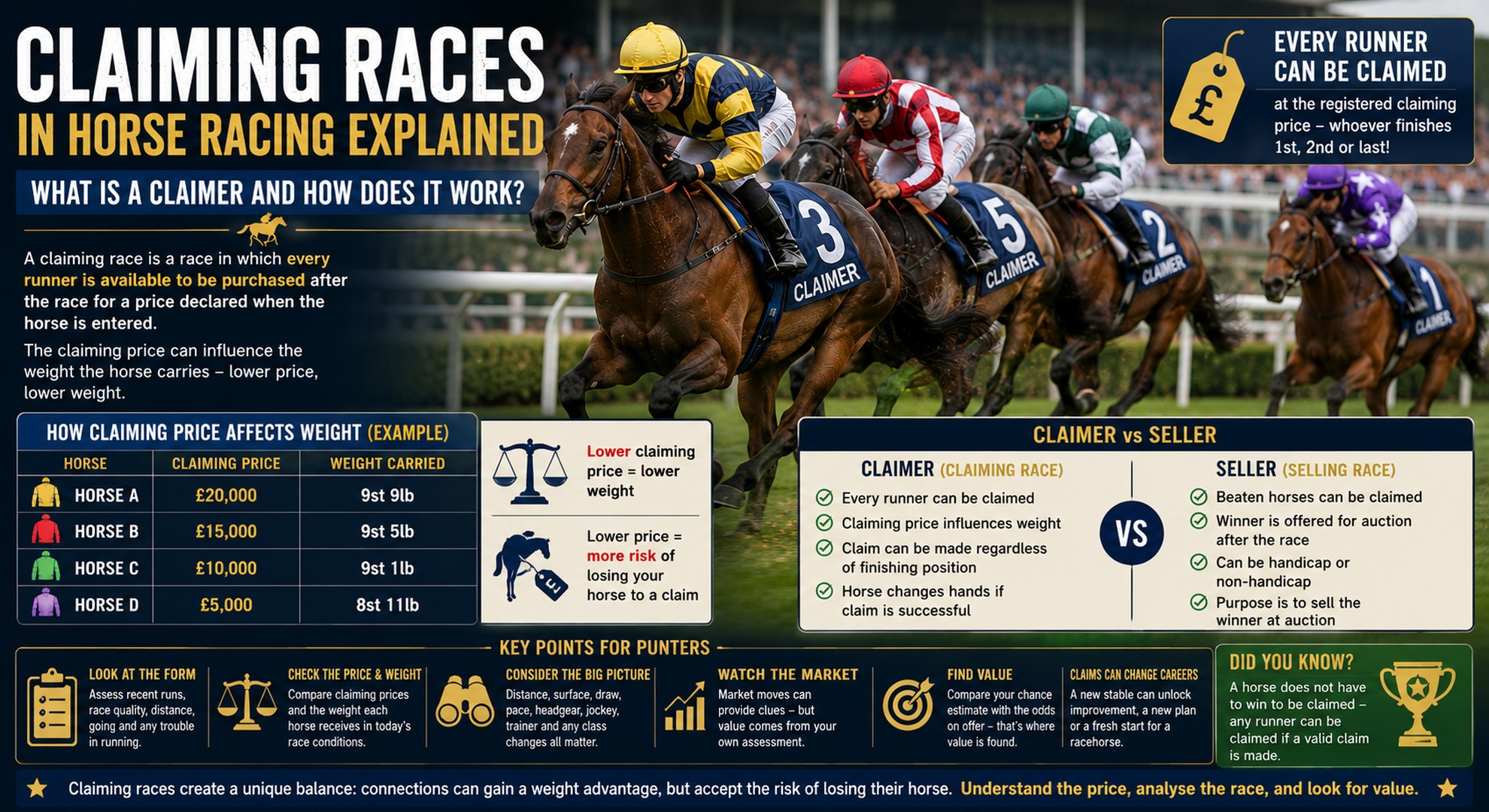
A claiming race is a horse race in which every runner is available to be purchased, or “claimed”, after the race for a price declared when the horse is entered.
Claiming races are unusual because the price placed on a horse is part of the conditions of the race. Connections can enter their horse at different claiming prices, and that price can affect the weight the horse carries.
Generally, a horse entered at a lower claiming price receives a weight advantage compared with a horse entered at a higher price.
That creates an interesting decision for owners and trainers.
Reducing the claiming price can help a horse at the weights, but it also means making the horse available to another eligible claimant at that lower price.
For racing fans and bettors, claimers therefore require a slightly different type of analysis.
Form, ability, pace, distance and going remain important, but you should also understand the claiming price, the weights and why connections may have chosen to enter a particular horse under those conditions.
This is how claiming races work in British horse racing.
What Is a Claiming Race in Horse Racing?
A claiming race, commonly shortened to a claimer, is a race in which every horse can be claimed after it runs.
The trainer sets a claiming value against the horse when making the entry.
That means a horse entered for £10,000 can potentially leave the race under different ownership if an eligible person successfully claims it for the required amount.
The principle behind a claimer is different from an ordinary horse racing handicap.
In a conventional handicap, weight is primarily determined by the horse’s Official Rating.
In a claimer, the claiming price forms part of the mechanism determining the weight carried.
A lower claiming value can result in less weight.
The trade-off is straightforward:
Lower claiming price = potentially less weight, but the horse is available to be claimed at a lower value.
That relationship between price and weight is fundamental to understanding claiming races.
Why Are They Called Claiming Races?
They are called claiming races because eligible people can submit a claim to purchase horses that have competed in the race.
The purchase mechanism is built into the race conditions.
It is not the same as approaching an owner after an ordinary handicap and offering to buy their horse.
By entering a claimer, connections know that the horse is being made available under the claiming system.
The horse can win, finish last or finish anywhere in between and still be subject to a valid claim.
That is an important difference from a selling race, which we will explain later.
What Does Claimer Mean in Horse Racing?
“Claimer” can have two different meanings in British racing.
Claimer meaning 1: a claiming race
A claiming race is frequently called a claimer.
You might hear:
“He’s dropping into a claimer.”
That means the horse is competing in a claiming race.
Claimer meaning 2: a claiming jockey
The term can also refer informally to an apprentice or conditional jockey entitled to claim a weight allowance.
These are completely different concepts.
A claiming jockey receives an allowance because of their level of experience.
A horse in a claiming race is available to be purchased after racing.
Our Jockey Claims in Horse Racing guide explains apprentice and conditional allowances in detail.
How Does a Claiming Race Work?
The basic process can be broken into several stages.
1. The Horse Is Entered
The trainer enters the horse in an appropriate claiming race.
2. A Claiming Price Is Declared
The horse is entered with a specified claiming price.
The available claiming prices and associated weights are governed by the conditions of the individual race.
3. The Claiming Price Influences Weight
A horse entered at a lower claiming price can receive a weight allowance compared with horses entered at higher claiming prices.
4. The Race Takes Place
The horses compete normally.
The winner is decided exactly as it would be in another race.
5. Claims Are Processed
Eligible claimants can submit claims in accordance with the Rules of Racing.
6. A Successful Claim Changes Ownership
If the claim is successful and all relevant requirements are satisfied, the horse changes hands through the claiming process.
That means the result of the race and ownership of the horse are separate issues.
A horse does not need to win to be claimed.
How Does the Claiming Price Affect Weight?
The relationship between price and weight is one of the most distinctive features of a claiming race.
The exact scale depends on the conditions of the particular contest, but the principle is that connections can make a horse available at a lower claiming price in exchange for a more favourable weight.
Consider a simplified fictional example:
| Horse | Claiming Price | Weight |
|---|---|---|
| Horse A | £20,000 | 9st 9lb |
| Horse B | £15,000 | 9st 5lb |
| Horse C | £10,000 | 9st 1lb |
| Horse D | £5,000 | 8st 11lb |
Horse A is being made available at the highest price and carries the most weight.
Horse D is available at a much lower price but receives a significant advantage at the weights.
The figures above are illustrative rather than a universal claiming scale. Always read the conditions of the actual race.
The important question for analysis is:
Has the weight concession gained by reducing the claiming price made the horse more competitive?
Why Would an Owner Put a Horse in a Claiming Race?
At first glance, entering a horse in a race where somebody else can buy it might seem strange.
Claimers serve several practical purposes.
Finding the Right Level of Competition
Not every racehorse is capable of competing successfully in high-grade races.
Claiming races provide another competitive opportunity for horses operating at a particular level.
Giving a Horse a Winning Opportunity
A horse struggling in handicaps may find claiming company more suitable.
That does not mean a claimer is necessarily weak.
The important consideration is the quality of the particular race.
Obtaining a Weight Advantage
Connections can choose a claiming value that provides a favourable weight under the conditions of the race.
Moving Horses Between Stables
Claiming races provide a structured mechanism through which racehorses can change ownership.
A horse may subsequently improve for new connections, move into a different racing programme or simply prove better suited to its new environment.
Does Every Horse in a Claiming Race Have to Be for Sale?
Yes.
The defining feature of a claiming race is that every runner is available to be claimed at the relevant registered price.
A trainer cannot enter a horse in a claimer, receive the associated race conditions and then simply declare that the horse is not available.
The claiming mechanism is part of entering the race.
This distinguishes claimers from ordinary handicaps, maidens, novices and Pattern races.
You can learn about the wider structure of British racing in our Type of Horse Races guide.
Does the Winning Horse Have to Be Claimed?
No.
Being available to claim does not mean somebody will necessarily submit a claim.
A horse can win a claimer and remain with its existing connections if no successful claim is made.
Likewise, a horse that finishes well down the field can still attract a claim.
The claiming decision concerns the horse’s perceived value rather than simply where it finished that day.
Can a Losing Horse Be Claimed?
Yes.
Every runner in a claiming race is available to claim under the conditions of the race.
A horse finishing sixth could attract more interest than the winner.
For example, somebody might believe:
- the horse was unsuited by the distance
- the going was against it
- it encountered traffic
- a different training regime would help
- the horse has a favourable handicap mark
- it could improve over another surface
- its pedigree suggests untapped potential.
The finishing position is therefore only one part of the assessment.
What Happens If More Than One Person Claims the Same Horse?
A desirable horse can attract multiple claims.
Only one claimant can ultimately acquire it through that race.
The British claiming procedure contains rules for determining the successful claimant when more than one valid claim has been submitted.
This is another reason the claiming system is more structured than a normal private sale between an owner and buyer.
What Happens to a Horse After It Is Claimed?
A successful claim results in the horse changing hands under the Rules of Racing.
The new connections can then plan the horse’s future campaign.
That might involve:
- remaining at a similar level
- returning to handicaps
- changing distance
- changing surface
- trying different headgear
- targeting another claimer
- changing racing code where eligible
- allowing the horse time away from racing.
From a form-analysis perspective, a change of trainer following a claim is worth noting.
The horse’s historical form remains relevant, but its circumstances have changed.
What Is an Unfriendly Claim?
An unfriendly claim is essentially a successful claim by someone other than the existing connections seeking to retain the horse.
The term can sound more dramatic than it is.
Claiming races exist specifically so horses can be acquired through the claiming mechanism.
An unfriendly claim is therefore part of the established system rather than somebody unexpectedly purchasing a horse that was never supposed to be available.
There are also specific Rules surrounding horses acquired through successful unfriendly claims, so the process is more regulated than a simple post-race transaction.
What Is a Friendly Claim?
You may also encounter the term friendly claim.
This refers to a claim connected with the horse’s existing interests rather than an outside party attempting to acquire it.
The exact procedures surrounding claims are governed by the current Rules of Racing, so owners and participants should use the official procedures rather than relying on informal explanations of how a claim should be submitted.
For a racing fan, the main distinction to understand is simply:
Friendly claim = existing interests seeking to retain the horse.
Unfriendly claim = an outside claimant seeking to acquire the horse.
Can You Claim a Horse Yourself?
Claiming a racehorse is not as simple as attending the races, seeing a horse you like and handing over the advertised amount.
Claims must comply with British racing’s official claiming procedures and eligibility requirements.
There are rules governing who can submit a claim, how it is lodged and how payment and ownership are dealt with.
For most racegoers and bettors, the important point is that the claiming price should not be interpreted as an ordinary public sale price.
It operates within the regulated racing system.
What Is the Difference Between a Claiming Race and a Selling Race?
Claiming races and selling races are related but they are not the same.
The distinction is worth learning because the two terms often appear together.
| Claiming Race | Selling Race |
|---|---|
| Every runner can be claimed | Beaten horses can be claimed |
| Claiming values are declared | Winner is offered for auction |
| Claiming price can influence weight | Can be handicap or non-handicap |
| Horse can be claimed regardless of finishing position | Winner follows the post-race auction process |
In a claimer, every horse is available to be claimed at its registered price.
In a seller, the winner is offered for auction after the race, while beaten runners can be available through the claiming mechanism.
This makes the post-race process different even though both race types provide ways for horses to change hands.
Is a Claimer the Same as a Handicap?
No.
Both can involve horses carrying different weights, but the underlying mechanisms differ.
Standard Handicap
In a normal handicap, the Official Rating is central to determining the horse’s weight relative to its opponents.
The handicapper attempts to compensate for differences in ability.
Claiming Race
In a claimer, the value at which connections make the horse available affects its weight according to the conditions of the race.
That means analysing a claimer requires understanding both the horse and the claiming conditions.
Are Claiming Races Run on the Flat?
Yes.
Claiming races can form part of the Flat programme.
They can be staged on turf or all-weather surfaces depending on the fixture and programme.
This creates plenty of variation.
A horse moving into a claimer might simultaneously be:
- changing class
- changing surface
- changing distance
- carrying a different weight
- running for a different claiming price.
Those changes need to be separated when analysing its prospects.
Are There Claiming Races Over Jumps?
Claiming and selling races can also feature within the Jump racing programme.
The same broad concept of horses being available through the claiming system applies, although the conditions of the individual race remain important.
Our National Hunt Jump Horse Racing guide explains the wider structure of British Jump racing.
Are Claiming Races Low-Class Races?
Claimers are generally associated with horses below Pattern level, but simply describing every claimer as a “bad race” is not useful.
Race quality is relative.
What matters to a bettor is whether the runners are competitive at the level in which they are racing.
A lower-level horse can still produce consistent and predictable form.
A Group-class horse can produce an unexpected poor performance.
The analytical task remains the same:
Assess the horse relative to its opposition and the price available.
Why Do Horses Drop Into Claiming Company?
A horse may move into claiming company after racing in handicaps, novice races or other company.
There can be several reasons.
The Horse Is Struggling at Its Current Level
Connections may believe the horse needs weaker opposition.
The Horse Has Become Difficult to Place
Its rating, preferred distance or other characteristics may limit suitable opportunities.
Connections Want to Exploit the Race Conditions
The weight available at a particular claiming price may make the race attractive.
The Horse Is Available to Change Hands
Connections may be comfortable with the possibility that another owner claims the horse.
Do not assume a drop into a claimer means connections have “given up” on the horse.
Analyse the circumstances.
Is Dropping Into a Claimer a Positive Betting Sign?
It can be, but not automatically.
A horse moving from stronger company into a claimer may face weaker opposition.
That sounds positive.
However, ask why it is dropping.
Perhaps the horse:
- has been badly out of form
- has physical limitations
- has become difficult to place
- dislikes today’s surface
- is poorly suited by the distance
- has been regressing.
Class drops should therefore be analysed rather than treated as automatic betting signals.
British Racecourses tracks runners changing grade on our Horses Dropped in Class Today page.
How to Analyse a Claiming Race
Claimers deserve the same detailed analysis as other races, with several additional factors.
1. Start With Recent Form
Establish how each horse is currently performing.
Look beyond finishing positions.
Consider:
- margins
- race strength
- pace
- trouble in running
- going
- distance
- surface.
A horse finishing fifth in stronger company could be more interesting than a horse winning a weak race.
Our How to Analyse a Horse Race Like a Professional guide explains the wider process.
2. Compare Previous Class With Today’s Race
Class changes can be particularly important.
Identify horses dropping from stronger races.
Then decide whether the drop is enough to compensate for any weaknesses in their recent form.
A class drop alone does not create value.
The market often recognises obvious drops immediately.
3. Examine the Claiming Price
Do not ignore the claiming price.
Ask:
- What price has the horse been entered for?
- How does it compare with its rivals?
- What weight does that produce?
- Is today’s claiming price different from previous runs?
- Has the trainer sacrificed claiming value to obtain less weight?
The answers can reveal how connections have positioned the horse within the race conditions.
4. Compare the Weights
Weight remains important.
Suppose two horses appear closely matched on form but one receives a meaningful weight advantage because of its claiming value.
That difference should form part of your assessment.
Do not reduce the entire race to a simple pounds-per-length calculation, though.
Racehorses are affected by pace, ground, distance and numerous other variables.
Weight is one factor.
5. Look at Official Ratings
A claimer is not a standard handicap, but Official Ratings still provide useful information about ability.
Compare each runner’s rating with:
- its current form
- today’s weight
- the strength of previous opposition
- the race conditions.
A horse’s rating gives you a reference point even when it does not directly determine the race in the same manner as a conventional handicap.
6. Assess the Distance
A drop into claiming company will not help much if the horse is racing over an unsuitable trip.
Look for horses returning to proven distances.
Our Course and Distance Winners page can also help identify runners with demonstrated form under similar conditions.
For an exposed horse, proven distance form can carry considerable weight.
7. Check the Surface and Going
Claimers can take place under different conditions.
A horse’s previous form may have been achieved:
- on turf
- on an all-weather surface
- on firm ground
- on soft ground.
Changing class and changing surface simultaneously can make form harder to compare.
Establish whether the horse has demonstrated an ability to handle today’s conditions.
8. Analyse the Pace
Race shape remains important regardless of race class.
A front-runner dropping into a claimer may look attractively treated, but three other habitual leaders could make its task difficult.
Alternatively, the only obvious front-runner might obtain a tactical advantage.
Our Horse Racing Pace Maps Explained guide explains how to identify likely leaders, prominent racers and hold-up horses.
9. Consider the Draw
The draw can be significant in Flat claimers, particularly over shorter distances.
Its importance depends on the course and race configuration.
Do not simply look for a historically successful stall.
Combine draw with pace.
A horse drawn near the expected early speed may receive a much better trip than a rival isolated elsewhere.
10. Check Headgear
Claiming races often involve relatively exposed horses, so equipment changes deserve attention.
A trainer might apply:
- blinkers
- cheekpieces
- a visor
- a hood.
Our Horse Racing Headgear guide explains what the different types do.
First-time headgear is not automatically positive.
Look at why it may have been introduced.
11. Consider Trainer Changes
Previously claimed horses can appear for new trainers.
A change of yard can matter.
The new trainer might:
- alter the horse’s distance
- change its routine
- use different headgear
- switch surfaces
- change riding tactics.
Do not assume every trainer change produces improvement.
Look for evidence.
12. Study Market Movements Carefully
Claimers can produce significant betting moves.
A horse dropping sharply in class may attract obvious support.
Another runner could shorten after being entered at a favourable claiming price.
Market movement is information, not proof.
British Racecourses’ Best Backed Horses Today page tracks notable market movers, while our Betting Odds Shortening guide explains why prices contract.
The final question remains whether the available odds represent value.
Worked Example: Analysing a Claimer
Imagine a six-runner claiming race over one mile.
Three runners stand out.
Horse A
Official Rating: 78
Claiming price: £20,000
Weight: 9st 10lb
Recent form: 3-2-4
Best distance: 1 mile
Horse A has the strongest recent form but carries plenty of weight.
Horse B
Official Rating: 75
Claiming price: £12,000
Weight: 9st 3lb
Recent form: 6-5-3
Best distance: 1 mile
Horse B’s form is slightly weaker but it receives 7lb from Horse A.
Horse C
Official Rating: 72
Claiming price: £8,000
Weight: 8st 12lb
Recent form: 8-7-6
Best distance: 7 furlongs
Horse C receives considerably more weight but has weaker recent form and questionable stamina.
The lowest claiming price does not automatically identify the best bet.
Horse B might prove the interesting runner because it combines competitive form with a useful weight advantage.
Horse C has an even bigger weight advantage but may simply lack the ability or stamina to exploit it.
Horse A remains capable of winning despite carrying top weight.
That is why claiming-race analysis needs to consider price, weight and ability together.
Claiming Price Does Not Equal a Horse’s True Value
This distinction is important.
A £10,000 claiming price does not necessarily mean everybody involved believes the horse is worth exactly £10,000 in an open market.
The price forms part of the race conditions.
Connections must balance the weight advantage associated with a particular claiming value against the possibility of losing the horse through a successful claim.
The claiming figure therefore has both a commercial and a racing function.
Can a Claimed Horse Improve for a New Trainer?
Yes.
Racehorses can improve after changing stables, although improvement is never guaranteed.
Different trainers use different:
- routines
- gallops
- feeding regimes
- race planning
- tactics
- equipment
- schooling methods.
Some claimed horses subsequently win for new connections.
Others perform at roughly the same level.
Some regress.
Treat the trainer switch as a factor requiring analysis rather than a reason to back the horse automatically.
Do Claiming Races Matter to Bettors?
Yes, because they create a different set of variables.
A bettor needs to understand why each horse carries its particular weight and why connections selected its claiming price.
The same principles used elsewhere still matter:
- form
- class
- distance
- pace
- draw
- going
- jockey
- trainer
- price.
The claiming conditions add another layer.
That can make these races interesting for people prepared to understand the structure rather than simply comparing recent finishing positions.
Finding Value in Claiming Races
A value bet exists when you believe the available odds underestimate a horse’s chance of winning.
Suppose you assess a horse as having a 25% chance.
That corresponds to fair decimal odds of:
1 ÷ 0.25 = 4.00
If bookmakers offer 5.00, or 4/1, your assessment suggests the available price is greater than your estimated fair price.
That does not mean the horse will win.
A horse with a genuine 25% chance still loses three times out of four on average.
Our How to Find Value Bets in Horse Racing guide explains why price should be separated from winner selection.
Common Mistakes When Betting on Claiming Races
Automatically Backing the Class Dropper
A horse coming from stronger company can still be out of form.
Automatically Backing the Lowest Weight
Less weight does not compensate for unlimited differences in ability.
Ignoring the Claiming Price
It is central to understanding why the horse carries its allocated weight.
Confusing a Claimer With a Claiming Jockey
The terms sound similar but describe completely different things.
Ignoring Surface Changes
A turf horse moving to the all-weather, or vice versa, may face very different conditions.
Treating Market Support as Certainty
Strong support can be informative but does not guarantee anything.
Ignoring Race Shape
A horse can be well treated at the weights and still receive a poor tactical setup.
Claiming Race Analysis Checklist
Before betting on a claimer, consider:
- What company has the horse been running in?
- Is it dropping or rising in class?
- What is its claiming price?
- How has that price affected its weight?
- What is its Official Rating?
- How does its rating compare with today’s rivals?
- Is today’s distance suitable?
- Does it handle the surface and going?
- What is its preferred running style?
- What does the likely pace look like?
- Does the draw matter?
- Is there a headgear change?
- Has the horse recently changed trainer?
- Has it been claimed previously?
- Is the market moving?
- Do the available odds represent value?
No single answer determines the result.
The aim is to build a complete picture of the race.
Claiming Races and the Wider British Racing Programme
Claimers are not the most prominent races in British racing, but they still have a role.
The 2026 programme illustrates this.
Changes to handicap eligibility mean some low-rated horses may have fewer handicap opportunities when they would be too far out of the weights. Claiming races and selling races remain among the alternative race types available to suitable horses.
That underlines an important point.
British racing needs different race categories because horses have very different levels of ability, ages, experience and circumstances.
Claimers provide another place within that structure for suitable horses to compete.
Frequently Asked Questions
What is a claiming race?
A claiming race is a race in which every horse is available to be purchased through the official claiming process at a price registered when the horse is entered.
What does claimer mean in horse racing?
A claimer usually means a claiming race, although the term can also be used for an apprentice or conditional jockey who claims a weight allowance. The two meanings are different.
Is every horse in a claiming race for sale?
Every runner is available to be claimed under the conditions and Rules governing the race.
Can the winner of a claiming race be claimed?
Yes. The winner is available to claim just like the other runners.
Can the last horse be claimed?
Yes. Finishing position does not remove a horse from the claiming process.
Does the claiming price affect weight?
Yes. Claiming races can use the price at which a horse is entered to determine its weight under the conditions of the race. Lower claiming values can result in lower weights.
Does the lowest claiming price mean the horse is the worst?
Not necessarily. The claiming price is part of how connections enter the horse under the race conditions and should not be treated as a definitive measure of ability.
What happens if two people claim the same horse?
British racing has procedures for dealing with multiple valid claims so that one claimant ultimately acquires the horse.
Can anybody claim a racehorse?
No. Claims have to comply with the eligibility and procedural requirements contained within the Rules of Racing.
What is a friendly claim?
A friendly claim involves existing interests seeking to retain the horse through the claiming process.
What is an unfriendly claim?
An unfriendly claim is made by an outside claimant seeking to acquire the horse.
What is the difference between a claimer and a seller?
Every runner in a claimer is available through the claiming system. In a seller, the winner is offered for auction after racing while beaten horses can be available to claim.
Is a claiming race a handicap?
Not necessarily. Claiming races have their own conditions, with the claiming price capable of influencing the weight carried.
Are claiming races run over jumps?
Selling and claiming races can form part of both the Flat and Jump racing programmes.
Are claiming races worth betting on?
They can be analysed and bet on like other horse races, but bettors should understand the claiming prices and weight conditions as well as conventional factors such as form, distance, pace, going and price.
Why would an owner risk losing a horse?
The race may provide suitable competition and a favourable weight depending on the claiming value. Claimers also provide a structured way for horses to move between connections.
Is a horse guaranteed to be claimed?
No. A horse is available to claim, but that does not mean somebody will necessarily submit a successful claim.
Summary
A claiming race is a race in which every horse is available to be purchased through the official claiming process after competing.
The trainer registers a claiming value when entering the horse.
That value can influence how much weight the horse carries.
A lower claiming price can provide a weight advantage, but connections must accept that the horse is available at that lower value.
That trade-off is what makes claiming races different.
For bettors, the claiming price should never be analysed in isolation.
Look at:
- recent form
- class
- Official Rating
- weight
- claiming value
- distance
- going
- surface
- draw
- pace
- jockey
- trainer
- headgear
- market price.
It is also important not to confuse a claiming race with a jockey claim. One concerns the potential purchase of a horse after racing. The other is a weight allowance available to eligible apprentice or conditional jockeys.
Claimers may sit away from the highest-profile areas of British racing, but they serve a clear purpose within the race programme.
And from a betting perspective, the key question is not simply which horse has the lowest claiming price or carries the least weight.
It is:
Which horse is best treated by today’s claiming conditions relative to its actual ability?
Answer that accurately, then compare your assessment with the available odds.