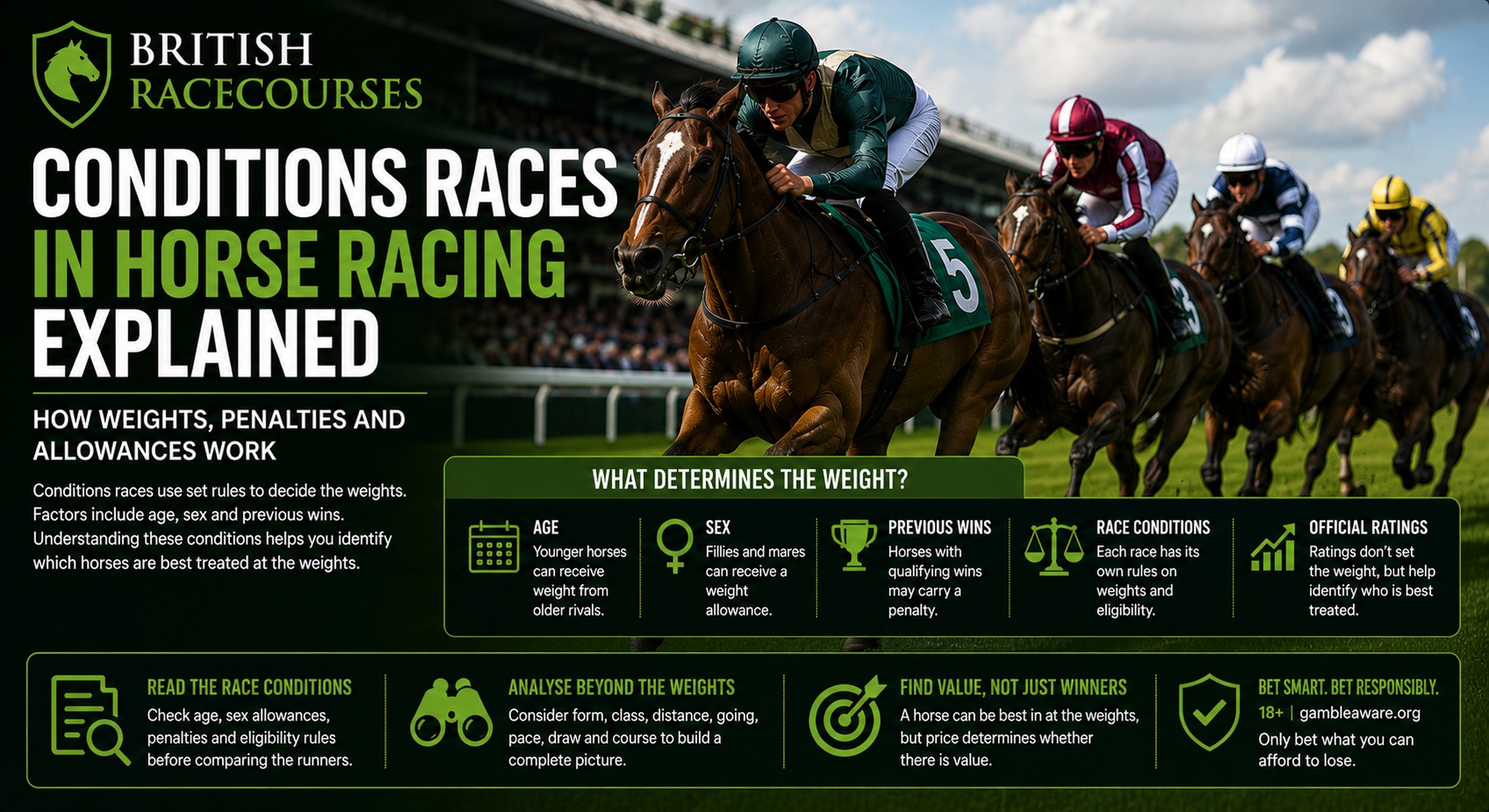
Conditions races are horse races where the weight carried by each runner is determined by the specific conditions of the race rather than simply by its handicap rating.
Those conditions can take account of a horse’s age, sex and previous achievements. A younger horse may receive weight from an older rival, fillies and mares can receive an allowance against males, while horses that have already won certain races may have to carry penalties.
This creates a very different type of contest from a handicap.
In a handicap, the handicapper attempts to use weight to give horses of different abilities more equal chances. In a Conditions race, the published race conditions determine the weights.
That distinction can create some interesting situations.
A horse rated 105 and a horse rated 95 could potentially meet on the same weight terms. The higher-rated horse would theoretically be 10lb better treated if their ratings accurately represent their ability.
Understanding these differences is useful when reading a racecard, assessing class and comparing runners.
What Is a Conditions Race in Horse Racing?
A Conditions race is a race in which the weights carried by the horses are determined according to predetermined race conditions.
The weights are not allocated individually by the handicapper in an attempt to equalise each horse’s chance.
Instead, the race conditions establish which horses can compete and how much weight they should carry.
Factors can include:
- age
- sex
- previous victories
- level of previous victories
- value of races previously won
- specific eligibility restrictions.
A simple Conditions race could state that all four-year-olds carry 9st 2lb, with fillies receiving a 3lb allowance and previous winners of a specified class carrying a 5lb penalty.
Every horse is then assessed against those published conditions.
The precise terms vary considerably between races.
Why Are They Called Conditions Races?
The name comes from the conditions attached to the race.
Every horse race has conditions, but in a Conditions race those rules play a particularly important role in determining the weights.
A race might specify:
For three-year-olds and upwards
followed by a basic weight and a series of allowances or penalties.
For example:
3yos: 8st 12lb
4yos and upwards: 9st 5lb
Fillies and mares allowed 3lb
Winner of a Class 2 race since a specified date: 4lb penalty
This tells you considerably more than simply looking at the weight beside each horse’s name.
You need to understand why each horse has been allocated that weight.
Conditions Race vs Handicap
The difference between a Conditions race and a handicap is fundamental.
In a horse racing handicap, the weights are primarily determined by the horses’ Official Ratings.
A horse rated 90 generally carries more weight than a horse rated 80 because the handicapper considers the 90-rated horse superior.
The objective is to use weight to reduce the difference between them.
A Conditions race works differently.
The Official Ratings can still be extremely useful when analysing the race, but they do not directly determine the basic weight allocation.
Consider this simplified example:
| Horse | Official Rating | Weight |
|---|---|---|
| Horse A | 108 | 9st 5lb |
| Horse B | 101 | 9st 5lb |
| Horse C | 96 | 9st 5lb |
| Horse D | 104 | 9st 2lb |
Horse A, B and C are carrying the same weight despite having different ratings.
Horse D receives 3lb under the conditions.
That creates a very different analytical problem from a handicap.
Why Official Ratings Still Matter
A common mistake is assuming Official Ratings become irrelevant because the race is not a handicap.
The opposite can be true.
Ratings can become particularly useful because they allow you to compare the established ability of the runners with the weights they are actually carrying.
Suppose:
Horse A: rated 105, carries 9st
Horse B: rated 95, carries 9st
If both ratings accurately reflect current ability, Horse A appears substantially better treated at the weights.
In a handicap, Horse A would normally be expected to concede weight to Horse B.
In this Conditions race, it does not.
That does not automatically make Horse A the winner. Form, fitness, distance, going, pace, draw and other factors still matter.
But the weight structure provides an important starting point.
Our guide to how racehorse handicap ratings work explains how Official Ratings are calculated and used.
What Does “Best In at the Weights” Mean?
You will often hear racing analysts say a horse is:
“best in at the weights”
This means the weight conditions appear favourable when compared with the horses’ established levels of ability.
Imagine three horses:
| Horse | Rating | Weight |
|---|---|---|
| Red Star | 110 | 9st 5lb |
| Blue Moon | 104 | 9st 5lb |
| Green Light | 100 | 9st 2lb |
Red Star is rated:
- 6lb superior to Blue Moon
- 10lb superior to Green Light.
Yet Red Star meets Blue Moon at level weights and concedes only 3lb to Green Light.
On ratings, Red Star is therefore best in at the weights.
This does not mean Red Star is guaranteed to win.
It means the published weight conditions favour it compared with what would happen in a conventional handicap.
How Are Weights Decided in Conditions Races?
There is no single weight formula covering every Conditions race.
You must read the conditions of the individual race.
The main factors include:
Age
Younger horses can receive weight from older horses.
This is designed to account for differences in physical maturity.
A three-year-old competing against older horses may therefore carry less weight.
The amount depends on factors including:
- time of year
- race distance
- age of the horses.
This is known as the weight-for-age system.
Our dedicated Weight-for-Age in Horse Racing guide explains this in detail.
Sex
Fillies and mares can receive an allowance when competing against colts, horses and geldings.
This is commonly called the sex allowance.
It allows female horses to carry less weight under specified race conditions.
The allowance should always be considered alongside the horse’s rating and actual ability.
Previous Wins
A horse may have to carry additional weight because it has previously won.
This is a penalty.
The conditions determine:
- which wins count
- the relevant time period
- the level of race
- the size of the penalty.
Quality of Previous Wins
Not every victory necessarily produces the same penalty.
A horse that has won a stronger race may have to carry more additional weight than a horse whose previous victory came at a lower level.
This prevents an accomplished horse from necessarily meeting less successful rivals on completely equal terms.
What Is a Penalty in a Conditions Race?
A penalty is additional weight that a horse must carry because it meets a criterion specified in the race conditions.
For example:
9st 2lb
Penalties: winner of a Class 3 race 3lb; winner of a Class 2 race 5lb
A horse without a qualifying victory carries:
9st 2lb
A horse subject to the 3lb penalty carries:
9st 5lb
A horse subject to the 5lb penalty carries:
9st 7lb
The crucial point is that the penalty is dictated by the conditions.
Do not assume that every previous win results in additional weight.
You need to establish which victories qualify.
Are Penalties Always a Disadvantage?
No.
A penalty adds weight, which is theoretically a disadvantage.
But the reason the horse has the penalty is often because it has already demonstrated a higher level of ability.
Suppose:
Horse A: OR 108, 9st 7lb
Horse B: OR 96, 9st 2lb
Horse A is carrying a 5lb penalty.
At first glance, that sounds negative.
But Horse A is rated 12lb superior and is conceding only 5lb.
On those figures, it could still be favourably treated.
This is why simply identifying which horse carries the least weight is not enough.
The better question is:
How does the weight difference compare with the difference in ability?
What Is an Allowance?
An allowance works in the opposite direction to a penalty.
It reduces the weight a horse is required to carry because it qualifies under a particular race condition.
Common examples include:
- weight-for-age allowances
- sex allowances.
If the basic weight is:
9st 5lb
and a filly receives a:
3lb allowance
she carries:
9st 2lb.
The allowance does not mean the horse is automatically well treated.
You still need to compare the allowance with the horse’s ability.
Weight-for-Age in Conditions Races
Weight-for-age is one of the most important concepts associated with Conditions races.
Young racehorses mature rapidly.
A three-year-old in early summer is physically different from the same horse later in the year.
The weight-for-age scale attempts to compensate younger horses when they compete against older horses.
The allowance varies according to:
- age
- distance
- time of year.
The principle is straightforward.
The younger horse receives weight because it has not yet reached the same expected level of physical maturity as the older horse.
As the season progresses, the allowance generally changes as the younger generation matures.
This is why age should never be considered separately from the race conditions.
Are Group 1 Races Conditions Races?
Many of the most prestigious races in British racing operate on Conditions or weight-for-age principles rather than as handicaps.
The basic objective at the highest level is very different from a handicap.
A handicap attempts to create a competitive race by using weight to compensate for differences in ability.
A championship race is generally trying to establish:
Which is the best horse?
That is why major races such as the Derby and many other Group 1 contests use weight-for-age and sex allowances rather than handicap marks to determine the weights.
A superstar is not forced to concede a large amount of weight simply because it has a much higher Official Rating than its opponents.
Conditions Races Can Be High Quality
The term “Conditions race” should not be interpreted as a low-level racing category.
Conditions principles are used across different levels of the sport.
At one end, you can encounter ordinary Conditions Stakes below Pattern level.
At the other, many of the sport’s most prestigious contests operate under weight-for-age conditions.
The common principle is that weights are determined by the race conditions rather than directly through a handicapper attempting to equalise the field.
Conditions Stakes vs Conditions Race
You may see both terms used.
Conditions Race describes the general type of contest.
Conditions Stakes commonly appears in the title or description of individual races.
For most racegoers and bettors, the underlying analytical principle is the same:
Read the conditions to understand why each horse carries its allocated weight.
Conditions Race vs Classified Stakes
Conditions races and Classified Stakes are easily confused because neither necessarily uses handicap ratings to determine the exact weight carried.
There is an important distinction.
A Classified Stakes uses a ratings band to determine eligibility.
For example:
For horses rated 0-65
A horse rated 65 and another rated 52 might then compete at equal or near-equal weights, subject to the conditions.
In a broader Conditions race, eligibility and weights can instead depend on criteria such as:
- age
- sex
- previous wins
- class of previous wins
- other specified qualifications.
Classified Stakes are therefore a more specific race type.
Conditions Race vs Selling Race
A Selling Race has a different purpose.
The winner is offered for sale after the race under the relevant rules.
Selling races therefore combine racing with a mechanism through which horses can change ownership.
Conditions races do not have that defining post-race selling element.
The two types can also attract very different levels of horse.
Conditions Race vs Claiming Race
A Claiming Race allows horses to be claimed according to the rules and prices attached to the race.
Again, the defining feature is ownership rather than simply how weights are allocated.
Claiming races can use weight structures linked to claiming prices.
Conditions races use their own eligibility, penalty and allowance rules.
Conditions Race vs Nursery Handicap
A Nursery Handicap is a handicap restricted to two-year-olds.
The handicapper’s ratings are central to determining the weights.
A Conditions race involving two-year-olds works differently because its published conditions establish the weight structure.
This distinction becomes useful when assessing developing horses whose ratings may still be changing quickly.
Conditions Race vs Maiden Race
A maiden race is restricted to horses that have not previously won, subject to the precise race conditions.
Its primary defining feature is the winning status of the horses.
A Conditions race can contain previous winners.
Indeed, previous success is often important because it can determine whether a horse carries a penalty.
Conditions Race vs Novice Race
Novice races have specific qualification rules and are designed around relatively inexperienced horses.
Previous winners can often participate subject to the relevant rules and penalties.
A Conditions race is a broader category based around the particular conditions attached to that contest.
Do not assume that “novice” and “Conditions” mean the same thing simply because both can contain horses with limited racing experience.
Conditions Race vs Listed Race
Listed races sit immediately below Group races on the Flat and form part of the black-type structure.
Their weights are typically determined by race conditions rather than handicap marks.
The distinction is therefore mainly one of race status and quality.
A normal Conditions Stakes does not automatically have Listed status.
Winning or being placed in a Listed race is particularly important for breeding value, especially for fillies and mares.
How to Read a Conditions Race on a Racecard
A horse racing racecard gives you the information required to begin analysing the contest, but Conditions races reward a little more investigation.
Start with the race header.
Look for:
- age restrictions
- sex restrictions
- basic weights
- penalties
- allowances
- qualification criteria.
Then examine each runner.
Record:
- Official Rating
- actual weight carried
- age
- sex
- previous qualifying wins
- current form.
The aim is to understand how the conditions have affected each horse.
A Conditions Race Analysis Example
Consider this fictional Conditions Stakes.
For four-year-olds and upwards
Basic weight: 9st 2lb
Fillies and mares allowed 3lb
Winner of a Class 2 race: 5lb penalty
Four horses are entered:
| Horse | OR | Details | Weight |
|---|---|---|---|
| Alpha | 108 | Class 2 winner | 9st 7lb |
| Bravo | 103 | No penalty | 9st 2lb |
| Charlie | 96 | No penalty | 9st 2lb |
| Delta | 101 | Mare | 8st 13lb |
Now compare their ratings with their weights.
Alpha
Rated 108 but carries 5lb more than Bravo.
Alpha has 5lb more weight but is rated 5lb higher.
On a simple ratings comparison, there may be relatively little between them at the weights.
Bravo
Rated 103 and carries the standard weight.
Bravo avoids a penalty and therefore meets Alpha 5lb better.
This could make Bravo particularly interesting if its current form supports the rating.
Charlie
Carries the same weight as Bravo but is rated 7lb lower.
Charlie therefore appears badly treated compared with Bravo on established ratings.
It would need another reason to improve the assessment.
Perhaps:
- the rating understates current ability
- it is improving rapidly
- conditions suit particularly well
- the higher-rated horses are out of form.
Delta
Rated 101 and receives the 3lb sex allowance.
She carries 3lb less than Bravo despite being rated only 2lb lower.
On the raw ratings, Delta could therefore be considered well treated.
That is how the Conditions race should begin to be analysed.
Ratings Are a Starting Point, Not the Answer
A ratings comparison is extremely useful.
It is not enough on its own.
Official Ratings describe established performance rather than guaranteeing future performance.
You still need to assess:
- recent form
- distance
- going
- course
- pace
- draw
- fitness
- tactical position
- improvement potential
- trainer form.
A horse that is theoretically best in at the weights can still be a poor bet if the race conditions do not suit it.
Look for Improving Horses
Improvement is particularly important when analysing younger or lightly raced horses.
Suppose:
Horse A: OR 102
Horse B: OR 96
On published ratings, Horse A appears 6lb superior.
But Horse B has raced only three times and improved substantially on every start.
Its current ability could already be higher than 96.
If you believe Horse B is actually performing to 103 or 104, the published ratings comparison changes completely.
This is why experienced bettors do not treat ratings as fixed measures of ability.
Consider the Distance
A favourable weight position is of little value if the horse is racing over the wrong distance.
Check:
- previous form at the trip
- pedigree
- finishing effort
- running style
- evidence of stamina or speed.
A horse rated 105 over a mile may not reproduce that level over 1m4f.
Another horse rated only 100 could be much better suited by the longer trip.
Our broader guide on how to analyse a horse race explains how to combine these different factors.
Assess the Going
Ground conditions can completely change the hierarchy between horses.
Imagine the highest-rated horse has produced its best performances on:
good to firm
but today’s race is on:
soft
A rival rated several pounds lower may have repeatedly produced its best form on testing ground.
The ratings gap therefore needs context.
Do not allow a favourable weight calculation to override clear evidence about suitability.
Consider Pace
Race shape matters in Conditions races just as much as it does in handicaps.
A small Conditions field may contain only one obvious front-runner.
That horse could gain a tactical advantage.
Alternatively, several aggressive horses may compete for the lead and create a strong pace.
Understanding likely positioning can identify horses whose chance is better or worse than their raw ratings suggest.
Our guide to horse racing pace bias explains how race shape can influence results.
Use Pace Maps
A horse racing pace map can be particularly useful in small-field Conditions races.
Suppose the race contains five runners:
- one habitual leader
- one prominent racer
- three hold-up horses.
The leader may secure an uncontested advantage.
If the same horse is also favourably treated at the weights, that strengthens its case.
The combination of:
ratings + weights + pace
is usually more useful than considering any one factor alone.
Does the Draw Matter?
It can.
The importance depends on:
- racecourse
- distance
- field size
- going
- pace.
A Conditions race at a course where stall position has historically mattered should still be analysed through that lens.
Our full horse racing draw section explains why some stalls can gain or lose an advantage.
Check Course Form
Some horses consistently perform better at particular tracks.
Reasons include:
- track direction
- gradients
- bends
- surface
- finish
- pace characteristics.
This is why British Racecourses maintains detailed individual British racecourse guides rather than treating every track as interchangeable.
A horse can be well treated at the weights and still face a major question about the course.
Look Beyond the Finishing Position
Previous finishing positions can hide important information.
A horse that finished fifth may have:
- been badly positioned
- met traffic
- raced against a pace bias
- covered extra ground
- been unsuited by the going
- finished strongly after the race was effectively over.
Equally, a recent winner may have enjoyed a perfect tactical setup.
Our guide to identifying a horse that ran better than the result explains why context matters when assessing previous performances.
Class Is Particularly Important
Conditions races often expose differences in class.
A horse dropping from stronger company may suddenly find itself facing substantially weaker opponents.
That becomes especially important when it is not being asked to concede enough weight to compensate for its class advantage.
Look at:
- quality of previous opposition
- race class
- ratings achieved
- finishing margins
- subsequent form of previous rivals.
A bare finishing position can be misleading.
Finishing sixth in a high-quality race can represent much stronger form than winning a weak contest.
What Does Dropping in Class Mean?
A horse is dropping in class when it competes at a lower level than in its recent races.
This can create significant interest in a Conditions race.
A runner may have struggled against Group or Listed horses but now face rivals competing at a lower level.
British Racecourses tracks this angle through our horses dropped in class today coverage.
The important question is whether the market has already fully accounted for the class drop.
Trainer Intent Can Matter
Conditions races can be deliberately targeted.
A trainer may identify a particular race because:
- the horse qualifies favourably
- it avoids a penalty
- the distance suits
- the opposition is expected to be weaker
- it provides a suitable stepping stone to a bigger target.
This is particularly relevant with progressive horses.
A Conditions Stakes can sit between ordinary company and a move into Listed or Group races.
A convincing performance may therefore tell you something about where connections believe the horse belongs.
Why Do Trainers Run Horses in Conditions Races?
Conditions races can serve several purposes.
Finding Favourable Weight Terms
A trainer can identify a race where their horse is particularly well treated under the published conditions.
Preparing for a Bigger Race
A Conditions race can provide a suitable preparation for a future target.
Avoiding a Handicap
A high-rated horse may have to concede substantial weight in handicap company.
A Conditions race can offer more favourable terms.
Testing Class
Connections may want to establish whether an improving horse is ready for Listed or Group company.
Finding the Right Opposition
Race conditions can create a field that suits a particular horse’s profile.
Why Conditions Races Can Produce Short-Priced Favourites
Some Conditions races contain one horse that is clearly superior on ratings.
If that horse also receives favourable weight terms, the market may make it a strong favourite.
For example:
Favourite: OR 112, 9st 5lb
Rival: OR 100, 9st 5lb
The favourite has a substantial ratings advantage without having to concede weight.
The market will normally recognise this.
That does not mean the favourite automatically represents value.
A horse can have the best chance of winning and still be too short a price.
Price Still Matters
The strongest horse is not necessarily the strongest bet.
Suppose you estimate that the favourite has a:
60% chance of winning
Fair decimal odds would be approximately:
1.67
If bookmakers offer:
1.40
you may consider the price too short despite believing the horse is the most likely winner.
If the market offers:
1.90
the same assessment creates a very different proposition.
This is the distinction between:
finding the winner
and:
finding value.
Our guide to how to find value bets in horse racing explains the difference.
Creating Your Own Price
One useful approach is to assess the race before looking too closely at bookmaker odds.
Start with:
- ratings
- weight terms
- current form
- improvement
- distance
- going
- course
- pace
- draw
- fitness.
Then estimate each horse’s chance.
If you believe a runner has a:
25% chance
its theoretical fair decimal price is:
1 ÷ 0.25 = 4.00
or:
3/1 fractional odds
If a bookmaker offers 9/2, your assessment suggests potential value.
If the price is 2/1, it does not.
Our how to price a horse race guide covers this process in greater detail.
Compare Bookmaker Prices
Price comparison remains important regardless of race type.
If you want to back a horse at:
6/1
and another bookmaker offers:
13/2
the second price provides a better potential return for exactly the same outcome.
Small differences accumulate over a large number of bets.
British Racecourses compares the main options in our horse racing betting sites section.
Our dedicated bet365 Horse Racing guide also explains the racing markets and features available through bet365.
Use a Bet Calculator
Weights, ratings and race conditions can make the analysis complicated enough without making mistakes when calculating returns.
Our horse racing bet calculator can help calculate potential returns across common bet types and odds formats.
The important point is to separate two questions:
Which horse has the strongest chance?
and:
Does the available price justify the bet?
They are not the same question.
Conditions Races and Best Odds Guaranteed
If you are betting before a race, Best Odds Guaranteed can be relevant depending on the bookmaker, bet and current terms.
A horse might be backed at an early price before drifting in the market.
Eligible BOG bets can be settled differently depending on the bookmaker’s current offer and the Starting Price.
Always check the actual terms rather than assuming every horse racing market qualifies.
Are Conditions Races Easier to Analyse Than Handicaps?
Not necessarily.
They can appear easier because the strongest horses are not deliberately compressed together through handicap weights.
Sometimes one runner does have an obvious ratings advantage.
But other factors create complexity.
These include:
- lightly raced horses
- rapidly improving horses
- penalties
- allowances
- tactical small fields
- class changes
- uncertain fitness
- horses returning from breaks.
The handicapper may not be setting the weights, but you still need to assess the true ability of every runner.
Can Conditions Races Be Good for Betting?
They can provide interesting opportunities because the race conditions sometimes create obvious differences between the published ratings and actual weights.
The useful question is:
Which horse benefits most from today’s conditions?
But there is no race type that automatically produces profitable bets.
A well-treated horse can still:
- run below form
- dislike the ground
- fail to stay
- receive a poor ride
- encounter an unsuitable pace
- simply be priced too short.
Treat the weight structure as one component of the analysis.
Common Conditions Race Mistakes
Assuming the Highest-Rated Horse Must Win
Ratings measure established ability, not today’s guaranteed performance.
Looking Only at Weight
A horse carrying 9st is not automatically better treated than one carrying 9st 7lb.
Ability matters.
Ignoring Why a Horse Has a Penalty
A penalty often exists because the horse has achieved more than its rivals.
Ignoring Allowances
Age and sex allowances can materially alter the weight comparison.
Treating Conditions Races Like Handicaps
The weights are constructed differently.
Ignoring Improvement
A lightly raced horse may already be better than its published rating.
Ignoring Race Conditions
Read the actual qualification, penalty and allowance rules.
Looking Only at the Last Result
Previous performances need context.
Assuming the Best Horse Is the Best Bet
Price determines whether an opinion potentially represents value.
Conditions Race Analysis Checklist
Before assessing a Conditions race, ask:
Race Conditions
- What are the basic weights?
- Are there age allowances?
- Are there sex allowances?
- Are there penalties?
- Which previous wins trigger those penalties?
- Are there eligibility restrictions?
Ability
- What are the Official Ratings?
- Which horse is best in at the weights?
- Are those ratings still reliable?
- Is any runner improving quickly?
Current Form
- How have the horses been running?
- How strong was the opposition?
- Were there excuses for poor results?
- Has any horse run better than its finishing position suggests?
Suitability
- Does the distance suit?
- Does the going suit?
- Does the course suit?
- Does the draw matter?
Race Shape
- Who leads?
- Is there likely to be a strong pace?
- Could one horse gain a tactical advantage?
Market
- What price should each horse be?
- What price is available?
- Has the market already accounted for the obvious ratings advantage?
- Is a better price available elsewhere?
That provides a much stronger framework than simply backing the highest-rated runner.
Frequently Asked Questions
What is a Conditions race in horse racing?
A Conditions race is a race where the weights are determined by the published conditions of the race rather than directly by each horse’s handicap rating. Age, sex and previous victories can all affect the weight carried.
How is a Conditions race different from a handicap?
In a handicap, the weights are primarily based on Official Ratings with the aim of making horses of different abilities more competitive with each other. In a Conditions race, the race’s predetermined rules establish the weights.
Do Official Ratings matter in Conditions races?
Yes. Ratings are extremely useful for comparing the established ability of the runners with the weights they are required to carry.
What does best in at the weights mean?
It means a horse appears favourably treated when its level of ability is compared with the weight it carries relative to its rivals.
What is a penalty in a Conditions race?
A penalty is additional weight imposed because a horse meets a condition specified by the race, often because it has previously won a particular type or level of race.
What is an allowance in a Conditions race?
An allowance reduces the weight a horse carries. Common examples include weight-for-age allowances for younger horses and sex allowances for fillies and mares.
What is weight-for-age?
Weight-for-age is a system under which younger horses receive weight from older horses to account for differences in physical maturity. The scale varies according to factors including age, distance and time of year.
Do fillies carry less weight than colts?
Fillies and mares can receive a sex allowance when competing against male horses under the relevant race conditions.
Are Conditions races high-quality races?
They can be. Conditions races exist at different levels, while many of Britain’s highest-quality races operate using weight-for-age and other Conditions principles.
Is a Group 1 a Conditions race?
Group 1 races generally operate under predetermined weight conditions rather than conventional handicap weights. Weight-for-age and sex allowances can apply depending on the race.
Is a Conditions Stakes the same as a Conditions race?
Conditions Stakes is a commonly used race title or description within the broader Conditions race category. The key feature is that weights are determined by the race conditions.
What is the difference between Conditions Stakes and Classified Stakes?
Classified Stakes generally use a defined ratings band to determine eligibility, while Conditions races can use broader criteria involving age, sex, previous success and other specified qualifications.
Can previous winners run in Conditions races?
Yes. Previous winners can compete where eligible. Their previous victories may result in a weight penalty depending on the conditions.
Are Conditions races easier to bet on?
Not automatically. Ratings and weight comparisons can make some races appear straightforward, but improvement, form, pace, going, distance and price still need to be assessed.
Should I back the highest-rated horse in a Conditions race?
Not automatically. Establish whether the horse is favourably treated at the weights, whether today’s conditions suit and whether the available odds represent value.
Summary
Conditions races are an important part of British horse racing and operate differently from conventional handicaps.
The key distinction is simple:
In a handicap, the handicapper uses ratings to determine the weights.
In a Conditions race, the published race conditions determine the weights.
Those conditions can account for:
- age
- sex
- previous victories
- level of previous victories
- other eligibility requirements.
This creates opportunities to compare each horse’s actual ability with the weight it has been allocated.
Official Ratings remain particularly useful.
If a 108-rated horse meets a 100-rated horse at level weights, the higher-rated runner is theoretically favoured by the conditions.
But racing analysis should never stop there.
You also need to consider:
- current form
- improvement
- class
- distance
- going
- course
- draw
- pace
- fitness
- price.
The best approach is to establish which horse is best treated by the conditions, then decide whether everything else about the race supports that conclusion.
For readers building their knowledge of British racing, our Horse Racing Types section provides the broader starting point, while the guides to Weight-for-Age, Classified Stakes, Claiming Races and Selling Races explain the other race structures in more detail.
If you choose to bet on Conditions races, focus on price rather than simply trying to identify the most likely winner. Gambling involves financial risk and no analytical approach can guarantee a profit. Bet responsibly and only stake money you can afford to lose.