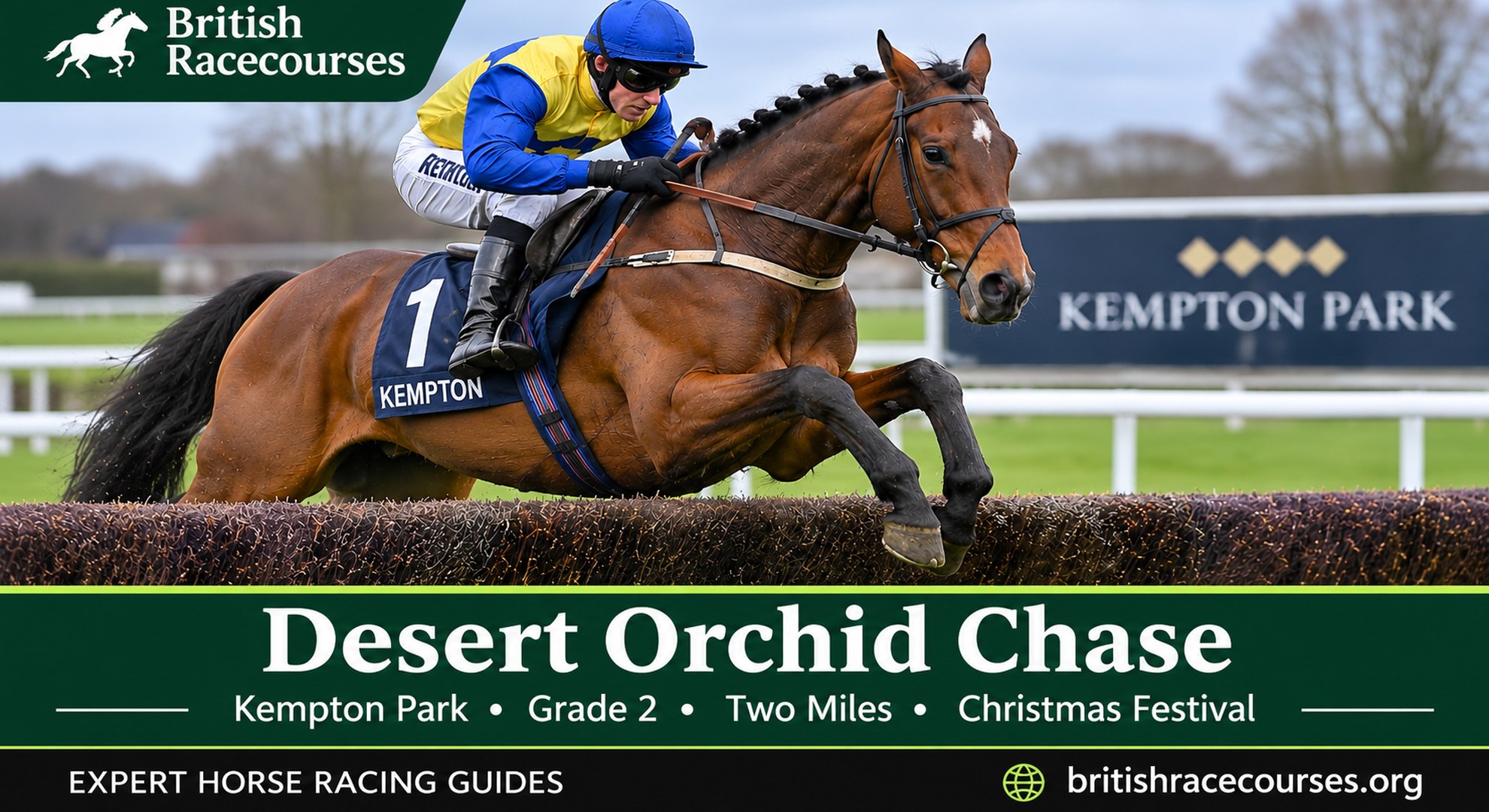
The Desert Orchid Chase is a Grade 2 National Hunt steeplechase run over approximately two miles at Kempton Park Racecourse in December. It is one of Britain’s leading mid-season contests for established two-mile chasers and forms an important part of Kempton’s Christmas Festival.
The race is named after Desert Orchid, the celebrated grey chaser who won the King George VI Chase four times and became one of the most popular horses in British racing history.
First staged in 2006, the Desert Orchid Chase has been won by outstanding horses including Sprinter Sacre, Altior, Shishkin, Sire De Grugy, Special Tiara and Politologue.
The 2026 Desert Orchid Chase is scheduled for Sunday 27 December at Kempton Park.
The contest is now run as a Grade 2 limited handicap, meaning the weights carried by the runners can be particularly important. This makes it a different betting proposition from the traditional level-weights championship chases.
Thistle Ask won the 2025 renewal for Dan Skelton and Harry Skelton, producing an impressive front-running performance.
Desert Orchid Chase 2026 Race Details
| Race information | Details |
|---|---|
| Race | Desert Orchid Chase |
| Date | Sunday 27 December 2026 |
| Racecourse | Kempton Park |
| Grade | Grade 2 |
| Race type | Limited handicap steeplechase |
| Distance | Approximately 2 miles |
| Fences | 12 |
| Age qualification | 4 years and older |
| Meeting | Kempton Christmas Festival |
| Previous winner | Thistle Ask (2025) |
The race takes place on the second day of Kempton’s Christmas Festival, following the King George VI Chase and Christmas Hurdle on Boxing Day.
The exact race conditions, weights, declarations and starting time should be checked when the official 2026 racecard is published.
Our Kempton Park Racecourse guide provides further information about the venue and its racing characteristics.
When Is the Desert Orchid Chase in 2026?
The Desert Orchid Chase takes place on Sunday 27 December 2026.
The race is traditionally held on 27 December, making it one of the principal events immediately after Boxing Day.
It forms part of the two-day Kempton Christmas Festival, which features several of Britain’s most important winter jump races.
The 2026 second-day programme also includes the Grade 1 Kauto Star Novices’ Chase and Grade 2 Wayward Lad Novices’ Chase.
These three races provide an opportunity to assess established two-mile chasers, developing two-mile novices and promising staying novice chasers at the same meeting.
Where Is the Desert Orchid Chase Run?
The Desert Orchid Chase takes place at Kempton Park in Sunbury-on-Thames, Surrey.
Kempton is a right-handed, relatively flat National Hunt racecourse with a sharp layout.
The Desert Orchid Chase is run over approximately two miles, with runners negotiating twelve fences.
The course can favour horses with tactical speed and accurate jumping.
A runner that repeatedly loses ground at its fences may struggle to recover, particularly when the leaders maintain a strong pace.
However, the race is not simply a test of speed.
Horses must sustain their effort throughout the contest, and a strongly run race can expose weaknesses in stamina.
Kempton’s relatively flat layout creates a different challenge from Sandown, where the uphill finish and demanding Railway Fences place additional pressure on runners.
These differences are important when assessing form from other leading two-mile chases.
Why Is the Race Named After Desert Orchid?
The Desert Orchid Chase commemorates one of Britain’s greatest and most popular racehorses.
Desert Orchid, affectionately known as Dessie, was a distinctive grey gelding trained by David Elsworth.
He became famous for his bold jumping, front-running style and remarkable versatility.
Although he was particularly effective at Kempton, Desert Orchid also produced outstanding performances at other major racecourses.
His greatest achievements included:
- Four King George VI Chase victories: 1986, 1988, 1989 and 1990.
- 1989 Cheltenham Gold Cup: A famous victory on testing ground.
- 1988 Tingle Creek Chase: Demonstrating his exceptional two-mile ability.
- 1988 Whitbread Gold Cup: A major staying chase success.
- 1990 Irish Grand National: Another outstanding stamina performance.
Desert Orchid won 34 of his 70 races and became one of the defining horses of his generation.
His popularity extended far beyond regular racing enthusiasts.
He attracted large crowds wherever he appeared and became a familiar sporting figure throughout Britain.
Desert Orchid and Kempton Park
Kempton was particularly important to Desert Orchid’s career.
His four King George victories established him as one of the most successful horses in the history of the race.
The course’s relatively sharp layout suited his natural speed and bold jumping.
His performances helped make Kempton’s Boxing Day meeting one of the most recognisable occasions in British sport.
Desert Orchid died on 13 November 2006 at the age of 27.
The inaugural Desert Orchid Chase was staged on 27 December 2006, shortly after his death.
His ashes were interred at Kempton, where a memorial commemorates his remarkable career.
The race provides a permanent connection between the legendary grey and the racecourse where he achieved so much.
For more about Kempton’s most prestigious contest, see our King George VI Chase guide.
History of the Desert Orchid Chase
The Desert Orchid Chase was first run in 2006.
It replaced the Castleford Chase in the National Hunt calendar and was established as an important Grade 2 contest for leading two-mile chasers.
The inaugural winner was Voy Por Ustedes, trained by Alan King and ridden by Robert Thornton.
He returned to win the race again in 2007.
The contest quickly developed an impressive roll of honour.
Several winners subsequently captured major Grade 1 prizes, including the Queen Mother Champion Chase at Cheltenham.
For much of its history, the Desert Orchid was run as a conditions chase, with weights determined by the race conditions rather than conventional handicap ratings.
That changed for the 2023/24 season, when the race became a Grade 2 limited handicap.
The change created a different challenge for trainers, jockeys and bettors.
Under handicap conditions, a horse’s official rating influences the weight it carries, although the permitted weight range is restricted.
Consequently, the best horse on ratings does not necessarily have the strongest chance of winning.
The race continues to attract high-quality two-mile chasers, but its handicap conditions allow improving horses to compete against more established performers on adjusted terms.
Famous Desert Orchid Chase Winners
Voy Por Ustedes
Voy Por Ustedes won the first two renewals in 2006 and 2007.
Trained by Alan King and ridden by Robert Thornton, he was one of the leading two-mile chasers of his generation.
He had already won the Arkle Challenge Trophy at Cheltenham in 2006.
Following his first Desert Orchid victory, he went on to win the 2007 Queen Mother Champion Chase.
His success demonstrated the race’s potential as an important stepping stone towards Cheltenham.
Voy Por Ustedes also developed into a high-class performer over longer distances, winning major races including the Melling Chase at Aintree.
Finian’s Rainbow
Finian’s Rainbow won the Desert Orchid Chase in 2011 for Nicky Henderson and Barry Geraghty.
He was already an established high-class chaser and subsequently won the 2012 Queen Mother Champion Chase.
His Kempton success demonstrated the importance of proven Grade 1 ability in the race’s earlier conditions-chase format.
Finian’s Rainbow was particularly effective when travelling strongly and jumping accurately at speed.
Sire De Grugy
Sire De Grugy won the 2013 Desert Orchid Chase for Gary Moore and Jamie Moore.
He subsequently captured the 2014 Queen Mother Champion Chase at Cheltenham.
His Kempton victory formed part of an outstanding season that established him as Britain’s leading two-mile chaser.
Sire De Grugy was particularly effective over two miles and demonstrated the importance of maintaining a strong jumping rhythm.
Special Tiara
Special Tiara won the Desert Orchid Chase twice, in 2014 and 2016.
Trained by Henry de Bromhead, he was one of the most consistent two-mile chasers of his generation.
He was renowned for his attacking racing style and willingness to race prominently.
Special Tiara subsequently won the 2017 Queen Mother Champion Chase.
His performances demonstrate how a horse with strong tactical speed and accurate jumping can excel in major two-mile contests.
Sprinter Sacre
Sprinter Sacre won the 2015 Desert Orchid Chase for Nicky Henderson and Nico de Boinville.
He was already one of the most celebrated two-mile chasers in National Hunt history.
His earlier achievements included the 2012 Arkle Challenge Trophy and 2013 Queen Mother Champion Chase.
After suffering health problems and losing his best form, Sprinter Sacre returned to the highest level.
His Kempton victory was an important stage in that comeback.
He subsequently regained the Queen Mother Champion Chase in 2016, producing one of the most memorable performances in Cheltenham Festival history.
Politologue
Politologue won the 2017 Desert Orchid Chase for Paul Nicholls and Sam Twiston-Davies.
He had already established himself as a leading two-mile chaser and produced a strong performance at Kempton.
Politologue subsequently won the 2020 Queen Mother Champion Chase.
His career demonstrated the value of reliable jumping and consistent performances against high-class opposition.
Altior
Altior won the 2018 Desert Orchid Chase for Nicky Henderson and Nico de Boinville.
He was one of the outstanding National Hunt horses of his generation.
Altior won the 2017 Arkle Challenge Trophy before capturing the Queen Mother Champion Chase in 2018 and 2019.
His Kempton victory came during an extraordinary winning sequence.
He combined exceptional jumping accuracy with the ability to produce a powerful finishing effort.
Altior’s success reinforced the Desert Orchid’s reputation for attracting the strongest two-mile chasers in training.
Nube Negra
Nube Negra won the 2020 Desert Orchid Chase for Dan Skelton and Harry Skelton.
He defeated Altior in an impressive performance that established him among Britain’s leading two-mile chasers.
Nube Negra subsequently finished second in the 2021 Queen Mother Champion Chase.
His victory demonstrated that the race could produce a significant change in the established two-mile chasing hierarchy.
Shishkin
Shishkin won the 2021 Desert Orchid Chase for Nicky Henderson and Nico de Boinville.
He had previously won the Supreme Novices’ Hurdle and Arkle Challenge Trophy at Cheltenham.
His Kempton victory confirmed his position among the leading two-mile chasers.
Shishkin subsequently developed into a high-class performer over longer distances, winning the Ascot Chase and Aintree Bowl.
His career demonstrated the versatility of an outstanding chaser and the importance of assessing whether a horse’s optimum distance may change as it matures.
Editeur Du Gite
Editeur Du Gite won the Desert Orchid Chase in both 2022 and 2023.
Trained by Gary Moore and ridden by Niall Houlihan, he became the third horse to win the race twice.
His front-running style was particularly effective around Kempton.
Editeur Du Gite also won the 2023 Clarence House Chase, staged at Cheltenham after the original Ascot fixture was abandoned.
His performances demonstrated how tactical speed and accurate jumping can compensate for differences in raw ability.
Soul Icon
Soul Icon won the 2024 Desert Orchid Chase for Keiran Burke and Harry Cobden.
He started at 16/1 and defeated more fancied rivals.
His victory was particularly significant because the race was now being run under limited-handicap conditions.
It demonstrated how an improving horse carrying a favourable weight could challenge established performers.
Thistle Ask
Thistle Ask won the 2025 Desert Orchid Chase for Dan Skelton and Harry Skelton.
He produced an impressive front-running performance to defeat Saint Segal, with Boothill finishing third.
The victory followed his success in the Haldon Gold Cup at Exeter.
Thistle Ask had improved dramatically since joining Dan Skelton and developing into a progressive chaser.
He carried 11st 3lb at Kempton, compared with 11st 12lb for runner-up Saint Segal.
His success demonstrated the importance of considering both current form and handicap weights.
Thistle Ask also showed how a horse improving rapidly over fences can become competitive in Graded company without previously possessing an established championship record.
Desert Orchid Chase Previous Winners
| Year | Winner | Trainer |
|---|---|---|
| 2025 | Thistle Ask | Dan Skelton |
| 2024 | Soul Icon | Keiran Burke |
| 2023 | Editeur Du Gite | Gary Moore |
| 2022 | Editeur Du Gite | Gary Moore |
| 2021 | Shishkin | Nicky Henderson |
| 2020 | Nube Negra | Dan Skelton |
| 2019 | Bun Doran | Tom George |
| 2018 | Altior | Nicky Henderson |
| 2017 | Politologue | Paul Nicholls |
| 2016 | Special Tiara | Henry de Bromhead |
| 2015 | Sprinter Sacre | Nicky Henderson |
| 2014 | Special Tiara | Henry de Bromhead |
| 2013 | Sire De Grugy | Gary Moore |
| 2012 | Sanctuaire | Paul Nicholls |
| 2011 | Finian’s Rainbow | Nicky Henderson |
| 2010 | Abandoned | — |
| 2009 | Petit Robin | Nicky Henderson |
| 2008 | Fiepes Shuffle | Christian von der Recke |
| 2007 | Voy Por Ustedes | Alan King |
| 2006 | Voy Por Ustedes | Alan King |
The 2010 renewal was abandoned because of frost.
Three horses have won the race twice:
- Voy Por Ustedes in 2006 and 2007.
- Special Tiara in 2014 and 2016.
- Editeur Du Gite in 2022 and 2023.
The winners’ list demonstrates the race’s strong historical connection with championship two-mile chasers.
However, the introduction of limited-handicap conditions means that results from 2023 onwards should be analysed differently from earlier renewals.
Desert Orchid Chase Trainer Records
Nicky Henderson
Nicky Henderson is the most successful trainer in the race’s history, with five victories.
His winners are:
- Petit Robin in 2009.
- Finian’s Rainbow in 2011.
- Sprinter Sacre in 2015.
- Altior in 2018.
- Shishkin in 2021.
Several subsequently won the Queen Mother Champion Chase.
Henderson’s record demonstrates his success in preparing outstanding two-mile chasers for major winter races.
However, his victories came before the race became a limited handicap.
This distinction matters when interpreting his historical record.
Gary Moore
Gary Moore trained three winners:
- Sire De Grugy in 2013.
- Editeur Du Gite in 2022.
- Editeur Du Gite in 2023.
Both horses were particularly effective over two miles.
Editeur Du Gite’s second victory also demonstrated his ability to compete successfully under the revised handicap conditions.
Dan Skelton
Dan Skelton has trained two winners:
- Nube Negra in 2020.
- Thistle Ask in 2025.
Both horses produced strong performances at Kempton.
Thistle Ask’s victory was particularly notable because of his rapid improvement over fences and the influence of the handicap weights.
Paul Nicholls
Paul Nicholls trained Sanctuaire to win in 2012 and Politologue in 2017.
Both were high-class two-mile chasers.
Nicholls has a long history of success with leading steeplechasers at Kempton, particularly in the King George VI Chase.
Henry de Bromhead
Henry de Bromhead trained Special Tiara to win in 2014 and 2016.
Special Tiara subsequently captured the Queen Mother Champion Chase in 2017.
His success demonstrated the ability of Irish-trained horses to compete effectively in the race.
Leading Desert Orchid Chase Jockeys
Barry Geraghty and Nico de Boinville share the historical jockey record with three victories each.
Barry Geraghty’s winners were:
- Petit Robin in 2009.
- Finian’s Rainbow in 2011.
- Special Tiara in 2014.
Nico de Boinville won aboard:
- Sprinter Sacre in 2015.
- Altior in 2018.
- Shishkin in 2021.
Other notable winning jockeys include Jamie Moore, Robert Thornton, Ruby Walsh, Noel Fehily, Harry Cobden and Harry Skelton.
Harry Skelton has won the race twice, partnering Nube Negra in 2020 and Thistle Ask in 2025.
A jockey’s ability to judge the pace and maintain a horse’s jumping rhythm can be particularly important over two miles at Kempton.
However, the horse’s current ability and suitability for the race conditions should carry more weight than historical jockey records alone.
Desert Orchid Chase Betting Trends
The Desert Orchid Chase has produced several clear historical patterns.
However, the change to limited-handicap conditions makes it important to separate the earlier results from the more recent renewals.
The race was previously dominated by high-class established chasers, many of whom started at short prices.
Since becoming a limited handicap, the weights carried by the runners have become a more significant factor.
Age of Winners
The Desert Orchid has been won by horses across a relatively wide age range.
Recent winners include:
- Thistle Ask, aged eight in 2025.
- Soul Icon, aged seven in 2024.
- Editeur Du Gite, aged nine in 2023.
- Editeur Du Gite, aged eight in 2022.
- Shishkin, aged seven in 2021.
Historically, horses aged between six and nine have dominated.
However, age alone is not a reliable selection method.
A younger horse may possess greater potential for improvement, while an older runner may benefit from experience and proven Graded form.
The most important consideration is whether the horse retains sufficient ability to compete at the required level.
Previous Graded Form
Many winners arrived with established Graded chase form.
Sprinter Sacre, Altior and Shishkin were already outstanding performers when winning the race.
However, the introduction of handicap conditions has created opportunities for horses without the same championship background.
Soul Icon and Thistle Ask demonstrate the importance of identifying improving runners.
The quality of previous opposition remains useful, but it should be assessed alongside each horse’s current handicap mark.
Favourites
The race historically produced several short-priced winners.
Altior won at 1/8 in 2018, while Shishkin justified odds of 4/9 in 2021.
However, favourites do not always win.
Nube Negra defeated Altior at 20/1 in 2020, while Soul Icon won at 16/1 in 2024.
The race’s revised handicap conditions make it particularly important to assess whether a short-priced runner is carrying a demanding weight.
A horse may possess the strongest form but still represent poor betting value at the available odds.
Weight Carried
Handicap weights are now central to analysing the Desert Orchid Chase.
In a limited handicap, the weights are determined by official ratings, subject to the published race conditions and permitted weight range.
A horse with a higher rating may be required to concede weight to lower-rated rivals.
This can reduce the advantage of the highest-rated runner.
Thistle Ask’s 2025 victory provides a useful example.
He carried 11st 3lb, while runner-up Saint Segal carried 11st 12lb.
Thistle Ask was also improving rapidly, making his official rating an important part of the assessment.
However, carrying less weight does not automatically make a horse more likely to win.
The runner must still possess sufficient ability to compete at Grade 2 level.
Recent Chase Form
Recent form is particularly important in a race where improving horses can challenge established performers.
Look for runners that have demonstrated strong jumping, tactical speed and the ability to finish their races well.
A horse that has won several recent chases may still be improving.
However, a significant rise in the handicap weights can make further success more difficult.
The quality of the opposition should also be considered.
Course Form
Kempton’s right-handed layout can suit horses that travel strongly and jump accurately.
Previous course form is useful, but not essential.
A horse that has performed well at other sharp or relatively flat tracks may also be suited to Kempton.
However, horses that have struggled on right-handed courses may require closer examination.
Ground Conditions
The Desert Orchid is staged during winter, when the going can vary considerably.
Soft or heavy ground can increase the stamina required, while quicker conditions may favour horses with greater tactical speed.
A runner with proven form on the prevailing surface may hold an advantage.
However, the official going should be checked close to the race rather than assumed from the time of year.
Small Fields
The Desert Orchid has frequently attracted relatively small fields.
This can make race tactics particularly influential.
A horse allowed to establish an uncontested lead may be difficult to catch.
Conversely, several front-runners competing for the lead can create a stronger pace and favour a horse ridden more patiently.
The number of runners also affects each-way betting terms.
Bettors should check the available place conditions rather than assume that standard each-way terms will apply.
Important Desert Orchid Chase Trials
The Desert Orchid attracts runners from several important two-mile chase races.
Previous performances in these contests can provide useful evidence when assessing the field.
Tingle Creek Chase
The Tingle Creek Chase is a Grade 1 contest run over approximately two miles at Sandown in December.
It is one of Britain’s most important early-season races for championship two-mile chasers.
The Tingle Creek can provide a strong form reference for the Desert Orchid.
However, Sandown and Kempton present different challenges.
Sandown’s Railway Fences and uphill finish place considerable emphasis on jumping accuracy and stamina.
Kempton is relatively flat and sharp, making tactical speed particularly important.
A horse that performs well at Sandown may still need to prove that it can reproduce its form around Kempton.
Haldon Gold Cup
The Haldon Gold Cup is a Grade 2 limited handicap chase staged at Exeter during the autumn.
It provides an important early-season test for established and improving two-mile chasers.
Thistle Ask won the 2025 Haldon Gold Cup before following up in the Desert Orchid Chase.
This connection is particularly relevant because both races are run under limited-handicap conditions.
However, Exeter and Kempton are very different courses.
Exeter’s demanding layout places greater emphasis on stamina, while Kempton can reward tactical speed.
A horse capable of performing well at both venues has demonstrated useful versatility.
Shloer Chase
The Shloer Chase is a Grade 2 contest at Cheltenham in November.
It regularly attracts established two-mile chasers returning to action during the early part of the National Hunt season.
Previous Shloer form can provide useful evidence of a horse’s current ability.
However, Cheltenham’s undulations and uphill finish create a different test from Kempton.
The likely ground and race pace should also be considered.
Clarence House Chase
The Clarence House Chase is a Grade 1 contest traditionally staged at Ascot in January.
It is one of the principal mid-season races for championship two-mile chasers.
Desert Orchid winners including Editeur Du Gite have subsequently performed successfully in the Clarence House.
The race provides an opportunity to assess how Kempton form translates into another major championship contest.
Queen Mother Champion Chase
The Queen Mother Champion Chase is the principal two-mile championship steeplechase at the Cheltenham Festival.
Several Desert Orchid winners have subsequently won the race, including Voy Por Ustedes, Finian’s Rainbow, Sire De Grugy, Special Tiara, Sprinter Sacre and Politologue.
The historical connection demonstrates the quality of horses that have competed successfully at Kempton.
However, the Desert Orchid’s limited-handicap conditions mean that recent winners should not automatically be regarded as championship contenders.
A horse must still demonstrate that it can compete successfully against the strongest two-mile chasers under level-weights conditions.
For more about the meeting, see our Cheltenham Festival guide.
How to Analyse the Desert Orchid Chase
The Desert Orchid requires a slightly different approach from many other Graded chases because of its limited-handicap conditions.
A practical assessment should consider the following factors.
1. Compare Official Ratings and Weights
Start by examining each runner’s official rating and allocated weight.
Identify which horses are required to concede weight to their rivals.
Consider whether a lower-rated horse may have improved since its rating was assigned.
An improving runner can sometimes be better than its handicap mark suggests.
However, the highest-rated horse may still possess sufficient class to overcome a weight disadvantage.
2. Review Recent Chase Performances
Examine each horse’s recent races over fences.
Look beyond finishing positions.
Consider the quality of the opposition, jumping accuracy, race pace and how strongly the horse finished.
A runner beaten by a high-class opponent may have produced a better performance than a horse winning an ordinary handicap.
3. Assess Two-Mile Speed
The Desert Orchid is run over approximately two miles.
Horses need sufficient speed to remain competitive when the pace increases.
A runner stepping down from longer distances may possess strong stamina but lack the tactical speed required.
Conversely, a specialist two-mile chaser may be particularly effective around Kempton.
4. Examine Jumping Accuracy
Fluent jumping is essential.
A horse that loses momentum at several fences can quickly become detached from the leaders.
Look for runners that jump confidently and maintain their rhythm under pressure.
Previous jumping mistakes should be considered in the context of the race conditions and the horse’s overall experience.
5. Consider the Likely Pace
Identify which runners usually race prominently and which prefer to be held up.
A horse that enjoys making the running may be particularly effective if allowed to establish a comfortable lead.
However, several front-runners competing for the lead can create a stronger pace and favour a horse with greater stamina.
6. Check Course and Going Form
Consider previous performances at Kempton and other right-handed tracks.
Review each runner’s record on the expected ground.
A horse that has demonstrated strong form on soft ground may be particularly effective if conditions deteriorate.
However, the race’s relatively sharp layout can still favour runners with tactical speed.
7. Assess the Trainer’s Recent Form
Trainer records can provide useful background.
However, a trainer’s historical success in the race should not replace an assessment of the individual horse.
Recent stable form, the horse’s preparation and previous performances after a break may be more relevant.
8. Compare the Available Odds
Once the runners have been assessed, compare the available prices.
The favourite may possess the strongest form, but its odds still need to reflect the weight it carries and the quality of the opposition.
Our horse racing betting odds guide explains how to interpret fractional prices and implied probability.
Desert Orchid Chase Betting Tips
The Desert Orchid Chase is a race where recent form, handicap weights and tactical speed deserve particular attention.
A strong starting point is a horse with proven two-mile chase form and reliable jumping.
However, the limited-handicap conditions mean that the highest-rated runner may not necessarily have the strongest chance.
An improving horse carrying a favourable weight can be particularly interesting.
The 2025 winner Thistle Ask demonstrated this principle after progressing rapidly through the handicap ranks.
Previous Graded form remains valuable, especially when a horse has competed successfully against strong opposition.
However, bettors should consider whether that form was achieved under comparable race conditions.
Kempton’s sharp layout makes tactical positioning important.
A horse that jumps accurately and maintains a strong rhythm may hold an advantage over rivals that repeatedly lose ground.
The likely pace and ground conditions should also influence the assessment.
For current selections at the venue, see our Kempton Park betting tips.
Readers can compare our recommended horse racing betting sites for information about racing markets, prices and bookmaker features.
Other Major Races at Kempton’s Christmas Festival
The Desert Orchid Chase forms part of Kempton’s two-day Christmas Festival.
Several other important National Hunt races take place during the meeting.
King George VI Chase
The King George VI Chase is the centrepiece of British Boxing Day racing.
Run over approximately three miles, it is one of the most prestigious Grade 1 steeplechases in the National Hunt calendar.
Famous winners include Desert Orchid, Kauto Star, Long Run and Bravemansgame.
The race provides a different challenge from the Desert Orchid because stamina over three miles is particularly important.
Christmas Hurdle
The Christmas Hurdle is a Grade 1 contest for leading two-mile hurdlers.
It is traditionally staged on Boxing Day.
The race provides an important mid-season test for horses preparing for the Champion Hurdle at Cheltenham.
Unlike the Desert Orchid, it is run over hurdles rather than fences.
Kauto Star Novices’ Chase
The Kauto Star Novices’ Chase is a Grade 1 contest for developing staying chasers.
It is run over approximately three miles.
The race was previously known as the Feltham Novices’ Chase before being renamed in honour of Kauto Star.
The 2026 renewal is scheduled for Sunday 27 December.
Wayward Lad Novices’ Chase
The Wayward Lad Novices’ Chase is a Grade 2 contest for developing two-mile chasers.
It provides an interesting comparison with the Desert Orchid because both races are run over approximately the same distance.
However, the Wayward Lad is restricted to novice chasers, while the Desert Orchid attracts more experienced horses.
The Wayward Lad has produced several outstanding future championship performers, including Sprinter Sacre, Altior and Shishkin.
Attending Desert Orchid Chase Day at Kempton
The Desert Orchid Chase takes place during the second day of Kempton’s Christmas Festival.
The 2026 renewal is scheduled for Sunday 27 December.
The meeting provides an opportunity to watch high-quality National Hunt racing at one of Britain’s best-known jump racing venues.
Kempton offers grandstand viewing areas, hospitality facilities and access to the parade ring.
The racecourse has its own railway station, although Christmas transport services may be restricted.
Visitors should check the official Kempton website for ticket availability, admission arrangements and the final race schedule.
Winter weather can also affect racing conditions, so racegoers should check for any inspections or changes before travelling.
Desert Orchid Chase FAQs
What Is the Desert Orchid Chase?
The Desert Orchid Chase is a Grade 2 National Hunt steeplechase run over approximately two miles at Kempton Park in December.
When Is the Desert Orchid Chase in 2026?
The race takes place on Sunday 27 December 2026.
Where Is the Desert Orchid Chase Run?
It is run at Kempton Park Racecourse in Surrey.
How Far Is the Desert Orchid Chase?
The race is run over approximately two miles.
How Many Fences Are Jumped?
Runners negotiate twelve fences.
What Grade Is the Desert Orchid Chase?
It is a Grade 2 race.
Is the Desert Orchid Chase a Handicap?
Yes. The race became a Grade 2 limited handicap from the 2023/24 season.
Who Won the Desert Orchid Chase in 2025?
Thistle Ask won the 2025 race for Dan Skelton and Harry Skelton.
Who Won the Desert Orchid Chase in 2024?
Soul Icon won the 2024 renewal for Keiran Burke and Harry Cobden.
Why Is the Race Named After Desert Orchid?
It commemorates Desert Orchid, the famous grey chaser who won the King George VI Chase four times.
When Was the Desert Orchid Chase First Run?
The inaugural race took place on 27 December 2006.
Who Won the First Desert Orchid Chase?
Voy Por Ustedes won the inaugural renewal for Alan King and Robert Thornton.
Which Horses Have Won the Race Twice?
Voy Por Ustedes, Special Tiara and Editeur Du Gite have each won two renewals.
Which Trainer Has Won the Most Desert Orchid Chases?
Nicky Henderson has trained five winners.
Which Jockeys Have Won the Most Desert Orchid Chases?
Barry Geraghty and Nico de Boinville have each ridden three winners.
Has a Desert Orchid Winner Won the Champion Chase?
Yes. Several winners have subsequently won the Queen Mother Champion Chase, including Voy Por Ustedes, Finian’s Rainbow, Sire De Grugy, Special Tiara, Sprinter Sacre and Politologue.
What Are the Main Desert Orchid Chase Trials?
The Tingle Creek Chase, Haldon Gold Cup and Shloer Chase can provide useful form references.
What Should I Look for When Betting on the Desert Orchid Chase?
Focus on recent two-mile chase form, official ratings, handicap weights, jumping accuracy, course suitability, ground conditions and the likely race pace.
Desert Orchid Chase Summary
The Desert Orchid Chase is one of Britain’s leading Grade 2 races for established two-mile chasers.
Run at Kempton Park during the Christmas Festival, it commemorates the legendary grey who won the King George VI Chase four times.
The race has produced several outstanding winners, including Sprinter Sacre, Altior, Shishkin, Sire De Grugy, Special Tiara and Politologue.
Since becoming a limited handicap, the contest has provided opportunities for improving chasers to compete successfully against established performers.
Thistle Ask won the 2025 renewal after an impressive rise through the handicap ranks.
The 2026 Desert Orchid Chase takes place on Sunday 27 December.
When assessing the runners, pay particular attention to recent chase form, handicap weights, jumping accuracy, tactical speed and suitability for Kempton.
These factors provide a stronger foundation than relying solely on historical betting trends.