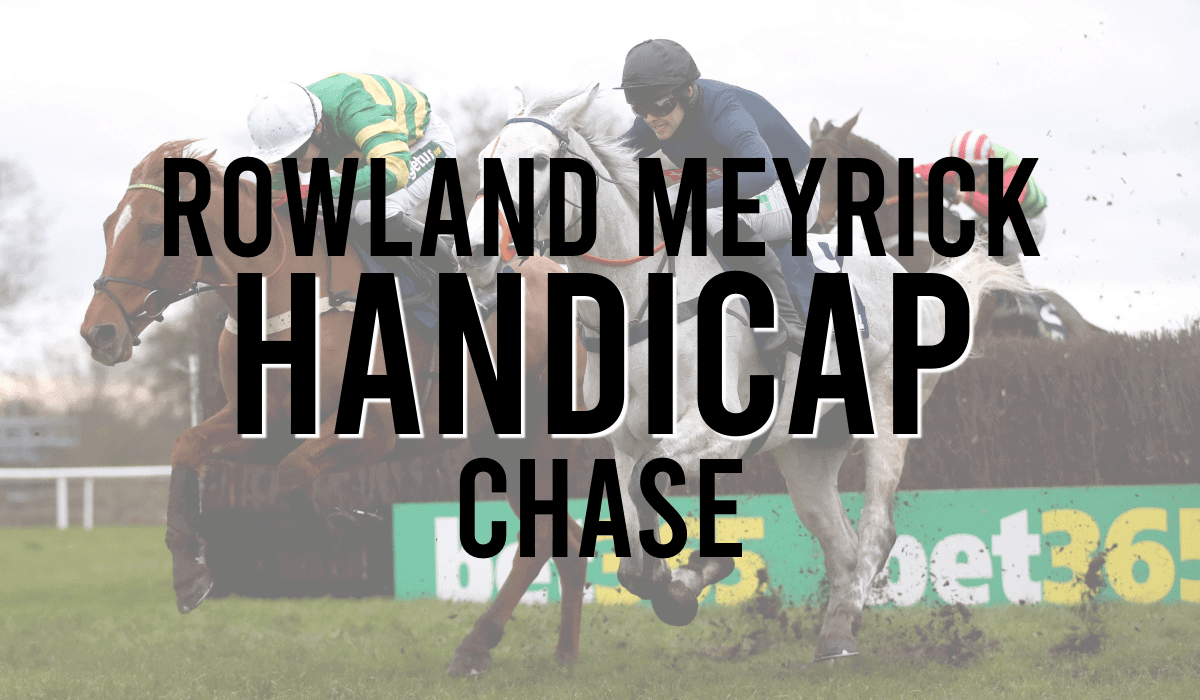
The Rowland Meyrick Handicap Chase is a Premier Handicap run over approximately three miles at Wetherby Racecourse on Boxing Day.
The race is one of the highlights of Wetherby’s National Hunt season and provides a demanding test for staying handicap chasers. Horses need to combine stamina with efficient jumping around a left-handed course where maintaining a good rhythm can make a considerable difference.
Its roll of honour contains several exceptional staying chasers. Forgive ‘n Forget and The Thinker won the race before going on to Cheltenham Gold Cup success, while Grand National winner Merryman II, Yahoo, Durham Edition and Definitly Red are among its other notable winners.
The modern Rowland Meyrick remains a valuable race in its own right and a useful source of form for the staying handicaps that follow later in the winter.
Rowland Meyrick Handicap Chase Key Facts
| Race detail | Rowland Meyrick Handicap Chase |
|---|---|
| Racecourse | Wetherby |
| Race type | National Hunt handicap chase |
| Classification | Premier Handicap |
| Distance | 3m 45yds |
| Fences | 19 |
| Eligibility | Horses aged 4+ |
| Usual date | Boxing Day, 26 December |
| Course direction | Left-handed |
| Surface | Turf |
Older records and articles may describe the Rowland Meyrick as a Grade 3 chase. Britain’s leading jump handicaps previously carrying that classification are now known as Premier Handicaps.
When Is the Rowland Meyrick Handicap Chase 2026?
The 2026 Rowland Meyrick Handicap Chase takes place at Wetherby on Saturday 26 December 2026.
It is the feature race of Wetherby’s Boxing Day racing programme and one of several important National Hunt races taking place around Britain on 26 December.
That places it on the same afternoon as the King George VI Chase and Christmas Hurdle at Kempton, although the Rowland Meyrick provides a very different challenge. Rather than a conditions race for established Grade 1 horses, Wetherby’s feature is a handicap in which weight, official ratings and the potential for improvement all become central to the analysis.
The declared runners, weights and going will provide the most useful information for assessing the 2026 renewal. Those details are best considered close to Boxing Day rather than speculating about runners months in advance.
History of the Rowland Meyrick Handicap Chase
The Rowland Meyrick has a long history at Wetherby and has produced an unusually strong collection of winners for a staying handicap.
One of its most remarkable performances came from Merryman II in 1960.
The Neville Crump-trained chaser won the race carrying 12st 6lb, which remains a striking weight-carrying performance. Merryman II had already won the Grand National at Aintree earlier that year, demonstrating the stamina and class he possessed.
The race became particularly notable during the 1980s.
Forgive ‘n Forget won in 1984 before taking the Cheltenham Gold Cup the following spring. The Thinker won the Rowland Meyrick in 1986 and followed him by winning the Gold Cup in 1987.
Yahoo then won at Wetherby in 1987 before coming agonisingly close to adding another Gold Cup connection to the race two years later.
That sequence helped establish the Rowland Meyrick as far more than simply another Boxing Day handicap.
Forgive ‘n Forget
Forgive ‘n Forget won the Rowland Meyrick in 1984 for trainer Jimmy Fitzgerald and jockey Mark Dwyer.
He was already developing into one of the strongest staying chasers of his generation and went on to win the Cheltenham Gold Cup in 1985.
His Wetherby victory provides an important piece of the race’s history because it demonstrates the quality of horse capable of winning the Rowland Meyrick before it became part of the modern Premier Handicap structure.
Forgive ‘n Forget later became closely associated with the Gold Cup division, and his success helped strengthen the link between Wetherby’s Christmas feature and the leading staying chases of the season.
The Thinker
The Thinker won the Rowland Meyrick in 1986 for legendary northern trainer Arthur Stephenson.
A few months later, he won one of the most memorable editions of the Cheltenham Gold Cup.
Snow and blizzard conditions affected Cheltenham on Gold Cup day in 1987, with the start delayed before racing was eventually able to proceed. The Thinker’s ability to cope with testing conditions proved crucial as he defeated Cybrandian and Door Latch.
His success at Wetherby before winning at Cheltenham reinforced the Rowland Meyrick’s reputation as a race capable of attracting genuine top-level staying chasers.
Yahoo
Yahoo won the Rowland Meyrick in 1987 and subsequently became part of one of the most famous Cheltenham Gold Cups.
He looked set to win the 1989 Gold Cup after opening a clear advantage, only for Desert Orchid to wear him down in the closing stages.
Yahoo finished second but gained compensation at Aintree the following month.
His career is another example of why historical Rowland Meyrick form deserves respect. The race has repeatedly featured horses capable of competing at a considerably higher level than the typical handicap chaser.
Durham Edition
Durham Edition won the Rowland Meyrick in 1989 and developed an exceptional record in the Grand National.
He finished second to Rhyme ‘N Reason at Aintree in 1988 and filled the same position behind Mr Frisk in 1990. He also finished fifth in 1989 and sixth in 1991.
Those performances demonstrated remarkable consistency over the National course.
Durham Edition’s record also illustrates the different ways in which Rowland Meyrick winners can progress. Some have developed into Gold Cup horses, while others have proved better suited to marathon handicaps and the unique demands of Aintree.
Definitly Red
Definitly Red won the Rowland Meyrick in 2016 for trainer Brian Ellison and jockey Henry Brooke.
He became one of the leading northern-trained staying chasers of his era, winning races including the Charlie Hall Chase, Cotswold Chase and Many Clouds Chase.
His success also began a remarkable sequence for Brooke, who returned to win the next two Rowland Meyricks aboard Get On The Yager in 2017 and Lake View Lad in 2018.
Definitly Red’s subsequent record showed that his Wetherby victory was no isolated handicap performance. He remained competitive in strong staying chases for several seasons.
Recent Rowland Meyrick Winners
The latest renewals demonstrate that the Rowland Meyrick can be won by horses with very different profiles.
Some Scope won in 2024 for trainer Richard Hobson, ridden by Charlie Maggs. The six-year-old carried 10st 2lb and defeated Kinondo Kwetu by three-quarters of a length on good to soft ground.
That was an example of a relatively lightly weighted younger chaser taking advantage of his position in the handicap.
The 2025 Rowland Meyrick was won by Konfusion, trained by Joel Parkinson and Sue Smith and ridden by Callum Bewley. The seven-year-old carried 11st 2lb and made all the running, drawing clear before the final fence to defeat Marble Sands.
The contrast is useful. Some Scope carried a relatively low weight and came through a competitive finish, while Konfusion controlled his race from the front under a considerably larger burden.
Historical trends cannot capture those differences particularly well. Race shape, current ability and the handicap conditions provide much more useful information.
What Makes Wetherby a Distinctive Test?
Wetherby’s jumps course is left-handed and galloping, with stiff fences that reward horses capable of maintaining a fluent jumping rhythm.
There are nine fences on a circuit, with four in the home straight. In the Rowland Meyrick, horses jump 19 fences in total.
The course is relatively flat, but that does not make a three-mile chase straightforward. A horse that repeatedly loses momentum at its fences can use substantial energy recovering its position.
Wetherby can also reward horses able to race within striking distance of the leaders.
That does not mean every winner needs to lead. The important consideration is how easily a horse can hold its position while conserving enough energy for the closing stages.
The Charlie Hall Chase provides another important three-mile test at Wetherby earlier in the season, although its Grade 2 conditions create a different type of race from the Rowland Meyrick handicap.
Jumping in the Rowland Meyrick
Accurate jumping is particularly important at Wetherby.
A single mistake can be recovered from, especially over three miles, but a succession of small errors can gradually undermine a horse’s chance.
The effect is not always obvious from the final form figure.
A horse might finish fourth after repeatedly losing ground at its fences yet have demonstrated enough stamina and ability to be interesting when encountering a different track or improving its jumping.
Conversely, a horse that enjoyed an uncontested lead and jumped fluently at its own pace may find life harder when challenged for position in its next race.
That is why our approach to reading horse racing form looks beyond finishing positions and starting prices.
The manner in which a horse achieved its result often provides the more useful evidence.
How Important Is Stamina?
Three miles places stamina at the heart of the Rowland Meyrick, particularly when the ground becomes testing.
A proven three-mile chaser has already answered an important question, but distance alone does not tell us everything.
A slowly run three-mile race on good ground can demand less stamina than a strongly run contest over the same distance on soft ground. Horses may therefore arrive with apparently similar distance records despite having faced very different tests.
Look at how a horse finishes.
A runner repeatedly weakening late in three-mile races has more to prove than one staying strongly through the line. Equally, a horse stepping up from shorter distances may have shown through its running style and finishing effort that three miles is likely to suit.
Stamina should be assessed through the circumstances of previous performances rather than a simple win-or-lose record at the distance.
How Does the Going Affect the Rowland Meyrick?
Boxing Day conditions at Wetherby can vary significantly from one year to another.
Soft ground increases the stamina requirement and can magnify jumping mistakes. Horses need to use more energy maintaining their position, while carrying a large weight becomes a more demanding physical task.
Better ground can bring tactical speed further into the equation.
Some Scope’s 2024 victory came on good to soft ground, while Konfusion won the following year when conditions were officially soft, good to soft in places.
Those examples underline why the going in horse racing needs to be considered alongside previous form.
A horse does not simply “act at Wetherby”. The conditions in which its previous Wetherby form was achieved can materially affect how relevant that form is to the next renewal.
Pace and Race Position
The 2025 result provides a good example of why pace matters.
Konfusion made the running and was able to maintain his advantage before going clear approaching the final fence. His success did not mean front-runners automatically hold an advantage in every Rowland Meyrick.
It showed that an effective front-runner can become difficult to pass when allowed to establish a comfortable rhythm.
The next renewal may contain several horses that prefer to race prominently, producing much greater competition for the lead. Alternatively, one obvious front-runner could again be allowed to dictate.
Assess the individual horses rather than applying the tactics of the previous winner to the next race.
Our horse racing pace maps guide explains how running styles can be combined to anticipate the likely shape of a race.
Does Weight Matter?
Weight inevitably attracts attention in a three-mile handicap.
The basic principle is straightforward. Higher-rated horses carry more weight because their previous performances indicate greater ability.
That makes a large weight both a challenge and evidence of class.
Merryman II’s historic victory under 12st 6lb provides an extreme example. The burden did not prevent him winning because he possessed the ability to overcome it.
At the other end of the scale, Some Scope carried 10st 2lb when winning in 2024. A lightly weighted, improving horse can be dangerous when its official rating has not yet caught up with its ability.
Neither example supports a rule that high or low weights should automatically be preferred.
Instead, assess whether the horse’s current handicap rating accurately represents what it can now produce.
That question is particularly important with younger chasers, whose ability can develop faster than their handicap marks.
Age and Experience
The old BR article placed considerable emphasis on seven-year-olds because they had won a cluster of previous renewals.
That statistic described what had happened during a particular period without explaining why it should continue.
Age is better considered in terms of development and experience.
A younger chaser may still be improving and could have more potential than its official rating reflects. An older horse may possess considerably more experience over fences and proven stamina in competitive handicaps.
The question is not whether a horse fits a preferred age bracket.
Ask whether it is still progressing, has retained its ability and possesses enough experience for a competitive three-mile handicap.
Which Previous Races Matter?
Several winter staying chases can provide useful evidence for the Rowland Meyrick, but there is no single qualifying trial.
The Rehearsal Chase at Newcastle has historically produced horses that subsequently ran well at Wetherby. It takes place earlier in the winter over a similar staying trip and can provide useful evidence of fitness and stamina.
The Charlie Hall is also relevant for horses with Wetherby form, although the quality and conditions of that race are different.
Looking forward rather than backwards, the Peter Marsh Chase at Haydock can become a suitable January target for horses emerging from the Rowland Meyrick.
The Peter Marsh is an extended three-mile handicap where winter ground can place even greater emphasis on stamina.
Some horses may later move towards Haydock’s Grand National Trial or other major staying handicaps.
The important point is not that one race mechanically predicts another. Each performance adds evidence about stamina, jumping, ground preferences and the horse’s relationship with its handicap mark.
Rowland Meyrick and the Cheltenham Gold Cup
The historical connection with the Cheltenham Gold Cup is unusually strong for a handicap.
Forgive ‘n Forget and The Thinker both won the Rowland Meyrick before winning the Gold Cup later in the same season.
Yahoo came close to joining them when finishing second to Desert Orchid at Cheltenham in 1989.
Modern racing programmes mean the Rowland Meyrick is more commonly associated with staying handicappers than established Gold Cup favourites. Even so, those historical performances remain important because they demonstrate the quality of horses the race has attracted.
They should be treated as part of the race’s heritage rather than evidence that the modern winner is automatically a Gold Cup contender.
Cheltenham presents a very different challenge, with an undulating track, an extended trip and a demanding uphill finish.
Rowland Meyrick and the Grand National
Merryman II and Durham Edition provide the strongest historical connections between the Rowland Meyrick and Aintree.
Merryman II had already won the Grand National when he carried his huge weight to victory at Wetherby in 1960.
Durham Edition never won the National but produced four notable finishes over the famous course, including two seconds.
That history makes the Rowland Meyrick interesting when a winner or placed horse later develops into a potential Aintree contender.
Wetherby does not reproduce the Grand National test. The Grand National fences create a different jumping challenge, while the longer distance adds another stamina requirement.
A strong Rowland Meyrick performance can therefore provide evidence of staying ability without answering every question about Aintree.
Trainers with a Strong Rowland Meyrick Record
Two great northern trainers dominate the historical record.
Neville Crump won the race seven times, with Merryman II, Tudor Fort, Chesapeake Bay, Glen Owen, Irish Tony, Ballet Lord and Richdee.
Arthur Stephenson won six renewals, including victories with Tartan Ace, The Gent, Fortina’s Express, The Thinker, Durham Edition and Stay On Tracks.
Their records reflect an era when powerful northern jumping yards regularly targeted the major races at Wetherby.
Trainer statistics can still provide useful context, particularly when a stable has repeatedly demonstrated an ability to prepare staying chasers for a specific race.
They should not override the evidence presented by the current horse.
A trainer’s historical record cannot compensate for doubtful stamina, unsuitable ground or a handicap mark that leaves a runner poorly treated.
Henry Brooke’s Hat-Trick
Henry Brooke achieved a notable modern riding record when winning three consecutive Rowland Meyricks.
He partnered Definitly Red in 2016, Get On The Yager in 2017 and Lake View Lad in 2018.
Winning the same competitive handicap on three different horses in successive years is an unusual achievement.
It also demonstrates the role a jockey can play at Wetherby. Understanding when to hold a position, when to increase the pressure and how to keep a staying chaser in a jumping rhythm can make a difference.
Even so, jockey records remain secondary to the horse’s suitability for the race.
What Matters Most in the Rowland Meyrick?
The strongest Rowland Meyrick analysis starts with the demands of the current race rather than trying to recreate a profile from previous winners.
Stamina matters. Look for evidence that a horse can remain effective over three miles, particularly if Boxing Day ground is testing.
Jumping matters. Wetherby’s stiff fences reward horses that maintain their rhythm without wasting energy.
Pace matters. An uncontested leader can be difficult to catch, while several prominent racers can create a much stronger early gallop.
Going matters. Soft ground changes the physical demands of the race and can make previous performances on quicker surfaces less relevant.
Weight requires context. High weights belong to the better-rated horses, while lightly weighted improvers may still be ahead of the handicapper.
Current form matters. Historical age, weight and favourite statistics tell us what happened previously. They do not explain whether today’s horse is capable of producing the required performance.
Combining these factors gives a much clearer picture than relying on a rigid checklist of old trends.
How to Analyse the Rowland Meyrick Handicap Chase
Start with the declared runners and establish the likely pace.
Identify which horses normally lead, which race prominently and which are usually held up. This provides an initial picture of how competitive the early stages could become.
Then assess stamina and jumping together.
Look for previous three-mile performances where the horse travelled efficiently and continued jumping accurately as the pressure increased. A strong finishing effort is more persuasive when it came in genuinely demanding conditions.
Next consider the ground.
Compare the Boxing Day going with each runner’s strongest performances rather than simply counting wins on broadly similar surfaces.
The handicap can then be examined. Improving horses may still be ahead of their official marks, while exposed runners need to demonstrate that they remain capable of producing their established level.
Finally, compare your assessment with the market.
The shortest-priced horse is not automatically the best betting proposition. Price only becomes meaningful when compared with the chance you believe the horse has of winning.
Our guide to finding value bets in horse racing explains this distinction in more detail.
Readers comparing where to place a racing bet can also use our horse racing betting sites comparison rather than choosing a bookmaker solely because it sponsors a particular race.
Rowland Meyrick Handicap Chase FAQs
Where is the Rowland Meyrick Handicap Chase run?
The Rowland Meyrick Handicap Chase is run at Wetherby Racecourse in West Yorkshire.
When is the Rowland Meyrick Handicap Chase?
The race takes place on Boxing Day, 26 December. The 2026 renewal is scheduled for Saturday 26 December.
How far is the Rowland Meyrick Handicap Chase?
The race is run over 3 miles and 45 yards, generally described as approximately three miles.
How many fences are jumped?
Horses jump 19 fences during the Rowland Meyrick Handicap Chase.
Is the Rowland Meyrick a Grade 3 race?
No. Historical records may describe it as a Grade 3 handicap, but it is now classified as a Premier Handicap.
What age horses can run?
The Rowland Meyrick is open to horses aged four and older.
Who won the Rowland Meyrick in 2025?
Konfusion won the 2025 Rowland Meyrick for Joel Parkinson and Sue Smith, ridden by Callum Bewley.
Who won the Rowland Meyrick in 2024?
Some Scope won the 2024 race for Richard Hobson, ridden by Charlie Maggs.
Which horse carried the most weight to victory?
Merryman II carried 12st 6lb when winning in 1960, an exceptional weight-carrying performance from a Grand National winner.
Have Rowland Meyrick winners won the Cheltenham Gold Cup?
Yes. Forgive ‘n Forget won the Rowland Meyrick in 1984 before winning the 1985 Cheltenham Gold Cup, while The Thinker won at Wetherby in 1986 before taking the Gold Cup in 1987.
Has a Grand National winner won the Rowland Meyrick?
Yes. Merryman II won the 1960 Grand National and subsequently won the Rowland Meyrick later that year.
Is the Rowland Meyrick a Grand National trial?
It can provide useful staying-chase evidence for horses that eventually head towards Aintree, but it is not a direct Grand National trial. The courses, distances and fences present different challenges.
Which jockey has a notable recent record in the race?
Henry Brooke won three consecutive renewals aboard Definitly Red in 2016, Get On The Yager in 2017 and Lake View Lad in 2018.
What should I look for when analysing the Rowland Meyrick?
Concentrate on stamina, jumping, the going, likely pace, current form and whether the horse appears well treated by its handicap mark. These factors provide more useful evidence than trying to match runners to arbitrary historical trends.
Rowland Meyrick Handicap Chase Summary
The Rowland Meyrick has been a significant part of Wetherby’s Boxing Day programme for decades and possesses a roll of honour considerably stronger than that of the average staying handicap.
Merryman II brought Grand National form to the race, Forgive ‘n Forget and The Thinker subsequently won Cheltenham Gold Cups, while Yahoo, Durham Edition and Definitly Red all produced high-class staying performances during their careers.
The modern race remains a demanding three-mile Premier Handicap. Wetherby’s fences, the prospect of testing winter ground and the handicap conditions mean the winner needs much more than a favourable historical statistic.
Stamina, efficient jumping, pace, going and the relationship between a horse’s current ability and official rating provide the strongest starting points for analysis.
The 2026 Rowland Meyrick Handicap Chase takes place at Wetherby on Saturday 26 December, forming one of the principal staying chases on Britain’s busy Boxing Day racing programme.