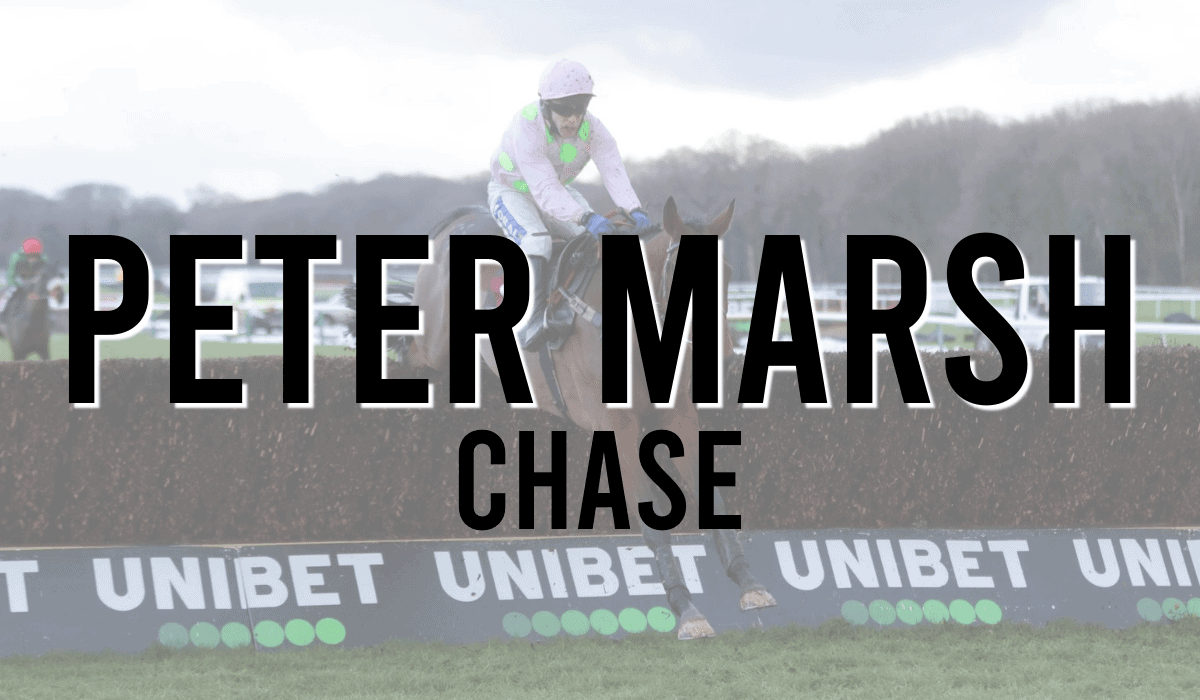
The Peter Marsh Chase is a Premier Handicap run at Haydock Park in January and one of the established staying handicap chases of the British jumps season.
Run over 3 miles, 1 furlong and 125 yards, the race asks horses to jump 19 fences around Haydock’s left-handed course. Conditions can have a major influence on the contest, with soft or heavy winter ground turning an already demanding staying chase into a serious test of stamina.
The Peter Marsh has an outstanding roll of honour. Cheltenham Gold Cup winners Little Owl, Bregawn, The Thinker and Jodami all won the race, while Earth Summit went on to win the Grand National.
More recent winners include Haydock specialists Bristol De Mai and Royale Pagaille, while Mr Vango and Imperial Saint added their names to the race’s history in 2025 and 2026.
Peter Marsh Chase Key Facts
| Race detail | Peter Marsh Chase |
|---|---|
| Racecourse | Haydock Park |
| Race type | National Hunt handicap chase |
| Classification | Premier Handicap |
| Distance | 3m 1f 125yds |
| Fences | 19 |
| Eligibility | Horses aged 5+ |
| Usual month | January |
| Course direction | Left-handed |
| Surface | Turf |
Older records may describe the Peter Marsh as a Grade 2 limited handicap. Under the current British jumps classification, it is a Premier Handicap.
When Is the Next Peter Marsh Chase?
The next Peter Marsh Chase Day is scheduled to take place at Haydock Park on Saturday 23 January 2027.
The race is traditionally staged in January, placing it in the middle of the winter staying-chase programme. By this point in the season, there is usually enough recent form to assess the established handicappers while progressive chasers may still be improving.
Final declarations, weights and ground will determine the precise shape of each renewal, so those factors are best assessed closer to the race.
History of the Peter Marsh Chase
The Peter Marsh Chase was first run in 1981 and immediately established an impressive association with high-class staying chasers.
The inaugural winner was Little Owl, trained by Peter Easterby and ridden by amateur Jim Wilson. Little Owl went on to win the Cheltenham Gold Cup later that season.
That was not an isolated example.
Bregawn won the Peter Marsh in 1982 before leading home Michael Dickinson’s remarkable first five finishers in the 1983 Cheltenham Gold Cup. The Peter Marsh roll of honour also includes The Thinker, Jodami and several other horses capable of competing at the highest level.
Although the modern Peter Marsh is firmly established as a major handicap, its history demonstrates the quality of staying chaser it has attracted.
The race can also provide a useful bridge between the busy Christmas programme and the major staying races later in the season.
Famous Peter Marsh Chase Winners
Little Owl
Little Owl won the inaugural Peter Marsh Chase in 1981 before winning the Cheltenham Gold Cup.
His victory gave the new Haydock race immediate credibility and started a remarkable sequence of high-class winners during its early years.
Bregawn
Bregawn followed Little Owl by winning the Peter Marsh in 1982.
A year later, he produced his most famous performance when winning the Cheltenham Gold Cup for Michael Dickinson. Dickinson trained the first five horses home that day, with Bregawn followed by Captain John, Wayward Lad, Silver Buck and Ashley House.
Ashley House had himself won the Peter Marsh in 1983.
The Thinker
The Thinker won at Haydock in 1987 and later that season won an extraordinary Cheltenham Gold Cup staged in snow.
His success added another Gold Cup winner to a race that was still relatively young.
Jodami
Jodami became one of the outstanding staying chasers of the 1990s.
He won the Peter Marsh in 1993 before taking the Cheltenham Gold Cup later that season. He returned to Haydock four years later and won the Peter Marsh again in 1997.
That second victory made him the first dual winner of the race.
Earth Summit
Earth Summit won the Peter Marsh in 1995 and later developed into one of Britain’s most accomplished marathon chasers.
He won the 1998 Grand National at Aintree and also recorded victories in the Welsh and Scottish Grand Nationals during his career.
His achievements underline an important point about the Peter Marsh. Although it is run over a little more than three miles, the race has repeatedly attracted horses capable of excelling over substantially longer distances.
Bristol De Mai
Bristol De Mai won the Peter Marsh in 2017 and subsequently became one of the horses most closely associated with Haydock.
The grey won the Betfair Chase three times and repeatedly produced high-class performances at the course.
His Haydock record provides a particularly strong example of course form having genuine analytical value. He did not simply win here once. He repeatedly demonstrated that the layout, fences and frequently testing conditions played to his strengths.
Royale Pagaille
Royale Pagaille won consecutive Peter Marsh Chases in 2021 and 2022, carrying 11st 10lb on both occasions.
Those performances were particularly notable because he was conceding substantial amounts of weight to several of his rivals.
Royale Pagaille subsequently developed his own exceptional Haydock record and became a Grade 1 winner at the course when taking the Betfair Chase.
His Peter Marsh victories show why high weight should not automatically be treated as a negative. A sufficiently talented horse can still hold an important class advantage even when the handicap asks it to concede weight.
Recent Peter Marsh Chase Results
The recent history of the race needs some context because weather intervened in successive years.
The 2023 Peter Marsh Chase was abandoned, as was the 2024 renewal. The race therefore went two years without a winner before returning in 2025.
Mr Vango won in 2025, producing a strong staying performance for trainer Sara Bradstock and jockey Jack Tudor. Racing on soft ground, he made the running and stayed on strongly to defeat Iwilldoit.
Imperial Saint won the 2026 Peter Marsh Chase, trained by Philip Hobbs and Johnson White and ridden by Callum Pritchard. He defeated Richmond Lake by a neck after a competitive finish, with the race staged on good to soft ground.
Those two renewals illustrate how differently the Peter Marsh can develop. Mr Vango was able to make extensive use of his stamina in testing conditions, while Imperial Saint’s success came in a much tighter finish on less demanding ground.
That is why the conditions of individual renewals matter more than simply comparing winning profiles from year to year.
What Makes Haydock a Difficult Test?
Haydock is a left-handed, galloping course, but the severity of the Peter Marsh depends heavily on the ground.
Three miles and one and a half furlongs is already a staying trip. When winter rain produces soft or heavy conditions, horses need to sustain their effort for considerably longer than they would over the same distance on a quicker surface.
The course also provides opportunities for pressure to build gradually rather than relying on one short burst of speed.
Horses that race too freely can use valuable energy early. Those that become detached may find themselves under pressure before the race reaches its decisive stages.
The ideal position depends on the pace, but efficiency matters throughout. A horse that travels comfortably and jumps economically can conserve energy for the closing stages.
Jumping in the Peter Marsh Chase
The Peter Marsh contains 19 fences, making jumping a central part of the analysis.
One bad mistake does not necessarily end a horse’s chance over a staying distance. There can be time to recover, particularly when the early pace is sensible.
Repeated mistakes are much more damaging.
A horse that continually loses half a length or a length at its fences must expend additional energy regaining its position. On testing ground, that effort can become particularly costly.
It is also worth looking at when previous jumping errors occurred.
Mistakes late in a race may indicate that a horse’s jumping deteriorates as it tires. That is more concerning in the Peter Marsh than an isolated early error followed by a fluent round.
When reading horse racing form, the comments attached to previous performances can help identify these patterns, but watching the races provides considerably more context.
How Important Is Stamina?
Stamina is one of the defining requirements of the Peter Marsh.
The race is run over an extended three miles, and winter conditions can make it feel considerably further. Horses need enough stamina to remain effective after the pace increases while still having the energy to jump accurately.
Proven form over three miles or further is therefore valuable.
That does not mean every runner needs to have won over the exact Peter Marsh distance. A horse finishing strongly over three miles in testing ground may provide enough evidence that the additional distance will suit.
Conversely, a horse repeatedly weakening late over three miles has a legitimate stamina question to answer.
The circumstances of previous races matter. A horse beaten after racing too freely or being forced into an unsustainably strong pace may deserve a different interpretation from one that travelled efficiently and simply failed to stay.
How Does the Going Affect the Peter Marsh Chase?
Ground conditions can change the character of the Peter Marsh more than many simplistic trends suggest.
Soft and heavy ground increase the stamina requirement and magnify jumping inefficiencies. Carrying a large weight can also become more demanding when horses are using additional energy simply to travel through the surface.
Better ground can produce a more tactical race.
Horses with greater cruising speed may remain competitive for longer, while the ability to hold a useful position can become more important if the field is not stretched by testing conditions.
Previous form should therefore be compared with the likely conditions rather than viewed in isolation.
A horse described as having strong Haydock form may have produced all of it on heavy ground. That evidence becomes less persuasive if the Peter Marsh is staged on a much quicker surface.
Our horse racing going guide explains how different conditions affect the demands of a race.
Does Previous Haydock Form Matter?
Haydock form is worth considering, particularly in the Peter Marsh.
Bristol De Mai and Royale Pagaille provide obvious examples of horses that repeatedly excelled at the course. Both won the Peter Marsh before adding major Haydock victories elsewhere.
There are logical reasons for taking course form seriously.
A previous Haydock performance can show that a horse handles the fences, travels comfortably around the course and operates effectively on the type of ground often encountered here during winter.
Course form should still be placed in context.
A horse winning a weaker race at Haydock does not automatically hold stronger credentials than a better horse arriving without previous course experience.
The quality of the performance matters more than the simple presence of a course win beside a horse’s name.
Which Races Can Provide Useful Form?
There is no single mandatory trial for the Peter Marsh.
The Rowland Meyrick Handicap Chase at Wetherby can provide relevant evidence because it is another staying handicap staged during the winter. Horses coming through that race have already faced a test beyond three miles against experienced chasers.
Haydock’s own Tommy Whittle Chase can also provide useful course evidence. A horse performing well there has shown that it can cope with the track before returning for a stronger assignment in January.
Other staying handicaps around Christmas can be equally informative.
Rather than searching for one previous race that produces a high percentage of Peter Marsh winners, look at what the horse actually demonstrated. Did it stay strongly? Did it jump well? Was the ground comparable? How hard a race did it have?
Those questions remain useful regardless of where the horse last ran.
Peter Marsh Chase and the Grand National Trial
The Peter Marsh and Grand National Trial are both major staying handicaps at Haydock, but they should not be treated as the same test.
The Peter Marsh is run over 3m 1f 125yds in January. The Grand National Trial follows in February and extends to approximately three miles and four and a half furlongs.
That extra distance is significant.
A horse can perform strongly in the Peter Marsh while leaving some doubt about whether it wants the longer trip of the Grand National Trial. Conversely, a strong stayer may find the Peter Marsh slightly sharper than its ideal test before improving over further.
Ground can widen or narrow the difference. A Peter Marsh run in heavy conditions can demand enormous stamina even though the official distance is shorter.
The two races therefore provide useful evidence when analysed together, but the bare finishing positions do not tell the whole story.
Does Weight Matter in the Peter Marsh Chase?
Weight matters, but not in isolation.
As a handicap, the Peter Marsh asks higher-rated horses to concede weight to lower-rated opponents. The purpose is to give horses of different abilities a more equal chance.
That means a large weight is also evidence of the horse’s established class.
Royale Pagaille demonstrated the point by winning consecutive renewals under 11st 10lb. His handicap burden did not remove the underlying ability that later enabled him to win at Grade 1 level.
At the other end of the handicap, a lightly weighted runner can become particularly interesting if it is improving faster than its official rating.
The important question is whether a horse’s current handicap rating accurately reflects its ability.
Ground should also form part of the assessment. Conceding weight in heavy conditions can be much more demanding than carrying the same burden when the surface is less testing.
Age and Experience
The Peter Marsh has been won by horses at very different stages of their careers.
Bristol De Mai won as a six-year-old in 2017, while Jodami and Our Vic both succeeded at the age of twelve.
That range is a useful warning against rigid age trends.
A younger chaser may have more scope to improve and could still be ahead of its handicap rating. An older horse may bring considerably more experience and proven stamina.
Neither characteristic is automatically superior.
The more useful assessment is whether the horse remains capable of producing the performance required by its current handicap mark.
Recent form, physical progression or regression, jumping and the demands of the race provide better evidence than age alone.
Peter Marsh Chase Trainers
Sue Smith has an outstanding historical record in the Peter Marsh.
Her winners include The Last Fling, Artic Jack, Cloudy Too, Wakanda and Vintage Clouds. That record is particularly notable because her successes came with several different horses over an extended period.
Venetia Williams has also enjoyed considerable success in the race, including the two victories of Royale Pagaille.
Trainer records can be informative because they show that a stable has previously prepared horses successfully for the demands of a particular race.
They should not become automatic betting systems.
The ability and current condition of the individual horse remain more important than the trainer’s historical total.
Peter Marsh Chase Jockeys
Danny Cook has enjoyed particular success in the Peter Marsh, winning aboard Our Vic, Cloudy Too, Wakanda and Vintage Clouds.
Norman Williamson also produced an unusual sequence during the 1990s, winning the race in three consecutive years. He partnered Jodami in 1997 before riding General Wolfe to successive victories.
Jockey records are interesting historically, but they carry less analytical weight than the horse’s ability, jumping and suitability for the race.
In a staying chase, however, judgement remains important. A jockey needs to conserve enough energy for the closing stages without allowing the horse to become poorly positioned.
What Matters Most in the Peter Marsh Chase?
The Peter Marsh is better analysed through the demands of the race than a fixed list of historical percentages.
Stamina matters. Proven form around three miles or further provides evidence that a horse can remain competitive through the closing stages.
Jumping matters. Repeated errors waste energy and become increasingly costly on soft or heavy ground.
Going matters. The same Haydock distance can provide a substantially different test depending on conditions.
Weight needs context. A large weight reflects proven ability, while a low weight becomes particularly valuable when attached to an improving horse.
Course form can strengthen the case. Previous strong performances at Haydock provide evidence that the horse handles the track, but weak course form should not be valued simply because it happened here.
Current form matters more than an arbitrary historical profile. A horse does not become a strong Peter Marsh candidate simply because its age, weight or starting price resembles previous winners.
Combining these factors produces a more useful assessment than relying on a checklist built from a small sample of past renewals.
How to Analyse the Peter Marsh Chase
Start with the likely ground.
That establishes how severe the stamina test is likely to become and helps identify which previous performances are genuinely comparable.
Next assess stamina and jumping together. Look for horses that have maintained their effort beyond three miles while continuing to jump efficiently late in their races.
Then consider the handicap.
An improving horse may still have more ability than its official rating suggests. An exposed horse needs to show that it remains capable of performing to the level represented by its mark.
Previous Haydock form, recent workload and likely pace can then refine the assessment.
A runner returning quickly from a gruelling race on heavy ground faces a different preparation from one arriving fresh after a controlled seasonal programme.
Only after working through those factors should price determine whether a horse represents a bet. Our guide to finding value bets in horse racing explains why identifying the most likely winner is only part of that decision.
Peter Marsh Chase FAQs
Where is the Peter Marsh Chase run?
The Peter Marsh Chase is run at Haydock Park in Merseyside.
When is the Peter Marsh Chase?
The race is normally staged in January. The next Peter Marsh Chase Day is scheduled for Saturday 23 January 2027.
How far is the Peter Marsh Chase?
The Peter Marsh Chase is run over 3 miles, 1 furlong and 125 yards, commonly described as approximately 3 miles and 1½ furlongs.
How many fences are jumped?
Horses jump 19 fences in the Peter Marsh Chase.
Is the Peter Marsh Chase a Grade 2 race?
The race was historically classified as a Grade 2 limited handicap. It is now classified as a Premier Handicap under the current British jumps structure.
Who can run in the Peter Marsh Chase?
The Peter Marsh Chase is open to horses aged five and older.
Who won the Peter Marsh Chase in 2026?
Imperial Saint won the 2026 Peter Marsh Chase for trainers Philip Hobbs and Johnson White, ridden by Callum Pritchard.
Who won the Peter Marsh Chase in 2025?
Mr Vango won the 2025 Peter Marsh Chase for trainer Sara Bradstock and jockey Jack Tudor.
Who won the Peter Marsh Chase in 2024?
There was no winner in 2024 because the Peter Marsh Chase was abandoned.
Who won the Peter Marsh Chase in 2023?
There was no winner in 2023 because the race was abandoned.
Which horses have won the Peter Marsh Chase twice?
Jodami, General Wolfe and Royale Pagaille are among the dual winners of the race.
Has a Peter Marsh winner won the Cheltenham Gold Cup?
Yes. The Peter Marsh has an exceptional historical association with the Gold Cup. Little Owl, Bregawn, The Thinker and Jodami are among the horses to have won both races during their careers.
Has a Peter Marsh winner won the Grand National?
Yes. Earth Summit won the Peter Marsh in 1995 and later won the 1998 Grand National at Aintree.
Is the Peter Marsh a Grand National trial?
The Peter Marsh can provide useful staying-chase form, but it is not a direct Grand National trial. Haydock’s own Grand National Trial is staged the following month over a longer distance.
Peter Marsh Chase Summary
The Peter Marsh Chase has been part of the British staying-chase programme since 1981 and its roll of honour is considerably stronger than that of the average handicap.
Little Owl, Bregawn, The Thinker and Jodami became Cheltenham Gold Cup winners, Earth Summit went on to Grand National success, while Bristol De Mai and Royale Pagaille developed outstanding records at Haydock.
The modern race remains a demanding Premier Handicap. Its difficulty comes from the combination of an extended three-mile trip, 19 fences, the handicap conditions and the prospect of testing winter ground.
Those factors also provide the best way to analyse it. Stamina, jumping, going, current form and the relationship between ability and handicap mark tell us far more than trying to find a runner that happens to match a narrow historical trend.
The next Peter Marsh Chase Day is scheduled for Saturday 23 January 2027 at Haydock Park.