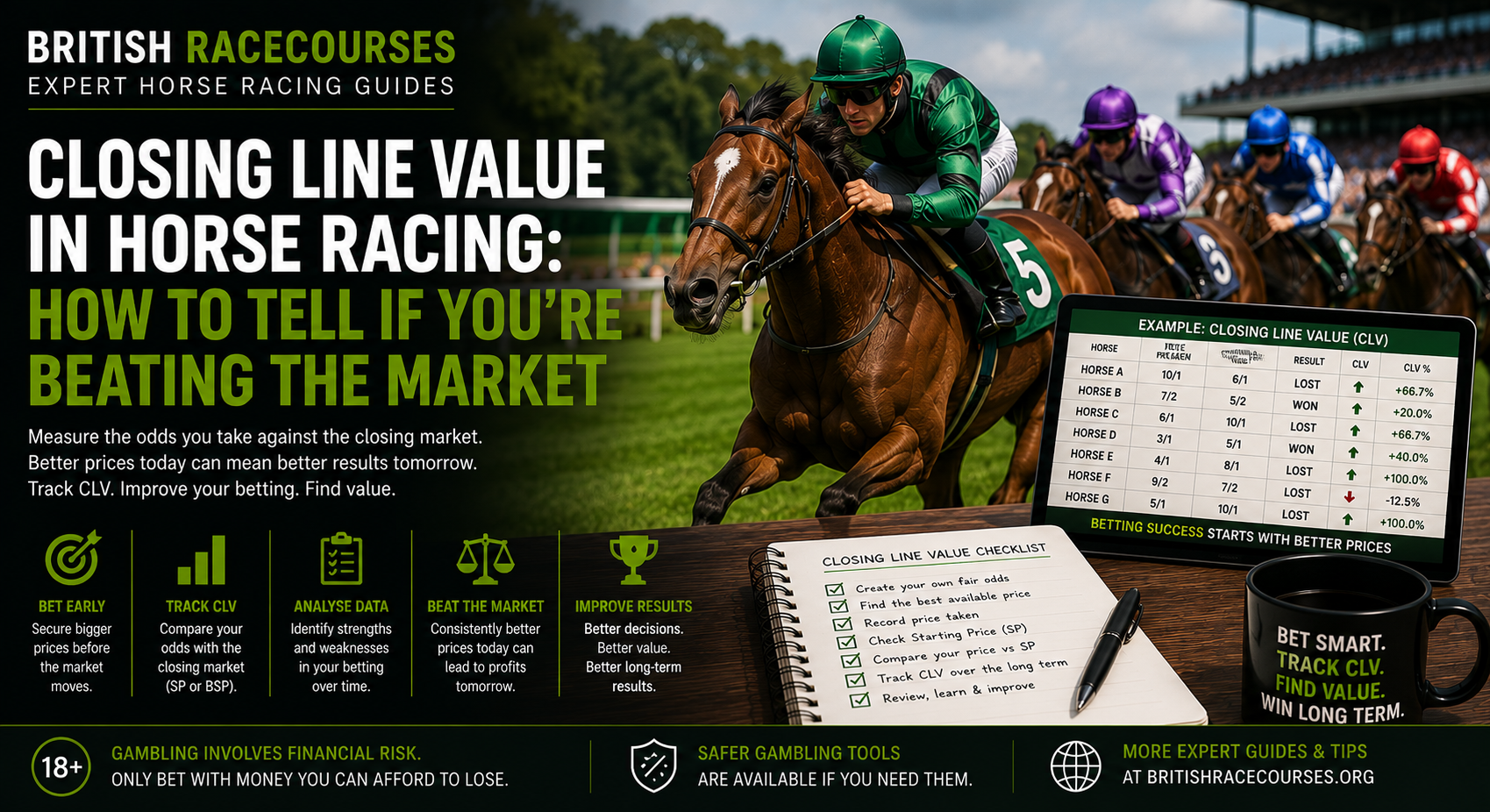
Closing line value in horse racing measures whether the odds you take are better or worse than the price available when the betting market closes.
It can be one of the most useful ways to assess the quality of your betting decisions.
Suppose you back a horse at:
10/1
and it eventually starts at:
6/1
Your horse might win.
It might lose.
But you have secured a significantly bigger price than the later market.
That is positive closing line value.
Now imagine you take:
4/1
and the horse drifts to:
8/1
You have taken a substantially shorter price than was available later.
That represents negative closing line value.
Neither example tells you whether the individual horse will win.
Closing line value is not about predicting one result.
It is about asking:
Am I consistently obtaining better prices than the market eventually offers?
For bettors who create their own prices and try to find value, that question can be extremely useful.
If you have not already done so, read our How to Price a Horse Race guide first. It explains how to create your own fair odds before comparing them with bookmakers.
What Is Closing Line Value?
Closing line value, commonly shortened to CLV, compares the odds you obtained when placing a bet with the market price closer to the start of the event.
In horse racing, the most obvious closing reference is often the Starting Price.
Imagine:
Price taken: 8/1
Starting Price: 5/1
You took the bigger price.
That is positive CLV.
Alternatively:
Price taken: 3/1
Starting Price: 6/1
The later market offered a considerably bigger price.
That is negative CLV.
The idea is simple.
The challenge is interpreting what it actually means.
Why Does Closing Line Value Matter?
Betting results contain a huge amount of short-term randomness.
A strong selection can lose.
A poor-value selection can win.
That makes it difficult to judge your betting ability from a small sample of results.
Closing line value gives you another measurement.
Instead of asking only:
Did the horse win?
you can also ask:
Did I take a good price?
If you consistently take 8/1 about horses that eventually start at 5/1, you are doing something potentially useful even if several of those horses lose.
If you consistently take 3/1 about horses that eventually drift to 6/1, your selection or timing process may deserve investigation.
Closing Line Value Does Not Guarantee Profit
This is important.
Positive CLV does not guarantee that you will make money.
You can beat the closing price repeatedly and still experience:
- losing runs
- variance
- poor staking
- inaccurate selections
- unusual market movements
Likewise, occasionally taking a shorter price than SP does not prove your betting strategy is bad.
CLV becomes more useful when assessed across a large sample of bets.
Why the Closing Market Is Useful
As a race approaches, the betting market incorporates increasing amounts of information.
This can include:
- bookmaker price movements
- exchange activity
- professional betting activity
- public betting
- non-runners
- going updates
- jockey changes
- weather
- market liquidity
The closing market is therefore often more informed than the market many hours earlier.
That does not mean it is perfectly accurate.
But it provides a useful benchmark against which to compare your earlier prices.
What Is the Closing Line in Horse Racing?
In other sports, the closing line often means the final widely available price immediately before an event begins.
Horse racing has a particularly convenient reference point:
Starting Price
or:
SP
The Starting Price reflects the market around the off.
British Racecourses has a dedicated Starting Price Betting guide explaining how SP betting works.
For CLV analysis, you can compare your early price against:
- Starting Price
- Betfair Starting Price
- exchange price near the off
- bookmaker closing prices
The most useful benchmark depends on the data you record.
Starting Price vs Exchange Closing Price
Traditional SP and exchange markets are not identical.
A bookmaker Starting Price reflects the bookmaker market.
An exchange closing price reflects prices available between exchange customers and can also involve commission.
This means you should try to use a consistent benchmark.
If you record:
Bookmaker price taken vs bookmaker SP
for one race and:
Bookmaker price taken vs exchange price
for another, your dataset becomes less consistent.
Choose a method and stick with it.
Simple Closing Line Value Example
You believe Horse A represents value at anything above 5/1.
On the morning of the race you find:
8/1
You place your bet.
Before the off, the horse shortens to:
9/2
Your decision looks strong from a price perspective.
You have obtained:
8/1
when the later market values the horse considerably shorter.
Even if Horse A finishes seventh, you still made the bet at a substantially bigger price than was ultimately available.
Negative CLV Example
You back Horse B at:
5/2
Later the market drifts.
The horse starts:
5/1
The horse then wins.
You collect your winnings.
But you still took poor closing value because you could have secured a much bigger price later.
That does not make the winning bet worthless.
It does mean the price-selection process could have been better.
Winning and Good Betting Decisions Are Different
This distinction is central to value betting.
A winning bet can have negative CLV.
A losing bet can have positive CLV.
For example:
Bet A
Odds taken: 8/1
SP: 5/1
Result: Lost
Bet B
Odds taken: 2/1
SP: 4/1
Result: Won
Bet B made money.
But Bet A secured the more favourable price relative to the closing market.
Over one race, result matters financially.
Over hundreds of bets, consistently taking the stronger price can become much more informative.
Closing Line Value and Value Betting
CLV fits naturally with value betting in horse racing.
A value bettor tries to identify odds that are bigger than the horse’s genuine chance deserves.
Closing line value provides one way to test whether that assessment is broadly aligning with later market opinion.
Suppose your tissue says:
Fair odds: 4/1
You back:
7/1
The horse starts:
9/2
Your analysis and the closing market have moved in broadly the same direction.
That is encouraging.
Create Your Own Price First
Closing line value becomes particularly useful when combined with independent pricing.
Start with:
Your fair price
Then record:
Price available when you bet
Finally record:
Closing price
For example:
| Your Fair Price | Price Taken | SP |
|---|---|---|
| 5/1 | 8/1 | 11/2 |
You believed 5/1 was fair.
You obtained 8/1.
The market eventually closed at 11/2.
That is a much richer piece of information than simply recording:
Lost
Our How to Price a Horse Race guide explains how to build those fair prices.
How to Calculate CLV Using Decimal Odds
Decimal odds make calculations easier.
Suppose:
Price taken: 6.00
Closing price: 4.00
One simple comparison is:
6.00 ÷ 4.00 = 1.50
You obtained a price 1.5 times the later market price.
However, comparing raw odds alone can sometimes be misleading.
Probability provides another useful method.
Calculate Implied Probability
The formula is:
Implied Probability = 1 ÷ Decimal Odds
Suppose:
Price taken: 6.00
The implied probability is:
1 ÷ 6.00 = 16.7%
Closing price:
4.00
The implied probability is:
1 ÷ 4.00 = 25%
You obtained odds implying a much lower probability than the closing market eventually assigned.
That represents meaningful positive CLV.
Fractional Odds Example
Suppose you take:
10/1
Decimal equivalent:
11.00
The horse starts:
6/1
Decimal equivalent:
7.00
You obtained the bigger price.
For a £10 win bet:
At 10/1:
£110 total return
At 6/1:
£70 total return
That is a £40 difference on exactly the same winning outcome.
This demonstrates why securing price matters.
Why Small Price Differences Add Up
Not every CLV advantage will be dramatic.
You might take:
5/1
about a horse that starts:
9/2
That appears relatively small.
But if you consistently obtain slightly better prices across hundreds of bets, the difference accumulates.
This is one reason experienced bettors place so much emphasis on getting the best available odds.
Compare Bookmakers Before Betting
You cannot maximise CLV if you automatically use one bookmaker.
Imagine the same horse is:
Bookmaker A: 7/2
Bookmaker B: 4/1
Bookmaker C: 9/2
Bookmaker D: 5/1
If you have already decided to bet, accepting 7/2 unnecessarily sacrifices price.
Our How to Compare Horse Racing Bookmakers guide explains how to compare the complete proposition.
Multiple Bookmaker Accounts and CLV
Having several legitimate bookmaker accounts can make price comparison easier.
The purpose is not to collect accounts.
It is to give yourself access to different:
- odds
- each-way terms
- Best Odds Guaranteed offers
- markets
Read our Multiple Bookmaker Accounts guide for the practical advantages and disadvantages.
Best Odds Guaranteed and Closing Value
Best Odds Guaranteed adds another dimension.
Suppose you take:
6/1
The horse drifts and starts:
9/1
If your bet qualifies for Best Odds Guaranteed, settlement at the larger applicable price can protect you from some negative price movement.
However, BOG terms vary.
You should still record the original price you selected if you are analysing your own CLV.
Otherwise, you could confuse:
good price selection
with:
a bookmaker concession improving settlement.
Market Movers and CLV
Market movements can provide useful evidence.
British Racecourses tracks Best Backed Horses Today, which highlights horses attracting notable market support.
But market movement should generally support your analysis rather than create it.
Backing every shortening horse after the movement has already happened can mean continually arriving late.
CLV analysis asks whether you were ahead of that movement.
Early Prices vs Late Prices
There are advantages and disadvantages to betting early.
Advantages
You may secure:
- bigger prices
- value before the market corrects
- attractive BOG terms where eligible
Disadvantages
You have less information.
Later developments can include:
- going changes
- non-runners
- weather
- draw information
- jockey changes
- market information
The best betting time depends on what type of edge you believe you have.
When Should You Bet?
There is no universal answer.
If your advantage comes from:
independent race analysis
you may benefit from betting before the wider market reaches the same conclusion.
If your advantage depends heavily on:
- final going
- market liquidity
- confirmed race shape
- late information
you may prefer betting later.
Record your CLV by betting time.
You may discover that your morning bets perform differently from bets placed shortly before the off.
Closing Line Value and Pace Analysis
Suppose you identify a horse as likely to receive an uncontested lead.
Your pace map suggests the horse should be shorter than the market price.
You back:
10/1
As more bettors analyse the race, the horse shortens to:
6/1
That movement can support the idea that your pace assessment identified something meaningful.
It does not prove the horse will win.
Closing Line Value and Sectional Times
Sectionals can also create early opportunities.
You may identify a horse whose previous finishing position hides a strong underlying performance.
You price the horse at:
5/1
The market initially offers:
9/1
Later bettors recognise the performance and the horse starts:
11/2
Again, you have positive CLV.
Our Horse Racing Sectional Times Explained guide shows how hidden performances can be identified.
Closing Line Value and Draw Bias
Draw information can also produce market movement.
A particular stall may become more or less attractive depending on:
- course
- distance
- field size
- pace
- going
Understanding Horse Racing Draw can help you identify situations where the market may eventually move towards a runner.
Closing Line Value and Pace Bias
Historical pace advantages can also affect your pricing.
If a course and distance repeatedly favour front-runners, and today’s race contains only one natural leader, you may price that horse differently from the market.
Read Horse Racing Pace Bias Explained for more.
CLV and Horse Racing Form
Strong form analysis can produce positive CLV when you identify something not obvious from finishing positions.
For example, a horse may have:
- raced against stronger opposition
- encountered trouble
- been badly positioned
- run on unsuitable ground
- faced an impossible pace setup
The basic race result looks weak.
Your deeper horse racing form analysis suggests otherwise.
If the market later moves towards your view, your CLV can help confirm that your interpretation was useful.
CLV and Speed Ratings
Speed ratings can reveal horses capable of stronger performances than the market initially expects.
British Racecourses’ Top Speed Ratings provide another analytical input.
Again, CLV can help assess whether your use of speed data is producing useful early opinions.
Does Beating SP Mean You Are a Winning Bettor?
Not automatically.
It is possible to beat SP and still lose money.
Reasons can include:
- small sample size
- poor staking
- unusual variance
- inappropriate benchmark
- focusing on tiny price differences
- each-way complexities
However, consistently beating a robust closing market is generally more encouraging than consistently taking prices substantially shorter than the close.
Treat it as an analytical metric, not a guarantee.
How Much CLV Is Good?
There is no universal target.
The correct amount depends on:
- odds range
- race type
- market
- liquidity
- betting time
- sample size
A bettor specialising in short-priced favourites may show smaller raw price differences.
Someone betting outsiders may experience much larger swings.
The important question is whether the pattern remains positive over time.
CLV on Short-Priced Horses
Suppose:
Price taken: 2.00
Closing price: 1.80
The difference looks small in fractional terms.
But implied probability changes from:
50%
to:
55.6%
That is a meaningful market movement.
Do not judge CLV solely by how visually different the fractional prices look.
CLV on Outsiders
Outsider markets can be more volatile.
A horse may move from:
25/1
to:
16/1
or:
20/1
to:
33/1
without necessarily representing the same information content as movement in a heavily traded favourite.
Be careful drawing major conclusions from one outsider move.
Sample size matters enormously.
Market Liquidity Matters
A market with little money available can move sharply after relatively modest betting activity.
A highly liquid market can require much more money to move.
That makes the closing price more useful in some markets than others.
Major races such as the Grand National and Cheltenham Gold Cup can attract huge betting interest.
Smaller races may have different market dynamics.
Exchange Markets and CLV
Betting exchanges can provide particularly useful price information because prices are created by customers backing and laying against each other.
If you use exchange closing prices, remember to consider commission.
Our UK Betting Exchange Sites guide explains how exchanges work.
What Is Betfair Starting Price?
Betfair Starting Price is generated through the Betfair Exchange market around the off.
Some bettors use BSP as a closing-price benchmark.
It can provide a useful reference because it reflects exchange supply and demand rather than simply one bookmaker’s price.
However, use the same benchmark consistently when analysing your records.
How to Track Closing Line Value
Add several columns to your betting record.
| Horse | Your Fair Odds | Price Taken | Closing Price | Result |
|---|---|---|---|---|
| Horse A | 5/1 | 8/1 | 11/2 | Lost |
| Horse B | 2/1 | 5/2 | 7/4 | Won |
| Horse C | 10/1 | 12/1 | 14/1 | Lost |
| Horse D | 4/1 | 6/1 | 7/2 | Lost |
Now you can assess more than profit and loss.
Horse A and Horse D both lost.
But both show positive price movement.
Horse C lost and also drifted beyond the price you took.
That could deserve further investigation.
Record When You Placed the Bet
Timing can be extremely revealing.
Add:
- morning
- afternoon
- one hour before off
- ten minutes before off
You might discover your strongest CLV comes from:
early analysis
while your late bets perform worse.
Or the reverse.
That can help you refine when you enter the market.
Track CLV by Bet Type
You can also separate:
- Flat
- jumps
- handicaps
- non-handicaps
- favourites
- outsiders
- each-way
- win-only
Perhaps you regularly beat the market in handicaps but not novice races.
That tells you something important about where your analytical strength may lie.
Track CLV by Analytical Method
If you tag why you placed each bet, you can learn even more.
Examples:
Pace
Draw
Sectionals
Speed ratings
Handicap mark
Trainer angle
Value tissue
After a large sample, you might find that your pace-based bets consistently beat the closing market while another method does not.
That is useful feedback.
Closing Line Value and Your Betting Tissue
One of the best combinations is:
Fair price → Bet price → Closing price
Suppose:
Your fair price:
4/1
Price taken:
7/1
Closing price:
9/2
You believed the market was wrong.
You obtained 7/1.
The market eventually moved very close to your original 4/1 assessment.
That is exactly the type of information worth recording.
What If You Consistently Beat Your Own Fair Price but Not SP?
Suppose your tissue says:
3/1
You repeatedly take:
5/1
but those horses regularly start:
7/1
Your own model says you have value.
The market repeatedly disagrees.
That does not automatically prove your model is wrong.
But it is a strong reason to investigate your assumptions.
Ask whether you are systematically:
- overrating form
- misreading pace
- ignoring going
- overvaluing sectionals
- underestimating uncertainty
CLV can help identify weaknesses in your pricing process.
What If Your Horses Keep Shortening but Losing?
Do not panic after a small sample.
If you take:
8/1 → SP 5/1
10/1 → SP 6/1
6/1 → SP 4/1
and all three lose, you have experienced three losing bets.
But your price selection appears encouraging.
Horse racing naturally produces losing sequences.
Judge the process over much larger samples.
Don’t Chase Steam
A horse shortening sharply can attract attention.
That does not mean you should immediately follow the move.
If a horse has moved from:
10/1
to:
5/1
the value that existed at 10/1 may already be gone.
Your job is not to say:
This horse is shortening, therefore I must back it.
It is to ask:
Does the current price still exceed my fair price?
Don’t Automatically Back Drifters Either
A drifting horse can occasionally become better value.
Suppose your tissue says:
5/1
The horse drifts from:
4/1
to:
7/1
If nothing fundamental has changed, the bigger price may become attractive.
But investigate why the market moved.
There may be information you have missed.
Price Movement Can Be Information
Treat a significant market move as a prompt.
If a horse you like drifts sharply, recheck:
- going
- non-runners
- equipment
- trainer news
- jockey
- market conditions
- race shape
Do not blindly follow the market.
Do not blindly ignore it either.
Closing Line Value and Best Backed Horses
British Racecourses’ Best Backed Horses Today page can show which runners are attracting market support.
Use it as one data point.
The more important question for CLV is:
At what price did you act?
Knowing that a horse shortened from 12/1 to 6/1 is much more useful if you were able to take 12/1 than if you joined at 11/2.
Closing Line Value and Betting Apps
Fast access to changing prices can matter if you actively compare markets.
Our Best Horse Racing Betting Apps guide covers mobile bookmaker options.
However, speed should not encourage impulsive betting.
Your analysis should determine whether the price is attractive.
The app simply provides the mechanism.
Closing Line Value and Bookmaker Choice
Different bookmakers move prices at different times.
One may cut a horse quickly.
Another may retain the bigger price for longer.
This gives price-sensitive bettors a reason to compare bookmakers.
Use our main Best Horse Racing Betting Sites page when deciding which operators are worth including in your comparison.
Common Closing Line Value Mistakes
Judging CLV from one bet
One price move proves very little.
Assuming positive CLV guarantees profit
It does not.
Using inconsistent closing benchmarks
Choose SP, BSP or another consistent market reference.
Ignoring bookmaker margin
Raw prices contain overround.
Ignoring exchange commission
Exchange odds and bookmaker odds are not directly identical.
Only recording winners
You need every qualifying bet.
Changing the benchmark after the result
Decide how you measure CLV beforehand.
Following shortening horses blindly
The value may already have disappeared.
Assuming every drifter is a bad bet
Markets can move incorrectly.
Ignoring price availability
A quoted price is useful only if you could genuinely obtain it.
How to Improve Your Closing Line Value
You cannot simply decide:
I will beat SP from now on.
Improve the underlying process.
Analyse races independently
Use How to Analyse a Horse Race Like a Professional.
Create your own prices
Use How to Price a Horse Race.
Understand pace
Analyse hidden performances
Use Horse Racing Sectional Times.
Compare bookmakers
Use How to Compare Horse Racing Bookmakers.
Record everything
Track both your prices and the closing market.
That gives you a complete feedback loop.
A Practical CLV Workflow
Use this process for each bet.
Step 1: Analyse the race
Form your opinion independently.
Step 2: Create a fair price
Decide what odds you believe the horse deserves.
Step 3: Compare bookmakers
Find the best genuinely available price.
Step 4: Decide whether sufficient value exists
Do not bet simply because you like the horse.
Step 5: Record your price
Do this immediately.
Step 6: Record the closing price
Use your chosen consistent benchmark.
Step 7: Record the result
Win or lose.
Step 8: Review after a large sample
Look for patterns in your pricing ability.
Example CLV Betting Record
| Date | Horse | Fair Price | Bet Price | SP | Result |
|---|---|---|---|---|---|
| 1 Aug | Horse A | 4/1 | 6/1 | 7/2 | Lost |
| 2 Aug | Horse B | 3/1 | 7/2 | 5/2 | Won |
| 4 Aug | Horse C | 8/1 | 10/1 | 12/1 | Lost |
| 6 Aug | Horse D | 5/1 | 8/1 | 11/2 | Lost |
Do not conclude anything important from four bets.
The purpose is to create a record that becomes useful after dozens or hundreds of selections.
Closing Line Value Checklist
Before betting:
☐ Have I analysed the race independently?
☐ What is my fair price?
☐ What is the best available price?
☐ Is the difference large enough to matter?
☐ Have I compared bookmakers?
After betting:
☐ What price did I actually obtain?
☐ When did I place the bet?
☐ What was the SP?
☐ What was the exchange closing price if I track it?
☐ Did the horse shorten or drift?
Review:
☐ Am I beating the closing market overall?
☐ Which race types perform best?
☐ Which analytical methods produce the best CLV?
☐ Does betting earlier or later work better?
☐ Am I taking enough of a margin over my fair price?
That is considerably more useful than simply counting winners.
Closing Line Value and the Complete Race-Analysis Process
The British Racecourses analysis pathway now fits together like this:
Read the racecard
↓
↓
Analyse the form
↓
↓
Understand the draw
↓
↓
Build the pace map
↓
Horse Racing Pace Maps Explained
↓
Study hidden performances
↓
Horse Racing Sectional Times Explained
↓
Create your own odds
↓
↓
Find value
↓
How to Find Value Bets in Horse Racing
↓
Compare bookmaker prices
↓
How to Compare Horse Racing Bookmakers
↓
Place the bet
↓
Measure your closing line value
That creates a complete analytical cycle.
You form the opinion.
You price it.
You bet only when the market gives you sufficient value.
Then you measure whether the later market supports your price selection.
Frequently Asked Questions
What is closing line value in horse racing?
Closing line value compares the odds you take with the price available when the betting market closes.
What does CLV mean in betting?
CLV stands for closing line value.
What is positive closing line value?
Positive CLV means you obtained odds bigger than the later closing price.
What is negative closing line value?
Negative CLV means you accepted a shorter price than the later market eventually offered.
Is Starting Price the closing line in horse racing?
SP can be used as a convenient closing-market benchmark, although some bettors use exchange closing prices or Betfair Starting Price instead.
What is BSP?
BSP means Betfair Starting Price, a price generated from the Betfair Exchange market around the start of the race.
Does positive CLV mean my bet will win?
No. Price quality and race outcome are separate.
Does beating SP guarantee profit?
No. It can be a useful analytical signal over a large sample but does not guarantee profitability.
Can a losing bet have positive CLV?
Yes. You can take 10/1 about a horse that starts at 6/1 and still lose.
Can a winning bet have negative CLV?
Yes. You can back a winner at 2/1 that later drifts to 4/1.
Why is CLV useful?
It gives you another way to assess the quality of your betting decisions without relying entirely on short-term results.
How many bets do I need before analysing CLV?
There is no magic number, but larger samples are substantially more meaningful than a handful of bets.
Should I compare against SP or BSP?
Either can be useful. Consistency matters more than switching between benchmarks whenever convenient.
Should I always bet early?
No. The best timing depends on your strategy and the information you use.
Are morning prices better?
Sometimes. They can also contain greater uncertainty because less information is available.
Should I back a horse because it is shortening?
No. The shortened price may no longer represent value.
Should I back a drifting horse?
Only if the new price is attractive relative to your assessment and you understand why the market may be moving.
How does BOG affect CLV?
Best Odds Guaranteed can improve settlement when an eligible horse drifts, but you should still record the original price taken when evaluating your price-selection ability.
Can sectional times help beat the closing price?
They can provide information that helps you identify horses the market may initially underestimate.
Can pace maps help CLV?
Yes. Identifying a favourable race shape before the wider market adjusts can potentially lead to better early prices.
Should I record my fair odds?
Yes. Comparing fair price, bet price and closing price provides much more useful information than recording the result alone.
Is closing line value the same as value betting?
No. Value betting concerns your assessment of fair odds relative to the available price. CLV compares the price you took with the later market.
Is CLV useful for horse racing outsiders?
It can be, although outsider markets can be more volatile and individual price movements should be interpreted cautiously.
Is CLV useful for favourites?
Yes. Small-looking price movements at short odds can represent meaningful changes in implied probability.
Can I use bookmaker odds and exchange odds together?
You can compare them, but remember exchange commission and different market structures when evaluating the prices.
Summary
Closing line value helps you answer one of the most important questions in serious horse racing betting:
Am I consistently getting a good price?
If you regularly back horses at:
10/1
that eventually start:
6/1
your price selection appears stronger than if you repeatedly take:
4/1
about horses that drift to:
8/1.
That remains true regardless of what happens in one individual race.
CLV does not guarantee profit.
It does not tell you which horse will win.
It gives you another tool for assessing the quality of your betting process.
The strongest approach is to record:
Your fair price
↓
The price you actually take
↓
The closing price
↓
The result
Then analyse those numbers across a substantial sample.
If your own prices repeatedly identify horses before the market moves towards them, that can be encouraging evidence that your analysis is adding something useful.
If the market consistently moves sharply against you, investigate why.
Your form analysis may be wrong.
Your pace assumptions may be inaccurate.
Your probabilities may be too optimistic.
Or you may simply be entering the market at the wrong time.
Start with How to Price a Horse Race to create your own fair odds.
Use How to Find Value Bets in Horse Racing to decide whether the available price justifies a bet.
Use How to Compare Horse Racing Bookmakers to maximise the price you receive.
And use Best Backed Horses Today to understand how the market is moving.
Winning matters.
But before the race even begins, you can measure whether you got the better price.
18+. Gambling involves financial risk. Only bet with money you can afford to lose. Safer-gambling and self-exclusion tools are available if you need them.