
Use the British Racecourses Lucky 15 bet calculator to work out the total stake, return and profit from a Lucky 15.
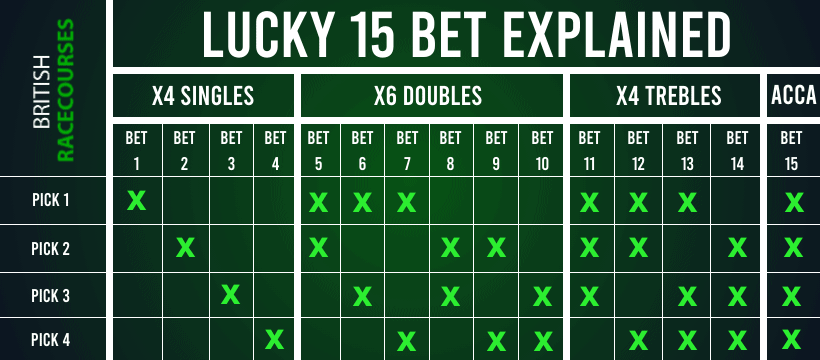
A Lucky 15 uses four selections to create 15 separate bets:
- 4 Singles
- 6 Doubles
- 4 Trebles
- 1 Four-Fold Accumulator
Enter your selections, odds, outcomes and stake into the calculator below.
The calculator can also account for each-way bets, non-runners, dead heats, Rule 4 deductions and bookmaker bonuses when the relevant information is entered.
Use our Lucky 15 Bet calculator to work out your winnings now.
Use the Free Lucky 15 Calculator
How To Work Out a Lucky 15 Bet?
The winnings you would receive from a lucky bet are calculated by multiplying your stake by the odds on your four selections.
Here is how to calculate a Lucky 15 bet:
- Make sure that “Lucky 15” is selected on the ‘Bet Type’ dropdown
- The ‘Number of Selections’ should default to 4 selections
- Select the ‘Outcome’ for each selection, either “Winner”, “Placed”, “Lost”, “Dead Heat”, “Void” or “Non-runner”
- Select the ‘Odds’ for each selection like “15/8 odds payout”, “12/1”, “15/2” (you can choose your odds format – such as decimal or fractional)
- Select the ‘Stake’ wagered per bet, such as “£1”, “£3”, “£8” (if you prefer, you can select “Total Combined Stake”)
- The Lucky 15 bet Calculator will then work out total outlay, total return and total profit
What Affects the Payout on a Lucky 15 Bet?
Your return from a Lucky 15 bet will essentially depend upon the following:
- The number of winning selections
- The betting odds of each selection
- The stake wagered on the Lucky 15 bet
On a win, a Lucky 15 bet has selections with a 15/8 odds payout or a 10/11 odds payout, and the fractional odds reflect your winning payouts.
On each-way Lucky 15 bets, you might have selections with 20 to 1 odds or even 50 to 1 odds and with some bookies offering treble the odds for one winner, you can return some big win payouts.
How to Place a Lucky 15 Bet?
Here is a step-by-step guide on how to place a Lucky 15 Bet:
- Choose four racehorses you want to bet on
- Add all four selections (four selections) to your betting slip
- Look under the ‘multiple’ segment and tick ‘Lucky 15’
- Enter the stake that you want to bet (bear in mind your stake will be multiplied by 15)
- Double-check your choices and click ‘place bets’ if you are betting online or hand it to a cashier at a betting shop.
And don’t forget, if you win, to use our Lucky fifteen calculator (Lucky 15 cal) to work out your profit and winnings.
Lucky 15 Example
Suppose you choose four horses:
- Horse A: 2/1
- Horse B: 3/1
- Horse C: 4/1
- Horse D: 5/1
A £1 Lucky 15 does not mean that £1 is being risked across the entire wager.
The £1 is the unit stake on each of the 15 component bets.
Your total stake is therefore:
15 × £1 = £15
If all four horses win, you receive returns from:
- 4 Winning Singles
- 6 Winning Doubles
- 4 Winning Trebles
- 1 Winning Four-Fold
If three horses win, you receive returns from the successful singles, doubles and treble involving those three selections.
If two win, the successful singles and double produce returns.
If only one wins, the relevant single produces a return.
The Lucky 15 calculator handles these combinations automatically.
How to Use the Lucky 15 Calculator
Select Lucky 15 from the bet-type options if it is not already selected.
Enter the outcome and odds for each of your four selections.
Then enter the unit stake or total combined stake, depending on how you want to calculate the wager.
For settled bets, make sure the information reflects what actually happened.
If a horse was a non-runner, mark it as a non-runner rather than a loser.
If a dead heat occurred, enter the relevant dead-heat information.
For each-way bets, enter the correct place terms.
If a Rule 4 deduction applied, enter that information too.
The calculator then shows:
- Total Outlay: The complete amount staked.
- Total Return: The amount paid back from the successful components.
- Total Profit: The return minus the original outlay.
Our main bet calculator can calculate Lucky 15s alongside many other bet structures.
How Much Does a Lucky 15 Cost?
The total cost is the unit stake multiplied by 15.
| Unit Stake | Total Lucky 15 Cost |
|---|---|
| 5p | 75p |
| 10p | £1.50 |
| 20p | £3.00 |
| 25p | £3.75 |
| 50p | £7.50 |
| £1 | £15 |
| £2 | £30 |
| £5 | £75 |
| £10 | £150 |
This distinction is important.
Entering a £5 unit stake means risking £75, not £5.
Permutation bets can become expensive quickly because the stake is applied to several individual wagers.
How Much Is a £1 Lucky 15?
A £1 Lucky 15 costs £15 in total.
That consists of:
- £4: Four £1 singles.
- £6: Six £1 doubles.
- £4: Four £1 trebles.
- £1: One £1 four-fold accumulator.
Total:
£4 + £6 + £4 + £1 = £15
The potential return depends entirely on the odds and results of the four selections.
How Much Is a 50p Lucky 15?
A 50p Lucky 15 costs:
15 × £0.50 = £7.50
If you wanted your complete outlay to be £15, the unit stake would be £1.
How Much Is a 10p Lucky 15?
A 10p Lucky 15 costs:
15 × £0.10 = £1.50
Small unit stakes can therefore be used to keep the total cost of a permutation bet lower.
Always look at total outlay rather than concentrating only on the unit stake.
How Are Lucky 15 Winnings Calculated?
Every successful component of the Lucky 15 is settled individually.
Suppose two of your four selections win.
You would have:
- 2 Winning Singles
- 1 Winning Double
All bets containing either of the losing selections would lose.
If three selections win, the successful components become:
- 3 Winning Singles
- 3 Winning Doubles
- 1 Winning Treble
If all four win, all 15 bets are successful.
This is why the return increases sharply as additional selections win.
The extra winner does not simply add another single. It can turn several doubles, trebles and the accumulator into winning bets at the same time.
Lucky 15 Example With Four 6/1 Winners
A simple example demonstrates how the combinations work.
Imagine placing a £1 Lucky 15 with all four selections priced at 6/1.
Your total stake is £15.
If one horse wins and three lose, the winning £1 single returns:
£7
That produces a net loss of £8 against the £15 total outlay.
If two horses win, the two singles and the double return:
£7 + £7 + £49 = £63
That represents £48 profit after the £15 outlay.
If three horses win, the successful singles, doubles and treble return a combined:
£511
If all four win, all 15 component bets are successful and the combined return is:
£4,095
These figures assume standard fixed odds of 6/1, a £1 unit stake and no deductions or additional bonuses.
They demonstrate why a Lucky 15 can produce a large displayed potential return while still containing substantial risk.
Do You Need All Four Winners on a Lucky 15?
No.
One of the defining features of a Lucky 15 is that the four singles are included.
One winner therefore produces a return from that single.
Compare that with a four-selection accumulator.
If one selection in a standard accumulator loses, the accumulator loses.
A Lucky 15 spreads the stake across several combinations instead.
That provides more ways to receive a return, but it also increases the total number of bets and therefore the total outlay.
Does One Winner Mean You Make a Profit?
No.
One winner produces a return, but it does not guarantee a profit.
This is an important distinction.
Imagine placing a £1 Lucky 15.
Your total stake is £15.
If only one selection wins at 2/1, the successful £1 single returns £3.
You have received money back, but the overall Lucky 15 has still lost £12.
Some bookmaker Lucky 15 promotions can alter the settlement for a single winner, but promotional terms vary and should be checked before placing the wager.
Lucky 15 vs Accumulator
A four-fold accumulator contains one bet.
A Lucky 15 containing the same four selections contains 15.
With an accumulator, all four selections need to win for the bet to succeed.
With a Lucky 15, the singles and smaller multiples mean that fewer than four winners can still produce returns.
The trade-off is cost.
A £1 four-fold accumulator costs £1.
A £1 Lucky 15 costs £15.
Neither structure is automatically better.
They are different wagers with different return profiles.
Our horse racing bet types section explains the structures used in common racing bets.
Lucky 15 vs Yankee
Lucky 15s and Yankees both use four selections.
The difference is the singles.
| Bet | Selections | Singles | Doubles | Trebles | Accumulator | Total Bets |
|---|---|---|---|---|---|---|
| Lucky 15 | 4 | 4 | 6 | 4 | 1 | 15 |
| Yankee | 4 | 0 | 6 | 4 | 1 | 11 |
A Yankee requires at least two successful selections to generate a return because it contains no singles.
A Lucky 15 can produce a return from one winner.
The additional four singles also mean the Lucky 15 costs more at the same unit stake.
A £1 Yankee costs £11.
A £1 Lucky 15 costs £15.
Lucky 15 vs Lucky 31
A Lucky 31 follows the same basic principle but uses five selections rather than four.
| Bet | Selections | Number of Bets |
|---|---|---|
| Lucky 15 | 4 | 15 |
| Lucky 31 | 5 | 31 |
| Lucky 63 | 6 | 63 |
All three include singles.
The number of combinations increases quickly as selections are added.
A £1 Lucky 15 costs £15.
A £1 Lucky 31 costs £31.
A £1 Lucky 63 costs £63.
Use our Lucky 31 bet calculator or Lucky 63 bet calculator for those larger permutations.
Lucky 15 vs Canadian
A Canadian uses five selections and contains 26 bets.
Unlike a Lucky 31, it does not contain singles.
The same distinction applies when comparing a Lucky 15 with a Yankee.
The “Lucky” versions include singles.
That changes both the total stake and what happens when only one selection wins.
Can You Place an Each-Way Lucky 15?
Yes.
An each-way Lucky 15 effectively contains a win Lucky 15 and a place Lucky 15.
That means the stake is doubled.
A 10p win Lucky 15 costs £1.50.
A 10p each-way Lucky 15 costs £3.
A £1 win Lucky 15 costs £15.
A £1 each-way Lucky 15 costs £30.
The place portion is settled using the applicable place fraction and number of places.
This makes manual calculation considerably more complicated, particularly when the four selections have different each-way terms.
Use the each-way option in the calculator and enter the correct terms for each selection.
Our each-way betting guide explains how win and place portions are settled.
Each-Way Lucky 15 Example
Suppose you place a £1 each-way Lucky 15.
There are 15 win bets and 15 place bets.
Your total stake is therefore:
30 × £1 = £30
If some selections win and others only place, the win and place portions produce different combinations.
The place odds also depend on the terms offered for the individual race.
For example, a horse at 20/1 with place terms of one-fifth the odds would have its place portion settled at 4/1.
Different place fractions produce different returns.
This is one of the strongest reasons to use the calculator rather than trying to settle a complex each-way Lucky 15 manually.
What Happens If a Horse Is Placed but Does Not Win?
On a standard win-only Lucky 15, a placed horse that does not win counts as a losing selection.
On an each-way Lucky 15, the place portion can remain successful if the horse finishes within the qualifying places.
The win portion loses.
The exact settlement depends on the number of places and place fraction attached to the bet.
Always enter the actual terms rather than assuming every each-way race pays the same number of places.
What Happens to a Non-Runner in a Lucky 15?
A non-runner is normally removed from a conventional fixed-odds Lucky 15 and the remaining combinations are reduced accordingly, subject to the bookmaker’s rules.
The single involving the non-runner is void.
A double containing the non-runner can reduce to a single.
A treble containing the non-runner can reduce to a double.
The four-fold can reduce to a treble.
The other bets involving only the remaining runners continue.
A Lucky 15 containing one non-runner therefore effectively reduces to combinations involving the three active selections.
Do not mark a non-runner as a losing selection in the calculator.
Does Rule 4 Apply to a Lucky 15?
A Rule 4 deduction can affect horse racing selections within a Lucky 15 when the relevant conditions apply.
Rule 4 is associated with withdrawals after a fixed price has been taken.
The deduction reflects the fact that the withdrawal of another horse can improve the remaining runners’ chances.
It does not automatically apply simply because a Lucky 15 contains a non-runner.
The circumstances and timing of the withdrawal matter.
If a Rule 4 deduction applies, enter the appropriate information into the calculator.
What Happens With a Dead Heat?
A dead heat can change the settlement of the affected Lucky 15 combinations.
The bookmaker generally divides the relevant stake according to the number of horses involved in the dead heat and settles the reduced stake at the original odds.
Because one selection can appear in several Lucky 15 combinations, a dead heat can affect the single, doubles, trebles and four-fold containing that selection.
Use the dead-heat option in the calculator rather than treating the selection as an ordinary outright winner.
What Happens if the Odds Change?
A fixed-odds Lucky 15 is normally settled using the price taken when the bet was placed, subject to the applicable bookmaker rules and any Best Odds Guaranteed eligibility.
If you take 4/1 and the horse later shortens to 2/1, the fixed price originally accepted remains important.
If it drifts from 4/1 to 6/1, qualifying Best Odds Guaranteed terms may affect settlement.
The terms vary between operators and bets, so check eligibility rather than assuming BOG applies automatically.
Our Starting Price betting page explains the difference between taking an early fixed price and SP.
Do Bookmakers Pay Lucky 15 Bonuses?
Some bookmakers offer additional Lucky 15 settlement terms.
Examples can include enhanced odds when only one selection wins or an additional bonus when all four selections win.
These promotions are not part of the underlying Lucky 15 bet structure.
They are bookmaker-specific terms.
They can also change.
For that reason, do not assume that a Lucky 15 placed with one operator will settle identically to the same four selections placed elsewhere.
Before betting, check:
- Single-Winner Bonus: Whether any enhancement applies when exactly one selection wins.
- All-Winner Bonus: Whether an additional return applies when all four win.
- Minimum Odds: Whether selections must meet minimum-price requirements.
- Sports and Markets: Whether the promotion applies to the event being backed.
- Each-Way Terms: Whether the promotion also applies to each-way Lucky 15s.
- Maximum Payout: Whether any relevant payout limit applies.
Enter an applicable bonus into the calculator only when you know the terms attached to your bet.
Is Double or Treble Odds for One Winner Automatic?
No.
Double or treble odds for a single winner is a promotional settlement term offered by some bookmakers.
It is not an inherent feature of a Lucky 15.
A standard Lucky 15 with one winner simply produces the return from the successful single.
If an operator applies an enhanced one-winner bonus, that can increase the return.
Always check the current terms rather than relying on an old list of bookmaker promotions.
Can You Place a Lucky 15 on Horse Racing?
Yes.
Lucky 15s are commonly associated with horse racing because four selections from different races can be combined in one bet.
For example, a bettor might select one horse from four races at the same meeting or combine runners from several racecourses.
The structure of the Lucky 15 does not make the selections themselves more likely to win.
Each horse still needs to be assessed individually.
Useful racing factors include recent horse racing form, going, distance, class, handicap mark, draw and expected pace.
Our how to analyse a horse race page covers those factors in more detail.
Can You Place a Lucky 15 on Football?
Yes.
A Lucky 15 is a bet structure rather than a horse-racing-only product.
Four football selections can be combined into a Lucky 15 if the bookmaker permits the markets to be combined.
The same 15-bet structure applies:
- 4 Singles
- 6 Doubles
- 4 Trebles
- 1 Four-Fold
The selections could come from match results, goals markets or other eligible markets.
Bookmaker rules determine which selections can be combined.
Can You Mix Sports in a Lucky 15?
Potentially, yes.
A bookmaker can permit selections from different sports to be combined within a multiple.
The availability of particular combinations depends on the operator’s rules.
For example, a bet could theoretically contain selections from horse racing, football, tennis and another sport if all four markets are eligible to be combined.
The Lucky 15 structure remains unchanged.
Are Lucky 15 Bets Profitable?
No bet type is inherently profitable.
A Lucky 15 changes how your stake is distributed across four selections.
It does not create an automatic mathematical advantage.
Your long-term result depends on factors including the prices taken, the accuracy of your selections and the bookmaker margin incorporated into the odds.
The inclusion of singles means one winner can produce a return, but that return can still be substantially smaller than the total amount staked.
Do not confuse getting money back with making a profit.
Our bookmaker overround guide explains how bookmaker margin is incorporated into a betting market.
Does a Lucky 15 Increase Your Chance of Winning?
It creates more individual bets from the same four selections than a single accumulator.
That means there are more combinations capable of producing a return.
It does not improve the underlying probability that any individual selection wins.
If a horse has a 20% chance of winning, placing it within a Lucky 15 does not change that probability.
The Lucky 15 simply places that selection into several different combinations.
Lucky 15 Odds and Value
Potential returns can become large when several selections are combined at bigger prices.
That does not automatically make the bet good value.
The important question is whether the available odds adequately compensate for the probability of each outcome.
For example, 4/1 represents an implied probability of 20% before considering bookmaker margin.
If you assess a horse as having a substantially better chance than the available price implies, you may consider the price attractive.
If you assess its chance as lower, the fact that it could create a large Lucky 15 payout does not make the selection good value.
Our horse racing betting odds section explains how odds, probability and returns fit together.
Comparing Prices on a Lucky 15
Price differences become particularly important in multiple bets.
Suppose one selection is available at 4/1 with one bookmaker and 5/1 elsewhere.
That price affects:
- The Single
- Three Doubles
- Three Trebles
- The Four-Fold
One inferior price can therefore reduce the return from several component bets.
The effect becomes greater if all four selections win.
This is one reason to compare odds rather than looking only at headline promotions.
Our horse racing betting sites comparison looks at bookmakers from a horse-racing perspective.
For mobile betting, see our separate horse racing betting apps comparison.
Lucky 15 and Best Odds Guaranteed
Best Odds Guaranteed can be particularly relevant to a Lucky 15 because an improved settlement price can feed into several winning combinations.
Suppose a horse is backed at 5/1 but qualifies to be settled at a larger SP.
The improved price can affect the single and every successful multiple containing that selection.
Eligibility matters.
BOG is not universal across every operator, market, customer or bet.
Check the terms attached to the wager.
Lucky 15 and Maximum Payouts
A Lucky 15 containing four large-priced winners can generate a substantial theoretical return.
Bookmakers can operate maximum payout rules.
The relevant limit can vary according to sport, market, operator and account terms.
This becomes more important as the unit stake and combined odds increase.
Our maximum payout betting sites page explains why payout limits should be considered before placing bets capable of generating unusually large returns.
Should You Take SP on a Lucky 15?
There is no universal answer.
Taking a fixed price locks in the quoted odds, subject to the normal settlement rules.
Taking SP means the selection is settled at the official Starting Price.
The better choice cannot be known simply from the bet type.
It depends on how the market subsequently moves and any applicable Best Odds Guaranteed terms.
A horse backed at 10/1 that starts at 5/1 demonstrates the value of having secured the earlier price.
A horse backed at 5/1 that starts at 10/1 demonstrates the opposite situation, unless qualifying BOG terms improve the settlement.
Lucky 15 Betting Mistakes
The most common Lucky 15 errors come from misunderstanding the structure rather than the calculator.
Confusing Unit Stake With Total Stake
A £5 Lucky 15 costs £75.
Check the total outlay before confirming the bet.
Assuming One Winner Means Profit
One winner means a successful single.
It does not guarantee that the return exceeds the cost of all 15 bets.
Ignoring Price Differences
Each selection appears in several combinations.
Taking an inferior price can therefore reduce several potential returns.
Assuming Bonuses Always Apply
Enhanced Lucky 15 terms are promotional.
Check the current rules for the specific bet.
Treating a Non-Runner as a Loser
A non-runner is normally void rather than losing, with affected multiples reducing accordingly.
Forgetting Each-Way Stakes Are Doubled
A £1 each-way Lucky 15 costs £30, not £15.
Chasing a Large Displayed Return
A large potential payout does not increase the probability that all four selections win.
Assess the selections and prices before focusing on the headline return.
Lucky 15 Calculator FAQs
What is a Lucky 15 bet?
A Lucky 15 is a multiple containing four selections and 15 individual bets: four singles, six doubles, four trebles and one four-fold accumulator.
Why is it called a Lucky 15?
It contains 15 separate bets.
How many selections are in a Lucky 15?
Four.
How many bets are in a Lucky 15?
There are 15 bets.
How much does a £1 Lucky 15 cost?
£15 in total.
How much does a 50p Lucky 15 cost?
£7.50.
How much does a 25p Lucky 15 cost?
£3.75.
How much does a 10p Lucky 15 cost?
£1.50.
Do all four selections have to win?
No. Because singles are included, one winner can produce a return.
Do you make a profit with one Lucky 15 winner?
Not necessarily. The winning single needs to return more than the complete Lucky 15 outlay for the overall bet to make a profit, unless an applicable bookmaker bonus changes the settlement.
What happens with two winners?
The two successful singles and the double combining those selections can produce returns.
What happens with three winners?
Three singles, three doubles and one treble can produce returns.
What happens if all four selections win?
All four singles, six doubles, four trebles and the four-fold accumulator win, subject to the applicable settlement rules.
Can a Lucky 15 be each-way?
Yes. An each-way Lucky 15 contains 15 win bets and 15 place bets, making 30 bets in total.
How much is a £1 each-way Lucky 15?
£30 in total.
Can you place a Lucky 15 on football?
Yes, provided the bookmaker allows the four selections to be combined.
Can you mix sports in a Lucky 15?
Potentially. The bookmaker determines which selections and markets are eligible to be combined.
What happens to a non-runner?
The non-runner is normally void and the affected multiples reduce accordingly, subject to the bookmaker’s rules.
Can Rule 4 affect a Lucky 15?
Yes, when the circumstances for a Rule 4 deduction apply to one or more horse racing selections.
What happens with a dead heat?
The affected selection is settled according to dead-heat rules, which can reduce the stake used for the successful components containing that selection.
Is a Lucky 15 the same as a Yankee?
No. Both use four selections, but a Yankee has 11 bets and contains no singles. A Lucky 15 adds four singles, producing 15 bets.
Is a Lucky 15 the same as an accumulator?
No. A four-fold accumulator is one bet requiring all four selections to win. A Lucky 15 contains 15 separate bets.
Is a Lucky 15 better than an accumulator?
Neither is automatically better. A Lucky 15 provides more ways to generate a return but costs substantially more at the same unit stake.
Can you get a Lucky 15 bonus?
Some bookmakers offer enhanced settlement terms for Lucky 15s. These are promotions rather than a standard part of the bet and should be checked before betting.
What is the best Lucky 15 calculator?
The British Racecourses calculator lets you enter the four selections, odds, outcomes and stake and can account for each-way bets, non-runners, Rule 4 deductions, dead heats and relevant bonus information.
Can I calculate Lucky 15 winnings manually?
Yes, but the calculation becomes increasingly time-consuming when several selections win because every successful single, double, treble and accumulator needs to be settled.
Each-way bets, non-runners, dead heats, deductions and bonuses make the calculation more complicated.
Using the calculator reduces the risk of missing one of the component bets.
Is the Lucky 15 calculator free?
Yes. The British Racecourses Lucky 15 calculator is free to use.
Can I use decimal odds?
Yes. Select the appropriate odds format in the calculator.
Can I use fractional odds?
Yes. Fractional odds are supported.
Where can I calculate other bet types?
Use our main free bet calculator for singles, accumulators, Trixies, Patents, Yankees, Lucky 31s, Lucky 63s and other multiple bets.
Responsible Betting
A Lucky 15 can display a large potential return because four selections are being combined across 15 individual bets.
The potential payout should not be confused with the probability of winning.
Check the complete outlay before placing the bet.
A small-looking unit stake can create a much larger total stake when multiplied across 15 bets, or 30 components for an each-way Lucky 15.
Set a betting budget before placing the wager and do not increase stakes simply to recover previous losses.
Summary
A Lucky 15 combines four selections into 15 bets: four singles, six doubles, four trebles and one four-fold accumulator.
A £1 Lucky 15 therefore costs £15 rather than £1.
One winner can produce a return because singles are included, but one winner does not automatically produce an overall profit.
Each-way Lucky 15s contain both win and place components and double the total stake.
Non-runners, Rule 4 deductions, dead heats, place terms and bookmaker-specific bonuses can all affect settlement.
Use the Lucky 15 calculator at the top of this page to enter the actual odds, results and stake and calculate the total outlay, return and profit.
For other wagers, use the main British Racecourses bet calculator. To understand the prices themselves, see our betting odds section












