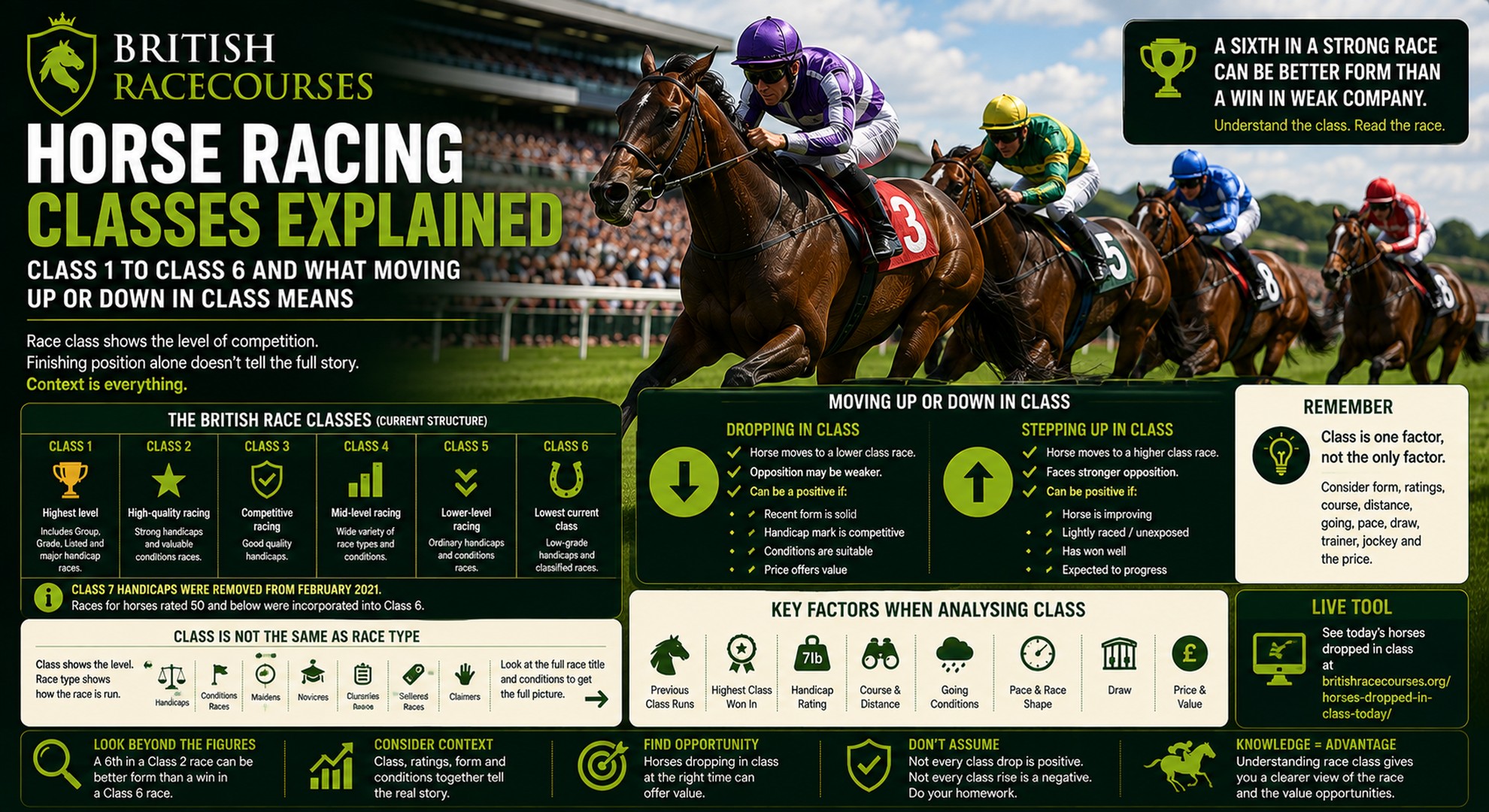
Horse racing classes provide a quick indication of the level of competition in a British horse race.
The basic principle is simple:
Class 1 contains the highest-level racing.
At the other end of the current British classification structure:
Class 6 contains much of the lowest-level racing.
Between them sit Classes 2, 3, 4 and 5.
Understanding race class matters because finishing position alone does not tell you how well a horse performed.
A horse finishing sixth in a strong Class 2 handicap may have produced better form than a horse winning a weak Class 6 contest.
Similarly, a horse dropping from Class 3 into Class 5 company could face substantially weaker opposition even though its recent form figures look poor.
Race class therefore provides context.
It helps answer one of the most important questions when analysing a horse race:
How strong is today’s race compared with the races this horse has been contesting?
What Are Horse Racing Classes?
British horse races are divided into classes to help organise races according to quality and race conditions.
The current structure broadly runs from:
| Race Class | General Level |
|---|---|
| Class 1 | Highest level |
| Class 2 | High-quality racing |
| Class 3 | Strong handicaps and competitive races |
| Class 4 | Mid-level racing |
| Class 5 | Lower-level racing |
| Class 6 | Lowest current general class |
This table is deliberately simplified.
Class does not mean every horse in a Class 3 race is automatically better than every horse running in Class 4.
Different race types, rating bands, age restrictions and conditions affect eligibility.
That is why class should be read alongside the complete race conditions.
Is Class 1 or Class 6 Better in Horse Racing?
Class 1 is the highest class of British horse racing.
Class 1 includes many of the sport’s most prestigious races and highest-quality horses.
Class 6 sits at the lower end of the current classification system.
Therefore:
Class 1 = highest
Class 6 = lowest current general class
This is the opposite of systems where a larger number represents a higher level.
A horse moving from Class 5 to Class 3 is therefore moving up in class.
A horse moving from Class 2 to Class 4 is dropping in class.
What Happened to Class 7 Horse Racing?
You may still see references online to Class 7 horse races.
Class 7 handicaps were previously part of British Flat racing.
The British Horseracing Authority removed Class 7 handicaps from the programme from February 2021.
Races specifically aimed at horses rated 50 and below were instead incorporated into the Class 6 programme, including 0-50 Classified races.
This means current British racing should not simply be described as a Class 1-to-Class 7 ladder.
Older race results and older educational material can still contain references to Class 7, which explains why the term remains visible online.
For current racing analysis, think primarily in terms of:
Class 1 to Class 6.
Horse Racing Class 1 Explained
Class 1 represents the top level of British racing.
This category includes many of Britain’s:
- Group races
- Grade races
- Listed races
- Premier Handicaps
- other high-level contests.
Class 1 itself therefore contains different levels of quality.
A Group 1 race and a Listed race can both fall within Class 1, but that does not make them equivalent.
Group 1 Flat Races
Group 1 races represent the highest level of Flat racing.
They include races such as major championship and Classic contests.
These races attract elite horses and often play an important role in determining championship honours and future breeding value.
Group 2 and Group 3 Races
Group 2 and Group 3 races sit below Group 1 within the Flat Pattern.
They remain high-quality races and frequently feature horses capable of competing at Group 1 level.
Listed Races
Listed races sit below Group races in the black-type structure but remain significantly above ordinary racing.
A horse progressing from handicap company into Listed company can therefore be facing a meaningful increase in quality.
Grade 1 Jump Races
Jump racing uses Grades rather than Groups for its highest-level contests.
Grade 1 represents the highest level.
British Racecourses has a dedicated guide to Grade 1 jump races.
These races include many of the major championship events of the National Hunt season.
Grade 2 Jump Races
Grade 2 contests sit below Grade 1 but remain high-quality races.
Our Grade 2 jump races page covers this level in more detail.
The key point is that race class and race grade are related but not interchangeable concepts.
A racecard can therefore show both:
Class 1
and:
Grade 2
because the Grade describes the race’s position within the graded structure while Class 1 places it within the wider British race classification.
What Is a Class 2 Horse Race?
Class 2 races sit immediately below Class 1 in the broad classification hierarchy.
They can include:
- valuable handicaps
- strong conditions races
- high-quality novice races
- National Hunt Flat races
- other competitive contests.
A Class 2 handicap can contain highly capable horses without being a Pattern or Graded race.
Class 2 is therefore an important bridge between ordinary handicapping and the highest levels of British racing.
A horse moving successfully from Class 4 through Class 3 and into Class 2 company may be demonstrating considerable progression.
What Is a Class 3 Horse Race?
Class 3 races contain competitive horses and often produce strong handicaps.
They sit below Class 2 and above Class 4.
A typical Class 3 handicap may contain experienced runners with established form.
These races can be particularly useful for form analysis because many of the horses are sufficiently exposed for their ability to be assessed while remaining competitive enough for handicap marks and race conditions to matter significantly.
Class 3 racing is common enough to appear regularly without representing low-grade racing.
What Is a Class 4 Horse Race?
Class 4 occupies the middle area of the British classification structure.
It is common across both Flat and Jump racing.
Class 4 races can include:
- handicaps
- novice races
- maiden races
- hurdles
- chases
- developmental races.
This illustrates an important point.
Class and race type are different things.
A Class 4 handicap and a Class 4 novice race may share the same overall class designation while operating under very different eligibility and weighting conditions.
Our horse racing types page provides the wider overview of the different types of races found in Britain.
What Is a Class 5 Horse Race?
Class 5 represents lower-level racing than Class 4.
It is common in ordinary handicap racing and parts of the developmental programme.
Many horses spend large parts of their careers competing around Classes 4, 5 and 6.
Class 5 races can still be highly competitive.
Lower class does not mean easier to predict.
In fact, lower-level handicaps can contain horses with:
- inconsistent form
- declining ability
- changing handicap marks
- limited recent success
- highly specific preferences.
That can make them difficult races to assess.
What Is a Class 6 Horse Race?
Class 6 sits at the lower end of the current British race classification.
Class 6 races frequently involve lower-rated horses.
Examples can include:
- low-grade handicaps
- classified races
- sellers
- other lower-level contests.
Our guide to selling races explains one race type commonly associated with this end of the racing programme.
Class 6 does not mean every runner lacks ability.
It means the race sits at a lower level relative to stronger British racing.
A horse dropping from Class 4 into Class 6 company may become much more competitive if its handicap mark and current ability allow it to take advantage of the weaker opposition.
Horse Racing Classes at a Glance
A useful simplified hierarchy is:
Class 1
Elite and high-level racing, including Pattern, Graded, Listed and major handicap contests.
Class 2
High-quality races immediately below much of the Class 1 programme.
Class 3
Strong competitive racing and good-quality handicaps.
Class 4
Mid-level racing covering a wide variety of race types.
Class 5
Lower-level racing.
Class 6
Lowest current general class within the British system.
The exact race conditions always matter more than a one-line description.
Race Class Is Not the Same as Race Type
This distinction is essential.
Class describes the broad level of the race.
Race type explains how the race is structured and who can compete.
Examples of race types include:
- handicaps
- conditions races
- maidens
- novices
- nurseries
- classified races
- sellers
- claimers.
A horse can therefore run in races with similar class numbers but completely different conditions.
For example:
Class 4 Novice Stakes
and:
Class 4 Handicap
are not the same type of contest.
The novice race operates according to novice eligibility and its published conditions.
The handicap uses Official Ratings to allocate weights.
Understanding both parts of the race title gives you much more information than looking at class alone.
Class vs Official Rating
Race class and a horse’s Official Rating are closely connected in many races, particularly handicaps, but they are not the same thing.
An Official Rating is the handicapper’s assessment of a horse’s ability.
Race class describes the level of the contest.
Many handicaps use rating bands.
You might see race descriptions containing figures such as:
0-100
or:
0-85
or:
0-65.
These figures tell you which ratings are generally eligible for that particular handicap, subject to the full race conditions.
Understanding Rating Bands
Suppose a race is advertised as:
Class 4 Handicap, 0-85
The 85 refers to the upper rating limit under the standard conditions of that race.
A horse rated 84 is therefore operating close to the top of the normal rating range.
A horse rated 70 is lower in the same band.
Now suppose the horse progresses and its rating rises beyond the relevant band.
Connections may need to move into stronger company or find a race with different conditions.
This is one way horses naturally progress through racing classes.
Race Classes and the Handicap System
The handicap system attempts to create competitive races by asking higher-rated horses to carry more weight.
A horse’s rating can rise after strong performances and fall after weaker ones.
As that mark changes, the range of suitable races changes too.
This creates one of the most important patterns in handicap racing:
a horse moving up and down the class structure as its handicap mark changes.
Our Ahead of the Handicapper guide explores situations where a horse’s current mark may not fully reflect its ability.
What Does Dropping in Class Mean?
A horse is dropping in class when it moves from a higher level of race into a lower one.
For example:
Last race: Class 3
Today’s race: Class 5
The horse is dropping two classes.
That can be significant because today’s opposition may be weaker than the horses it has recently faced.
British Racecourses tracks horses dropped in class today for exactly this reason.
But a class drop should never be treated as an automatic positive.
You need to understand why the horse is dropping.
Why Do Horses Drop in Class?
There are several possible reasons.
The Horse Has Been Struggling
A horse may have failed to compete effectively at a higher level.
Connections lower its sights to find a more suitable race.
Its Handicap Mark Has Fallen
Repeated defeats can cause a handicap rating to decline.
That can open lower-level opportunities.
Connections Want a Winning Opportunity
A trainer may deliberately choose weaker opposition to give the horse a more realistic chance.
The Race Conditions Suit
The class drop may be only one attraction.
Today’s:
- distance
- course
- going
- field size
- race type
may also suit the horse.
The Horse Is Declining
This is the danger.
An older horse dropping from Class 2 into Class 4 may look attractively placed based on historic form.
But it may be racing at the lower level because its ability has deteriorated.
The class drop is only valuable if enough of the old ability remains.
When Is a Class Drop Significant?
A class drop becomes more interesting when supported by other evidence.
For example:
Horse A
Recent races:
Class 2 → Class 2 → Class 3 → Class 4 today
Recent finishes:
6th → 5th → 4th
Those results might look ordinary.
But the horse has been competing against stronger opposition.
If it:
- remains in good form
- is favourably handicapped
- gets suitable conditions
- has proven course or distance form
the drop into Class 4 could be important.
What Does Moving Up in Class Mean?
A horse is moving up in class when today’s race is stronger than its previous contest.
For example:
Previous race: Class 5
Today: Class 3
The horse is stepping up two classes.
This often happens after a horse:
- wins impressively
- improves rapidly
- rises in the handicap
- moves from developmental racing into stronger company.
An improving horse can overcome a class rise.
The question is whether its previous performance indicates enough ability to compete at the new level.
A Winner Moving Up in Class Can Still Be Vulnerable
Punters naturally notice horses with a recent 1 beside their name.
But consider this:
Horse A
Won a Class 6 handicap comfortably.
Today:
Class 3.
Horse B
Finished fifth in a Class 2 handicap.
Today:
Class 3.
The form figures say:
Horse A: 1
Horse B: 5
Looking only at finishing position makes Horse A appear superior.
Looking at class reveals a different picture.
Horse B has already been competing against stronger opposition.
That does not mean Horse B must win.
It means the raw form figures need context.
Why Finishing Position Can Be Misleading
A finishing position tells you where the horse finished.
It does not tell you:
- how strong the opposition was
- whether the horse had a troubled passage
- whether the pace suited
- whether the distance suited
- whether the ground suited
- whether the horse was well treated by the weights.
This is why British Racecourses also examines horses that ran better than the result.
Class is another part of that interpretation.
A fourth-place finish in a strong race can sometimes represent much better form than a victory against weak opposition.
Worked Example: Class 5 Winner vs Class 2 Sixth
Consider two horses entering a Class 3 handicap.
Horse Alpha
Previous run:
1st, Class 5 handicap
Won by two lengths.
Horse Bravo
Previous run:
6th, Class 2 handicap
Beaten four lengths.
At first glance:
1st looks much better than 6th.
But now examine the races.
Horse Alpha defeated horses rated around the lower level of the handicap structure.
Horse Bravo competed against significantly stronger opposition and was beaten only four lengths.
Today’s Class 3 race sits between their previous levels.
Horse Alpha must prove that its improvement can translate upwards.
Horse Bravo faces easier opposition than last time.
This is why class movement deserves to be assessed alongside the form figure.
Class Drop vs Handicap Drop
These concepts are related but different.
A horse can:
drop in class
without necessarily having a dramatic reduction in its handicap rating.
Likewise, its rating can fall while it continues running in broadly similar classes.
When assessing a class drop, check both:
today’s race class
and:
today’s Official Rating.
The strongest situations can occur when a horse has both:
- dropped into weaker company
- reached an attractive handicap mark.
Previous Winning Class
One of the most useful questions in handicap analysis is:
What is the highest class this horse has previously won in?
Imagine a horse runs today in Class 4.
It has previously won:
Class 3 off OR 84.
Today:
Class 4 off OR 77.
That tells you the horse has historically demonstrated enough ability to win stronger races from a higher rating.
If recent evidence suggests it retains enough ability, the profile becomes interesting.
Highest Class Competed In
Winning class is useful, but so is the level at which a horse has been competitive.
A horse may never have won a Class 2 handicap but could have repeatedly:
- finished second
- finished third
- run close behind strong horses.
Dropping into Class 4 could therefore represent a substantial reduction in opposition quality.
Do not restrict analysis to previous wins.
Look at the level of the horse’s best performances.
Class and Course Form
Class should also be combined with course form.
Suppose a horse:
- has won three times at today’s racecourse
- previously won there in Class 3
- runs today in Class 5.
That is more informative than simply knowing the horse has a C beside its name.
Our course and distance winners page explains how previous course, distance and C&D performances should be assessed.
Class and Distance
A class drop cannot compensate for an unsuitable distance indefinitely.
A horse may be the best horse in the field based on historic ability but still struggle if today’s trip is wrong.
Ask:
- has it won over the distance?
- has it produced strong form over the trip?
- is it moving significantly up or down in distance?
- will today’s pace change the stamina requirement?
Class is one part of the race, not the whole race.
Class and Going
Ground conditions can change the value of a class advantage.
Imagine a horse dropping from Class 2 into Class 4.
On ability, it looks well treated.
But all its strongest performances came on good ground and today’s going is heavy.
The weaker opposition may not matter if the horse cannot reproduce its ability on the surface.
Always combine class analysis with the horse racing going.
Class and Pace
Race shape matters at every level.
A horse dropping substantially in class may still be vulnerable if today’s pace setup is unsuitable.
A front-runner may struggle if several rivals compete for the lead.
A hold-up horse may struggle in a slowly run race.
Use the horse racing pace maps alongside class analysis rather than treating class as a standalone system.
Class and Draw
On the Flat, draw can also influence whether a class advantage translates into today’s race.
A strong horse can lose position or cover extra ground from an unfavourable stall.
This becomes particularly important at tracks and distances with established draw patterns.
Our horse racing draw guide explains how to assess stall position properly.
Class and Weight
A horse dropping in class may carry more weight against weaker rivals.
That does not necessarily remove the advantage.
In handicaps, the relationship between ability, rating and weight is central.
A higher-rated horse is expected to concede weight to lower-rated rivals.
The important question is whether today’s mark accurately reflects the horse’s current ability.
Do not simply assume:
more weight = worse chance.
Class and Weight-for-Age
Age can also affect the weights carried in certain races.
Younger horses may receive allowances from older horses at particular stages of the season.
Our weight-for-age in horse racing guide explains why these allowances exist.
Again, class tells you the broad level.
The full conditions tell you how the race actually works.
Class and Conditions Races
Not every race uses handicap weights.
In a conditions race, weights are determined by the published conditions rather than simply using handicap ratings to equalise runners.
Factors can include:
- age
- sex
- previous victories
- level of previous victories
- race-specific eligibility.
This is why you should never use class without first identifying the race type.
Class and Classified Stakes
A Classified Stakes operates differently from a standard handicap.
These races can bring together horses within defined rating or eligibility conditions.
The fact that a race carries a particular class number does not remove the need to understand those conditions.
Class and Maiden Races
A maiden race is fundamentally about eligibility rather than simply race quality.
A horse can therefore contest a maiden at a particular class level while still being inexperienced or unexposed.
This makes direct comparison with an exposed handicap horse difficult.
Race class gives context, but race type explains what kind of form you are dealing with.
Class and Novice Races
The same principle applies to novice races.
Novice company can contain horses at very different stages of development.
Some are inexperienced.
Others have already won while remaining eligible under the relevant novice conditions.
A class number cannot tell you how much improvement each runner has left.
Class and Nursery Handicaps
A nursery handicap is a Flat handicap for two-year-olds.
The BHA’s 2026 nursery programme includes a consolidated structure ranging through Classes 6, 5, 4 and 3 to open Class 2 nurseries.
That provides a particularly clear example of how rating bands and class interact.
Young horses can also improve rapidly, meaning their previous class level may underestimate their current ability.
Class and Claiming Races
Claiming races introduce another variable because horses can be available to claim under the race conditions.
The weighting structure and claiming values therefore matter alongside the class designation.
This again demonstrates why:
class tells you the level
while:
race type tells you the structure.
How to Read Class on a Racecard
A race title might look something like:
Class 4 Handicap Chase, 0-120, 2m4f
Do not read “Class 4” in isolation.
Break the race into components.
Class 4
The broad level of competition.
Handicap
Weights are linked to handicap ratings.
0-120
The relevant rating band under the race conditions.
Chase
The race is run over fences.
2m4f
The distance.
Then add:
- going
- course
- field size
- pace
- individual form.
This gives you a much more complete picture.
Our guide to reading horse racing racecards explains the other information displayed before a race.
How to Compare Today’s Class With Previous Runs
A simple process works well.
Step 1: Identify Today’s Class
Start with the race title.
For example:
Class 4.
Step 2: Check the Horse’s Recent Races
Suppose its last five runs were:
Class 2
Class 3
Class 3
Class 4
Class 4 today
You immediately know the horse has experience against stronger opposition.
Step 3: Examine Performance, Not Just Position
Did it finish close up in the stronger races?
Or was it completely outclassed?
Step 4: Compare Ratings
What was its handicap mark in those races?
What is today’s mark?
Step 5: Check Previous Winning Class
Has it previously won at today’s level or higher?
Step 6: Consider Current Ability
Historic class form becomes less useful if the horse has declined.
Step 7: Add Today’s Conditions
Check:
- course
- distance
- going
- draw
- pace
- jockey
- trainer form.
Step 8: Consider the Price
Even a strongly fancied class dropper can represent poor value at sufficiently short odds.
Class Pars and Performance Levels
Experienced form analysts often think beyond the class number itself.
Not every Class 4 race is equally strong.
One Class 4 handicap may contain several improving horses capable of competing in Class 3.
Another may contain exposed runners whose ratings are falling.
The nominal class is the same.
The actual strength can differ.
This is why analysing the individual runners remains essential.
A Strong Class 5 Can Be Better Than a Weak Class 4
Class boundaries should not be treated as walls.
Imagine a Class 5 handicap containing:
- three recent winners
- two lightly raced improvers
- several horses dropping from Class 4.
It could prove stronger than an ordinary Class 4 event containing exposed horses in poor form.
This is especially important when comparing historical races.
Use class as a framework, then assess the actual field.
How to Judge the Strength of a Previous Race
Look beyond the label.
Useful evidence includes:
- ratings of the runners
- subsequent winners
- finishing margins
- sectional performance
- pace
- class of surrounding races
- future performances of horses from the race.
If several horses subsequently win, the original contest may have been stronger than it appeared at the time.
This can reveal form that the market has underestimated.
Class and Sectional Times
Horse racing sectional times can add context to class analysis.
A horse may finish fifth in stronger company after:
- racing too quickly early
- making a sustained move
- producing a strong closing sectional
- being compromised by race shape.
Dropping in class next time can make that performance particularly interesting.
The finishing position alone may hide the strength of the run.
Class and Market Price
Class changes are obvious information.
Bookmakers and bettors can see them.
A horse dropping from Class 2 to Class 4 will often attract attention.
The market may shorten its price accordingly.
Therefore, identifying a class drop is not enough.
You need to ask:
Has the market overreacted, underreacted or priced the change correctly?
This connects class analysis directly to finding value bets in horse racing.
Should You Back Horses Dropping in Class?
Not automatically.
A class drop is a reason to investigate a horse, not a complete betting strategy.
A strong class-drop candidate might have:
- competitive recent performances in stronger races
- a falling handicap mark
- previous winning form from a higher rating
- suitable course form
- suitable distance
- suitable going
- favourable pace
- a reasonable price.
A weak class-drop candidate might be:
- badly out of form
- declining with age
- unsuited by today’s conditions
- still badly handicapped
- dropping because it can no longer compete at its old level
- too short in the market.
Context decides whether the drop matters.
Should You Oppose Horses Moving Up in Class?
Again, not automatically.
Improving horses frequently rise through the classes.
A lightly raced horse might progress:
Class 6 → Class 5 → Class 4 → Class 3
while continuing to win.
Its previous class does not place a permanent ceiling on its ability.
The important question is:
How much improvement is still available?
Young and lightly raced horses can improve much faster than exposed older horses.
Exposed vs Unexposed Horses
Class analysis changes according to the horse’s profile.
Exposed Horse
An experienced horse with 40 career runs has provided substantial evidence about its ability.
Its historical class record can be highly useful.
Unexposed Horse
A lightly raced three-year-old with four starts may be improving rapidly.
Its previous Class 5 victory may tell you little about its eventual ceiling.
This is particularly important in:
- maidens
- novices
- nurseries
- lightly raced handicappers.
Do not assume previous class defines future potential.
Trainer Placement and Race Class
Race selection is part of training.
A trainer decides where to place a horse based on:
- rating
- fitness
- distance
- ground
- available races
- opposition
- future targets.
A deliberate class drop can therefore be informative.
So can an ambitious class rise.
If a respected trainer moves a horse rapidly into stronger company after one victory, that can indicate confidence in its ability.
But trainer placement should support your analysis rather than replace it.
Jockey Claims and Class
Some races feature apprentices or conditional jockeys who claim weight.
A claim can alter the effective weight a horse carries.
Our guide to jockey claims in horse racing explains how these allowances work.
This can become relevant when comparing horses within handicaps, particularly when a capable claiming rider reduces the burden carried by a higher-rated horse.
Horse Racing Class Analysis Checklist
Before deciding that a horse is well placed because of race class, ask:
Today’s race
- What class is it?
- What type of race is it?
- What rating band applies?
Previous races
- What classes has the horse recently contested?
- How did it perform?
- How close did it finish?
Historical ability
- What is the highest class it has won?
- What is the highest class in which it has run well?
Handicap rating
- What was its rating during its best performances?
- What is today’s mark?
Class movement
- Is it dropping?
- Is it rising?
- By how many levels?
Current form
- Is the horse still performing near its historical ability?
Conditions
- Does today’s course suit?
- Is the distance suitable?
- Does it handle the going?
- Is the draw favourable?
- Does the expected pace suit?
Price
- Has the market already accounted for the class change?
This turns the class number into useful analytical information.
Common Mistakes When Using Horse Racing Classes
Assuming a Class Drop Means a Horse Will Win
The horse may be dropping because its ability has declined.
Looking Only at Finishing Position
A sixth in strong company can represent better form than a win in weak company.
Treating Every Race in the Same Class as Equal
The actual quality of fields varies.
Ignoring Official Ratings
Class and handicap marks need to be considered together.
Ignoring Race Type
A Class 4 maiden and Class 4 handicap are different analytical challenges.
Assuming Improving Horses Cannot Handle a Class Rise
Lightly raced horses can progress rapidly.
Using Historical Class Without Checking Recency
A ten-year-old horse that once competed in Class 1 company is not necessarily a Class 1 horse today.
Ignoring Price
An obvious class drop can become overbet.
Horse Racing Classes and Betting
Understanding class can improve the way you interpret racing form.
It cannot tell you which horse will win.
Class works best as one component within a broader process incorporating:
- ability
- form
- ratings
- course
- distance
- going
- pace
- draw
- trainer
- jockey
- price.
If you decide a horse represents value after completing that analysis, compare available prices rather than assuming all bookmakers offer the same odds.
British Racecourses compares options on our horse racing betting sites page.
Readers specifically interested in our principal bookmaker coverage can also see the bet365 Horse Racing page.
Always treat betting as a financial risk rather than a source of guaranteed income.
Frequently Asked Questions
What are the horse racing classes in the UK?
Current British racing broadly uses Classes 1 through 6. Class 1 represents the highest level, while Class 6 sits at the lower end of the current classification system.
Is Class 1 the best class in horse racing?
Yes. Class 1 contains the highest-level British races, including major Group, Grade and Listed contests as well as certain leading handicaps.
Is Class 6 good in horse racing?
Class 6 represents lower-level British racing. That does not mean the races are easy to predict or that the horses lack all ability. It describes their position within the wider racing programme.
Is there Class 7 horse racing?
Class 7 handicaps were removed from the British programme from February 2021. Races aimed specifically at horses rated 50 and below were incorporated into Class 6, including 0-50 Classified races. You may still encounter Class 7 in older results and outdated explanations.
What does Class 2 mean in horse racing?
Class 2 represents high-quality racing immediately below much of the Class 1 programme. It includes strong handicaps and other valuable races.
What is a Class 3 horse race?
Class 3 is a strong level of British racing below Class 2 and above Class 4. It commonly includes competitive handicaps.
What is a Class 4 horse race?
Class 4 sits around the middle of the current British class structure and can contain handicaps, maidens, novices, hurdles, chases and other race types.
What is a Class 5 horse race?
Class 5 is lower than Class 4 and higher than Class 6. It is common in ordinary handicap racing.
What is a Class 6 horse race?
Class 6 sits at the lower end of current British racing and includes many lower-rated handicaps and classified races.
What is the difference between class and grade in horse racing?
Class describes a race’s broad position within the British classification structure. Grade is used within the higher-level National Hunt structure, such as Grade 1 and Grade 2 races. A graded race can therefore also be described as Class 1.
What is the difference between class and Group in horse racing?
Group describes levels within the Flat Pattern, including Group 1, Group 2 and Group 3. These races sit within Class 1 but have their own hierarchy.
What does dropping in class mean in horse racing?
Dropping in class means a horse is moving from a higher-level race into a lower-level race. For example, moving from Class 2 to Class 4 represents a class drop.
Is dropping in class good for a horse?
It can be positive because the horse may face weaker opposition. However, horses sometimes drop in class because their form or ability has declined, so the reason for the move matters.
What does stepping up in class mean?
Stepping up in class means entering a stronger race than previously. A horse moving from Class 5 into Class 3 is stepping up two classes.
Should I back a horse dropping in class?
Not solely because it is dropping in class. Check current form, handicap mark, previous winning class, course, distance, going, pace and price before making a decision.
Can a Class 5 winner beat a Class 3 horse?
Yes. Race class describes previous or current competition rather than setting a permanent ability level. Improving horses can progress rapidly through the classes.
Does race class affect handicap weight?
Race class and handicap ratings are connected through race eligibility and rating bands, but handicap weight is determined according to the race conditions and the horses’ ratings rather than simply the class number.
Is a higher number a better class in horse racing?
No. Lower class numbers represent higher-level racing. Class 1 is higher than Class 2, Class 2 is higher than Class 3, and so on.
How can I see if a horse is dropping in class today?
Compare the class of today’s race with the classes of the horse’s recent races. British Racecourses also maintains a dedicated Horses Dropped in Class Today resource highlighting relevant runners.
Summary
Horse racing classes help establish the level of competition a horse faces.
The current British structure broadly runs:
Class 1 → Class 2 → Class 3 → Class 4 → Class 5 → Class 6
with Class 1 representing the highest level.
Class 7 handicaps are historical rather than part of the current British programme.
Understanding class becomes particularly useful when comparing a horse’s previous races with today’s contest.
A horse dropping from Class 2 to Class 4 may face weaker opposition.
A Class 5 winner moving into Class 3 must prove that its form translates to stronger company.
But class should never be analysed alone.
The best approach combines:
race class + race type + Official Rating + previous form + course + distance + going + pace + draw + price.
Most importantly, do not judge form solely by finishing positions.
A horse that finishes sixth against much stronger opposition can have produced a better performance than a horse winning a weak race.
Understanding race class helps reveal that difference and gives the numbers in the form book much more meaning.