First-time cheekpieces are worn by a racehorse when it races in cheekpieces for the first time. Cheekpieces are strips of sheepskin or similar material attached to the bridle, running down the sides of the horse’s face. Trainers may use them when they believe a horse needs help concentrating during a race.
On a racecard, p1 means the horse is wearing cheekpieces for the first time in a race. The letter p identifies cheekpieces, while the number 1 indicates first-time use.
Cheekpieces may help an individual horse focus, but they do not guarantee an improved performance. The useful question is why the trainer has introduced them and whether the horse’s previous races suggest that the change could make a difference.
Today’s Horses Wearing Cheekpieces
Racecards identify horses declared to wear cheekpieces, including those wearing them for the first time.
Check today’s racecards for the latest runner and equipment declarations. Look for p1 if you want to identify horses making their first race start in cheekpieces.
A first-time equipment change is worth investigating, but it should not determine a selection on its own. The horse’s recent form, distance, going, opposition and available odds remain central to its chance.
What Are Cheekpieces in Horse Racing?
Cheekpieces are strips of material, usually sheepskin, attached to either side of a horse’s bridle. They sit alongside the horse’s face and may influence how it responds to activity around it.
They are sometimes called French blinkers, although their design differs from conventional blinkers. Cheekpieces do not have the solid eye cups used in blinkers or visors.
Trainers may fit cheekpieces when a horse has shown signs of losing concentration, looking around or failing to maintain its effort. Their effect varies between horses.
Our horse racing headgear guide explains how cheekpieces compare with other equipment declared on racecards.
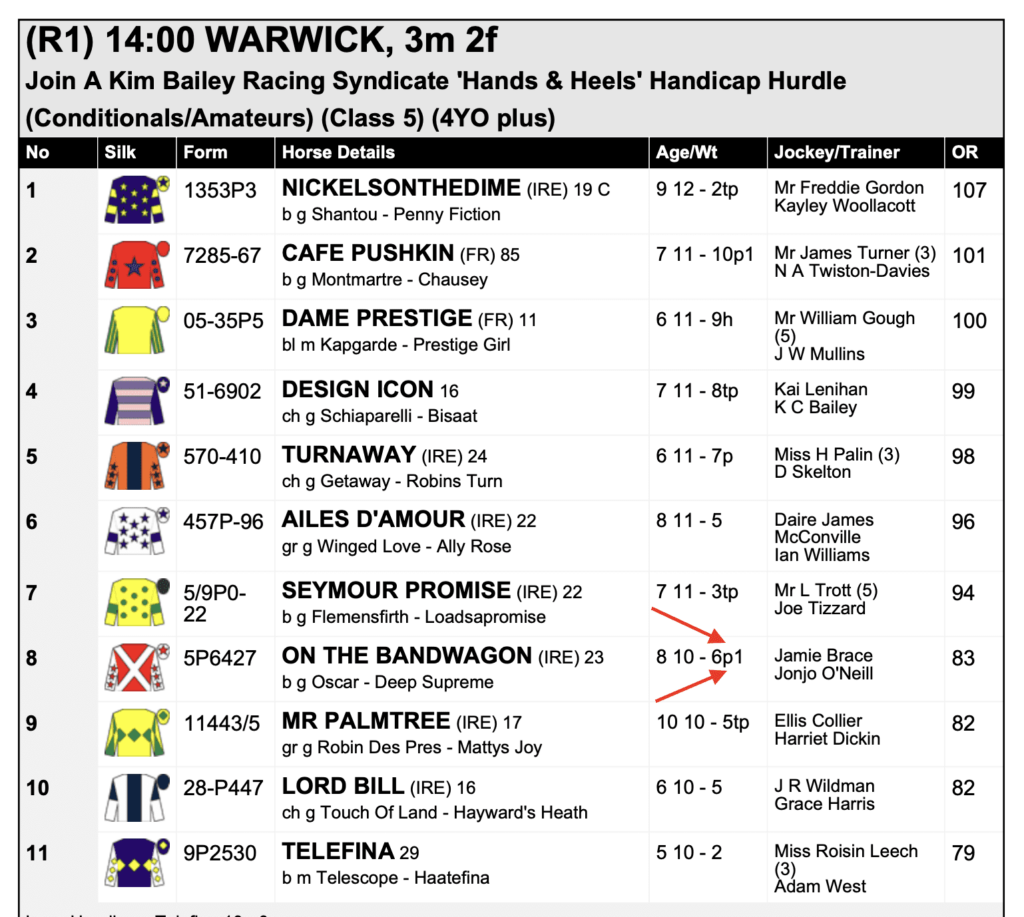
What Does p1 Mean on a Racecard?
The symbol p1 means a horse is wearing cheekpieces for the first time in a race.
A horse that has worn cheekpieces in a previous race is generally identified by p. Racecard providers may position the notation beside the horse’s weight or within its runner details.
| Symbol | Meaning |
|---|---|
| p | Cheekpieces |
| p1 | Cheekpieces for the first time |
| b | Blinkers |
| b1 | Blinkers for the first time |
| v | Visor |
| v1 | Visor for the first time |
| h | Hood |
| h1 | Hood for the first time |
| t | Tongue strap |
| t1 | Tongue strap for the first time |
The number 1 refers to first-time use in a race. It does not establish whether the horse has worn cheekpieces during training.
If you are unfamiliar with the other information beside a runner’s name, our racecard reading guide explains the main symbols, ratings and form figures.
Why Do Trainers Use Cheekpieces?
A trainer may introduce cheekpieces after reviewing how a horse has behaved in its previous races.
A horse might look towards rivals, become distracted when racing alongside other runners or wander when asked to quicken. Cheekpieces are one possible way of addressing those behaviours.
The equipment does not resolve every reason for a disappointing run. A horse may have weakened because it failed to stay the distance, raced too keenly or faced stronger opposition.
A trainer’s decision to use cheekpieces does not prove that the horse’s earlier defeats were caused by a lack of concentration.
The best starting point is the horse’s previous form. Look for repeated behaviour that could explain the change rather than relying on a single poor result.
Do First-Time Cheekpieces Improve Performance?
Some horses perform better after cheekpieces are fitted. Others show little change, while some run below their previous level.
An improved finishing position does not prove that the cheekpieces caused it. The horse may also have encountered a more suitable distance, better ground, weaker opposition or a favourable race pace.
The same caution applies to a disappointing first run. One defeat is not enough to establish that the equipment was unsuitable.
Compare performances under similar conditions and watch how the horse travels during the race. The complete beginner’s guide to horse racing explains how racecards and equipment fit into a wider assessment of a runner.
How to Assess a Horse Wearing Cheekpieces for the First Time
First-time cheekpieces are most useful as a reason to examine a horse more closely. The p1 symbol provides information about the trainer’s equipment choice, not a reliable prediction of the result.
Review Its Previous Race Comments
Look for references to a horse wandering, hanging, looking around or losing concentration.
Race comments can identify a possible pattern, but they are brief descriptions of what happened. A race replay may provide more context, particularly if the horse appeared to lose its position after meeting traffic or racing alongside a rival.
A horse that repeatedly wanders under pressure presents a different case from one that simply finishes behind better horses.
If the horse has shown the same behaviour in several races, the decision to introduce cheekpieces may be easier to understand.
Check Its Early Pace
A horse’s running style can affect how much use it makes of its ability.
A runner that struggles to hold its position may encounter traffic. Another that races too keenly can use too much energy before the closing stages.
Cheekpieces may influence how an individual horse behaves, but they do not guarantee a change in tactics or running style.
Study the likely pace of the race and the positions the other runners normally adopt. A horse that prefers to lead faces a different test when several rivals are likely to compete for the same position.
Assess the Distance
A horse stepping up in trip must still demonstrate that it has the stamina for the new distance.
If it has weakened late in previous races, cheekpieces may not address the underlying problem. The horse may have been racing over a trip beyond its stamina.
A runner dropping in distance could face a faster early pace. Its ability to hold a position and respond when asked to quicken may become more important.
Compare previous performances over similar trips before deciding whether the equipment change is significant.
Consider the Going and Course
There is no general rule that first-time cheekpieces are more effective on a particular type of ground or racecourse.
A horse with proven form on soft ground may have a different chance when returning to that surface. A runner that has struggled around sharp bends may still face that challenge in cheekpieces.
Consider the demands of the course separately from the equipment. Our British racecourses directory provides information about individual tracks and their characteristics.
Check the Handicap Mark
A horse may wear cheekpieces for the first time after several disappointing runs have led to a lower handicap rating.
If it retains its previous ability, the reduced mark may be relevant. That is a separate factor from whether the cheekpieces help.
Compare the current rating with the marks from which the horse previously won or performed well. A favourable handicap mark can explain an improved result without establishing that the equipment caused it.
Examine the Trainer’s Record
A trainer’s results with first-time cheekpieces may provide context if the sample is large enough and the races are comparable.
A high strike rate from a handful of runners is not a reliable betting system. Check the number of runners, the period covered and the prices of the winners.
The trainer’s wider form is also relevant, but a yard’s recent winners do not tell you how one horse will respond to cheekpieces.
Cheekpieces Versus Blinkers
Cheekpieces and blinkers are different types of headgear.
Blinkers have eye cups that restrict a horse’s side and rear vision. Cheekpieces are strips attached to the bridle and do not have those cups.
A trainer may switch between the two after reviewing a horse’s response, but neither should be treated as an automatic improvement over the other.
A horse that has previously raced in blinkers may still be wearing cheekpieces for the first time. The p1 symbol identifies its first race in cheekpieces, not its first experience of headgear.
Our first-time blinkers guide explains what b1 means and how to assess that change.
Cheekpieces Versus Visors
A visor resembles blinkers but has openings in its eye cups that permit some additional side or rear vision.
Cheekpieces do not have eye cups. Their design and effect should therefore be considered separately from those of a visor.
If a horse switches from a visor to cheekpieces, examine how it performed in the previous equipment. Did it settle, hold its position and respond when asked for an effort?
Our first-time visors guide covers the v1 symbol and the reasons trainers may introduce a visor.
Can a Horse Wear Cheekpieces and a Tongue Strap Together?
Cheekpieces and tongue straps are different items of equipment.
Cheekpieces are attached to the bridle alongside the horse’s face. A tongue strap is used to hold the tongue in a controlled position and may be considered for an individual horse for different reasons.
A horse may be declared to wear more than one permitted item of equipment. Check the racecard to identify each declaration.
If a horse wears cheekpieces and a tongue strap for the first time in the same race, it becomes harder to attribute any change in performance to one item. Our tongue straps article explains what t1 means and why trainers may use that equipment.
Do Horses Improve on Their Second Run in Cheekpieces?
There is no general rule that horses perform better on their second run in cheekpieces.
Some respond immediately, some show a different performance later, and others show no meaningful improvement.
The first run provides evidence about how the horse behaved in the equipment. The next start provides an opportunity to see whether that performance can be repeated.
Compare the race conditions before drawing conclusions. A horse that ran well in cheekpieces over six furlongs on good ground may face a different test over seven furlongs on soft ground.
A second run should be assessed on its own merits rather than treated as an automatic positive.
First-Time Cheekpieces in Flat Racing
First-time cheekpieces can be particularly noticeable on the racecards of young or lightly raced Flat horses.
A two-year-old may still be learning how to settle, race alongside rivals and respond under pressure. Its behaviour can change as it gains experience, regardless of whether the trainer introduces equipment.
In a nursery handicap, a young horse may wear cheekpieces for the first time while also making its handicap debut or racing from a revised rating. Those changes need to be assessed separately.
The same applies to maiden races, where inexperienced horses can improve naturally between starts.
A first-time cheekpieces declaration may be relevant, but it should not replace an assessment of the horse’s ability and development.
First-Time Cheekpieces in Jump Racing
A jumps horse wearing cheekpieces must still meet the demands of the distance, ground and obstacles.
A horse that has lost concentration between fences may respond differently to equipment, but cheekpieces cannot compensate for inadequate jumping ability or stamina.
The demands are especially clear in staying races such as the Cheltenham Gold Cup and the Grand National. A headgear change is one detail within a much wider assessment of a runner.
Review the horse’s jumping, previous performances over the trip and suitability for the likely conditions before deciding how much significance to attach to p1.
Are First-Time Cheekpieces a Profitable Betting System?
Backing every horse wearing cheekpieces for the first time is not a reliable betting method on its own.
Trainers use cheekpieces for different reasons, and the runners involved vary in ability, form and suitability for their races.
A meaningful historical analysis needs a defined period, a sufficient sample and a consistent method of recording prices and returns. It should also distinguish first-time cheekpieces from horses that have worn them previously.
Even a method that finds winners can lose money if the winning prices are too short. Compare the available odds with your assessment of each horse’s chance.
The bet calculator can help check potential returns, but it cannot establish whether a selection represents value.
What to Look for After a Horse Runs in Cheekpieces
The first race provides evidence about how the horse behaved while wearing the equipment.
Watch whether it settled, held its position, travelled comfortably and responded when its jockey asked for an effort. If the horse previously wandered or looked around, check whether the same behaviour occurred.
A better finishing position is encouraging only when considered alongside the quality of the opposition and the race conditions.
If the horse wears cheekpieces again, its next start may provide more evidence. If the trainer removes them, do not assume that the equipment failed. The decision may reflect information that is not publicly available.
First-Time Cheekpieces FAQs
What does p1 mean in horse racing?
p1 means a horse is wearing cheekpieces for the first time in a race. The letter p identifies cheekpieces, and the number 1 indicates first-time use.
What does p mean on a racecard?
The letter p indicates that a horse is declared to wear cheekpieces. Without the number 1, it does not identify the run as the horse’s first race in the equipment.
What are cheekpieces made from?
Cheekpieces are commonly made from sheepskin or similar material and are attached to the sides of the horse’s bridle.
Why do trainers put cheekpieces on horses?
A trainer may introduce cheekpieces when they believe a horse is becoming distracted or losing concentration during races. The reason depends on the individual horse.
Do first-time cheekpieces make a horse run faster?
Cheekpieces do not increase a horse’s natural speed. They may help some horses use their ability more effectively, but an improved performance is not guaranteed.
Are cheekpieces the same as blinkers?
No. Blinkers have eye cups that restrict side and rear vision. Cheekpieces are strips attached to the bridle and do not have those cups.
Can a horse wear cheekpieces after racing in blinkers?
Yes. A horse may switch from blinkers to cheekpieces. If it has never raced in cheekpieces before, its racecard may show p1.
Are cheekpieces better on a horse’s second run?
There is no general rule that the second run produces a better performance. Assess how the horse responded on its first start and whether the next race conditions suit it.
Should I back a horse wearing p1?
The p1 symbol alone is not a reason to back a horse. Assess its previous form, distance, going, likely pace, opposition and odds before deciding whether the equipment change is relevant.
Summary
First-time cheekpieces are identified by p1 on a racecard. They are strips of material attached to the bridle that trainers may use when they believe a horse needs help concentrating.
Some horses respond positively, while others show little change or perform less well. The equipment does not guarantee improvement.
The strongest assessment starts with the horse’s previous races. Check its behaviour, form, distance, going, handicap mark and likely pace before deciding whether cheekpieces could be significant. After the race, review how the horse actually performed rather than assuming the equipment caused the result.