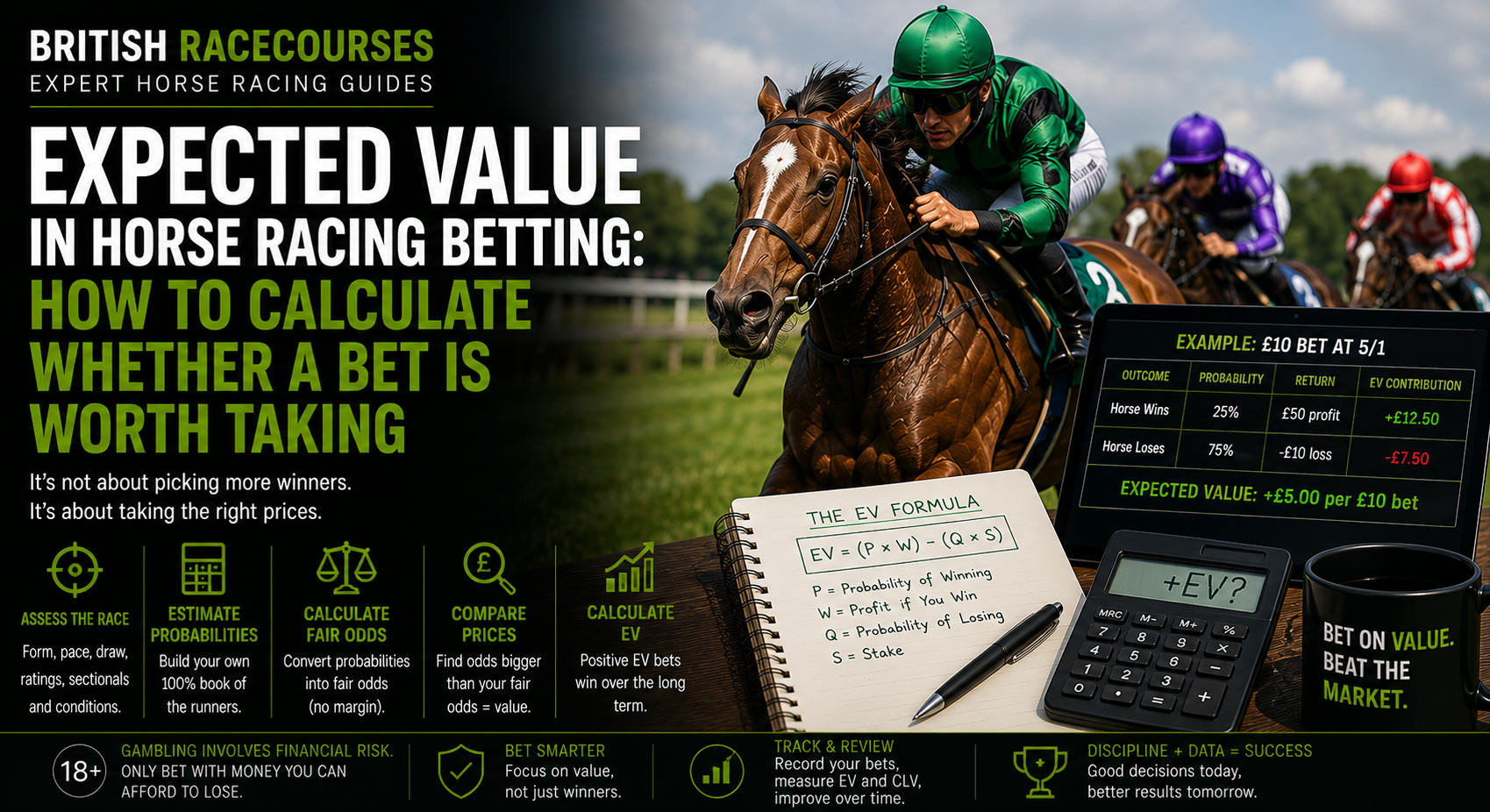
Expected value is one of the most important concepts to understand if you want to approach horse racing betting seriously.
It changes the question from:
Will this horse win?
to:
Are the odds good enough for the horse’s chance of winning?
Those are very different questions.
A horse can be the most likely winner in a race and still represent a poor bet.
An outsider can be unlikely to win and still represent an excellent bet.
Expected value, usually shortened to EV, gives you a mathematical framework for separating those two ideas.
The basic principle is straightforward:
If the potential reward is greater than the risk implied by your estimate of the horse’s probability, the bet has positive expected value.
If the opposite is true, the bet has negative expected value.
This does not mean every positive-EV bet wins.
A horse with a genuine 20% chance of winning should still lose around four times out of five.
The objective is to find situations where the bookmaker is offering a price that compensates you sufficiently for those losses.
If you have not already done so, read our How to Find Value Bets in Horse Racing guide alongside this page. Value and expected value are closely connected.
What Is Expected Value in Horse Racing Betting?
Expected value estimates the average amount you would expect to win or lose if you could place the same type of bet repeatedly under identical conditions.
It combines:
Probability of winning
with:
Potential profit
and:
Probability of losing
with:
Potential loss.
The result can be positive or negative.
A positive number indicates positive expected value.
A negative number indicates negative expected value.
What Does +EV Mean in Betting?
+EV means positive expected value.
It describes a bet where your estimated probability of success is greater than the probability represented by the available price.
For example, suppose a horse is available at:
5/1
That represents decimal odds of:
6.00
The raw implied probability is:
16.67%
But your analysis suggests the horse actually has:
25%
chance of winning.
Your assessment corresponds to fair odds of:
3/1
Yet the bookmaker is offering:
5/1
If your probability estimate is accurate, that is a positive-EV opportunity.
What Does -EV Mean?
-EV means negative expected value.
Suppose a horse is:
2/1
Decimal odds:
3.00
Raw implied probability:
33.33%
You believe the horse actually has only:
25%
chance of winning.
Your fair odds would therefore be:
3/1
The bookmaker is offering only 2/1.
The horse might still win.
But according to your probability assessment, you are not receiving sufficient odds for the risk.
That is negative EV.
The Expected Value Formula
A simple betting EV formula is:
EV = (Probability of Winning × Profit if You Win) – (Probability of Losing × Stake)
Imagine:
Stake: £10
Odds: 5/1
Your estimated winning probability: 25%
If the horse wins:
Profit = £50
If it loses:
Loss = £10
The horse has:
25% chance of winning
and:
75% chance of losing
Therefore:
EV = (0.25 × £50) – (0.75 × £10)
Which gives:
£12.50 – £7.50 = +£5
Your expected value is therefore:
+£5 per £10 bet
That does not mean you will make £5 from the actual race.
You will either win £50 profit or lose £10.
The £5 represents the theoretical average result if you could repeatedly make equivalent bets with the same probabilities and odds.
A Simpler EV Formula Using Decimal Odds
You can also calculate expected return using:
Expected Return = Probability × Decimal Odds
Then:
EV Percentage = (Expected Return – 1) × 100
Suppose:
Your probability: 25%
Available odds: 6.00
Calculate:
0.25 × 6.00 = 1.50
Then:
1.50 – 1 = 0.50
Therefore:
EV = +50%
In theoretical terms, you have a 50% expected return on the amount staked if your probability estimate is accurate.
That final condition is extremely important.
Expected Value Depends on Your Probability Being Right
EV calculations can look impressively precise.
But they are only as good as the probability you put into them.
Suppose you believe a horse has:
25% chance
when its genuine chance is actually:
15%
Your calculation might tell you that you have found a fantastic bet.
In reality, your original assessment was wrong.
This is the biggest challenge in value betting.
The arithmetic is easy.
Estimating probability accurately is difficult.
Expected Value vs Implied Probability
Bookmaker odds can be converted into implied probability.
British Racecourses already covers this in our Betting Odds guide.
For decimal odds:
Implied Probability = 1 ÷ Decimal Odds
Examples:
| Fractional Odds | Decimal | Raw Implied Probability |
|---|---|---|
| 1/2 | 1.50 | 66.67% |
| Evens | 2.00 | 50.00% |
| 2/1 | 3.00 | 33.33% |
| 3/1 | 4.00 | 25.00% |
| 4/1 | 5.00 | 20.00% |
| 5/1 | 6.00 | 16.67% |
| 9/1 | 10.00 | 10.00% |
| 19/1 | 20.00 | 5.00% |
Your job is not simply to know these percentages.
It is to decide whether the bookmaker’s implied probability is higher or lower than your own estimate.
Fair Odds vs Bookmaker Odds
Suppose your analysis gives Horse A a:
20% chance of winning
The fair decimal odds are:
1 ÷ 0.20 = 5.00
That is:
4/1
Now compare the bookmaker market.
Bookmaker Offers 3/1
Too short according to your assessment.
Bookmaker Offers 4/1
Approximately fair.
Bookmaker Offers 6/1
Potential value.
Bookmaker Offers 8/1
Even greater theoretical value.
This is why creating your own prices matters.
Our How to Price a Horse Race guide explains how to build a betting tissue and fair odds in detail.
A £10 Positive EV Example
Consider a horse priced at:
4/1
You estimate its genuine winning chance at:
25%
A 25% chance corresponds to fair odds of:
3/1
For a £10 bet at 4/1:
Winning profit = £40
Your estimated outcomes are:
25% chance of winning £40
75% chance of losing £10
EV:
(0.25 × £40) – (0.75 × £10)
=
£10 – £7.50
=
+£2.50
The theoretical expected profit is:
£2.50 for every £10 staked.
That represents:
+25% EV.
A £10 Negative EV Example
Now consider the same horse.
Your estimated probability remains:
25%
But the bookmaker offers only:
2/1
Winning profit from £10:
£20
EV:
(0.25 × £20) – (0.75 × £10)
=
£5 – £7.50
=
-£2.50
Expected value:
-£2.50 per £10 staked
or:
-25%
The horse has exactly the same winning chance.
Only the price changed.
That transformed a potentially good bet into a poor one.
Why Finding Winners Is Not Enough
Imagine two bettors.
Bettor A
Backs lots of short-priced horses and has a 60% strike rate.
Bettor B
Backs higher-priced horses and has a 25% strike rate.
Who is better?
You cannot answer from strike rate alone.
Suppose Bettor A’s average odds imply that 70% of their selections should win.
A 60% strike rate could be poor.
Suppose Bettor B’s odds imply only a 17% winning rate.
A 25% strike rate could be excellent.
The relationship between odds and results matters more than winner count alone.
A Losing Bet Can Be +EV
This is one of the hardest concepts for some bettors to accept.
Imagine you back a horse at:
10/1
You estimate its genuine chance as:
15%
Fair odds for a 15% chance are roughly:
5.67/1
You have secured 10/1.
The horse finishes ninth.
Was the bet necessarily bad?
No.
If your 15% assessment was accurate, the bet had strong positive expected value.
A 15% chance still means the horse should lose approximately:
85% of the time.
Losing was the most likely individual outcome.
A Winning Bet Can Be -EV
The reverse is equally important.
Imagine a horse has a genuine:
20% chance
but you back it at:
2/1
Those odds imply:
33.33%
The horse wins.
You make money.
But if your 20% assessment was correct, you took a poor price.
One winning outcome does not turn a negative-EV decision into a positive-EV one.
Good Decision, Bad Result
A bettor focused only on outcomes thinks:
Won = good bet
Lost = bad bet
A price-focused bettor asks:
Was the probability assessment reasonable?
Was the available price bigger than my fair price?
Did I obtain the best available odds?
Did the later market support my assessment?
The result still matters financially.
But it is not the only measure of decision quality.
EV and Closing Line Value
This is where Closing Line Value in Horse Racing becomes useful.
Suppose:
Your fair price: 5/1
Price taken: 9/1
Starting Price: 11/2
Result: Lost
Your bet lost.
But you believed 5/1 was fair.
You secured 9/1.
The wider market eventually moved towards your assessment and closed at 11/2.
That provides useful feedback.
It does not prove your probability was correct, but it can be more informative than simply writing:
-£10
in your betting record.
EV and Favourite-Longshot Bias
Our Horse Racing Favourite-Longshot Bias Explained guide shows why large potential payouts can distort betting decisions.
Expected value explains the mathematics behind that problem.
A 50/1 horse can be negative EV.
A 4/6 favourite can be positive EV.
The odds themselves do not determine value.
The relationship between:
Odds + probability
determines value.
Example: A 50/1 Horse
Suppose a horse is available at:
50/1
Decimal odds:
51.00
You estimate its chance as:
1%
Expected return:
0.01 × 51 = 0.51
EV:
0.51 – 1 = -0.49
Therefore:
-49% EV
The potential payout looks enormous.
The theoretical value is poor according to your estimate.
Example: An Odds-On Favourite
Suppose a favourite is:
4/5
Decimal odds:
1.80
You estimate its genuine chance as:
65%
Expected return:
0.65 × 1.80 = 1.17
EV:
+17%
The potential profit looks modest.
But according to your assessment, the bet offers positive expected value.
This demonstrates why potential payout and value are different concepts.
What Is a Good EV Percentage?
There is no universal number.
You might calculate:
+2%
+5%
+15%
+40%
But bigger calculated EV is not automatically better.
Probability estimates contain uncertainty.
Suppose you calculate:
+3% EV
Your small edge could disappear completely if your probability estimate is slightly wrong.
A larger margin gives you more room for estimation error.
This is why many price-sensitive bettors demand a meaningful difference between their fair price and the market price.
Build a Margin of Safety Into Your Prices
Imagine your fair price is:
4/1
That corresponds to:
20%
Would you automatically bet at:
9/2?
Perhaps not.
The difference between 4/1 and 9/2 may be too small given the uncertainty in your analysis.
You might instead decide that you require:
11/2 or bigger
before betting.
This creates a margin of safety.
Probability Is an Estimate, Not a Fact
Before the race, nobody knows a horse’s exact probability of winning.
A bettor might estimate:
24%
Another might estimate:
20%
A bookmaker’s market might imply:
18%
The horse eventually either wins or loses.
That single result does not reveal which probability estimate was correct.
Probabilities become meaningful across repeated observations.
Use Probability Ranges
Instead of pretending your probability is perfectly precise, consider a range.
You might believe:
Horse A has somewhere between a 22% and 26% chance.
That corresponds roughly to fair decimal odds between:
4.55 and 3.85
If the market offers:
3.75
there may be no bet.
If the market offers:
6.00
you have much more room for estimation error.
This is a useful way of avoiding false precision.
Demand a Bigger Edge When You Are Less Certain
Not every race is equally predictable.
You may have more confidence analysing:
- exposed handicappers
- familiar course conditions
- established running styles
and less confidence with:
- lightly raced novices
- debutants
- major distance changes
- unusual ground
- races full of unexposed horses
When uncertainty increases, demanding a larger price advantage can be sensible.
How to Estimate Horse Racing Probability
Your probability assessment can incorporate:
- recent form
- class
- Official Ratings
- speed ratings
- sectional times
- pace
- draw
- going
- distance
- course suitability
- jockey
- trainer
- fitness
- race competitiveness
Our How to Analyse a Horse Race Like a Professional guide brings these factors together.
EV and Horse Racing Form
Form should contribute to your probability estimate rather than produce a simple:
Back / don’t back
decision.
Suppose Horse A has excellent recent form.
That does not automatically make it a bet.
If everyone else can see the same form, bookmakers may already have shortened the horse sufficiently.
The question becomes:
Has the market overreacted, underreacted or priced the horse correctly?
Use our Horse Racing Form guide to understand what sits behind recent results.
EV and Pace Maps
Pace can alter a horse’s genuine winning probability.
Imagine a horse performs best when leading.
Today’s race contains no other natural front-runner.
Your Horse Racing Pace Map suggests the horse can control the race.
The market may not fully reflect that advantage.
You might therefore assign a higher winning probability than the bookmaker price implies.
That can create positive EV.
EV and Pace Bias
Historical running-style advantages can also affect probability.
A particular course and distance may favour horses racing prominently.
A front-runner that initially appears ordinary on form could have an improved chance under today’s setup.
Our Horse Racing Pace Bias Explained guide shows how to investigate this.
EV and Sectional Times
Sectional data can reveal performances hidden by finishing positions.
Suppose a horse finished seventh after being badly positioned in a slowly run race but recorded an exceptional closing section.
The market might focus on:
Finished seventh
Your analysis might focus on:
Performed significantly better than seventh place suggests.
That can lead to a different probability estimate.
Read Horse Racing Sectional Times Explained for the full approach.
EV and the Draw
Draw can materially affect winning chances at some course-and-distance combinations.
A horse you normally rate at:
10%
might deserve:
13%
under a particularly favourable draw and pace setup.
That change sounds small.
But it makes a major difference to fair odds.
10% = 9/1 fair odds
13% = approximately 6.7/1 fair odds
That could transform an 8/1 market price from:
poor value
into:
potential value.
Use Horse Racing Draw as part of the assessment.
EV and Handicap Ratings
Handicap racing can create value when a horse’s current rating underestimates its ability under today’s conditions.
Look for runners:
- dropping to workable marks
- returning to preferred conditions
- better than recent finishing positions suggest
- improving faster than their rating
- suited by a different trip
Our How Racehorse Handicap Ratings Work guide explains how handicap marks influence races.
Bookmaker Margin and Expected Value
Bookmaker markets contain a margin.
This is why converting every runner’s odds into probabilities can produce a total above:
100%
That excess is commonly called the bookmaker’s overround.
If you repeatedly accept market prices without identifying any genuine pricing edge, the margin works against you over time.
This is another reason EV matters.
You are looking for situations where your assessment suggests the bookmaker price more than compensates for the horse’s actual risk.
Removing the Bookmaker Margin
More advanced bettors may convert the whole market into probabilities and adjust them so they total 100%.
This gives an estimate of the market’s underlying view before overround.
Suppose the raw implied probabilities total:
110%
Those percentages contain bookmaker margin.
Normalising the market can help you compare:
Your 100% book
with:
The market’s adjusted 100% book.
This is more sophisticated than comparing one raw implied probability in isolation.
Why Your Own Book Should Total 100%
If you price every horse in a race, your probabilities should broadly add to:
100%
For example:
| Horse | Your Probability |
|---|---|
| A | 30% |
| B | 22% |
| C | 18% |
| D | 12% |
| E | 8% |
| F | 5% |
| Others | 5% |
| Total | 100% |
If your estimates total:
135%
you have effectively overestimated the field.
If they total:
70%
you have left too much probability unallocated.
Building a complete book forces you to consider every runner relative to every other runner.
EV and Comparing Bookmakers
Suppose you believe a horse has:
20% chance
Fair odds:
4/1
You find:
Bookmaker A: 7/2
Bookmaker B: 4/1
Bookmaker C: 9/2
Bookmaker D: 11/2
The same selection ranges from:
negative or approximately neutral EV
to:
clearly more attractive EV
depending on where you place the bet.
This is why price comparison matters.
Use How to Compare Horse Racing Bookmakers before accepting an inferior price.
For the operators themselves, use our Best Horse Racing Betting Sites guide.
A Half-Point Can Matter
Small differences in odds compound over many bets.
Consider:
4/1 versus 9/2
On a £10 winning bet:
4/1 produces £40 profit
9/2 produces £45 profit
That £5 difference may not seem enormous.
Repeat similar price improvements across hundreds of winning bets and it becomes significant.
This is one of the main reasons serious bettors often maintain multiple bookmaker accounts.
EV and Best Odds Guaranteed
Best Odds Guaranteed can improve the final settlement price of eligible bets when the Starting Price is bigger than the qualifying early price.
That can improve realised returns.
But do not use BOG as an excuse to accept a poor initial price.
Compare the available market first and check the bookmaker’s current eligibility and terms.
EV and Betting Exchanges
Betting exchanges can sometimes offer different prices from fixed-odds bookmakers.
Suppose:
Bookmaker: 5/1
Exchange: 6.40 decimal
The exchange appears better.
But commission needs to be considered.
Our UK Betting Exchange Sites guide explains how exchange betting differs from traditional bookmakers.
EV After Exchange Commission
Suppose your exchange profit would be:
£50
but commission reduces the net profit.
Your EV calculation should use the net potential return, not simply the headline odds.
Otherwise, you overestimate expected value.
The same principle applies whenever costs affect the final payout.
EV and Each-Way Betting
Each-way expected value is more complicated because an each-way bet contains two components:
Win bet
and:
Place bet
You need to consider:
- probability of winning
- probability of placing
- win odds
- place fraction
- number of places
- dead heats
- bookmaker terms
A horse can theoretically offer:
poor win EV
but:
strong place EV
or vice versa.
This is one reason Extra Places Bookmakers can materially alter an each-way proposition.
Extra Places Can Change Expected Value
Imagine one bookmaker pays:
1/5 odds, first five places
while another offers:
1/5 odds, first seven places
The second proposition provides additional ways for the place component to succeed.
But price matters too.
If the seven-place bookmaker offers substantially shorter win odds, the overall value may not actually be better.
Compare the complete proposition.
EV and Free Bets
Free bets require a different EV calculation because the stake is often not returned with winnings.
A:
£10 free bet at 5/1
does not necessarily produce the same return structure as a £10 cash bet at 5/1.
Always use the promotion’s actual settlement terms when calculating expected value.
EV and Boosted Odds
Price boosts can potentially turn a marginal or negative-EV selection into a positive-EV one.
Suppose:
Normal price: 3/1
Boosted price: 4/1
Your fair price: 7/2
You would reject the normal price.
The boosted price may be attractive.
Again, the important factor is the price relative to your estimated probability.
EV and Accumulators
Expected value becomes particularly important with multiples.
Each additional selection introduces another probability and another bookmaker margin.
A four-fold can offer an exciting payout.
That does not mean it offers good value.
You need each component price to be assessed properly.
Combining several negative-EV selections does not magically create a positive-EV bet.
Why Bettors Overestimate Their Edge
One of the biggest dangers with EV is overconfidence.
A bettor analyses a race and thinks:
This horse has a 40% chance.
But why 40%?
Why not:
35%?
Or:
30%?
Small differences dramatically alter EV.
At decimal odds of 3.00:
30% probability = -10% EV
35% probability = +5% EV
40% probability = +20% EV
The price has not changed.
Only your subjective probability has.
Do Not Chase Huge EV Numbers Blindly
Suppose you believe a horse is:
3/1
and the market offers:
20/1
Your spreadsheet may show enormous positive EV.
That should not automatically make you stake more.
Ask:
Why does almost everyone else disagree with me?
Recheck:
- race conditions
- non-runners
- going
- jockey
- form
- pace
- draw
- market information
You may have found a major market error.
You may also have made one yourself.
Large disagreements require more investigation, not more confidence.
EV and Variance
Positive expected value does not produce smooth profits.
Results fluctuate.
You can make ten excellent bets and lose all ten.
You can make ten poor bets and win several.
This is variance, and understanding it is essential if you are going to use expected value properly.
A betting strategy can have a positive theoretical edge and still experience:
- losing days
- losing weeks
- losing months
- long drawdowns
That does not automatically mean the edge has disappeared.
It also does not automatically mean the edge ever existed.
You need enough data to judge.
EV and Sample Size
Imagine you place:
10 positive-EV bets
and lose money.
That tells you relatively little.
Now imagine:
1,000 bets
where your probability assessments, prices and results can be analysed together.
The larger dataset provides much more useful information.
This is why betting records become so important.
How to Track Expected Value
Add these columns to your betting record:
| Selection | Your Probability | Fair Odds | Odds Taken | Estimated EV | Closing Price | Result |
|---|---|---|---|---|---|---|
| Horse A | 25% | 3/1 | 5/1 | +50% | 7/2 | Lost |
| Horse B | 40% | 6/4 | 2/1 | +20% | 13/8 | Won |
| Horse C | 10% | 9/1 | 6/1 | -30% | 8/1 | Lost |
Horse C is particularly important.
Even if Horse C happened to win, your own pre-race assessment suggests you should not have taken the bet at 6/1.
Compare Estimated EV With Actual Results
Over time, group bets by estimated EV.
For example:
0% to +5%
+5% to +10%
+10% to +20%
+20%+
Then examine actual returns.
If your probability model is useful, stronger estimated edges should eventually show some relationship with better outcomes.
If your supposed +30% EV bets consistently perform terribly across a large sample, your probability estimates may be too optimistic.
Compare EV With Closing Line Value
This becomes even more useful when combined with closing prices.
Suppose your highest-EV selections also consistently shorten before the off.
That is encouraging.
Suppose your highest-EV selections repeatedly drift dramatically.
That does not prove you are wrong, but it deserves investigation.
Together:
EV measures your estimated edge.
CLV measures how your entry price compares with the later market.
Results measure what actually happened.
Analyse all three.
Common Expected Value Mistakes
Confusing Probability With Certainty
A 70% chance still loses 30% of the time.
Assuming Every Winner Was +EV
Winning does not prove you took a good price.
Assuming Every Loser Was -EV
A strong value bet can lose.
Making Up Probabilities
EV is meaningless if the probability input has no analytical basis.
False Precision
There is little point pretending you know a horse has exactly 17.43% chance of winning unless your methodology genuinely supports that precision.
Ignoring Bookmaker Margin
Market odds contain margin.
Ignoring Exchange Commission
Exchange returns should be assessed after relevant commission.
Ignoring Each-Way Terms
Place terms materially affect expected return.
Taking Tiny Edges Too Seriously
A calculated 1% advantage may disappear because your probability estimate is slightly wrong.
Ignoring Better Prices Elsewhere
Positive EV at one price can become substantially stronger at another.
Chasing Big EV Numbers
An apparent +80% edge often deserves extra scrutiny.
Increasing Stakes Because a Bet “Can’t Lose”
Every horse can lose.
Expected value does not remove uncertainty.
Expected Value Checklist
Before betting, ask:
☐ What is my estimated winning probability?
☐ What are my fair odds?
☐ What price is available?
☐ What probability does that price imply?
☐ Is the market price comfortably bigger than my fair price?
☐ How confident am I in my probability estimate?
☐ Have I allowed for uncertainty?
☐ Have I compared bookmakers?
☐ Are there relevant each-way or BOG terms?
☐ Does exchange commission affect the calculation?
☐ Have I recorded my assessment before the race?
Afterwards:
☐ What was the closing price?
☐ Did my selection shorten or drift?
☐ Did the race unfold as expected?
☐ Was my probability assessment reasonable?
☐ Am I reviewing the decision independently from the result?
A Practical EV Betting Process
A structured process could look like this.
Step 1: Analyse the Race
Use form, pace, draw, sectionals, ratings and conditions.
Step 2: Assign Probabilities
Estimate each runner’s chance.
Step 3: Create a 100% Book
Ensure the probabilities across the field are coherent.
Step 4: Convert Probabilities Into Fair Odds
These become your benchmark.
Step 5: Check Bookmaker Prices
Only after completing your assessment.
Step 6: Identify Positive-EV Opportunities
Look for meaningful differences.
Step 7: Compare Every Available Price
Do not sacrifice edge unnecessarily.
Step 8: Decide Whether the Edge Is Large Enough
Allow for uncertainty.
Step 9: Record Your Bet and Reasoning
Do this before the result.
Step 10: Record the Closing Price
Measure CLV.
Step 11: Review the Race
Understand what happened.
Step 12: Analyse Results Over Large Samples
Improve the process rather than reacting to individual winners and losers.
How Expected Value Fits Into the British Racecourses Analysis Cluster
The analytical process now becomes:
Analyse the race
↓
How to Analyse a Horse Race Like a Professional
↓
Study form
↓
↓
Analyse draw
↓
↓
Predict race shape
↓
Horse Racing Pace Maps Explained
↓
Understand historical pace advantages
↓
Horse Racing Pace Bias Explained
↓
Identify hidden performances
↓
Horse Racing Sectional Times Explained
↓
Create your own prices
↓
↓
Understand market bias
↓
Horse Racing Favourite-Longshot Bias Explained
↓
Calculate expected value
↓
Expected Value in Horse Racing Betting
↓
Find the best available price
↓
How to Find Value Bets in Horse Racing
↓
Measure your entry against the later market
↓
Closing Line Value in Horse Racing
↓
Understand why results fluctuate
↓
Betting Variance in Horse Racing Explained
That last subject is the logical next new article in this cluster.
Frequently Asked Questions
What does EV mean in betting?
EV means expected value. It estimates the theoretical average return from a bet based on its probability and potential payout.
What is positive EV?
Positive EV means your estimated expected return is greater than the amount risked.
What does +EV mean?
+EV is shorthand for positive expected value.
What is negative EV?
Negative EV means the potential return is insufficient relative to your estimate of the chance of success.
What does -EV mean?
-EV is shorthand for negative expected value.
What is the expected value formula for betting?
A simple formula is:
EV = (Probability of Winning × Winning Profit) – (Probability of Losing × Stake)
Can a losing bet be positive EV?
Yes. A positive-EV selection can lose because probability never guarantees an individual result.
Can a winning bet be negative EV?
Yes. A poorly priced bet can still win.
Is value betting the same as EV?
They are closely related. Value betting involves finding prices bigger than your assessment of fair odds. Expected value quantifies the theoretical advantage or disadvantage.
How do I calculate implied probability?
For decimal odds:
1 ÷ Decimal Odds
What is the implied probability of 5/1?
5/1 equals decimal odds of 6.00, corresponding to a raw implied probability of approximately 16.67%.
Can odds-on bets have positive EV?
Yes. Short odds can still represent value if the horse’s genuine probability is higher than the market implies.
Can outsiders have negative EV?
Yes. A large potential payout does not automatically compensate for a very low probability of success.
Does higher EV always mean a better bet?
Not necessarily. A very large calculated edge may indicate that your probability estimate deserves further scrutiny.
How accurate does my probability need to be?
There is no perfect threshold, but inaccurate probabilities produce inaccurate EV calculations. Building a margin of safety can help account for uncertainty.
Should I bet every positive-EV selection?
Not automatically. Consider the size of the estimated edge, confidence in your analysis, price availability and your overall staking approach.
What is a fair price?
A fair price is the odds corresponding to your estimated probability without adding bookmaker margin.
Why should my probabilities total 100%?
When pricing the complete race, the runners collectively represent all possible winners, so your estimated winning probabilities should total approximately 100%.
Does bookmaker overround affect EV?
Yes. The bookmaker margin contributes to negative expected returns for bettors who accept prices without identifying an edge.
Does BOG improve expected value?
Best Odds Guaranteed can improve settlement on qualifying bets when applicable, but the precise effect depends on the bookmaker’s terms.
Do extra places affect EV?
Yes. Additional places can improve the expected value of the place component of an each-way bet.
Does exchange commission affect EV?
Yes. Expected returns should account for applicable commission.
Can I calculate EV on an each-way bet?
Yes, but you need separate probability estimates for winning and placing and must account for the bookmaker’s place terms.
Is a 10% EV edge good?
It can be meaningful if your probability estimate is accurate, but the calculation itself does not prove that your estimate is correct.
How can I tell whether my EV estimates are accurate?
Record them alongside your prices, closing prices and results, then analyse a large sample.
Does closing line value prove a bet was +EV?
No, but consistently beating a robust closing market can provide useful additional evidence about your price selection.
Why can I lose money when making positive-EV bets?
Variance. Individual outcomes fluctuate around their underlying probabilities, sometimes for long periods.
What should I learn after expected value?
Betting variance. Understanding EV without understanding variance can cause bettors to abandon good decisions after losing runs or become overconfident after winning runs.
Summary
Expected value changes how you think about horse racing betting.
Instead of asking:
Will this horse win?
ask:
Does this horse win often enough to justify the price I am being offered?
That distinction is fundamental.
Imagine you believe a horse has:
25% chance of winning.
Your fair odds are:
3/1
At:
2/1
the horse may be a poor bet.
At:
3/1
the price is approximately fair according to your estimate.
At:
5/1
the same horse potentially offers substantial positive expected value.
Nothing about the horse changed.
The price changed.
This is why serious betting analysis cannot stop at identifying likely winners.
You need to estimate probability.
You need to translate probability into fair odds.
You need to compare those odds with the market.
And you need enough of a margin to compensate for the fact that your probability estimates will never be perfect.
Use How to Analyse a Horse Race Like a Professional to build your underlying assessment.
Use How to Price a Horse Race to convert that assessment into probabilities and fair odds.
Use How to Find Value Bets in Horse Racing to compare your prices with bookmakers.
Use Horse Racing Favourite-Longshot Bias Explained to understand why attractive payouts can distort betting decisions.
Then use Closing Line Value in Horse Racing to measure how the price you secured compares with the later market.
Expected value does not tell you which horse will win today.
It tells you whether the potential reward justifies the risk according to your assessment of the probabilities.
That is a far more useful question over the long term.
18+. Gambling involves financial risk. Only bet with money you can afford to lose.