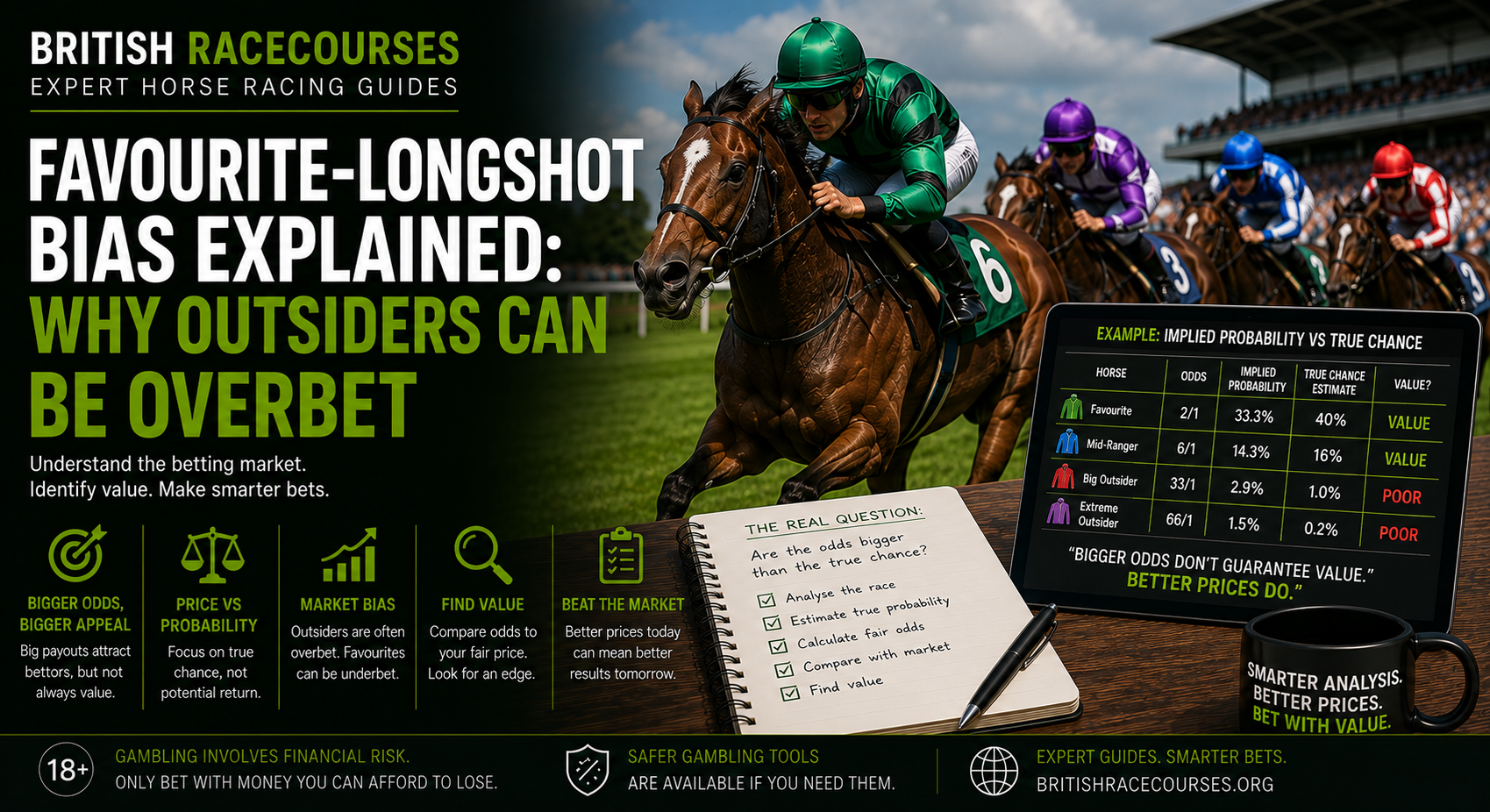
Horse racing favourite-longshot bias describes a long-observed tendency for bettors to accept relatively poor value on outsiders while shorter-priced horses can offer better returns relative to their apparent winning chances.
Put more simply:
Bettors can pay too much for the chance of a big win.
A 50/1 horse looks exciting.
A £10 winning bet returns a substantial amount.
An odds-on favourite looks considerably less exciting because the potential profit is much smaller.
But the size of the potential payout tells you nothing about whether the bet represents value.
That distinction is at the heart of favourite-longshot bias.
A horse at 50/1 can be too short.
A horse at 4/6 can be too big.
The question serious bettors should ask is not:
Which horse offers the biggest potential return?
It is:
Are the available odds bigger than the horse’s true chance of winning?
This guide explains favourite-longshot bias, why it can occur, how implied probability affects the calculation, why bettors are attracted to outsiders and how to use the concept alongside value betting, race pricing and market analysis.
What Is Favourite-Longshot Bias?
Favourite-longshot bias is the tendency for long-priced selections to produce poorer returns relative to their apparent probabilities than shorter-priced selections.
It does not mean:
Favourites always win.
It does not mean:
You should never back outsiders.
And it certainly does not mean:
Backing every favourite is profitable.
The concept concerns price and probability, not simply winners and losers.
Imagine two horses.
Horse A
Odds: 1/2
Horse B
Odds: 50/1
Horse A clearly has a much greater chance of winning.
Horse B offers a much greater potential payout.
The important question is whether the odds accurately compensate you for the probability of losing.
If Horse B’s genuine chance is only 1%, then 50/1 may actually be a poor price.
If Horse A has a genuine 75% chance of winning, 1/2 could potentially represent value despite appearing very short.
Why Is It Called Favourite-Longshot Bias?
The name describes the relationship between opposite ends of a betting market.
At one end are:
Favourites
These horses have the shortest odds and highest market-implied probability.
At the other are:
Longshots or outsiders
These have much bigger odds and lower market-implied probability.
Historical betting-market research has repeatedly investigated whether those prices are equally efficient.
The broad favourite-longshot bias hypothesis suggests that longshots tend to be overbet relative to their true chances, while favourites can be comparatively underbet.
Does Favourite-Longshot Bias Exist in Horse Racing?
Evidence for the effect has been found across different racing markets and periods, although its strength is not identical everywhere or permanent.
British Racecourses’ existing Favourites Horse Racing System page already touches on the phenomenon.
The important point for bettors is not to treat favourite-longshot bias as a guaranteed betting system.
Markets change.
Bookmakers change.
Exchange markets have become important.
Betting behaviour changes.
The useful lesson is broader:
Do not assume bigger odds automatically mean better value.
Why Are Bettors Attracted to Outsiders?
There are several possible explanations.
The Potential Payout Is Exciting
Compare:
£10 at 1/2
with:
£10 at 50/1
The first offers relatively little profit.
The second offers the prospect of hundreds of pounds.
That large potential reward can influence decision-making.
People Remember Big-Priced Winners
A 66/1 winner is memorable.
A 4/6 favourite winning is not.
This can distort our perception of how frequently outsiders actually succeed.
Small Stakes Can Produce Large Returns
Some bettors treat longshots almost like lottery tickets.
They accept a very low chance of success in return for a potentially large payout.
Major Races Encourage Outsider Betting
Large-field races naturally encourage bettors to search for overlooked runners at big prices.
The Grand National is an obvious example.
Finding a 33/1 or 50/1 winner feels much more satisfying than backing the favourite.
But emotional satisfaction and mathematical value are different things.
Outsiders Do Win Horse Races
Favourite-longshot bias does not mean outsiders cannot win.
They obviously can.
British racing history contains numerous spectacular long-priced winners.
The important distinction is:
Can win
versus:
Is a good bet at this price.
A horse with a genuine 1% winning chance will occasionally win.
That does not make it value at 50/1.
Understanding Implied Probability
Odds can be converted into implied probability.
This makes favourite-longshot bias much easier to understand.
For decimal odds:
Implied probability = 1 ÷ decimal odds
For fractional odds:
Probability = denominator ÷ (numerator + denominator)
Let’s look at some examples.
| Fractional Odds | Approx. Decimal Odds | Implied Probability |
|---|---|---|
| 1/2 | 1.50 | 66.7% |
| Evens | 2.00 | 50.0% |
| 2/1 | 3.00 | 33.3% |
| 4/1 | 5.00 | 20.0% |
| 9/1 | 10.00 | 10.0% |
| 19/1 | 20.00 | 5.0% |
| 49/1 | 50.00 | 2.0% |
| 99/1 | 100.00 | 1.0% |
The odds are effectively telling you what probability the price represents before accounting fully for bookmaker margin.
A 50/1 Horse Does Not Necessarily Have a 1.96% True Chance
This is an important distinction.
Fractional odds of 50/1 convert to decimal odds of 51.00.
That represents a raw implied probability of approximately:
1.96%
But bookmaker markets contain a margin.
That means the implied probabilities of every runner will normally add to more than 100%.
The horse’s market-implied probability therefore is not automatically its true probability.
Bookmaker Overround
Bookmakers build a margin into their markets.
Suppose a perfectly fair race had five horses with these true chances:
| Horse | True Chance |
|---|---|
| A | 30% |
| B | 25% |
| C | 20% |
| D | 15% |
| E | 10% |
| Total | 100% |
A bookmaker will not normally offer perfectly fair odds corresponding to those percentages.
The available prices may imply:
| Horse | Market-Implied Chance |
|---|---|
| A | 33% |
| B | 28% |
| C | 22% |
| D | 17% |
| E | 12% |
| Total | 112% |
The extra 12 percentage points represent the market’s overround.
Our How to Find Value Bets in Horse Racing guide explains why understanding this margin matters when assessing prices.
Is Bookmaker Margin Distributed Equally?
Not necessarily.
This is where favourite-longshot bias becomes particularly interesting.
Imagine a bookmaker has to distribute margin across a field.
That margin does not have to affect every horse equally in percentage terms.
If more margin is effectively loaded onto longshots, those outsiders can offer worse expected returns.
This means looking only at the total overround does not tell you everything about the quality of each individual price.
Favourite-Longshot Bias Example
Imagine a simplified market with two selections.
Favourite
True probability: 70%
Fair decimal odds: 1.43
Bookmaker odds: 1.40
Outsider
True probability: 30%
Fair decimal odds: 3.33
Bookmaker odds: 3.00
Both prices contain bookmaker margin.
But the distortion is proportionally more damaging to the outsider.
That is the type of effect favourite-longshot bias describes.
Why a Bigger Price Can Still Be Too Short
This sounds contradictory at first.
How can 50/1 be “too short”?
Imagine a horse’s genuine chance of winning is:
1%
Fair odds would be approximately:
99/1
If a bookmaker offers:
50/1
the price looks huge.
But it is actually poor value relative to the true probability.
Now imagine another horse has a genuine:
60%
chance of winning.
Fair odds would be roughly:
4/6
If you can obtain:
4/5
the price may represent value.
The 4/5 horse can therefore be the better value bet despite offering dramatically less potential profit.
Short Odds Do Not Mean Bad Value
Many casual bettors dislike short-priced horses.
They may say:
There’s no value at odds-on.
That statement is mathematically incorrect.
Value depends on probability.
If you believe a horse should be:
1/2
and the market offers:
4/5
then the market price is bigger than your fair price.
That can be value.
Conversely, if a 20/1 horse should really be 40/1, it is poor value despite the attractive payout.
Long Odds Do Not Mean Good Value
The reverse mistake is equally common.
Bettors sometimes say:
At that price, it’s worth a chance.
But price alone cannot make a selection worthwhile.
You need an estimate of its probability.
A horse at 100/1 may still be terrible value if its genuine chance is closer to 250/1.
This is why learning How to Price a Horse Race is so important.
The Difference Between Price and Payout
These concepts are often confused.
Payout tells you how much you receive if the bet wins.
Price tells you what odds you are receiving for accepting the risk.
A huge payout can come from a poor price.
A small payout can come from an excellent price.
Professional-style betting analysis focuses on the second question.
Expected Value and Favourite-Longshot Bias
Expected value helps explain the issue.
Suppose a horse has a genuine:
10%
chance of winning.
Fair decimal odds are:
10.00
or 9/1 fractionally.
If a bookmaker offers:
7/1
the decimal odds are 8.00.
For every £1 staked:
Expected return:
0.10 × £8 = £0.80
You are effectively receiving an expected return of 80p for every £1 staked before considering uncertainty in your probability estimate.
That is negative expected value.
Now suppose the bookmaker offers:
11/1
Decimal odds:
12.00
Expected return:
0.10 × £12 = £1.20
If your 10% estimate is accurate, that would represent positive expected value.
The horse has exactly the same chance in both examples.
Only the price changes.
Why Strike Rate Can Be Misleading
Backing favourites produces more winners.
That is obvious because favourites have higher implied probabilities.
But a high strike rate does not automatically mean a profitable strategy.
Likewise, backing outsiders produces fewer winners but larger payouts.
Neither strike rate tells you whether the strategy has positive expected value.
You need to consider:
Strike rate + average odds + returns
together.
Do Favourites Win More Often?
Yes.
By definition, the favourite is the horse the market considers most likely to win.
British Racecourses tracks favourite performance on its Favourites Horse Racing System page.
But:
Most likely winner
does not mean:
Certain winner
and it does not mean:
Profitable bet.
A favourite can be the likeliest winner and still be priced too short.
Are Odds-On Favourites Better Value?
Not automatically.
Favourite-longshot bias should never be simplified into:
Back every odds-on favourite.
Suppose a horse has a genuine:
60% chance
but trades at:
1/2
The market-implied probability is:
66.7%
If your assessment is accurate, that horse is too short.
The correct decision would be to avoid it despite its high chance of winning.
Are Outsiders Always Bad Bets?
No.
This is equally important.
There can be excellent value among outsiders.
Imagine you believe a horse has a:
10%
chance of winning.
Fair odds:
9/1
The market offers:
20/1
That is potentially a very attractive bet.
Favourite-longshot bias describes an aggregate market tendency.
It does not mean every individual outsider is overpriced.
Finding Value Among Outsiders
Look for situations where the market may have underestimated:
- recent form
- hidden sectional performance
- pace advantage
- draw advantage
- ground suitability
- distance suitability
- handicap mark
- trainer intent
- equipment changes
- course suitability
Our How to Analyse a Horse Race Like a Professional guide provides a complete framework for making those assessments.
Hidden Form and Outsiders
Outsiders can become attractive when the market focuses too heavily on finishing positions.
A horse may have finished:
8th, 7th, 10th
and look completely out of form.
But deeper analysis might reveal:
- unsuitable ground
- races over the wrong distance
- severe pace disadvantages
- trouble in running
- stronger opposition
- unfavourable draw positions
The horse may therefore have a better chance than its headline form suggests.
That is genuine analysis.
Backing it simply because it is 33/1 is not.
Sectional Times and Longshots
Sectional analysis can reveal outsiders whose recent performances were better than the result.
A horse might finish sixth but record an unusually strong closing section after being trapped behind slower runners.
If the market overlooks that performance, you may have identified genuine value.
Our Horse Racing Sectional Times Explained guide covers this process in detail.
Pace and Outsider Value
Race shape can create another source of outsider value.
Imagine a 12-runner handicap.
Eleven horses normally race midfield or towards the rear.
One 16/1 outsider regularly leads.
If that horse can secure an uncontested lead, it may have a tactical advantage the market has underestimated.
Use Horse Racing Pace Maps Explained to identify these situations.
Pace Bias Can Affect Longshots
Some course-and-distance combinations favour particular running styles.
If an outsider has the ideal running style for a strong historical bias, its chance may be better than the raw form suggests.
Our Horse Racing Pace Bias Explained guide explains how to analyse these patterns.
Draw Bias and Outsiders
Draw can create similar opportunities.
A horse’s price may be based heavily on its recent form without enough consideration of a favourable stall.
This is particularly relevant in races where draw and pace interact.
Read our Horse Racing Draw guide before treating a high or low stall as automatically advantageous.
Handicap Marks and Outsiders
Handicaps can produce attractive long-priced opportunities when a horse has fallen to a competitive mark.
Imagine a horse once capable of winning from:
Official Rating 90
It has gradually dropped to:
OR 78
Recent performances look poor, so the market loses interest.
But conditions change:
- ideal ground
- preferred distance
- suitable track
- favourable pace
- strong jockey booking
The horse could be better handicapped than its odds imply.
Our How Racehorse Handicap Ratings Work guide explains the rating system.
Why Big-Field Handicaps Encourage Longshot Betting
Large handicaps are particularly attractive to outsider bettors.
There may be:
- 16 runners
- 20 runners
- 25 runners
- or even more
The favourite may trade at relatively generous odds.
Several outsiders can be available at 25/1, 33/1 or bigger.
That creates the impression that:
Anything can win.
Upsets certainly happen.
But the presence of more runners does not make every outsider value.
Each-Way Betting Can Increase the Appeal of Outsiders
Each-way betting gives bettors two opportunities for a return:
- win
- place
This can make longshots feel more attractive.
The key issue is whether the:
- win price
- place fraction
- number of places
represent good value.
An extra-place concession can materially change the attractiveness of a bet.
British Racecourses compares Extra Places Bookmakers for this reason.
Don’t Confuse Extra Places With Value
A bookmaker offering six places rather than four sounds attractive.
It may be.
But if the bookmaker has shortened several runners to compensate, another operator offering fewer places at much bigger odds could still provide the better bet.
Always consider:
Price + terms
rather than terms alone.
Favourite-Longshot Bias and Betting Exchanges
Betting exchanges operate differently from traditional bookmakers.
Customers bet against each other rather than simply accepting prices set by one bookmaker.
This can create:
- tighter markets
- different price discovery
- greater transparency around available liquidity
But exchanges still reflect human behaviour.
Favourite-longshot bias can therefore still be relevant.
Our UK Betting Exchange Sites guide explains how exchange betting works.
Exchange Commission Matters
Suppose an exchange offers:
10.0
while a bookmaker offers:
9/1
At first glance they look equivalent.
But exchange commission can affect the net return.
You should compare prices after relevant costs rather than assuming the headline exchange number is automatically better.
Favourite-Longshot Bias and Starting Price
Starting Price provides a useful benchmark because it reflects the market around the beginning of the race.
Our Starting Price Betting guide explains how SP works.
If you are studying favourite-longshot bias yourself, you could record results by SP band.
For example:
| Odds Band | Bets | Winners | Stakes | Returns | ROI |
|---|---|---|---|---|---|
| Odds-on | |||||
| Evens to 2/1 | |||||
| 2/1 to 5/1 | |||||
| 5/1 to 10/1 | |||||
| 10/1 to 20/1 | |||||
| 20/1+ |
Over a sufficiently large dataset, this lets you examine how returns change as odds increase.
Why Sample Size Matters
Do not analyse favourite-longshot bias using:
20 races.
A 50/1 winner can completely transform a small dataset.
Suppose you back 30 horses at 50/1.
One winner produces a substantial return.
That can make the strategy look excellent.
But the result tells you very little about the underlying probability distribution.
Longshot analysis requires particularly large samples because winners occur infrequently.
Variance Is Greater With Outsiders
Imagine two strategies.
Strategy A
Average odds:
6/4
Strategy B
Average odds:
25/1
Strategy B will naturally experience much longer losing sequences.
Even if both strategies had identical expected returns, their short-term results would look dramatically different.
This makes emotional discipline particularly important when betting outsiders.
Losing Runs Can Distort Your Thinking
After 20 losing outsider bets, a bettor may think:
I’m due a winner.
That is a form of gambler’s fallacy.
Previous independent losses do not make the next horse more likely to win.
Likewise, after landing a 40/1 winner, a bettor may become overconfident about their ability to identify outsiders.
Neither reaction is useful.
Analyse the quality of each individual price.
The Lottery Effect
Favourite-longshot bias is often compared with lottery behaviour.
Lottery players accept extremely poor probabilities because the potential jackpot is enormous.
A similar psychological effect can occur in racing.
A bettor may prefer:
£5 at 100/1
to:
£50 at Evens
because the first feels more exciting and limits the amount initially risked.
But the correct mathematical question remains:
What probability am I receiving for the price?
The Story Behind the Horse
Outsiders can also become appealing because they have a compelling narrative.
Examples include:
- veteran returning to favourite track
- trainer targeting a major race
- promising jockey booking
- dramatic previous win
- horse dropping significantly in class
- famous owner or colours
These factors can be relevant.
But stories can also cause bettors to overlook probability.
Every narrative must ultimately be converted into an assessment of the horse’s chance.
Media Attention Can Influence Betting
Major racing festivals generate enormous media coverage.
Tipsters naturally want to identify:
the big-priced winner
because it makes memorable content.
A 33/1 winner receives far more attention than an odds-on favourite doing what everyone expected.
This can reinforce the perception that outsiders win more frequently than they actually do.
Survivor Bias and Longshots
Successful outsiders are remembered.
The dozens of 33/1 and 50/1 horses that finish down the field are forgotten.
This creates survivor bias.
You remember:
the 50/1 winner
but not:
the other 40 horses backed at similar prices that lost.
A betting record solves this problem.
Numbers remember every bet.
Record Every Bet
If you want to understand whether you have an outsider bias yourself, record:
- date
- race
- horse
- odds
- stake
- fair odds
- result
- profit/loss
- Starting Price
- reason for bet
Then divide your results into price bands.
You might discover that your analysis works particularly well between:
3/1 and 8/1
but performs badly at:
20/1+
That is useful information.
Favourite-Longshot Bias and Closing Line Value
The new Closing Line Value in Horse Racing framework is particularly useful here.
Suppose you regularly back outsiders at:
25/1
and they start at:
12/1
You are consistently securing much bigger prices than the closing market.
That is encouraging.
Now imagine you regularly take:
16/1
and your selections drift to:
33/1
That does not automatically mean the bets are wrong.
But repeated negative closing-line movement deserves investigation.
CLV can therefore help separate:
genuine outsider value
from:
simply liking big prices.
Market Shorteners and Favourite-Longshot Bias
A longshot can attract significant money and shorten dramatically.
For example:
33/1 → 20/1 → 12/1
British Racecourses explains this process in Betting Odds Shortening.
If your analysis identified the horse at 33/1, that movement can be encouraging.
But joining at 12/1 is a different decision.
The original value may have disappeared.
Drifting Favourites
Favourite-longshot bias also does not mean you should ignore market weakness around favourites.
A horse can drift from:
6/4
to:
3/1
There may be a legitimate reason.
British Racecourses covers the mechanics in Betting Odds Drifting.
If your own assessment still says the horse should be 6/4, the bigger price might become attractive.
But first ask why the market has changed.
Market Price Is Information
The betting market contains information.
It should not control your opinion completely.
But it should not be ignored.
If you price a horse at:
2/1
and virtually every market participant is willing to oppose it at:
5/1
you should at least reconsider your assumptions.
Perhaps you have missed:
- ground concerns
- fitness
- pace problems
- class
- distance
- market information
The market can be wrong.
So can you.
Create Your Own Fair Odds
The best defence against favourite-longshot bias is independent pricing.
Do not begin with:
The horse is 25/1. Is it worth a bet?
Begin with:
What chance do I believe this horse has?
Suppose you estimate:
8%
That corresponds to fair odds of:
12.5 decimal
or roughly:
11/1 to 12/1
If the market offers:
20/1
you may have identified value.
If it offers:
8/1
you have not.
The horse has not changed.
Only the price has.
Don’t Start With the Market Price
Seeing the bookmaker odds before making your assessment can anchor your judgement.
If you see:
33/1
you may subconsciously look for reasons why the horse cannot win.
If you see:
2/1 favourite
you may look for reasons why it should win.
A stronger process is:
- Analyse the race.
- Estimate probabilities.
- Create fair prices.
- Check the market.
- Identify discrepancies.
Our How to Price a Horse Race guide covers this process in detail.
Compare Prices Across Bookmakers
Even if you have identified genuine value, taking the wrong bookmaker price can reduce your edge.
Imagine:
Bookmaker A: 14/1
Bookmaker B: 16/1
Bookmaker C: 20/1
Bookmaker D: 22/1
Taking 14/1 when 22/1 is genuinely available makes little sense.
Over hundreds of bets, those differences can have a major effect.
Use our Best Horse Racing Betting Sites guide to compare operators and their racing features.
Best Odds Guaranteed and Longshots
Best Odds Guaranteed can be particularly useful when taking an early fixed price.
Suppose you take:
20/1
The horse later drifts and qualifies at:
28/1 SP
Under applicable BOG terms, settlement may be made at the larger eligible price.
Terms and eligibility vary between bookmakers, so always check them before betting.
Should You Avoid All Bets Above 20/1?
No.
That would misunderstand the concept entirely.
There will be occasions when a 25/1, 50/1 or even bigger-priced horse is genuinely underestimated.
The correct response to favourite-longshot bias is not:
Never back outsiders.
It is:
Demand a sufficient price for the risk you are taking.
Should You Back Every Favourite?
No.
This is the opposite but equally dangerous interpretation.
A favourite can be:
- too short
- badly drawn
- unsuited by pace
- vulnerable on the ground
- overrated from its last race
- poorly handicapped
The market can overbet favourites too.
Every horse requires individual assessment.
Can You Build a Favourite Betting System?
You can analyse favourite performance systematically, but simply backing every favourite is not a shortcut to profit.
Our existing Favourites Horse Racing System page examines favourite statistics and different ways bettors approach the market.
The favourite-longshot bias concept explains why returns can differ across price ranges.
It does not transform favourites into automatic bets.
Can You Build an Outsider Betting System?
The same principle applies.
Rules such as:
Back every horse at 20/1+
ignore the most important variable:
true probability.
A successful outsider strategy would need to identify horses whose winning chances are systematically underestimated by the market.
That requires an actual analytical edge.
Testing Favourite-Longshot Bias Yourself
You can test the effect using historical racing data.
Step 1: Collect a Large Dataset
Record thousands of runners rather than dozens.
Step 2: Record Starting Price
Use a consistent odds source.
Step 3: Divide Horses Into Price Bands
For example:
- odds-on
- Evens to 2/1
- above 2/1 to 5/1
- above 5/1 to 10/1
- above 10/1 to 20/1
- above 20/1 to 50/1
- above 50/1
Step 4: Calculate Strike Rate
How frequently did horses in each band win?
Step 5: Calculate Level-Stakes Returns
Assume the same stake on every runner.
Step 6: Calculate ROI
Use:
ROI = Profit or Loss ÷ Total Stakes × 100
Step 7: Compare the Bands
Look for changes in returns as odds increase.
Step 8: Repeat Across Different Race Types
Separate:
- Flat
- jumps
- handicaps
- non-handicaps
- small fields
- large fields
- different classes
The effect may not be identical everywhere.
Why Historical Results Can Mislead
Historical testing has limitations.
A dataset may contain:
- different bookmaker margins
- different exchange liquidity
- changing market structures
- different racing periods
- errors in prices
- survivorship issues
A pattern that existed strongly ten years ago may be weaker today.
Do not assume a historical bias will continue unchanged.
Favourite-Longshot Bias Is Not a Magic Edge
Once a market tendency becomes widely known, participants can adapt.
Professional bettors look for pricing inefficiencies.
Bookmakers adjust models.
Exchange markets allow other participants to correct prices.
That means favourite-longshot bias is better viewed as:
a principle to understand
rather than:
a system to exploit blindly.
How Favourite-Longshot Bias Fits With Value Betting
The entire concept comes back to value.
You should not ask:
Favourite or outsider?
Ask:
Fair price or bad price?
Consider:
Horse A
Market price: 4/6
Your fair price: 1/2
Potential value.
Horse B
Market price: 20/1
Your fair price: 10/1
Potential value.
Horse C
Market price: Evens
Your fair price: 6/4
Poor value.
Horse D
Market price: 33/1
Your fair price: 50/1
Poor value.
Both favourites and outsiders can fall on either side.
Use Closing Line Value to Test Your Analysis
After placing your bets, record the closing price.
If you consistently take:
20/1 → closes 12/1
or:
7/4 → closes 5/4
you are securing positive closing-line movement.
That does not guarantee profit, but it provides useful feedback.
If your bets consistently move the other way, investigate why.
A Practical Favourite-Longshot Bias Workflow
Use this process before betting.
Step 1: Ignore the Excitement of the Payout
A large potential return is irrelevant if the odds are poor.
Step 2: Analyse the Horse
Assess:
- form
- class
- pace
- draw
- going
- distance
- fitness
- handicap mark
Step 3: Estimate Its Probability
Create your own assessment.
Step 4: Convert Probability Into Fair Odds
This gives you a price benchmark.
Step 5: Check the Market
Only now compare bookmaker prices.
Step 6: Look for a Meaningful Margin
Small differences may disappear because your probability estimate is uncertain.
Step 7: Compare Bookmakers
Take the strongest available terms and price where appropriate.
Step 8: Record the Bet
Include your fair price.
Step 9: Record Closing Price
Measure CLV.
Step 10: Review Over a Large Sample
Separate results by odds range.
This turns favourite-longshot bias from an interesting theory into something you can actually test within your own betting.
Favourite-Longshot Bias Checklist
Before backing a favourite:
☐ Have I independently assessed its chance?
☐ Is the short price actually bigger than my fair odds?
☐ Am I backing it simply because it is the favourite?
☐ Does the pace suit?
☐ Is the draw suitable?
☐ Is its recent form stronger than it appears?
Before backing an outsider:
☐ Why is the horse this price?
☐ What has the market potentially missed?
☐ Have I identified a genuine analytical reason?
☐ Am I attracted mainly by the payout?
☐ What probability do I give the horse?
☐ What are my fair odds?
☐ Is the bookmaker price comfortably bigger?
For every bet:
☐ Have I compared prices?
☐ Have I recorded the odds taken?
☐ Will I record SP or another closing benchmark?
☐ Am I staking consistently?
☐ Am I judging the process rather than one result?
Common Favourite-Longshot Bias Mistakes
Assuming Outsiders Are Value Because the Odds Are Big
Large odds and value are not the same thing.
Assuming Favourites Are Poor Value Because the Return Is Small
Short prices can still represent excellent value.
Backing Every Favourite
Favourite-longshot bias is not a blanket favourite betting system.
Avoiding Every Outsider
Some outsiders are genuinely underpriced by the market.
Looking Only at Winners
Returns matter more than raw winner counts.
Using Tiny Samples
Longshot strategies require particularly large datasets.
Ignoring Bookmaker Margin
Quoted odds do not represent perfectly fair probabilities.
Ignoring Price Shopping
Taking 14/1 when 20/1 is available damages expected returns.
Chasing Steamers
A shortening horse may already have lost its value.
Ignoring Market Information
Independent thinking is useful, but repeated disagreement with the market deserves investigation.
Focusing on Payout Rather Than Probability
This is perhaps the biggest mistake of all.
How This Fits Into the British Racecourses Analysis Process
A complete betting process can now look like this:
Analyse the race
↓
How to Analyse a Horse Race Like a Professional
↓
Understand form
↓
↓
Analyse draw
↓
↓
Build a pace map
↓
Horse Racing Pace Maps Explained
↓
Understand pace bias
↓
Horse Racing Pace Bias Explained
↓
Study hidden performances
↓
Horse Racing Sectional Times Explained
↓
Create fair odds
↓
↓
Identify value
↓
How to Find Value Bets in Horse Racing
↓
Consider market pricing biases
↓
Horse Racing Favourite-Longshot Bias Explained
↓
Compare the available prices
↓
Best Horse Racing Betting Sites
↓
Record the closing price
↓
Closing Line Value in Horse Racing
That creates a much stronger process than simply looking through a racecard and choosing the horse you think will win.
Frequently Asked Questions
What is favourite-longshot bias in horse racing?
Favourite-longshot bias describes the tendency for long-priced runners to be overbet relative to their actual chances while shorter-priced horses can produce comparatively stronger returns.
Why is it called favourite-longshot bias?
The name describes a pricing tendency between favourites at the short end of the market and longshots at the high-odds end.
Does favourite-longshot bias mean favourites are profitable?
No. A lower average loss or more efficient price does not automatically make every favourite profitable.
Should I always back the favourite?
No. Every favourite must still be assessed against its available price.
Are outsiders bad bets?
Not automatically. An outsider can be excellent value if its true chance is greater than the market price implies.
Why do bettors like outsiders?
Large potential payouts, excitement, memorable big-priced winners and the lottery-like appeal of risking a small amount for a large return can all contribute.
Can a 50/1 horse be too short?
Yes. If its true winning chance is lower than the probability represented by 50/1, the horse can be overpriced despite the large odds.
Can an odds-on horse be value?
Yes. If its genuine winning chance is greater than the probability represented by the available odds, an odds-on horse can represent value.
What is implied probability?
Implied probability converts betting odds into the chance of success represented by those odds.
What probability is Evens?
Evens represents an implied probability of 50% before considering market margin.
What probability is 9/1?
9/1 corresponds to a raw implied probability of 10%.
What probability is 99/1?
99/1 corresponds to a raw implied probability of 1%.
What is bookmaker overround?
Overround is the bookmaker margin created when the implied probabilities of all selections add to more than 100%.
Does bookmaker margin affect outsiders more?
Favourite-longshot bias research suggests market inefficiency can be greater among longshots in some markets, but the effect varies.
Is favourite-longshot bias found on betting exchanges?
It can still be relevant because exchange prices are also produced by market participants, although exchange market structure differs from traditional bookmakers.
Are exchanges always better for outsiders?
No. Compare the actual price and account for commission.
Do favourites win more often?
Yes. By definition, favourites have the highest market-implied chance of winning.
Why do favourites still lose?
Being the most likely winner does not mean having more than a 50% chance. A 3/1 favourite, for example, represents only a 25% raw implied probability.
Can each-way betting make outsiders good value?
It can improve the proposition when the odds and place terms are attractive, but each-way betting does not automatically make an overpriced horse good value.
Do extra places help?
Additional places can improve each-way value, but they need to be considered alongside the available win price and place fraction.
Can pace help find value outsiders?
Yes. A horse with a favourable projected race position may have a better chance than its headline form suggests.
Can sectional times uncover value outsiders?
Yes. Sectionals can reveal stronger underlying performances that finishing positions hide.
Can draw bias create outsider value?
Yes. A favourable draw that the market has underestimated can increase a horse’s chance.
What is the best way to avoid favourite-longshot bias?
Create your own fair prices before looking at the market and judge every horse on probability rather than potential payout.
How do I test favourite-longshot bias?
Collect a large historical dataset, divide runners into odds bands and compare strike rates, level-stakes returns and ROI.
How many races should I use?
The larger the sample, the better. Longshot analysis particularly requires substantial samples because winners are infrequent.
What is the difference between favourite-longshot bias and value betting?
Favourite-longshot bias describes a potential systematic market tendency. Value betting involves identifying any individual price that exceeds your assessment of fair odds.
Does positive closing-line value mean I’ve avoided favourite-longshot bias?
Not necessarily, but consistently obtaining bigger odds than the closing market can provide useful evidence about the quality of your price selection.
Summary
Favourite-longshot bias teaches one of the most important lessons in horse racing betting:
Big odds do not automatically mean big value.
A 50/1 horse can be overpriced.
An odds-on favourite can be underpriced.
What matters is the relationship between:
Probability
and:
Price.
Bettors are naturally attracted to outsiders because the potential payouts are exciting.
A £5 bet returning hundreds of pounds is more memorable than a short-priced favourite producing a small profit.
Big-priced winners also stick in the memory.
The dozens of similar outsiders that lose are quickly forgotten.
That can distort how bettors perceive risk and reward.
The solution is not to stop backing outsiders.
Nor is it to start blindly backing favourites.
Instead, analyse every horse in exactly the same way.
Ask:
What chance do I believe this horse has?
Convert that probability into fair odds.
Then compare your price with the market.
If you believe a horse should be:
10/1
and bookmakers offer:
25/1
the outsider may represent genuine value.
If you believe another horse should be:
40/1
and bookmakers offer:
20/1
the large potential payout does not make it a good bet.
The same applies to favourites.
If your fair price is:
4/6
and bookmakers offer:
Evens
the short-priced horse may provide the better value.
Use How to Price a Horse Race to build independent probabilities.
Use How to Find Value Bets in Horse Racing to compare those probabilities with the market.
Use Horse Racing Sectional Times Explained and Horse Racing Pace Maps Explained to uncover information the headline form may miss.
Then use Closing Line Value in Horse Racing to assess whether you are consistently securing better prices than the later market.
The objective is not to become a favourite bettor or an outsider bettor.
The objective is to become a price-sensitive bettor.
18+. Gambling involves financial risk. Only bet with money you can afford to lose.