

Use the British Racecourses Treble Bet Calculator to calculate the potential return and profit from three selections combined into one bet.
Enter the odds for each selection, choose your stake and the calculator will work out the result. You can calculate win or each-way trebles using fractional or decimal odds.
The calculator also supports horse racing settlement factors including non-runners, Rule 4 deductions and dead heats.
How to Use the Treble Bet Calculator
Here is the step-by-step guide on how to use the Treble bet calculator:
- Select “Treble” on the ‘Bet Type’ dropdown
- The ‘Number of Selections’ should default to 3 picks
- Select the ‘Outcome’ for each selection, such as “Winner”, “Placed”, “Void”, “Non-runner”
- Select the ‘Odds’ for each selection, such as “9/1” and “12/1”
- Select the ‘Stake’ wagered per bet, like “£10”, “£200”, “£50”
- The Treble calculator will work out total outlay, total return and total profit
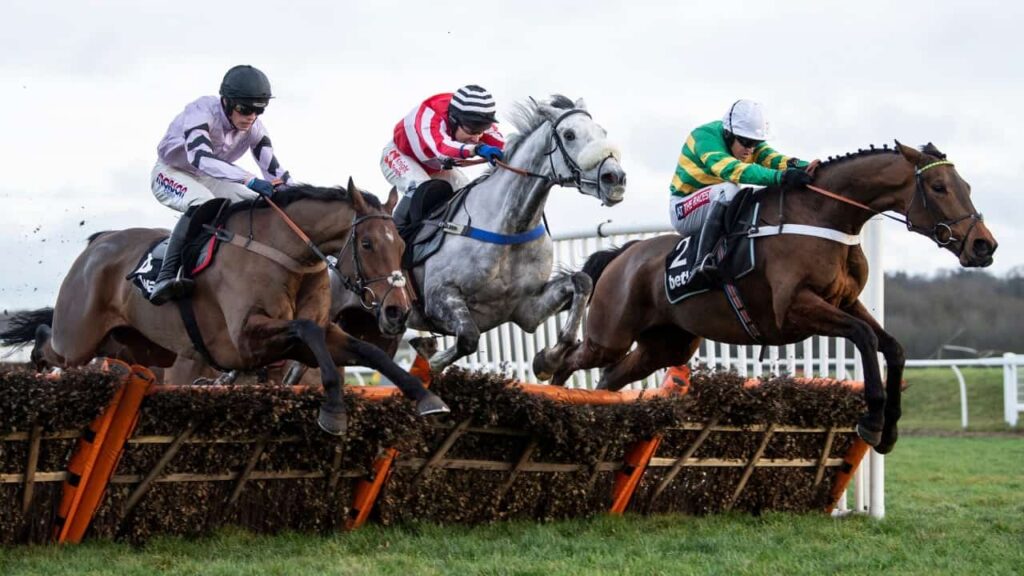
What Is a Treble Bet?
A treble combines three selections into one bet.
All three selections must normally win for a standard win treble to succeed.
Suppose you back three horses at:
2/1
3/1
4/1
These are equivalent to decimal odds of:
3.00
4.00
5.00
Multiply the three decimal prices:
3.00 × 4.00 × 5.00 = 60.00
A £10 winning treble therefore returns:
£600
That figure includes the original £10 stake.
The profit is:
£590
If any one of the three selections loses, the standard win treble loses.
How Does a Treble Bet Work?
A treble effectively rolls the return from one successful selection into the next and then into the third.
Consider a £10 treble containing:
Horse A at 2/1
Horse B at 3/1
Horse C at 4/1
The first £10 selection at 2/1 returns:
£30
That £30 effectively continues onto Horse B at 3/1, producing:
£120
The £120 then effectively continues onto Horse C at 4/1, producing:
£600
The same calculation can be performed more simply by multiplying the decimal odds:
3.00 × 4.00 × 5.00 = 60.00
Then multiply the combined price by the original £10 stake:
£10 × 60.00 = £600
The calculator performs this automatically.
How Do You Calculate a Treble Bet?
The simplest manual calculation uses decimal odds.
The formula is:
Selection 1 decimal odds × Selection 2 decimal odds × Selection 3 decimal odds × Stake = Total return
Suppose your three horses are priced at:
5/2
7/2
4/1
Convert those prices to decimal:
5/2 = 3.50
7/2 = 4.50
4/1 = 5.00
The combined decimal odds are:
3.50 × 4.50 × 5.00 = 78.75
A £10 treble therefore has a potential return of:
£787.50
The potential profit is:
£777.50
You can read more about these individual prices in our 5/2 odds, 7/2 odds and 4/1 odds explainers.
Fractional Odds Treble Calculator
Fractional odds remain widely used in British horse racing.
You can enter fractional prices directly into the calculator without converting each selection manually.
Suppose your treble contains:
Selection 1: 1/1
Selection 2: 5/2
Selection 3: 10/1
The decimal equivalents are:
2.00
3.50
11.00
The combined decimal price is:
2.00 × 3.50 × 11.00 = 77.00
A £5 winning treble therefore returns:
£385
including the original stake.
Our fractional-to-decimal odds converter provides a full conversion table, while our 1/1 odds and 10/1 odds pages explain those prices individually.
Decimal Odds Treble Calculator
Decimal odds make a treble particularly straightforward to calculate manually.
Suppose the three selections are:
2.50
4.00
6.00
Multiply them:
2.50 × 4.00 × 6.00 = 60.00
A £20 winning treble therefore returns:
£1,200
The profit is:
£1,180
Decimal prices include the returned stake, which is why the final combined price can be multiplied directly by the original stake.
Our main betting odds guide explains the different odds formats in more detail.
Treble Bet Return Versus Profit
Return and profit are not the same thing.
Return is the complete amount paid back from a successful treble, including the returned stake.
Profit is the amount won above the original stake.
For example:
Stake: £10
Combined decimal odds: 25.00
The total return is:
£250
The profit is:
£240
The calculator displays these figures separately.
What Happens If One Selection Loses?
All three selections need to win for a standard win treble to succeed.
Suppose the results are:
Horse A: Winner
Horse B: Winner
Horse C: Loser
The treble loses.
It does not matter that two of the three selections won because the treble combines all three outcomes into one bet.
This is an important distinction between a treble and combination bets such as a Trixie or Patent.
Treble Versus Three Singles
Three singles and one treble can contain exactly the same selections but create very different bets.
With three singles, every selection is settled independently.
If two horses win and one loses, the two successful singles still return.
With a treble, all three selections are linked.
If one loses, the standard treble loses.
The treble produces a larger potential return from the same single unit stake because all three prices are multiplied together, but it also requires all three outcomes to succeed.
Our horse racing bet types guide explains the differences between singles, simple multiples and combination bets.
What Is an Each-Way Treble?
An each-way treble contains two separate trebles:
One win treble
One place treble
A £10 each-way treble therefore has a total stake of:
£20
The £10 win treble requires all three horses to win.
The £10 place treble requires all three horses to satisfy the relevant place terms.
The place component is settled using the applicable place fraction for each race.
Our each-way betting guide explains how the two parts of an each-way wager work.
How to Calculate an Each-Way Treble
Each-way trebles become more complicated because the win and place components need to be calculated separately.
Suppose three horses are backed at:
5/1
10/1
20/1
Assume, purely for this example, that all three races pay one-fifth of the win odds for a qualifying place.
The place odds become:
1/1
2/1
4/1
In decimal terms:
2.00
3.00
5.00
The combined decimal price for the place treble is:
2.00 × 3.00 × 5.00 = 30.00
A £5 place component would therefore return:
£150
if all three horses satisfied the applicable place terms.
The win component is calculated separately using the full win prices.
Place fractions and the number of places vary between races and bookmaker terms, so use the actual terms applying to each selection.
Our each-way value guide looks more closely at how price, place fraction and number of places affect the bet.
What Happens If Two Horses Win and One Places?
For a standard win treble, the bet loses because all three selections were required to win.
An each-way treble can produce a different result.
Suppose:
Horse A wins
Horse B wins
Horse C finishes in a qualifying place
The win treble loses because Horse C did not win.
The place treble can still succeed because all three selections satisfied the place conditions.
A winning horse also satisfies the place part of an each-way wager.
The final return depends on the odds, place fractions and stake.
What Happens If One Horse Is a Non-Runner?
A non-runner does not always cause the complete treble to lose.
For many conventional race-day multiples, a selection that is settled as void is removed from the bet.
A treble containing one void selection can therefore effectively become a double.
Suppose:
Horse A: Winner
Horse B: Non-runner
Horse C: Winner
If Horse B is treated as void, the bet can be settled using Horses A and C as a double.
The exact treatment depends on the rules applying to the wager.
Ante-post bets can operate differently, so a non-runner should not automatically be assumed to be void in every situation.
How Does Rule 4 Affect a Treble?
A Rule 4 deduction can apply when a horse is withdrawn after you have placed a fixed-price bet and the relevant conditions for a deduction are met.
If Rule 4 applies to one leg of a treble, it affects the return carried through that selection and therefore the final return from the multiple.
The deduction depends on the relevant price of the withdrawn horse under the applicable rules.
A shorter-priced withdrawn horse can produce a larger deduction than a long-priced withdrawal.
Use the Rule 4 option within the calculator when checking a settled treble.
Our Rule 4 deductions guide explains how these deductions work.
What Happens If One Selection Dead Heats?
A dead heat occurs when horses cannot be separated for the relevant finishing position.
If one of your treble selections is involved in a dead heat, that leg is settled under dead-heat rules before the return continues through the remainder of the multiple.
For a two-horse dead heat for first, the relevant stake on that selection is normally divided for settlement purposes.
That adjustment can materially change the final treble return.
Use the dead-heat setting in the calculator rather than simply multiplying the original three prices.
Best Odds Guaranteed and Trebles
Best Odds Guaranteed can affect the settlement price of qualifying horse racing selections within a treble.
Suppose a horse is backed at 5/1 and wins at a larger Starting Price.
Where that selection and wager qualify for BOG under the bookmaker’s current terms, the larger qualifying price can affect the return from the entire treble.
Eligibility varies between bookmakers, races and bet types.
Our Best Odds Guaranteed guide explains the feature and the factors to check.
When calculating a completed bet, use the odds at which each selection was actually settled.
Treble Versus Double
A double combines two selections.
A treble combines three.
For a conventional win bet:
Double: Both selections must win
Treble: All three selections must win
Adding the third selection increases the potential payout because another price is multiplied into the bet.
It also adds another required outcome.
Suppose all three selections are priced at decimal odds of 3.00.
A double using two selections has combined odds of:
3.00 × 3.00 = 9.00
A treble has combined odds of:
3.00 × 3.00 × 3.00 = 27.00
The treble has the larger potential return, but it needs three successful selections instead of two.
Use our Double Bet Calculator when combining two selections.
Treble Versus Accumulator
A treble contains exactly three selections.
Accumulator is commonly used for a multiple containing four or more selections.
The underlying calculation is the same.
Every price is multiplied together and all the required selections must normally win.
The difference is the number of legs.
Adding further selections can increase the potential return rapidly, but it also adds more required outcomes.
Use the Accumulator Bet Calculator when calculating a larger multiple.
Treble Versus Trixie
A treble and a Trixie can both use three selections, but they are very different bets.
A treble contains:
1 bet
A Trixie contains:
3 doubles
1 treble
That creates four bets in total.
With a standard win Trixie, two successful selections can produce a return from one of the doubles.
A standard treble requires all three selections to win.
The Trixie provides more combination coverage, but the total stake is higher at the same unit stake.
A £5 treble costs:
£5
A £5 unit Trixie costs:
£20
Use our Trixie Bet Calculator to calculate all four components.
Treble Versus Patent
A Patent also uses three selections.
It contains:
3 singles
3 doubles
1 treble
That creates seven separate bets.
Because singles are included, one winning selection can generate a return from a conventional win Patent.
The extra coverage also increases the total stake.
A £5 treble costs £5.
A £5 unit Patent costs:
£35
Use the Patent Bet Calculator when calculating that structure.
Do Trebles Offer Better Value?
A treble is not automatically better value because it produces a larger potential return.
Value depends on the relationship between the available odds and the chance of each selection succeeding.
Suppose one of your three selections is available at a price shorter than you believe represents its true chance.
Adding that selection to a treble does not remove the price disadvantage.
It becomes one of the three prices used to create the combined bet.
This is why the individual price of every selection still matters.
Our guide to finding value bets in horse racing explains the relationship between price and probability.
Treble Odds and Implied Probability
The combined decimal odds can be converted into raw implied probability.
Suppose your treble has combined decimal odds of:
20.00
The raw implied probability represented by the price is:
1 ÷ 20 × 100 = 5%
At combined odds of:
50.00
the raw implied probability is:
2%
This describes the probability represented by the quoted combined price.
It should not automatically be treated as the true chance of all three selections winning.
Bookmaker prices contain margin, and your assessment of each horse can differ from the market.
Our bookmaker overround guide explains why quoted prices and theoretical fair probabilities differ.
Why Comparing Prices Matters on a Treble
Price differences compound when selections are combined.
Suppose three horses are available at decimal prices of:
3.00
4.00
5.00
The combined price is:
60.00
Now suppose you find slightly better prices of:
3.25
4.25
5.50
The combined price becomes:
75.97
A £10 stake at 60.00 produces a potential return of:
£600
The same £10 stake at combined odds of 75.97 produces:
£759.70
The selections have not changed.
The difference comes from the prices used to construct the treble.
Our Best Horse Racing Betting Sites comparison looks at bookmakers from a horse racing perspective, including odds, racing features and other factors relevant to bettors.
Why Adding Another Selection Changes the Bet
It can be tempting to add another horse to a treble simply because the potential return increases sharply.
Suppose three selections are each priced at 2/1.
Their decimal prices are all:
3.00
The treble price is:
27.00
Add a fourth 2/1 selection and the four-fold becomes:
81.00
The displayed potential return has tripled.
But you now need four successful outcomes rather than three.
The additional selection has increased both the potential return and the number of things that must go right.
It has not automatically improved the bet.
Maximum Payouts and High-Odds Trebles
Three long-priced selections can create a very large combined price.
For example, combining three horses at 20/1 creates a much larger theoretical return than backing any of the horses individually.
The mathematical return displayed by a calculator does not override bookmaker maximum payout limits.
These limits can vary according to operator, sport, race and terms.
For unusually large potential returns, check the applicable limits before placing the wager.
Our maximum payout betting sites guide covers this issue separately.
Can You Place a Treble Across Different Racecourses?
Yes.
The three horses in a treble do not normally need to run at the same meeting or in consecutive races.
You could combine runners from three different racecourses.
The structure remains the same.
All three required selections need to succeed for a conventional win treble to return.
Can a Treble Include Different Sports?
Eligible selections from different sports can be combined where the bookmaker permits them in a multiple.
The basic calculation remains the same.
Multiply the three decimal prices together and then multiply the combined price by the stake.
British Racecourses concentrates on horse racing, so the additional settlement guidance on this page focuses on racing-specific issues including Rule 4, each-way terms, dead heats and non-runners.
Can a Treble Bet Calculator Tell You What to Back?
No.
The calculator performs the arithmetic after you have chosen the selections and prices.
It tells you what a particular combination could return.
It does not tell you whether the horses are likely to win or whether the available odds represent value.
Those questions require race analysis.
Our horse racing form guide explains how to assess previous performances, while How to Analyse a Horse Race Like a Professional covers factors including form, class, distance, going and pace.
Once you have assessed the runners, the calculator can show what the chosen stake and prices would return.
Common Treble Bet Calculator Mistakes
A common mistake is confusing return with profit.
If a £10 treble returns £500, the profit is £490 because the £500 includes the original £10 stake.
Another is entering fractional prices as decimal odds or decimal prices as fractional odds.
For each-way trebles, remember that the stated stake applies separately to the win and place components. A £10 each-way treble therefore costs £20.
Use the correct place fraction for each selection rather than assuming every race has identical each-way terms.
If a horse is withdrawn, check the applicable non-runner and Rule 4 rules before calculating the final settlement.
For completed bets, use the prices at which the selections were actually settled rather than prices that were available at another point in the market.
Treble Bet Calculator FAQs
What is a treble bet?
A treble combines three selections into one multiple. All three selections must normally win for a standard win treble to succeed.
How many selections are in a treble?
Three.
How do I calculate a treble?
Convert the three prices to decimal odds, multiply them together and then multiply the result by your stake.
What does a £10 treble pay?
The return depends entirely on the three prices.
If the combined decimal odds are 20.00, a £10 winning treble returns £200.
If the combined decimal odds are 50.00, the same £10 stake returns £500.
Do all three selections have to win?
Yes, for a conventional win treble. One losing selection defeats the standard treble.
What happens if two horses win and one loses?
A standard win treble loses.
Combination bets such as a Trixie or Patent work differently because they contain smaller component bets.
Can I place an each-way treble?
Yes. An each-way treble contains a win treble and a place treble.
How much does a £10 each-way treble cost?
£20. There is a £10 win component and a £10 place component.
What happens if two horses win and the third places?
The win component of an each-way treble loses, but the place component can succeed if all three horses satisfy the relevant place terms.
What happens if one horse is a non-runner?
If the horse is treated as a void selection, a conventional treble can effectively become a double. Ante-post and other specialist rules can differ.
Can Rule 4 affect a treble?
Yes. A qualifying Rule 4 deduction affecting one selection can alter the final return from the entire multiple.
What happens if one selection dead heats?
The affected leg is settled under dead-heat rules before the return continues through the rest of the multiple.
Can Best Odds Guaranteed apply to a treble?
It can affect qualifying selections within eligible multiples, subject to the bookmaker’s current BOG terms.
Can I use fractional odds?
Yes. Enter the three fractional prices into the calculator.
Can I use decimal odds?
Yes. Choose decimal odds and enter each price directly.
What is the difference between a double and a treble?
A double contains two selections. A treble contains three. Both selections must normally win in a double, while all three must normally win in a treble.
What is the difference between a treble and an accumulator?
A treble contains three selections. An accumulator is commonly used for a multiple containing four or more selections.
What is the difference between a treble and a Trixie?
A treble is one bet requiring all three selections to win. A Trixie contains three doubles and one treble, creating four bets from the same three selections.
Is a treble better than three singles?
Neither structure is automatically better. Three singles are settled independently, while a treble combines the selections and requires all three to succeed. The appropriate structure depends on the prices, selections, stake and betting approach.
Are trebles worth it?
The bet type alone does not determine value. A treble can produce a larger potential return by multiplying three prices together, but all three selections must succeed. Each individual price still needs to justify its place in the bet.
Why is my bookmaker return different from the calculator?
Check the odds entered, stake, each-way terms, non-runners, Rule 4 deductions, dead heats and BOG settlement.
Promotional terms can also alter settlement. The bookmaker’s official account settlement remains the final transaction.
Responsible Betting
A treble can display a large potential return because three prices are multiplied together.
That does not make the bet more likely to win.
All three selections normally need to succeed, so consider the total stake and the price of every selection rather than focusing only on the potential payout.
Set a betting budget and do not increase stakes simply to recover previous losses.
Summary
The British Racecourses Treble Bet Calculator works out the potential return and profit from three selections combined into one bet.
Enter the odds for each selection, choose fractional or decimal format and add your stake. The calculator can also account for racing-specific settlement factors including each-way terms, Rule 4 deductions, non-runners and dead heats.
All three selections normally need to win for a standard win treble to succeed.
Combining the three prices creates a larger potential payout than any individual selection at the same unit stake, but the bet also requires three successful outcomes.
Use the calculator for the arithmetic, our betting odds guide to understand the prices and our horse racing bet types guide to compare trebles with doubles, accumulators and combination bets.












