A horse having its first run after wind surgery is returning to the racecourse following an operation intended to address a problem with its upper airway. British racecards identify this with WS, which means the horse has undergone a declared wind operation since its previous race.
The information is useful when studying a runner’s form, particularly if it had previously weakened, made an unusual respiratory noise or performed below its established level. It does not guarantee that the operation has resolved the problem or that the horse will improve.
British Racecourses tracks runners returning after wind surgery and explains how to assess the information alongside form, fitness, race conditions and betting odds.
Horses Running After Wind Surgery Today
The runners section below is intended to identify horses declared to race today for the first time since wind surgery.
Check the meeting, race time, horse and final declarations before relying on any daily list. A horse can be withdrawn after declarations, and the information displayed by a data provider may change before racing begins.
If the runners feature does not display any horses, that does not necessarily mean there are no WS runners today. Check the latest today’s racecards and the individual runners’ notes. Our tomorrow’s racecards are also useful when reviewing the next day’s declarations.
What Does WS Mean on a Horse Racing Racecard?
WS means that a horse has undergone wind surgery since its last race. The indicator appears for its first race start following the declared operation.
The British Horseracing Authority introduced wind-surgery declarations for racecards from 19 January 2018. The requirement gives racing followers information that was not previously available in a consistent way.
A WS marker tells you that an operation has taken place. It does not tell you the diagnosis, the type of surgery, whether the horse has recovered fully or how it has performed in training since the procedure.
Some racecard providers display the indicator beside the horse’s weight or in its equipment and notes section. The layout varies, so read the key supplied with the racecard.
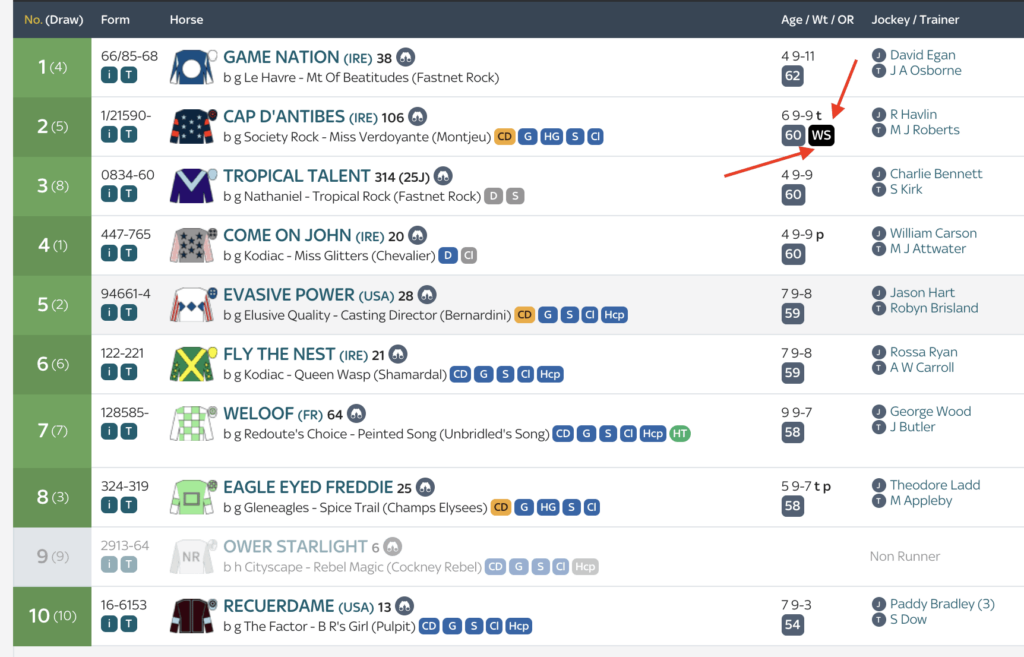
The example above shows how the wind-surgery indicator can appear on a racecard. The important point is that the marker relates to the horse’s first run since the operation, not every subsequent start.
Our horse racing form guide explains the other figures, symbols and abbreviations that appear alongside a runner’s previous performances.
What Is a Wind Operation in Horse Racing?
Wind surgery is a general term for several procedures used to treat problems affecting a horse’s upper airway. These problems can interfere with normal airflow during strenuous exercise.
A racehorse needs to move large volumes of air when galloping. If a structure in its upper airway obstructs airflow or fails to function properly, the horse may struggle to perform at its usual level. Some conditions also cause an abnormal respiratory noise.
The appropriate treatment depends on the condition diagnosed by a veterinary surgeon. Different procedures address different structures, and the outcome varies between horses.
Wind surgery should therefore be understood as a veterinary treatment rather than a standard performance-enhancing measure. An operation may help a horse affected by a specific breathing problem, but it cannot correct unrelated weaknesses in its form.
Why Do Racehorses Have Wind Surgery?
A trainer may investigate a horse’s breathing after it produces an unusual noise during exercise, repeatedly weakens in races or fails to perform as expected. These signs can have several causes, so veterinary assessment is needed to establish whether an upper-airway problem is present.
A horse’s previous results may provide clues, but the form book cannot diagnose a breathing condition. A runner can weaken because of unsuitable ground, a demanding pace, insufficient stamina, a fitness issue or stronger opposition.
That is why it helps to compare the horse’s performances under similar conditions. A runner that repeatedly fades late in races deserves a different assessment from one that has produced a single disappointing result.
Our course and distance winners page provides another way to assess whether a horse has previously shown that the racecourse and trip suit it.
Which Types of Wind Surgery Are Declared?
The BHA’s wind-surgery declaration framework covers several procedures. They address different upper-airway conditions, so they should not be treated as interchangeable.
Tie-Back Surgery
Tie-back surgery, also called prosthetic laryngoplasty, is commonly used to address a condition in which part of the larynx does not open normally. The procedure aims to hold the affected structure in a position that allows better airflow.
Its suitability and outcome depend on the individual horse and the underlying condition.
Hobday Surgery
Hobday surgery refers to procedures involving the laryngeal ventricle and, in some cases, the vocal cord. It may be used as part of the treatment of certain upper-airway conditions.
The term does not mean that every horse has undergone exactly the same operation. It is also incorrect to assume that a horse will improve on its first or second run simply because it has had a Hobday procedure.
Epiglottic Surgery
Epiglottic surgery addresses particular problems involving the epiglottis, a structure associated with the horse’s airway. The precise procedure depends on the diagnosed condition.
The WS marker does not identify whether a horse has undergone this treatment.
Tie-Forward Surgery
Tie-forward surgery is associated with treatment of certain soft-palate problems. It is different from tie-back surgery, which addresses a different part of the upper airway.
The two names sound similar, but they should not be grouped together as though they treat the same condition.
Soft Palate Cautery
Soft palate cautery is another procedure used for selected soft-palate conditions. A veterinary surgeon decides whether it is appropriate for the horse.
There is no reliable basis for assuming that a horse will need a fixed number of races to regain confidence or show improvement after this procedure.
Why the Type of Surgery Matters
The BHA requires the relevant wind surgery to be declared, but the specific procedure is not shown on the racecard. A bettor seeing WS cannot safely assume that the horse has had a tie-back, Hobday or soft-palate operation.
If a trainer has publicly explained the procedure, that information may provide additional context. Otherwise, assess the horse using the information actually available rather than guessing which operation took place.
Does Wind Surgery Improve a Horse’s Performance?
Wind surgery can help a horse when an upper-airway condition has been limiting its performance and the treatment successfully addresses that problem. It does not follow that every horse will run faster, achieve a higher rating or win after an operation.
A horse may have several factors affecting its results. Correcting a breathing problem will not necessarily overcome unsuitable going, a demanding handicap mark, a lack of stamina or stronger opposition.
The first race after surgery is therefore evidence to assess, not a guaranteed improvement opportunity.
Compare the horse’s return with its previous performances over similar distances and on similar ground. Look at how it travelled, where it came under pressure and whether it maintained its effort through the finish.
A horse that previously weakened sharply but now finishes its race strongly may have produced an encouraging performance. Even then, one run does not establish that surgery caused the improvement.
The Racing Post Ratings explained page shows how performance ratings can help compare a horse’s runs, while our top speed ratings page covers a different measure based on race times.
How to Assess a Horse Having Its First Run After Wind Surgery
Start with the horse’s established ability. The operation is one new piece of information, but its previous form remains the foundation of the assessment.
Review Its Form Before the Operation
Look at several runs rather than focusing on the last defeat. Establish whether the horse had shown consistent ability before its form declined.
Check the distances, going, race class and finishing margins. A runner that performed well over two miles before struggling over three miles may have been facing a stamina problem rather than a breathing problem.
Previous comments about weakening or making a respiratory noise may be relevant, but they should not be treated as a diagnosis.
The winning distances guide explains why finishing margins need context when comparing performances.
Check the Time Since Its Previous Run
A horse returning after surgery may also be returning from a lengthy absence. Its fitness becomes an important part of the assessment.
Some horses perform well fresh, while others have historically needed a race to reach their best level. Check the runner’s record after breaks and consider any reliable trainer comments.
The time since its last run does not reveal the date of the operation or the length of its rehabilitation. Avoid assuming that a particular number of weeks off the track means the horse is fully fit.
Compare Today’s Race Conditions
The horse may return over a different distance, on different going or at another racecourse. Those changes can make it difficult to isolate the effect of surgery.
For example, a horse with strong form on soft ground may improve when returning to those conditions, regardless of its recent operation. A horse stepping up sharply in class may struggle despite having received successful treatment.
Our guides to soft-ground horses and fast-ground horses help put previous performances into context.
Assess the Handicap Mark
A horse returning from surgery may be competing from a lower Official Rating after a sequence of defeats. That can make its handicap position interesting if it is capable of returning to an earlier level of form.
The operation itself does not make a horse well handicapped. Compare today’s rating with the marks from which it previously ran well, taking account of its current age, race conditions and opposition.
Our ahead of the handicapper page covers horses whose current racing terms may be favourable, while the handicap ratings guide explains how Official Ratings affect weights.
Consider Trainer Form and Intent
The trainer’s recent results can add context, particularly when a horse returns from a break. A stable in good form may provide some reassurance, but it does not establish that an individual runner is ready to produce its best performance.
Look at the horse’s previous record after absences, the race selected for its return and any specific comments from the trainer.
The in-form trainers page helps identify recent stable results. Trainer form should support the horse’s own case rather than replace it.
Watch the First Run Back
The return race can be more informative than the WS marker itself.
Note whether the horse travels comfortably, responds when asked to quicken and maintains its effort late in the race. Compare those observations with its performances before surgery.
A horse can also run below its best for reasons unrelated to breathing. Pace, interference, jumping errors, fitness and unsuitable conditions all matter.
If you are assessing a jump horse, pay particular attention to whether it jumps fluently and sustains its effort after the final obstacle. A better finishing position does not necessarily mean that every aspect of its performance has improved.
Does a Horse Improve on Its Second Run After Wind Surgery?
Some horses may produce a better performance on their second run after surgery, but there is no sound reason to assume that the second start is automatically the best betting opportunity.
A horse might improve because it has gained race fitness, returned to more suitable conditions or faced weaker opposition. Those factors can apply to any horse returning from a break, regardless of surgery.
Other horses may run well immediately, show little change or fail to regain their previous level.
The WS indicator normally appears only on the first run following the declared operation. If you want to assess the second start, you need to examine the horse’s recent race history rather than expect the original marker to remain on every racecard.
The first run back should be reviewed on its merits. A horse that finished strongly after a difficult passage may be worth reassessing, while one that weakened again despite favourable conditions may raise further questions.
How Long Does a Horse Take to Recover From Wind Surgery?
Recovery time depends on the procedure, the horse’s condition, veterinary advice and how its rehabilitation progresses.
There is no single four- or five-week recovery period that applies to every type of wind surgery. A horse may require a different period of rest and a gradual return to exercise depending on the treatment it received.
A racecard does not disclose the recovery plan. The gap between races also includes time spent training and preparing for a return, so it should not be interpreted as the surgical recovery period alone.
For a bettor, the practical question is whether the horse is ready to perform in today’s race. Its previous record after breaks, the trainer’s comments and the way it runs on its return provide more useful evidence than an assumed recovery timetable.
Does Wind Surgery Affect Betting Odds?
A horse may shorten in the market if bettors expect the operation to help it return to its previous level. It may also drift if there are concerns about fitness, the race conditions or the strength of its opposition.
Neither move establishes the outcome of the surgery.
A well-known horse returning after a poor run may attract attention because of the WS marker, but the available price still needs to be compared with its realistic chance of winning.
Our betting odds drifting guide explains why prices lengthen and why a market move should not be treated as proof of a horse’s condition. You can also check the best-backed horses today to put support for an individual runner into a wider market context.
A short-priced WS runner is not automatically a strong selection. Equally, a bigger-priced runner should not be dismissed solely because the market is cautious about its return.
Is First Run After Wind Surgery a Profitable Betting System?
The WS marker is useful information, but it is not a complete betting system.
To establish whether backing these runners has historically been profitable, you would need a defined sample, accurate results, the prices available when bets were placed and a consistent method of calculating returns.
A win strike rate alone is insufficient. A group of runners can win frequently and still produce a loss if their prices are too short.
It is also important to distinguish between different race types, distances, trainers, time off the track and a horse’s previous ability. Combining every WS runner into one group can conceal substantial differences between individual cases.
British Racecourses does not have a verified, current dataset on this page that supports a blanket claim that horses improve by a particular number of pounds after surgery or that a fixed proportion produce a better performance. Those claims should not be used as betting rules.
The wider horse racing statistics section provides other factors to investigate, including ratings, recent form and runners returning under changed conditions.
Other Changes That Can Affect a Horse’s Form
Wind surgery is one of several changes worth noting when studying a runner. None should be treated as a guaranteed source of improvement.
A horse wearing first-time blinkers may respond differently to the equipment, but the effect varies. A runner returning after being gelded may also attract attention, although that change does not guarantee a better result.
A different trip, more suitable ground, a lower handicap mark or a change in race tactics can be equally important.
The strongest assessment considers how these factors interact. If a horse returns after wind surgery, drops in class and races on its preferred ground, its performance cannot be attributed to the operation alone.
First Run After Wind Surgery FAQs
What does WS mean next to a horse’s name?
WS indicates that the horse has undergone declared wind surgery since its previous race and is making its first race start following the operation. The exact position of the marker varies between racecard providers.
Does WS tell you which wind operation a horse has had?
No. The racecard indicator does not identify the specific procedure. It does not tell you whether the horse has had tie-back surgery, Hobday surgery or another declared treatment.
Do horses usually win after wind surgery?
There is no guarantee that a horse will win or improve after surgery. The result depends on its underlying ability, whether the treatment addressed its breathing problem, its fitness and the conditions of the race.
Is the first or second run after wind surgery better?
Neither run is automatically better. Assess the horse’s first performance after surgery and compare it with its previous form. Any improvement on the second run may also reflect race fitness or more suitable conditions.
Can a horse have wind surgery more than once?
Yes. Under the BHA declaration framework, a further relevant wind operation must be declared when required before the horse’s first race start after that procedure.
Will WS appear on every racecard after the operation?
No. The indicator is intended for the first race start following a declared wind operation. It does not normally remain beside the horse for all subsequent starts.
Should I back a horse because it has had wind surgery?
The operation is a reason to reassess the horse, not a reason to back it automatically. Review its previous ability, current fitness, handicap mark, race conditions and price before reaching a conclusion.
Summary
First run after wind surgery is a useful racecard indicator because it identifies a material change since a horse’s previous performance. The WS marker confirms that a declared operation has taken place, but it does not disclose the procedure or predict the result.
Assess the horse’s form before surgery, the circumstances of its return and what it achieves on the racecourse. A better performance may be encouraging, but it needs to be considered alongside fitness, going, distance, class and the strength of the opposition.
The value of the WS information lies in helping you ask better questions about a runner, not in treating every returning horse as an automatic improver.